Carbon Market Network


Every carbon credit you read about started life as a messy, real-world project. A forest that needed protecting. A field that needed new farming methods. A machine that needed to pull CO2 out of the air.
Somebody had to find that project, fund it, measure it, and get it certified. That somebody is a carbon project developer.
Carbon project developers sit at the very start of the carbon market. When they do the job well, buyers get credits they can trust. When they cut corners, the whole market pays for it.
This guide covers the top 12 carbon project developers in the world. You will see what each one builds, where it works, and what makes it stand out.
You will also learn how developers make money, how to compare them, and which red flags to watch for.
What Are Carbon Project Developers?
Carbon project developers are the companies that turn a climate idea into a certified carbon credit.
They find the site or the technology. They secure land rights or permits. They pay for the studies, audits, and monitoring. Then they register the project and sell the credits it produces.
Think of them as the builders of the carbon market. Registries write the rules, auditors check the work, and buyers pay for the result. Developers do the actual building.
You will also see them called carbon credit developers, carbon offset project developers, or carbon asset developers. The names change. The job stays the same.
Carbon Market Insider Newsletter
Weekly insights on carbon markets, climate policy, carbon credits, and sustainability.
Who Does What in the Carbon Market
| Role | What they do | Examples |
|---|---|---|
| Carbon project developer | Designs, funds, runs, and registers the project that creates credits | South Pole, Finite Carbon, Climeworks |
| Registry or standard setter | Writes the rules and tracks every credit | Verra, Gold Standard, American Carbon Registry |
| Validation and verification body | Independent auditor that checks the design and the results | Accredited audit firms |
| Rating agency | Scores the quality and risk of credits | BeZero Carbon, Sylvera, Calyx Global |
| Broker or platform | Helps buyers find and purchase credits | Marketplaces and trading desks |
| Buyer | Purchases and retires credits | Corporations, airlines, energy companies |
Some companies play several roles at once. A developer may also advise buyers, trade credits, or raise money for projects. That mix matters when you compare them.
Main Types of Carbon Project Developers
| Type | What they focus on | Typical example on this list |
|---|---|---|
| Global full-service developers | Many project types in many countries | South Pole, Climate Impact Partners |
| Forest and land specialists | Working with landowners on forest carbon | Finite Carbon, Wildlife Works |
| Removal developers | New forests or machines that remove CO2 | Chestnut Carbon, Mombak, Climeworks |
| Agriculture developers | Paying farmers for soil carbon practices | Agreena |
| Regional and portfolio players | Local markets or curated credit portfolios | EKI Energy Services, Rubicon Carbon |
What Do Carbon Project Developers Actually Do?
Every project is different, but most follow the same path. Here is the typical journey from idea to credit.
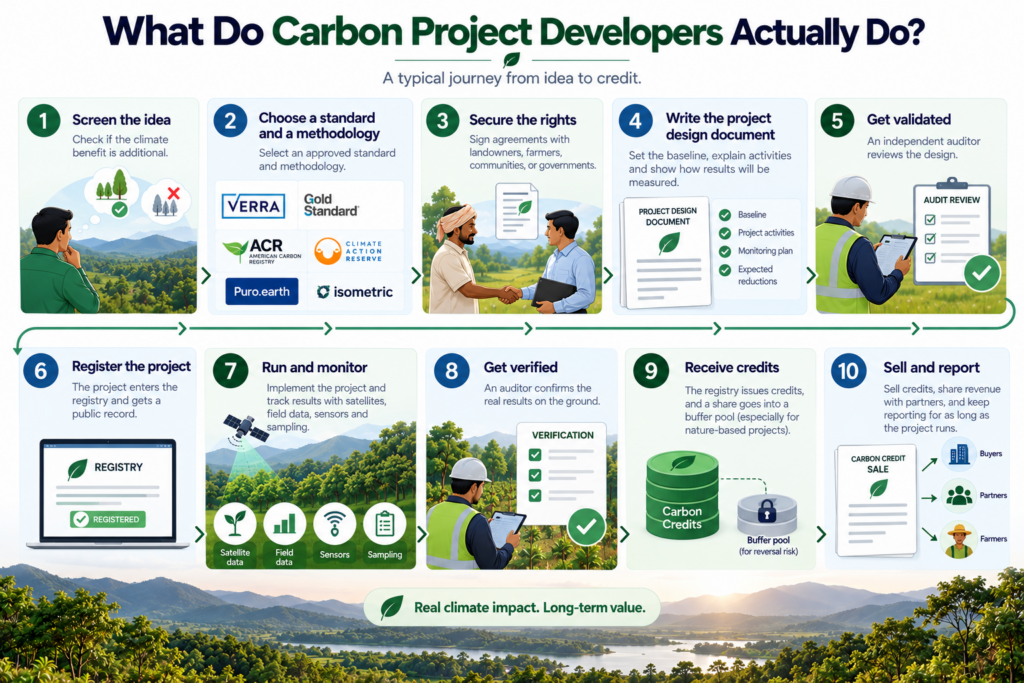
- Screen the idea. The developer checks if the climate benefit would happen anyway. Credits only make sense when the benefit is additional.
- Choose a standard and a methodology. Common options include Verra’s VCS, Gold Standard, the American Carbon Registry, the Climate Action Reserve, Puro.earth, and Isometric.
- Secure the rights. The developer signs agreements with landowners, farmers, communities, or governments. Clear carbon rights and fair benefit sharing protect everyone.
- Write the project design document. This document sets the baseline, explains the activities, and shows how results will be measured.
- Get validated. An independent auditor reviews the design and confirms it meets the standard.
- Register the project. The project enters the registry and gets a public record.
- Run and monitor. The team protects forest, plants trees, works with farmers, or operates a plant. They track results with satellites, field data, sensors, and sampling.
- Get verified. An auditor confirms the real results on the ground.
- Receive credits. The registry issues credits. A share usually goes into a buffer pool that covers reversal risk, especially for nature-based projects.
- Sell and report. The developer sells the credits, shares revenue with partners, and keeps reporting for as long as the project runs.
Many projects need two or more years to reach first issuance. Tree-based projects can take longer because trees need time to grow.
That long timeline is why upfront money matters so much in carbon project development.
How Carbon Project Developers Make Money
Developers earn money in a few common ways:
- Share of credits or revenue. The developer pays the upfront costs and keeps an agreed share of what the project earns. Landowners and partners receive the rest.
- Service fees. Some developers charge for design, registration, and monitoring work.
- Forward sales and offtake deals. A buyer commits to purchase credits years ahead. Developers use these contracts to raise capital and build.
- Project finance. Banks and investors fund projects against long-term buyer contracts, much like they fund wind or solar farms.
- Portfolio sales. Larger firms bundle credits from many projects and sell them to corporate clients.
Revenue splits vary widely by project type, risk level, and who carries the upfront cost. Always ask to see the split in writing.
How We Picked the Top 12 Carbon Project Developers
No official ranking of carbon project developers exists. Credit volumes change every year, and many firms do not publish full numbers.
So this list does not claim an exact order. Use it as a map, not a scoreboard.
Here is what we looked at:
- Scale and track record. Number of projects, credits issued, and time in the market.
- Project mix. Forests, farms, removals, energy, and community projects.
- Quality signals. Recognized standards, independent ratings, and trusted buyers.
- Geographic spread. Developers working across North America, Europe, Africa, South America, and Asia.
- Recent momentum. New financing, new buyer contracts, and verified issuances.
- Transparency. How openly the developer handles criticism and publishes data.
The list starts with large multi-project developers. It then moves toward specialists in forests, removals, farming, and regional markets.
Top 12 Carbon Project Developers at a Glance
| # | Developer | Based in | Main focus | Standout strength |
|---|---|---|---|---|
| 1 | South Pole | Zurich, Switzerland | Multi-sector projects and climate consulting | 850+ projects in 50+ countries |
| 2 | Climate Impact Partners | London, United Kingdom | Project portfolios and CarbonNeutral certification | 600+ projects in 56 countries |
| 3 | Anew Climate | United States | Forest, agriculture, cookstove, and industrial projects | 400+ projects developed |
| 4 | Finite Carbon | United States | Forest carbon with landowners | One of the biggest US forest developers |
| 5 | 3Degrees | United States | Project development and environmental commodities | Developer of the Year recognition from the Climate Action Reserve |
| 6 | Wildlife Works | United States and Kenya | REDD+ forest conservation | Pioneer of large REDD+ projects in Africa |
| 7 | Climeworks | Zurich, Switzerland | Direct air capture with storage | Permanent engineered removal |
| 8 | Chestnut Carbon | United States | Afforestation and reforestation | Long-term Microsoft offtake backed by bank financing |
| 9 | Mombak | Brazil | Amazon reforestation | First Amazon reforestation credits delivered early |
| 10 | Agreena | Denmark | Soil carbon and regenerative farming | Large Verra-verified soil carbon project |
| 11 | EKI Energy Services | Indore, India | Carbon credit development and supply | Over 200 million offsets supplied, by its own count |
| 12 | Rubicon Carbon | United States | Carbon credit management and investment | Rated portfolios and large removal offtakes |
The Top 12 Carbon Project Developers in the World
1. South Pole
Headquarters: Zurich, Switzerland
Main focus: Multi-sector carbon projects and climate consulting
South Pole is one of the best-known carbon project developers on the planet. It works with governments, public bodies, and more than 1,000 clients.
The company says it has channeled climate finance into over 850 projects in more than 50 countries. It reports that those projects have helped reduce more than 200 million tonnes of CO2.
Its portfolio spans renewable energy, forestry, agriculture, industry, and community projects.
Why it stands out
- Wide geography and a very broad project mix
- A consulting arm that helps buyers plan before they buy
- Active Article 6 work, including a Singapore hub with its investor GenZero to build projects across Asia, such as early coal plant retirement and green shipping
Worth knowing
South Pole faced heavy criticism over the Kariba REDD+ project in Zimbabwe, and it ended its involvement in that project. The episode shows why buyers should check project-level quality, not just a big developer name.
The company has also gone through leadership changes in recent years.
2. Climate Impact Partners
Headquarters: London, United Kingdom
Main focus: Project portfolios, removals, and CarbonNeutral certification
Climate Impact Partners formed when two long-running pioneers, ClimateCare and Natural Capital Partners, merged. The private equity firm Averna Capital organized the deal.
The group says it supports more than 600 carbon removal and reduction projects across 56 countries. It serves over 500 clients on six continents.
Its projects have helped cut more than 100 million tonnes of CO2e. The company has set a goal of delivering one billion tonnes of reductions by the end of this decade.
Why it stands out
- More than two decades of combined experience in the voluntary market
- A mix of nature, clean energy, health, and livelihood projects
- Maintains the CarbonNeutral Protocol, a widely used framework for carbon neutral claims
- Has worked with Microsoft on high-quality carbon removal projects
Worth knowing
The company blends projects it develops with projects run by partners. Ask which specific projects your money would support.
3. Anew Climate
Headquarters: Houston, United States
Main focus: Forest, agriculture, cookstove, blue carbon, and industrial projects
Anew Climate came from the merger of Bluesource and Element Markets, backed by the investment firm TPG Rise. At the time, Bluesource was described as the largest carbon credit developer in North America.
Anew says it has developed more than 400 carbon projects. It also reports that its legacy companies transacted over 150 million tonnes of carbon and built projects on more than 3.5 million acres of forest and farmland.
Its work includes improved forest management, blue carbon, cookstoves, agricultural carbon, and refrigerant reclamation.
Why it stands out
- Recent first issuances under the American Carbon Registry’s updated improved forest management method, built with forest owner Aurora Sustainable Lands and Anew’s own Epoch evaluation platform
- A large agreement with TotalEnergies covering about 20 forest projects across roughly 300,000 hectares in 10 US states
- Sales of premium forest credits to major removal buyers such as JPMorganChase
Worth knowing
Anew mixes carbon projects with low carbon fuel and environmental commodity work. That breadth can help large buyers, but smaller buyers should confirm exactly which projects they are funding.
4. Finite Carbon
Headquarters: United States
Main focus: Forest carbon projects with private and tribal landowners
Finite Carbon describes itself as North America’s leading developer of forest carbon offsets. The company works with landowners who agree to manage forests for more carbon storage, then sells the credits those forests generate.
bp took a majority stake in the company. Finite says it protects more than 60 projects across about 4 million acres.
In an earlier announcement, the company said it generated over one-third of California’s compliance offset supply. It also launched CORE Carbon, an online platform that lets small landowners with as few as 40 forested acres take part.
Why it stands out
- Deep experience in both compliance and voluntary markets
- Strong landowner relationships across the US
- A pathway for small private forest owners
Worth knowing
Improved forest management credits face real scrutiny. A satellite analysis from the ratings agency Renoster and the nonprofit CarbonPlan questioned whether some Finite projects protected trees that were truly at risk. Finite defended its credits.
Read that debate before you buy. It applies to the whole forest carbon category, not only one company.
5. 3Degrees
Headquarters: United States
Main focus: Carbon project development, renewable energy, and environmental commodities
3Degrees helps companies cut emissions across scopes 1, 2, and 3. Carbon project development sits alongside its work in renewable energy certificates and biomethane.
The company says it has co-launched more than 50 US offset projects over two decades and manages over 25 active projects for the long term. The Climate Action Reserve once named it Carbon Offset Project Developer of the Year.
Why it stands out
- Hands-on project design that matches buyer goals, location, and co-benefits
- Experience building projects for corporate clients rather than only selling spot credits
- A growing Asia Pacific push, including expanded carbon development capacity in Singapore backed by the Singapore Economic Development Board
Worth knowing
The Singapore expansion focuses on early-stage Article 6 projects across Southeast Asia. That makes 3Degrees one to watch as government-backed credit demand grows.
6. Wildlife Works
Headquarters: United States and Kenya
Main focus: REDD+ forest conservation
Wildlife Works is one of the early pioneers of REDD+. The company builds projects that protect standing forest and share the money with local communities.
Its flagship Kasigau Corridor project in Kenya protects about 200,000 hectares of dryland forest between Tsavo East and Tsavo West national parks. It was the first REDD+ project validated and verified under both the Verified Carbon Standard and the Climate, Community and Biodiversity Standards.
The company also runs the Mai Ndombe REDD+ project in the Democratic Republic of the Congo, covering about 300,000 hectares.
Why it stands out
- More than two decades of work in forest conservation
- Projects tied closely to wildlife protection and local jobs
- A long record that other REDD+ developers still learn from
Worth knowing
Like many REDD+ projects, Kasigau has drawn academic and NGO attention to how benefits are shared with communities. Strong community consent and clear benefit sharing are essential for any developer in this space.
7. Climeworks
Headquarters: Zurich, Switzerland
Main focus: Direct air capture with permanent underground storage
Climeworks builds machines that pull CO2 straight out of the air. Its storage partner Carbfix then turns the captured gas into stone deep underground in Iceland.
The company runs two plants there. Orca was designed for about 4,000 tonnes a year. Mammoth, the larger plant, was designed for 36,000 tonnes a year at full capacity.
Here is the honest part. Mammoth has run well below its design. Climeworks reported that net removal reached 675 tonnes in the first half of its latest reporting year, up from 119 tonnes in the same period a year earlier.
Upgraded collector containers have now reached their original target of 1.37 tonnes of CO2 per day. The company is rolling those upgrades out and says it signed 14 new removal deals covering about 450,000 tonnes in six months.
Why it stands out
- Permanent storage through mineralization
- Some of the most recognized corporate buyers in engineered removal
- Credits priced at several hundred dollars per tonne, which reflects the cost of the technology
Worth knowing
Engineered removal is still young. When you evaluate any direct air capture developer, ask about tonnes actually delivered, not only planned capacity.
8. Chestnut Carbon
Headquarters: United States
Main focus: Afforestation and reforestation on former farmland
Chestnut Carbon, a Kimmeridge company, plants native forest on marginal farmland and pasture across the southern United States.
Its 25-year agreement with Microsoft covers more than 7 million tonnes of removal credits. The project plans to restore about 60,000 acres in Arkansas, Texas, and Louisiana with more than 35 million native trees.
The company aims to reach 500,000 acres by the end of this decade and remove 100 million tonnes of CO2 over 50 years.
Why it stands out
- J.P. Morgan led a non-recourse project finance facility of up to $210 million, backed by the Microsoft contract
- That structure shows tree planting projects can attract bank-style financing
- The company registers its credits with Gold Standard after earlier using Verra
Worth knowing
Reforestation credits arrive slowly because trees take time to grow. Check issued credits against the promised schedule, and look at how the land was used before planting.
9. Mombak
Headquarters: Sao Paulo, Brazil
Main focus: Reforestation of degraded pasture in the Brazilian Amazon
Mombak restores cattle pasture back into native forest in the state of Para. The company plants more than 100 native species and uses mapping to choose the right method for each site.
Microsoft agreed to buy up to 1.5 million removal credits from Mombak over several years. Google signed two deals, first for 50,000 tonnes and then for 200,000 tonnes.
Mombak also became the first nature restoration project picked by the Symbiosis Coalition, a group of large buyers that includes Google, Microsoft, Meta, and Salesforce.
Why it stands out
- Delivered its first credits, more than 21,000 removal credits, over two years ahead of schedule
- Reports close to 15 million native trees planted across 12 farms
- A research partnership with Google DeepMind to track biodiversity using sound monitoring
Worth knowing
The first issuance is small next to the volumes buyers have contracted. Watch how steadily Mombak delivers as its young forests grow.
10. Agreena
Headquarters: Denmark
Main focus: Soil carbon and regenerative agriculture
Agreena pays farmers to adopt practices such as reduced tillage and cover crops. It then measures the results with satellite imagery, soil samples, and AI models, and registers them under Verra.
The company says it works with thousands of farmers across about 4.5 million hectares in 20 markets.
Its AgreenaCarbon Project became the first large-scale cropland project verified under Verra’s VM0042 method. It issued 2.3 million verified credits from about 1.6 million enrolled hectares.
Why it stands out
- Proof that soil carbon can scale beyond small pilots
- Early buyers such as Radisson Hotel Group pre-ordered a large share of the credits
- According to Agreena, the independent rating agency BeZero Carbon rated the issued credits BBB
Worth knowing
Soil carbon can be reversed if farmers change practices. Ask how the developer handles permanence and measurement uncertainty.
11. EKI Energy Services
Headquarters: Indore, India
Main focus: Carbon credit development, supply, and climate advisory
EKI Energy Services, formerly EnKing International, is a listed Indian company that develops and supplies carbon credits worldwide.
It says it has supplied over 200 million offsets. It works with standards such as CDM, VCS, Gold Standard, the Global Carbon Council, I-REC, and TIGR.
Its services cover project development, offset portfolio management, and advice on Article 6 and other carbon market rules.
Why it stands out
- A strong view into India’s fast-growing carbon market
- Experience with both international voluntary standards and compliance schemes
- Public company filings that let buyers and investors review its finances
Worth knowing
EKI earns from trading credits as well as developing them. Ask whether a specific credit comes from a project it developed or from a supplier it sourced.
12. Rubicon Carbon
Headquarters: United States
Main focus: Carbon credit management, investment, and portfolio building
Rubicon Carbon calls itself a vertically integrated carbon credit management and investment firm. It funds projects and builds portfolios for corporate buyers.
Its flagship product, the Rubicon Carbon Tonne, mixes carbon removal, nature-based avoidance, and industrial avoidance credits.
The firm signed a framework agreement with Microsoft covering up to 18 million tonnes of nature-based removal credits. More recently it agreed to supply Microsoft with 2 million tonnes from the Kijani forestry project in Uganda.
Why it stands out
- Launched the Rubicon Rated Tonne, the first portfolio rated by BeZero Carbon’s portfolio framework, which earned an AAport rating
- Offtake deals across direct air capture and biochar, including projects in Kenya
- A collaboration with YvY Capital to scale carbon investments in Brazil
Worth knowing
Rubicon works as both an investor and a seller. That model suits buyers who want a curated basket instead of a single project.
Which Carbon Project Developer Fits Your Goal?
| If you want… | Start by looking at |
|---|---|
| A broad portfolio with advisory support | South Pole, Climate Impact Partners, 3Degrees |
| US forest carbon, or to enroll your own forest | Finite Carbon, Anew Climate |
| Forest conservation in Africa | Wildlife Works |
| Permanent engineered removal | Climeworks |
| Nature-based carbon removal | Chestnut Carbon, Mombak |
| Soil carbon from European farmland | Agreena |
| Supply from India and emerging markets | EKI Energy Services |
| A curated, rated portfolio | Rubicon Carbon |
Carbon Project Developers by Project Type
The project type often matters more than the developer’s name. Each type carries different risks.
| Project type | How it cuts carbon | Developers on this list | What to check |
|---|---|---|---|
| Forest protection (REDD+ and improved forest management) | Keeps forests standing or stores more carbon in them | Wildlife Works, Finite Carbon, Anew Climate, South Pole | Baseline realism, leakage, permanence, community benefit |
| Reforestation and afforestation | Plants new forest that absorbs CO2 | Chestnut Carbon, Mombak | Survival rates, native species, land history, monitoring |
| Soil and regenerative agriculture | Farm practices store carbon in soil | Agreena, Anew Climate | Measurement method, permanence, farmer payments |
| Direct air capture and storage | Machines capture CO2 and store it underground | Climeworks | Delivered tonnes, storage proof, price |
| Clean energy and community projects | Cuts emissions from energy and cooking | South Pole, Climate Impact Partners, EKI Energy Services | Methodology quality, baseline, CCP status |
| Industrial gas projects | Destroys or reclaims potent gases such as refrigerants | Anew Climate | Verification of destruction, regulatory fit |
What Is Changing for Carbon Project Developers Right Now
The market is shifting fast. Developers who adapt will win the next round of deals.
Quality Labels and Ratings Matter More
The Integrity Council for the Voluntary Carbon Market created the Core Carbon Principles, or CCP, label. A credit earns the label only when two things are true.
- The registry is approved as CCP-eligible. Verra, Gold Standard, the American Carbon Registry, the Climate Action Reserve, ART, Isometric, and Puro.earth are among the approved programs.
- The specific methodology is approved for that project type.
The council has approved the newer Verra REDD+ methodology, VM0048, and certain US forest management methods. It did not approve most legacy cookstove and renewable energy methodologies.
Rating agencies add another layer. Buyers increasingly ask for ratings from firms such as BeZero Carbon, Sylvera, and Calyx Global before they sign.
Sylvera data shows the shift. BBB+ rated credits made up 23% of issuances in its latest full-year review, up from 14%, and 31% of retirements, up from 25%.
Removals and Long-Term Offtakes Drive the Biggest Deals
Buyers now prefer to lock in supply years ahead. Sylvera reported that offtake agreements totaled about $12.3 billion in its latest full-year review. That is more than 12 times the value of credits retired in the same period.
Microsoft alone made up 58% of the volume among the 80 largest offtakers Sylvera tracks. Buyers of durable removal paid about $160 per credit on average.
This is why developers like Chestnut Carbon, Mombak, Climeworks, and Rubicon Carbon have grown so quickly. Long contracts help them raise money to build.
Article 6 and Compliance Demand Are Opening New Doors
Article 6 of the Paris Agreement lets countries trade emission reductions. The UN approved the first credits under the Article 6.4 mechanism from a clean cooking project in Myanmar.
Airlines under CORSIA also need eligible units, and many of those need host country authorization.
Developers such as South Pole and 3Degrees are building project pipelines in Asia for exactly this reason. Government approval can make a credit more valuable, but it also adds paperwork and timelines.
Supply Is Tighter and Buyers Are Pickier
Sylvera reported that retirements fell to about 168 million tonnes in its latest full-year data, while new issuances dropped to roughly 270 million tonnes, the lowest level in several years.
Buyers also moved away from older REDD+ projects. They shifted toward improved forest management, reforestation, and agriculture projects.
For carbon credit developers, the message is clear. Quality, transparency, and delivery now matter more than volume.
How to Choose the Right Carbon Project Developer
Use these steps when you compare carbon project developers.
- Define your goal. Are you offsetting emissions, buying removals, selling credits, or enrolling your land? Each goal points to a different developer.
- Match the project type. Decide whether you want forest protection, new forest, soil carbon, or engineered removal.
- Check the registry and methodology. Find the project on a public registry. Look for CCP-approved methodologies where they exist.
- Look at independent ratings. Read the rating reports, not only the headline score.
- Ask for project-level data. Request issuance history, retirement records, and monitoring reports.
- Review community and landowner terms. Strong projects share benefits fairly and document consent.
- Test delivery and financial strength. For forward deals, ask how the developer will deliver if timelines slip or the parent company hits trouble.
- Read the contract closely. Look for delivery dates, replacement of reversed credits, and remedies if the project underperforms.
Questions to Ask Any Developer
| Question | Why it matters |
|---|---|
| Which exact projects will my credits come from? | Prevents vague portfolio claims |
| What registry and methodology apply? | Shows the rules behind the credits |
| What is the baseline and how was it set? | Tests whether the climate benefit is real |
| How do you handle reversals and leakage? | Protects against lost carbon |
| How do local people benefit? | Signals long-term project stability |
| Can I see monitoring and verification reports? | Confirms transparency |
Red Flags to Watch For
Some warning signs show up again and again:
- No public registry link. If you cannot find the project, walk away.
- Guaranteed results. Nature carries risk. Honest developers explain it.
- Very cheap credits with no explanation. Low prices often signal weak baselines or low-risk claims that do not hold up.
- No proof of community consent. Missing consent documents can lead to conflict and reputational damage.
- Refusal to share monitoring data. Good developers welcome scrutiny.
- Pressure to buy fast. Careful buyers need time to review.
- A big name and nothing else. Always judge the project, not just the company behind it.
How to Become a Carbon Project Developer
You do not need to be a giant to enter this field. Many strong developers started with one site and one method.
- Pick a niche. Forests, farms, cookstoves, methane, or removal technology each need different skills.
- Learn the standards. Study Verra, Gold Standard, ACR, CAR, Puro.earth, Isometric, and the Article 6.4 rules.
- Secure rights and partners. Build trust with landowners, farmers, and local communities first.
- Line up funding. Seek forward buyers, project finance, or impact investors before you build.
- Hire accredited auditors. Choose validation and verification bodies early to avoid delays.
- Start small and document everything. A clean first project builds credibility for the next.
Conclusion
The best carbon project developers do three things well. They build real projects, prove the results, and treat communities as partners.
The 12 carbon project developers in this guide cover a wide range of strategies. South Pole, Climate Impact Partners, Anew Climate, Finite Carbon, 3Degrees, and Wildlife Works bring scale and long track records. Climeworks, Chestnut Carbon, Mombak, Agreena, EKI Energy Services, and Rubicon Carbon show where the market is heading, from permanent removal to farmland, reforestation, and rated portfolios.
No single developer fits every need. Start with your goal, match it to a project type, and then check the developer’s evidence.
Take these actions next:
- Shortlist two or three carbon project developers that match your project type
- Request registry links, ratings, and monitoring reports
- Compare contract terms for delivery and reversal risk
Choose carbon project developers that show their work. In a market built on trust, proof is the best differentiator.
Frequently Asked Questions About Carbon Project Developers
Who is the largest carbon project developer in the world?
No single answer exists because firms measure size differently. Some count projects, others count credits issued, and many do not publish full data. South Pole, Anew Climate, and Climate Impact Partners are among the largest by number of projects and reach.
What do carbon project developers do?
They design, fund, build, and register projects that cut or remove emissions. They then manage monitoring, verification, and the sale of the credits those projects earn.
How do carbon project developers make money?
They earn a share of credit revenue, charge service fees, sign forward sales contracts, and use project finance. Larger firms also sell curated portfolios to corporate buyers.
What is the difference between a carbon project developer and a carbon broker?
A developer creates the project that generates credits. A broker or platform helps buyers find and purchase credits. Some companies do both.
How long does it take to develop a carbon project?
Often two years or more before the first credits arrive. Tree-based projects can take longer because forests need time to grow, though some, such as Mombak, have delivered early.
Are credits from carbon project developers trustworthy?
It depends on the project. Check the registry, methodology, CCP status, independent ratings, and monitoring reports. Quality varies widely, even within one developer’s portfolio.
Which carbon project developers focus on carbon removal?
Climeworks focuses on engineered removal through direct air capture. Chestnut Carbon and Mombak focus on removal through new forests. Rubicon Carbon includes removal credits in its portfolios.
How can I become a carbon project developer?
Pick a niche, learn the standards, secure land or technology rights, line up funding, and hire accredited auditors. Start with one well-documented project before you scale.
Explore more guides, tools, and resources on Carbon Market Network to deepen your understanding of carbon markets and climate.