Carbon Market Network


Climate change is no longer a distant problem. Every business, investor, government, and household already faces its consequences today. Floods destroy factories. Droughts cut crop yields. New regulations raise energy costs overnight. That is climate risk in action.
But climate risk is not just about the weather. It covers everything from policy shifts and market disruptions to legal battles and stranded assets. If you own a business, manage investments, or work in sustainability, understanding climate risk is no longer optional.
This guide breaks down what climate risk is, the different types, who it affects, how it connects to carbon markets, and what you can do about it. Let us start from the beginning.
What Is Climate Risk?
Climate risk refers to the potential harm that climate change can cause to people, businesses, economies, and natural systems. It is the probability that a climate-related event or shift results in negative outcomes.
The definition covers two broad directions:
- The physical effects of a changing climate (extreme weather, rising seas, more heat)
- The economic and social effects of trying to fix the problem (new laws, changing technologies, shifting markets)
Think of it this way. If your coastal factory gets flooded, that is climate risk. If your fossil fuel supply chain becomes economically unviable because of new carbon pricing laws, that is also climate risk. Both come from the same root cause: climate change and the global response to it.
The Financial Stability Board’s Task Force on Climate-related Financial Disclosures (TCFD) formally split climate risk into two major categories: physical risks and transition risks. Researchers and regulators have since added a third: liability risk. We will cover all three in depth.
Carbon Market Insider Newsletter
Weekly insights on carbon markets, climate policy, carbon credits, and sustainability.
Why Does Climate Risk Matter Now More Than Ever?
Climate risk has moved from a niche ESG topic to a mainstream financial concern. Here is why it demands attention right now.
The numbers are staggering. In 2024 alone, global insured losses from natural catastrophes reached nearly $140 billion, according to Swiss Re. Hurricanes Helene and Milton together caused $113 billion in damage that year. The 2025 Los Angeles wildfires caused an estimated $76 billion to $131 billion in property and capital losses.
Regulation is tightening fast. In 2026, companies across the EU, UK, Australia, Singapore, and California face mandatory climate risk disclosure requirements. The International Sustainability Standards Board (ISSB) standards (IFRS S1 and S2) now form the global baseline for climate reporting. The EU’s Corporate Sustainability Reporting Directive (CSRD) requires thousands of companies to report detailed climate risk data. California’s SB 261 requires companies with over $500 million in revenue to disclose climate-related financial risks starting in 2026.
Investors are paying attention. Climate risk is now a board-level issue and a strategic priority for capital access. Companies that cannot demonstrate climate resilience are increasingly facing barriers to investment and financing.
The injustice angle matters too. The Germanwatch Climate Risk Index 2026 confirmed that the countries least responsible for climate change are often the most affected. In 2024, seven of the ten most climate-affected countries were low-income or lower-middle-income nations.
The Three Main Types of Climate Risk
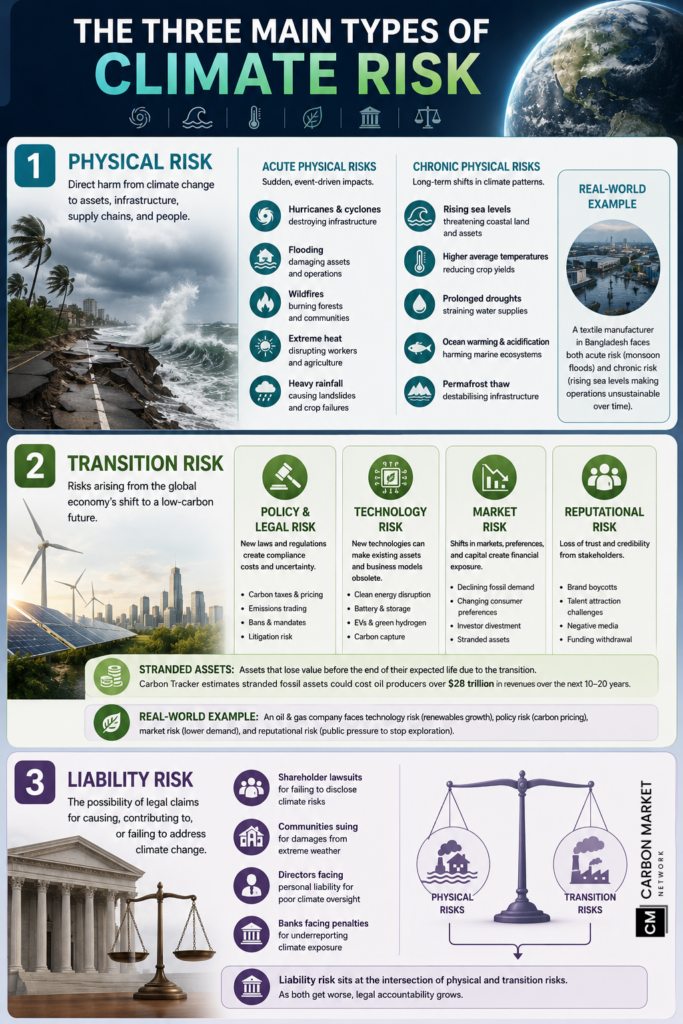
1. Physical Risk
Physical risk is the most intuitive type. It refers to the direct harm that climate change causes to assets, infrastructure, supply chains, and people.
Physical risks fall into two sub-categories.
Acute Physical Risks
These are sudden, event-driven impacts. They happen fast and can cause immediate damage.
Examples include:
- Hurricanes and cyclones destroying port infrastructure
- Flooding damaging factories, warehouses, and roads
- Wildfires burning forests, power lines, and communities
- Extreme heat waves disrupting outdoor workers and agriculture
- Heavy rainfall events causing landslides and crop failures
Acute risks are easier to see. They make headlines. They trigger insurance claims. Businesses in coastal areas, flood plains, and wildfire zones face the highest acute physical risk today.
Chronic Physical Risks
These are slower, long-term shifts in climate patterns that build up over time.
Examples include:
- Rising sea levels gradually making coastal land uninhabitable or unprofitable
- Increased average temperatures reducing crop yields in key growing regions
- Prolonged droughts straining water supplies for farms, cities, and factories
- Ocean warming and acidification affecting fisheries and marine ecosystems
- Permafrost thaw destabilising infrastructure in Arctic and sub-Arctic regions
Chronic risks are often underestimated because they unfold slowly. But they can permanently alter which regions, industries, and business models remain viable over the long term.
Real-world example: A textile manufacturer in Bangladesh with factories in flood-prone areas faces both acute risk (seasonal monsoon floods) and chronic risk (gradually rising sea levels making operations unsustainable within decades).
2. Transition Risk
Transition risk arises from the process of shifting the global economy away from fossil fuels and toward a low-carbon future. Even if the physical climate stabilised tomorrow, the economic disruption of decarbonising would still create enormous risk and opportunity.
The TCFD framework identifies four types of transition risk.
Policy and Legal Risk
Governments around the world are introducing new laws, taxes, and regulations to cut greenhouse gas emissions. For businesses, this creates sudden cost increases and compliance challenges.
Examples:
- Carbon taxes and pricing schemes raising operational costs for heavy emitters
- Emissions trading systems (ETS) forcing companies to buy allowances
- Bans on petrol and diesel vehicles cutting demand for related industries
- Energy efficiency mandates requiring costly upgrades to buildings and equipment
- Litigation risk from lawsuits against companies for contributing to climate damage
Carbon pricing now covers about 23% of global greenhouse gas emissions. As this expands, policy risk grows for high-emission businesses.
Technology Risk
The rapid development and deployment of low-carbon technologies can make existing assets and business models obsolete.
Examples:
- Solar and wind energy undercutting the economics of coal and gas plants
- Battery storage threatening the dominance of gas-peaking power plants
- Electric vehicles disrupting demand for combustion engine components and fuel
- Green hydrogen potentially replacing fossil fuels in heavy industry
- Carbon capture technologies creating new competitive advantages for some sectors
Companies that do not adapt to new low-carbon technologies risk losing market share rapidly.
Market Risk
Consumer preferences, investor sentiment, and commodity prices are all shifting in response to climate awareness.
Examples:
- Declining demand for fossil fuels as clean energy grows
- Consumers avoiding high-carbon products in food, travel, and fashion
- Investors divesting from carbon-intensive industries, raising capital costs
- Stranded assets that lose value before the end of their expected economic life
Stranded assets deserve special attention. A company that builds a coal power plant expecting to operate it for 30 years may face new regulations that make the plant unprofitable after just 10. The initial investment cannot be recovered. That asset is “stranded.”
Carbon Tracker research has found that stranded fossil assets could cost oil producers over $28 trillion in revenues over the next 10 to 20 years.
Reputational Risk
Companies seen as climate laggards face growing scrutiny from consumers, employees, investors, and the media.
Examples:
- Brands facing boycotts for greenwashing claims
- Companies losing talent because employees prefer climate-conscious employers
- Firms seeing stock price drops after being linked to environmental damage
- Banks facing withdrawal of deposits for financing fossil fuel expansion
Real-world example: An oil and gas company with assets that depend on high oil prices for economic viability faces technology risk from the growth of renewables, policy risk from carbon pricing, market risk from reduced fossil fuel demand, and reputational risk from public pressure to stop new exploration.
3. Liability Risk
Liability risk is the newest and fastest-growing category. It refers to the possibility that companies, investors, or governments face legal claims for their role in causing or failing to address climate change.
Climate litigation has expanded dramatically. Courts in multiple countries have ruled against governments and corporations for insufficient climate action or inadequate disclosure of climate risks to investors.
Key examples:
- Shareholders suing companies for failing to disclose material climate risks
- Communities suing fossil fuel companies for damages from extreme weather
- Directors facing personal liability for not managing climate risk at a board level
- Banks facing regulatory penalties for underreporting climate exposure in lending portfolios
Liability risk sits at the intersection of physical and transition risks. As both get worse, legal accountability grows.
How Climate Risk Affects Different Sectors
Climate risk does not affect all industries equally. Here is a sector-by-sector breakdown.
Agriculture and Food
- Physical risk: Droughts, floods, and extreme heat reduce crop yields and raise food prices.
- Transition risk: Water pricing regulations and land-use rules increase costs.
- Opportunity: Sustainable agriculture and regenerative practices can generate carbon credits and reduce input costs.
Energy and Utilities
- Physical risk: Extreme weather damages power infrastructure and disrupts fuel supply chains.
- Transition risk: Coal and gas assets risk becoming stranded as renewables gain ground. Carbon pricing raises costs for fossil fuel use.
- Opportunity: Utilities that pivot to renewables, green hydrogen, or battery storage position themselves well.
Finance and Banking
- Physical risk: Loans to climate-vulnerable businesses or properties may turn into non-performing assets.
- Transition risk: Carbon-intensive loan portfolios lose value as regulations tighten.
- Liability risk: Banks face regulatory scrutiny for climate risk in lending and investment decisions.
Real Estate and Infrastructure
- Physical risk: Properties in coastal zones, flood plains, or wildfire corridors face damage and loss of value.
- Transition risk: Older buildings that cannot meet new energy efficiency standards face stranding.
- Opportunity: Green building certifications add value and attract premium tenants.
Manufacturing and Supply Chains
- Physical risk: Extreme weather disrupts raw material sourcing, logistics, and production.
- Transition risk: Higher energy costs and carbon pricing raise production costs. Supplier-level emissions (Scope 3) face growing scrutiny.
- Opportunity: Operational efficiency improvements reduce both emissions and costs.
Insurance
- Physical risk: Climate change increases the frequency and severity of insured losses, threatening profitability.
- Transition risk: Portfolios of assets in fossil fuel sectors face devaluation.
- Opportunity: New products covering climate risk itself (parametric insurance, carbon reversal insurance) are growing.
Climate Risk and Carbon Markets: The Direct Connection
Carbon markets are one of the most powerful tools the world has for managing climate risk at a systemic level. Understanding climate risk helps explain why these markets exist and why they are growing.
Here is the core logic:
- Climate risk is caused by greenhouse gas emissions.
- Reducing emissions reduces climate risk for everyone.
- Carbon markets put a financial price on emissions, creating economic incentives to cut them.
- Companies that reduce emissions below a set limit can sell carbon credits to others that have not yet reduced enough.
This creates a market signal that rewards climate action and penalises inaction.
Compliance Carbon Markets
In compliance markets (also called emissions trading systems or cap-and-trade systems), regulators set a total cap on emissions. Companies must hold permits equal to their emissions. Those who exceed their allocation must buy extra permits from those who have spare. This directly prices transition risk into business operations.
The EU Emissions Trading System (EU ETS), China’s national carbon market, and California’s cap-and-trade program are the largest examples. These markets directly translate climate risk into financial reality for regulated industries.
Voluntary Carbon Markets
In voluntary carbon markets (VCM), companies buy carbon credits to offset emissions they cannot yet eliminate. These credits represent verified emissions reductions or removals from projects such as forest protection, renewable energy, and carbon capture.
The VCM is evolving rapidly. In 2025, the market saw credit retirements fall 7% even as corporate climate commitments surged by 227%, highlighting the growing gap between ambition and action. High-quality credits, especially from carbon removal projects, are commanding higher prices as buyers prioritise integrity.
For companies managing transition risk, carbon credits are both a tool and a signal of credibility. For carbon project developers and investors, understanding climate risk helps assess the durability and additionality of those projects.
Climate Risk Within Carbon Projects
Carbon credits themselves carry climate risk. For example:
- A forest carbon offset project in a wildfire-prone area faces acute physical risk that could wipe out the carbon stored in those trees.
- A blue carbon project in a coastal mangrove faces chronic physical risk from rising sea levels.
- An industrial efficiency project faces policy risk if regulations change and the credit methodology is revised.
Reputable carbon credit rating agencies like BeZero Carbon, Sylvera, and Calyx Global now publish independent risk ratings for carbon projects, helping buyers assess these exposures before purchasing.
How to Assess Climate Risk: A Step-by-Step Overview
Businesses and investors use a structured process to identify and quantify their climate risk exposure.
Step 1: Identify Your Exposure
Start by mapping where your operations, assets, and supply chains sit. Ask:
- Which assets are in climate-vulnerable locations?
- Which products or services depend on fossil fuels or high-emission processes?
- Which suppliers face physical or transition risk?
Step 2: Classify the Risks
Organise your exposure into the three categories:
- Physical risks (acute and chronic)
- Transition risks (policy, technology, market, reputation)
- Liability risks
Use the TCFD or ISSB (IFRS S2) framework as your guide. Most disclosure requirements globally now follow this structure.
Step 3: Run Scenario Analysis
Test your business against different possible futures. The standard approach uses at least two scenarios:
- A Paris-aligned scenario (1.5°C or 2°C warming) where climate policies tighten sharply
- A high-warming scenario (3°C or more) where physical impacts intensify but policy action is slow
Each scenario reveals a different risk profile. Under a tight-policy scenario, transition risks dominate. Under a high-warming scenario, physical risks dominate. Resilient businesses survive both.
Step 4: Quantify the Financial Impact
Translate identified risks into financial terms:
- Revenue at risk from reduced demand
- Cost increases from carbon pricing or energy price shifts
- Asset impairment from physical damage or stranding
- Increased insurance premiums
This step is the hardest but the most critical. Investors and regulators increasingly expect quantified disclosures, not just narrative descriptions.
Step 5: Develop a Response Strategy
Build a plan that addresses your identified risks:
- Avoid: Exit high-risk assets or markets
- Reduce: Cut emissions to lower transition risk exposure
- Adapt: Harden assets against physical risk (flood defences, heat-resistant materials)
- Transfer: Use insurance, hedging, or carbon credits to transfer residual risk
- Disclose: Report your exposure transparently under ISSB/TCFD/CSRD as required
Step 6: Monitor and Update
Climate risk is not a one-time assessment. It evolves as the climate, policy environment, and technologies change. Build regular review cycles into your risk management processes.
Climate Risk Disclosure: What the Rules Require in 2026
Climate risk reporting has moved from voluntary best practice to legally mandated in many jurisdictions. Here is the current state as of 2026.
ISSB (IFRS S1 and S2)
The ISSB, housed within the IFRS Foundation, now sets the global baseline for climate disclosure. IFRS S2 (Climate-related Disclosures) builds directly on the TCFD framework and became the standard backbone worldwide. The TCFD was formally disbanded in October 2023 after its recommendations were fully integrated into ISSB standards.
EU: Corporate Sustainability Reporting Directive (CSRD)
The CSRD requires detailed climate risk reporting from thousands of EU companies. Companies are beginning to report in 2026 based on their 2025 financial year data.
UK: Sustainability Disclosure Standards
UK Sustainability Disclosure Standards, aligned with ISSB, apply from January 2026 for the largest listed companies.
Australia
Australian Sustainability Standards, aligned with ISSB, apply from January 2025 for the largest reporters.
Singapore
SGX-listed companies follow ISSB-aligned requirements phased in from 2025.
United States
California’s SB 261 requires companies with over $500 million in annual revenue doing business in California to disclose climate-related financial risks starting in 2026, aligned with the TCFD framework.
The core elements required across all frameworks are:
- Governance: How does your board oversee climate risk?
- Strategy: How do climate risks affect your business model and financials?
- Risk Management: How do you identify, assess, and manage climate risks?
- Metrics and Targets: What are you measuring, and what are your reduction goals?
Climate Risk vs. Climate Change: What Is the Difference?
People often use these terms interchangeably. They are related but distinct.
Climate change is the physical phenomenon: the warming of the Earth’s atmosphere due to rising greenhouse gas concentrations, leading to shifts in weather patterns, sea levels, and ecosystems.
Climate risk is what that change means for you, your business, your investments, or your community. It is the financial, operational, and social exposure that flows from climate change.
You can think of it like this: climate change is the hazard; climate risk is your vulnerability to that hazard. Two companies in the same industry can face very different levels of climate risk depending on their location, business model, supply chain, and preparedness.
Climate Risk vs. ESG Risk: Understanding the Overlap
You may hear “climate risk” and “ESG risk” used interchangeably. They are not the same, though they overlap significantly.
ESG stands for Environmental, Social, and Governance. It is a broad framework for evaluating non-financial risks and opportunities.
Environmental risk within ESG includes climate risk but also covers biodiversity loss, water stress, pollution, and deforestation. Climate risk is arguably the largest and most financially material component of the E in ESG.
Social and Governance risks (the S and G) cover labour rights, community relations, executive pay, board diversity, and anti-corruption practices.
So: all climate risks are ESG risks, but not all ESG risks are climate risks. When companies and investors say they are integrating climate risk into decision-making, they are focusing on the most financially significant part of the ESG spectrum.
The Opportunity Side of Climate Risk
Every risk contains an opportunity. Climate risk is no different. As the global economy responds to climate change, enormous new markets and industries are emerging.
Key opportunities include:
- Renewable energy: The clean energy transition creates trillions of dollars in investment opportunity in solar, wind, geothermal, and green hydrogen.
- Energy efficiency: Technologies and services that help buildings, factories, and transport systems use less energy face growing demand.
- Carbon markets: The voluntary carbon market and compliance carbon markets represent a growing asset class. Carbon credits from high-integrity projects are increasingly valuable.
- Sustainable finance: Green bonds, sustainability-linked loans, and climate-related insurance products are growing rapidly.
- Resilience infrastructure: Flood defences, drought-resistant agriculture, and climate-adapted urban design represent large investment opportunities.
- Nature-based solutions: Forest protection, wetland restoration, and regenerative agriculture generate both carbon credits and broader ecosystem services.
Companies and investors that identify and act on these opportunities ahead of the crowd gain competitive advantage and contribute to the systemic reduction of climate risk.
How India Faces Climate Risk
India presents a compelling case study in climate risk because it sits at the intersection of high physical vulnerability and rapid economic growth.
Physical risks are acute. India regularly faces extreme heat, erratic monsoons, flooding, and drought. Agricultural communities across Vidarbha, Bundelkhand, and coastal Odisha face severe chronic risks. Rising sea levels threaten coastal cities including Mumbai, Chennai, and Kolkata.
Transition risks are growing. India has committed to achieving net zero by 2070 and to sourcing 50% of its electricity from non-fossil sources by 2030. This ambitious policy direction creates both transition risk for coal-dependent industries and opportunity for renewables, green hydrogen, and carbon markets.
India’s carbon market is developing. The Carbon Credit Trading Scheme (CCTS) launched under India’s Energy Conservation (Amendment) Act 2022 is building a domestic compliance carbon market. As this develops, climate risk management and carbon credit generation will become increasingly important for Indian businesses.
Farmers face both sides. Indian farmers face severe physical climate risk from extreme weather but also have significant opportunity to generate agricultural carbon credits by adopting sustainable practices. This dual position makes climate risk literacy vital at every level of the Indian economy.
Common Misconceptions About Climate Risk
Let us clear up a few things people often get wrong.
Misconception 1: Climate risk only affects coastal or extreme-weather regions. Reality: Every geography faces some form of climate risk. Landlocked regions face drought, heat stress, and supply chain disruption. Even temperate regions face transition risk from policy changes.
Misconception 2: Climate risk is a problem for the future. Reality: Climate risk is affecting balance sheets, insurance costs, and property values right now. The 2024 and 2025 catastrophe loss data confirms this.
Misconception 3: Only large corporations need to worry about climate risk. Reality: Small and medium enterprises face significant climate risk through their supply chains, premises, and customer bases. Many face it more acutely because they lack the resources to adapt quickly.
Misconception 4: Buying carbon credits eliminates your climate risk. Reality: Carbon credits are one tool for managing transition risk and demonstrating climate commitment. They do not eliminate physical risk, liability risk, or the need to reduce actual emissions.
Misconception 5: Climate risk reporting is voluntary. Reality: As of 2026, climate risk reporting is mandatory for large companies in the EU, UK, Australia, Singapore, and California. The trend toward mandatory disclosure is accelerating globally.
Key Terms You Should Know
Understanding climate risk means getting comfortable with some key vocabulary.
- TCFD: Task Force on Climate-related Financial Disclosures. The framework that established the standard structure for climate risk reporting. Its recommendations are now embedded in ISSB standards.
- ISSB: International Sustainability Standards Board. Sets global baseline standards for sustainability and climate disclosure (IFRS S1 and S2).
- CSRD: Corporate Sustainability Reporting Directive. EU law requiring detailed climate and sustainability reporting from large companies.
- Physical risk: Direct climate impact on assets and operations.
- Transition risk: Risk from the shift to a low-carbon economy.
- Liability risk: Legal risk from climate-related claims.
- Stranded assets: Assets that lose economic value before their expected end of life due to climate-related policy or market shifts.
- Carbon pricing: A policy mechanism that puts a direct cost on greenhouse gas emissions, typically through a carbon tax or cap-and-trade system.
- Scenario analysis: A tool for testing how different possible climate futures affect a business or portfolio.
- Net zero: Achieving a balance between greenhouse gas emissions produced and removed, reducing overall atmospheric concentration.
- Carbon credits: Tradeable certificates representing one tonne of CO2 equivalent avoided, reduced, or removed from the atmosphere.
- Nature-based solutions (NbS): Projects that use natural ecosystems (forests, wetlands, soils) to reduce emissions and build climate resilience.
Actionable Takeaways
If you want to start managing climate risk today, here is where to begin.
- Map your exposure. Identify which of your assets, revenues, and supply chains are most vulnerable to physical or transition risk.
- Use the TCFD or ISSB framework. Even if you are not yet required to report, using this structure improves your own risk understanding.
- Run at least one scenario analysis. Test your business against a 1.5°C pathway and a 3°C+ physical impact scenario.
- Engage your supply chain. Scope 3 emissions and climate risk extend far beyond your direct operations.
- Consider carbon credits strategically. For emissions you cannot yet eliminate, high-integrity carbon credits backed by robust ratings can support your transition.
- Build resilience, not just compliance. Disclosure requirements will keep evolving. Build genuine resilience rather than just box-ticking.
- Follow the carbon market. Compliance carbon markets and the voluntary carbon market signal where climate risk is being priced. Tracking these gives you early warning of where transition risk is accelerating.
Conclusion
Climate risk is one of the defining challenges of our era. It is not just an environmental concept. It is a financial reality that is reshaping insurance markets, investment strategies, supply chains, and regulatory landscapes across the world.
Understanding climate risk means understanding three things: the physical impacts of a warming world, the economic disruption of transitioning away from fossil fuels, and the growing legal accountability for those who fail to act.
For carbon market professionals, sustainability practitioners, and anyone building a business in the decade ahead, climate risk literacy is not a nice-to-have skill. It is a core competency.
The good news is that every climate risk contains a corresponding opportunity. Carbon markets, clean energy, sustainable agriculture, and resilient infrastructure are all growing because they directly address the risks outlined in this guide.
Stay informed, stay ahead, and use the tools available to you, including carbon markets, to turn climate risk into climate resilience.
Frequently Asked Questions (FAQ)
What is climate risk in simple terms?
Climate risk is the potential harm that climate change causes to businesses, economies, and people. It covers both the physical effects of a changing climate (floods, droughts, extreme heat) and the economic effects of responding to it (new laws, shifting markets, changing technologies).
What are the two main types of climate risk?
The two main types are physical risk (direct damage from climate events and chronic changes) and transition risk (economic disruption from moving to a low-carbon economy). A third growing category is liability risk, covering legal claims related to climate damage.
How does climate risk affect businesses?
Climate risk can raise operating costs, destroy assets, disrupt supply chains, trigger new regulations, and expose companies to lawsuits. It can also reduce access to insurance and investment if companies fail to manage it. Conversely, businesses that manage it well gain competitive advantage and access to new markets.
What is the difference between physical risk and transition risk?
Physical risk comes from the direct consequences of climate change, such as extreme weather and rising sea levels. Transition risk comes from the shift to a low-carbon economy, including carbon pricing, new technologies, changing consumer preferences, and new regulations.
What is a stranded asset in climate risk?
A stranded asset is a physical or financial asset that loses its economic value before the end of its expected life because of climate-related policy, regulation, or market changes. Coal power plants and fossil fuel reserves facing phase-out policies are classic examples.
How are carbon markets related to climate risk?
Carbon markets are a direct financial response to climate risk. They put a price on greenhouse gas emissions, creating economic incentives to reduce them. Companies managing transition risk use carbon credits to offset residual emissions while working toward deeper reductions. Carbon project developers and investors assess physical and policy risks when evaluating the durability of those projects.
What is the TCFD and why does it matter?
The Task Force on Climate-related Financial Disclosures (TCFD) created the global standard framework for disclosing climate risk. Its four pillars (Governance, Strategy, Risk Management, and Metrics and Targets) are now embedded in legally binding disclosure requirements across the EU, UK, Australia, Singapore, and the US through ISSB standards.
Is climate risk reporting mandatory?
Yes, for many companies. As of 2026, mandatory climate risk disclosure applies to large companies in the EU (CSRD), the UK (aligned with ISSB), Australia, Singapore, and California (SB 261). Voluntary frameworks like the ISSB standards are increasingly becoming mandatory baselines globally.
What can small businesses do about climate risk?
Small businesses can start by identifying their top climate exposures (location risk, supply chain risk, energy costs), using publicly available climate risk tools, reviewing their insurance coverage, and exploring whether their operations could benefit from carbon credit generation or clean energy adoption.
How does India face climate risk?
India faces severe physical climate risk from extreme heat, monsoon disruption, flooding, and rising sea levels affecting coastal cities and agricultural communities. At the same time, India’s ambitious climate commitments and developing carbon market (CCTS) create growing transition risk for high-emission industries and growing opportunity for sustainable and low-carbon businesses.