Carbon Market Network


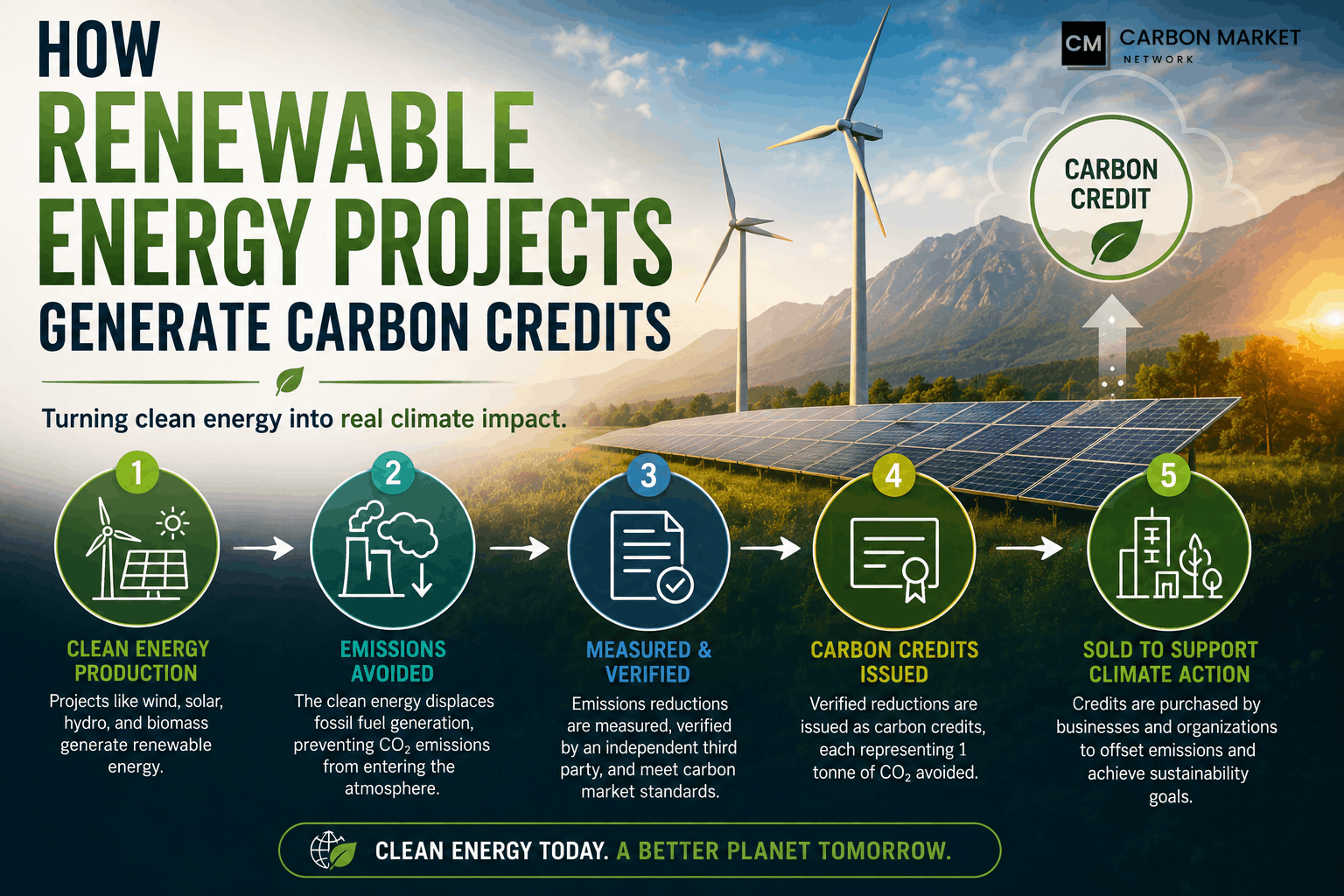
Every time a solar farm sends clean electricity into the grid, something invisible happens alongside the physical power flow. Carbon credits are born.
If you have ever wondered how a wind turbine in rural India or a solar plant in sub-Saharan Africa can produce not just electricity but also a tradable financial asset, you are in the right place.
This guide explains exactly how renewable energy projects generate carbon credits, step by step, from the very first calculation to the moment a credit lands on a trading registry. Whether you are a project developer, a corporate sustainability officer, or simply a curious reader, you will leave this page with a clear, complete picture.
What Are Carbon Credits and Why Do Renewable Energy Projects Matter?
Before diving into the process, let us make sure the foundation is solid.
A carbon credit is a certificate that represents the reduction or avoidance of one metric tonne of carbon dioxide (CO2) or its equivalent in other greenhouse gases (GHGs). When a project proves it has kept that one tonne of CO2 out of the atmosphere, it earns one credit.
Renewable energy projects sit at the heart of the carbon credit market because they displace fossil fuel energy. Every unit of clean electricity they supply means a power plant somewhere does not burn coal, gas, or oil to meet that demand.
The math is straightforward: less fossil fuel burned equals less CO2 released. Those avoided emissions, once measured and verified, become carbon credits.
The global renewable energy carbon credit market exceeded USD 43.3 billion in 2024 and is expected to grow at a compound annual growth rate (CAGR) of 16.2% through 2034. That scale reflects just how much corporate and government demand exists for verified emission reductions from clean energy sources.
Carbon Market Insider Newsletter
Weekly insights on carbon markets, climate policy, carbon credits, and sustainability.
The Two Markets Where Renewable Energy Carbon Credits Are Traded
Renewable energy projects can generate credits for two distinct markets. Understanding the difference is essential before looking at how credits are actually created.
The Compliance Market
In compliance markets, companies or governments must hold a certain number of carbon credits to meet legally binding emission caps. Cap-and-trade programs and carbon taxation schemes increasingly recognise renewable energy projects as eligible sources of compliance credits. These markets are highly regulated and typically offer more price stability.
The Voluntary Carbon Market (VCM)
In the voluntary market, businesses buy carbon credits because they want to, not because the law requires it. They use credits to offset unavoidable emissions and progress toward net-zero or carbon-neutral goals.
The voluntary carbon market was valued at approximately USD 1.68 billion in 2025 and is projected to grow dramatically to USD 32.44 billion by 2035, driven by rising corporate net-zero pledges, ESG integration, and stricter sustainability reporting requirements.
Renewable energy projects feed both markets, though the voluntary market has historically absorbed the majority of clean energy credits.
Which Types of Renewable Energy Projects Generate Carbon Credits?
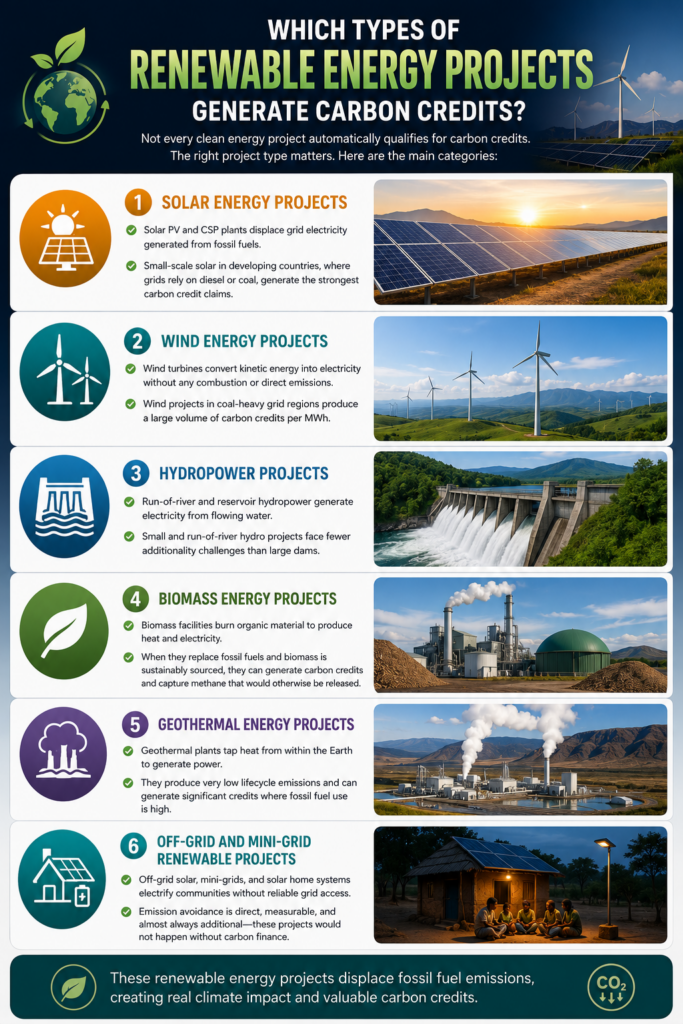
Not every clean energy project automatically qualifies for carbon credits. The right project type matters. Here are the main categories:
Solar Energy Projects
Solar photovoltaic (PV) and concentrating solar power (CSP) plants displace grid electricity generated from fossil fuels. In 2025, global solar PV capacity additions surpassed 600 GW for the first time, bringing cumulative solar capacity to around 2,800 GW. Small-scale solar projects in developing countries, where grid electricity still relies heavily on diesel or coal, tend to generate the strongest carbon credit claims because the emissions they avoid are higher.
Wind Energy Projects
Wind turbines convert kinetic energy into electricity without any combustion and therefore without any direct emissions. Annual global wind capacity additions increased by nearly 40% in 2025, setting a new record of around 160 GW. Wind projects in regions that depend on coal-heavy grids produce a large volume of carbon credits per megawatt-hour of generation.
Hydropower Projects
Run-of-river and reservoir hydropower projects generate electricity from flowing water. The Ngonye Falls Hydropower Project in Zambia made history in 2024 as the first hydropower project in Africa to achieve Gold certification under the Hydropower Sustainability Standard. Small and run-of-river hydro projects face fewer additionality challenges than large dams, which we will explain in a later section.
Biomass Energy Projects
Biomass facilities burn organic material such as agricultural waste, wood pellets, or municipal solid waste to produce heat and electricity. When they replace fossil fuel energy and the biomass is sustainably sourced, they can generate carbon credits. These projects often also capture methane that would otherwise be released into the atmosphere.
Geothermal Energy Projects
Geothermal plants tap heat from within the Earth to generate power. They produce very low lifecycle emissions and, in regions where they displace heavy fossil fuel use, can generate significant credits.
Off-Grid and Mini-Grid Renewable Projects
Off-grid solar systems, mini-grids, and solar home systems in developing countries are among the most impactful carbon credit generators. These projects electrify communities that would otherwise rely on kerosene lamps or diesel generators. The emission avoidance is direct, measurable, and almost always additional, meaning the project would not have happened without carbon finance.
The Core Concept: How Carbon Credits Are Actually Generated
Here is where it gets interesting. Carbon credits do not appear just because a project uses clean energy. The project must prove, rigorously and transparently, that it has genuinely reduced emissions that would not have been reduced otherwise.
Three foundational concepts govern this proof:
1. The Baseline
The baseline is a calculation of how much CO2 would have been emitted if the renewable energy project had never existed.
Think of it as the “what would have happened anyway” scenario.
For a solar farm in India, the baseline is the emissions intensity of the regional electricity grid the solar farm is feeding into. If the regional grid emits 0.82 kg of CO2 per kilowatt-hour (kWh), and the solar farm delivers 1 million kWh per year, the baseline emissions equal 820 tonnes of CO2 per year.
The baseline is not a fixed number. Standards require developers to update it periodically to reflect how grids evolve as more renewables come online.
2. Additionality
Additionality is arguably the most important and most debated concept in carbon credit generation.
A project is “additional” if its emission reductions would not have occurred without the financial incentive provided by carbon credit revenue. In simple terms: would this project have happened without carbon credit income? If the answer is no, the project is additional and deserves credits.
This is where renewable energy projects face scrutiny. As solar and wind costs have fallen dramatically, many projects in well-developed markets are now economically viable without any carbon revenue. If a solar project earns enough from selling electricity alone, carbon market revenue is not the deciding factor, and the project may fail the additionality test.
Investment analysis examines whether the project would be financially viable without carbon credit income.
Barrier analysis asks whether there are non-financial obstacles like regulatory constraints, technology barriers, or market access issues that carbon revenue helps overcome.
Common practice analysis checks whether similar projects are already widespread in the region. If they are, the project is probably not doing anything above and beyond the norm.
The two main US voluntary market registries, the Climate Action Reserve and the American Carbon Registry, excluded wind and solar projects from their registries entirely on additionality grounds. This reflects a broader industry shift toward stricter additionality requirements.
3. Quantification of Emission Reductions
Once the baseline and additionality are established, the project must quantify how many tonnes of CO2 it has avoided.
The formula is simple:
Carbon Credits = Baseline Emissions minus Project Emissions
A wind farm that produces 10 million kWh per year in a grid with an emissions factor of 0.65 kg CO2 per kWh avoids approximately 6,500 tonnes of CO2 annually. If all conditions are met, this project can generate up to 6,500 carbon credits per year.
The more emission-intensive the grid it displaces, the more credits the project generates.
Step-by-Step: How a Renewable Energy Project Generates Carbon Credits
Now let us walk through the full process from project inception to credit issuance.
Step 1: Project Design and Feasibility
The developer decides to build a renewable energy project, such as a 20 MW solar plant in a developing country with a coal-heavy electricity grid.
The developer identifies the right carbon standard to work under. The two most widely used standards globally are:
- Verra’s Verified Carbon Standard (VCS): The world’s leading voluntary GHG program. Credits issued under VCS are called Verified Carbon Units (VCUs), with each representing one metric tonne of CO2. Verra-certified projects account for roughly 55% of all renewable energy carbon credits issued globally.
- Gold Standard: Established by WWF and other NGOs in 2003, it requires projects to meet both emission reduction criteria and UN Sustainable Development Goal benchmarks. It is particularly popular for renewable energy and cookstove projects, with a strong focus on social co-benefits. Gold Standard projects account for around 45% of all renewable energy carbon credit projects globally.
The developer chooses a methodology. This is a standardised set of rules that defines how to calculate the baseline, assess additionality, and measure emission reductions for that specific project type.
Step 2: Project Design Document (PDD)
The developer prepares a Project Design Document (PDD). This document is comprehensive and detailed.
It includes:
- Project description: What the project does, where it is, and who runs it
- Baseline scenario: The emissions that would occur without the project
- Additionality demonstration: Evidence that the project would not happen without carbon revenue
- Monitoring plan: How the project will measure and report emission reductions over time
- Estimated annual emission reductions: The projected number of credits to be generated each year
- Stakeholder consultation: Evidence that local communities were consulted and their concerns were addressed
The PDD is a public document. Anyone can read it. Transparency is a core requirement of all major carbon standards.
Step 3: Validation by a Third-Party Auditor
The PDD is submitted to an independent Validation and Verification Body (VVB). These are accredited organisations approved by the carbon standard to conduct audits.
The VVB reviews the entire PDD in detail. It checks:
- Whether the methodology has been applied correctly
- Whether the baseline calculation is realistic and defensible
- Whether the additionality case holds up to scrutiny
- Whether the monitoring plan is robust and practical
If the VVB is satisfied, it issues a validation report confirming the project is designed in accordance with the chosen standard’s rules.
The project is then formally registered with the carbon standard’s registry, such as the Verra Registry or the Gold Standard Registry.
Step 4: Project Implementation
The renewable energy project is built and starts generating clean electricity.
During operations, the project continuously collects data according to its monitoring plan. For a solar project, this typically includes:
- Total electricity generated (metered output)
- Grid electricity displaced
- Any project-related emissions (maintenance equipment fuel use, etc.)
- Updated grid emissions factor
This data is recorded carefully because it forms the basis of the verification report.
Step 5: Monitoring and Reporting
At regular intervals, typically every one to two years, the project developer compiles a Monitoring Report. This report documents:
- How much electricity was generated during the monitoring period
- The grid emissions factor applicable for that period
- The resulting calculation of emission reductions
The monitoring period is clearly defined in the PDD and must be followed consistently.
Step 6: Verification
The Monitoring Report goes back to an accredited VVB. This is the verification stage.
The VVB conducts a site visit, reviews metering records, checks grid data, interviews project staff, and scrutinises all calculations. It independently confirms that the emission reductions claimed in the Monitoring Report are accurate and methodologically sound.
If verification is successful, the VVB issues a Verification Report confirming the amount of CO2 reduced during the monitoring period.
Step 7: Credit Issuance
The developer submits the Verification Report to the carbon registry. The registry reviews it and, if satisfied, issues carbon credits equal to the verified emission reductions.
For a Verra-registered project, these credits appear as Verified Carbon Units (VCUs) in the developer’s account on the Verra Registry. Each VCU has a unique serial number and is traceable to the specific project and monitoring period it came from.
These credits are now ready to be sold.
Step 8: Listing and Sale
The developer can sell credits:
- Directly to corporate buyers through bilateral agreements
- Through carbon market brokers who connect buyers and sellers
- On digital marketplaces and exchanges where credits are listed and traded transparently
Once a buyer purchases a credit and uses it to offset their emissions, the credit is retired. Retirement is permanent and publicly recorded on the registry. A retired credit cannot be sold again, ensuring no double-counting.
How Carbon Credit Prices Work for Renewable Energy Projects
Carbon credit pricing is not uniform. Prices vary based on project type, location, certification standard, vintage (the year the emission reduction occurred), and quality.
As of 2026, the market shows a clear quality premium:
- High-quality credits (A to AAA rated) average around USD 14.80 per tonne
- Low-quality or legacy credits (CCC to B rated) fetch as little as USD 3.50 per tonne
- Premium certified credits from leading developers in the DACH region sell for EUR 25 to EUR 80 per tonne in verified portfolios
The ICVCM (Integrity Council for the Voluntary Carbon Market) rejected all legacy renewable energy methodologies under its Core Carbon Principles review. This means that older, lower-quality renewable energy credits no longer meet the highest integrity standards, pushing buyers toward newer, more rigorously verified projects.
EU carbon permits in compliance markets rose to EUR 82.85 per tonne in December 2025, reflecting the tightening of regulated emission caps.
The lesson for project developers is clear: quality drives value. A well-designed, rigorously verified project with strong additionality earns significantly more per credit than a project scraping through minimum requirements.
The Role of Carbon Standards and Registries
Carbon standards are the rulebooks. Registries are the record-keepers. Both are essential to the integrity of the credit system.
Verra (Verified Carbon Standard)
Verra is the world’s most widely used voluntary carbon standard. Its Verified Carbon Standard has divided project types into 16 sectoral scopes. Projects under any scope can qualify for VCU issuance, provided they meet all requirements.
VVBs approved by Verra conduct independent auditing against VCS Program rules and methodologies, ensuring both the project design and the emission reduction claims meet the standard’s rigour.
Gold Standard
The Gold Standard was established by the WWF and other NGOs in 2003. It emphasises both environmental and social integrity. Projects must demonstrate contributions to multiple UN Sustainable Development Goals alongside emission reductions.
Gold Standard issues credits called Verified Emission Reductions (VERs). It recognises three main project scopes: community services, renewable energy projects, and land use and forestry projects.
American Carbon Registry (ACR) and Climate Action Reserve (CAR)
These are the leading US-focused registries. Both have excluded standalone wind and solar projects due to additionality concerns in well-developed markets. They remain active in other project types including methane capture, forestry, and agriculture.
The Paris Agreement Crediting Mechanism (PACM)
At the international government level, Article 6.4 of the Paris Agreement established the Paris Agreement Crediting Mechanism (PACM). This is the successor to the Clean Development Mechanism (CDM) under the Kyoto Protocol.
In February 2026, the UN issued its first credits under PACM from a cookstove project in Myanmar coordinated with South Korea. This marked a major milestone for internationally governed carbon markets.
As of March 2026, 106 bilateral arrangements under Article 6.2 had been formalised across 53 host countries, and five CDM-era methodologies covering renewable energy and energy efficiency were being evaluated for incorporation into the new mechanism. From 2026, projects operating under these frameworks are expected to comply fully with Article 6 guidelines.
Additionality Challenges Facing Renewable Energy Projects in 2026
The additionality question is the biggest challenge for renewable energy carbon credit projects today, and it deserves a frank conversation.
As renewable energy costs have collapsed over the past decade, solar and wind projects in many regions are now commercially viable without any carbon revenue. When a project is profitable enough to stand on its own, claiming that carbon credits were the deciding factor becomes very difficult to justify.
A report by India’s Centre for Science and Environment found that for several renewable energy projects, carbon market payments covered only 3 to 4% of the project’s total costs. This casts serious doubt on whether those projects genuinely needed carbon revenue to go ahead.
Nine of the 47 largest “problematic” projects identified globally in a 2024 Corporate Accountability report were in India’s hydropower, solar, and wind sectors, together accounting for 7.7 million retired credits that were deemed questionable.
This does not mean renewable energy projects cannot generate legitimate carbon credits. It means the bar is rightfully higher, and the projects that clear it deserve recognition.
Where Additionality Is Still Strong
Renewable energy projects still demonstrate genuine additionality in several scenarios:
- Off-grid projects in developing countries where communities depend on kerosene or diesel, and no grid connection exists. Carbon revenue is often the only way these projects get financed.
- Projects in markets without renewable energy policies or subsidies, where there is no government support to make the project viable without carbon income.
- Small-scale community projects with high upfront costs relative to revenue from electricity sales.
- Innovative technologies that have not yet reached commercial scale in the project’s geography.
Real-World Examples of Renewable Energy Carbon Credit Projects
East Sumba Solar Initiative, Indonesia
A solar and battery storage initiative in East Sumba, Indonesia, brings 15 MW of clean energy to the region, enough to power 4,000 homes while avoiding approximately 5,500 tonnes of CO2 annually. Projects like this, where communities previously relied on diesel generation, represent some of the most defensible additionality cases in the renewable energy carbon market.
Bangkok E-Bus Program, Thailand
Thailand and Switzerland completed the first-ever ITMO (Internationally Transferred Mitigation Outcome) transfer under Article 6.2 of the Paris Agreement in December 2023, with a second batch covering 2023 to 2024 emissions approved in April 2026. The project converted Bangkok’s private diesel bus fleet to electric vehicles, financed by Switzerland’s KliK Foundation through ITMO purchases. This represents the intersection of renewable energy, transport decarbonisation, and international carbon market cooperation.
Ngonye Falls Hydropower Project, Zambia
This project made history in 2024 as the first hydropower project in Africa to achieve Gold certification under the Hydropower Sustainability Standard. It demonstrates that small and responsibly developed hydropower projects can meet both environmental and social integrity requirements, unlocking access to carbon credit markets.
India’s Renewable Expansion
India achieved a major milestone in 2025 when renewable sources surpassed 50% of the country’s total installed electricity capacity, five years ahead of schedule. India’s annual renewable capacity additions increased by nearly 60% in 2025, driven by almost 50 GW of solar PV commissioned in that year alone. While this scale creates additionality challenges for large projects, it also demonstrates the growing maturity and confidence of renewable energy development in emerging economies.
How Revenue from Carbon Credits Benefits Renewable Energy Projects
Carbon credits are not just a climate instrument. They are also a financial tool.
Here is how revenue flows from carbon credits to renewable energy project economics:
Revenue diversification: A project earns from two streams: electricity sales and carbon credit sales. This dual revenue reduces financial risk and improves project bankability.
Bridging the viability gap: In markets where electricity tariffs are low or where government subsidies do not exist, carbon credit revenue makes the difference between a project that moves forward and one that sits on paper.
Attracting investment: Institutional investors and development finance institutions are more willing to fund renewable energy projects that carry verified carbon revenue alongside power purchase agreements.
Supporting local communities: Many Gold Standard certified projects must demonstrate social co-benefits, meaning a portion of carbon revenue often funds community infrastructure, education, or clean cooking programmes alongside the energy project itself.
Accelerating deployment in developing nations: Africa aims to boost carbon credit production nearly 19-fold by 2030, with renewable energy projects playing a central role. Carbon finance is one of the mechanisms making this ambition achievable.
The Compliance vs. Voluntary Market Dynamic in 2026
The line between compliance and voluntary carbon markets is blurring.
Compliance carbon markets now cover approximately 28% of global emissions, with average prices around EUR 16 per tonne across all covered sectors. As these markets expand and tighten, demand for high-quality renewable energy carbon credits is increasing from regulated entities as well.
In 2025, around 95 million voluntary credits were retired in the first half of the year alone, signalling robust and growing demand. Businesses facing mandatory sustainability reporting under frameworks like the EU’s Corporate Sustainability Reporting Directive (CSRD) are increasingly scrutinising the quality of the credits they purchase.
In January 2025, Microsoft announced the purchase of over 3.5 million carbon credit units to offset emissions from AI development, reflecting the scale at which large corporations are now engaging with the carbon market.
This growing demand pressure is pushing prices higher for high-integrity credits while leaving lower-quality legacy credits behind.
What Makes a High-Quality Renewable Energy Carbon Credit in 2026?
With so much discussion about credit quality, here is a practical checklist of what separates a credible renewable energy carbon credit from a questionable one.
Strong additionality: The project genuinely would not have proceeded without carbon revenue. This is demonstrable through investment analysis, barrier analysis, and documentation.
Accurate baseline: The baseline emissions calculation uses up-to-date, location-specific data and follows an approved methodology. It is not inflated to generate more credits than the project deserves.
Robust monitoring: The project has rigorous metering systems in place, not just estimates. Data is collected consistently throughout each monitoring period.
Independent third-party verification: An accredited VVB has independently audited the monitoring data and confirmed the emission reductions.
Registered and traceable: Credits have a unique serial number on a recognised registry. They can be traced to the specific project, location, and monitoring period.
No double counting: Credits are not claimed by both the project developer and the host country government toward their national climate targets, unless a corresponding adjustment has been made as required under Article 6 rules.
Social and environmental co-benefits: The best projects go beyond just reducing emissions. They create jobs, improve energy access, support biodiversity, and uplift communities.
Key Risks and Challenges for Renewable Energy Carbon Credit Projects
No market is without risk. Here are the main challenges that renewable energy developers and buyers need to navigate.
Additionality Scrutiny
As noted throughout this article, the additionality bar keeps rising. Projects that would have sailed through approval five years ago now face detailed financial and market analysis. This is good for market integrity but requires more upfront documentation and legal rigour.
Baseline Revision
Grid emission factors change over time as more renewables come online. A project’s baseline can shrink significantly as the grid it serves becomes cleaner. Developers must account for this when projecting long-term credit revenues.
Regulatory Uncertainty
Policy changes can affect the value of carbon credits. The removal of certain tax credits and incentive structures, changes in compliance market rules, or revisions to national carbon pricing schemes all create uncertainty that project developers must plan around.
Price Volatility
Carbon credit prices fluctuate based on supply, demand, policy developments, and market sentiment. Developers and buyers both need strategies to manage price risk, such as forward purchase agreements, diversified credit portfolios, and long-term supply contracts.
Reputational Risk
Buying poor-quality credits and calling it “carbon neutral” exposes companies to serious greenwashing accusations. The ICVCM’s Core Carbon Principles and third-party rating systems from organisations like Sylvera and BeZero Carbon are helping buyers identify and avoid low-quality credits.
Double Counting
Under the Paris Agreement, both project developers and host country governments can claim the same emission reductions. Without a corresponding adjustment, this creates double counting. Article 6 rules address this issue but implementation is still evolving in many jurisdictions as of mid-2026.
The Future of Renewable Energy Carbon Credits
Several powerful trends are shaping the trajectory of renewable energy carbon credit generation:
Rising standards for quality: The ICVCM’s Core Carbon Principles have already rejected legacy renewable energy methodologies, forcing the market toward newer, more rigorous approaches. This trend will continue.
Blockchain and digital verification: Innovative platforms are enabling real-time tracking, transparent issuance, and efficient trading. Blockchain integration in carbon markets is listed as a key growth driver for the voluntary market through 2030.
Article 6 full operationalisation: As the Paris Agreement Crediting Mechanism matures and bilateral Article 6.2 agreements multiply, renewable energy projects in developing countries will gain access to new, government-endorsed credit pathways with stronger international recognition.
Emerging market growth: Renewable capacity additions doubled in both sub-Saharan Africa and the Middle East and North Africa in 2025. As these regions expand clean energy rapidly, and as their grids remain relatively carbon-intensive, renewable energy projects there will continue to generate strong and defensible carbon credit claims.
Corporate demand acceleration: With net-zero pledges now mainstream and sustainability reporting becoming mandatory in major markets, demand for verified renewable energy carbon credits from corporations will remain strong through the decade.
Actionable Takeaways for Developers and Buyers
For renewable energy project developers:
- Choose your carbon standard early in the project design phase, as it shapes the entire documentation process
- Invest in a strong additionality case; shortcuts here will haunt the project during verification
- Use certified metering equipment and maintain impeccable data records throughout operations
- Engage local stakeholders early and document the process; it strengthens both your additionality case and your social co-benefits narrative
- Consider emerging Article 6 pathways for projects in countries with active bilateral agreements
For corporate carbon credit buyers:
- Prioritise credits with independent quality ratings from organisations like Sylvera or BeZero Carbon
- Avoid legacy renewable energy credits that were issued under outdated methodologies now rejected by the ICVCM
- Look for credits from off-grid or mini-grid projects in developing countries where additionality is strongest
- Pair credit purchases with direct emission reduction efforts; credits should complement, not replace, internal decarbonisation
- Verify that credits are properly retired on a recognised registry before claiming any offset
Frequently Asked Questions (FAQ)
Q: How many carbon credits does a renewable energy project generate per year?
A: It depends on the project size and the emissions intensity of the grid it displaces. A 10 MW solar project in a coal-heavy grid might generate anywhere from 5,000 to 15,000 carbon credits per year. Larger projects in high-emission grids generate more. Off-grid projects are calculated differently, based on the fuel they replace.
Q: Can any renewable energy project get carbon credits?
A: No. The project must meet specific criteria including additionality, accurate baseline calculation, approved methodology, and third-party verification. Projects in markets where renewables are already economically viable without carbon revenue face significant additionality challenges.
Q: How long does it take to generate carbon credits from a renewable energy project?
A: The timeline from project design to first credit issuance typically takes one to three years. This includes preparing the PDD, third-party validation, registration, one monitoring period, and verification. Some smaller projects move faster with streamlined approval pathways.
Q: What is the difference between a Renewable Energy Certificate (REC) and a carbon credit?
A: A REC certifies that one megawatt-hour of electricity was generated from a renewable source. It proves the origin of the energy but does not directly represent an emissions reduction. A carbon credit represents one metric tonne of CO2 avoided or removed. The two instruments serve different purposes and can sometimes be generated and sold separately from the same project.
Q: How are renewable energy carbon credits verified?
A: An independent, accredited Validation and Verification Body (VVB) reviews the project’s monitoring data, visits the site, checks metering records, and confirms emission reduction calculations against the approved methodology. Only after this independent audit does the carbon standard issue credits.
Q: Are carbon credits from renewable energy projects reliable?
A: They can be, but quality varies significantly. Credits from projects with strong additionality, accurate monitoring, independent verification, and registration on a recognised registry are reliable. Legacy credits from projects that may have happened without carbon revenue are less so. Use third-party rating tools to assess quality before purchasing.
Q: What happens to a carbon credit after it is sold?
A: Once a buyer uses a credit to offset their emissions, the credit is permanently “retired” on the registry. A unique serial number records the retirement. The credit can never be sold or used again, ensuring the emission reduction is only counted once.
Q: How does Article 6 of the Paris Agreement affect renewable energy carbon credits?
A: Article 6 creates a framework for countries to trade emission reductions with each other. Under Article 6.2, bilateral agreements allow countries to transfer Internationally Transferred Mitigation Outcomes (ITMOs). Under Article 6.4, the new Paris Agreement Crediting Mechanism issues UN-supervised credits. Renewable energy projects that qualify under these frameworks can access new, government-endorsed markets, but they must account for “corresponding adjustments” to prevent double counting between the project developer and the host country’s national climate target.
Conclusion: Renewable Energy Projects and Carbon Credits Are Reshaping Climate Finance
The connection between renewable energy projects and carbon credits is one of the most powerful mechanisms the world has developed to direct private capital toward climate action.
When done right, it works elegantly. A solar project in a developing country gets the financing it needs to go ahead. It delivers clean electricity to thousands of homes. It avoids tens of thousands of tonnes of CO2. It earns verified carbon credits that corporations around the world purchase to back their net-zero commitments. Everyone wins: the local community, the global climate, the investor, and the corporate buyer.
But “done right” demands rigour. Additionality must be genuine. Baselines must be accurate. Verification must be independent and thorough. Credits must be traceable, transparent, and retired when used.
As standards rise, as Article 6 matures, and as the voluntary carbon market grows toward billions in annual value, renewable energy projects that meet the highest quality bar will remain in strong demand. The ones that cut corners will find themselves locked out of a market that is rapidly growing up.
If you are developing a renewable energy project and exploring carbon credit opportunities, or if you are a business looking to purchase high-integrity clean energy credits, the Carbon Market Network is here to help you navigate every step of the process with confidence.
This article was written for Carbon Market Network and reflects the latest information available as of June 2026.