Carbon Market Network


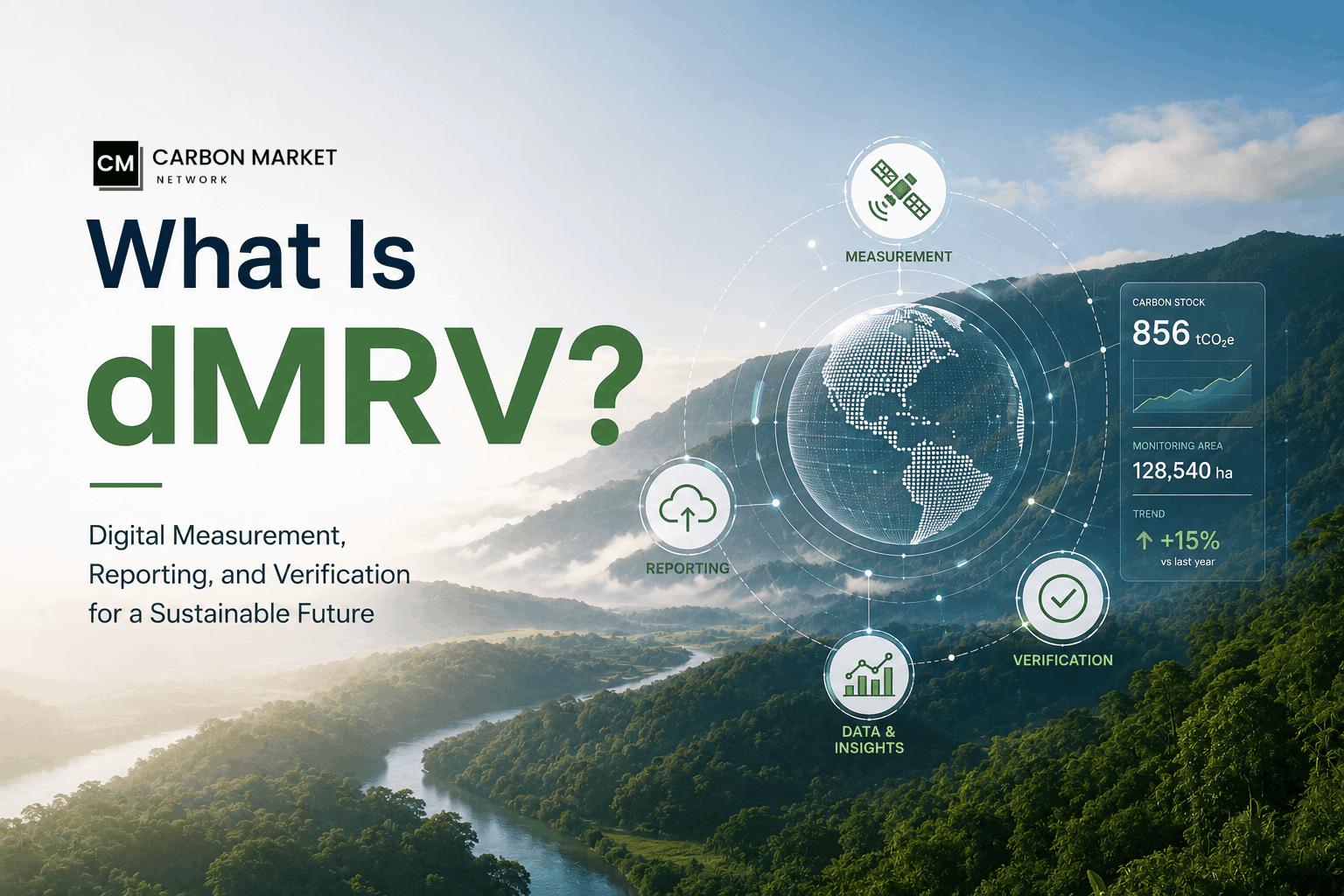
Carbon markets run on trust. And trust depends on one thing: proof.
Every time a company buys a carbon credit, it needs to know that a real tonne of CO₂ was actually reduced or removed. That proof comes from a process called MRV, which stands for Monitoring, Reporting, and Verification.
For decades, MRV has worked through manual surveys, paperwork, and in-person audits. It has been slow, expensive, and hard to scale. But a new approach is changing everything.
That approach is called dMRV, short for digital Monitoring, Reporting, and Verification. It uses satellites, artificial intelligence, IoT sensors, and blockchain to verify carbon outcomes faster, more cheaply, and with far greater transparency.
This guide explains exactly what dMRV is, how it works, why it matters, and where the industry is heading in 2026 and beyond.
What Does MRV Stand For? A Quick Recap
Before diving into dMRV, it helps to understand what traditional MRV involves.
MRV stands for Monitoring, Reporting, and Verification. These three steps form the backbone of any carbon crediting project.
Monitoring is the ongoing collection of data about a project’s activities. For a forest conservation project, this might mean measuring tree growth and tracking deforestation rates. For a renewable energy project, it means logging how much clean electricity was generated.
Reporting is the process of documenting that data in a standardized format and submitting it to a carbon registry or regulatory body. This step creates the official record of what a project has achieved.
Verification is where an independent third party audits the reported data. A qualified validation and verification body (VVB) checks the numbers, reviews the methodology, and confirms that the claimed emission reductions are real, additional, and permanent.
Together, these three steps determine how many carbon credits a project can issue.
Carbon Market Insider Newsletter
Weekly insights on carbon markets, climate policy, carbon credits, and sustainability.
The Problem with Traditional MRV
Traditional MRV has served carbon markets for more than 20 years. But it has significant limitations that become more serious as carbon markets try to scale.
It is expensive. Conventional MRV relies on field crews, manual measurements, physical audits, and extensive paperwork. For forest projects, ground-based tree inventories can cost tens to hundreds of thousands of dollars and take months to complete.
It is slow. Verification cycles under traditional MRV can take years. Project developers often wait 18 months or more to receive their first batch of carbon credits after a project begins. This creates serious cash flow problems and makes it harder to attract investment.
It has limited coverage. Field teams can only measure a fraction of a project’s total area. Sampling methods introduce uncertainty. The larger the project, the harder it becomes to monitor effectively with manual approaches.
It is prone to human error. Manual data entry, inconsistent measurement techniques, and subjectivity in audit processes all introduce potential inaccuracies.
It is costly relative to project revenues. Traditional MRV costs can consume 30 to 40 percent of a carbon project’s total revenues, leaving less money to flow back to project developers and local communities.
These problems have contributed to broader trust issues in carbon markets. Some projects have been accused of over-crediting because their measurement methods were insufficient. dMRV exists to fix these structural weaknesses.
What Is dMRV? The Full Definition
dMRV, or digital MRV, is the use of digital technologies to automate, improve, and accelerate the monitoring, reporting, and verification of carbon outcomes.
Instead of relying on manual field surveys and in-person audits, dMRV uses a combination of remote sensing satellites, IoT sensors, artificial intelligence, and secure digital data platforms to measure and verify carbon emission reductions in close to real time.
Think of traditional MRV as a yearly check-up with a doctor. dMRV is like a continuous health monitor that tracks your vitals 24 hours a day. The result is not just more data, but better, faster, and more reliable insights.
dMRV is sometimes written as D-MRV, DMRV, or digital MRV. All of these terms refer to the same concept.
How Does dMRV Work? The Core Technologies
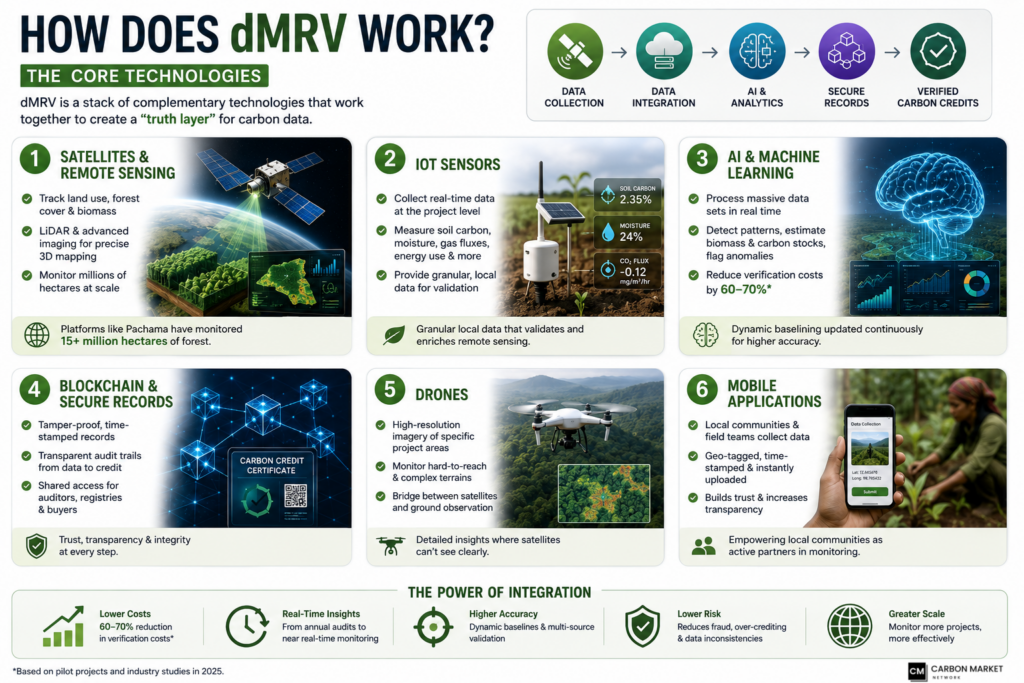
dMRV is not a single tool. It is a stack of complementary technologies that work together to create what experts call a “truth layer” for carbon data. Here is how each technology contributes.
Satellites and Remote Sensing
Satellites are the eyes of a dMRV system. They provide continuous, large-scale monitoring of the physical world without anyone setting foot on the ground.
For forest projects, satellites track forest cover, detect deforestation events, and monitor changes in above-ground biomass. Modern remote sensing tools, including LiDAR (Light Detection and Ranging), can generate precise 3D models of forest canopy height, allowing for highly accurate estimates of carbon stocks.
Platforms like Pachama use advanced satellite imagery, combined with machine learning, to evaluate the carbon stored in forests and monitor growth over time. Pachama has used this approach to monitor more than 15 million hectares of forest.
For blue carbon projects covering mangroves, seagrasses, and coastal wetlands, dedicated satellites are now available. South Korean space company TelePIX launched BlueBon in early 2025, the world’s first satellite designed exclusively for blue carbon observation, built to track and measure carbon stored in coastal ecosystems.
The advantage of satellites is scale. They can monitor millions of hectares simultaneously, with consistent methodology, at a fraction of the cost of ground surveys.
IoT Sensors
Internet of Things (IoT) sensors collect real-time data at the project level. These are physical devices deployed in the field that measure specific variables relevant to carbon accounting.
In agricultural carbon projects, IoT sensors track soil carbon content, moisture levels, and gas fluxes. For cookstove projects, sensors record how often stoves are used and how much fuel is consumed. For industrial carbon capture projects, sensors monitor CO₂ flows at capture, transport, and storage boundaries.
One notable benefit of IoT sensors is granularity. Where satellites provide the big picture, sensors provide precise local data that validates and enriches remote sensing observations.
Artificial Intelligence and Machine Learning
Raw satellite imagery and sensor data are only useful when someone can interpret them. That is where AI and machine learning come in.
AI systems can process enormous volumes of data far faster than any human team. They identify patterns, detect anomalies, estimate biomass, calculate carbon stocks, and flag potential issues.
AI-augmented dMRV systems can reduce verification costs by 60 to 70 percent compared to traditional approaches, while increasing monitoring frequency from annual audits to near-real-time assessment. This figure comes from pilot projects run in 2025.
Machine learning also enables dynamic baselining. Traditional MRV often uses static baseline scenarios that quickly become outdated. AI systems can update baselines continuously based on new data, making carbon accounting more accurate over time.
Blockchain and Secure Digital Records
Blockchain technology provides the record-keeping layer of a dMRV system.
When monitoring data flows in from satellites and sensors, blockchain creates a tamper-proof, time-stamped record of every data point. This means that verification bodies and registries can access the same information simultaneously, reducing the back-and-forth of traditional audit processes.
Blockchain also enables transparent audit trails. Any buyer, investor, or auditor can trace a carbon credit back to the underlying data that supports it. This dramatically reduces the risk of fraud and over-crediting.
Drones
Drones serve as a bridge between satellite imagery and ground-level observation. They provide high-resolution images of specific areas, monitor hard-to-reach locations, and supplement satellite data where cloud cover or resolution is a limitation.
For forestry projects, drones can capture detailed information about canopy structure and individual tree health that satellites cannot easily resolve.
Mobile Applications
Mobile apps allow local community members and field teams to contribute data directly to dMRV systems. With geotagging, timestamping, and instant uploads, mobile-collected data becomes part of the formal verification record.
This is particularly valuable for community-based projects where local knowledge is important, and where engaging local populations in monitoring increases transparency and builds trust.
dMRV vs. Traditional MRV: A Clear Comparison
Understanding the difference between traditional MRV and dMRV makes the value of digital approaches easy to see.
Cost: Traditional MRV can consume 30 to 40 percent of project revenues. dMRV can reduce this to 10 to 15 percent over time, as automation replaces manual labor and on-site audits become less frequent.
Speed: Under traditional MRV, verification cycles can take one to two years or more. dMRV enables continuous data collection, allowing for monthly or even more frequent credit issuances rather than annual batches.
Coverage: Field teams can only measure a fraction of a project’s area. Satellites and sensors can monitor the entire project area continuously.
Accuracy: Manual data collection introduces human error and inconsistency. dMRV systems use consistent algorithms that apply the same measurement approach every time, reducing variance and increasing reliability.
Transparency: Traditional MRV produces documentation that is reviewed by a limited number of auditors. dMRV creates shared digital records accessible to all relevant parties simultaneously, enabling parallel verification rather than sequential checks.
Scalability: Manual MRV processes do not scale easily. dMRV systems can expand to cover vastly larger project portfolios without proportional increases in cost.
Why dMRV Matters for Carbon Market Integrity
Carbon markets have faced serious credibility challenges. High-profile investigations in 2022 and 2023 found that some major REDD+ forest projects had significantly over-credited their emission reductions. Buyer confidence fell, and carbon credit prices dropped sharply.
These integrity problems trace back, in large part, to weak MRV. When measurement methods are manual, infrequent, and opaque, it is easier for errors or exaggerations to go undetected.
dMRV addresses this directly. By making monitoring continuous and transparent, it becomes far harder for a project to issue credits that do not reflect real emission reductions.
Stronger MRV also supports the broader integrity agenda. The Integrity Council for the Voluntary Carbon Market (ICVCM) has established Core Carbon Principles (CCPs) that set a global quality bar for carbon credits. Robust, data-driven MRV is central to meeting these principles.
Independent rating agencies like Sylvera and BeZero Carbon are increasingly factoring dMRV capabilities into their credit quality assessments. Credits backed by digital monitoring consistently score better and command price premiums in the market.
Real-World dMRV Examples and Case Studies
Verra’s First dMRV Credits: February 2026
One of the most significant milestones in dMRV history came in February 2026. Verra, which operates the world’s largest carbon crediting program, approved its first carbon credits under a dMRV pilot initiative for high-frequency issuances.
The first project approved under this pilot was the Foumbouni-Mitsamiouli solar project. This milestone marked the beginning of a new digital chapter for Verra. The pilot structure includes an 80/20 model: 80 percent of credits are issued initially, with 20 percent withheld pending further validation. This is explicitly a pilot rather than a market-wide rollout, but it signals a clear direction.
Isometric and Pachama: dMRV for Reforestation
Leading carbon registry Isometric has developed its own dMRV platform and partnered with Pachama to apply digital verification to reforestation credits. Pachama’s platform uses LiDAR, satellite remote sensing, and AI to generate robust canopy height models and dynamic baselines.
This partnership reflects a growing recognition that reforestation projects require more rigorous and frequent monitoring than traditional methods can provide.
Gold Standard dMRV Pilots
Gold Standard launched a dMRV pilot programme running through October 2026. In early 2025, it approved three new dMRV pilot projects across electric cooking solutions, biomass cooking systems, and sustainable rice cultivation. These pilots use IoT sensors, satellite imagery, and secure data platforms to verify project outcomes.
Gold Standard’s CEO noted that this signals a new era for project developers, enabling faster and more reliable impact verification.
BioCarbon Standard’s Working Group
In October 2025, BioCarbon Standard established a dMRV Working Group in partnership with Planet 2050. The group brings together more than 20 experts from across the carbon and nature-based solutions ecosystem, including technology providers, project developers, verification bodies, rating agencies, and financiers. Their goal is to develop a phased roadmap for full dMRV integration aligned with ICVCM and CORSIA standards.
World Bank Carbon Market Infrastructure Working Group
The World Bank convened a Carbon Markets Infrastructure Working Group in 2024 and 2025, with SustainCERT co-leading the digital MRV subgroup. The group published a technical guidance note establishing evaluation criteria for dMRV systems based on transparency, cost-effectiveness, scalability, and accuracy.
The World Bank’s SCALE programme and related climate finance initiatives are building dMRV requirements directly into their funding conditions. The Bank has also deployed open-source MRV systems in countries including Jordan, Sri Lanka, and Palestine.
The Financial Case for dMRV
Beyond improving accuracy, dMRV has a powerful financial argument that is often underappreciated.
Traditional MRV produces annual or biannual credit issuances. A project developer must wait months or years before receiving revenue. This delays break-even and makes it harder to attract investment, particularly for large-scale infrastructure projects with high upfront costs.
dMRV enables monthly or even continuous credit issuances. For a bioenergy with carbon capture and storage (BECCS) project, research published in December 2025 showed that switching from annual to monthly issuance under dMRV shifts the project’s break-even point from July 2035 to September 2033. That is a two-year acceleration in reaching profitability, which can be the difference between a project attracting investment or not.
While the initial setup costs for digital infrastructure can be substantial, operational costs fall significantly over time. Automation reduces the need for expensive field teams and frequent on-site audits. For large project portfolios, the long-run economics strongly favor digital approaches.
dMRV also helps projects access better credit pricing. Buyers and corporate purchasers like Microsoft, Stripe, and Frontier have signaled that they pay premiums for credits backed by robust, transparent monitoring. In a market that is increasingly differentiating on quality, dMRV is a competitive advantage.
Who Uses dMRV? Stakeholders Across the Carbon Market
dMRV does not affect just one type of participant. It reshapes how every major player in the carbon market operates.
Project Developers use dMRV platforms to collect, process, and submit monitoring data more efficiently. Instead of assembling PDF reports manually, they provide verifiers with comprehensive access to continuous digital records. This reduces preparation time and lowers verification costs.
Validation and Verification Bodies (VVBs) gain access to real-time, structured data rather than static reports. Parallel data flows allow for faster audits, and the transparency of digital records makes anomaly detection easier and more reliable.
Carbon Registries like Verra and Gold Standard use dMRV to move from annual issuance cycles to high-frequency issuance, reducing bottlenecks and improving market liquidity.
Corporate Buyers benefit from clearer, more auditable proof that the credits they purchase represent real outcomes. dMRV-backed credits reduce reputational risk and support stronger climate claims.
Investors and Financiers gain real-time dashboards that show project performance against targets, reducing uncertainty and enabling more confident capital allocation.
Regulators and Governments use dMRV infrastructure to support national climate accounting under Article 6 of the Paris Agreement, improving the reliability of Nationally Determined Contributions (NDCs).
dMRV and the Project Types It Covers
dMRV applies across a wide range of carbon project categories, though the specific technologies used vary by project type.
Forest and Land-Use Projects: Satellite imagery, LiDAR, and AI are the primary tools. These projects benefit most clearly from continuous overhead monitoring. dMRV can detect deforestation events, estimate biomass changes, and track permanence over decades.
Agricultural Carbon Projects: IoT sensors in soil, combined with satellite monitoring of land cover, enable continuous tracking of soil organic carbon, sustainable farming practices, and methane emissions from rice cultivation.
Blue Carbon Projects: Mangrove, seagrass, and saltmarsh projects now benefit from dedicated blue carbon satellites that can measure sequestration with unprecedented frequency.
Renewable Energy Projects: IoT sensors on clean energy infrastructure measure electricity generation, fuel displacement, and associated emission reductions in real time.
Industrial Carbon Capture and Storage (CCS): Because CO₂ mass can be measured at all inlets and outlets of capture, transport, and storage systems, industrial CCS projects are among the strongest candidates for full dMRV. The CCS+ Initiative, founded in 2021, is developing monitoring methodology modules for the entire CCS value chain for use under Article 6.4.
Cookstove Projects: Sensors that track stove usage frequency and fuel consumption replace the survey-based estimation methods that have historically produced unreliable results in this sector.
The Challenges Facing dMRV Adoption
dMRV is not a seamless solution. Real and significant challenges remain.
High Upfront Costs
Setting up digital infrastructure requires investment in sensors, software platforms, satellite data subscriptions, and connectivity solutions. For project developers in low-income countries or small organizations, these upfront costs can be prohibitive.
Lack of Standardization
Many carbon standards and methodologies were designed before digital tools existed. Switching from manual to digital processes is not simply a matter of swapping one tool for another. It requires revising the underlying methodologies to accommodate continuous data flows, automated calculations, and digital audit trails.
The World Bank’s technical guidance note identifies standardization as a critical priority. Without common evaluation criteria, dMRV systems from different providers cannot be compared, and market fragmentation reduces the credibility gains that digital approaches are supposed to deliver.
Technical Capacity Gaps
Reading satellite imagery, managing IoT sensor networks, and running machine learning models all require specialized skills. Many project developers, particularly in emerging markets, currently lack these capabilities. Significant investment in training and capacity building is needed.
Connectivity in Remote Areas
Many carbon projects operate in remote locations with limited internet access. Running a data-intensive dMRV system in areas with patchy connectivity requires creative technical solutions, such as offline data storage and periodic uploads.
“Black Box” Algorithmic Risk
When AI models calculate carbon stocks or verify emission reductions, the underlying logic is not always transparent. This creates what researchers call a “black box” problem: if buyers and auditors cannot understand how a number was generated, they cannot fully trust it. Ensuring that dMRV algorithms are explainable, auditable, and free from bias is an active area of work.
Data Sovereignty and Governance
dMRV systems collect large volumes of sensitive environmental data. Questions about who owns that data, where it is stored, and who has access to it remain unresolved in many contexts. For communities that host carbon projects, data sovereignty is not just a technical issue but a matter of rights.
Risk of Conflicts of Interest
In some dMRV models, project developers build and manage their own digital platforms. This creates potential conflicts of interest if the same party that benefits from credit issuance also controls the monitoring data. Robust governance frameworks are needed to ensure independence.
dMRV and Article 6 of the Paris Agreement
The global policy framework is moving in dMRV’s favor.
Article 6 of the Paris Agreement establishes rules for how countries can cooperate through carbon markets to meet their climate targets. Article 6.4 in particular creates a UN-supervised Paris Agreement Crediting Mechanism (PACM) to replace the old Clean Development Mechanism (CDM).
The digital infrastructure being built to support Article 6.4 will likely set the template for global carbon market architecture for decades. The Article 6.4 Supervisory Body approved initial methodologies in late 2025, and the first credits under this mechanism are expected in 2026.
Countries including Singapore, Switzerland, and Japan have explicitly signaled interest in blockchain-based systems for corresponding adjustments under Article 6.2. This creates a policy pull toward dMRV infrastructure across compliance and voluntary markets alike.
The CCS+ Initiative is developing dMRV methodology modules with the intent to make them available as a public good for Article 6.4 and domestic carbon markets. This signals a push toward open, standardized dMRV frameworks rather than proprietary systems.
Two Models for How dMRV Could Reshape Verification
SustainCERT and the World Bank have outlined two distinct blueprints for how dMRV could change the structure of the carbon verification process.
Blueprint One: Digital Tools, Same Roles. In this model, project developers build project-specific digital verification platforms. They provide verifiers with comprehensive access to all relevant project data and automated calculations. The roles of developers, standards bodies, and verifiers remain similar to today, but the process is faster and more transparent.
Blueprint Two: Paradigm Shift. In this more radical model, project developers simply capture raw data. An independent integrated quantification and verification (I-Q&V) entity handles all processing, calculation, and verification through a shared digital platform. This removes the developer from the calculation process entirely, eliminating potential conflicts of interest and creating a completely independent verification layer.
Both models are being tested in current pilots. Which approach dominates in the long run will depend on market preferences, regulatory guidance, and the emergence of trusted independent platforms.
The Future of dMRV: What Comes Next
The trajectory for dMRV is clear. Digital monitoring is becoming the expected standard rather than an optional upgrade. Several trends will define how this plays out.
Continuous Issuance as the Norm. As dMRV platforms mature, monthly and real-time credit issuances will replace annual batches. This improves cash flows for project developers and provides buyers with up-to-date information about their purchased credits.
AI at Scale. Machine learning systems will make continuous, automated carbon accounting the norm across project categories. AI-generated baselines, AI-driven anomaly detection, and AI-powered permanence monitoring will reduce human labor in verification.
Open Data Platforms. Sharing dMRV data publicly will become an expectation, not an exception. Open platforms allow independent researchers, rating agencies, and buyers to access and verify the underlying data behind every credit.
Integration with Finance. Investors and corporate buyers will increasingly demand real-time dMRV dashboards before committing capital or making procurement decisions. dMRV data quality will become a financial underwriting criterion.
Hybrid Human-Digital Systems. Full automation will not replace human judgment entirely, at least not soon. The most effective systems will combine continuous digital monitoring with periodic human oversight, using technology to flag issues and humans to resolve them.
Global Standardization. The World Bank, ICVCM, and Article 6 frameworks are converging on shared standards for dMRV evaluation. As these standards solidify, the market will reward projects that meet them and exclude those that do not.
Key Takeaways: What dMRV Means for You
Whether you are a project developer, a corporate buyer, or simply someone trying to understand where carbon markets are heading, dMRV matters.
For project developers, dMRV reduces verification costs, accelerates credit issuance, and makes your project more attractive to premium buyers. Investing in digital monitoring infrastructure now positions you ahead of an industry-wide shift.
For corporate buyers, credits backed by dMRV carry stronger proof of impact. In an era of increasing scrutiny over corporate climate claims, dMRV-backed credits reduce the risk of reputational exposure from over-crediting scandals.
For investors, dMRV provides real-time project performance data that traditional MRV cannot offer. It enables better risk assessment and supports earlier break-even on project investments.
For policymakers, dMRV is the infrastructure layer that makes national climate accounting under Article 6 more reliable, comparable, and trustworthy.
The carbon market is undergoing a fundamental shift. It is moving from a system built on documents and annual audits to one built on continuous data and digital proof. dMRV is the technology that makes this shift possible.
Conclusion: dMRV Is Rewriting the Rules of Carbon Market Trust
dMRV is not just a technical upgrade. It is a structural reform of how carbon markets generate and maintain trust.
For too long, the credibility of carbon credits depended on manual processes that were slow, expensive, and limited in scope. dMRV changes this by placing real-time data at the center of the verification process. Satellites watch forests continuously. Sensors measure soil carbon day and night. AI turns raw data into verified carbon accounts. And blockchain records every step in a way that anyone can inspect.
The milestones of 2025 and 2026 show that this transition is now underway in practice, not just in theory. Verra issued its first credits under a dMRV pilot. Gold Standard approved pilots across multiple sectors. The World Bank published global guidance. The BioCarbon Standard formed a working group. These are not small steps. They are the early moves of an industry-wide transformation.
The market will reward this transformation. Credits backed by strong digital monitoring command higher prices, attract better buyers, and survive scrutiny. Projects that adopt dMRV now will be better positioned for a market where data quality is not a differentiator but a baseline requirement.
Understanding dMRV means understanding the future of carbon markets. And that future is already here.
Frequently Asked Questions About dMRV
What does dMRV stand for?
dMRV stands for digital Monitoring, Reporting, and Verification. It refers to the use of digital technologies, including satellites, AI, IoT sensors, and blockchain, to automate and improve the process of measuring and verifying carbon emission reductions in carbon credit projects.
How is dMRV different from traditional MRV?
Traditional MRV relies on manual field surveys, in-person audits, and annual reporting cycles. dMRV automates these processes using digital tools, enabling continuous monitoring, faster verification, lower costs, and greater transparency.
Which technologies are used in dMRV?
The main technologies in dMRV are satellite and remote sensing imagery, LiDAR, IoT sensors, artificial intelligence and machine learning, blockchain, drones, and mobile data collection applications. These technologies work together to create a complete digital verification system.
Why is dMRV important for carbon markets?
dMRV improves the accuracy and transparency of carbon credit measurement. This reduces the risk of over-crediting, builds buyer confidence, supports better pricing for high-quality credits, and enables more frequent credit issuances that improve project cash flows.
Which registries are piloting dMRV?
Verra approved its first dMRV credits in February 2026 as part of a high-frequency issuance pilot. Gold Standard has run multiple dMRV pilots since 2025 covering cookstoves, agricultural practices, and other project types. Isometric has developed its own dMRV platform and partnered with Pachama for reforestation verification.
Is dMRV fully automated?
Not entirely. Current dMRV systems automate data collection, processing, and much of the reporting. But human oversight remains important, particularly for reviewing AI-generated outputs, resolving anomalies, and ensuring governance. The most effective systems combine automation with human judgment.
What are the main challenges with dMRV?
The main challenges include high upfront infrastructure costs, lack of standardized methodologies, technical capacity gaps in emerging markets, connectivity issues in remote areas, “black box” algorithmic risks, and unresolved questions about data sovereignty.
Does dMRV apply to all carbon project types?
dMRV applies across many project types, including forests, agriculture, blue carbon, renewable energy, industrial carbon capture, and cookstoves. The specific technologies used vary depending on what is being measured, but the underlying principles of continuous digital monitoring apply broadly.
How does dMRV relate to Article 6 of the Paris Agreement?
Article 6.4 of the Paris Agreement is establishing a new UN-supervised carbon crediting mechanism. The digital infrastructure being developed to support Article 6.4 will likely rely on dMRV principles and set a global template for carbon market architecture. Countries pursuing international carbon trading are increasingly building dMRV capabilities into their systems.
Will dMRV replace auditors and VVBs?
dMRV will change the role of auditors and VVBs, but it will not eliminate them. Digital tools accelerate data collection and preliminary analysis, but independent human verification of AI-generated outputs and governance oversight will remain essential for maintaining market credibility.
Explore more resources on carbon markets, carbon credit verification, and climate finance on Carbon Market Network.