Carbon Market Network


India is building one of the world’s largest carbon markets. Hundreds of industrial plants now carry legally binding emission targets. Thousands of project developers are racing to register renewable energy, forestry, and clean technology projects to earn tradable carbon credits.
But here is the one question every company, farmer, developer, and investor keeps asking: which carbon credit registry should I use in India?
The answer shapes everything. The registry you choose determines how your credits are verified, who can buy them, what price they command, and whether they count toward India’s national climate goals.
This guide breaks down every major carbon credit registry used in India. Whether you are an industry compliance team, a sustainability officer, a project developer, or simply someone trying to understand India’s carbon market, this is the most complete resource you will find.
What Is a Carbon Credit Registry and Why Does It Matter?
A carbon credit registry is a secure, digital database that records the creation, ownership, transfer, and retirement of carbon credits.
Think of it like a land records office, but for carbon. Every tonne of CO2 reduced or removed by a project gets assigned a unique serial number. That number lives in the registry. When someone buys the credit, the registry updates the ownership record. When someone uses the credit to offset their emissions, the registry marks it as “retired” so it can never be claimed again.
Without a registry, carbon credits could be sold twice, fabricated, or used to make false environmental claims. The registry is what makes carbon credits trustworthy and tradable.
A credible carbon credit registry does six key things:
- Lists and validates carbon reduction projects
- Issues unique, serialized credits for verified emission reductions
- Tracks who owns each credit at any point in time
- Records every transfer between buyers and sellers
- Retires credits permanently when used for offsetting
- Publishes all project and credit data transparently so anyone can verify
Carbon Market Insider Newsletter
Weekly insights on carbon markets, climate policy, carbon credits, and sustainability.
India’s Carbon Market: The Big Picture Before We Dive In
To understand which registries matter in India, you first need to understand the market structure.
India’s carbon market operates under the Carbon Credit Trading Scheme (CCTS), notified by the Ministry of Power in June 2023 under the Energy Conservation (Amendment) Act, 2022. This law gave India the legal foundation to build a national carbon market for the first time.
The Indian Carbon Market (ICM) has two distinct streams: the compliance mechanism (mandatory for large industries) and the Offset Mechanism (voluntary, open to any entity).
The CCTS compliance mechanism is set to initially cover over 700 million tonnes of CO2e, placing India among the world’s largest emissions trading systems.
The compliance mechanism targets obligated entities from nine energy-intensive industrial sectors, including aluminum, cement, iron and steel, paper, chlor-alkali, fertilizer, petroleum refining, petrochemicals, and textiles.
On top of this mandatory system, India also hosts a rich ecosystem of international voluntary registries. Both the domestic and international registries play important and complementary roles.
Here is the landscape at a glance:
Domestic (Government-Operated):
- ICM Registry (operated by Grid Controller of India Limited)
- Carbon Registry India (CR-I) by NCCF
International (Voluntary Market):
- Verra (Verified Carbon Standard)
- Gold Standard
- Other niche standards (Plan Vivo, ACR, CAR)
Each registry serves different project types, buyers, and compliance purposes. Let us look at each one in depth.
The ICM Registry: India’s Official National Carbon Credit Registry
What Is the ICM Registry?
The Indian Carbon Market (ICM) Registry is the government’s official, centralized platform for issuing, tracking, and trading Carbon Credit Certificates (CCCs) under the CCTS.
The Grid Controller of India (GCI) is the registry operator and manages and operates the ICM registry. It functions as a meta-registry for the country and maintains a secure database with all security protocols as approved by the National Steering Committee for the Indian Carbon Market (NSCICM).
The Grid Controller of India Limited (GCIL), previously known as POSOCO, is the body that runs the electrical grid across India. The government designated it as the registry operator because of its deep experience in managing large-scale, real-time national databases for critical infrastructure.
Who Governs the ICM Registry?
The ICM is not run by one body alone. It is a multi-stakeholder system with clearly defined roles:
Bureau of Energy Efficiency (BEE) BEE is responsible for the administration and implementation of the CCTS. Its responsibilities include identifying relevant sectors and their potential for GHG reduction, developing emissions trajectories and targets for covered entities under the compliance mechanism, issuing CCCs, and developing the necessary IT infrastructure for the operation of the ICM.
Central Electricity Regulatory Commission (CERC) The Central Electricity Regulatory Commission (CERC) is the regulator for trading activities under the ICM. It approves business regulations of power exchanges for trading purposes and provides market oversight to prevent fraud or mistrust.
National Steering Committee for Indian Carbon Market (NSCICM) The NSCICM brings together representatives from various ministries, state governments, and industry experts. It serves as the highest authority overseeing the establishment and functioning of India’s carbon market.
Accredited Carbon Verification Agencies (ACVAs) These are the independent bodies that audit and verify your emission reductions before any credits are issued. You cannot receive credits without their sign-off. BEE accredits and publishes the list of eligible ACVAs.
What Does the ICM Registry Record?
The registry serves as the central platform for project registration data, CCC issuance, serial number assignment, transfers, banking, retirement, and cancellation. It incorporates safeguards against double counting through unique digital identifiers, project exclusivity rules, and centralized issuance review by BEE.
Who Can Use the ICM Registry?
The ICM registry serves two types of participants:
1. Obligated Entities (Compliance Track) These are large industrial companies in the nine notified sectors. Around 740 entities will have legally binding emission intensity targets for the compliance years 2025-26 and 2026-27, using fiscal year 2023-24 as the baseline. These companies must register on the ICM portal, track their emissions, and either earn CCCs (if they over-perform) or buy CCCs (if they under-perform) on regulated power exchanges.
2. Non-Obligated Entities (Offset Mechanism Track) The offset mechanism enables non-obligated entities across diverse sectors, including mangrove afforestation and reforestation, renewable energy, industrial energy efficiency, and emerging technologies like green hydrogen, to voluntarily develop projects that reduce, remove, or avoid GHG emissions, thereby generating tradable carbon credit certificates.
On June 6, 2025, the Bureau of Energy Efficiency announced the opening of registrations for entities to register themselves as non-obligated entities under the offset mechanism.
The Eight Approved Offset Methodologies
On March 28, 2025, India’s Ministry of Power approved eight crediting methodologies for generating voluntary carbon credits, covering sectors including:
- Renewable energy with storage
- Green hydrogen production
- Methane recovery from waste
- Afforestation and reforestation
- Energy efficiency in industry
- Agriculture
- Waste management
- Emerging technologies like carbon capture
BEE released additional draft methodologies in August 2025, with more sectors including construction, solvent use, fugitive emissions, and CCUS planned for Phase 2.
How Are CCCs Traded?
CCCs will be traded through India’s power exchanges under the supervision of the Central Electricity Regulatory Commission (CERC), which will provide market oversight and take corrective action to prevent fraud. Initially, the system will not allow over-the-counter trading; all transactions will take place through regulated exchanges.
Unlimited banking of CCCs is allowed. Banked CCCs can be either sold within the ICM or used to meet future compliance obligations. Borrowing is not allowed.
Important Rule: No Double Registration
One critical rule every project developer must understand is this: a project should not be concurrently registered with any other carbon market under the ICM’s offset mechanism rules. If you register your project under the ICM, you cannot simultaneously register it under Verra or Gold Standard.
ICM Registry Status
As of January 2026, India is finalizing the ICM portal and registry, with government statements indicating that market operations and digital trading infrastructure are expected to become operational by mid-2026.
CCC trading is expected to open on the designated exchange around October 2026. Surplus entities will be able to sell CCCs, while deficit entities must purchase them to meet compliance. GRID-INDIA’s registry records all transactions.
Compliance Mechanism: Step-by-Step Process for Obligated Entities
If your company falls under one of the nine notified sectors, here is how the compliance process works:
Step 1: Register on the ICM Portal Register your facility and authorize signatories through the CCTS portal managed by BEE.
Step 2: Submit a Monitoring Plan A monitoring plan must be submitted within three months of the start of the first trajectory period, and annually within three months of the start of each compliance year.
Step 3: Track Your Emissions Throughout the Year Monitor fuel consumption, electricity use, production volumes, and calculated emission intensity at your plant for the full compliance year.
Step 4: Submit Verified MRV Data By July 31, facilities must submit verified emission data for the fiscal year, including fuel consumption, production volumes, electricity purchases, and calculated emission intensity. This data must be third-party verified by a BEE-accredited verification agency.
Step 5: Receive or Surrender CCCs If you beat your emission intensity target, BEE issues CCCs to your ICM registry account. If you fall short, you must buy and surrender CCCs on the power exchange.
Step 6: Bank or Trade Surplus CCCs You can sell your surplus CCCs on the power exchange immediately, or bank them for use in future compliance cycles.
Offset Mechanism: Step-by-Step Process for Non-Obligated Entities
If you run a renewable energy plant, reforestation project, or any eligible decarbonization activity, here is how to earn CCCs through the Offset Mechanism:
Step 1: Choose an Approved Methodology Select the BEE-approved methodology that matches your project type (renewable energy, afforestation, waste management, etc.).
Step 2: Develop a Project Design Document (PDD) Prepare a detailed document outlining your baseline emissions, project boundary, and monitoring plan.
Step 3: Engage an ACVA for Validation Have a BEE-accredited Carbon Verification Agency validate your PDD before you start the project.
Step 4: Register on the ICM Portal Submit your validated PDD to BEE. Wait for BEE review and NSCICM recommendation.
Step 5: Implement the Project and Monitor Run your project activities and collect monitoring data as per your approved plan.
Step 6: Get Verified and Receive CCCs Have an ACVA verify your actual emission reductions. Receive your CCCs in your ICM Registry account. Then list your CCCs for sale on India’s power exchange platform, ensuring compliance with CERC trading rules.
Carbon Registry India (CR-I) by NCCF
What Is CR-I?
The Carbon Registry India (CR-I) is a voluntary carbon registry developed by the Network for Certification and Conservation of Forests (NCCF).
CR-I is an India-centric, standards-based voluntary carbon market mechanism that provides rules, requirements, and procedures for design, development, validation and registration of projects, and subsequent verification and certification of net GHG emissions reductions. It also provides rules, requirements, and procedures for approval and listing of methodologies and tools.
CR-I issues its own carbon credit units called Million Carbon Units (MCUs), where one MCU represents one tonne of CO2 equivalent reduced or removed.
What Makes CR-I Unique?
CR-I was designed specifically for India. It focuses strongly on forest-related projects, land-use change, and sustainable development. Key features include:
- India-specific standards aligned with national forestry and land-use policy
- Accepts CDM, Verra, and Gold Standard methodologies, making it easier for existing project developers to transition
- Integrated with CTX India for trading
- Special provisions for converting CDM projects into the CR-I system
NCCF is developing the Carbon Registry India to provide a listing, trading, and tracking platform for relevant stakeholders in India, supporting database creation of the country’s quantified greenhouse gas emission reduction and removal enhancement, creating a market based on supply and demand of carbon credits, and facilitating carbon to be traded as a commodity.
CR-I Standards and Procedures
CR-I maintains its own set of published standards:
- CR-I Carbon Standard: Sets rules for project design, development, and inclusion of new methodologies
- CR-I Validation and Verification Standard: Governs validation of proposed projects and verification of achieved emission reductions
- Methodology Approval Procedure (MAP): The step-by-step process for submitting and approving new methodologies
CR-I is particularly relevant for forestry project developers, NGOs working on Trees Outside Forests (ToF), and entities in sectors that may not qualify for the ICM Offset Mechanism.
Verra (Verified Carbon Standard): The World’s Largest Voluntary Registry
What Is Verra?
Verra is a US-based nonprofit organization that runs the Verified Carbon Standard (VCS), the largest carbon crediting program in the world by volume.
By marrying scientific rigor and transparency with innovative thinking, the VCS Program has continually brought new projects, organizations, and people into the voluntary carbon market, as well as a growing number of compliance markets, and given them the necessary confidence to participate.
Verra was founded in 2007 to create greater quality assurance in the voluntary carbon market. Since then it has become the biggest standard in the market with over 2,000 registered projects.
Credits issued under VCS are called Verified Carbon Units (VCUs). Each VCU represents one metric tonne of CO2 equivalent reduced or removed.
Why Do Indian Projects Use Verra?
India hosts hundreds of active Verra-registered projects. The reasons are straightforward:
Deep global buyer pool. Corporate buyers from Europe, North America, and Asia Pacific actively seek VCUs. This gives Indian project developers access to international pricing.
Broad project type coverage. VCS covers afforestation and agroforestry, IFM (Improved Forest Management), soil carbon, biochar, renewable energy, methane abatement, plastic recovery, and more.
CORSIA compatibility. While primarily used in the voluntary market, some compliance regimes like CORSIA for aviation accept VCS credits for regulatory meeting targets. This gives Indian VCUs access to the aviation industry’s offset market.
Price premium. Credits from well-known registries typically trade 10 to 40 percent higher than those from unknown or purely local systems.
How Does Verra Work for Indian Projects?
The registration process involves several structured steps:
Step 1: Pipeline Listing Pay USD 1,000 to list your project in Verra’s pipeline, making it publicly visible.
Step 2: Develop a Project Design Document (PDD) Prepare your full PDD using one of Verra’s approved methodologies. Popular ones for India include VM0047 (Agroforestry in Smallholder Bunds), VM0042 (Biochar), and VM0049 (Rice).
Step 3: Engage a Validation and Verification Body (VVB) VVBs are approved by Verra based on their expertise in the program and sectoral scope they audit. During the auditing process, VVBs evaluate projects against the VCS Program rules and methodologies. India hosts fewer than 15 VVBs accredited for land-use projects, so early booking is important.
Step 4: Validation Validation is the first part of the process, taking place before the project is implemented. During validation, a VVB checks whether the project plan meets VCS rules and requirements and approves the project description. After validation, the project can be registered under the VCS and be included in the carbon credit registry.
Step 5: Registration and Credit Issuance Once a project has been registered and issued VCUs, the project proponent can sell these credits on the open market, typically the voluntary market and occasionally in a compliance market.
Step 6: Periodic Verification Verification usually occurs periodically, for example every one to five years, depending on the project type and the monitoring plan established during registration.
Verra’s Quality Safeguards
VCS uses a “Buffer Pool” system where a percentage of credits from all projects are set aside to cover potential reversals or natural disasters. This is especially important for forestry projects where fire or disease could reverse emission reductions.
All VCS projects must meet the following quality principles: credits must be additional (they would not happen without the project), permanent, measurable, and independently verified.
Verra Fees for Indian Projects
- Pipeline listing: USD 1,000
- Registration fee: USD 2,000 (single methodology) or USD 3,000 (multi-methodology)
- Typical timeline to first credit issuance: 12 to 18 months
Gold Standard: The Premium Label for Community and SDG Benefits
What Is Gold Standard?
Gold Standard is a voluntary carbon certification standard launched in 2003 by the World Wide Fund for Nature (WWF), HELIO International, and South North NGOs.
This standard verifies projects that take into account holistic development including environment, social, and community economy aspects. Projects that successfully satisfy strict requirements for GHG reduction, sustainable development, and stakeholder participation are given the Gold Standard accreditation.
Gold Standard issues Gold Standard Certified Emission Reductions (GS-CERs), each representing one tonne of CO2e.
Why Indian Projects Choose Gold Standard
Gold Standard positions itself as the premium label for projects with strong community and sustainable development co-benefits. Indian projects in the following areas frequently opt for Gold Standard:
- Improved cookstove projects in rural communities
- Clean drinking water projects (reducing the need to boil water with wood fuel)
- Community-scale renewable energy in underserved areas
- Agroforestry with strong livelihoods components
- Waste management projects with health and gender co-benefits
If your ESG communications emphasize community and development impact alongside climate, Gold Standard provides a stronger narrative. If your priority is access to the largest market with the most project types and competitive pricing, VCS offers more flexibility.
Gold Standard and SDGs
Every Gold Standard project must demonstrate measurable contributions to at least three United Nations Sustainable Development Goals (SDGs). This rigorous SDG reporting is what makes Gold Standard credits attractive to buyers who need to demonstrate social impact alongside carbon reduction.
Indian projects using Gold Standard can document impacts on SDG 3 (Good Health), SDG 6 (Clean Water), SDG 7 (Affordable and Clean Energy), SDG 13 (Climate Action), and SDG 15 (Life on Land), among others.
Gold Standard Fees and Timeline
Gold Standard’s registration fees are comparable to Verra, but the SDG documentation and stricter stakeholder engagement requirements make the timeline slightly longer. Developers typically see their first credit issuance within 14 to 22 months.
The slower process often pays off. Gold Standard offers an SDG premium that can fetch an additional USD 2 to 3 per tonne compared to standard VCS credits, making it worthwhile for community-focused projects.
Verra vs. Gold Standard: Choosing the Right Registry for Your Indian Project
Both Verra and Gold Standard are globally accepted and trusted. The right choice depends on your project type and target buyer.
Choose Verra (VCS) if:
- Your project involves large-scale afforestation, REDD+, renewable energy, or industrial methane abatement
- You want access to the largest buyer pool with the most competitive pricing
- Your project type does not fit neatly into SDG storytelling
- You need CORSIA eligibility for aviation market buyers
Choose Gold Standard if:
- Your project directly improves community health, livelihoods, or access to energy
- You run a cookstove, clean water, or community solar project
- Your corporate buyers specifically require strong SDG documentation
- You are targeting European or impact-focused institutional buyers
Important Note on ICM Compatibility: Under Article 6 of the Paris Agreement, credits used for international purposes require corresponding adjustments from the Indian government. If you plan to eventually move your project into the ICM Offset Mechanism, ensure you choose your registration path carefully to avoid double counting issues.
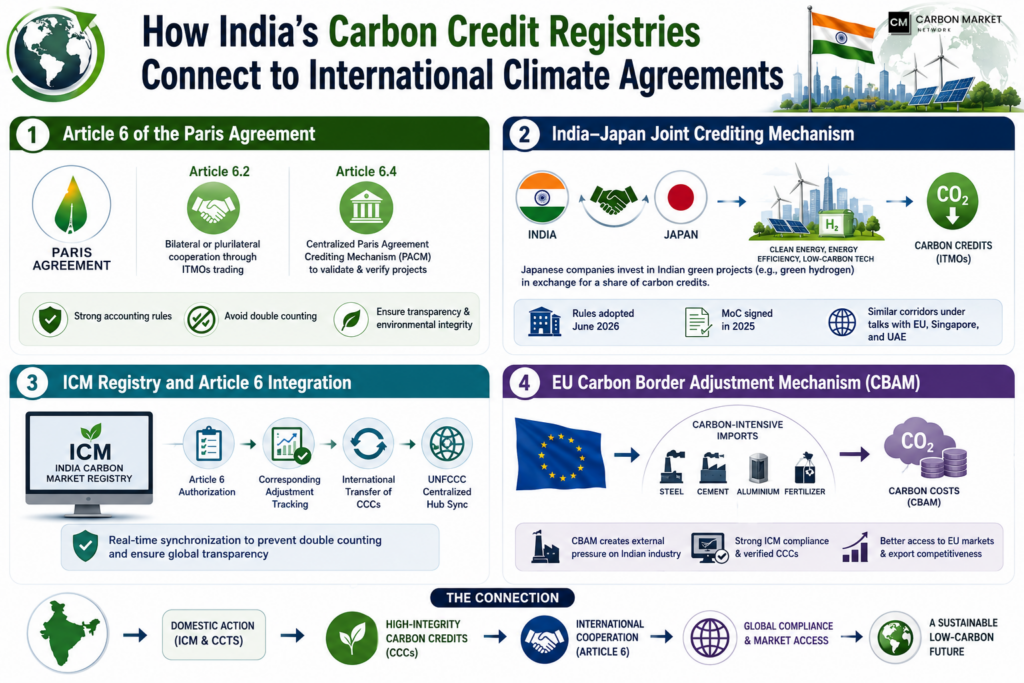
How India’s Carbon Credit Registries Connect to International Climate Agreements
Article 6 of the Paris Agreement
India has been actively integrating its domestic carbon market with the international architecture under Article 6 of the Paris Agreement.
Article 6.2 enables bilateral or plurilateral cooperation through the trading of emission reductions called Internationally Transferred Mitigation Outcomes (ITMOs). Article 6.4 establishes a centralized Paris Agreement Crediting Mechanism (PACM), evolved from the earlier Clean Development Mechanism (CDM), to validate and verify projects generating carbon credits. Both mechanisms are backed by strong accounting rules to avoid double counting and ensure transparency and environmental integrity.
India-Japan Joint Crediting Mechanism
India and Japan have taken a major step forward in global climate cooperation by formally adopting the Rules of Implementation for the Joint Crediting Mechanism (JCM) under Article 6.2 of the Paris Agreement. The rules were adopted in June 2026, following the Memorandum of Cooperation signed between both countries in 2025. The mechanism will allow India and Japan to jointly implement climate mitigation projects, especially in sectors such as clean energy, energy efficiency, and low-carbon technologies.
This mechanism allows Japanese companies to invest in Indian green projects like green hydrogen in exchange for a share of the carbon credits. India is currently in advanced negotiations with the EU, Singapore, and the UAE to create similar corridors for trading high-integrity carbon credits.
ICM Registry and Article 6 Integration
The registry is expected to support Article 6 authorization and corresponding adjustment tracking as the ICM portal expands. Article 6 modules will be embedded in the ICM portal, allowing certain CCCs to be internationally transferred with corresponding adjustments.
Under Article 6.4, every national registry must synchronize credit issuance, transfer, retirement, and corresponding adjustment records with the UNFCCC’s centralized hub in near-real time. The purpose is structural: to eliminate the double-counting that has quietly plagued voluntary carbon markets for a decade.
EU Carbon Border Adjustment Mechanism (CBAM) Connection
The EU’s CBAM will levy carbon costs on imports of carbon-intensive products like steel, cement, aluminum, and fertilizer. These are precisely the sectors that underpin India’s industrial growth. CBAM creates external pressure on Indian industry to demonstrate credible carbon pricing and emission reductions.
India’s CCTS directly addresses this pressure. Companies with strong ICM compliance records and verified CCCs will be better positioned to meet CBAM requirements and protect their export competitiveness in European markets.
The Sectors Covered Under India’s CCTS Compliance Mechanism
Understanding which sectors carry mandatory obligations helps you identify whether your business needs to engage with the ICM registry for compliance or for voluntary offsetting.
The nine sectors initially covered under the CCTS account for approximately 16% of India’s total emissions.
The nine sectors and their emission reduction target ranges include:
- Aluminium: Approximately 2.8% to 7.06% reduction
- Cement: Approximately 4.7% to 7.6% reduction
- Chlor-Alkali: Approximately 3.3% to 11% reduction
- Pulp and Paper: Up to 15% reduction
- Petroleum Refining: Targets notified in January 2026
- Petrochemicals: Targets notified in January 2026
- Textiles: Targets notified in January 2026
- Iron and Steel: Targets being finalized
- Fertilizers: Targets being finalized
Targets are back-loaded: about 40% of the required reduction must be achieved in the first compliance year and the remaining 60% in the second compliance year.
Approved Methodologies Under India’s Offset Mechanism
The BEE has approved specific methodologies for project developers registering under the CCTS Offset Mechanism. These methodologies define exactly how you measure, report, and verify your emission reductions.
Phase 1 Approved Methodologies cover:
- Renewable energy generation (solar, wind, small hydro)
- Industrial energy efficiency improvements
- Green hydrogen production
- Methane recovery from landfills and agricultural waste
- Afforestation, reforestation, and mangrove restoration
- Sustainable agriculture practices
- Waste-to-energy projects
Phase 2 Methodologies (In Development): Phase 2 covers construction, solvent use, fugitive emissions, and carbon capture, utilization, and storage (CCUS).
BEE periodically releases new draft methodologies for public consultation. Staying current with BEE notifications is essential for project developers who want to register new project types.
What Do Carbon Credits Cost in India?
Price is a practical question every developer and buyer asks. Here is where the market currently stands.
ICM Compliance Market (CCCs): CCCs will be traded within a floor price and forbearance price range, as approved by the CERC upon a proposal from the BEE. This price collar system protects both buyers and sellers from extreme volatility, a deliberate design choice by the Indian government to build market confidence. Reported indicative price ranges are between INR 800 and INR 1,200 per tonne for compliance CCCs.
Voluntary Market (Verra and Gold Standard): International voluntary credits from Indian projects vary widely based on project type, vintage, and co-benefits. Nature-based solutions with strong SDG documentation can fetch significantly higher prices than commodity-grade renewable energy credits.
Project Returns Example: At INR 800 to INR 1,200 per tonne for compliance market CCCs, a project generating 10,000 tonnes per year earns INR 80 lakh to INR 1.2 crore annually. The economics often justify the upfront investment, especially for larger projects.
The Cost of Registering a Carbon Project in India
First-year costs vary significantly depending on the registry and project size. Here is a realistic picture:
For ICM Offset Mechanism Projects:
- BEE registration fees: Published by BEE on the ICM portal (nominal for domestic projects)
- ACVA validation cost: USD 5,000 to USD 15,000 depending on project size
- ACVA verification cost (annual): Similar to validation cost
- Monitoring system setup: INR 2 lakh to INR 10 lakh
For Verra VCS Projects:
- Pipeline listing: USD 1,000
- Registration fee: USD 2,000 to USD 3,000
- VVB validation and verification: USD 5,000 to USD 20,000 per cycle
- Total first-year cost estimate: USD 15,000 to USD 60,000 for a small-to-mid-size project. Larger projects may cost significantly more.
For Gold Standard Projects: Fees are comparable to Verra, but additional stakeholder engagement documentation adds time and cost to the process.
Key Differences Between India’s Carbon Credit Registries
Here is a clear comparison to help you choose the right registry:
ICM Registry (GCIL)
- Registry type: Government-operated compliance and voluntary
- Credit name: Carbon Credit Certificate (CCC)
- Regulator: BEE and CERC
- Buyer base: Primarily Indian industries (compliance) and Indian voluntary buyers
- Best for: Obligated industrial entities; Indian voluntary offset projects
Carbon Registry India (CR-I)
- Registry type: Indian voluntary (NCCF)
- Credit name: Million Carbon Unit (MCU)
- Regulator: NCCF
- Buyer base: Indian domestic voluntary buyers and ESG-focused companies
- Best for: Forestry, land-use, and Trees Outside Forests (ToF) projects in India
Verra (VCS)
- Registry type: International voluntary
- Credit name: Verified Carbon Unit (VCU)
- Regulator: Verra (nonprofit)
- Buyer base: Global corporate buyers, aviation (CORSIA)
- Best for: Large-scale agroforestry, REDD+, renewable energy, and industrial projects seeking international buyers
Gold Standard
- Registry type: International voluntary
- Credit name: Gold Standard Certified Emission Reduction (GS-CER)
- Regulator: Gold Standard Foundation
- Buyer base: European corporate buyers, impact investors, SDG-focused buyers
- Best for: Community cookstove, clean water, community renewable energy projects
Real-World Examples: Indian Companies and Projects Engaging With Carbon Registries
Understanding how leading Indian companies use these registries makes the practical stakes clear.
Large Industrial Groups Companies like Tata Group and major cement manufacturers are already registered under the CCTS compliance mechanism. They track emission intensity across their plants through the ICM portal and prepare for CCC trading on India’s power exchanges.
Technology Companies Offsetting Voluntarily Infosys became carbon neutral and continues to invest in high-quality reforestation carbon projects across India, partnering with certified land managers to ensure each planted tree contributes to measurable, verified carbon sequestration.
Agroforestry and Reforestation Developers Smallholder agroforestry projects across states like Maharashtra, Jharkhand, and Karnataka register under Verra using methodology VM0047. These projects bring additional income to farmers while generating internationally tradable VCUs.
Mangrove Restoration Projects India’s extensive mangrove ecosystems along the coasts of Gujarat, Maharashtra, West Bengal, and Odisha are prime candidates for the ICM Offset Mechanism’s afforestation and mangrove restoration methodology.
Common Mistakes Project Developers Make With Carbon Credit Registries
Learning from others’ mistakes saves time and money. Watch out for these common pitfalls:
1. Starting the project before registration Verra and Gold Standard invalidate projects launched prior to listing except under strict “expedited listing” clauses. Similarly, the ICM Offset Mechanism requires a project start date of January 1, 2025 or later. Document your additionality evidence before you start.
2. Double-registering on two platforms If you opt for CCTS later, ensure any voluntary credits are correspondingly adjusted under Article 6 to avoid invalidation. Registering the same project on both ICM and Verra is not allowed.
3. Underestimating verification costs Many first-time developers budget only for registration fees and overlook the recurring ACVA or VVB verification costs that come every year or every few years.
4. Choosing the wrong VVB or ACVA India hosts fewer than 15 VVBs accredited for land-use projects. Early booking can cut validation waits from six months to three.
5. Trying to develop a new methodology Developing a new methodology adds significant cost and time. Choose an existing approved methodology unless your project is very large and has dedicated technical capacity.
6. Poor stakeholder consultation documentation Both BEE and international standards require robust evidence of community consultation. This is not a tick-box exercise. Document every meeting, concern raised, and response given.
The Role of Verification Bodies in India’s Carbon Registries
No registry issues credits without independent verification. Verification bodies are the quality gatekeepers of the entire system.
Under the ICM: Validation and verification activities are conducted by Accredited Carbon Verification Agencies (ACVAs). The Bureau of Energy Efficiency publishes detailed eligibility criteria and procedures for accreditation of such agencies.
Under Verra: Projects use globally accredited Validation and Verification Bodies (VVBs). VVBs recognized by the VCS include companies such as Carbon Check (India) Pvt. Ltd. and other internationally accredited bodies operating in India.
Under Gold Standard: Gold Standard uses its own list of approved verification bodies, many of which overlap with the Verra VVB list.
What verification bodies actually do:
- Review your project design documents
- Visit your site to verify physical conditions
- Check measurement equipment calibration
- Audit fuel, electricity, and production records
- Calculate your actual emission reductions
- Issue a verification opinion to the registry
Engage your verification body early. A good ACVA or VVB will flag documentation issues before formal submission, saving you multiple rounds of corrections.
India’s Carbon Registry Landscape: What Changes Are Coming
India’s carbon market is in active development. Here is what project developers and compliance teams should watch:
Full ICM Portal Launch As of January 2026, India is finalizing the ICM portal and registry, with government statements indicating that market operations and digital trading infrastructure are expected to become operational by mid-2026.
CCC Trading on Power Exchanges CCC trading is expected to open on the designated exchange around October 2026. Surplus entities will be able to sell CCCs, while deficit entities must purchase them to meet compliance.
Expansion to New Sectors The government plans to add the coal-fired power generation sector to the compliance mechanism in a future phase. More sectors mean more obligated entities entering the ICM registry.
More Approved Methodologies BEE continues to approve new crediting methodologies for Phase 2 sectors. Watch for new methodologies in CCUS, construction, and advanced agriculture.
International Linkages India is currently in advanced negotiations with the EU, Singapore, and the UAE to create similar corridors for trading high-integrity carbon credits. As these negotiations progress, the ICM registry will need to support cross-border credit transfers with corresponding adjustments.
CBAM Alignment With the EU’s CBAM set to levy carbon costs on imports of carbon-intensive products like steel, cement, aluminum, and fertilizer from 2026, the ICM registry will play an increasingly important role in helping Indian exporters document their carbon pricing and emission performance.
Actionable Takeaways for Different Stakeholders
For Large Industrial Companies (Obligated Entities)
- Register immediately on the ICM portal if you are in one of the nine notified sectors
- Set up your MRV system now; data collection must start at the beginning of the compliance year
- Engage a BEE-accredited ACVA well in advance of the July verification deadline
- Understand your emission intensity target and model your likely CCC position (surplus or deficit)
For Project Developers (Voluntary Offset Projects)
- Determine whether your project is eligible under ICM Offset Mechanism, Verra, or Gold Standard
- Remember: you cannot register the same project on the ICM and on Verra or Gold Standard simultaneously
- Choose Verra for large agroforestry, REDD+, or renewable energy projects seeking international buyers
- Choose Gold Standard for community-focused cookstove, clean water, or social impact projects
- Consider CR-I for smaller forestry projects with a primarily domestic Indian buyer base
For Corporate Buyers of Carbon Credits
- If you are buying credits to support Indian ESG commitments, both Verra VCUs and Gold Standard GS-CERs are globally recognized
- Once ICM CCCs become tradable, they will carry compliance market credentials and may command a domestic premium
- Understand the difference between “avoiding emissions” credits and “removing emissions” credits; net zero frameworks increasingly require the latter
For Investors
- India’s CCTS covers over 700 million tonnes of CO2e, creating substantial demand for CCCs
- Early-mover project developers who register now under the ICM Offset Mechanism will benefit from first-mover advantages
- Nature-based solutions projects with Gold Standard or Verra certification command premium prices from global impact buyers
Frequently Asked Questions About Carbon Credit Registries in India
Q1: What is the official carbon credit registry in India?
The official government-operated carbon credit registry in India is the ICM Registry, operated by the Grid Controller of India Limited (GCIL). It issues Carbon Credit Certificates (CCCs) under the Carbon Credit Trading Scheme (CCTS), administered by the Bureau of Energy Efficiency (BEE).
Q2: Can Indian projects register with both Verra and the ICM Offset Mechanism?
No. Under the ICM Offset Mechanism rules, a project cannot be concurrently registered with any other carbon market. You must choose one. However, projects that started before the ICM Offset Mechanism’s official start date can register with Verra or Gold Standard instead.
Q3: What is the difference between a CCC and a VCU?
A Carbon Credit Certificate (CCC) is issued by the Indian government under the CCTS through the ICM Registry. A Verified Carbon Unit (VCU) is issued by Verra under the Verified Carbon Standard. Both represent one tonne of CO2 equivalent, but they serve different markets and carry different regulatory recognition.
Q4: Which sectors must register under the ICM Registry for compliance?
The nine sectors currently covered are aluminum, cement, chlor-alkali, pulp and paper, petroleum refining, petrochemicals, textiles, iron and steel, and fertilizers. Together they cover approximately 740 industrial entities with legally binding emission intensity targets.
Q5: How long does it take to get carbon credits registered in India?
For Verra or Gold Standard projects, the typical timeline from project development to first credit issuance is 12 to 18 months. For the ICM Offset Mechanism, the timeline will depend on BEE’s review process, which is still being finalized. For compliance entities, CCCs are issued based on verified annual MRV data submitted by the July deadline.
Q6: What is the price of carbon credits in India?
Compliance market CCCs are expected to trade in an indicative range of INR 800 to INR 1,200 per tonne, within a CERC-approved price collar. Voluntary market credits from Verra or Gold Standard can vary widely depending on project type, co-benefits, and buyer demand.
Q7: Is Gold Standard accepted in India?
Yes. Gold Standard is internationally recognized and widely accepted for voluntary carbon offsetting by Indian companies. It is not, however, accepted for meeting CCTS compliance obligations, which require ICM-registered CCCs.
Q8: What is CR-I and is it the same as the ICM Registry?
No. CR-I (Carbon Registry India) is a voluntary carbon registry developed by NCCF, an Indian forestry organization. It is separate from the government’s ICM Registry. CR-I focuses on forestry and land-use projects with India-specific standards, while the ICM Registry is the official government platform for the CCTS compliance and offset mechanism.
Q9: What is an ACVA in India’s carbon market?
An Accredited Carbon Verification Agency (ACVA) is an independent body accredited by BEE to validate and verify carbon projects under the CCTS. ACVAs serve the same function as Validation and Verification Bodies (VVBs) do under Verra and Gold Standard, but they are specifically accredited for the Indian domestic market.
Q10: When will CCC trading start on India’s power exchanges?
Based on government announcements and regulatory timelines, CCC trading on India’s designated power exchanges is expected to begin around October 2026, following the submission of verified MRV data by the July 2026 deadline.
Conclusion: Choose Your Registry Wisely, Act Early
India’s carbon credit registry landscape is no longer a distant future concept. It is an operational reality, and the decisions you make now determine your position in one of the world’s fastest-growing carbon markets.
The ICM Registry operated by GCIL is the backbone of India’s mandatory and voluntary domestic carbon market. If your company falls under the CCTS compliance mechanism, engagement is not optional. If you run eligible offset projects, registration now puts you ahead of the crowd before trading opens.
Verra and Gold Standard remain the gateways to international voluntary markets. They offer proven frameworks, global buyer access, and premium pricing for high-quality Indian projects.
Carbon Registry India (CR-I) offers an India-specific path for forestry and land-use projects that want domestic recognition and alignment with national standards.
The right registry is not always the most famous one. It is the one that matches your project type, your target buyer, your timeline, and your long-term strategy within India’s evolving carbon market.
India’s carbon market is moving fast. The regulatory framework is in place. The methodologies are approved. The compliance clock is ticking. Whether you are a steel plant manager, a solar developer, a mangrove restoration NGO, or an ESG director at a major corporation, the time to engage with carbon credit registries in India is now.
For more insights on India’s carbon market, carbon credit verification, and investment opportunities in the green economy, visit carbonmarketnetwork.com.