Carbon Market Network


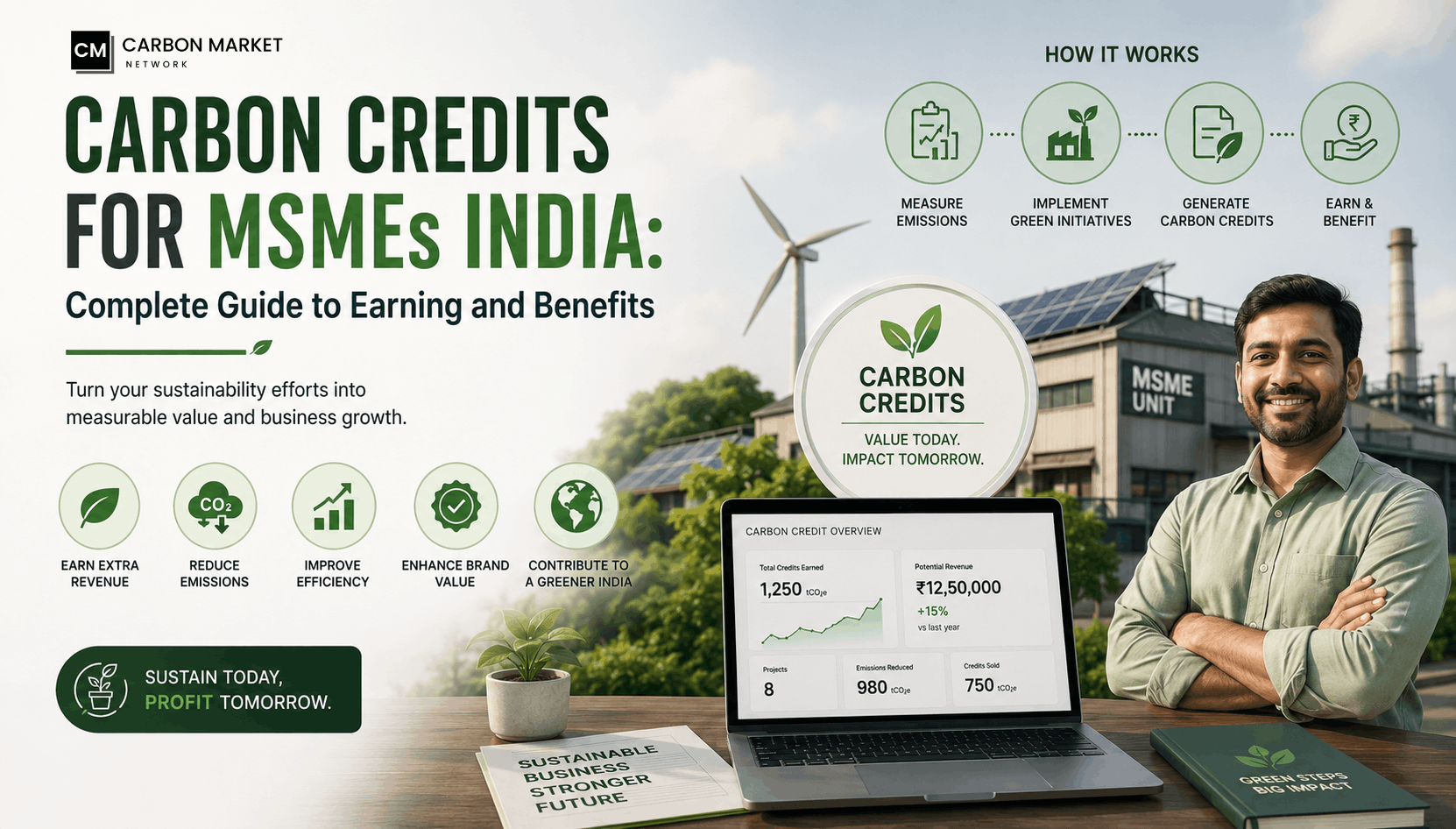
If you run a small or medium business in India and someone mentioned carbon credits to you, you probably thought: “That’s a big-company thing. Not for me.”
You would be wrong. And that assumption could cost you.
Carbon credits for MSMEs in India are no longer a future concept. They are an active opportunity right now. The government has opened India’s carbon market to small businesses through a voluntary offset mechanism. Global buyers are paying real money for verified emission reductions from Indian enterprises. And with the European Union’s carbon border tax already in full effect, Indian MSMEs that export to the EU are facing real shipment seizures, order cancellations, and ballooning compliance costs.
This guide breaks down everything you need to know about carbon credits for MSMEs in India. What they are. How to earn them. What the government supports. What risks you face if you ignore them. And how to take your first step today.
What Are Carbon Credits and Why Do MSMEs Need to Know About Them?
A carbon credit is a certificate that represents the reduction or removal of one metric tonne of carbon dioxide equivalent (CO2e) from the atmosphere.
When a business reduces its greenhouse gas emissions through energy efficiency improvements, renewable energy adoption, waste management, or similar actions, it earns carbon credits. Those credits can then be sold to other businesses that need to offset their own emissions.
Think of it as a reward for going green. You reduce your factory’s emissions. You get a credit. Someone else buys that credit because they have their own emissions targets to meet.
Why MSMEs specifically?
India has over 7.83 crore registered MSMEs. Together, they consume about 25 percent of all industrial energy in the country. That makes the MSME sector one of the largest contributors to India’s overall industrial emissions.
At the same time, MSMEs often operate on tight margins, outdated equipment, and high energy costs. Transitioning to cleaner operations usually feels like a financial burden, not an opportunity.
Carbon credits flip this logic. Instead of only bearing the cost of going green, MSMEs can actually earn revenue from the process.
Carbon Market Insider Newsletter
Weekly insights on carbon markets, climate policy, carbon credits, and sustainability.
How India’s Carbon Market Works: The Basics You Need to Know
India launched its Carbon Credit Trading Scheme (CCTS) under the Energy Conservation (Amendment) Act of 2022. The CCTS is the foundation of India’s Indian Carbon Market (ICM).
The scheme has two distinct pathways:
The Compliance Mechanism
This pathway applies to large industrial entities in energy-intensive sectors such as aluminium, cement, chlor-alkali, pulp and paper, petroleum refining, petrochemicals, and textiles. Around 490 entities are covered so far, with more sectors to be added.
These entities receive legally binding greenhouse gas (GHG) emission intensity targets. If a company beats its target, it earns Carbon Credit Certificates (CCCs), which it can sell. If it falls short, it must buy CCCs from others to make up the gap.
Most MSMEs do not fall under this compliance mechanism. This is important to understand because it means there is no mandatory burden on you as an MSME. However, there is a significant voluntary opportunity.
The Offset Mechanism
This is the gateway for MSMEs.
The Offset Mechanism allows any non-obligated entity, including small businesses, farmers, cooperatives, startups, and local enterprises, to voluntarily register a carbon reduction project and earn CCCs.
The Ministry of Power approved eight offset methodologies in March 2025. These cover:
- Renewable energy (solar, wind, small hydro, pumped hydro storage)
- Green hydrogen production
- Industrial energy efficiency
- Landfill methane recovery
- Mangrove afforestation and reforestation
More methodologies are being developed, with the eventual target of 50 to 100 approved sectors, including green construction, carbon capture, and fugitive emissions.
Credits generated under the Offset Mechanism are issued by the Grid Controller of India (GCI), which operates the official ICM registry. These credits can be sold to:
- Large obligated companies that need credits for compliance top-ups
- Indian corporations meeting net-zero pledges
- International voluntary buyers
Why This Moment Matters for Indian MSMEs
Here is the urgency that many small business owners are still missing.
The EU’s Carbon Border Tax Is Already Hurting Indian Exporters
The European Union’s Carbon Border Adjustment Mechanism (CBAM) entered its full financial phase on January 1 of this year. This means that EU importers of goods like steel, aluminium, cement, and fertilizers from India must now purchase CBAM certificates based on the carbon emissions embedded in those products.
The consequences are already visible. Indian MSME exporters are reporting shipment seizures at European ports. Order cancellations have begun. Companies without verified emissions data are being assessed at punitive default emission values that are 30 to 80 percent higher than their actual emissions.
Between 25,000 and 30,000 MSMEs that supply indirectly to EU-bound value chains are now exposed to CBAM risk, along with 3,000 to 4,000 direct exporters.
One Mumbai-based exporter recently had a 7,000-tonne steel order cancelled after CBAM increased the final cost by Rs 5 to 6 crore. A tractor manufacturer’s shipment was stuck at a Polish port incurring heavy detention charges.
Even if you do not export directly, the CBAM pressure travels through supply chains. If you supply components or materials to a large manufacturer that exports to the EU, that manufacturer will begin demanding emissions data from you. It has already started happening.
The Domestic Carbon Market Is Going Live
India’s domestic CCC trading is expected to commence on power exchanges by mid-to-late 2026. Compliance market credit prices are projected to range between Rs 800 and Rs 1,200 per tonne, with nature-based high-quality projects fetching Rs 1,200 to Rs 2,000 per tonne.
MSMEs that register their projects early, before the market gets crowded, will have a significant advantage.
Large Buyers Are Demanding Green Credentials
India’s large listed companies are now required to disclose Scope 3 emissions under SEBI’s Business Responsibility and Sustainability Reporting (BRSR) framework. Scope 3 emissions include the indirect greenhouse gases in their entire supply chain.
This means your large buyers will increasingly require emission data from you. MSMEs that can demonstrate verified carbon reductions will win supplier relationships. Those that cannot will lose them.
What Types of Projects Can Indian MSMEs Register?
If you are wondering whether your business qualifies for carbon credits, the list is broader than most people expect.
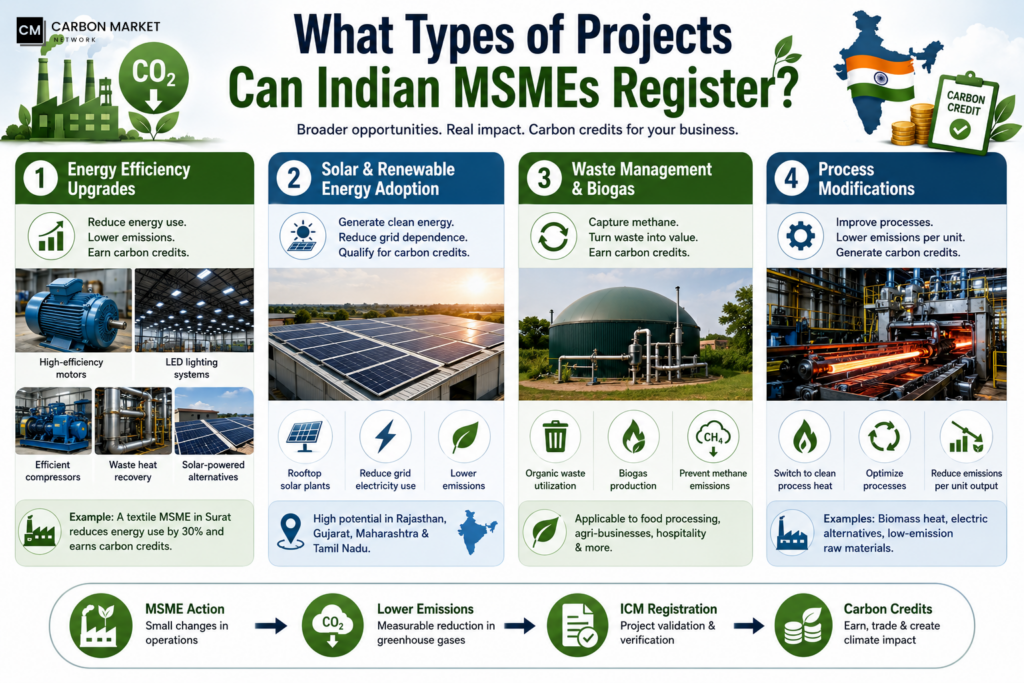
Energy Efficiency Upgrades
This is the most practical and accessible entry point for MSMEs. If you replace old, inefficient machinery with energy-efficient equipment, you reduce your electricity consumption. That reduction in energy use translates into lower greenhouse gas emissions. Those verified reductions can be converted into carbon credits.
Practical examples:
- Replacing conventional motors with IE3-rated energy-efficient motors
- Installing LED lighting systems in manufacturing units
- Upgrading compressors, boilers, or furnaces to high-efficiency models
- Installing waste heat recovery systems
- Replacing diesel generators with solar-powered alternatives
A textile MSME in Surat that upgrades its dyeing machinery to reduce energy use by 30 percent can potentially earn and sell credits from that verified reduction.
Solar and Renewable Energy Adoption
Installing a rooftop solar plant on your factory or warehouse reduces your dependence on grid electricity, which in India is still heavily coal-dependent. This emission reduction qualifies as a carbon credit project under BEE’s approved renewable energy methodologies.
Small businesses in Rajasthan, Gujarat, Maharashtra, and Tamil Nadu are particularly well-placed given the high solar irradiation in these regions.
Waste Management and Biogas
If your business generates significant organic waste, installing a biogas plant to capture methane from that waste instead of letting it decompose and emit methane into the atmosphere qualifies for carbon credits. This applies to food processing units, agri-based businesses, and hospitality-sector MSMEs.
Landfill gas recovery is also an approved methodology under the ICM.
Process Modifications
Any meaningful modification to your manufacturing process that demonstrably reduces greenhouse gas emissions per unit of output can potentially be registered. This includes switching from fossil fuel-based process heat to biomass or electric alternatives, or reducing the use of high-emission raw materials.
How to Earn Carbon Credits as an MSME: Step by Step
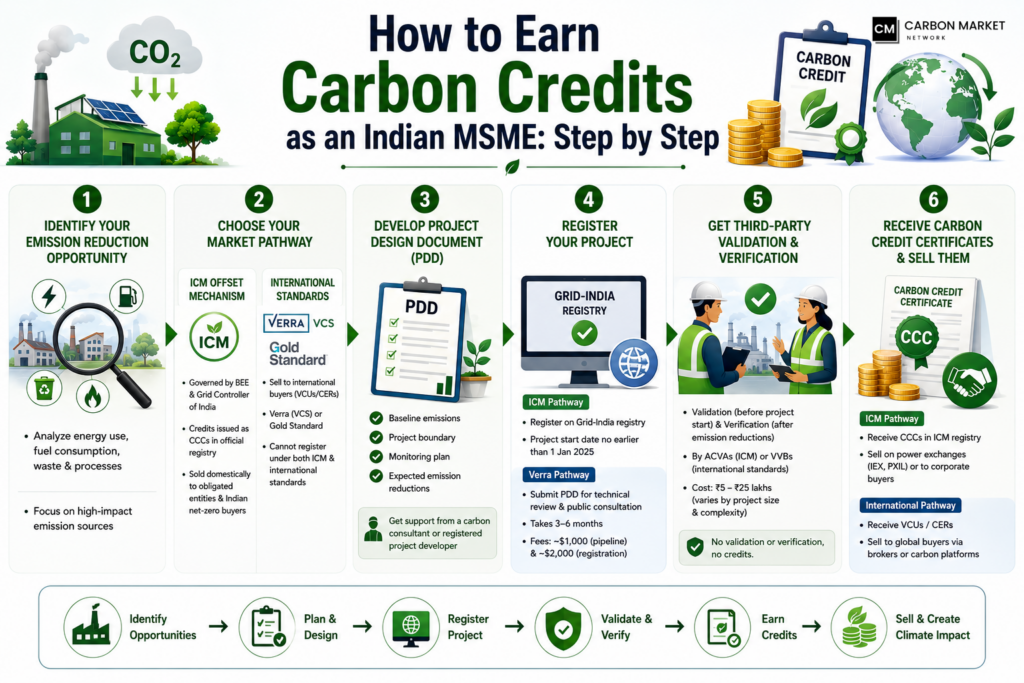
The process of generating carbon credits has a clear structure. Here is how it works under India’s domestic Offset Mechanism:
Step 1: Identify Your Emission Reduction Opportunity
Start by looking at where your business consumes the most energy or generates the most emissions. Focus on areas like fuel use, electricity consumption, waste generation, and production processes. These are your potential credit-generating activities.
Step 2: Choose Your Market Pathway
You have two options:
- India’s ICM Offset Mechanism: Governed by BEE and the Grid Controller of India. Credits are issued as CCCs in the official government registry. Credits can be sold domestically to obligated entities and Indian net-zero buyers.
- International voluntary standards (Verra or Gold Standard): Credits are sold to international buyers. Verra’s Verified Carbon Standard (VCS) is the world’s largest voluntary registry. Gold Standard offers premium pricing for projects with strong social co-benefits. Note that your project cannot be concurrently registered under both ICM and an international standard to avoid double-counting.
Step 3: Develop a Project Design Document (PDD)
This is the core technical document that describes your project. It defines:
- Your baseline emissions (what your emissions would have been without the project)
- The project boundary
- The monitoring and measurement plan
- The expected emission reductions
You will almost certainly need a carbon market consultant or a registered project developer to help you prepare this document correctly.
Step 4: Register Your Project
Under the ICM Offset Mechanism, you register with the Grid-India registry. Your project must have a start date no earlier than January 1, 2025 for ICM eligibility.
Under Verra, you submit your PDD for technical review and public consultation. Registration typically takes three to six months. Verra registration fees are approximately USD 1,000 for pipeline listing and USD 2,000 for formal registration.
Step 5: Get Third-Party Validation and Verification
Your project needs to be validated (assessed before it starts) and later verified (assessed after it has reduced emissions). These are carried out by Accredited Carbon Verification Agencies (ACVAs) under the ICM, or Validation and Verification Bodies (VVBs) under international standards.
This is a non-negotiable step. No validation or verification means no credits. Verification costs range from Rs 5 to 25 lakhs depending on project size and complexity.
Step 6: Receive Carbon Credit Certificates and Sell Them
Once verified, your emission reductions are issued as CCCs in the ICM registry. You can then sell these on India’s power exchanges (IEX, PXIL) under CERC oversight, or directly to corporate buyers in the voluntary market.
Under international standards, you receive Verified Carbon Units (VCUs) or Certified Emission Reductions (CERs) that you can sell to global buyers directly or through brokers and carbon trading platforms.
Government Support for MSMEs Going Green
The Indian government has launched several schemes specifically designed to help MSMEs finance green transitions. These directly support the kind of investments that generate carbon credits.
MSE-GIFT Scheme (Green Investment and Financing for Transformation)
This scheme, launched by the Ministry of MSME under the World Bank-supported RAMP program, provides:
- 2 percent interest subvention on loans for adopting green technologies
- Risk-sharing facility to reduce collateral burden for small businesses
- Loan size from Rs 10 lakhs to Rs 2 crore
- Eligible technologies: Solar panels, energy-efficient motors, LED lighting, waste heat recovery units, and other cleaner production technologies
The scheme operates through SIDBI-empanelled banks and financial institutions. Any Micro or Small Enterprise registered under the MSME Act and planning green technology investment is eligible.
You apply through a participating bank, not directly to SIDBI. Your bank submits the application, and SIDBI provides the risk-sharing support behind the scenes.
MSE-SPICE Scheme (Scheme for Promotion and Investment in Circular Economy)
This scheme supports circular economy projects with a total outlay of Rs 472.5 crore covering credit-linked capital subsidies and awareness support. If your business transitions to circular economy practices, such as recycling, resource efficiency, or waste reduction, this scheme provides financial backing.
Technology Upgradation Scheme (Proposed)
A new Rs 2,000 crore technology upgradation scheme under consideration for the 2026-27 Union Budget would offer a 20 percent capital subsidy for energy-efficient machinery, smart manufacturing, and automation upgrades. This is specifically designed to help export-oriented MSMEs stay competitive in the face of global carbon tariffs.
This scheme is expected to cover MSMEs with annual turnover below Rs 50 crore.
The Real Financial Case: What Can an MSME Actually Earn?
Let us put some numbers to this.
Under India’s domestic voluntary market, carbon credits currently trade at roughly Rs 200 to Rs 400 per tonne of CO2e. As the compliance market matures and demand from obligated entities increases, prices in the compliance-driven segment are expected to reach Rs 800 to Rs 1,200 per tonne.
High-quality nature-based solutions like afforestation, mangrove restoration, and biochar projects command Rs 1,200 to Rs 2,000 per tonne domestically, and even higher on international markets.
A simple example:
Suppose a small textile unit in Tiruppur upgrades its machinery and energy systems, reducing its verified emissions by 500 tonnes of CO2e per year.
At Rs 800 per tonne (compliance market price), that generates Rs 4 lakh per year from credit sales alone. Over five years, that is Rs 20 lakhs, not counting energy cost savings from the efficiency upgrades themselves.
Beyond direct credit revenue, carbon credentials produce additional business value:
- Retention of EU export contracts that would otherwise be lost to CBAM penalties
- Access to green-tagged finance at lower interest rates
- Preferred supplier status with large Indian corporates managing their Scope 3 footprints
- Brand differentiation with customers who increasingly value sustainability
The investment in a carbon project is not purely a climate decision. It is a financial strategy with multiple return streams.
Real Challenges MSMEs Face in the Carbon Market (And How to Overcome Them)
Being honest matters here. The carbon market is not perfectly designed for MSMEs. There are real hurdles.
High Verification Costs Relative to Small Project Size
A single verification can cost Rs 5 to 25 lakhs. For a small business generating only a few hundred tonnes of CO2e annually, this cost can wipe out the credit revenue entirely.
Solution: Aggregate with other MSMEs in the same industrial cluster. Group certification models allow multiple small businesses to share verification costs while pooling their emission reductions into a single credit lot large enough to be commercially viable. Industrial cluster associations and SIDBI are beginning to facilitate this.
Lack of Technical Knowledge
Most MSME owners do not have a background in carbon accounting, emission measurement, or verification standards. The technical complexity of developing a Project Design Document or navigating BEE’s methodology requirements is a significant barrier.
Solution: Work with a carbon market consultant or a registered project developer who handles the technical work on your behalf, usually for a percentage of the credit revenue or a fixed fee. As the market matures, more affordable intermediaries are entering the space specifically to serve the MSME segment.
Data and Monitoring Gaps
Carbon credits require continuous, documented evidence of emission reductions. Many MSMEs do not currently track their energy use or emissions at the granular level required for verification.
Solution: Start simple. Install an energy meter at your facility’s entry point and begin recording monthly consumption. This baseline data is the foundation of any future carbon credit project. You do not need sophisticated equipment to start, but you do need consistent records.
Choosing the Right Registry
The choice between ICM, Verra, and Gold Standard has significant implications for price, buyer access, and timeline.
ICM: Best for domestic compliance demand and reducing forex risk. The buyer pool is growing but still limited compared to international standards. Trading expected to go fully live by mid-to-late 2026.
Verra: Largest global buyer pool. Best for larger projects or those with international buyer relationships. Registration costs in USD. First credit issuance takes 12 to 18 months.
Gold Standard: Best for projects with strong social co-benefits like clean cooking or community-level water access. Commands premium pricing but has slower timelines.
Choose based on your project scale, buyer target, and risk tolerance. You can change your strategy in future project cycles, but once a project is registered on one standard, it must stay there.
CBAM: The Pressure Indian MSMEs Cannot Ignore
The EU Carbon Border Adjustment Mechanism deserves its own section because it is the single most urgent external pressure facing export-oriented MSMEs today.
Under CBAM, any importer bringing CBAM-covered goods (steel, aluminium, cement, fertilizers, hydrogen, and electricity) into the EU must purchase certificates based on the embedded carbon in those goods. The certificate price is linked to EU Emissions Trading System (ETS) prices, which currently run at EUR 60 to 100 per tonne.
If an Indian exporter cannot provide verified emissions data, the EU assigns a default emission value based on the worst performers in the sector. That default value is typically 30 to 80 percent higher than the actual emissions of a well-run Indian MSME.
What this means in practice:
Your EU buyer ends up paying far more in CBAM certificates than they should. They come back to you demanding a price cut. Or they find a supplier in a country with a recognized domestic carbon pricing system who can provide clean data and a lower CBAM liability. You lose the order.
The first annual CBAM declaration covering imports during this year is due on September 30 of next year. That deadline is not soft.
What you need to do:
- Identify whether your products (or the products of your major customers) fall under CBAM-covered categories.
- Start measuring and documenting your facility-level GHG emissions.
- Understand your supply chain emissions, because CBAM captures embedded emissions across the production process, not just at your factory gate.
- Consider engaging a CBAM compliance specialist or carbon consultant to prepare your data package.
The good news: the MRV (monitoring, reporting, and verification) infrastructure you build for India’s CCTS directly satisfies CBAM reporting requirements. One investment serves both purposes.
Voluntary Carbon Market vs Compliance Market: Which Path Is Right for Your MSME?
Understanding the difference between these two markets helps you decide where to position your business.
Voluntary Carbon Market
This is where MSMEs can participate right now without waiting for compliance mandates.
In the voluntary market, companies buy carbon credits to meet self-declared sustainability commitments or net-zero pledges. Buyers include technology companies, financial institutions, consumer goods companies, and any business that has made public climate commitments.
India’s ICM Offset Mechanism operates as a government-certified domestic voluntary market. Verra and Gold Standard serve the international voluntary market.
Prices in the voluntary market are generally lower than compliance markets but are rising. Indian corporate demand for voluntary credits increased 65 percent year-over-year in the latest reporting period.
Compliance Carbon Market
India’s CCTS compliance mechanism creates mandatory demand for CCCs from 490 large industrial entities. When these obligated companies fall short of their emission intensity targets, they must buy CCCs from the market. This creates a structural, policy-driven buyer base.
MSMEs operating under the Offset Mechanism can sell their credits into this compliance market, potentially commanding higher prices.
The compliance market price signal is expected to be stronger and more stable than the voluntary market, driven by legal obligation rather than discretionary corporate spending.
Which is right for you?
Start with the voluntary market through India’s ICM Offset Mechanism. This gets you familiar with the process, builds your data infrastructure, and generates early revenue. As the compliance market matures and prices firm up, your established projects will be well-positioned to benefit.
Sectors Where Indian MSMEs Have the Biggest Carbon Credit Opportunity
Not all MSMEs have equal access to carbon credit projects. Here are the sectors with the strongest natural fit:
Textile and Apparel MSMEs
High energy intensity from dyeing, spinning, and weaving processes. Energy efficiency upgrades offer significant verified emission reductions. Urgently relevant given CBAM exposure and EU buyer demands.
Engineering and Metal Fabrication
Foundries, forging units, and precision engineering clusters consume large amounts of thermal energy. Fuel switching and efficiency improvements generate meaningful credits. Among the most CBAM-exposed MSME categories.
Food Processing
Organic waste generation is high. Biogas and methane capture projects are straightforward to implement and verify. Eligible under ICM’s landfill methane recovery methodology.
Chemical Manufacturing
Process improvements and solvent reduction initiatives can generate emission reductions. Medium-to-high complexity for verification but potentially high credit volumes.
Agro-based Industries
Rice mills, oil mills, and sugar co-products businesses can pursue biogas, biomass, or agricultural waste management projects.
Solar and Renewable Energy Developers
If your MSME manufactures or installs solar equipment, wind systems, or energy storage solutions, you can register renewable energy projects and earn credits. This is especially strong for small independent power producers in high-irradiation states.
Practical Checklist: Is Your MSME Ready to Start?
Use this checklist to assess your readiness to enter India’s carbon credit market.
Foundational steps:
- Confirm your business is registered under the MSME Act (Udyam Registration)
- Identify your top two or three emission-generating activities (electricity, fuel, process heat, waste)
- Install an energy meter if you do not already have one, and start recording monthly consumption
- Pull together at least 12 months of energy and fuel bills as baseline documentation
Exploratory steps:
- Identify which BEE-approved offset methodology best matches your potential project
- Contact a carbon market consultant or project developer for a preliminary feasibility assessment
- Explore whether your industrial cluster association has any group carbon credit initiatives underway
- Apply for the MSE-GIFT scheme through your bank if you are planning energy-efficiency upgrades
Readiness steps for EU-linked businesses:
- Identify whether any of your customers export to the EU
- Determine whether your products fall in CBAM-covered categories
- Begin collecting facility-level emissions data in a format compatible with EU CBAM reporting requirements
- Engage a CBAM compliance specialist or your industry association for guidance
Common Misconceptions About Carbon Credits for MSMEs in India
“Carbon credits are only for large companies.”
This was true under the old CDM era when project registration costs made small projects unviable. India’s new ICM Offset Mechanism is designed specifically to include MSMEs, farmers, and small land-owners. Group certification models make small projects commercially viable.
“I need to plant trees to earn carbon credits.”
Afforestation is one methodology. But industrial energy efficiency, renewable energy adoption, biogas, and waste management are equally valid and often more practical for urban and peri-urban MSMEs.
“Carbon credits are just a cost, not a revenue source.”
Carbon credits you buy are a cost. Carbon credits you earn and sell are revenue. MSMEs that implement qualifying emission-reduction projects are on the selling side of this market.
“It takes years to see any money.”
The timeline from project registration to first credit issuance is typically 12 to 18 months. It is not instant, but it is not indefinite either. For MSMEs with ongoing energy efficiency programs, each annual verification cycle produces a new tranche of tradable credits.
“I cannot afford the verification costs.”
Individual verification is expensive. Cluster-level aggregation brings costs down dramatically. As more MSMEs enter the market, more shared-service models are emerging. The MSE-GIFT and MSE-SPICE schemes also partially subsidize the underlying investments that enable carbon projects.
What Happens If You Do Nothing?
This question deserves a direct answer.
If your MSME exports to the EU, or supplies to companies that do, inaction is increasingly expensive. Default emission values assigned by the EU are punishing Indian exporters right now. Orders are being cancelled. Shipments are being held.
If you do not export but depend on large domestic buyers, those buyers are starting to ask for Scope 3 emissions data. Suppliers who cannot provide it will be deprioritized.
If you are in an energy-intensive sector, the domestic CCTS is expected to expand beyond its initial nine sectors over time. MSMEs in textiles, chemicals, and food processing may eventually face mandatory obligations.
The cost of building your carbon and energy data infrastructure now, when you have time to do it thoughtfully, is far lower than the cost of doing it under compliance pressure or in the middle of a lost-contract crisis.
Frequently Asked Questions (FAQ)
Q1. What are carbon credits for MSMEs in India?
Carbon credits for MSMEs in India are tradable certificates that small and medium businesses earn by reducing their greenhouse gas emissions. Under India’s Carbon Credit Trading Scheme (CCTS) Offset Mechanism, MSMEs can register qualifying projects and sell the verified emission reductions as Carbon Credit Certificates (CCCs) to large companies or voluntary buyers.
Q2. Are MSMEs covered under India’s mandatory CCTS compliance mechanism?
No. The CCTS compliance mechanism currently applies to approximately 490 large industrial entities in nine energy-intensive sectors. MSMEs are not mandatorily covered. However, MSMEs can voluntarily participate in the Offset Mechanism and earn credits that compliance entities can purchase.
Q3. How much money can an MSME earn from carbon credits in India?
This depends on the project size and type. Voluntary market prices currently range from Rs 200 to Rs 400 per tonne. Compliance-driven prices are expected to reach Rs 800 to Rs 1,200 per tonne. An MSME reducing 500 tonnes of CO2e annually at compliance prices would earn Rs 4 to 6 lakhs per year from credit sales alone, on top of energy cost savings.
Q4. What is the minimum size of carbon credit project an MSME can register?
Under India’s ICM Offset Mechanism, there is no strict minimum project size published yet. For international standards like Verra, standalone registration is typically viable at 5,000 tonnes CO2e or more per year. Smaller projects need to aggregate through cluster models or FPOs to make verification costs viable.
Q5. What government schemes help MSMEs finance green upgrades?
Key schemes include the MSE-GIFT Scheme (2 percent interest subvention on loans up to Rs 2 crore for green technology), the MSE-SPICE Scheme for circular economy projects, and a proposed Rs 2,000 crore technology upgradation scheme offering 20 percent capital subsidy. All are administered through SIDBI-empanelled banks.
Q6. Does CBAM apply to all Indian MSMEs or only those that export directly to the EU?
CBAM directly applies to goods exported to the EU in covered sectors. But the indirect impact extends far wider. If you supply to an Indian manufacturer that exports to the EU, that manufacturer will demand emissions data from you to calculate their own CBAM liability. Indirect exposure is estimated to affect 25,000 to 30,000 Indian MSMEs.
Q7. Can an MSME register under both India’s ICM and Verra at the same time?
No. A project cannot be concurrently registered under both to prevent double-counting of emission reductions. You must choose one pathway. If you register under ICM first and later pursue Verra, you must ensure the appropriate corresponding adjustments under Article 6 of the Paris Agreement.
Q8. How long does it take from starting a carbon project to receiving the first credit payment?
Under India’s ICM Offset Mechanism, the first credit issuance typically takes 12 to 18 months from project registration to verified credit issuance. Timelines vary based on project type, methodology complexity, and verifier availability. International standards have similar timelines.
Q9. What is the difference between carbon credits and Renewable Energy Certificates (RECs)?
Carbon credits represent a verified reduction in greenhouse gas emissions and are denominated in tonnes of CO2e. RECs represent the generation of one megawatt-hour of renewable electricity and are used primarily to claim renewable energy use in sustainability reports. Both support sustainability goals but serve different purposes. MSMEs can use RECs to report renewable energy sourcing without direct renewable installation.
Q10. How do I get started with carbon credits as an MSME in India?
Start by measuring your current energy consumption and identifying your largest emission sources. Then contact a carbon market consultant or SIDBI for guidance on eligible projects and available support schemes. Ensure your Udyam Registration is active. Review BEE’s eight approved offset methodologies to find the best fit for your business.
Final Thoughts: The Carbon Opportunity Is Already Open for Indian MSMEs
Carbon credits for MSMEs in India are not a distant promise. The Offset Mechanism is live. The government registry is operational. The compliance market launches formal trading later this year. International buyers are already purchasing Indian credits.
The businesses that move early will set the prices, build the buyer relationships, and develop the data infrastructure that gives them a structural advantage for years.
The businesses that wait will spend more, compete harder, and risk losing export contracts that their greener competitors will take.
India’s MSME sector has survived enormous disruptions through adaptability and resilience. This one is no different. Carbon markets reward early action. Penalty structures punish inaction. Government support makes the first step affordable.
Your first move is not complicated. Measure your energy. Find your biggest emission source. Call a consultant. Apply for MSE-GIFT if you need financing. Start building your carbon data record.
The market is open. The opportunity is real. And the cost of waiting is going up every month.
For more insights on India’s carbon market, carbon credit verification, and investment opportunities in the green economy, visit carbonmarketnetwork.com.