Carbon Market Network


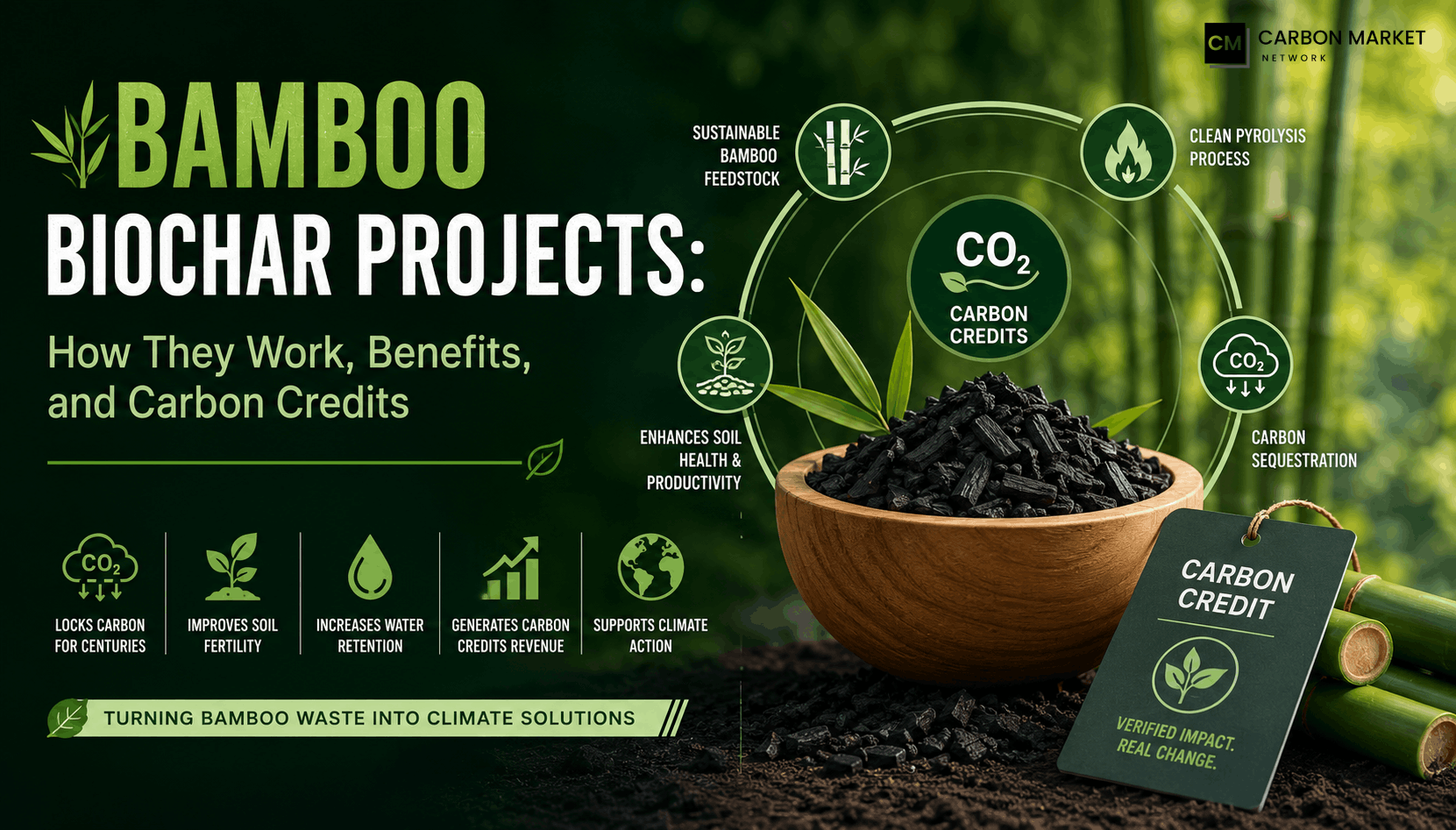
Imagine turning bamboo waste into a material that locks carbon away for a thousand years, improves soil, and earns you carbon credits. That is exactly what bamboo biochar projects do.
Biochar has been making headlines in the carbon market for a while now. But among all feedstocks available, bamboo stands out as one of the most powerful and renewable options on the planet. Fast-growing, carbon-hungry, and available across tropical and subtropical regions, bamboo is tailor-made for biochar production.
This article breaks down everything you need to know about bamboo biochar projects: how they work, why bamboo is such a strong feedstock, the environmental and agricultural benefits, how carbon credits are earned, and what it takes to develop one yourself.
What Is Biochar, and Why Does It Matter?
Biochar is a carbon-rich, charcoal-like material produced by heating organic matter in a low-oxygen environment through a process called pyrolysis.
When organic material like wood, crop residue, or bamboo is heated without oxygen, it does not combust. Instead, it transforms into a stable, porous black substance rich in carbon.
That carbon does not disappear into the atmosphere. It gets locked into a solid form that can persist in soil for hundreds to over a thousand years.
This makes biochar one of the most durable carbon dioxide removal (CDR) technologies available today, and one of the most scalable.
Beyond carbon storage, biochar improves soil fertility, holds water, supports beneficial soil microbes, and reduces the need for chemical fertilizers. It is both a climate tool and an agricultural one.
Carbon Market Insider Newsletter
Weekly insights on carbon markets, climate policy, carbon credits, and sustainability.
Why Bamboo Is the Ideal Feedstock for Biochar
Not all biochar feedstocks are equal. Biochar can be made from rice husks, corn cobs, wood chips, coconut shells, and dozens of other organic materials. So why does bamboo stand out?
The answer comes down to several key properties that make bamboo exceptionally well-suited for biochar production.
Bamboo Grows Faster Than Any Other Plant
Bamboo is technically a grass, not a tree. And it grows at a pace that no other woody plant can match.
Certain species of bamboo can grow close to a meter per day under ideal conditions. Most commercially relevant species reach full height within three to five years.
Compare that to hardwood trees, which can take 40 to 80 years to mature. This rapid regeneration cycle means that bamboo plantations can supply feedstock for biochar production continuously, year after year, without depleting the resource.
Bamboo Absorbs Enormous Amounts of CO2 While Growing
As bamboo grows, it pulls carbon dioxide from the atmosphere through photosynthesis and stores it in its biomass.
Studies suggest that a single bamboo plant can sequester around 2 tonnes of CO2 in just seven years, compared to a hardwood tree that might capture 1 tonne in 40 years. Bamboo can also absorb up to five times more CO2 per hectare than pine forests.
This means that bamboo biochar projects create a double carbon benefit: bamboo sequesters carbon while growing, and then pyrolysis locks that carbon into a durable form when the biomass is converted to biochar.
Bamboo Produces High-Quality Biochar
The chemical composition of bamboo makes it an excellent source of biochar.
Bamboo biochar typically has a carbon content exceeding 70%, and sometimes as high as 90% depending on pyrolysis temperature. This high carbon density makes it a highly effective and long-lasting carbon sink.
Compared to biochar made from rice husks, bamboo biochar has higher fixed carbon, lower ash content, and superior thermal stability. Research has consistently shown that bamboo-derived biochar outperforms many other feedstocks in terms of carbon quality and sequestration potential.
Bamboo Generates Waste That Would Otherwise Be Burned
Bamboo processing industries, including furniture, flooring, handicraft, and food production, generate large volumes of offcuts, shavings, stems, and sawdust.
In most cases, this waste gets burned in the open or left to decompose, releasing CO2 and methane into the atmosphere.
Bamboo biochar projects intercept this waste stream, turning a pollution problem into a carbon removal solution. This is what gives bamboo biochar projects strong additionality claims in the carbon markets.
How Bamboo Biochar Projects Work: Step by Step
Understanding the mechanics of a bamboo biochar project helps you see where the value comes from and what it takes to run one.
Step 1: Sourcing the Bamboo Feedstock
Every bamboo biochar project begins with securing a reliable and sustainable supply of bamboo biomass.
This can come from:
- Bamboo plantations grown specifically for biomass or carbon credit purposes
- Manufacturing offcuts from bamboo processing facilities (furniture, construction, handicraft industries)
- Agricultural waste such as bamboo stems and leaves left after harvest
Carbon credit standards require that feedstock comes from sustainable or waste sources. You cannot clear-cut forests or over-harvest plantations. The biomass must have a clear and documented origin.
Ideally, the baseline scenario is that this biomass was being openly burned or left to rot, adding to the emission baseline that the project now improves upon.
For a project to be worth certifying, most standards suggest a minimum of around 2,500 tonnes of biomass per year, which can produce roughly 500 to 600 tonnes of biochar annually.
Step 2: Drying the Bamboo
Before pyrolysis, the bamboo feedstock needs to be dried to reduce moisture content.
High moisture levels interfere with the pyrolysis process and reduce biochar quality. Research suggests that biomass dried to below approximately 10% moisture content produces better biochar and can even reduce methane emissions from the kiln.
Bamboo pieces are typically shredded or chipped into smaller particles to increase surface area and improve pyrolysis efficiency and consistency.
Step 3: Pyrolysis (The Core Process)
Pyrolysis is the thermal decomposition of bamboo in a low-oxygen or oxygen-free environment.
The bamboo chips are loaded into a reactor or kiln and heated. The process typically moves through three stages:
- Drying stage (100 to 200°C): Remaining moisture evaporates
- Pyrolysis stage (200 to 600°C): Organic matter breaks down into biochar, bio-oil, and combustible gas (syngas)
- Carbonization stage (600°C and above): The biochar structure stabilizes and volatile components are fully released
The co-products of pyrolysis, including syngas and bio-oil, can often be captured and reused as fuel to power the pyrolysis process itself, which improves energy efficiency and reduces the project’s carbon footprint.
Equipment ranges from simple Kon-Tiki kilns used in small-scale, artisanal projects to large industrial continuous pyrolysis reactors that process tonnes of material per day.
Step 4: Cooling and Collection
After pyrolysis, the biochar is hot and thermally unstable. It must be cooled carefully under controlled conditions to prevent re-oxidation.
Industrial systems use water-cooled spiral conveyors to bring the temperature down from several hundred degrees to ambient conditions. The cooled biochar is then collected, weighed, and sampled for quality testing.
Step 5: Quality Testing and Characterization
Biochar quality directly affects how many carbon credits a project can earn.
Independent laboratories test the biochar for:
- Carbon content (expressed as a percentage of dry mass)
- H/C ratio (used to assess long-term stability)
- Ash content
- pH level
- Surface area and porosity
- Contaminants (heavy metals, polycyclic aromatic hydrocarbons)
Higher carbon content, lower H/C ratios, and a clean contaminant profile all contribute to stronger and more valuable carbon credits.
Step 6: Applying Biochar to Soil
Producing biochar is only half the job. For the carbon to count, the biochar must be applied to soil or another durable end-use where it acts as a stable carbon sink.
Most bamboo biochar projects return the biochar to agricultural land, where it improves soil fertility and water retention while locking carbon into the ground.
Some projects mix biochar with compost or manure before application, which amplifies its effectiveness as a soil amendment.
Larger projects also explore applications in construction materials, water filtration, and industrial processes.
Step 7: Measurement, Reporting, and Verification (MRV)
Every tonne of CO2 removed must be measured, recorded, and independently verified before it becomes a tradable carbon credit.
This involves:
- Tracking feedstock quantities and sources
- Recording kiln temperatures, burn durations, and biochar yields
- Conducting laboratory analysis on biochar samples
- Digital MRV tools (including smartphone apps and IoT sensors) that record real-time data from kilns
- Third-party audits by accredited verifiers
The faster and more transparent this process, the sooner credits can be issued and sold. Platforms like Puro.earth have reduced the average time from credit issuance to delivery from around 95 days in the early 2020s to just 17 days.
The Benefits of Bamboo Biochar Projects
Bamboo biochar projects deliver benefits that extend well beyond carbon removal. This is one of the main reasons buyers and policymakers are paying attention.
Durable Carbon Removal
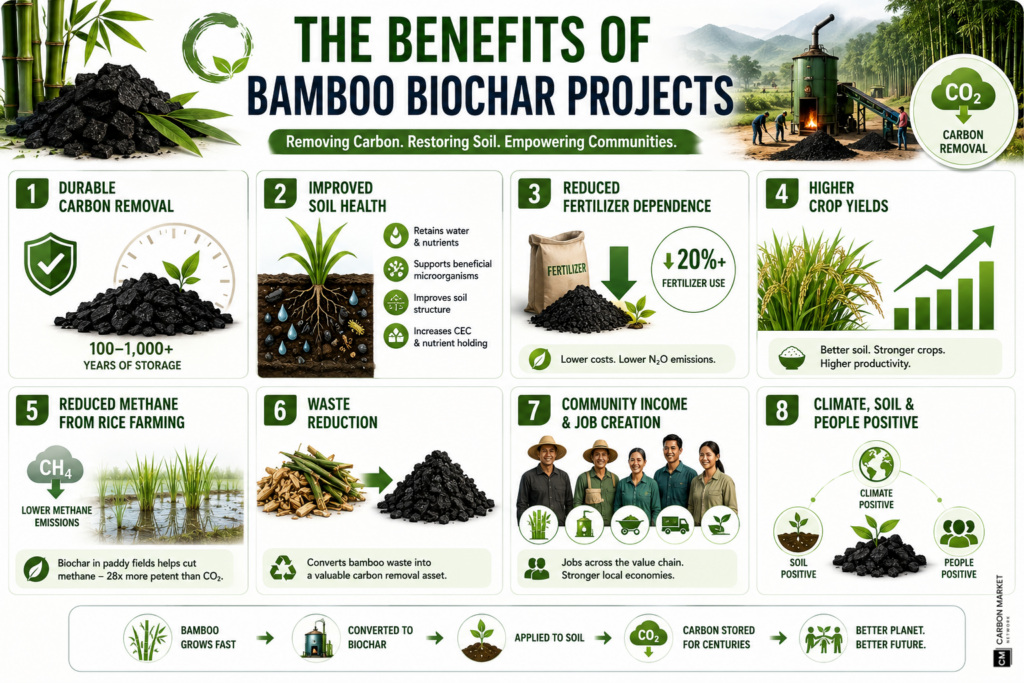
Unlike many nature-based solutions where carbon can be re-released through fires, disease, or land-use change, biochar provides near-permanent carbon storage.
When bamboo biochar is applied to soil, the carbon remains stable for anywhere from 100 to over 1,000 years. This durability is what gives biochar credits their premium value in the market.
Improved Soil Health
Bamboo biochar’s highly porous structure acts like a sponge in the soil. Its large internal surface area:
- Retains water and nutrients
- Creates habitat for beneficial soil microorganisms
- Improves soil aeration and structure
- Increases cation exchange capacity (CEC), which determines how well soil holds onto nutrients
These properties are especially valuable in tropical and subtropical soils, which are often nutrient-poor, acidic, and prone to leaching.
Reduced Fertilizer Dependence
When biochar is mixed with compost or applied to farm fields, it reduces the need for synthetic fertilizers.
Some projects report that farmers can reduce conventional fertilizer use by 20% or more over time after regular biochar application. This lowers costs for farmers and reduces nitrous oxide (N2O) emissions from fertilizer use, a greenhouse gas with a warming potential hundreds of times greater than CO2.
Higher Crop Yields
The combination of better soil structure, improved water retention, and enhanced microbial activity leads to measurably better crop growth.
Projects like the WongPhai Bamboo Biochar project in Thailand report that applying biochar to rice paddies improves soil health, boosts climate resilience, and enhances agricultural productivity for local farmers.
Reduced Methane from Rice Farming
Evidence is emerging that applying biochar to flooded rice paddies can reduce methane emissions from soil. Flooded rice paddies are a significant source of methane, a greenhouse gas 28 times more potent than CO2 over a 100-year period.
Waste Reduction
By converting bamboo manufacturing waste into a valuable product, these projects reduce the volume of biomass that would otherwise be burned or left to decompose.
One example is Bamboo King Vina in Vietnam, which processes around 1,500 tonnes of bamboo and wood daily, generating 800 to 900 tonnes of waste. Their biochar project converts that waste into a carbon removal asset rather than a pollution source.
Community Income and Job Creation
Bamboo biochar projects create jobs across the value chain, from biomass collection and kiln operation to biochar transport and application.
Projects operating in the tropics and developing countries specifically target communities most affected by climate change, directing carbon finance to where it is needed most. The WongPhai project in Thailand, for instance, employs 19 people with women playing key roles at every level, from management to field operations.
Bamboo Biochar and Carbon Credits: How the Market Works
One of the most compelling aspects of bamboo biochar projects is their ability to generate high-value carbon removal credits in the voluntary carbon market.
What Makes Biochar Credits Different
Most carbon credits in the market represent avoided emissions, meaning they prevent CO2 from being released. Biochar credits are different. They represent active carbon dioxide removal, physically pulling CO2 from the atmosphere and locking it into a durable solid.
This distinction matters enormously to corporate buyers, regulators, and rating agencies. Removal credits are seen as higher integrity, more permanent, and increasingly necessary for companies claiming net-zero status.
Current Market Prices
Bamboo biochar credits command a significant premium over standard nature-based avoidance credits.
| Credit Type | Typical Price Range |
|---|---|
| Standard avoidance credits (e.g., REDD+) | $3 to $15 per tonne |
| Nature-based removal credits | $15 to $35 per tonne |
| Biochar carbon removal credits | $125 to $300 per tonne |
| Direct air capture (DAC) credits | $450 to $1,000+ per tonne |
Biochar sits in the sweet spot: significantly more durable and credible than avoidance credits, but far more affordable than direct air capture.
The Nasdaq CO2X price index for biochar credits has consistently shown prices in the $125 to $145 per tonne range across projects from different regions and feedstocks, a sign of growing market maturity and standardization.
Who Is Buying Biochar Credits?
The list of companies purchasing biochar credits reads like a who’s who of global corporations:
- Microsoft signed a 10-year, 1.24-million-tonne agreement with Exomad Green and purchased 129,000 tonnes in the first quarter of 2024 alone
- Google contracted 100,000 tonnes from Varaha for delivery by 2030
- Swiss Re secured 70,000 tonnes through Carbonfuture
- BCG, JPMorgan Chase, Shopify, Stripe, British Airways have all made significant biochar purchases
The biochar carbon removal (BCR) market grew from $14.6 million in contracted sales in 2022 to $181.5 million in 2024, a compound annual growth rate of 131.6%.
Certification Standards for Bamboo Biochar Projects
To earn carbon credits, bamboo biochar projects must be certified under recognized standards. The main options are:
Puro.earth Puro.earth pioneered the world’s first biochar carbon credit methodology in 2019. Their standard issues CO2 Removal Certificates (CORCs) and is widely regarded as the market leader for engineered removals. Their process is relatively streamlined and does not require a full Project Design Document (PDD) for registration. Credits issued on Puro.earth are tracked through a Nasdaq-powered registry with price transparency.
Verra VM0044 Verra, one of the most widely recognized standards in the voluntary carbon market, released its dedicated biochar methodology in 2022. VM0044 uses lifecycle accounting and conservative assumptions. It is well-suited for larger-scale projects and carries the brand recognition that comes with Verra’s dominant market position.
Carbon Standards International (CSI) CSI is the leading standard for artisanal and small-scale biochar production. It works closely with the European Biochar Certificate (EBC) and offers the Global Artisan C-Sink certificate, making it accessible to smaller project developers and farming cooperatives in low-income countries.
Isometric Isometric offers a science-based, open-data approach with digital monitoring for durable CDR verified credits. Around 25 projects are registered with Isometric with approximately 500,000 credits expected to be issued.
EU Carbon Removals and Carbon Farming (CRCF) Regulation In February 2026, the European Commission formally adopted biochar as a category of permanent carbon removal under the CRCF Regulation. This framework introduces the QU.A.L.ITY criteria including quantification, additionality, long-term storage, and sustainability, along with a 200-year permanence threshold and 5-year recertification cycle. This government-backed quality benchmark is expected to unlock significant institutional demand for biochar credits in Europe.
Real-World Examples of Bamboo Biochar Projects
WongPhai Bamboo Biochar Project, Thailand
This project, run by Planboo in collaboration with WongPhai (a local environmental organization), supports bamboo farmers in Prachin Buri province to convert bamboo waste into biochar using Kon-Tiki kilns.
The biochar is mixed with compost and applied to bamboo groves and rice paddies. Each kilogram of biochar produced removes the equivalent of 1.8 kilograms of CO2 from the atmosphere. The project employs 19 local community members and specifically empowers women at every level of operations.
Bamboo King Vina Biochar Project, Vietnam
Bamboo King Vina, a bamboo processing company, launched its biochar project by investing in six high-tech pyrolysis lines operating at 600 to 800°C.
The project is registered under Verra’s VCS standard (Project ID 5108) with a crediting period from June 2024 to May 2031. Its design capacity reaches 47,520 tonnes of biochar per year and is estimated to reduce and remove approximately 112,000 tonnes of CO2 equivalent annually.
Planboo’s Global Network
Swedish company Planboo operates a growing global network of biochar projects across Colombia, Ghana, Namibia, Sri Lanka, Thailand, and other tropical countries. Many of their projects use bamboo as a primary feedstock and are certified under both Puro.earth and CSI.
Planboo’s model focuses on decentralized, small-scale production using Kon-Tiki kilns, with digital MRV tools that make monitoring accessible even in remote locations.
How to Start a Bamboo Biochar Project
If you are exploring the possibility of developing a bamboo biochar project, here is a practical roadmap.
Assess Your Feedstock Supply
The first question is whether you have consistent access to sufficient bamboo biomass.
To make the carbon credit certification process worthwhile, most standards expect a minimum of around 2,500 tonnes of dry biomass per year. This supply can come from a single plantation, a cluster of farms working cooperatively, or a bamboo processing facility’s waste stream.
Document where the biomass comes from, what would have happened to it without your project, and secure off-take agreements that guarantee supply volumes and schedule.
Choose Your Technology
Small and medium projects typically use Kon-Tiki kilns or modified ring kilns. These are cost-effective, require minimal technical expertise, and suit artisanal or cooperative production models.
Larger commercial projects use continuous pyrolysis systems that process bamboo at high throughput, recover energy from syngas, and produce consistent, high-quality biochar.
Your choice of technology affects both your carbon accounting and which certification standards you qualify for.
Select a Carbon Standard
Match your project scale and context to the right standard:
| Project Type | Recommended Standard |
|---|---|
| Small-scale, artisanal, tropical | CSI (Carbon Standards International) |
| Mid-to-large scale, global buyers | Puro.earth |
| Large-scale, globally recognized | Verra VM0044 |
| High-rigor, science-based | Isometric |
Talk to the standard early in the process. CSI requires completing their online coursework to earn C-Sink Manager accreditation. Puro.earth offers preliminary assessment services to check eligibility before formal registration.
Set Up MRV Systems
You need robust systems to record what goes in and what comes out. This means:
- Digital records of biomass weight, species, and moisture content
- Kiln temperature logs and burn duration records
- Biochar yield measurements (weight of output per batch)
- Biochar sampling and independent laboratory analysis
- Georeferenced records of where biochar is applied to soil
Digital MRV platforms, including smartphone apps and IoT sensors, make this much more accessible than it was even a few years ago.
Plan Your Biochar End-Use
The biochar must go somewhere durable. For most projects, it returns to agricultural soil in or near the production area.
Develop a clear plan for where and how biochar will be applied. Partner with local farmers, agricultural cooperatives, afforestation projects, or government land restoration programs.
If the project scales, you may need to work with large agricultural buyers who can absorb the volume.
Work with an Accredited Developer or Aggregator
If you are new to carbon markets, partnering with an experienced developer makes a significant difference.
Organizations like Planboo, Aim Carbon, and others specialize in helping project developers navigate certification, MRV, credit issuance, and buyer connections. Many offer a structured onboarding process including a feasibility study, life cycle assessment, financial modeling, and preparation of the Project Design Document (PDD).
Challenges and Risks in Bamboo Biochar Projects
No investment or project development pathway is without challenges. Here are the main issues to be aware of.
Feedstock Consistency
Carbon credits require consistent, documented feedstock with uniform properties. If different combinations of biomass are used across batches, it becomes very difficult to quantify carbon removal accurately.
Bamboo, when harvested from a managed plantation and processed consistently, avoids this problem. But if you are aggregating waste from multiple sources, you need strict sourcing protocols.
Permanence Risk
While biochar is among the most durable carbon removal methods, there are still questions about how long it lasts in specific soil types and climates.
High temperatures, waterlogging, or soil disturbance can theoretically accelerate degradation over very long timescales. Standards address this by applying permanence discount factors when calculating how many credits a given quantity of biochar earns.
Supply Constraints
The global biochar market is growing faster than production can scale. Between early 2022 and mid-2025, over 3 million tonnes were contracted but only 680,000 tonnes delivered.
This gap between commitments and delivery means buyers sometimes face supply shortfalls. For project developers, it represents an opportunity: well-run projects with reliable supply chains attract long-term offtake agreements at strong prices.
Quality Variability
Not all biochar is equal, and not all bamboo biochar is equal either. Pyrolysis temperature, residence time, and feedstock quality all affect the final product.
Biochar produced at higher temperatures (above 500°C) generally has higher carbon stability, lower H/C ratios, and better long-term permanence. Projects that invest in quality control and thorough lab testing earn more credits per tonne of biochar produced.
Regulatory Uncertainty
Carbon market rules continue to evolve. New methodologies, higher integrity standards, and changing eligibility criteria mean that what qualifies as a valid credit today may face scrutiny tomorrow.
Working with established standards and staying informed about updates from ICVCM, Verra, and Puro.earth is essential.
Bamboo Biochar vs. Other Biochar Feedstocks
It is useful to understand how bamboo compares to other common biochar feedstocks.
| Feedstock | Carbon Content | Regrowth Rate | Key Advantage |
|---|---|---|---|
| Bamboo | 70% to 90% | 3 to 5 years | High carbon quality, rapid renewability |
| Wood chips | 65% to 80% | 20 to 80 years | Widely available, established supply chains |
| Rice husks | 35% to 50% | Annual | Agricultural waste, low cost |
| Coconut shells | 70% to 80% | Perennial | High carbon content, tropical availability |
| Corn cobs | 55% to 70% | Annual | Widely available in farming regions |
Bamboo competes with wood chips on carbon quality and beats virtually all agricultural residues. Its unique advantage is the combination of very high carbon content and very fast regrowth, making it the only woody biomass that matches industrial demand without the long replanting cycles of timber.
The Future of Bamboo Biochar Projects
The direction of travel in carbon markets strongly favors bamboo biochar projects.
Demand is rising fast. Biochar Carbon Removal dominated as the leading CDR technology in terms of credit delivery, accounting for 89.4% of total durable CDR deliveries in Q2 2025. Corporate net-zero commitments are pushing more buyers toward removal-based credits.
Regulation is catching up. The EU’s CRCF framework gives biochar its first government-backed quality standard. As compliance markets increasingly recognize biochar removals, demand from regulated entities will add another buyer tier.
Technology is improving. Faster credit issuance, better digital MRV tools, and more transparent pricing through Nasdaq’s CO2X index are reducing friction for project developers and buyers alike.
Supply chains are maturing. Bamboo manufacturing is growing globally, generating more processing waste available as feedstock. Developer networks like Planboo are establishing repeatable project models that can be deployed rapidly across new geographies.
Prices remain attractive. Biochar credits continue to price significantly above nature-based avoidance credits while remaining far below direct air capture. This pricing sweet spot makes them attractive for a wide range of corporate sustainability budgets.
The market for bamboo biochar projects is not a niche experiment. It is a rapidly scaling, commercially serious carbon removal pathway with proven technology, strong regulatory support, and growing institutional demand.
Frequently Asked Questions About Bamboo Biochar Projects
What is bamboo biochar? Bamboo biochar is a carbon-rich, charcoal-like material produced by heating bamboo biomass in a low-oxygen environment through a process called pyrolysis. It has a carbon content of 70% to 90% and can store carbon in soil for hundreds to over a thousand years.
How much CO2 does bamboo biochar remove? On average, each kilogram of bamboo biochar produced removes approximately 1.5 to 2 kilograms of CO2 equivalent from the atmosphere. This accounts for the carbon stored in the biochar minus any emissions from the production process.
How long does carbon stay stored in bamboo biochar? Biochar carbon is highly stable and can persist in soil for 100 to over 1,000 years depending on soil type, climate, and pyrolysis conditions. This makes it one of the most durable carbon removal methods available.
Can bamboo biochar projects earn carbon credits? Yes. Bamboo biochar projects can be certified under standards like Puro.earth, Verra VM0044, Carbon Standards International (CSI), and Isometric to generate carbon removal credits worth $125 to $300 per tonne.
What is the difference between biochar credits and offset credits? Standard offset credits represent avoided emissions (CO2 not released). Biochar credits represent active carbon dioxide removal (CO2 physically taken from the atmosphere and stored). Removal credits are generally considered higher quality and more durable.
How long does it take to develop a bamboo biochar project? The timeline varies, but a small to mid-scale project can typically be registered and begin generating credits within 12 to 24 months of starting feasibility assessment. Larger industrial projects may take longer due to equipment installation and regulatory approvals.
Who buys bamboo biochar carbon credits? Major corporate buyers include Microsoft, Google, JPMorgan Chase, Swiss Re, BCG, Shopify, and British Airways, among hundreds of others. Companies with net-zero commitments and CSRD or SBTi obligations are the primary buyers.
Is bamboo a sustainable feedstock for biochar? Yes, when harvested properly. Bamboo is one of the fastest-growing plants on Earth and regenerates from its root system without replanting. As long as harvest rates are managed sustainably, bamboo provides a continuously renewable biomass supply.
What certification do I need to start a bamboo biochar project? The right standard depends on your project scale and region. Small artisanal projects typically work with CSI, while mid-to-large projects often choose Puro.earth or Verra VM0044. Your first step is contacting the standard directly to assess eligibility.
Can bamboo biochar improve soil quality? Yes. Bamboo biochar improves soil structure, increases water retention, enhances nutrient availability, supports beneficial soil microorganisms, and can reduce the need for synthetic fertilizers by 20% or more over time.
Conclusion
Bamboo biochar projects represent one of the most compelling convergences of climate action, agricultural benefit, and carbon market opportunity available today.
Bamboo brings unique advantages to biochar production: it grows faster than any other woody plant, absorbs significant CO2 while growing, produces biochar with carbon content well above 70%, and generates manufacturing waste that would otherwise be burned.
When converted to biochar and applied to soil, that carbon stays locked away for centuries. The farmer gets better soil. The planet gets durable carbon removal. And the project developer earns high-value carbon credits that trade at $125 to $300 per tonne.
The market is moving fast. Major corporations are contracting multi-year supplies. Regulators in Europe are formalizing biochar’s place in compliance frameworks. And technology is making it easier than ever to run, verify, and certify these projects.
Whether you are a project developer, a carbon market professional, an investor, or a farmer looking to unlock the value of your bamboo land, bamboo biochar projects offer a real, scalable, and scientifically sound pathway forward.
The combination is hard to beat: an ancient material, a fast-growing plant, and a modern carbon market coming together to create something that genuinely works.
Looking to learn more about carbon credits, biochar markets, and carbon project development? Explore the resources at Carbon Market Network.