Carbon Market Network


India has more than 7,500 kilometers of coastline. Along this coast, a quiet climate hero grows in the mud and salt water.
That hero is blue carbon, and India is now one of the most active countries in the world working to protect it.
Blue carbon projects in India focus on restoring mangroves, seagrass meadows, and salt marshes. These coastal ecosystems trap carbon dioxide far more efficiently than regular forests.
If you have ever wondered what blue carbon means, why India is investing in it, and how these projects actually work on the ground, this guide covers everything in simple language.
Let us break it down step by step.
What Is Blue Carbon?
Blue carbon is the carbon dioxide captured and stored by coastal and marine ecosystems.
These ecosystems include three main types of habitats:
- Mangroves: Salt-tolerant trees and shrubs that grow where rivers meet the sea
- Seagrass meadows: Underwater flowering plants that form dense beds on the seafloor
- Salt marshes: Coastal wetlands dominated by grasses and low shrubs
Unlike land forests, blue carbon ecosystems store most of their carbon underground in waterlogged soil. This soil has very little oxygen, so the carbon stays locked away for centuries instead of breaking down quickly.
That is why scientists often say blue carbon ecosystems store carbon 3 to 4 times more efficiently per hectare than tropical rainforests.
Carbon Market Insider Newsletter
Weekly insights on carbon markets, climate policy, carbon credits, and sustainability.
Why Blue Carbon Projects in India Matter So Much
India sits in a unique position. It has a long coastline, a huge coastal population, and some of the world’s most important mangrove forests, including a share of the Sundarbans.
Here is why blue carbon projects in India deserve attention right now.
1. India Has a Massive Coastal Population at Risk
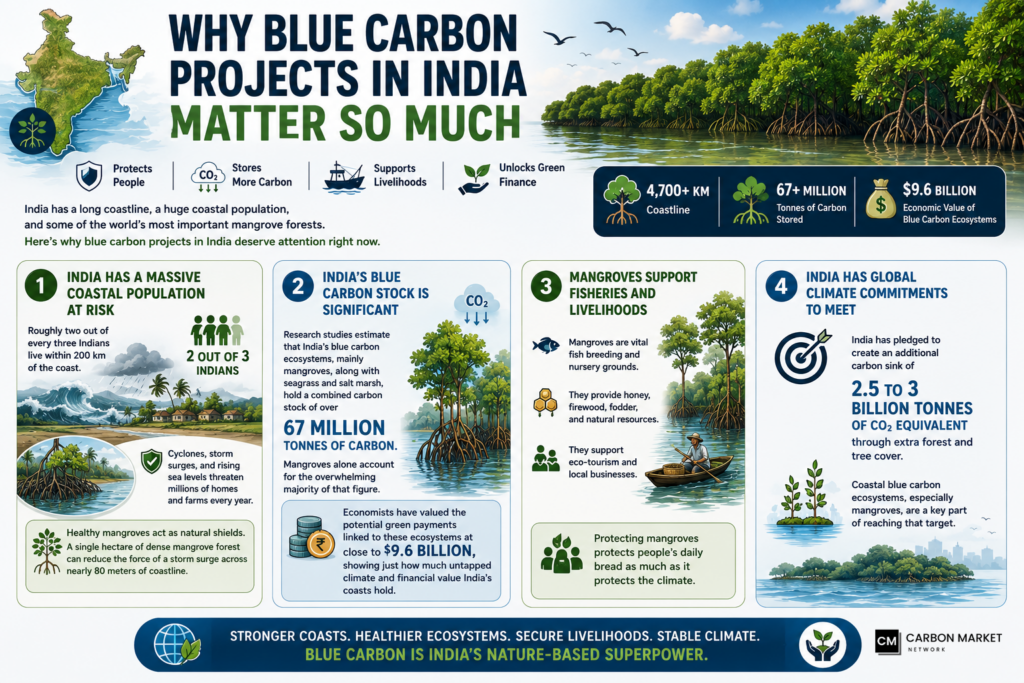
Roughly two out of every three Indians live within 200 kilometers of the coast. Cyclones, storm surges, and rising sea levels threaten millions of homes and farms every year.
Healthy mangroves act as natural shields. A single hectare of dense mangrove forest can reduce the force of a storm surge across nearly 80 meters of coastline.
2. India’s Blue Carbon Stock Is Significant
Research studies estimate that India’s blue carbon ecosystems, mainly mangroves, along with seagrass and salt marsh, hold a combined carbon stock of over 67 million tonnes of carbon. Mangroves alone account for the overwhelming majority of that figure.
Economists have valued the potential green payments linked to these ecosystems at close to 9.6 billion US dollars, showing just how much untapped climate and financial value India’s coasts hold.
3. Mangroves Support Fisheries and Livelihoods
Coastal communities depend on mangroves for fish breeding grounds, honey collection, firewood, and eco-tourism income. Protecting mangroves protects people’s daily bread as much as it protects the climate.
4. India Has Global Climate Commitments to Meet
India has pledged to create an additional carbon sink of 2.5 to 3 billion tonnes of CO2 equivalent through extra forest and tree cover. Coastal blue carbon ecosystems, especially mangroves, are a key part of reaching that target.
Key Blue Carbon Ecosystems Found in India
India is one of the few countries with a strong presence of all three major blue carbon habitats.
| Ecosystem | Where Found in India | Main Role |
|---|---|---|
| Mangroves | Sundarbans (West Bengal), Gujarat, Andhra Pradesh, Maharashtra, Odisha, Tamil Nadu, Andaman and Nicobar Islands | Carbon storage, storm protection, fish nurseries |
| Seagrass meadows | Gulf of Mannar, Palk Bay, Lakshadweep | Carbon sequestration, dugong habitat, water quality |
| Salt marshes | Scattered coastal wetlands across several states | Carbon storage, bird habitat, erosion control |
Mangroves get the most attention because India has a large mangrove cover and a long history of conservation work around them.
According to the India State of Forest Report, India’s total mangrove cover stands at roughly 4,992 square kilometers, which is about 3.3 percent of the world’s total mangrove area. West Bengal, Gujarat, and Andhra Pradesh together hold the largest shares.
Major Blue Carbon and Mangrove Restoration Projects in India
Let us look at the flagship initiatives driving blue carbon work across the country.
1. MISHTI: India’s Flagship Mangrove Scheme
MISHTI stands for Mangrove Initiative for Shoreline Habitats and Tangible Incomes. It is the most important government-led blue carbon program in India today.
Here is what you need to know about MISHTI:
- It was announced in the Union Budget under the Ministry of Environment, Forest and Climate Change
- It was formally launched on World Environment Day, following India joining the Mangrove Alliance for Climate at COP27
- The program targets restoration across roughly 540 square kilometers of mangrove habitat over five years
- It covers coastal states and union territories including West Bengal, Gujarat, Odisha, Maharashtra, Tamil Nadu, Kerala, Karnataka, Goa, Andhra Pradesh, and the Andaman and Nicobar Islands
- Funding comes through a mix of State CAMPA, National CAMPA, and rural employment guarantee schemes
MISHTI’s core activities include gap plantation, afforestation, and enrichment planting in degraded mangrove patches. Support activities cover livelihood diversification, awareness campaigns, research, and eco-tourism development through self-help groups.
Government estimates suggest MISHTI could deliver indirect economic benefits worth over 51 billion rupees a year and create an additional carbon sink of around 4.5 million tonnes over a decade.
Gujarat has emerged as the top-performing state under MISHTI, accounting for a large share of the total restored land, thanks to strong administrative push and large mudflat areas suited for plantation.
2. Sundarbans Mangrove Restoration Projects
The Sundarbans is the largest mangrove forest on Earth, spread across India and Bangladesh. The Indian portion falls mainly in West Bengal and includes a UNESCO World Heritage Site and a Ramsar wetland of international importance.
Several restoration efforts are active here:
- Conservation organizations are restoring degraded, non-protected mangrove patches in the Sundarbans, targeting carbon sequestration rates of well over 4,000 tonnes of CO2 equivalent per 100 hectares each year
- A private sector-backed initiative, the Sundarbans Mangrove Restoration Project, has generated verified carbon credits under an international standard, though the credits are currently held as part of a corporate emissions offset strategy rather than sold on the open market
- The West Bengal government has announced its own mangrove restoration plan targeting around 100 square kilometers of coverage over three years
The Sundarbans also faces real threats. Cyclones like Amphan and Remal caused heavy damage, and satellite data after these storms showed that villages behind thick mangrove cover suffered far less destruction than villages behind cleared or thin mangrove strips. This is one of the clearest real-world proofs of why mangrove protection matters.
3. Gujarat’s Mangrove and Carbon Credit Push
Gujarat holds the second-largest mangrove cover in India, concentrated around the Gulf of Kutch and Gulf of Khambhat.
The state has signed multiple memorandums of understanding with private companies to plant mangroves in exchange for future carbon credits. One set of agreements alone is expected to generate carbon credits valued at over 2,200 crore rupees.
Large corporates have also stepped in through corporate social responsibility programs. One major energy conglomerate has committed to developing thousands of acres of mangrove forest inside a marine protected area as part of the MISHTI framework.
Mangroves in the Kutch and Saurashtra belt have already proven their worth. During Cyclone Biparjoy, these mangrove stretches helped reduce the impact of the storm on nearby settlements.
4. Tamil Nadu: Pichavaram and the Gulf of Mannar
Tamil Nadu has been a long-standing focus area for mangrove and seagrass conservation.
The Pichavaram mangrove forest has received sustained central government funding over the years under the Conservation and Management of Mangroves and Coral Reefs component of the National Coastal Mission.
The Gulf of Mannar and Palk Bay are also home to some of India’s most significant seagrass meadows, which support dugong populations and add another layer of blue carbon storage beyond mangroves alone.
5. Maharashtra: Thane Creek and Corporate Conservation
Maharashtra hosts India’s first dedicated Mangrove Cell, a specialized state forest department unit created to focus purely on mangrove protection.
Thane Creek near Mumbai has become an important site for blue carbon project development, with efforts underway to register mangrove restoration activity for verified carbon credits under international carbon standards.
A private conglomerate has also run a long-standing mangrove conservation program across a large area in Maharashtra, combining species protection, community training, and livelihood generation, active for several decades.
6. Andhra Pradesh and the Godavari-Krishna Deltas
The Godavari and Krishna river deltas in Andhra Pradesh support extensive mangrove cover, including the Coringa mangrove forest, one of India’s designated Ramsar sites.
These deltas play a dual role of carbon storage and flood buffering for one of India’s most agriculturally productive coastal regions.
7. Namami Gange and Riverine Blue Carbon Contribution
Blue carbon in India is not limited to the coast alone. The Namami Gange programme, focused on cleaning and restoring the Ganga river, has carried out large-scale riverside plantation across several states.
Thousands of hectares of plantation along the Ganga basin indirectly contribute to carbon sequestration, even though this effort sits outside the strict coastal blue carbon definition.
How Blue Carbon Projects Actually Work: Step by Step
Curious how a blue carbon project moves from an idea to a functioning carbon sink? Here is the general process followed in India.
- Site assessment: Experts survey degraded or historically mangrove-rich areas to check soil salinity, tidal flow, and water quality
- Species selection: Native mangrove species suited to local conditions are chosen, since planting the wrong species often leads to project failure
- Community engagement: Local fishing and farming communities are trained and involved as paid labor, since long-term success depends on their participation
- Plantation and gap filling: Saplings are planted in cleared or thin patches, often using traditional seeding methods passed down through generations in areas like Odisha and the Sundarbans
- Monitoring and protection: Forest departments and NGOs track survival rates, growth, and threats like illegal aquaculture or grazing
- Carbon measurement: For projects seeking carbon credits, third-party verifiers measure biomass and soil carbon using approved international methodologies
- Credit issuance: Once verified, carbon credits are issued and can be used for corporate offsetting or, in some cases, sold in the voluntary carbon market
This is very different from planting trees on land. Tidal timing, salinity levels, and soil type all need careful planning, which is why mangrove restoration has a higher failure rate than typical afforestation if done without proper expertise.
Blue Carbon Credits: Where India Stands
Blue carbon credits are carbon credits generated specifically from coastal ecosystem restoration or protection.
India’s blue carbon credit market is still young compared to its forestry and renewable energy carbon credit markets. A few important points define where things stand:
- Government schemes like MISHTI are largely designed around restoration funding, not direct carbon credit generation
- State-level mangrove plantation deals, particularly in Gujarat, are increasingly structured with carbon credit generation in mind
- A small number of mangrove projects have moved through independent verification standards to issue credits
- India still lacks a single, unified national blue carbon policy framework, which makes it harder for smaller developers to scale projects confidently
- Blue carbon ecosystems cover a tiny share of the ocean surface worldwide, yet they account for close to half of all carbon buried in marine sediments globally, showing the scale of opportunity that remains largely untapped
For businesses and project developers exploring this space, blue carbon in India represents genuine long-term potential, but it also requires patience, strong community partnerships, and careful navigation of coastal regulations.
Challenges Facing Blue Carbon Projects in India
Blue carbon restoration sounds simple on paper, but real projects face several hurdles.
Habitat Loss Continues
Over the past several decades, a significant share of India’s mangroves has been lost to urban expansion, aquaculture ponds, and agriculture. Restoration has to constantly work against this ongoing pressure.
Freshwater Starvation
Dams and river diversions reduce the freshwater flow that mangroves and estuaries depend on. Without enough freshwater mixing with seawater, mangrove health declines over time, as seen in parts of the Sundarbans.
Weak Regulatory Enforcement
Coastal Regulation Zone rules classify mangroves as ecologically sensitive areas with strict limits on activity. Enforcement, however, remains inconsistent in several states, allowing illegal encroachment and aquaculture expansion.
Limited Private Investment
Public and philanthropic funding still covers most blue carbon restoration costs in India and globally. Private sector investment in nature-based solutions remains a small share of the total, leaving a large funding gap.
Lack of a Unified National Framework
India does not yet have one comprehensive blue carbon policy that ties together carbon accounting, credit issuance, and coastal community rights under a single set of national rules.
Climate Threats Keep Rising
Cyclones, sea-level rise, and warming waters put constant pressure on young restoration sites, sometimes wiping out years of plantation work in a single storm season.
The Role of Local Communities
No blue carbon project in India succeeds without local buy-in.
Coastal and fishing communities have protected mangroves through traditional knowledge for generations, long before formal government schemes existed. In parts of Odisha and the Sundarbans, villagers still seed and guard mangrove patches using inherited methods.
Modern programs like MISHTI build on this tradition by paying local workers for plantation labor, training them in sustainable aquaculture, and creating eco-tourism opportunities through women-led self-help groups.
This community-first approach delivers two wins at once. It restores the ecosystem, and it gives coastal families a steady, climate-resilient source of income.
Practical Takeaways: What This Means for You
Whether you are a student, a business professional, or simply someone interested in climate action, here is what matters most about blue carbon projects in India.
- For businesses and CSR teams: Mangrove restoration offers a credible, community-linked way to invest in climate action, though due diligence on project quality and community involvement is essential
- For carbon market professionals: India’s blue carbon segment is still emerging, which means early, well-structured projects can capture significant long-term value
- For students and researchers: Blue carbon sits at the intersection of climate science, coastal policy, and community livelihoods, making it a rich area for study
- For coastal residents: Mangroves are not just environmental assets, they are practical protection against cyclones, floods, and erosion
- For everyday readers: Supporting organizations working on verified mangrove restoration, or simply spreading awareness, contributes to a larger national effort
Quick Comparison: Blue Carbon vs Traditional Forest Carbon
| Factor | Blue Carbon (Mangroves) | Traditional Forest Carbon |
|---|---|---|
| Carbon storage location | Mostly in waterlogged soil | Mostly in tree biomass |
| Storage duration | Centuries, due to low-oxygen soil | Decades, with higher decomposition risk |
| Carbon density per hectare | Generally higher | Generally lower |
| Additional benefits | Storm protection, fisheries, biodiversity | Timber, biodiversity, water regulation |
| Restoration complexity | Higher, due to tidal and salinity needs | Lower to moderate |
| India’s current policy maturity | Emerging | More established |
Frequently Asked Questions
What are blue carbon projects in India? Blue carbon projects in India are restoration and conservation initiatives focused on mangroves, seagrass meadows, and salt marshes. These projects aim to capture carbon dioxide, protect coastlines, and support fishing and farming communities.
Which is the biggest blue carbon initiative in India? MISHTI, the Mangrove Initiative for Shoreline Habitats and Tangible Incomes, is currently India’s largest and most structured government-led blue carbon program, targeting mangrove restoration across multiple coastal states and union territories.
Which Indian state has the most mangrove cover? West Bengal has the largest mangrove cover, largely due to the Sundarbans, followed closely by Gujarat and Andhra Pradesh.
Can companies buy blue carbon credits from India? A small but growing number of Indian mangrove projects have been verified under international carbon standards and can generate tradable credits. However, most current blue carbon activity in India is funded through government and CSR channels rather than open credit sales.
Why are mangroves considered better carbon sinks than forests? Mangroves store carbon mainly in waterlogged, low-oxygen soil, which slows down decomposition. This allows them to lock away carbon for much longer periods and at higher density than many land-based forests.
Are blue carbon projects only about mangroves? No. While mangroves get the most attention in India, seagrass meadows in the Gulf of Mannar and Palk Bay, along with scattered salt marshes, also count as blue carbon ecosystems.
How do mangroves protect coastal communities? Dense mangrove forests reduce the force of storm surges, slow down cyclone winds, and prevent soil erosion. Areas behind healthy mangrove cover consistently show less cyclone damage than areas with degraded or cleared mangroves.
Is India’s blue carbon market regulated? India does not yet have a single unified national blue carbon policy. Existing efforts rely on a mix of forest department rules, Coastal Regulation Zone notifications, and individual state-level carbon credit agreements.
Final Thoughts
Blue carbon projects in India sit at a rare intersection of climate action, coastal protection, and community livelihood. Mangroves, seagrass meadows, and salt marshes may not get as much attention as solar parks or electric vehicles, but their impact on India’s climate goals and coastal safety is just as real.
Programs like MISHTI, state-level initiatives in Gujarat and Tamil Nadu, and ongoing restoration in the Sundarbans show that India is moving in the right direction. Challenges around funding, enforcement, and policy clarity remain, but the foundation is strong.
As India continues to build its blue carbon economy, one thing is clear. Protecting a stretch of muddy, salt-soaked coastline today can shield millions of lives and lock away carbon for generations to come.
Blue carbon is not a side project in India’s climate story. It is quickly becoming one of its most important chapters.
For more insights on carbon markets, environmental finance, and sustainability mechanisms, explore the resources at Carbon Market Network.