Carbon Market Network


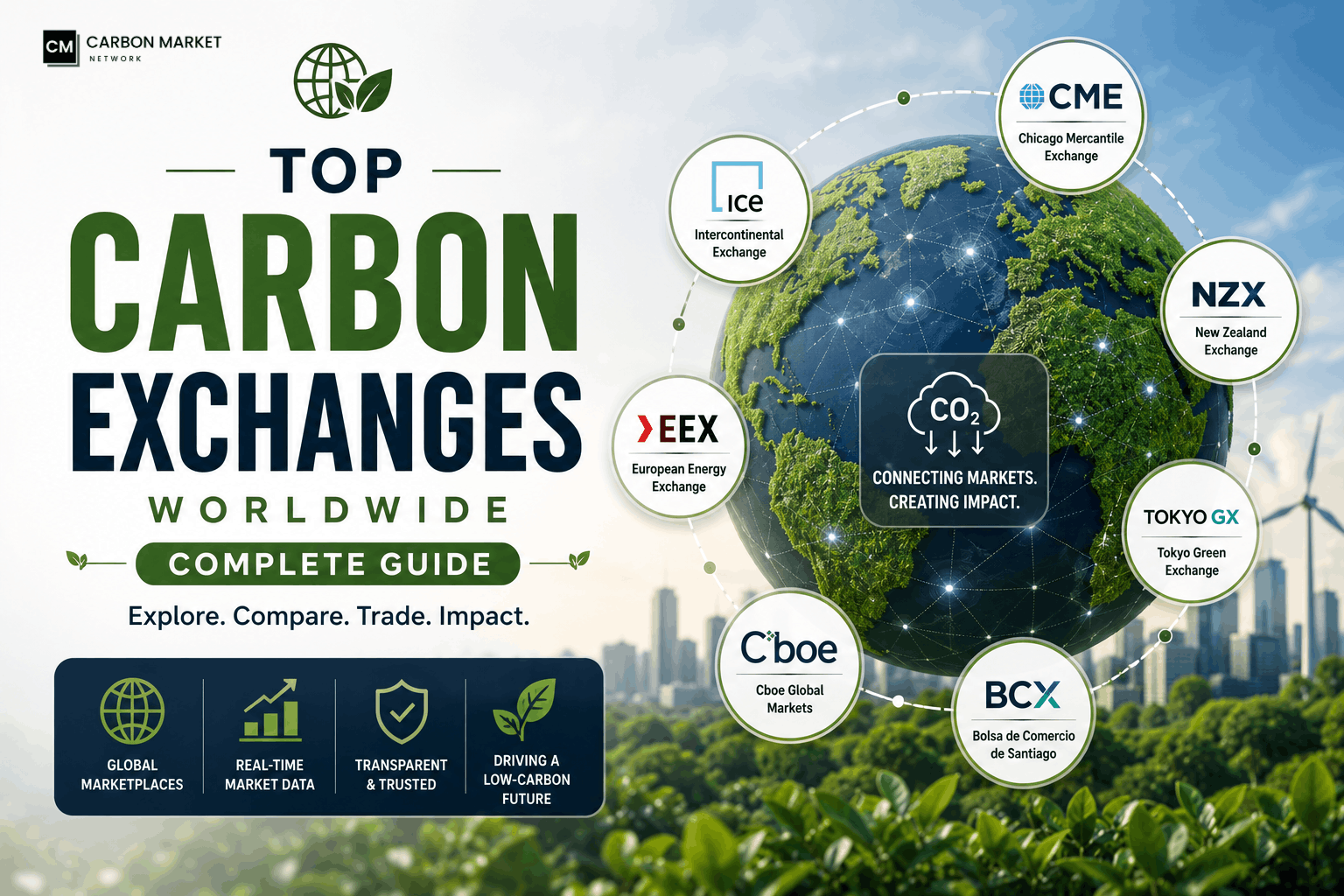
Carbon trading is no longer a niche activity for climate experts. It has become a mainstream financial market that touches airlines, power plants, tech companies, and even small businesses trying to go carbon neutral.
If you have ever wondered where carbon credits and carbon allowances actually get bought and sold, the answer lies in carbon exchanges. These are the marketplaces that make the entire carbon economy function.
This guide breaks down the top carbon exchanges worldwide in simple language. You will learn how these exchanges work, which ones dominate compliance markets, which ones lead the voluntary carbon market, and how to choose the right one for your needs.
Whether you are a business owner exploring carbon offsets, a student researching climate finance, or an investor curious about carbon derivatives, this article gives you a complete, practical picture of global carbon trading.
What Is a Carbon Exchange?
A carbon exchange is a trading platform where carbon credits or carbon allowances change hands between buyers and sellers.
Think of it like a stock exchange, but instead of shares, people trade units that represent one tonne of carbon dioxide either avoided, reduced, or removed from the atmosphere.
Carbon exchanges generally fall into two broad categories.
- Compliance carbon exchanges handle mandatory trading under government regulated cap and trade programs.
- Voluntary carbon exchanges handle credits that companies buy on their own, usually to support net zero goals or corporate sustainability commitments.
Both types are essential, but they serve very different markets and different types of buyers.
Carbon Market Insider Newsletter
Weekly insights on carbon markets, climate policy, carbon credits, and sustainability.
Why Carbon Exchanges Matter
Carbon exchanges do far more than just connect buyers and sellers. They play a central role in making carbon markets credible and efficient.
Here is why they matter so much:
- They create price transparency, so buyers and sellers know the fair market value of a credit or allowance.
- They reduce counterparty risk through standardized contracts and clearing systems.
- They improve liquidity, meaning credits can be bought or sold quickly without huge price swings.
- They support regulatory compliance for industries covered under emissions trading laws.
- They help companies plan long term decarbonization strategies with reliable pricing data.
Without exchanges, carbon markets would be scattered, inconsistent, and much harder to trust.
Compliance vs Voluntary Carbon Exchanges
Before diving into specific exchanges, it helps to understand the difference between compliance and voluntary markets. This distinction shapes everything about how each exchange operates.
| Feature | Compliance Carbon Exchanges | Voluntary Carbon Exchanges |
|---|---|---|
| Who participates | Regulated industries under cap and trade laws | Any company or individual buying credits voluntarily |
| Legal requirement | Mandatory under government policy | Optional, driven by climate commitments |
| Products traded | Emission allowances (like EUAs) | Verified carbon credits (like VCS or Gold Standard credits) |
| Price drivers | Government caps, auctions, policy decisions | Corporate demand, project quality, credit ratings |
| Examples | EU ETS, California Cap and Trade, China ETS | Xpansiv CBL, AirCarbon Exchange, Climate Impact X |
| Typical buyers | Power plants, factories, airlines under regulation | Corporates pursuing ESG or net zero goals |
Both markets are growing rapidly, and many large exchanges now operate across both categories to serve a wider range of clients.
Top Carbon Exchanges Worldwide
Here is a detailed look at the leading carbon exchanges shaping global carbon trading today. This list includes both compliance focused exchanges and voluntary market platforms.
1. Intercontinental Exchange (ICE)
Intercontinental Exchange, widely known as ICE, is the largest and most liquid environmental derivatives marketplace in the world.
ICE hosts trading for the European Union Emissions Trading System allowances, known as EUAs, along with California carbon allowances, Regional Greenhouse Gas Initiative allowances, and UK Emissions Trading Scheme products.
Key facts about ICE:
- It offers futures and options contracts on carbon allowances from multiple regulated markets.
- It supports both compliance trading and growing voluntary carbon credit products.
- Institutional investors, energy companies, and commodity trading firms rely heavily on ICE for hedging carbon exposure.
- ICE has continued expanding its carbon product suite, including newer contracts tied to the expanded EU emissions trading system covering buildings and road transport.
Best suited for: large corporations, energy firms, and financial institutions that need deep liquidity and sophisticated hedging tools.
2. European Energy Exchange (EEX)
The European Energy Exchange, based in Leipzig, Germany, is the official auction platform for the European Union Emissions Trading System.
Most European Economic Area countries auction their carbon allowances through EEX, making it one of the most important compliance exchanges in the world.
Key facts about EEX:
- It runs primary auctions for EU ETS allowances on behalf of participating governments.
- It also facilitates secondary market trading in carbon allowances and related derivatives.
- Through its US subsidiary Nodal Exchange, EEX extends its reach into North American environmental markets.
- Its affiliated marketplace, operated with IncubEx, supports trading of voluntary carbon credits alongside compliance products.
Best suited for: European industrial companies, utilities, and compliance buyers who need direct access to EU ETS allowances.
3. CME Group
CME Group is one of the largest derivatives exchanges in the world, and it has built a strong presence in carbon and environmental markets.
CME lists futures contracts on European Union Allowances, California Carbon Allowances, and voluntary carbon credit indexes developed in partnership with Xpansiv.
Key facts about CME Group:
- It offers standardized futures contracts that make carbon price hedging accessible to a broad range of market participants.
- Its voluntary carbon credit futures, including contracts like the Global Emissions Offset, help create benchmark pricing for the voluntary market.
- CME provides deep clearing infrastructure, which reduces settlement risk for large trades.
Best suited for: institutional traders, hedge funds, and corporations that want exchange traded, centrally cleared carbon products.
4. Xpansiv (CBL Markets)
Xpansiv operates CBL, widely regarded as the leading spot exchange for voluntary carbon credits and other environmental commodities.
Since it began operating, the platform has facilitated transactions covering hundreds of millions of carbon credits and environmental certificates, making it one of the most active venues in the voluntary carbon market.
Key facts about Xpansiv:
- It offers a central order book that improves price discovery for voluntary carbon credits.
- It supports standardized spot contracts, which reduce the complexity of comparing different credit types.
- It connects directly with major registries, including Verra, the American Carbon Registry, Climate Action Reserve, and Gold Standard.
- Its Aviation Carbon Exchange, developed with the International Air Transport Association, allows airlines to purchase credits that meet international aviation offsetting requirements.
- Xpansiv also provides advanced data analytics tools that help traders track pricing trends across credit categories.
Best suited for: experienced carbon buyers, brokers, and traders who need liquidity and standardized voluntary carbon products.
5. AirCarbon Exchange (ACX)
AirCarbon Exchange is a fully digital carbon exchange built specifically for trading environmental assets online.
It positions itself as the world’s first fully electronic carbon exchange, offering both spot and futures trading for voluntary carbon credits.
Key facts about ACX:
- It has attracted a global membership base spanning corporations, financial institutions, traders, and project developers.
- It supports tokenized and standardized carbon contracts, which simplify trading across different project types.
- It has secured backing from major financial institutions, reflecting growing institutional confidence in digital carbon trading infrastructure.
- Its fully online model makes it accessible to participants across different time zones and regions.
Best suited for: businesses seeking a modern, technology driven approach to buying and trading voluntary carbon credits at scale.
6. Climate Impact X (CIX)
Climate Impact X is a global carbon exchange and marketplace based in Singapore, built to serve corporate buyers across Asia and beyond.
CIX offers both an auction platform for high quality, large volume credits and a marketplace for smaller, more curated purchases.
Key facts about CIX:
- It focuses heavily on credit quality, working with rated and vetted carbon projects.
- It allows buyers to discover, compare, purchase, and retire credits within a single platform.
- It has positioned itself as a bridge between Asian corporate demand and global carbon project supply.
Best suited for: corporate sustainability teams that prioritize credit quality and want a streamlined discovery to retirement process.
7. Carbon Trade Exchange (CTX)
Carbon Trade Exchange is one of the longest running online spot exchanges for voluntary carbon credits.
CTX offers a straightforward, accessible trading interface aimed at both smaller buyers and larger institutional clients.
Key facts about CTX:
- It provides real time spot trading of verified carbon credits from a range of registries.
- It partners with project registries, including nature based credit providers, to expand its available credit inventory.
- Its simpler interface makes it approachable for companies new to carbon trading.
Best suited for: small and mid sized businesses that want a simpler entry point into voluntary carbon markets.
8. Nasdaq
Nasdaq has expanded beyond traditional equities into carbon and environmental markets through data services and trading infrastructure.
While Nasdaq is best known as a stock exchange, its involvement in carbon markets includes market data, indexes, and infrastructure support for environmental commodities.
Key facts about Nasdaq in carbon markets:
- It provides pricing benchmarks and market intelligence used across the carbon trading industry.
- It leverages its existing financial technology to support carbon market participants with analytics and risk tools.
- It has invested in partnerships that strengthen transparency in voluntary carbon credit pricing.
Best suited for: institutions that want carbon market data and analytics integrated with broader financial market tools.
9. ESGCX
ESGCX is an emerging carbon exchange positioned to serve the growing demand for environmental, social, and governance linked trading products.
It focuses on connecting carbon credits with broader ESG investment themes, appealing to a newer generation of climate conscious investors.
Key facts about ESGCX:
- It aims to combine carbon credit trading with wider ESG data and reporting tools.
- It targets investors who view carbon credits as part of a broader sustainable investment portfolio.
Best suited for: ESG focused investors and funds looking to combine carbon exposure with sustainability reporting.
10. Korea Exchange (KRX) Carbon Market
The Korea Exchange operates the trading platform for South Korea’s national emissions trading scheme, one of the largest compliance carbon markets in Asia.
KRX has also explored partnerships with global voluntary market platforms to expand access for Korean companies seeking international carbon credits.
Key facts about KRX carbon trading:
- It manages allowance trading for companies regulated under South Korea’s cap and trade system.
- It has shown growing interest in connecting domestic compliance markets with global voluntary carbon credit supply.
Best suited for: companies operating under South Korea’s compliance carbon scheme.
Carbon Exchanges vs Carbon Marketplaces vs Brokers
Beginners often confuse carbon exchanges with carbon marketplaces and carbon brokers. These terms sound similar, but they describe very different ways of buying and selling carbon credits.
- A carbon exchange operates a central order book, standardized contracts, and transparent pricing. Trades happen between many participants at published market prices.
- A carbon marketplace often lists individual projects for sale, letting buyers browse and choose specific credits, sometimes with less price standardization.
- A carbon broker or trader acts as a middleman, offering advisory support, curated project selection, and hands on guidance, usually for a service fee.
Understanding this distinction matters because it shapes your buying experience. Exchanges suit buyers who want speed, liquidity, and self-service trading. Marketplaces and brokers suit buyers who want more guidance or a smaller, more curated set of options.
Many large exchanges today blend these models. For instance, a platform might offer a central order book for standardized products while also running a curated marketplace section for buyers who want to select specific projects.
How Carbon Credit Pricing Varies Across Exchanges
Carbon prices are not uniform across the world. Compliance markets and voluntary markets price credits very differently, and even within voluntary markets, prices vary widely based on project type and quality.
| Market Type | Typical Price Driver | General Price Behavior |
|---|---|---|
| EU ETS allowances | Government cap, auction supply, energy prices | Historically among the highest priced compliance allowances globally |
| California and Quebec allowances | Auction floor price, program rules | Generally lower than EU ETS, with steady incremental increases over time |
| China National ETS allowances | Power sector demand, government targets | Lower average pricing due to the scheme’s early stage and broad coverage |
| Nature based voluntary credits | Project type, co-benefits, verification standard | Wide price range depending on quality and demand |
| Carbon removal credits | Technology cost, permanence, scarcity | Typically priced higher than avoidance credits due to durability and cost |
This price variation is completely normal. Just like different stocks trade at different valuations based on fundamentals, different carbon products trade at different prices based on scarcity, regulation, project type, and buyer demand.
Businesses evaluating carbon exchanges should always compare pricing within the same category rather than assuming one universal carbon price exists worldwide.
Real World Example: How a Company Might Use a Carbon Exchange
To make this more concrete, imagine a mid sized manufacturing company that wants to offset its unavoidable emissions after reducing what it can internally.
The company first defines its goal, which is purchasing high quality voluntary carbon credits rather than meeting a legal compliance obligation.
Next, the sustainability team researches exchanges and shortlists a platform known for strong registry integrations and transparent pricing, similar to the voluntary market leaders covered earlier in this guide.
The team reviews available credit categories, compares independent quality ratings, and selects a mix of nature based and technology based credits to diversify its portfolio.
After completing onboarding and funding its account, the company places its first purchase, choosing a smaller volume to test the process before scaling up in future quarters.
Once the credits are retired through the relevant registry, the company documents the transaction for its sustainability report, ensuring transparency for investors and stakeholders.
This simple example shows how the concepts covered throughout this guide come together in a real business decision.
Regional Compliance Markets and Their Exchanges
Compliance carbon markets differ significantly by region because each government designs its own cap and trade rules. Here is a snapshot of major regional schemes and where their trading happens.
| Region or Scheme | Exchange or Platform | Key Notes |
|---|---|---|
| European Union (EU ETS) | EEX (auctions), ICE (secondary trading) | World’s largest and most established cap and trade system |
| United Kingdom (UK ETS) | ICE | Launched after the UK left the EU ETS framework |
| California and Quebec | ICE, state run auctions | Joint cap and trade program linking two jurisdictions |
| Regional Greenhouse Gas Initiative (RGGI) | ICE | Covers power sector emissions across several US states |
| China National ETS | Shanghai Environment and Energy Exchange | World’s largest ETS by covered emissions, centered on the power sector |
| South Korea (K-ETS) | Korea Exchange (KRX) | One of Asia’s most mature compliance carbon markets |
| New Zealand ETS | Domestic auction platform | Covers forestry, energy, and industrial sectors |
| India (Carbon Credit Trading Scheme) | Domestic power exchanges | Intensity based scheme expanding across industrial sectors |
Globally, dozens of emissions trading systems now operate, with several more under development in different parts of the world. This steady expansion shows that carbon pricing is becoming a standard policy tool rather than an experimental one.
How Carbon Exchange Trading Actually Works
Understanding the mechanics of carbon trading helps demystify what can otherwise feel like a complicated financial system. Here is a simplified step by step breakdown.
Step 1: A Cap or Standard Is Set
For compliance markets, a government sets a cap on total allowed emissions for regulated industries. For voluntary markets, a certification standard defines how credits are issued and verified.
Step 2: Allowances or Credits Are Issued
In compliance markets, allowances are distributed through free allocation or auctions. In voluntary markets, credits are issued after a project proves it has reduced, avoided, or removed emissions.
Step 3: Trading Begins on an Exchange
Once issued, allowances or credits move onto an exchange, where buyers and sellers can trade them based on market demand.
Step 4: Price Discovery Happens
As trades occur, the exchange generates a market price. This price reflects supply, demand, policy expectations, and overall market sentiment.
Step 5: Buyers Retire Credits or Surrender Allowances
Companies under compliance obligations must surrender allowances matching their emissions. Voluntary buyers retire credits permanently to claim an emissions reduction.
Step 6: Data Feeds Back Into the Market
Exchanges publish pricing and volume data, which helps future buyers and sellers make informed decisions.
This cycle repeats continuously, creating a dynamic and constantly evolving marketplace.
How to Choose the Right Carbon Exchange
Picking the right carbon exchange depends heavily on your goals, budget, and level of expertise. Use these practical guidelines to narrow down your options.
- Define your purpose first. Are you meeting a legal compliance obligation, or are you buying credits voluntarily to support sustainability goals?
- Check liquidity levels. Highly liquid exchanges like ICE or Xpansiv make it easier to trade at fair prices without major slippage.
- Evaluate credit quality tools. Look for exchanges that integrate independent ratings from agencies that assess project integrity.
- Consider your experience level. Some platforms are built for sophisticated institutional traders, while others offer simpler interfaces for newer buyers.
- Review registry integrations. Strong exchanges connect directly with recognized registries, reducing the risk of double counting or fraud.
- Assess reporting support. If your company needs to disclose climate data for regulatory or investor purposes, choose a platform that provides clean, exportable transaction records.
- Compare fee structures. Trading fees, clearing costs, and membership requirements vary widely between exchanges.
Taking time to match your needs with the right exchange prevents costly mistakes and improves long term trading outcomes.
Key Trends Shaping Carbon Exchanges
The world of carbon trading keeps evolving quickly. Several major trends are shaping how exchanges operate and grow.
Rising Institutional Participation
Large financial institutions increasingly treat carbon as a legitimate asset class. This has pushed exchanges to build more sophisticated derivatives products, similar to those used in traditional commodity markets.
Stronger Quality Standards
Buyers now demand independently rated, high integrity credits. Many exchanges have integrated ratings from independent assessment agencies directly into their trading platforms.
Expansion of Compliance Markets
More countries are launching or expanding emissions trading systems. This steady policy momentum continues to grow the base of regulated buyers who need compliance focused exchanges.
Digital and Technology Driven Trading
Fully digital exchanges are gaining traction because they simplify onboarding, improve transparency, and reduce transaction friction compared to older, manual trading methods.
Consolidation and Partnerships
Established exchanges are forming partnerships or acquiring smaller platforms to expand product offerings and reach new regional markets.
Growing Corporate Demand for Removals
Interest is shifting beyond avoidance credits toward carbon removal credits, pushing exchanges to develop new product categories for removal focused projects.
Better Data and Satellite Monitoring
Exchanges increasingly rely on satellite data and remote sensing tools to verify project performance, which strengthens confidence in the credits being traded.
Cross Border Market Linkages
Some compliance schemes are exploring links with other regional systems, which could eventually allow allowances from one jurisdiction to be recognized in another. This kind of linkage tends to increase liquidity and stabilize prices across connected markets.
Risks and Challenges Facing Carbon Exchanges
Carbon exchanges are maturing quickly, but the industry still faces real challenges worth understanding before you participate.
- Price volatility. Compliance allowance prices can swing sharply based on policy announcements, energy prices, or macroeconomic shifts.
- Inconsistent quality standards. Voluntary market credits vary widely in rigor, which is why independent ratings have become so important.
- Regulatory uncertainty. Emerging compliance schemes sometimes change rules as they mature, affecting long term price predictability.
- Market fragmentation. With dozens of exchanges and registries worldwide, comparing products across platforms can be genuinely difficult for newcomers.
- Reputational risk. Companies that buy low quality credits may face criticism from stakeholders, even if the purchase was made in good faith.
Recognizing these challenges does not mean avoiding carbon markets. It means approaching them with the same diligence you would apply to any other financial or procurement decision.
Step by Step Guide: How to Start Trading on a Carbon Exchange
If you are new to carbon trading, here is a simple roadmap to get started.
- Clarify your objective. Decide whether you need compliance allowances or voluntary credits.
- Research exchange options. Compare the exchanges covered in this guide based on your budget, region, and experience level.
- Complete onboarding and verification. Most exchanges require identity verification, business documentation, and sometimes a minimum trading account setup.
- Fund your trading account. Set up payment and settlement arrangements according to the exchange’s requirements.
- Review available products. Study the specific allowances or credit types listed, including pricing history and project details.
- Place your first trade carefully. Start with smaller volumes to understand price movements and settlement processes.
- Track and report your purchases. Maintain clear records for compliance reporting or sustainability disclosures.
- Retire credits properly. If buying voluntary credits, ensure they are retired through the registry to avoid resale or double counting.
Following these steps reduces risk and builds confidence, especially for first time carbon market participants.
Common Mistakes to Avoid When Using Carbon Exchanges
Many companies make avoidable errors when entering carbon markets for the first time. Watch out for these common pitfalls.
- Ignoring credit quality. Cheap credits are not always a good deal if the underlying project lacks strong verification.
- Overlooking liquidity. Thinly traded products can be hard to exit if market conditions change.
- Skipping due diligence on registries. Always confirm that credits are properly registered and retired to avoid double counting.
- Failing to track regulatory changes. Compliance markets frequently update rules, caps, and eligible sectors.
- Choosing a platform based on price alone. Reliability, transparency, and support matter just as much as trading fees.
Avoiding these mistakes helps businesses build a more credible and cost effective carbon strategy.
The Future of Carbon Exchanges
Carbon exchanges are moving toward greater standardization, stronger integrity checks, and deeper integration between compliance and voluntary markets.
Expect continued growth in digital trading platforms, expanded derivatives products, and closer collaboration between exchanges and independent rating agencies.
As more countries adopt emissions trading systems and more corporations commit to net zero targets, the role of carbon exchanges will only become more central to the global climate economy.
Frequently Asked Questions
What is the biggest carbon exchange in the world?
Intercontinental Exchange, known as ICE, is widely considered the largest carbon exchange by trading volume, especially for compliance market products like EU ETS allowances.
What is the difference between a carbon exchange and a carbon registry?
A carbon exchange is where credits or allowances are traded and priced. A registry is where credits are officially issued, tracked, and retired to prevent double counting.
Can individuals trade on carbon exchanges?
Most major carbon exchanges are built for businesses, brokers, and institutions. Individuals typically access carbon credits through retail platforms rather than trading directly on institutional exchanges.
Are voluntary carbon credits and compliance allowances the same thing?
No. Compliance allowances are legally required instruments tied to government regulated cap and trade programs. Voluntary carbon credits are purchased outside legal obligations, usually to support corporate sustainability goals.
How is the price of carbon determined on an exchange?
Prices are determined by supply and demand, just like any other traded commodity. Factors include government policy, auction supply, corporate demand, and overall market sentiment.
Which carbon exchange is best for beginners?
Platforms with simpler interfaces and lower entry barriers, such as Carbon Trade Exchange, tend to be more approachable for companies new to carbon markets.
Do carbon exchanges guarantee credit quality?
Exchanges provide transparency and standardized trading, but credit quality ultimately depends on the underlying project and its verification standard. Independent ratings can help buyers assess quality more confidently.
Final Thoughts
Carbon exchanges sit at the heart of the global effort to price emissions and drive climate action through market mechanisms.
From compliance giants like ICE and EEX to voluntary market leaders like Xpansiv and AirCarbon Exchange, each platform plays a unique role in connecting buyers, sellers, and climate projects around the world.
Understanding the top carbon exchanges worldwide gives businesses, investors, and sustainability teams the knowledge they need to participate confidently in this fast growing market.
As carbon pricing continues to expand globally, choosing the right exchange will become an increasingly important decision for any organization serious about managing its climate impact.
Carbon Market Network will continue tracking these developments to help you stay informed on the platforms shaping the future of global carbon trading.
For more insights on carbon markets, environmental finance, and sustainability mechanisms, explore the resources at Carbon Market Network.