Carbon Market Network


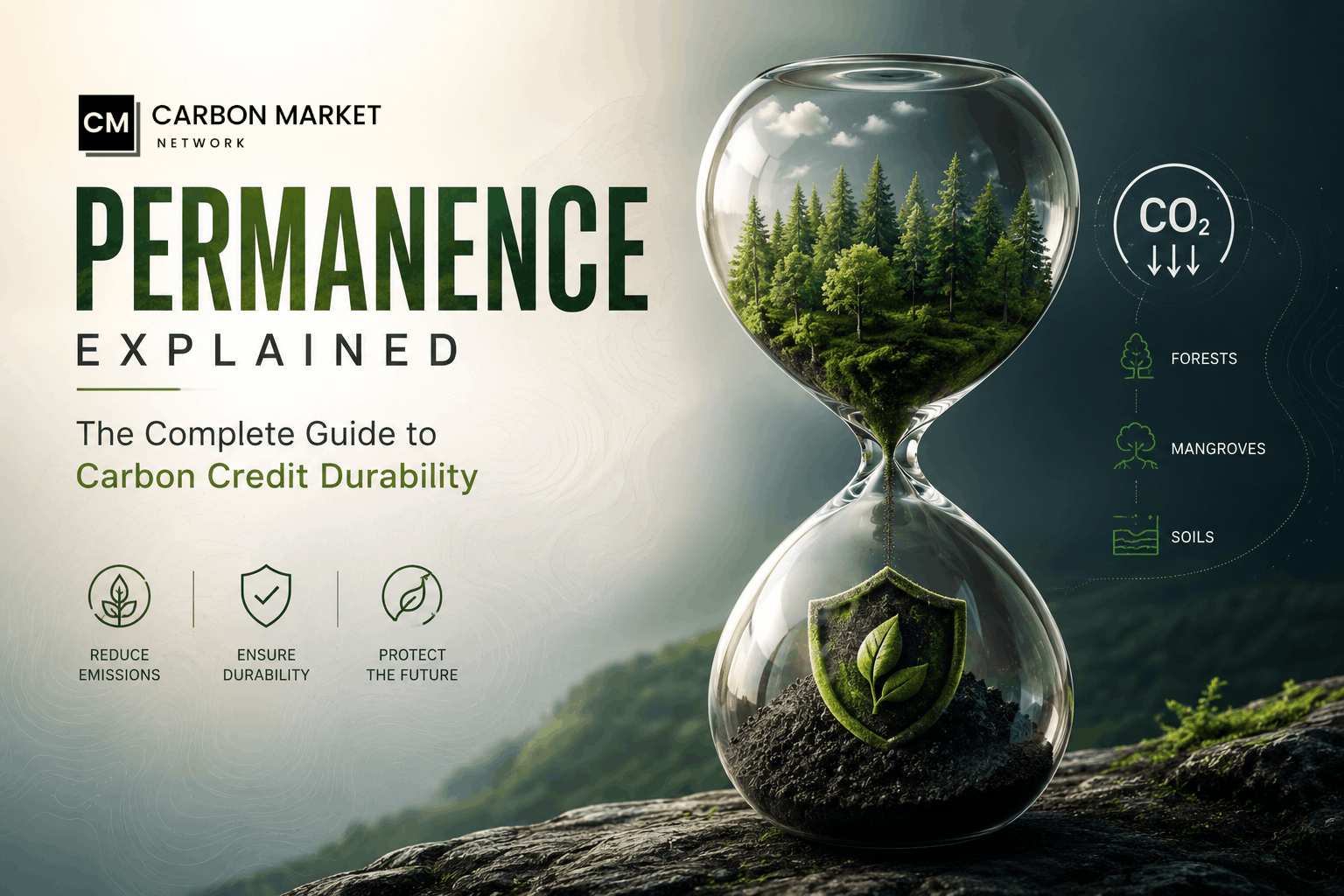
Imagine planting a forest to fight climate change, only to watch it burn down ten years later. All that stored carbon goes right back into the atmosphere.
This is exactly why permanence sits at the center of every serious conversation about carbon credits. If a project cannot keep carbon locked away, its climate benefit was never real to begin with.
This guide breaks down permanence in plain language. You will learn what it means, why it matters, how the carbon market manages the risk, and how to judge permanence before buying any carbon credit.
Whether you are a beginner exploring carbon markets or a buyer trying to protect your company’s climate claims, this article gives you a complete, practical understanding of permanence.
What Does Permanence Mean in Carbon Markets?
Permanence refers to how long carbon stays stored, captured, or kept out of the atmosphere after a climate project removes or avoids it.
A carbon credit represents one tonne of carbon dioxide equivalent that has been reduced, avoided, or removed. Permanence asks a simple follow-up question: will that tonne stay out of the atmosphere, or could it come back?
Some storage methods lock carbon away for centuries. Others carry a real risk of releasing it back within years or decades. That difference matters enormously for climate outcomes.
In simple terms, permanence is the durability of a climate solution. It tells you how confident you can be that the carbon benefit will last.
Carbon Market Insider Newsletter
Weekly insights on carbon markets, climate policy, carbon credits, and sustainability.
Why This Concept Confuses So Many Beginners
Many people assume a carbon credit is a fixed, guaranteed unit of climate benefit. That assumption is not quite right.
A credit represents a claim about carbon storage at a point in time. If that storage later fails, the original climate benefit can be partially or fully undone.
This is why permanence is not just a technical detail. It shapes how much trust the entire carbon market deserves.
Why Permanence Matters So Much
Climate change responds to the total amount of greenhouse gas in the atmosphere over time. A tonne of carbon dioxide released today keeps warming the planet for many decades.
If a carbon removal project stores carbon for only twenty years and then releases it, the climate impact looks very different from a project that stores carbon for a thousand years.
Here is why permanence carries so much weight in the carbon market:
- It protects the credibility of every carbon credit sold.
- It determines whether corporate net zero claims hold up to scrutiny.
- It affects how registries price, verify, and structure carbon projects.
- It influences government and international climate policy design.
- It shapes investor confidence in carbon removal technology.
Without strong permanence safeguards, buyers could pay for climate action that quietly unravels years later, without anyone realizing it happened.
Types of Carbon Storage and Their Permanence
Not all carbon storage methods last the same amount of time. Understanding the different categories helps you judge the strength of any carbon project.
Nature-Based or Biological Storage
Forests, soils, wetlands, mangroves, and grasslands store carbon through natural biological processes. Trees absorb carbon dioxide and lock it into wood, roots, and soil.
This storage method is powerful and scalable, but it carries meaningful reversal risk. Wildfires, disease, drought, illegal logging, and land-use change can all release stored carbon back into the atmosphere.
Nature-based storage typically operates on timeframes of decades, not centuries, unless projects are actively managed and protected for very long periods.
Geological Storage
Geological storage injects carbon dioxide deep underground into rock formations, often more than a kilometer below the surface. Carbon capture and storage projects use this method.
Once carbon mineralizes or becomes securely trapped underground, it can remain locked away for thousands of years. This makes geological storage one of the most durable options available today.
Monitoring wells and regulatory oversight help confirm that the carbon stays where it was injected.
Mineralization Storage
Mineralization converts carbon dioxide into stable solid minerals through a chemical reaction. Basalt rock formations are commonly used for this process.
Once the chemical reaction completes, the carbon becomes part of the rock itself. This is considered extremely durable, often lasting tens of thousands of years or longer.
Mineralization is gaining attention because it removes much of the ongoing monitoring burden that other methods require.
Product-Based Storage
Some methods lock carbon into manufactured products. Biochar, for example, converts organic waste into a stable carbon-rich material that resists decomposition for centuries.
Engineered wood products used in long-lasting buildings also store carbon, though the permanence depends on how long the building or product remains in use.
Ocean-Based Storage
Ocean alkalinity enhancement and other emerging methods aim to store carbon in ocean chemistry over long timeframes. This field is newer, and permanence data is still developing as monitoring techniques improve.
Comparing Permanence Across Storage Methods
| Storage Method | Typical Permanence Range | Main Reversal Risks |
|---|---|---|
| Forestry and reforestation | Decades, sometimes 100 years with active management | Wildfire, logging, drought, land conversion |
| Soil carbon | Years to decades | Tillage changes, poor management, drought |
| Mangroves and blue carbon | Decades to a century | Coastal development, storms, sea level rise |
| Biochar | Centuries | Very low risk once produced correctly |
| Geological storage (CCS) | Thousands of years | Leakage through poorly sealed wells |
| Mineralization | Tens of thousands of years | Extremely low once mineralized |
| Direct air capture with storage | Thousands of years | Storage site integrity |
| Engineered wood products | Decades to over a century | Building demolition, fire, decay |
This table shows why buyers increasingly ask about storage type before purchasing carbon credits. A tonne stored in basalt rock behaves very differently from a tonne stored in a young forest.
What Causes Reversals?
A reversal happens when previously stored carbon escapes back into the atmosphere. Understanding the causes helps explain why permanence safeguards exist in the first place.
Natural Causes of Reversal
Nature-based projects face several natural risks that can trigger a reversal:
- Wildfires that burn stored biomass and release carbon instantly.
- Drought and disease that weaken forests and reduce carbon stocks.
- Storms and floods that damage coastal and wetland ecosystems.
- Pest outbreaks that kill large sections of forest.
Climate change itself is increasing the frequency of many of these events, which adds pressure to nature-based project permanence.
Human-Caused Reversal
Human activity also drives reversals, sometimes intentionally and sometimes through neglect:
- Illegal logging inside protected project areas.
- Land conversion for agriculture, mining, or development.
- Poor land management that fails to sustain long-term carbon stocks.
- Political or economic instability that undermines conservation enforcement.
- Infrastructure failure at geological storage sites, though this is rare with proper engineering.
Both natural and human causes remind buyers that permanence is not automatic. It requires ongoing monitoring, enforcement, and financial planning.
How the Carbon Market Manages Permanence Risk
The carbon market has built several tools to address non-permanence risk. None of these tools eliminate risk completely, but together they create meaningful protection.
Buffer Pools
A buffer pool is a shared reserve of carbon credits set aside specifically to cover reversals. Registries require project developers to contribute a percentage of their issued credits into this pool instead of selling them.
Here is how it generally works, step by step:
- A project completes verification and earns a set number of carbon credits.
- The registry calculates a risk-adjusted contribution based on the project’s specific reversal risk factors.
- That percentage of credits goes into the buffer pool instead of being issued to the project.
- If a reversal happens anywhere in the program, credits get canceled from the shared pool to cover the loss.
- Buyers of the original credits are protected because the pool absorbs the impact instead.
Different registries use different contribution models. Some use a flat percentage for every project, while others calculate contributions based on individual project risk assessments, using tools that look at fire history, governance quality, and community engagement.
Buffer pool credits cannot be sold on the open market. They exist purely as an insurance mechanism, and any credits left over at the end of a project’s final crediting period get canceled rather than released for sale.
Researchers have raised valid questions about buffer pools too. Contribution levels are not always based on fully transparent, independently verified risk models, and rising climate volatility means historical risk assumptions may need frequent updates. This is an active area of improvement across the industry.
Insurance Products
A newer development in the carbon market is dedicated carbon credit insurance. These products work similarly to traditional insurance, allowing project developers or buyers to pay a premium in exchange for financial protection if a reversal occurs.
Insurance can complement buffer pools by covering risks that buffer contributions alone may not fully address, especially as extreme weather events become less predictable.
Long-Term Monitoring
Strong permanence protection depends on consistent, long-term monitoring of project sites. This includes:
- Satellite imagery to track forest cover and land-use changes.
- Ground-based verification visits by independent auditors.
- Remote sensing technology that can detect early signs of degradation.
- Regular reassessment of reversal risk, often every few years.
Some registries are actively working to extend monitoring periods well beyond the original crediting period, recognizing that carbon stored today can still face risk decades later.
Crediting Periods and Renewal Requirements
A crediting period is the timeframe during which a project can generate and sell carbon credits. Nature-based projects often use multi-decade crediting periods with renewal requirements.
At renewal, the project must prove it is still meeting its climate goals and managing reversal risk properly. This creates an ongoing incentive to maintain the project rather than treating carbon storage as a one-time event.
Non-Permanence Risk Tools
Major registries use structured risk assessment tools to calculate how much buffer contribution a project needs. These tools typically evaluate:
- Fire and natural disaster history in the project region.
- Quality of project governance and community involvement.
- Financial stability of the project developer.
- Legal protections covering the project land.
- Historical land-use change patterns in the area.
Projects with stronger risk profiles contribute less to the buffer pool, while higher-risk projects contribute more. This creates a financial incentive for developers to reduce reversal risk wherever possible.
Permanence Standards Across Major Registries
Different carbon credit registries take slightly different approaches to permanence. Here is a simplified comparison to help you understand the landscape.
| Registry or Standard | Permanence Approach | Buffer Contribution Style |
|---|---|---|
| Verra (VCS) | Non-Permanence Risk Tool assesses each AFOLU project individually | Risk-adjusted, generally above a set minimum threshold |
| Gold Standard | Standardized buffer requirement across land-based projects | Flat percentage rate |
| American Carbon Registry | Risk-based tool with periodic reassessment | Risk-adjusted with minimum requirements |
| Climate Action Reserve | Requires reversal risk assessment for forestry projects | Risk-adjusted |
| Puro.earth | Focused heavily on durable carbon removal methods like biochar and mineralization | Minimal buffer needed due to inherent durability |
| Isometric | Emphasizes high-durability removal methods with rigorous scientific verification | Reassessed on a defined schedule |
This table simplifies a complex landscape, but the pattern is clear. Registries dealing primarily with nature-based projects rely heavily on buffer pools, while registries focused on durable removal methods build permanence into the storage method itself.
Real-World Examples of Permanence in Action
Abstract explanations only go so far. Looking at real project types side by side makes permanence much easier to understand.
Example 1: A Tropical Forest Conservation Project
A forest conservation project protects standing rainforest from logging and clearing. It generates credits based on the carbon that would have been released if deforestation had continued.
This project faces genuine reversal risk from illegal logging, fires, and political pressure on land rights. To manage this, the registry requires the project to contribute a risk-adjusted percentage of its credits into the shared buffer pool.
If a fire later damages part of the protected forest, credits from the buffer pool get canceled to cover the loss. Buyers who purchased credits earlier remain protected because the pool absorbs the impact instead of quietly invalidating their original purchase.
Example 2: A Direct Air Capture Project With Geological Storage
A direct air capture facility pulls carbon dioxide directly from the atmosphere and injects it deep underground into a geological formation. Engineers monitor the injection site using pressure sensors and periodic well inspections.
Because the carbon becomes trapped in rock formations far below the surface, the reversal risk is extremely low. This project requires a much smaller buffer contribution, since the underlying storage method is inherently far more durable than biological storage.
Example 3: A Biochar Production Project
A biochar project converts agricultural waste, such as crop residue, into a stable carbon material through a controlled heating process. The resulting biochar gets mixed into farmland soil, where it also improves soil health.
Because biochar resists decomposition for centuries, this project carries a much lower reversal risk than typical forestry projects. Registries specializing in durable carbon removal, such as Puro.earth, apply lighter buffer requirements to project types like this.
Example 4: A Mangrove Restoration Project
A coastal mangrove restoration project rebuilds degraded wetland ecosystems, which store carbon in both biomass and waterlogged soil. Mangroves also provide strong co-benefits, including storm protection and fisheries support.
However, mangroves face permanence risks from coastal development, rising sea levels, and storm damage. Projects like this often combine buffer pool contributions with strict land tenure protections to strengthen long-term durability.
What These Examples Teach Buyers
Comparing these four project types side by side shows a clear pattern. Biological storage methods deliver strong near-term climate and ecosystem benefits but require active risk management. Geological and engineered methods deliver lower risk but often at a higher cost and smaller co-benefit profile.
Neither category is inherently better. The right choice depends on your climate strategy, budget, timeline, and risk tolerance.
Permanence in Carbon Policy and Compliance Markets
Permanence is not just a voluntary market concern. It plays a role in international climate policy too.
Article 6 of the Paris Agreement (website), which governs international carbon credit trading between countries, includes provisions requiring participating nations to address the risk of reversal in their carbon accounting.
Aviation’s global carbon offsetting program also sets eligibility criteria that consider the durability and reliability of carbon credits used for compliance.
National and regional compliance carbon markets, including cap-and-trade systems, often apply their own permanence safeguards, such as extended liability periods for project developers or government-backed reserve pools.
This shows that permanence is not a niche technical issue. It shapes how governments design climate policy at a global scale.
How to Evaluate Permanence Before Buying Carbon Credits
If you are sourcing carbon credits for your organization, evaluating permanence should be part of your due diligence process. Here is a practical, step-by-step approach.
- Identify the storage method. Determine whether the project uses nature-based storage, geological storage, mineralization, or a product-based approach.
- Check the crediting period length. Longer crediting periods with renewal requirements generally indicate stronger long-term commitment.
- Review the buffer pool contribution. Find out what percentage of credits the project contributes and whether the contribution is risk-adjusted.
- Look for independent risk assessments. Verify whether a third-party validation and verification body has reviewed the project’s reversal risk.
- Ask about monitoring frequency. Projects with regular satellite and ground-based monitoring can catch problems earlier.
- Consider insurance coverage. Some projects now carry dedicated reversal insurance, which adds another protection layer.
- Research the project developer’s track record. Established developers with a history of maintaining projects tend to carry lower long-term risk.
- Match permanence to your climate claim. If your company is making a long-term net zero claim, prioritize credits with durable storage methods over short-term nature-based credits alone.
Following these steps helps you avoid credits that look strong on paper but carry hidden reversal risk underneath.
Common Myths About Permanence
Several misconceptions about permanence circulate widely. Clearing them up helps buyers make smarter decisions.
Myth: A carbon credit guarantees permanent carbon storage. A credit represents a verified climate benefit at the time of issuance. Ongoing monitoring and buffer mechanisms exist precisely because permanence is not automatically guaranteed.
Myth: Nature-based credits are always low quality because of reversal risk. Nature-based projects deliver real, immediate climate and biodiversity benefits. Reversal risk is a factor to manage, not a reason to dismiss these projects entirely.
Myth: Buffer pools make reversal risk irrelevant. Buffer pools reduce risk significantly, but they are not unlimited. A large-scale reversal event could still challenge the pool’s capacity, which is why registries continue refining their models.
Myth: Only forestry projects face permanence concerns. Even geological and mineralization storage require monitoring, though their reversal risk is far lower than biological storage over long timeframes.
Myth: Longer permanence always means better climate impact. Durability matters, but so does the scale, additionality, and overall integrity of a project. Permanence is one important factor among several.
The Future of Permanence in Carbon Markets
Permanence standards continue to evolve as science, technology, and market experience improve. Several trends are shaping where this concept is headed.
Longer Monitoring Windows
Registries are exploring extended monitoring systems that track projects well beyond their original crediting period, sometimes for a century or more. This reflects growing recognition that carbon risk does not simply disappear once a project stops actively selling credits.
Better Risk Modeling With Technology
Advances in satellite imagery, remote sensing, and data science are making it easier to detect reversal risk early and quantify losses accurately, even years after a project’s active phase ends.
Growth of Durable Removal Methods
Interest in geological storage, mineralization, and biochar continues to grow because these methods offer permanence measured in centuries or millennia rather than decades. Buyers seeking the strongest possible durability increasingly look toward this category.
More Transparent Buffer Pool Management
Pressure from researchers, buyers, and civil society groups is pushing registries toward more transparent, scientifically grounded buffer pool calculations. Expect more public disclosure around how contribution percentages get determined.
Expansion of Carbon Credit Insurance
As the market matures, dedicated insurance products for reversal risk are becoming more common, giving buyers additional confidence beyond buffer pools alone.
Integration With Corporate Climate Strategy
Companies are increasingly building permanence considerations directly into their carbon credit procurement policies, often blending short-duration nature-based credits with longer-duration durable removal credits to balance cost, scale, and durability.
Permanence Versus Other Carbon Credit Quality Factors
Permanence often gets discussed alongside other quality concepts, and it helps to understand how they differ.
Permanence Versus Additionality
Additionality asks whether a project’s climate benefit would have happened anyway, without carbon credit funding. Permanence asks how long that climate benefit will actually last once it happens.
A project can be highly additional but carry weak permanence, and the reverse is also possible. Strong carbon credits need to perform well on both dimensions, not just one.
Permanence Versus Leakage
Leakage happens when protecting one area simply pushes the harmful activity somewhere else, such as when stopping logging in one forest shifts logging pressure to a neighboring forest. Leakage is a displacement problem, while permanence is a durability problem. Both can undermine a project’s real climate impact, but they require different safeguards.
Permanence Versus Measurement Accuracy
Measurement accuracy concerns whether a project correctly counts how much carbon it actually stores or avoids. A project can measure its carbon accurately at the time of verification and still face permanence risk later if that stored carbon is not protected long term.
Why Buyers Should Evaluate All Factors Together
Focusing on permanence alone is not enough, and the same is true for any single quality factor in isolation. A high-quality carbon credit needs solid performance across additionality, accurate measurement, leakage prevention, and permanence together.
Think of these factors as different tests a project must pass. A project that fails even one test can deliver a much weaker real-world climate outcome than its certificate suggests.
Building a Balanced Carbon Credit Portfolio Around Permanence
Many experienced carbon credit buyers now think in terms of portfolio strategy rather than picking a single project type.
A balanced approach often includes:
- Near-term nature-based credits that deliver immediate emissions reductions and strong co-benefits like biodiversity protection and community support.
- Medium-durability credits, such as biochar or improved soil carbon projects, that offer a middle ground between cost and durability.
- Long-duration removal credits, such as geological storage or mineralization, that anchor the portfolio with very low reversal risk.
This blended strategy spreads risk across storage methods instead of relying entirely on one category. It also allows organizations to support urgent near-term climate action while gradually shifting toward more durable solutions as the market matures and durable removal technology becomes more affordable.
Many climate frameworks now recommend this kind of phased approach, encouraging companies to fund high-quality nature-based projects today while scaling up investment in permanent removal methods over time.
Practical Takeaways Checklist
Use this quick checklist whenever you evaluate a carbon project or explain permanence to someone new to carbon markets.
- Permanence measures how long stored carbon stays out of the atmosphere.
- Nature-based storage typically lasts decades and carries real reversal risk.
- Geological and mineralization storage can last thousands of years or longer.
- Buffer pools act as shared insurance against reversal within a registry.
- Risk-adjusted contributions reward projects that actively reduce their reversal risk.
- Insurance products are emerging as an additional safeguard.
- Longer crediting periods with renewal requirements support stronger long-term accountability.
- No storage method offers a zero-risk guarantee, which makes ongoing monitoring essential.
- A balanced carbon credit portfolio often mixes durable and nature-based credits.
Conclusion: Why Permanence Deserves Your Attention
Permanence sits at the heart of what makes a carbon credit meaningful. A tonne of carbon that escapes back into the atmosphere after a few years does not deliver the same climate value as a tonne locked away for centuries.
Understanding permanence helps you ask better questions before buying carbon credits, whether you are a business building a climate strategy or an individual learning how carbon markets actually work.
The good news is that the market is not standing still. Buffer pools, insurance products, better monitoring technology, and durable removal methods are all working together to strengthen permanence across the industry.
Keep permanence in mind alongside other quality factors like additionality and verification, and you will be far better equipped to support carbon projects that deliver real, lasting climate impact.
Frequently Asked Questions About Permanence
What is permanence in simple terms?
Permanence describes how long carbon stays stored or kept out of the atmosphere after a climate project reduces or removes it. Longer permanence means a more durable climate benefit.
Why do nature-based carbon projects carry more permanence risk?
Forests, soils, and wetlands store carbon biologically, which makes them vulnerable to wildfires, disease, drought, and human land-use changes. These natural systems require ongoing management to maintain their carbon stocks.
What is a buffer pool and how does it protect permanence?
A buffer pool is a shared reserve of carbon credits that registries hold back from sale. If a project experiences a reversal, credits from the buffer pool get canceled to cover the loss, protecting the value of previously purchased credits.
Which carbon storage method has the strongest permanence?
Geological storage and mineralization generally offer the strongest permanence, often lasting thousands to tens of thousands of years, because carbon becomes chemically locked in rock formations.
Can a reversed carbon credit still be counted toward climate goals?
No. When a reversal occurs, the buffer pool mechanism typically cancels replacement credits to maintain the integrity of the original claim, since the underlying carbon storage no longer exists.
Is biochar considered a permanent carbon storage solution?
Biochar is considered highly durable, often storing carbon for centuries, because its chemical structure resists decomposition far better than raw organic matter.
Do all carbon credit registries require buffer pool contributions?
Most major registries handling land-based projects require some form of risk mitigation, though the specific mechanism and contribution percentage vary by registry and project type.
How can buyers reduce permanence risk in their carbon credit portfolio?
Buyers can diversify across storage methods, prioritize projects with strong monitoring and risk assessments, review buffer pool contributions, and consider blending nature-based credits with more durable removal credits.
Does permanence affect the price of a carbon credit?
Yes. Credits from highly durable storage methods, such as geological storage, often carry a price premium compared to shorter-duration nature-based credits, reflecting their lower long-term reversal risk.
Is permanence the only factor that determines carbon credit quality?
No. Additionality, accurate measurement, verification quality, and co-benefits like biodiversity protection also matter. Permanence is one important piece of a larger quality picture.
If you want to keep learning about carbon markets, ESG strategy, and sustainability trends, explore more resources on Carbon Market Network.