Carbon Market Network


If you have ever wondered how companies “pay” to pollute, or how a rice farmer or a forest owner can earn money for protecting trees, the answer usually leads back to one place: the US carbon market.
The US carbon market is not one single system. It is a patchwork of state programs, private exchanges, and voluntary initiatives that together move billions of dollars every year.
Whether you are a business owner trying to cut compliance costs, an investor looking for the next big opportunity, or just someone curious about how carbon trading actually works, this guide breaks it all down in plain language.
By the end, you will understand exactly how the US carbon market works, who the major players are, what drives prices, and how you can get involved, either as a buyer, a seller, or simply an informed observer.
What Is the US Carbon Market
The US carbon market is a system where companies buy and sell the right to emit carbon dioxide and other greenhouse gases, or they buy carbon credits that represent emissions reductions somewhere else.
Think of it like this. A power plant is allowed to release a certain amount of carbon dioxide each year. If the plant emits less than its limit, it can sell its unused allowance to another company that emitted more. This buying and selling of pollution rights is called carbon trading.
There are two very different halves to this market, and understanding the difference is the key to understanding everything else in this guide.
Carbon Market Insider Newsletter
Weekly insights on carbon markets, climate policy, carbon credits, and sustainability.
Compliance Carbon Market
The compliance market exists because a law or regulation requires it. Companies in certain states must hold an allowance for every ton of carbon dioxide they emit. If they do not have enough allowances, they face fines or legal penalties.
This is the mandatory side of US carbon trading. It includes state-level cap-and-trade programs like the California Cap-and-Invest Program, the Regional Greenhouse Gas Initiative, and Washington’s Cap-and-Invest Program.
Voluntary Carbon Market
The voluntary carbon market is different. No law forces anyone to participate. Companies buy carbon credits voluntarily because they want to meet a sustainability goal, satisfy customers, or reach a net zero pledge.
A voluntary carbon credit usually comes from a project that reduces or removes greenhouse gases, such as a reforestation project, a methane capture project on a farm, or a renewable energy installation.
Unlike compliance allowances, voluntary credits are not tied to a government cap. Their value depends on quality, credibility, and market demand.
Why the US Carbon Market Matters
The United States does not have a single nationwide carbon pricing law. Congress has debated federal carbon tax and cap-and-trade bills for years, but none have passed into law so far.
Because of that gap, individual states have stepped in to build their own carbon markets. This state-by-state approach makes the US carbon market unusual compared to systems like the European Union Emissions Trading System, which covers an entire economic bloc under one set of rules.
Here is why this matters for everyday people and businesses:
- It shapes electricity prices in many states.
- It creates new revenue streams for landowners, farmers, and forest managers.
- It influences how manufacturers plan long-term investments.
- It gives companies a financial reason to cut emissions instead of just following rules.
- It opens the door for climate related jobs in trading, verification, and project development.
The Major Compliance Carbon Markets in the United States
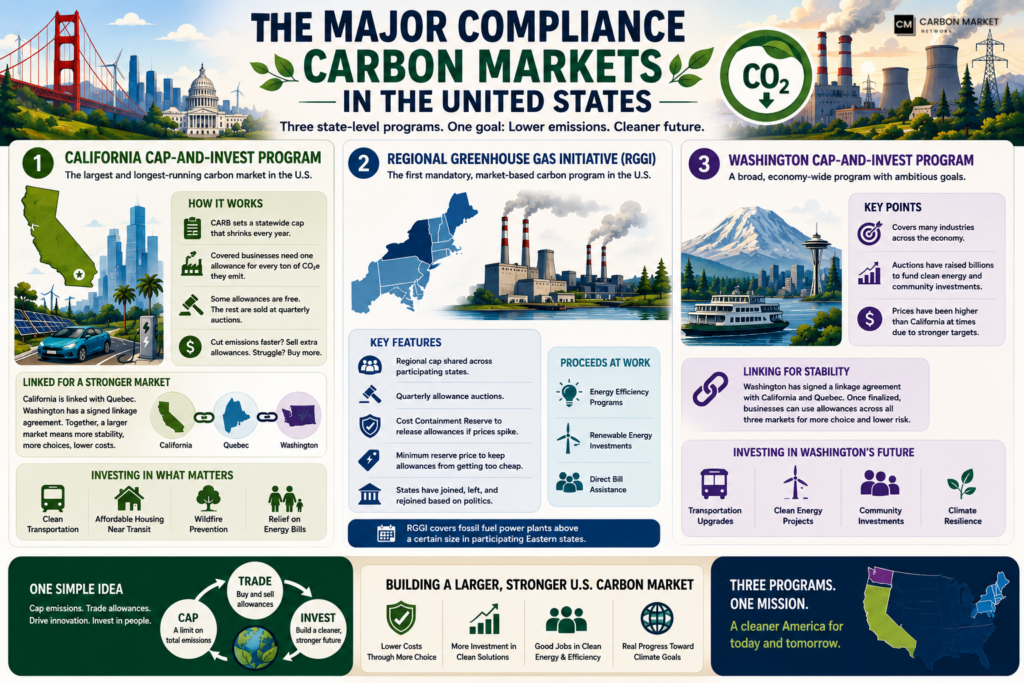
Three state-level programs currently form the backbone of mandatory carbon trading in the United States. Each works a little differently, but they all follow the same basic cap-and-trade logic.
California Cap-and-Invest Program
California runs the largest and longest-running carbon market in the country. It started as “Cap-and-Trade” and was later renamed “Cap-and-Invest” after the state extended its authority through legislation that keeps the program running for decades.
Here is how it works in simple terms:
- The California Air Resources Board sets a statewide cap on total carbon emissions from covered industries.
- The cap shrinks every year, forcing overall pollution down over time.
- Covered businesses, mostly large industrial facilities, power plants, and fuel suppliers, must hold one allowance for every ton of carbon dioxide equivalent they emit.
- Companies get some allowances for free and buy the rest at quarterly auctions.
- Businesses that cut emissions faster than required can sell extra allowances. Businesses that struggle to cut emissions must buy more.
California’s program is linked with Quebec’s carbon market, meaning both regions share the same pool of allowances and hold joint auctions. Washington State has also signed a linkage agreement with California and Quebec, and once the linkage rulemaking is finalized, all three markets will operate as one larger, combined system.
California uses the money raised from allowance auctions to fund clean transportation, affordable housing near transit, wildfire prevention, and direct relief on household energy bills.
Regional Greenhouse Gas Initiative (RGGI)
RGGI is the first mandatory, market-based carbon program in US history, and it focuses exclusively on the power sector. It covers fossil fuel power plants above a certain size in a group of Eastern states.
Unlike California’s economy-wide approach, RGGI only regulates electricity generators. That narrower scope makes it simpler to manage but also means it covers a smaller share of total emissions.
Key features of RGGI include:
- A regional cap shared across all participating states.
- Quarterly allowance auctions.
- A Cost Containment Reserve that releases extra allowances if prices rise too high.
- A minimum reserve price that keeps allowances from becoming too cheap.
- A history of states joining, leaving, and rejoining based on political leadership.
RGGI states use auction revenue mostly for energy efficiency programs, renewable energy investment, and direct bill assistance for residents.
Washington Cap-and-Invest Program
Washington launched its Cap-and-Invest Program under the Climate Commitment Act, a state law that set an ambitious emissions reduction target. The program covers a broad range of industries, similar to California’s model.
Washington’s auctions have raised billions of dollars since the program began, funding transportation upgrades, clean energy projects, and community investments. Prices in Washington’s market have at times run higher than California’s, partly because Washington’s emissions targets are more aggressive.
To reduce cost volatility and give businesses access to a bigger, more liquid pool of allowances, Washington negotiated a linkage agreement with California and Quebec. Once finalized, a Washington business will be able to use allowances issued by any of the three jurisdictions.
Quick Comparison of Compliance Programs
| Feature | California Cap-and-Invest | RGGI | Washington Cap-and-Invest |
|---|---|---|---|
| Coverage | Broad, multi-sector | Power sector only | Broad, multi-sector |
| Number of participating jurisdictions | Linked with Quebec, linking with Washington | Multiple Eastern states | Linking with California and Quebec |
| Allowance distribution | Auctions plus free allocation | Mostly auctions | Auctions plus free allocation |
| Program length | Extended through the mid 2040s | Multi-year control periods | Ongoing under state climate law |
| Offset usage | Limited annual percentage allowed | Being phased out | Limited annual percentage allowed |
| Revenue use | Transportation, housing, affordability, wildfire | Efficiency, renewables, bill assistance | Transportation, clean energy, community investment |
How Carbon Trading Actually Works, Step by Step
Understanding the mechanics helps everything else make sense. Here is a simplified walkthrough of how a compliance carbon market operates.
- A regulator sets a cap. This is the total amount of carbon dioxide allowed across all covered facilities in a given period.
- Allowances are created. Each allowance permits the holder to emit one ton of carbon dioxide equivalent.
- Allowances are distributed. Some go free to certain industries to prevent job losses or unfair competition. The rest are sold at auction.
- Companies emit and report. Facilities track their actual emissions and report them to the regulator, usually verified by an independent third party.
- Compliance deadline arrives. Each company must turn in enough allowances to cover its verified emissions.
- Trading happens in between. Throughout the year, companies buy and sell allowances on exchanges or directly with each other, based on whether they expect a surplus or a shortage.
- Penalties apply for shortfalls. A company that cannot cover its emissions with allowances faces fines and may need to buy extra allowances at a premium.
This structure creates a real financial incentive. Cutting emissions is not just good for the planet, it is good for the balance sheet, because a company that pollutes less can sell its spare allowances for profit.
Where US Carbon Allowances and Credits Are Traded
Trading does not happen in a single physical location like a stock exchange floor. Most trading happens electronically through a mix of platforms and private deals.
- Intercontinental Exchange (ICE): One of the largest platforms for trading carbon allowances and futures contracts tied to US programs.
- CME Group: Offers carbon allowance futures and options, used heavily by financial firms and large emitters for hedging.
- Nodal Exchange: A specialized platform for environmental and energy commodities, including carbon allowances.
- State compliance tracking systems: Systems like California’s CITSS or RGGI’s COATS record every allowance transfer and hold official compliance accounts.
- Over-the-counter deals: Many transactions happen directly between two parties, brokered privately rather than through a public exchange.
For the voluntary market, trading typically happens through registries and marketplaces rather than commodity exchanges. Buyers purchase credits directly from project developers, through brokers, or via online marketplaces that list verified projects.
The Voluntary Carbon Market in the United States
While compliance markets get most of the regulatory attention, the voluntary carbon market is where much of the innovation and public interest is happening.
Companies that are not legally required to reduce emissions still buy carbon credits for several reasons:
- To meet a corporate net zero or carbon neutral commitment.
- To respond to pressure from customers, employees, or investors.
- To offset emissions from air travel, events, or supply chains that are hard to eliminate directly.
- To support early-stage climate technology that needs funding to scale.
How Voluntary Carbon Credits Are Created
A voluntary carbon credit represents one ton of carbon dioxide equivalent that has been avoided, reduced, or removed from the atmosphere. Here is the typical process:
- A project developer designs a project, such as planting trees, capturing methane from a landfill, or restoring a wetland.
- The developer applies a recognized methodology to calculate how many tons of emissions the project will avoid or remove.
- An independent auditor verifies the project’s data and methodology.
- A registry issues credits based on verified results.
- The developer sells the credits to companies or individuals looking to offset emissions.
- Once a buyer uses a credit, it gets retired, meaning it can never be resold or reused.
Major US and International Registries Active in the American Market
| Registry | Focus Areas | Notes |
|---|---|---|
| Verra | Forestry, renewable energy, methane, agriculture | One of the largest registries by volume worldwide |
| Gold Standard | Renewable energy, community projects, cookstoves | Known for strong social impact standards |
| American Carbon Registry | Forestry, livestock, industrial projects | Long history serving the North American market |
| Climate Action Reserve | Forestry, landfill gas, ozone depleting substances | Focused heavily on North American project types |
Popular Voluntary Carbon Credit Project Types
| Project Type | How It Reduces Emissions | Common in the US |
|---|---|---|
| Forestry and reforestation | Trees absorb carbon dioxide as they grow | Very common |
| Improved forest management | Slower harvesting keeps more carbon stored in forests | Common |
| Landfill gas capture | Captures methane before it escapes into the atmosphere | Common |
| Livestock methane reduction | Captures or reduces methane from manure and digestion | Growing |
| Renewable energy | Displaces fossil fuel electricity generation | Declining in the US voluntary market due to additionality concerns |
| Direct air capture and carbon removal | Machines pull carbon dioxide directly from the air | Small but growing fast |
| Biochar | Converts biomass into stable carbon that resists decomposition | Growing |
| Soil carbon and regenerative agriculture | Farming practices that store more carbon in soil | Growing |
US Carbon Market vs European Union Carbon Market
People often compare the US system to the European Union Emissions Trading System, since the EU system is the largest and most established carbon market in the world. The comparison highlights just how different the American approach really is.
| Feature | United States | European Union |
|---|---|---|
| National coverage | No single federal system | Single system covering all member states |
| Legal basis | State-by-state laws | Unified EU-wide legislation |
| Sectors covered | Varies by state program | Power, industry, aviation, and expanding sectors |
| Carbon border adjustment | None currently | Carbon Border Adjustment Mechanism in force |
| Market maturity | Growing but fragmented | Long-established with deep liquidity |
| Price consistency | Varies significantly by state | One price across the entire bloc |
This fragmentation is one reason many US businesses that export to Europe are watching the EU Carbon Border Adjustment Mechanism closely. Since the United States lacks a federal carbon price, some American exporters could face extra costs when shipping carbon-intensive goods into the European market.
Federal Carbon Policy in the United States
Unlike many other developed economies, the United States has never passed a federal carbon tax or a national cap-and-trade law. Several bills have been introduced in Congress over the years proposing a fee on carbon emissions, sometimes paired with rebates for households, but none have become law.
Instead, federal climate policy in the US carbon space currently operates in a more indirect way:
- Environmental Protection Agency reporting rules require large emitters to report greenhouse gas data, which underpins both compliance and voluntary markets.
- Tax credits for carbon capture and clean energy create financial incentives for emissions reductions without pricing carbon directly.
- Corporate climate disclosure requirements have become a moving target at the federal level, with the Securities and Exchange Commission working to unwind its earlier climate disclosure rule, leaving state laws like California’s corporate emissions reporting requirements as a major driver of transparency for large companies doing business nationwide.
- State climate laws continue to expand faster than federal action, filling the gap left by Congress.
For businesses, this means state-level rules and voluntary market pressure currently matter more than federal mandates when it comes to actually pricing carbon in the United States.
What Drives Carbon Prices in the United States
Carbon allowance and credit prices move for many of the same reasons as any other commodity. Here are the biggest factors.
- Cap tightness: A shrinking cap with steady demand naturally pushes prices upward.
- Economic activity: A booming economy usually means more industrial output and more emissions, which increases demand for allowances.
- Weather and energy demand: Extreme heat or cold increases electricity use, which can raise emissions from power plants and lift allowance demand.
- Policy changes: New regulations, offset limits, or linkage agreements can shift supply and demand overnight.
- Reserve mechanisms: Cost containment reserves and price floors are specifically designed to keep prices within a target range.
- Investor and speculator activity: Financial firms trade carbon allowances as an asset class, which adds liquidity but can also add volatility.
- Credit quality concerns: In the voluntary market, growing scrutiny over whether certain project types truly deliver the promised emissions reductions has caused prices for lower-quality credits to fall, while high-integrity credits often command a premium.
Who Participates in the US Carbon Market
A wide range of players make up the ecosystem. Understanding their roles helps clarify how the whole system fits together.
- Regulated emitters: Power plants, refineries, cement manufacturers, and large industrial facilities that must comply with state caps.
- State regulators: Agencies like the California Air Resources Board and state environmental departments that design and enforce the rules.
- Financial institutions: Banks, hedge funds, and trading firms that provide liquidity and manage risk through carbon derivatives.
- Project developers: Companies and organizations that design, build, and manage carbon reduction or removal projects.
- Verification bodies: Independent auditors who confirm that emissions data and project claims are accurate.
- Registries: Organizations that track credit issuance, ownership, and retirement to prevent double counting.
- Brokers and marketplaces: Middlemen who connect buyers and sellers, especially in the voluntary market.
- Corporate buyers: Companies purchasing allowances for compliance or credits for voluntary climate goals.
- Landowners and farmers: Individuals who can generate income by managing land in ways that store or avoid carbon emissions.
How Businesses Can Get Involved in the US Carbon Market
If you run a business and want to participate in the carbon market, whether to manage compliance costs or pursue a voluntary strategy, here is a practical path forward.
For Businesses Subject to Compliance Programs
- Determine your coverage. Check whether your facility’s emissions and location fall under California, RGGI, or Washington’s rules.
- Set up a compliance account. Register with the relevant state tracking system, such as CITSS for California or COATS for RGGI states.
- Track your emissions carefully. Accurate monitoring and reporting prevents costly compliance surprises.
- Build a purchasing strategy. Decide whether to rely mainly on auctions, secondary market trades, or a mix of both.
- Watch price trends. Buying early when prices are low can meaningfully reduce compliance costs over time.
- Explore emissions reduction investments. Sometimes cutting emissions directly is cheaper long-term than continuously buying allowances.
For Businesses Interested in the Voluntary Market
- Define your climate goal clearly. Decide whether you are aiming for carbon neutrality, net zero, or simply a public sustainability commitment.
- Measure your footprint first. You cannot credibly offset emissions you have not measured.
- Prioritize direct reductions before offsetting. Buyers and regulators increasingly expect companies to cut emissions internally before turning to credits.
- Choose high-quality credits. Look for third-party verification, a reputable registry, and a project type with a strong track record.
- Diversify your credit portfolio. Mixing project types, such as forestry, methane capture, and carbon removal, can reduce risk if any single project type comes under scrutiny.
- Communicate transparently. Clearly explain what your credits fund and avoid vague or exaggerated marketing claims about being carbon neutral.
For Landowners, Farmers, and Project Developers
- Assess your land or operation for eligible activities, such as forest management, wetland restoration, or manure management.
- Choose a suitable methodology and registry that matches your project type.
- Work with a project developer or consultant who understands measurement, reporting, and verification requirements.
- Complete third-party verification before credits can be issued.
- List and sell your credits through a marketplace, broker, or direct corporate buyer relationship.
Common Challenges and Criticisms of the US Carbon Market
No system is perfect, and the US carbon market faces real, well-documented challenges.
- Fragmentation across states makes it harder for companies operating nationally to plan a consistent carbon strategy.
- No federal backstop leaves the country without a unified price signal, unlike many other major economies.
- Offset quality concerns have led to public scrutiny of certain forestry and renewable energy credits that critics argue overstate their climate benefit.
- Price volatility in some state programs has raised affordability concerns for consumers, since higher allowance prices can filter through to electricity bills.
- Political risk is significant, since state programs depend on legislative and executive support that can shift with elections.
- Complexity for small businesses, since compliance requirements and voluntary market standards can be difficult to navigate without dedicated staff or consultants.
Opportunities and the Road Ahead
Despite the challenges, momentum in the US carbon market continues to build in several important ways.
- Market linkage is expanding. California, Quebec, and Washington are moving toward a combined market, which should improve liquidity and price stability for all three.
- Corporate demand for high-quality credits keeps growing, even as scrutiny pushes low-quality projects out of the market.
- Carbon removal technology is scaling up. Direct air capture, biochar, and enhanced weathering are attracting significant investment as buyers look for durable, verifiable removals.
- Agricultural and forestry credits are maturing, giving landowners a genuine new revenue stream tied to sustainable land management.
- State-level policy innovation continues, with more states studying cap-and-invest or cap-and-trade models even without a federal push.
- Trade pressure from international carbon border rules may eventually push US policymakers toward some form of federal carbon pricing to protect exporters.
Practical Takeaways
- The US carbon market is really several markets: state compliance programs and a separate voluntary market, each with different rules and players.
- California, RGGI, and Washington are the three major compliance programs, and California and Washington are moving toward a linked market with Quebec.
- There is currently no federal carbon tax or nationwide cap-and-trade law in the United States.
- Voluntary carbon credits let any company participate, but credit quality varies widely, so careful due diligence matters.
- Prices are shaped by caps, economic activity, weather, policy shifts, and market confidence.
- Businesses, landowners, and even individual investors all have realistic pathways into this market.
- Credibility and transparency are becoming the deciding factors for success in the voluntary market, as public scrutiny of low-quality credits increases.
Frequently Asked Questions
What is the US carbon market in simple terms?
It is a system, or really a group of systems, where companies buy and sell the right to emit carbon dioxide, or purchase credits that fund emissions reductions elsewhere.
Is there a national carbon market in the United States?
No. There is no single federal carbon market. Carbon trading in the US currently happens through state programs like California’s Cap-and-Invest Program, the Regional Greenhouse Gas Initiative, and Washington’s Cap-and-Invest Program, along with a separate voluntary carbon credit market.
What is the difference between a carbon allowance and a carbon credit?
An allowance is issued by a government regulator and permits a company to emit one ton of carbon dioxide under a compliance program. A credit represents one ton of emissions that has been avoided or removed by a specific project, and it is mainly used in the voluntary market or for limited offset use within compliance programs.
Does the United States have a federal carbon tax?
No. Several carbon tax bills have been proposed in Congress over the years, but none have been passed into law at the federal level.
Can individuals buy carbon credits in the United States?
Yes. Many marketplaces sell small quantities of verified carbon credits directly to individuals who want to offset personal emissions, such as from flights or daily lifestyle choices.
Which states have mandatory carbon trading programs?
California and Washington run broad, multi-sector cap-and-invest programs. A group of Eastern states participate in the Regional Greenhouse Gas Initiative, which covers the power sector.
How do companies make money from carbon trading?
Companies that reduce emissions below their allowance can sell the surplus allowances for a profit. Investors and trading firms also profit by buying and selling allowances and credits as prices move.
Is the voluntary carbon market regulated?
It is not regulated the same way compliance markets are, but registries, verification bodies, and growing legal and reputational scrutiny all push toward higher standards and more transparency.
Will the United States ever have a national carbon market?
It is possible but not guaranteed. Growing pressure from international trade rules and rising interest in carbon border adjustments could eventually encourage federal action, but for now, state programs and the voluntary market remain the primary drivers of carbon pricing in the country.
Conclusion
The US carbon market may not look like a single, neat national system, but it is very real, very active, and growing more important every year. From California’s massive Cap-and-Invest Program to the voluntary credits funding forest restoration and carbon removal technology, this market touches electricity bills, corporate strategy, farmland income, and global trade relationships all at once.
Understanding how the United States carbon market works, from compliance programs to US carbon trading platforms to voluntary credits, gives businesses, investors, and everyday citizens a real edge. As state programs link together and corporate demand for credible climate action keeps rising, the US carbon market is likely to keep expanding its reach and its influence on the American economy.
Whether you are planning compliance strategy, exploring a new revenue stream from land you manage, or simply trying to make sense of the headlines, the fundamentals in this guide give you a solid foundation to move forward with confidence.
If you want to keep learning about carbon markets, ESG strategy, and sustainability trends, explore more resources on Carbon Market Network.