Carbon Market Network


Carbon markets just got a major upgrade. And the driving force behind this transformation is Article 6 of the Paris Agreement.
If you have been following climate news, you have probably seen the term “Article 6 carbon markets” come up more and more. Countries are signing deals. New carbon credits are being issued. Old systems are being replaced. And billions of dollars in climate finance hang in the balance.
But what exactly is Article 6? How does it work? And why does it matter for anyone involved in carbon markets, whether as a buyer, seller, project developer, or policy watcher?
This guide breaks it all down in plain language, from the basics to the latest developments shaping the market right now.
What Is Article 6 of the Paris Agreement?
Article 6 is the section of the Paris Agreement that sets the rules for international carbon market cooperation.
The Paris Agreement was signed in 2015. Its goal is to limit global warming to well below 2°C, ideally 1.5°C, above pre-industrial levels. To get there, every country submits a national climate plan called a Nationally Determined Contribution, or NDC.
The challenge is that cutting emissions is expensive. And some countries have more low-cost mitigation opportunities than others.
Article 6 offers a solution. It allows countries to cooperate on emissions reductions, including by trading carbon credits across borders. A country that reduces more emissions than its NDC requires can sell the surplus to a country that needs help meeting its own targets.
Done well, this lowers the global cost of meeting the Paris goals while directing climate finance to where it can have the most impact.
If the rules are structured appropriately, the result can be a win-win: both countries meet their climate commitments, the overachiever is financially rewarded for going above and beyond, finance flows to the country generating the reductions, and the world gets a step closer to avoiding catastrophic climate change.
The World Bank estimates that carbon trading under Article 6 could reduce the cost of implementing countries’ NDCs by as much as $250 billion per year and enable the removal of 50% more emissions at no additional cost.
Carbon Market Insider Newsletter
Weekly insights on carbon markets, climate policy, carbon credits, and sustainability.
Why Did It Take So Long to Get Article 6 Up and Running?
Article 6 was agreed in broad strokes in 2015. But turning broad principles into working rules took nearly a decade.
The core problem was trust. Countries could not agree on how to prevent the same emissions reduction from being counted twice, once by the country that reduced emissions and again by the country that bought the credit. This risk, known as double counting, could let countries claim progress on paper while global emissions kept rising.
COP26 laid out broad rules in 2021, but technical issues such as double counting, transparency, and benefit-sharing remained unresolved through COP27 and COP28. It was not until COP29 in Baku in 2024 that negotiators finalized the rulebook for carbon trading under both the bilateral mechanism and the UN-supervised market.
For nearly a decade after the Paris Agreement was signed, Article 6 was mostly theoretical. The text was there, but the rules were not. Countries argued, negotiations stalled, and the carbon market kept running on parallel, voluntary tracks. That has changed. The architecture of Article 6 is now largely settled.
The first official credit transfers between governments have now happened. The first credit under the brand-new UN crediting system was issued in early 2026. Article 6 has moved from policy to practice.
The Three Parts of Article 6
Article 6 contains three main mechanisms. Two are market-based, and one is not.
| Mechanism | Type | Key Feature |
|---|---|---|
| Article 6.2 | Market | Bilateral deals between countries trading ITMOs |
| Article 6.4 | Market | Centralized UN mechanism (PACM) open to countries and private actors |
| Article 6.8 | Non-market | Cooperation through finance, technology, and capacity building |
We will focus mainly on 6.2 and 6.4, since these are the market mechanisms that drive carbon credit trading.
Article 6.2: Bilateral Carbon Trading Between Countries
How Article 6.2 Works
Article 6.2 allows two or more countries to negotiate their own carbon trading arrangements directly.
Under these agreements, countries transfer what are called Internationally Transferred Mitigation Outcomes, or ITMOs. An ITMO represents one tonne of CO₂ equivalent that has been reduced or removed in one country and transferred to another.
They become ITMOs when reductions are transferred from one country’s national greenhouse gas inventory to another’s. This can happen at the government level. However, it is also possible at the corporate level, when a company in one country purchases ITMOs from abroad to meet compliance criteria at home.
The Corresponding Adjustment Mechanism
The most important concept in Article 6.2 is the corresponding adjustment. This is the accounting mechanism that prevents double counting.
Making a corresponding adjustment to emissions inventories of the seller and buyer when an ITMO is transferred is the cornerstone of Article 6.2’s environmental integrity provisions, preventing double counting. For example, if one country generates a carbon removal credit and sells it to another country, one tonne of carbon is added back to the seller country’s emissions count and one tonne is subtracted from the buyer country’s balance.
In practice, here is how the process works step by step:
- A project reduces emissions in Country A (the host country).
- Country A issues a Letter of Authorization (LoA) formally granting permission for those reductions to be transferred internationally.
- The ITMO is transferred to Country B (the acquiring country).
- Country A applies a corresponding adjustment, removing those tonnes from its own national inventory.
- Country B counts those tonnes toward its NDC.
The result is that the same tonne of CO₂ is only counted once, in Country B’s ledger, not in both countries’ accounts.
The basic idea of the corresponding adjustment is that countries’ emissions levels, as reported when they track progress towards their NDCs, should be adjusted to reflect the transfer or acquisition of mitigation outcomes.
The Bangkok E-Bus Program: A Real-World Example
The most advanced Article 6.2 project in the world to date is the Bangkok E-Bus Program.
The most significant example to date is the Bangkok E-Bus Program, a project converting Bangkok’s private diesel bus fleet to electric vehicles, financed by Switzerland’s KliK Foundation through the purchase of ITMOs. Thailand and Switzerland completed their first ITMO transfer in December 2023, making it the first-ever completed transaction under Article 6.2 of the Paris Agreement. A second batch covering 2023-2024 emissions was approved in 2026. It remains the most advanced project of its kind anywhere in the world, and most bilateral programs are still in early development stages.
This project shows what Article 6.2 looks like in practice: a buyer country (Switzerland) funds clean infrastructure in a host country (Thailand) and receives the ITMOs in return. Switzerland counts those emission reductions toward its own NDC.
How Many Article 6.2 Deals Have Been Signed?
As of December 2025, 108 bilateral agreements between 64 different countries have been signed under Article 6.2.
As of early 2025, 155 pilot projects were recorded under Article 6.2. These numbers indicate a growing relevance of the instrument, whose implementation had stalled for many years.
Switzerland has been among the most active buyers, having signed agreements with over a dozen countries including Peru, Ghana, Thailand, Morocco, and Chile. However, most of these deals are still in development. Actual credit flows remain small.
Article 6.2 Price Premium
The additional accountability of a corresponding adjustment comes with a price premium.
Switzerland’s bilateral credits trade at around $36 per ton. Comparable voluntary carbon market credits trade at $5-$8 per ton. That spread is driven almost entirely by the Corresponding Adjustment.
Buyers are willing to pay more for credits that carry host country authorization and a genuine corresponding adjustment, because those credits carry a much stronger integrity story.
Article 6.4: The UN’s Centralized Carbon Market (PACM)
What Is PACM?
Article 6.4 establishes a centralized, UN-supervised carbon crediting mechanism open to both countries and private sector entities.
It is formally called the Paris Agreement Crediting Mechanism, or PACM, and it is the designated successor to the Clean Development Mechanism (CDM), which operated under the Kyoto Protocol from 2001. PACM follows the same general model as the CDM: projects reduce or remove emissions, credits are issued, and those credits can be traded internationally, but with stricter additionality requirements, more conservative baselines, and tighter monitoring standards.
The credits issued under PACM are called Article 6.4 Emission Reductions, or A6.4ERs.
How the PACM Supervisory Body Works
PACM is governed by the Article 6.4 Supervisory Body, which operates under the authority of the Conference of the Parties to the Paris Agreement. The Supervisory Body:
- Develops and approves project methodologies
- Registers activities and projects
- Accredits third-party verification bodies (called Designated Operational Entities)
- Manages the Article 6.4 registry
Unlike Article 6.2, where the quality of credits depends on bilateral negotiations between countries, PACM provides a centralized standard that applies to all registered projects.
Key Standards Adopted Under PACM
At COP30 in Belém in November 2025, Parties endorsed the foundational standards adopted by the Article 6.4 Supervisory Body, covering baseline-setting, additionality, leakage, suppressed demand, and non-permanence and reversals, and acknowledged the first PACM methodology, covering landfill gas flaring and utilisation. The technical scaffold for a credible UN-managed carbon crediting mechanism is now in place.
Here is a summary of the key standards now in place:
| Standard | What It Covers |
|---|---|
| Baseline-setting | How to calculate what emissions would have been without the project |
| Additionality | Proving the project would not happen without carbon credit revenue |
| Leakage | Accounting for emissions displaced to other areas |
| Suppressed demand | Projects serving communities that previously lacked access to energy |
| Non-permanence and reversals | Managing the risk that stored carbon gets released back to the atmosphere |
The First PACM Methodology and Credit Issuance
The Supervisory Body approved the first official PACM methodology in late 2025.
The Article 6.4 Supervisory Body approved “A6.4-AMM-001: Flaring or use of landfill gas” at its 19th meeting on October 29-30. The methodology covers activities that capture landfill gas from a solid waste disposal site and flare it, use it to produce energy, or supply it to consumers through a natural gas distribution network. It also defines how methane emissions from these sites can be managed and qualify for Article 6.4 carbon credits.
The first actual credit issuance under PACM followed shortly after.
The first credit issued under PACM came in February 2026, from a cookstove project in Myanmar coordinated with South Korea. The project generated 58,428 mtCO2e credits, approximately 40% fewer than the CDM provisional figure for the same activity. That reduction reflects the more conservative methodological standards PACM is applying from the outset, not a one-off anomaly.
This is significant. Fewer credits issued per project, with stricter methodology, signals that PACM is setting a genuinely higher integrity bar than its predecessor.
The Article 6.4 Supervisory Body delivered significant progress in operationalizing the mechanism in 2025, including approving five methodological standards, the first PACM methodology for landfill gas, and accrediting 10 Designated Operational Entities as independent third-party organizations to verify carbon projects.
The CDM-to-PACM Transition: What You Need to Know
The Clean Development Mechanism (CDM) was the world’s primary international carbon crediting system under the Kyoto Protocol, running from 2001. With PACM now operational, the CDM is being wound down.
The formal closure of the Clean Development Mechanism by the end of 2026 was confirmed at COP30. The CDM, which has issued nearly 2.5 billion credits since 2001, will cease operations progressively, with remaining CDM funds transferred to support PACM development.
What Happens to Existing CDM Projects?
CDM projects registered after January 1, 2013 can apply to transition to PACM. But the transition process is not automatic, and it is not without controversy.
Following COP30 discussions, the host party approval deadline for CDM projects transitioning to PACM was pushed back to June 2026, with the documentation deadline extended to December 2026. To date, only around 13% of credits requesting transition have been approved, with the rest still awaiting host country approval.
Why the concern about transitioning projects?
Nearly 80% of CDM activities eligible to transition to PACM utilize grid-connected renewable energy methodologies. Major carbon credit registries, including Verra and Gold Standard, stopped accepting new grid-connected projects in 2019 as they were generally no longer considered additional. These methodologies were also rejected by the ICVCM, raising concerns about the environmental integrity of credits generated by transitioning projects.
In other words, the transition window could allow projects with questionable additionality to enter the new market before tighter standards fully apply. Buyers sourcing credits from recently transitioned projects should apply additional scrutiny.
Article 6.8: Non-Market Approaches
Not all international climate cooperation needs to involve trading.
Article 6.8 recognizes cooperative approaches that do not involve carbon credit transfers, including:
- Climate finance directed from wealthier to developing countries
- Technology transfer to help countries adopt clean technologies
- Capacity building to strengthen institutions and technical expertise
- Policy coordination across borders
While Article 6.8 does not generate tradable credits, it plays an important supporting role. Many developing countries prefer non-market approaches because they do not require transferring emission reductions to other countries, allowing them to retain the full benefit of their climate actions for their own NDC accounting.
Article 6 and the Voluntary Carbon Market: What Is the Connection?
A common question is: how does Article 6 relate to the existing voluntary carbon market (VCM)?
The short answer is that they are distinct but increasingly connected.
The VCM operates outside the UN framework. Companies voluntarily buy credits to offset their emissions or meet net zero pledges. These credits do not require government authorization or corresponding adjustments.
Article 6, by contrast, creates a government-to-government layer with stricter accountability. But the two systems interact in important ways.
Article 6.2 provides a framework for countries to trade GHG emission reductions by issuing and transferring ITMOs. The exchange of ITMOs under Article 6.2 is not subject to approval by a centralized authority; instead, participating countries negotiate the exchange via bilateral or multilateral agreements. Article 6.2 allows host countries to use existing structures to develop and implement projects, which could lead to a range of quality for the ITMOs traded.
Voluntary credits can be authorized for international use under Article 6.2, but only if the host country issues a Letter of Authorization and commits to applying a corresponding adjustment. This authorization converts a standard voluntary credit into an ITMO.
The key difference:
| Feature | Standard Voluntary Credit | Article 6 Authorized ITMO |
|---|---|---|
| Host country authorization | Not required | Required |
| Corresponding adjustment | Not required | Required |
| Can be used toward NDC | No | Yes |
| Typical price premium | Baseline market price | Significant premium (often 3-6x) |
| CORSIA eligible | Only if also authorized | Yes, if also authorized |
Understanding the distinctions between voluntary credits, Article 6-authorized credits, and compliance-eligible credits will be essential as the market continues to evolve.
Article 6 and CORSIA: Aviation’s Carbon Market
One of the biggest immediate use cases for Article 6-authorized credits is aviation.
CORSIA, the Carbon Offsetting and Reduction Scheme for International Aviation, is the global market-based measure for the aviation sector operated by the International Civil Aviation Organization (ICAO).
Article 6 governs international cooperation under the UNFCCC Paris Agreement, setting the rules for how countries transfer emission reductions between one another. CORSIA is a sector-specific mandatory offsetting scheme for international aviation, operating under ICAO. CORSIA interacts with Article 6 because CORSIA credits need to be accounted for in national GHG reports.
For Phase 1 and all subsequent phases, CORSIA-eligible credits with a 2021 or later vintage must be authorized by the host country for international use under Article 6. This authorization requires the host country to perform a corresponding adjustment to prevent double counting, ensuring the same reduction is not counted toward both the host country’s NDC and the airline’s CORSIA obligation.
CORSIA Phase 1 Demand
CORSIA Phase 1, running from 2024 to 2026, has produced the first concrete compliance demand in aviation. Following ICAO’s release of 2024 emissions data, approximately 58 million tonnes of CO₂ need to be covered under CORSIA-eligible credits for that year alone, with total Phase 1 demand potentially reaching 220 million units across 2024 to 2026. Airlines with flights between the 130 participating states must retire eligible credits by January 2028.
This represents a significant and growing source of demand for high-integrity, Article 6-authorized carbon credits.
Airlines with more than 10,000 tCO₂e of international emissions between participating states must buy and cancel eligible emissions units by 31 January 2028 for Phase 1. To qualify as CORSIA-eligible, a credit must be issued by an ICAO-approved programme, fall within approved project types and vintages, and carry a Letter of Authorization from the host country confirming a corresponding adjustment under Article 6.
Who Participates in Article 6 Carbon Markets?
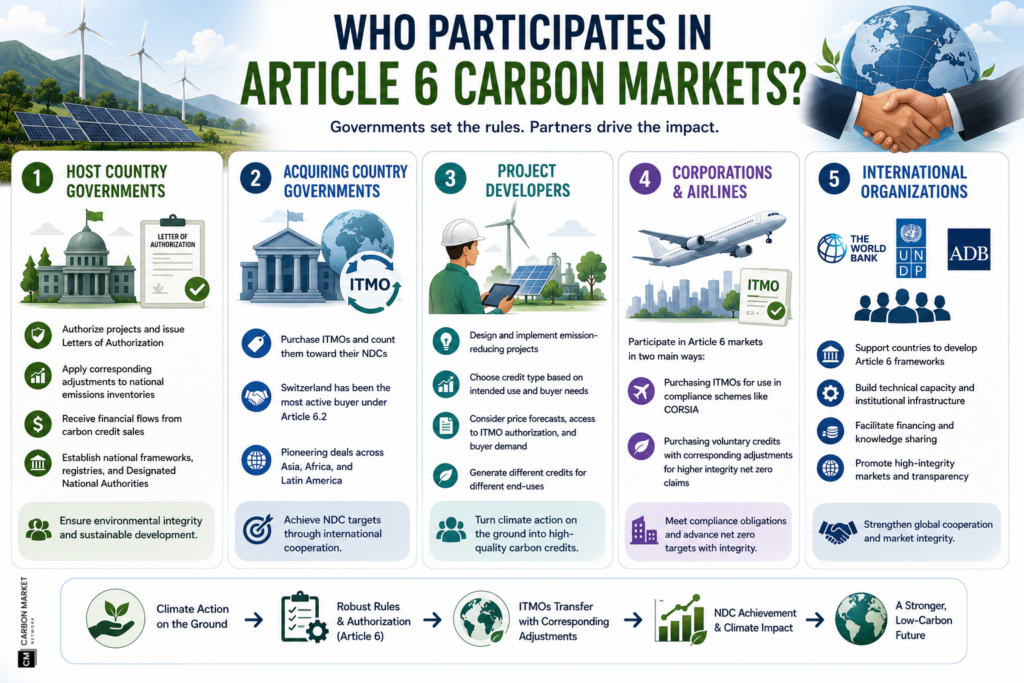
Article 6 is designed primarily as a framework for governments. But the private sector plays a central role in making it work.
Here is how different actors participate:
Host Country Governments
Host countries are where the emission-reducing projects are physically located. They:
- Authorize projects and issue Letters of Authorization
- Apply corresponding adjustments to their national emissions inventories
- Receive financial flows from carbon credit sales
- Establish national frameworks, registries, and Designated National Authorities
Acquiring Country Governments
Acquiring countries purchase ITMOs and count them toward their NDCs. Switzerland has been the most active buyer under Article 6.2, pioneering deals across Asia, Africa, and Latin America.
Project Developers
From the viewpoint of project developers, it is essential to understand the intended use of a carbon credit. This determines which entity must authorize it and what type of emissions reduction unit it will ultimately become. Project developers can generate different credits for different end-uses, and choices will then be made based on price forecasts, access to ITMO authorization, and on specific demands from prospective buyers.
Corporations and Airlines
Private companies can participate in Article 6 markets in two main ways:
- Purchasing ITMOs for use in compliance schemes like CORSIA
- Purchasing voluntary credits that have been authorized with corresponding adjustments, offering a higher integrity standard for net zero claims
International Organizations
Bodies like the World Bank, UNDP, and regional development banks are actively supporting countries to develop Article 6 frameworks, build technical capacity, and structure bilateral agreements.
Challenges and Criticisms of Article 6 Carbon Markets
Article 6 represents real progress. But it also faces significant challenges.
Challenge 1: Double Counting Risk
Despite the corresponding adjustment mechanism, double counting risks persist in certain areas.
Largely unregulated private schemes can still allow double counting, even though this defies logic and environmental integrity. It remains unclear whether buyers will even want double-counted credits when properly adjusted credits are available.
The problem is that Article 6 rules apply to ITMOs and authorized credits. Standard voluntary credits, without host country authorization, still do not require corresponding adjustments, which means the same reduction could theoretically be counted both by the company retiring the credit and by the host country in its NDC accounting.
Challenge 2: CDM Transition Quality Concerns
Critics warn that the CDM transition process could allow low-quality projects to enter PACM before stricter additionality requirements come into effect. An analysis by Carbon Market Watch found that the first approved transition project, a clean cookstove program in Myanmar, originally planned to issue 26 times more carbon credits than scientifically justified.
The good news is that the stricter PACM methodology standards are now requiring significant adjustments. The first credit issued under PACM came in approximately 40% below the CDM estimate for the same project, which shows the higher bar is actually being applied.
Challenge 3: Slow Host Country Participation
Building the institutional capacity for countries to authorize ITMOs takes time. Countries need national registries, Designated National Authorities, and legal frameworks that do not currently exist in many places.
Reasons for the slow uptake of trading under Article 6.2 include the lengthy development of national implementation frameworks, persisting uncertainty on rules and registries, and a lack of trust in the mechanism’s environmental integrity.
Challenge 4: Market Is Still in Pipeline Mode
The market is in pipeline mode, not delivery mode. A significant number of bilateral agreements have been signed and projects are being developed, but actual credit flows remain small and concentrated.
The architecture is largely in place, but the volume of actual ITMO transfers remains very small relative to the scale of the agreements signed. Translating signed bilateral deals into verified credit flows is the next major challenge.
Challenge 5: Ambition and Environmental Integrity
When emissions are transferred between countries whose climate targets are not aligned with the 1.5°C warming limit, this does not increase emission reductions globally; it merely shifts responsibility from one country to another. For Article 6 to work as intended, governments must first demonstrate their highest possible domestic ambition before relying on the use of ITMOs.
Critics argue that Article 6 could allow countries to outsource their climate ambitions rather than making the harder domestic reductions. This concern is especially relevant when host country NDC targets are not themselves aligned with a 1.5°C pathway.
The Integrity Push: How Quality Standards Are Strengthening Article 6
A parallel effort by independent organizations is raising the quality bar across carbon markets, and this directly supports the Article 6 ecosystem.
The Integrity Council for the Voluntary Carbon Market (ICVCM) has established Core Carbon Principles (CCPs), a set of quality benchmarks that carbon credit methodologies must meet.
By November 2025, the ICVCM had approved seven major carbon-crediting programmes and 36 methodologies, covering over 51 million credits in active use. CCP-labelled credits now command a price premium of up to 25% compared to other credits, according to market analysts.
The Voluntary Carbon Markets Integrity Initiative (VCMI) has also developed guidance for how companies can make credible climate claims when using carbon credits, reducing the risk of greenwashing.
These pieces reinforce one another: clearer standards raise supply quality, and clearer claims increase confident demand. The result is a more legitimate, more interoperable international market that coalesces around what good looks like, especially for nature and forests.
Article 6 and Nature-Based Solutions
One of the most important open questions in Article 6 is the role of nature-based solutions, including forests, wetlands, mangroves, and soils.
Nature-based projects make up a large share of the existing voluntary carbon market. Forests alone sequester enormous amounts of CO₂, and many of the world’s most biodiverse ecosystems are carbon-rich.
However, nature-based credits face particular scrutiny under PACM because of permanence risks. A forest that sequesters carbon today could burn tomorrow. PACM’s non-permanence and reversals standard directly addresses this, requiring projects to demonstrate how they will manage and account for reversal risks.
The approved standard on non-permanence and reversals addresses one of carbon accounting’s most debated challenges: managing the risk that carbon stored through reforestation, soil, or land-use projects could be released back into the atmosphere. The standard delegates permanence parameters to individual methodologies rather than setting universal standards, accommodating national circumstances and enabling innovation.
The inclusion of robust nature-based methodologies under PACM remains a key priority. Environmental groups argue strongly that Article 6 must be designed to channel finance toward the communities and ecosystems that can deliver near-term climate wins at scale.
Article 6 and Climate Finance for Developing Countries
One of the most compelling arguments for Article 6 is its potential to unlock climate finance for developing countries.
Many developing nations have significant mitigation potential, including forests, renewable energy potential, and low-carbon agricultural land. But they lack the capital to develop these opportunities at scale.
Article 6 creates a mechanism for finance to flow from countries with higher-cost mitigation opportunities to countries with lower-cost ones. For host countries, this means:
- Revenue from carbon credit sales that can fund domestic clean development
- Technology transfer through project development agreements
- Capacity building to develop stronger carbon market institutions
- International recognition of domestic climate actions
For countries, Article 6 is a finance mechanism, a route to attract climate investment and generate revenue from credits authorized for export.
However, the distribution of these benefits matters enormously. If the revenue from ITMO exports goes mainly to foreign project developers rather than local communities, the development co-benefits are diminished.
For Indigenous peoples and local communities, the integration of safeguards and fair benefit-sharing remains uncertain, raising concerns over whether carbon finance will genuinely reach them or instead become entangled in bureaucratic and technical barriers.
Some countries are already taking steps to address this. Kenya has legally mandated community benefit-sharing for carbon projects through Community Development Agreements, while Singapore and the United Kingdom have established frameworks that align voluntary market activity with high-integrity Article 6 standards.
How Article 6 Changes Carbon Credit Procurement
If you are a company buying carbon credits, Article 6 changes the questions you need to ask.
What to Look for When Buying Carbon Credits Today
| Question to Ask | Why It Matters |
|---|---|
| Is the credit Article 6 authorized? | Authorized credits carry a corresponding adjustment and can be used for NDC or CORSIA compliance |
| Is there a Letter of Authorization from the host country? | Confirms the host country has agreed to transfer the mitigation outcome |
| Does the credit carry a corresponding adjustment? | Prevents the same reduction being counted in both the host country’s NDC and your claim |
| Is the methodology PACM-approved or ICVCM-certified? | Signals the project meets a recognized quality standard |
| Is this a CDM transition project? | Requires extra scrutiny on additionality and baseline methodology |
The Greenwashing Risk
Regulatory frameworks are tightening on environmental claims. The EU’s Green Claims Directive and existing consumer protection laws are raising the bar for what companies can say about their use of carbon credits.
A credit purchased today to support a product-level environmental claim may not be legally defensible under EU consumer protection law in the near future. The credit type, the claim language, and the underlying reduction or removal methodology all need to align.
For companies making public climate claims, using Article 6-authorized credits with corresponding adjustments provides the strongest possible foundation. These credits have a documented chain of accountability that starts at the host country government level.
The Road Ahead: What to Watch in Article 6 Carbon Markets
Article 6 is now operational. But it is still in an early and formative stage. Here are the key developments to watch:
1. New PACM Methodologies
The first PACM methodology covers landfill gas. Many more are needed to cover the full range of project types: renewable energy, forestry, soil carbon, clean cookstoves, transportation, and industrial processes.
The Supervisory Body is prioritizing methodology reviews in key sectors like renewable energy and energy efficiency, responding to the CDM transition pipeline where most projects fall into these categories.
2. The PACM Registry
A functional, publicly accessible registry is essential for transparency. The Supervisory Body is developing the Article 6.4 registry, which will track all PACM projects and credit issuances and become interoperable with Article 6.2 reporting systems.
3. Growing Bilateral Deal Pipeline
Over 60 countries now reference Article 6 mechanisms in their updated NDCs, and bilateral deals continue to grow. As 2026 gets underway, countries are shifting from design to operational implementation.
Watch for more countries completing the institutional steps needed to actually transfer ITMOs, not just sign framework agreements.
4. CORSIA Phase 2 Preparation
CORSIA’s mandatory second phase begins in 2027. Airlines and carbon credit providers are already preparing. The rules for CORSIA Phase 2 will require Article 6-authorized credits with corresponding adjustments, and the supply of eligible credits currently remains limited relative to projected demand.
5. EU Integration
The European Union’s recent provisional agreement to cut emissions by 90% by 2040 allows Member States to use international carbon credits for up to 5% of their emissions, sparking renewed interest in carbon credits and paving the way for greater engagement with the Paris Agreement framework.
The EU intends to meet 3% of 1990 net EU emissions via high-quality international Article 6 credits from 2036 onwards, positioning the EU as a future large-scale institutional buyer of sovereign-level carbon credits.
6. COP31 in Turkey
Turkey has secured the bid to host COP31 in November 2026. With the PACM now operational and bilateral deals accumulating, COP31 will be an important moment to assess the early performance of Article 6 mechanisms and refine guidance based on real-world experience.
Article 6 Carbon Markets: Key Terms You Should Know
Article 6 of the Paris Agreement: The section of the Paris Agreement that establishes the framework for international cooperation on climate targets, including through carbon markets.
ITMO (Internationally Transferred Mitigation Outcome): The unit of account under Article 6.2, representing one tonne of CO₂ equivalent reduced or removed in a host country and transferred to an acquiring country.
Corresponding Adjustment (CA): An accounting entry that prevents double counting. When an ITMO is transferred, the host country adds those tonnes back to its own emissions total, while the acquiring country subtracts them.
Letter of Authorization (LoA): A formal document issued by a host country government that authorizes the international transfer of emission reductions as ITMOs.
PACM (Paris Agreement Crediting Mechanism): The centralized UN carbon crediting mechanism established under Article 6.4, successor to the Clean Development Mechanism.
A6.4ER (Article 6.4 Emission Reduction): The type of carbon credit issued under PACM.
NDC (Nationally Determined Contribution): A country’s national climate plan under the Paris Agreement, specifying its emissions reduction targets.
Supervisory Body (SBM): The UN body that governs PACM, approving methodologies, registering projects, and overseeing credit issuances.
Designated Operational Entity (DOE): An accredited, independent third-party organization that validates and verifies projects under PACM.
CDM (Clean Development Mechanism): The carbon crediting mechanism under the Kyoto Protocol that PACM is designed to replace.
CORSIA: The Carbon Offsetting and Reduction Scheme for International Aviation, which requires airlines to use Article 6-authorized credits for Phase 1 (2024-2026) and beyond.
ICVCM: The Integrity Council for the Voluntary Carbon Market, which awards a quality label (CCP) to carbon credits that meet its Core Carbon Principles.
Frequently Asked Questions About Article 6 Carbon Markets
Q: What is Article 6 of the Paris Agreement in simple terms?
Article 6 is the section of the Paris Agreement that allows countries to work together on cutting emissions, including by buying and selling carbon credits. It sets the rules for how those credits are counted, traded, and verified so that the same reduction is not claimed by more than one country.
Q: What is the difference between Article 6.2 and Article 6.4?
Article 6.2 allows two countries to negotiate their own bilateral carbon trading deal. The unit they trade is called an ITMO. Article 6.4 is a centralized UN system (called PACM) where any country or private sector entity can participate using a standardized set of rules and methodologies. Think of 6.2 as bilateral and 6.4 as multilateral.
Q: What is a corresponding adjustment and why does it matter?
A corresponding adjustment is an accounting mechanism that prevents the same tonne of CO₂ from being counted twice. When a host country transfers an ITMO to an acquiring country, the host country adds those tonnes back to its own emissions inventory so it cannot also count them toward its own climate targets. This is the foundation of Article 6’s environmental integrity.
Q: Can private companies buy Article 6 credits?
Yes. Private companies can purchase ITMOs directly for CORSIA compliance if they are airlines, or they can buy voluntary credits that have been authorized for international use under Article 6. These authorized credits carry a corresponding adjustment and are considered higher integrity than standard voluntary credits.
Q: What happened to the CDM under Article 6?
The Clean Development Mechanism is being wound down and replaced by PACM under Article 6.4. CDM projects registered after January 2013 can apply to transition to PACM, but the transition requires host country approval and compliance with new, stricter PACM standards. The CDM is expected to fully close by the end of 2026, with remaining funds transferred to support PACM.
Q: What is the relationship between Article 6 and CORSIA?
CORSIA is the aviation sector’s carbon offsetting scheme run by ICAO. For Phase 1 (2024-2026) and beyond, CORSIA-eligible credits with a 2021 or later vintage must carry host country authorization and a corresponding adjustment under Article 6. This means that airlines need Article 6-compatible credits to meet their compliance obligations.
Q: How does Article 6 affect carbon credit prices?
Article 6-authorized credits with corresponding adjustments trade at a significant premium over standard voluntary credits. Switzerland’s bilateral credits have traded at around $36 per tonne, compared to $5-$8 per tonne for comparable voluntary credits. The premium reflects the additional accountability, government authorization, and compliance eligibility that comes with Article 6 authorization.
Q: Is the Article 6 market operational now?
Yes, but at an early stage. The rules are largely in place, the first PACM methodology has been approved, the first PACM credits have been issued, and the first bilateral ITMO transfer has been completed. However, actual credit flows remain small. The market is building a pipeline that is expected to grow significantly over the next several years as more projects reach the authorization and transfer stage.
Q: What is the Bangkok E-Bus Program?
The Bangkok E-Bus Program is the world’s most advanced Article 6.2 project. It converts Bangkok’s diesel bus fleet to electric vehicles, financed by Switzerland’s KliK Foundation through ITMO purchases. Thailand and Switzerland completed their first ITMO transfer in December 2023, the first such transaction in history. A second batch was approved in 2026. It serves as the leading real-world example of how Article 6.2 works in practice.
Q: What should companies do to prepare for an Article 6 world?
Companies should review their existing carbon credit portfolios to assess whether credits carry host country authorization and corresponding adjustments. They should prioritize sourcing ICVCM-certified or PACM-registered credits for compliance use, review claims language in light of tightening greenwashing regulations, and monitor the evolution of CORSIA eligibility requirements and EU carbon market rules, both of which will increasingly require Article 6-authorized credits.
Conclusion: Article 6 Carbon Markets Are Reshaping Climate Finance
Article 6 represents the most significant structural change to international carbon markets since the Kyoto Protocol.
After nearly a decade of negotiation, the rulebook is now in place. The first bilateral ITMO transfer has happened. The first PACM credits have been issued. And a growing pipeline of projects is working through the authorization process.
The market is not yet at scale. But the direction is clear. Credits with host country authorization and corresponding adjustments command higher prices, carry stronger integrity guarantees, and qualify for an expanding range of compliance uses from CORSIA to potential future EU mechanisms.
For countries, Article 6 offers a pathway to attract climate investment and generate revenue from their decarbonization efforts. For project developers, it represents a higher bar with a higher price ceiling. For corporations and airlines with compliance obligations, it offers a supply of credits with a documented chain of accountability that the standard voluntary market has never provided.
The question now is not whether Article 6 will shape the next decade of carbon markets. It already is. The question is how quickly the pipeline of signed deals and registered projects translates into actual credit flows, and whether the integrity standards that have been put in place hold up as the market scales.
For anyone serious about carbon markets, understanding Article 6 is no longer optional. It is the foundation on which the next generation of international climate finance is being built.
Explore more in-depth carbon market analysis at Carbon Market Network.