Carbon Market Network


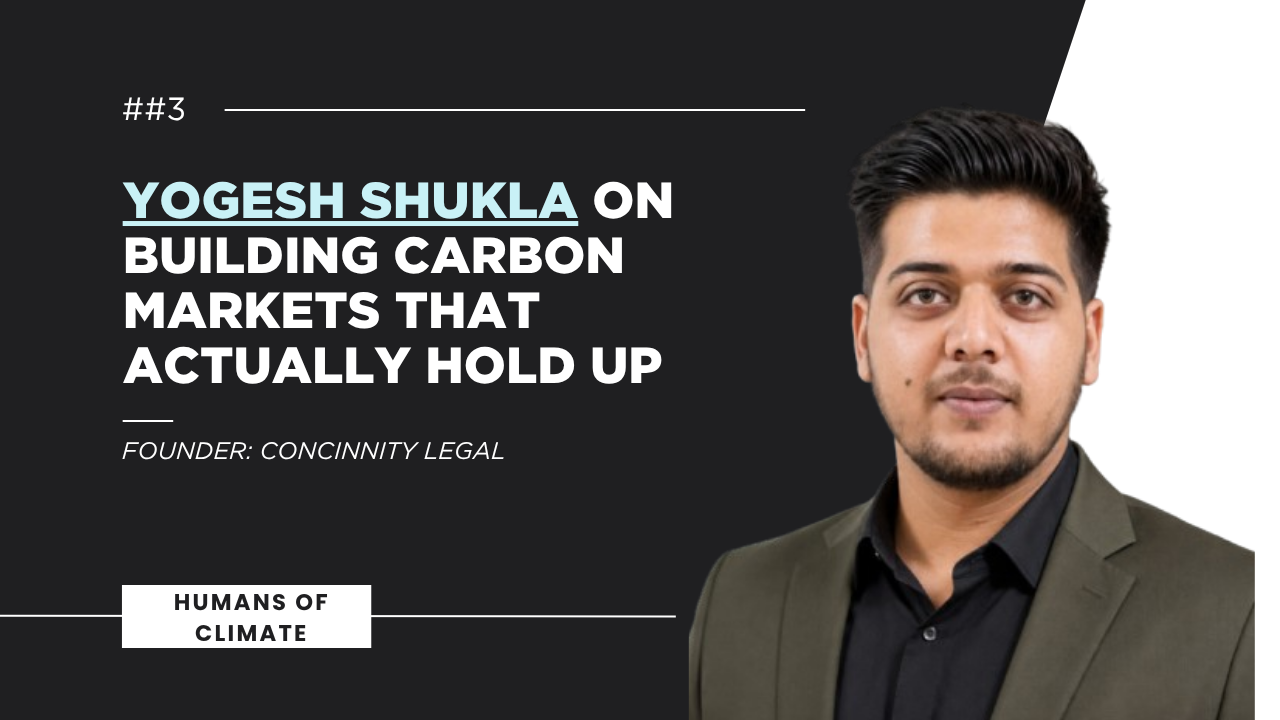
Carbon markets are frequently described as financial instruments, environmental tools, and policy mechanisms. They are rarely described as legal constructs. That omission, argues Adv. Yogesh Shukla, is one of the most consequential blind spots in the industry today.
Shukla is an advocate and the founder of Concinnity Legal, a practice focused on climate law, carbon transactions, and the increasingly complex regulatory terrain where environmental ambition meets commercial reality. He works across the full spectrum of carbon market participants: project developers structuring their first credit issuance, funds conducting pre-investment diligence, brands navigating their first market entry, and cross-border parties trying to align legal expectations that were never designed to align. His vantage point, sitting at the junction of climate science, finance, and law, has given him a precise and unsentimental view of where carbon markets are genuinely advancing and where they are quietly accumulating risk.
The argument he makes, steadily and through the granular detail of individual transactions, is that good climate outcomes require sound legal foundations. Without them, commercial value built on top of even the most credible environmental project becomes structurally exposed.
When Everyone Speaks the Same Word and Means Something Different
On being asked to Yogesh Shukla which discipline understands the others least in climate markets, and his answer is both direct and slightly subversive. None of them do, he says. Each side tends to underestimate the legal and commercial realities the other two are dealing with, and the consequences of that mutual incomprehension show up, repeatedly, in real transactions.
He illustrates the point with a scene that has become, in various forms, a recurring feature of his professional life. He has sat in a room where an engineer, a fund manager, and outside counsel were all using the word “additionality” and meant three different things by it. The scientists and engineers often assume that genuine climate benefit will be recognised and rewarded by the market without their needing to translate it into investor language. Investors focus hard on returns without always appreciating how much that return depends on additionality, permanence, and methodology requirements. Lawyers, for their part, can become so focused on compliance that they lose sight of whether the transaction is commercially viable at all.
“Carbon markets don’t grow because one discipline gets smarter on its own. They grow when these disciplines start complementing each other.”
Translation, as Shukla describes it, is not a peripheral function in his work. It is the work. Whether his counterpart is a project developer, an investor, a fund, an NGO, or a brand taking its first step into the space, the job is largely the same: helping people who are each fluent in their own language understand each other well enough that a project ends up legally sound and commercially viable, not just environmentally sound on paper.
What Capital Actually Looks For
There is a persistent assumption in carbon markets that strong climate impact is the primary driver of investor confidence. Yogesh’s experience suggests that assumption is both understandable and consistently wrong.
Climate impact, he argues, is only one part of the equation, and often not the part that determines whether capital actually arrives. Before committing, an investor needs to know that the project can generate credits consistently, year after year, not just in a best-case scenario. They need documentation that a due diligence team can actually rely on, clean and undisputed ownership of the carbon rights, revenue assumptions that are realistic rather than aspirational, and a legal structure that reduces uncertainty rather than adding to it.
He has seen projects with genuinely excellent environmental outcomes struggle to raise capital because these basic commercial and legal questions were left unanswered. He has also seen smaller, unremarkable-looking projects attract confident investors simply because the governance was transparent and the numbers were honest.
“At some point every investor conversation stops being about how good the story is and starts being about whether this particular team can actually execute it.”
The implications for project developers are specific. Commercial readiness, in his view, should not begin the day credits are issued. It should begin at project design. The best-performing projects he has seen are the ones where someone was thinking about documentation, legal rights, and the eventual transaction from day one, not attempting to reconstruct all of it after the fact.
Carbon Market Insider Newsletter
Weekly insights on carbon markets, climate policy, carbon credits, and sustainability.
The Lens That Carbon Markets Consistently Ignore
Among the multiple ways of seeing a carbon credit, Yogesh Shukla is categorical about which is most neglected. The legal lens, he says, and it is not close.
Most conversations about carbon credits are organised around climate impact or price. But every credit exists because a chain of legal relationships is holding it up: who owns it, who has the right to transfer it, how benefits are shared, what happens if delivery is delayed, which law governs the contract, and whether the underlying project actually complies with the applicable regulation. Strip away the legal scaffolding and the credit does not exist in any commercially meaningful sense.
What compounds this is that some fundamental legal questions in carbon markets remain genuinely unsettled. Whether carbon rights can be separated from land or operational rights depends on title documents, lease or concession terms, and how the project’s own agreements allocate that right. Whether a Carbon Credit Certificate should be characterised under Indian law as a good, a security, or something else is not resolved in the abstract. How it gets characterised in a particular transaction carries real consequences for tax treatment, transfer mechanics, and which regulator ends up with oversight.
“A carbon credit generally represents one tonne of avoided or removed emissions on paper. In practice it’s also a contractual asset, and law isn’t just regulating that market from the outside. It’s one of the things actually building it.”
The Supreme Court’s decision in M.K. Ranjitsinh v Union of India brought the point into sharp relief. The Court noted plainly that India still has no single, dedicated law on climate change, and built the right to be protected from its effects out of the general guarantees of equality and personal liberty in Articles 14 and 21 instead. When the country’s top court is constructing climate protection from constitutional principles because the legislature has not yet acted, the legal foundation problem stops being academic.
The Pattern Developers Miss in Their Own Projects
Across dozens of carbon projects, a pattern has emerged in Yogesh Shukla’s practice that most developers do not see in themselves. They spend years building the project itself and comparatively little time thinking about who is eventually going to buy the credits.
They know their technology in granular detail: the methodology, the monitoring system, the on-ground implementation. What they do not always anticipate is what a registry, an investor, or an international buyer will ask for two or three years down the line. Proof of ownership, including who actually holds beneficial ownership of the environmental attributes themselves, not just of the underlying project. Consistent data. Clean documentation. A chain of title that holds up if someone scrutinises it.
The hardest conversation he has had in this vein involved a developer who had built something with real environmental value. The documentation was incomplete, ownership of the carbon rights had not been resolved, and the monitoring systems needed serious work before anyone could rely on the data they were producing. The specific gap that stood out was that nobody had pinned down, in the land agreements or the financing documents, who actually controlled the environmental attributes the project would generate.
“Conversations like that are never easy. The person across the table has usually put years into the project, and you’re telling them it isn’t ready yet. But honesty serves people far better than encouragement does.”
Going to market prematurely, he argues, damages credibility in a way that is considerably harder to repair than the extra months it takes to prepare properly.
Regulation, Innovation, and the Timing Problem
On the question of whether regulation is enabling climate innovation or struggling to keep pace with it, Yogesh Shukla’s answer is unambiguous. Innovation moves faster, almost always, and he does not say that as a criticism of regulators.
Carbon markets sit at the intersection of environmental integrity, financial regulation, international trade, and public policy simultaneously. The regulatory challenge is compounded by a deeper structural shift. Regulation in India has historically operated through command and control: standards, permits, and penalties. What is happening now with schemes like the Carbon Credit Trading Scheme is something more difficult to design: regulators using incentives rather than restrictions, trying to shape behaviour through market mechanisms rather than mandating it directly.
The CCTS, notified in 2023, has moved well beyond the theoretical. Compliance obligations have been legally in force since the financial year beginning in 2025 for roughly 490 entities from energy-intensive sectors, and the first compliance filings under the scheme fell due at the end of July this year. What has not yet happened is the trading itself. The exchanges are expected to go live later this year. The legal obligation is real and running while the market infrastructure to transact against it is still being switched on.
“The real challenge isn’t speed. It’s designing rules that give the market certainty without locking it into a shape that kills the next round of innovation.”
That, he argues, only happens when regulators and industries operate in genuine sync, not merely during formal consultation windows.
The Advice He Hears and Rejects
Every emerging industry accumulates its own received wisdom, and carbon markets are no exception. The piece of advice Yogesh Shukla most consistently pushes back on is one of the most widely repeated: “Build the project first, think about carbon later.”
By the time a project is built, a significant number of decisions that affect its carbon potential have already been locked in: how it is designed, how it is monitored, what data gets collected, what the contracts and financing look like. Carbon does not have to be the primary business model for a project to benefit from being considered early.
“Treating carbon as something to figure out later usually just means figuring it out too late, after most of the options have already narrowed.”
The same principle, he notes, applies to climate startups more broadly. The decision about whether a business could plausibly generate carbon credits belongs at the idea stage rather than three years into development. It changes which technology choices make sense, what data is worth collecting from the outset, and how the financing gets structured. Even when the honest answer turns out to be no, working through that question early costs far less than retrofitting it once something has been built.
Where Trust Is Earned and Where It Is Assumed
Carbon credits only exist because trust exists. Yogesh Shukla is precise about where that trust is genuinely earned and where it is too often taken for granted.
Trust is earned, he says, through consistency, transparency, documentation, independent validation, reliable monitoring, honest communication, and agreements that hold up if something goes wrong. Where it is too often assumed is at the due diligence stage, specifically in the treatment of registry listings as though they answer every question, when they really only answer some of them.
He uses a concrete Indian example to make the point. Whether the same underlying generation from a renewable energy project can support an international certificate and also be claimed under the domestic offset mechanism comes down to what the project’s own documents say, what the registry rules actually permit, and whether the applicable standards allow those claims to sit alongside each other. A registry entry does not resolve that. Registries matter, he is clear on that, but they are one input into due diligence, not a replacement for it.
The broader argument about trust applies at the market level too. SEBI’s Business Responsibility and Sustainability Reporting requirements now compel India’s largest listed companies to disclose climate-related risk, not as a voluntary gesture but because a regulator decided disclosure needed to be mandatory. That kind of institutional habit, repeated across enough participants over enough years, is the material from which market-wide trust is actually made.
“Trust in this market gets built slowly, and through performance rather than messaging.”
The Cross-Border Dimension That Business Consistently Underestimates
As cross-border carbon transactions become more frequent, one legal and commercial challenge appears with a regularity that Yogesh Shukla finds striking. Companies consistently underestimate how much jurisdiction matters.
The pattern he sees is one of misplaced familiarity. Businesses treat a cross-border carbon credit transaction like any other international sale: agree on quantity and price, sign a contract, done. But different countries have different regulatory requirements for the underlying project, different tax treatment, different expectations of what a contract should cover, and different approaches to how carbon rights are recognised as property in the first place.
The India-EU situation offers a current and concrete illustration. India and the EU concluded free trade agreement negotiations at the start of this year, and the agreement includes a framework for continued engagement on concerns related to the EU’s Carbon Border Adjustment Mechanism. What it does not do is exempt Indian exporters from the CBAM itself. Nor does complying with India’s Carbon Credit Trading Scheme automatically count as a carbon price that can be deducted from CBAM liability. Whether India’s intensity-based scheme qualifies as a carbon price for that purpose under the CBAM Regulation is genuinely open, and depends on how the EU applies its own rules to a mechanism that does not look like a conventional carbon charge. Exporters in sectors like steel, cement, and aluminium need to be watching this closely.
“A contract that works perfectly well for a domestic deal can leave real gaps once you cross a border.”
Cross-border carbon deals require thinking about tax, regulatory characterisation, and jurisdiction from the outset. These are not afterthoughts to address once price and quantity are agreed.
What the Shift in Buyers Reveals About the Market
Of all the stakeholders Yogesh Shukla works with, he identifies buyers as the group that has changed most significantly over the past five years. The transformation, he says, is a healthy one.
Five years ago, most buyer conversations were organised around volume and price: how many credits and at what cost. Today the same conversations involve considerably deeper questions about project quality, legal rights, methodology, reputational risk, community impact, and long-term credibility. The kind of buyer has changed too. Shukla now spends as much time with funds conducting pre-investment diligence as he does with traditional buyers.
That shift in buyer sophistication, he argues, pushes the market toward better projects rather than simply bigger ones. It also raises the bar for developers and validators alike, which, for a market still working to establish the credibility it needs to grow, is exactly the right direction of pressure.
The Transaction That Changed How He Thinks
When Yogesh Shukla reflects on the single engagement that most fundamentally shaped his view of carbon markets, he points to a cross-border transaction involving parties based in India and elsewhere. The sharpest disagreement in the deal was never about price.
It was about exactly when title to the credits passed, and who carried the risk if issuance ended up delayed. The parties came from different regulatory cultures with different assumptions about what constitutes normal in a contract, and those assumptions, left unexamined, had the potential to unravel a transaction that was commercially sound on its face.
“A successful carbon deal is rarely just about credits changing hands. It’s about aligning legal expectations, commercial interests, timelines, and risk allocation across parties who often come from very different regulatory cultures.”
That experience crystallised for him how much of carbon market work is actually about making implicit assumptions explicit, before they become disputes.
What Climate Lawyers Will Do That Does Not Exist Yet
Looking twenty years ahead, Yogesh Shukla does not predict that climate lawyers will become more prominent. He predicts they will become more ordinary, and he means that as a compliment.
Drafting carbon rights documentation and registry participation arrangements will, he expects, become routine transactional work rather than specialty practice, the way a real estate lawyer drafts a lease today without anyone treating it as niche. Advising exporters on CBAM compliance and cross-border carbon obligations will be as standard as advising on any other trade regulation. Climate exposure will become a standard warranty and disclosure item in M&A and lending deals that have nothing intrinsically to do with carbon markets, the way tax representations are non-negotiable today.
The litigation prediction he is most willing to stand behind is specific. Disputes over who actually owns a batch of carbon credits, greenwashing claims, and disagreements over what a sustainability disclosure actually promised will move from occasional headlines to a routine docket over the next two decades. Climate lawyers, he argues, will not simply interpret the rules. Increasingly, they will help build the frameworks within which these markets operate, the way earlier generations of lawyers helped build the frameworks that capital markets and insolvency law now run on.
“I think we’ll become strategic transaction enablers rather than people who just show up to flag legal risk after the commercial decisions have already been made.”
Quick Takes
One climate regulatory framework every founder should understand: India’s Carbon Credit Trading Scheme. Even founders who never plan to touch the compliance market should understand roughly how it works, since it’s shaping actual carbon market demand in India.
One contract clause more important than people realise: A clear warranty against double counting, paired with exclusivity over the environmental attributes and a real remedy sitting behind it. The warranty alone sounds like boilerplate until a buyer discovers the same attribute was sold or claimed somewhere else.
One misconception investors have about carbon projects: That strong environmental impact automatically makes a project investment-ready. It doesn’t.
One sector in India sitting on enormous carbon market potential: Agriculture, particularly nature-based solutions and regenerative practices. The potential only becomes real once additionality, MRV, permanence, land tenure, and aggregation across small farms are solved for.
One emerging trend that excites him more than most people are talking about: Carbon markets quietly merging into mainstream corporate finance and supply chain strategy, instead of sitting off to the side as a separate ESG initiative.
One skill every climate entrepreneur should develop: The ability to translate. Getting a technical expert, an investor, and a regulator to actually understand each other in the same room is harder than it sounds, and more valuable than any single one of those skills alone.
One person he would love to debate on the future of carbon markets: Danny Cullenward. He’s a lawyer and climate economist, and has some very interesting views on the carbon markets,
One word that best describes India’s carbon market today: Emerging.
Carbon markets will succeed when…: “People trust the integrity of every individual credit as much as they trust the integrity of the institutions behind it.”
The biggest opportunity for India is…: “To become not just a leading supplier of high-quality carbon credits, but also a global leader in climate market governance, innovation, and legal infrastructure.”

Adv. Yogesh Shukla
Yogesh Shukla is a corporate and commercial lawyer who practices before the Hon’ble High Court of Delhi and is the Founder of Concinnity Legal, a law practice focused on climate and carbon markets in India. His work lies at the intersection of law, commerce, and the emerging carbon economy. He advises project developers, carbon market agencies, and businesses on carbon credit transactions, regulatory matters, commercial structuring, and related legal issues. He also works with project developers on raising capital, navigating the carbon credit issuance process, and facilitating the sale and trading of carbon credits by connecting them with relevant experts, investors, and market participants.