Carbon Market Network


If you have ever heard the phrase “Gold Standard certified carbon credit” and wondered what it actually means, you are in the right place.
The Gold Standard is one of the most trusted and respected carbon credit certification systems in the world. It sets the bar for what counts as a high-quality carbon offset. When a climate project earns this certification, it means the project has been rigorously checked, independently verified, and proven to deliver real climate and social benefits.
In this guide, you will learn everything you need to know about the Gold Standard, from what it is and how it works, to who uses it, how it compares to other standards, and what is new in 2026.
What Is Gold Standard? A Simple Definition
The Gold Standard is a certification framework for carbon offset projects. It was created to answer a simple but important question: how do we know that a carbon credit actually represents a real reduction in greenhouse gas emissions?
A Gold Standard certified project proves that:
- It has genuinely reduced or removed carbon dioxide (CO2) or other greenhouse gases from the atmosphere
- The reductions would not have happened without carbon finance (this is called “additionality”)
- The project also creates positive social and environmental benefits, known as co-benefits
- Independent auditors have verified everything
In short, the Gold Standard is like a quality seal of approval for carbon credits. It tells buyers, investors, governments, and the public that a project delivers what it promises.
Carbon Market Insider Newsletter
Weekly insights on carbon markets, climate policy, carbon credits, and sustainability.
Who Created the Gold Standard?
The Gold Standard was established in 2003 by WWF and other international NGOs as a best practice standard to ensure projects that reduced carbon emissions featured the highest levels of environmental integrity and contributed to sustainable development.
It was created to address concerns about the credibility of early carbon markets, setting a new benchmark for transparency, additionality, and sustainable development impact.
The Gold Standard operates as a non-profit Swiss foundation based in Geneva, Switzerland. The full name of the certifying body is the Gold Standard Foundation.
Gold Standard became an ISEAL subscriber in 2016 and developed Gold Standard for the Global Goals (GS4GG) in line with ISEAL requirements in July 2017. ISEAL is the global association for credible sustainability standards.
Gold Standard’s mission is to accelerate progress toward climate security and sustainable development for all by catalysing finance and maximising its impact.
Understanding Gold Standard for the Global Goals (GS4GG)
The modern framework is officially called Gold Standard for the Global Goals, commonly written as GS4GG.
The foundation runs the Gold Standard for the Global Goals (GS4GG), which is the standard that carbon credit projects are certified against. It enables carbon projects to quantify and certify their impacts against a high bar of environmental and social benefits.
Projects can be issued Gold Standard carbon credits after robust assurance of emission reductions as well as contributing to at least two additional Sustainable Development Goals to ensure a positive impact.
Furthermore, Gold Standard carbon credits require a gender and stakeholder-inclusive design and the implementation of different environmental and social safeguards.
The GS4GG framework was designed to align directly with the United Nations Sustainable Development Goals (SDGs) and the Paris Climate Agreement.
This means every Gold Standard project does more than just reduce emissions. It also helps communities, improves livelihoods, and protects ecosystems.
Why Were the SDGs Built Into Gold Standard?
Most people assume that a carbon credit is only about reducing CO2. Gold Standard takes a broader view.
Every Gold Standard project must make a measurable difference to at least three of the UN’s Sustainable Development Goals.
Why does this matter? Because climate change does not exist in isolation. A cookstove project in rural Kenya, for example, does not just reduce deforestation.
It also improves indoor air quality (SDG 3: Good Health), reduces the burden on women who collect firewood (SDG 5: Gender Equality), and creates local employment (SDG 8: Decent Work and Economic Growth).
By requiring SDG contributions, Gold Standard ensures that carbon finance does real good in the world, not just on paper.
What Types of Projects Does Gold Standard Certify?
Gold Standard was originally designed to certify high-quality renewable energy and energy efficiency projects, with a strong emphasis on sustainable development. Since then, the scope of Gold Standard has broadened significantly. Under its current framework, the standard supports a wide range of climate and development interventions.
Gold Standard carbon credits can be issued under three different scopes: community services projects, renewable energy projects, and land use and forestry projects.
Here is a breakdown of the main project categories:
1. Community Services Projects
These are projects that directly benefit local communities while reducing emissions. Examples include:
- Clean cooking projects (fuel-efficient cookstoves)
- Safe drinking water projects (water purification to reduce fuel use for boiling water)
- Household biogas (producing clean gas from organic waste)
- Lighting solutions (replacing kerosene lamps with solar lights)
Community projects are among the most popular Gold Standard project types because they combine strong carbon outcomes with high social impact.
2. Renewable Energy Projects
These projects generate clean electricity or heat, replacing fossil fuel use. Examples include:
- Solar power plants
- Wind energy projects
- Small-scale hydropower
- Biomass energy
These projects must demonstrate that they are truly additional, meaning the clean energy would not have been produced without carbon finance.
3. Land Use and Forestry Projects
These projects protect or restore forests and natural ecosystems that absorb CO2. Examples include:
- Afforestation and reforestation
- Avoided deforestation
- Improved forest management
- Agriculture soil carbon projects
- Wetland restoration and blue carbon
Land-use projects require strict permanence standards because forests can be lost to fire, disease, or illegal logging.
How Does Gold Standard Certification Work? Step by Step
Getting a Gold Standard certification is a rigorous process. Here is how it works from start to finish.
Step 1: Project Design
The project developer designs the climate project and prepares a detailed Project Design Document (PDD). This document explains what the project will do, how emissions will be reduced, and how SDG impacts will be measured.
Step 2: Stakeholder Consultation
Before anything is submitted, the project must conduct public stakeholder consultations. This means talking to local communities, governments, and NGOs who may be affected by the project. Their feedback must be documented and addressed.
Gold Standard places a strong emphasis on gender-inclusive and community-inclusive design. Women and marginalized groups must be specifically engaged during this stage.
Step 3: Validation
An independent, accredited third-party auditor (called a Validation and Verification Body, or VVB) reviews the project design. They check that the methodology is correct, that additionality is demonstrated, and that SDG contributions are credible.
Step 4: Design Certification
Once the VVB submits its validation report, Gold Standard reviews the project and grants Design Certification if everything meets the standard. The project is now listed on the Gold Standard Impact Registry.
Step 5: Implementation and Monitoring
The project runs and begins reducing emissions. The project team monitors, measures, and records all data according to the approved methodology.
Step 6: Verification
A VVB conducts a field visit and reviews the monitoring data. They verify that the claimed emissions reductions actually happened. Once the third-party verification is completed, the VVB uploads the final verification report and any other relevant documentation onto the Assurance Platform. Gold Standard conducts a completeness check and then initiates the global consultation, which runs for two weeks in parallel with the performance review.
Step 7: Issuance of Carbon Credits
Gold Standard issues the certification outcomes, including carbon credits where relevant, into the Gold Standard Impact Registry based on the decision provided by the VVB. Approval results in “Certified Gold Standard Project” status.
Each carbon credit issued represents one metric tonne of CO2 equivalent reduced or removed.
Step 8: Sale, Transfer, and Retirement
Credits can be sold on the voluntary carbon market. When a company buys credits to offset its emissions, it “retires” them. Retired credits cannot be used again. This prevents double-counting.
The Gold Standard Impact Registry
The Gold Standard Impact Registry is where products for Gold Standard projects, such as carbon credits, are issued, held, transferred, and retired, providing transparency and credibility. It can be considered the “source of truth” for information related to Gold Standard products, with unique serial numbers generated for every issued credit, allowing full traceability through the lifecycle of the credit from generation to sale, and eventual use or retirement. It also showcases the certified Sustainable Development Goal (SDG) impacts.
The Impact Registry is publicly accessible. Anyone can look up a project, see how many credits have been issued, and verify whether credits have been retired. This level of transparency is one of Gold Standard’s most important features.
The Five Principles of Gold Standard Certification
Gold Standard projects must satisfy five core eligibility principles. These principles are the backbone of the standard’s integrity.
Principle 1: Contribution to Climate Security and Sustainable Development
Every project must demonstrate that it contributes to SDG 13 (Climate Action) plus at least two additional SDGs. This ensures every certified project goes beyond just carbon.
Principle 2: Safeguarding Principles
Projects must do no harm. Gold Standard requires that projects assess and manage risks to communities, ecosystems, and human rights. If a project could cause negative impacts, it must put safeguards in place to prevent them.
Principle 3: Stakeholder Inclusivity
Meaningful consultation with local stakeholders, including women and vulnerable groups, is mandatory. This is not a checkbox exercise. Gold Standard requires documented, responsive engagement.
Principle 4: Demonstration of Real Outcomes (MRV)
Projects must use approved Monitoring, Reporting, and Verification (MRV) methodologies to prove that emission reductions actually happened. This must be verifiable by an independent auditor.
Principle 5: Additionality
This is perhaps the most critical principle. The project must prove that the emission reductions go beyond “business as usual.” If the project would have happened anyway without carbon finance, it is not eligible.
What Is Additionality and Why Does It Matter?
Additionality is the concept that a project’s emission reductions would not have occurred without the revenue from carbon credits.
Think of it this way. If a solar farm in a country with a strong renewable energy mandate was going to be built regardless, selling carbon credits for it would not represent any additional benefit to the climate. The emissions were going to be avoided anyway.
Gold Standard’s additionality requirements are strict. Projects must demonstrate that:
- The project faces financial, technical, or regulatory barriers that carbon finance helps overcome
- The technology or practice is not already “common practice” in the market
- The project goes beyond national climate targets and regulatory requirements
Gold Standard is updating its framework to align with the Paris Agreement’s long-term temperature and emissions goals for all 2026+ vintage credits, including reflecting national climate targets and regulatory additionality, and ensuring credits represent real progress, not static business-as-usual.
Gold Standard and the Paris Agreement: Major 2026 Updates
This is one of the most important developments in the Gold Standard’s history.
Paris Alignment Becomes Mandatory from January 2026
Gold Standard mandates that all carbon credits (GSVERs) with a vintage of 1 January 2026 and onwards must be quantified using Paris Agreement-aligned methodologies.
The mandatory cut-off means that the use of non-PA-aligned methodologies for issuance of GSVERs ended strictly on 31 December 2025.
This is a major shift. Before 2026, some projects still used older Clean Development Mechanism (CDM) methodologies designed under the Kyoto Protocol era. Those methods are now retired.
What This Means for Projects
Effective from January 1, 2026, updated requirements include Methodology Development V1.0 to bolster the robustness of carbon crediting methods, and Additionality Demonstration V1.0, providing a framework to confirm that emission reductions go beyond business-as-usual under the Paris Agreement.
Gold Standard has also updated its GHG Emissions Reduction and Sequestration Product Requirements to align requirements related to Article 6 authorisations with the latest UNFCCC decisions adopted at COP29.
Why This Matters
Countries are now implementing Nationally Determined Contributions (NDCs). From 2026 onwards, carbon credits must reflect this reality to avoid over-crediting against outdated baselines.
Clean Development Mechanism (CDM) methodologies are being withdrawn, as they are no longer suited to the Paris Agreement era.
In plain terms: old baselines assumed a world without ambitious climate targets. Today, every country has climate commitments. A project in a country where the government is already phasing out coal, for example, needs to show that its emission reductions go beyond what the national policy already requires.
Biomass Accounting Updates for Clean Cooking
The Gold Standard has determined that the additional criteria for meeting the Core Carbon Principles (CCP) requirements will be mandatory for all projects from January 2026.
The Foundation myclimate expects this step to reduce the supply of CO2 certificates from these projects, but anticipates that it will significantly improve quality and put an end to over-crediting.
Clean cooking projects were among the most scrutinized in the market. The new biomass accounting rules ensure that only genuinely non-renewable biomass is counted toward emission reductions.
Gold Standard and CORSIA
CORSIA stands for the Carbon Offsetting and Reduction Scheme for International Aviation. It is the global framework for airlines to offset their CO2 emissions.
Gold Standard has for the first time labelled carbon credits as eligible to be used under Phase One of CORSIA, marking a step forward in the functioning of CORSIA and other compliance frameworks worldwide.
This is significant. CORSIA eligibility means Gold Standard credits can now be used by airlines to meet their legally binding emissions reduction obligations. This opens a large new market for Gold Standard certified projects.
Gold Standard is updating all existing methodologies to align with the principles of the Paris Agreement. Non-Paris-aligned methodologies will be retired, and PA-aligned versions must be applied for all vintage 2026 issuances.
Gold Standard and Article 6 of the Paris Agreement
Article 6 of the Paris Agreement allows countries to trade emission reductions internationally. This is one of the most complex and important developments in carbon markets today.
Gold Standard is actively preparing its framework for Article 6 participation.
The fee schedule includes a per-credit fee for transfers, retirements and cancellations as well as a fee for labelling Article 6 and CORSIA credits. These fees have been applied to reflect and support the increase in administration and infrastructure costs.
When a Gold Standard credit is authorized under Article 6, it can be used by governments to meet their NDC commitments through Internationally Transferred Mitigation Outcomes (ITMOs). This creates a new layer of value for high-quality credits.
Gold Standard vs. Verra VCS: Key Differences
The two biggest names in voluntary carbon certification are Gold Standard and Verra (Verified Carbon Standard or VCS). Here is how they compare.
Overview
| Feature | Gold Standard | Verra VCS |
|---|---|---|
| Founded | 2003 | 2005 |
| Headquarters | Geneva, Switzerland | Washington, D.C., USA |
| Primary focus | Carbon + SDGs | Carbon reduction |
| SDG requirements | Mandatory (min. 3 SDGs) | Optional (SD VISta add-on) |
| Project types | Community, renewables, land use | Very broad (widest range) |
| Reputation | Premium quality | Largest market volume |
| Price per credit | Generally higher | Generally more variable |
| Best for | ESG-focused buyers, community projects | Large-scale, diverse projects |
Key Differences Explained
SDG Co-Benefits
Unlike other certification standards, Gold Standard requires projects to go beyond emissions reductions. They must also contribute to the United Nations Sustainable Development Goals (SDGs), such as improving health, gender equality, and economic opportunities for local communities.
Verra does not require SDG contributions under its VCS standard, though it offers an optional add-on called SD VISta.
Market Scale
Managed by Verra, VCS is the most widely used standard globally, covering nearly all project types. Gold Standard is known for its strict co-benefit requirements, offering highly traceable and transparent credits, often at a higher price point.
MRV Approach
The difference lies in audit scope: Gold Standard emphasizes stakeholder participation and co-benefit management quality; Verra prioritizes carbon quantification integrity and leakage risk assessment.
Choosing Between Them
If your ESG communications emphasize community and development impact alongside climate, Gold Standard provides a stronger narrative. If your priority is access to the largest market with the most project types and competitive pricing, VCS offers more flexibility.
How Much Do Gold Standard Carbon Credits Cost?
The price of a Gold Standard carbon credit varies depending on the project type, location, vintage year, and market conditions.
Credits from recognized standards such as Verra and Gold Standard are priced higher due to perceived reliability.
As a general guide for 2025 to 2026:
- Lower-cost Gold Standard credits (older renewables, some community projects) can trade at around $5 to $15 per tonne
- Premium Gold Standard credits (cookstove projects with strong MRV, land-use projects with robust buffers) often trade at $15 to $50 per tonne or more
- High-integrity credits screened by ICVCM can command 25% premiums above uncertified equivalents
The voluntary carbon market will hit around 3 billion euros in 2026 and is projected to reach 15 billion euros by 2035, fueled by stricter regulations, new integrity standards like ICVCM’s Core Carbon Principles, and surging corporate net-zero commitments.
The general trend is clear: quality now commands a premium. Buyers who once focused on buying the cheapest offsets available are now paying more for verified, Paris-aligned, high-integrity credits.
Who Buys Gold Standard Carbon Credits?
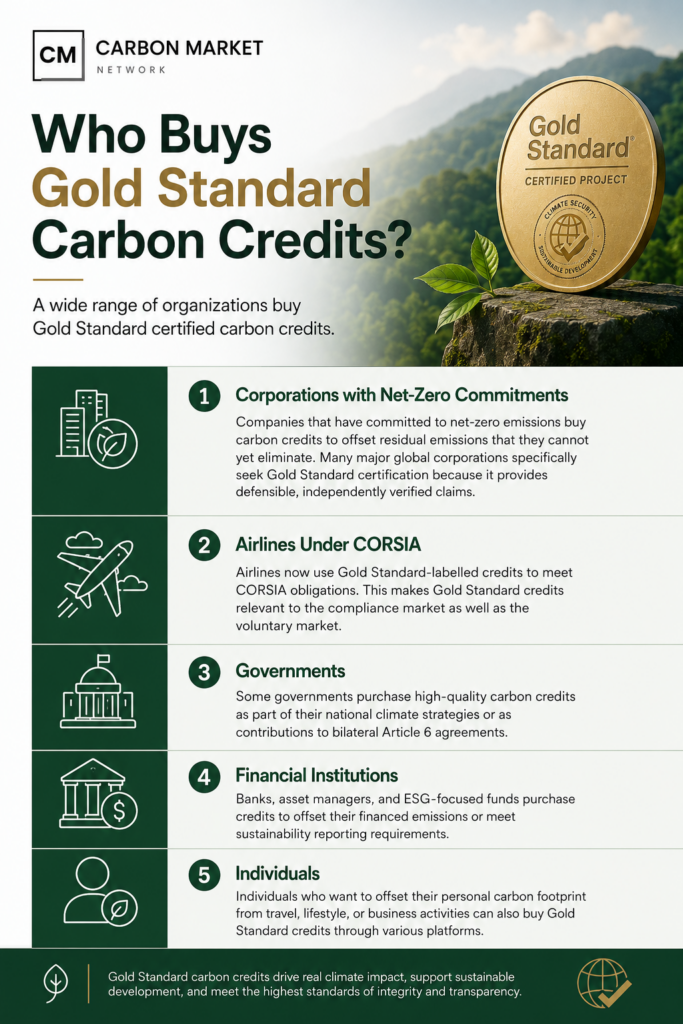
A wide range of organizations buy Gold Standard certified carbon credits.
Corporations with Net-Zero Commitments
Companies that have committed to net-zero emissions buy carbon credits to offset residual emissions that they cannot yet eliminate. Many major global corporations specifically seek Gold Standard certification because it provides defensible, independently verified claims.
Airlines Under CORSIA
Airlines now use Gold Standard-labelled credits to meet CORSIA obligations. This makes Gold Standard credits relevant to the compliance market as well as the voluntary market.
Governments
Some governments purchase high-quality carbon credits as part of their national climate strategies or as contributions to bilateral Article 6 agreements.
Financial Institutions
Banks, asset managers, and ESG-focused funds purchase credits to offset their financed emissions or meet sustainability reporting requirements.
Individuals
Individuals who want to offset their personal carbon footprint from travel, lifestyle, or business activities can also buy Gold Standard credits through various platforms.
Gold Standard and the ICVCM Core Carbon Principles
The Integrity Council for the Voluntary Carbon Market (ICVCM) published its Core Carbon Principles (CCPs) to define what a high-quality carbon credit looks like. The CCPs cover areas like additionality, permanence, transparency, and social safeguards.
The Gold Standard has made the important decision to align its methodologies for project types that reduce the use of non-renewable biomass with the CCP, with this being mandatory from 2026.
This marks an essential step towards greater quality and integrity in the voluntary carbon market.
Alignment with the CCPs is becoming increasingly important for corporate buyers. Companies facing scrutiny under the EU Corporate Sustainability Reporting Directive (CSRD) and other regulations need credits that can withstand external audit.
Only 16% of carbon credits meet the highest standards for real environmental and social impact.
Gold Standard certification ensures additionality, transparency, and sustainable development co-benefits, making it the most trusted benchmark in the voluntary carbon market.
Real-World Examples of Gold Standard Projects
Clean Cookstove Projects in Sub-Saharan Africa
One of the most common Gold Standard project types involves distributing fuel-efficient cookstoves to households in countries like Kenya, Ethiopia, Uganda, and Ghana. Traditional cookstoves burn biomass inefficiently, producing large amounts of black carbon and CO2.
A Gold Standard cookstove project:
- Measures the fuel saved compared to a traditional stove
- Counts the emission reductions from less burning
- Documents health improvements from reduced smoke inhalation
- Records economic benefits for households spending less on fuel
Each stove can generate several carbon credits per year per household.
Safe Drinking Water Projects in Cambodia and Bangladesh
Water purification projects provide clean drinking water to communities, eliminating the need to boil water over open fires. By removing the need to burn wood or charcoal, these projects reduce emissions while also improving health outcomes.
These projects typically qualify for SDG 3 (Good Health), SDG 6 (Clean Water and Sanitation), and SDG 13 (Climate Action).
Renewable Energy in India and Southeast Asia
Small-scale solar and wind projects in developing countries use Gold Standard certification to attract carbon finance. The credits generated help cover the upfront capital cost of building clean energy infrastructure.
Reforestation in South America and Africa
Land-use projects protect existing forests and restore degraded land. The trees absorb CO2 over time, and the project generates carbon removal credits. Gold Standard requires a 20% buffer pool for forestry projects to account for permanence risks such as fire or disease.
Gold Standard and Corporate Net-Zero Claims
As more companies commit to net-zero targets, carbon credits have become a central tool in corporate sustainability strategies.
However, not all carbon credits are accepted equally under today’s frameworks.
In 2026, purchasing carbon credits is no longer a simple transactional “offset” to claim carbon neutrality. It has evolved into a strategic instrument for Beyond Value Chain Mitigation (BVCM). For corporate sustainability leaders, the focus has shifted from volume to integrity.
The Science Based Targets initiative (SBTi) is clear that carbon credits cannot replace internal emission reductions. They should be used to address residual emissions that a company cannot yet eliminate.
For companies subject to the EU’s CSRD, Gold Standard credits must now be disclosed in detail in sustainability reports. This includes the project ID, methodology, vintage year, whether the reduction is an avoidance or removal, and whether it is Article 6 authorized.
Gold Standard’s public registry makes all of this information accessible, which simplifies disclosure and audit preparation.
Common Criticisms of Gold Standard (and How They Are Being Addressed)
No certification system is perfect. Here are the main criticisms that have been raised about Gold Standard and how the organization is responding.
Criticism 1: Additionality Concerns for Renewable Energy Credits
Grid-connected renewable energy credits face widespread additionality concerns, particularly for projects registered years ago in countries with supportive policy environments and falling technology costs.
Analysis shows that around one-third of voluntary-market credits, heavily weighted toward renewables, fail ICVCM’s CCP additionality tests. Many legacy Gold Standard renewable projects fall into this category.
Response: Gold Standard’s 2025 to 2026 rule updates strengthen additionality requirements and baseline conservativeness. The new Paris alignment requirements directly address this by requiring projects to demonstrate additionality relative to national climate policies.
Criticism 2: Over-Crediting in Clean Cooking Projects
Some cookstove projects have been criticized for generating more credits than the actual emission reductions warrant, particularly due to assumptions about how often stoves are used.
Response: The new biomass accounting updates and mandatory CCP alignment aim to end over-crediting. The use of metered stoves and real-time data collection is now encouraged.
Criticism 3: Cost and Complexity of Certification
Small project developers, especially in developing countries, sometimes find the certification process expensive and time-consuming.
Response: Gold Standard has published extensive free resources, training programs, and simplified processes for small-scale projects. It also offers project design templates and community support.
Criticism 4: Permanence Risks in Land-Use Projects
Trees can be burned, cut down, or destroyed by disease. This raises questions about whether forestry credits represent permanent emission reductions.
Response: Gold Standard’s 20% buffer pool requirement and regular re-verification requirements address this. If a forest suffers a major loss event, credits from the buffer pool are cancelled to compensate.
How to Verify a Gold Standard Carbon Credit
Anyone can verify whether a carbon credit is Gold Standard certified. Here is how.
Step 1: Visit the Gold Standard Impact Registry at registry.goldstandard.org.
Step 2: Search for the project by name, ID, or country.
Step 3: Review the project documentation, including the methodology, verification reports, and SDG impact data.
Step 4: Check the credit serial number. Every Gold Standard Verified Emission Reduction (GS-VER) has a unique serial number that tracks its entire lifecycle.
Step 5: Confirm whether the credits have been retired. Retired credits appear with a retirement record showing the date and the retiring entity.
This level of transparency is what makes Gold Standard one of the most trusted systems in the carbon market.
The Gold Standard Fee Structure (2025 to 2026)
In December 2024, Gold Standard published an updated fee schedule to manage the evolution of carbon markets whilst maintaining focus on mission alignment in supporting high-impact projects in countries where finance is slower to reach. The fee schedule includes a per-credit fee for transfers, retirements and cancellations as well as a fee for labelling Article 6 and CORSIA credits.
For project developers planning in 2026, the key fees to know include:
- Listing and design certification fees for registering a new project
- Issuance fees charged when credits are issued (per tonne)
- Transfer fees when credits change ownership on the registry
- Retirement fees when credits are permanently cancelled
- Article 6 or CORSIA labelling fees for credits being used in compliance contexts
Gold Standard makes its full fee schedule publicly available on its website for transparency.
Future of the Gold Standard: What to Expect Beyond 2026
The carbon markets are changing rapidly and Gold Standard is evolving with them.
Full Paris Alignment Across All Methodologies
All Gold Standard methodologies are to be Paris Agreement aligned by the end of 2026. This means buyers and project developers can expect all new credits to meet the highest bar for Paris alignment by the close of the year.
Growing Demand for High-Integrity Credits
Quality now trumps price. With 95 million credits retired in H1 2025 alone, businesses are increasingly paying premiums for verified, transparent credits from Verra, Gold Standard, and similar registries to avoid greenwashing risks and future compliance headaches.
Expansion of Engineered Removals
Gold Standard is beginning to develop methodologies for engineered carbon removal technologies such as biochar, enhanced weathering, and direct air capture. As these technologies scale, Gold Standard certification will help ensure their credits are trustworthy.
Article 6 Growth
As more countries operationalize their Article 6 frameworks, Gold Standard-labeled credits with host country authorizations will become more valuable. This creates new opportunities for project developers in countries with ambitious NDCs.
CORSIA Phase Expansion
Phase One of CORSIA covers 2021 to 2026. As CORSIA expands to cover more airlines and more routes in subsequent phases, the demand for eligible credits from recognized standards like Gold Standard will grow.
Gold Standard vs. Other Carbon Standards: Quick Comparison
| Standard | Operator | Key Strength | Best Use Case |
|---|---|---|---|
| Gold Standard (GS4GG) | Gold Standard Foundation | SDG co-benefits, high integrity | ESG buyers, community projects, CORSIA |
| Verra VCS | Verra | Broadest methodology range | Large-scale, diverse project types |
| American Carbon Registry (ACR) | Winrock International | US compliance markets | North American projects, CORSIA |
| Climate Action Reserve (CAR) | Climate Action Reserve | US regulatory focus | Livestock, forestry, landfill gas |
| Plan Vivo | Plan Vivo Foundation | Community-led projects | Smallholder agriculture, agroforestry |
Each standard has strengths in different areas. Gold Standard stands out for its mandatory social and environmental co-benefit requirements and its strong governance structure.
How to Start a Gold Standard Certified Project: A Practical Overview
If you are a project developer, land owner, NGO, or entrepreneur considering starting a Gold Standard project, here is what the journey looks like.
1. Identify a suitable project type. Review Gold Standard’s approved methodology list. Make sure your project type and geography are eligible.
2. Choose your methodology. Gold Standard offers 30+ methodologies covering different sectors and geographies. From January 2026, only Paris Agreement-aligned methodologies can be used for new credit vintages.
3. Conduct a feasibility study. Estimate how many carbon credits your project could generate per year and whether the revenue justifies the certification costs.
4. Engage local stakeholders. Begin the mandatory consultation process early. Document everything carefully.
5. Hire a Validation and Verification Body (VVB). Select an accredited VVB from Gold Standard’s approved list. They will review your project design and later verify your monitoring data.
6. Submit for design certification. Upload all required documents to the Gold Standard Assurance Platform.
7. Implement, monitor, and maintain records. Set up robust monitoring systems from day one.
8. Apply for verification and credit issuance. After an agreed monitoring period (typically one to five years for the first verification), apply for your first credit issuance.
The full process can take one to two years from design to first credit issuance, depending on the project type and geography.
Key Terms Every Carbon Market Participant Should Know
Additionality: The principle that emission reductions would not have occurred without carbon finance.
Baseline: The estimated emissions that would have happened if the project did not exist.
Co-benefits: Positive impacts beyond carbon reduction, such as improved health, biodiversity, or economic opportunity.
Double counting: When the same emission reduction is claimed by more than one party. Gold Standard’s registry system prevents this.
GS-VER (Gold Standard Verified Emission Reduction): The formal name for a carbon credit issued by Gold Standard.
GSVER vintage: The year in which the emission reduction occurred, not the year the credit was issued.
ITMO (Internationally Transferred Mitigation Outcome): An emission reduction unit transferred between countries under Article 6 of the Paris Agreement.
MRV: Monitoring, Reporting, and Verification. The process of measuring and proving emission reductions.
NDC (Nationally Determined Contribution): A country’s climate action plan submitted under the Paris Agreement.
Permanence: The guarantee that emission reductions or removals will last long enough to matter for the climate.
Retirement: The permanent cancellation of a carbon credit to prevent it from being used again.
VVB (Validation and Verification Body): An independent auditor accredited to review Gold Standard projects.
Frequently Asked Questions About Gold Standard
Q1. What is the Gold Standard in simple terms?
The Gold Standard is a globally recognized certification system for carbon offset projects. It ensures that a carbon credit represents a real, verified, and additional emission reduction, and that the project also delivers social and environmental benefits alongside climate impact.
Q2. Is Gold Standard the same as Verra VCS?
No. Gold Standard and Verra VCS are separate, independent certification standards. Gold Standard requires mandatory SDG co-benefits and places a strong emphasis on community and environmental impact. Verra VCS covers a broader range of project types with more methodological flexibility.
Q3. What does a Gold Standard carbon credit represent?
One Gold Standard carbon credit (called a GS-VER) represents one metric tonne of CO2 equivalent that has been reduced or removed from the atmosphere. It has been independently verified and meets Gold Standard’s rigorous criteria.
Q4. How can I verify a Gold Standard carbon credit?
You can verify any Gold Standard credit through the publicly accessible Gold Standard Impact Registry at registry.goldstandard.org. Every credit has a unique serial number that tracks its full lifecycle from issuance to retirement.
Q5. Are Gold Standard credits accepted for CORSIA?
Yes. Gold Standard has achieved CORSIA eligibility, meaning airlines can use Gold Standard labeled credits to meet their CORSIA compliance obligations under the international aviation offset scheme.
Q6. How are Gold Standard credits different from regular carbon credits?
Not all carbon credits are created equal. Gold Standard credits must meet much stricter criteria than unverified or low-quality credits. They require independent third-party verification, proof of additionality, and contributions to at least three UN SDGs. This is why they typically trade at a premium.
Q7. What is the Gold Standard for the Global Goals (GS4GG)?
GS4GG is the official name of the modern Gold Standard framework. It was designed in alignment with the Paris Climate Agreement and the UN Sustainable Development Goals. All Gold Standard certified projects today are certified under GS4GG.
Q8. How long does it take to get Gold Standard certified?
The time varies depending on the project type and complexity. For a new project, design certification and first verification typically take one to two years in total. Subsequent verification cycles are usually faster.
Q9. What changes has Gold Standard made in 2026?
From January 1, 2026, all new Gold Standard credits must use Paris Agreement-aligned methodologies. This includes updated additionality requirements, new biomass accounting rules for clean cooking projects, and alignment with COP29 decisions on Article 6. These changes significantly raise the quality bar for new credits.
Q10. Can individuals buy Gold Standard carbon credits?
Yes. Individuals can purchase Gold Standard credits through various online platforms and carbon credit marketplaces to offset their personal carbon footprint. The credits can be retired in their name through the Gold Standard Impact Registry.
Conclusion: Why the Gold Standard Matters More Than Ever
The Gold Standard is not just a label. It is a rigorous, independent, and transparent system that has spent over two decades proving that climate finance can deliver real results for people and the planet.
In a world where greenwashing is a serious risk and carbon market integrity is under increasing scrutiny, the Gold Standard provides exactly what buyers, regulators, and communities need: proof that a carbon credit is worth something.
With its 2026 Paris alignment updates, CORSIA eligibility, and expanded Article 6 framework, Gold Standard is more relevant today than at any point in its history. It has set the standard for what the voluntary carbon market can and should be.
Whether you are a company building a net-zero strategy, a project developer in a developing country, an investor evaluating carbon assets, or simply someone who wants to understand how climate finance works, the Gold Standard is a name you need to know.
It is called the Gold Standard for a reason.
This article reflects information available as of May 2026. Gold Standard requirements and fee schedules may be updated periodically. Always refer to the official Gold Standard website for the most current requirements. Website – https://www.goldstandard.org/