Carbon Market Network


If you have ever tried to buy or sell a carbon credit, you have probably asked one simple question: how do I know this credit is real?
That question is exactly why carbon credit registries exist. They are the backbone of the entire carbon market. They track every credit from the moment a project generates it to the moment a company retires it. Without them, the voluntary carbon market would collapse under the weight of fraud, double-counting, and greenwashing.
In this guide, you will get a full breakdown of the best carbon credit registries operating in 2026. Whether you are a project developer, a corporate sustainability lead, or just someone trying to understand how the carbon market works, this article covers everything you need to know.
What Is a Carbon Credit Registry?
A carbon credit registry is a public database that records the creation, ownership, transfer, and retirement of carbon credits.
Think of it like a stock exchange ledger, but for carbon. Every credit gets a unique serial number. Every transaction gets recorded. And when a company uses a credit to offset its emissions, the registry marks that credit as “retired” so no one else can claim it.
This system prevents one of the biggest risks in the carbon market: double-counting. Without a registry, the same credit could be sold to two different buyers, which would mean only one tonne of CO2 was reduced but two companies claimed the credit for it.
Registries also do far more than just bookkeeping. They set the rules for what counts as a valid carbon project, approve the methodologies projects must follow, require independent third-party audits, and publish all project documents publicly.
Carbon Market Insider Newsletter
Weekly insights on carbon markets, climate policy, carbon credits, and sustainability.
Why Carbon Credit Registries Matter More Than Ever in 2026
The carbon market is under intense scrutiny right now. Regulators, journalists, and corporate legal teams are all asking harder questions about credit quality. Greenwashing lawsuits are on the rise. The EU’s Empowering Consumers Directive, coming into force in September 2026, bans generic “climate neutral” claims that are not backed by rigorous, verifiable evidence.
At the same time, the market is also growing. Article 6 of the Paris Agreement, finalized at COP29 in 2024, now provides a proper international rulebook for cross-border carbon trading. This means the role of registries is expanding, not shrinking.
In 2026, choosing the right registry is not just a technical decision. It is a reputational one. Credits certified by a recognized, high-integrity registry carry weight. Credits from lesser-known or low-rigor registries carry risk.
Understanding the differences between the leading registries helps you make smarter decisions, whether you are buying, selling, or simply learning.
How a Carbon Credit Registry Works: The Step-by-Step Process
Before diving into specific registries, it helps to understand how the process actually works.
Step 1: A developer designs a project. A project developer creates a plan for reducing or removing greenhouse gases. This could be a reforestation project, a methane capture facility, a cookstove distribution program, or a biochar production operation. The developer chooses a registry and follows that registry’s approved methodology for measuring the expected emissions reductions.
Step 2: Third-party validation. An independent auditor, accredited by the registry, reviews the project design. They check whether the project is additional (meaning it would not have happened without carbon finance), whether the methodology is sound, and whether the emission estimates are credible.
Step 3: The project gets registered. Once validation passes, the project gets officially listed in the registry’s public database. All project documents become publicly available for anyone to review.
Step 4: Verification and credit issuance. After the project runs for a period of time (usually one to three years), another independent audit takes place to verify the actual emissions reductions achieved. The registry then issues credits into the developer’s account, typically one credit per verified tonne of CO2 reduced or removed.
Step 5: Credits are sold and transferred. The developer sells credits to buyers. The registry records each transfer of ownership. This creates a transparent chain of custody.
Step 6: Retirement. When a company wants to use a credit to offset its emissions, it retires the credit. The registry permanently moves that credit into a retirement account. It can never be resold or reused. The registry issues a retirement certificate, which the company can use to demonstrate its climate action.
This whole process ensures that carbon credits are real, measurable, independently verified, and cannot be claimed twice.
The Best Carbon Credit Registries in 2026
Here is a detailed look at the top registries operating globally in 2026. These are the registries that account for the overwhelming majority of voluntary carbon market activity.
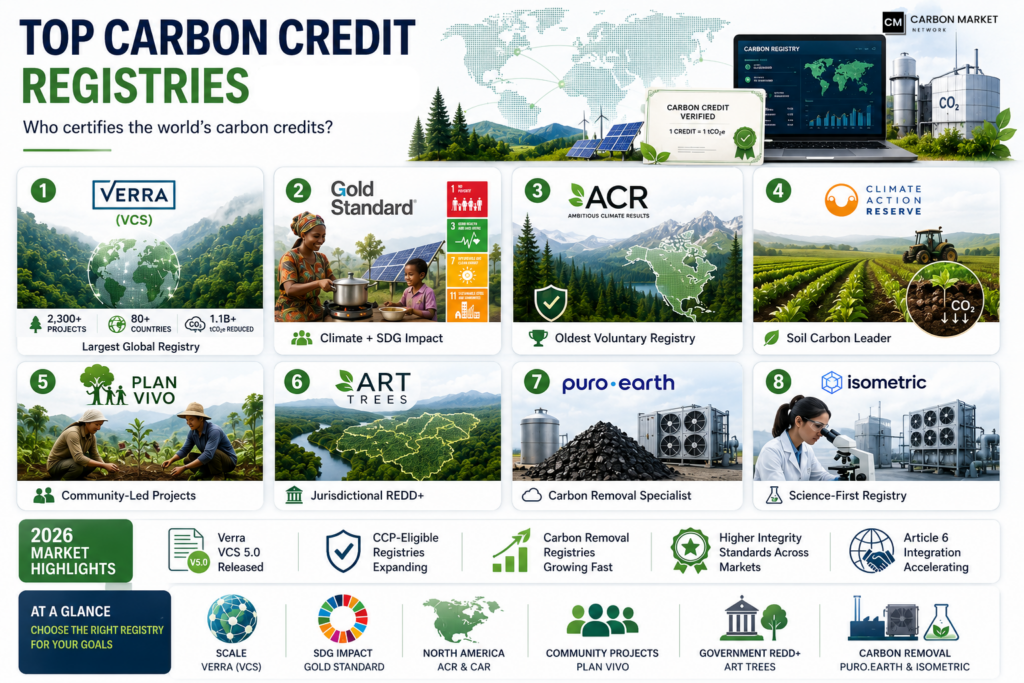
1. Verra (Verified Carbon Standard)
Best for: Large-scale nature-based and technology-based projects globally.
Verra is the world’s largest carbon credit registry. It runs the Verified Carbon Standard (VCS) program, which is the most widely used voluntary carbon crediting standard on the planet.
As of 2026, the VCS registry lists over 2,300 registered projects across more than 80 countries. These projects have collectively removed over 1.1 billion tonnes of greenhouse gases from the atmosphere.
Credits issued under the VCS program are called Verified Carbon Units (VCUs). Each VCU represents one metric tonne of CO2 equivalent reduced or removed.
The Verra registry is fully public. Anyone can search for any VCS project, download its project design documents, and see exactly how many credits have been issued, sold, and retired. This level of transparency is one of Verra’s greatest strengths.
Verra supports a huge range of project types across 16 sectoral scopes, including forestry and land use (REDD+), renewable energy, waste handling, agriculture, and carbon removal. This breadth makes it the default choice for many project developers worldwide.
What changed in 2026: Verra released VCS Version 5.0, the most comprehensive update to the standard in a decade. New registrations from January 2027 onward must follow the full version 5 requirements. This version strengthens additionality rules, improves alignment with the ICVCM’s Core Carbon Principles, and introduces better safeguards for social and environmental outcomes. In 2026, Verra is also rolling out a new Project Hub with phased improvements throughout the year.
Verra has also received CCP-Eligible status from the ICVCM, meaning projects on the VCS platform that use approved methodologies can now carry the CCP label, the market’s emerging quality benchmark.
Verra’s strengths:
- Largest registry by project count and credit volume
- Strong global recognition among buyers and financial institutions
- Accepted in compliance markets including Colombia, South Africa, and CORSIA (aviation)
- Publicly searchable database for full transparency
- CCP-Eligible across approved methodologies
Things to watch: Verra has faced criticism over some legacy REDD+ and renewable energy projects, particularly those issued under older methodologies. Buyers focused on quality now filter by current methodologies (VM0047 for afforestation and VM0048 for REDD+) rather than accepting any VCS credit at face value.
2. Gold Standard
Best for: Projects with strong community co-benefits and SDG impact.
Gold Standard was founded in 2003 by WWF and other international NGOs. Its mission from day one was to raise the quality bar in the voluntary carbon market by requiring not just verified emissions reductions but also verified contributions to sustainable development.
Every project certified under the Gold Standard for the Global Goals (GS4GG) must demonstrate contributions to at least two Sustainable Development Goals (SDGs) beyond its climate impact. This makes Gold Standard credits particularly popular with companies whose sustainability strategies go beyond carbon numbers.
The Gold Standard Impact Registry tracks every credit with a unique serial number, showing the full chain from issuance to retirement. The registry also showcases the certified SDG impacts alongside the carbon data, which gives buyers a richer picture of the real-world benefits their purchase creates.
Gold Standard accepts three main categories of projects: community services (including clean cookstoves and water purification), renewable energy, and land use and forestry. For forestry projects, Gold Standard requires a 20% pooled buffer to protect against reversals.
What changed in 2026: Gold Standard introduced stronger additionality requirements and updated baseline conservativeness rules as part of its 2025 to 2026 rule refresh. In November 2025, Gold Standard joined Verra and Singapore to publish a joint Article 6.2 Crediting Protocol, signaling the registry’s active role in bridging voluntary and compliance markets.
Like Verra, Gold Standard holds CCP-Eligible status from the ICVCM.
Gold Standard’s strengths:
- Mandatory SDG co-benefit requirements set it apart from most other registries
- Strong brand recognition and trust among NGOs, governments, and conscious buyers
- Active role in shaping Article 6 frameworks
- Clear public registry with full traceability
- Strong clean cookstoves and community project portfolio
Things to watch: Legacy grid-connected renewable energy credits issued under Gold Standard before recent rule updates carry additionality risk. Buyers should apply vintage filters and prefer current-methodology projects.
3. American Carbon Registry (ACR)
Best for: North American projects with compliance market access; nature-based solutions.
ACR holds a unique distinction in the global registry landscape: it is the oldest voluntary greenhouse gas registry in the world, founded in 1996 by the Environmental Resources Trust, long before voluntary carbon markets became mainstream.
ACR is operated by Winrock International, a non-profit organization. In 2023, ACR rebranded to reflect its expanded global reach (“Ambitious Climate Results”) while keeping its established methodologies and standards.
ACR was the first registry to receive full program-level approval from the ICVCM as a CCP-Eligible program. This first-mover advantage on integrity has become a real market differentiator. ACR enters 2026 with a reputation as the integrity incumbent in North America.
ACR registers projects globally but with a strong focus on the United States and North America. Its methodologies cover natural climate solutions (forests, grasslands, wetlands), waste handling, methane destruction, and industrial gas projects.
ACR credits are also accepted in California’s cap-and-trade program, which gives them dual value in both voluntary and compliance markets. The Climate Action Reserve (more on this below) operates as ACR’s sister program in the North American compliance space.
All ACR methodologies are based on ISO 14064 international standards, and validation and verification bodies must meet ISO 14065 and ISO 14066 requirements.
ACR’s strengths:
- Oldest voluntary GHG registry in the world
- First to receive ICVCM CCP-Eligible status
- Compliance market access in California and other North American programs
- Rigorous ISO-based methodologies
- Strong transparency through its public registry
4. Climate Action Reserve (CAR)
Best for: North American compliance and voluntary projects; soil carbon; forestry.
The Climate Action Reserve started in 2001 under the name California Climate Action Registry, originally created by the state of California to help organizations report emissions. It grew into one of the leading registries for the voluntary carbon market and select compliance markets.
CAR focuses primarily on North America. Its protocols have been independently recognized for rigor, and in 2026, it surpassed a major milestone: two million credits issued for soil enrichment projects, along with tagging the market’s first sustainable agriculture credits with the CCP label.
This makes CAR particularly relevant for agricultural and forestry carbon projects in North America. CAR’s protocols for soil carbon, forest carbon, and landfill methane have all received CCP-Approved methodology status.
Credits issued by CAR can be transferred to the Verra VCS platform, meaning CAR-registered developers can tap into the larger VCS marketplace for buyers.
CAR is a nonprofit. It does not sell carbon credits directly but focuses entirely on registration and verification.
CAR’s strengths:
- CCP-Approved methodologies for multiple sectors
- Strong North American compliance market track record
- Pioneer in soil carbon crediting
- Credits transferable to VCS
- Nonprofit governance model
5. Plan Vivo
Best for: Small-scale community-led land use and agroforestry projects in developing countries.
Plan Vivo is one of the oldest carbon standards in the world, having started in the 1990s as a pilot agroforestry project in Mexico. It has since grown into a specialized registry for community-based land management projects across Africa, Asia, and Latin America.
Plan Vivo’s credits are called Plan Vivo Certificates (PVCs). These are registered and managed on the S&P Global Environmental Registry, making them fully trackable and transparent.
What makes Plan Vivo distinctive is its community-first philosophy. Every project must be led by smallholder farmers or local community groups. The standard is specifically designed to direct carbon finance to rural communities in developing countries, often working in areas with high biodiversity and significant climate vulnerability.
Plan Vivo projects tend to be smaller in scale than Verra or Gold Standard projects. But they carry a strong reputation for grassroots impact. For buyers who want to demonstrate support for local livelihoods alongside emissions reductions, Plan Vivo projects offer a compelling option.
High-rated nature-based removal credits from Plan Vivo projects traded at median prices above 30 euros per tonne in 2025, reflecting the premium buyers place on their quality and co-benefits.
Plan Vivo’s strengths:
- Community-led model with direct benefit to local populations
- Specialized in smallholder and agroforestry projects
- Strong co-benefits in biodiversity and livelihood outcomes
- Transparent registry through S&P Global
6. Architecture for REDD+ Transactions (ART TREES)
Best for: Jurisdictional REDD+ credits from national and subnational governments.
ART TREES is different from every other registry on this list. While most registries certify individual projects, ART certifies entire national or subnational forest programs. This is called jurisdictional crediting.
ART’s TREES (The REDD+ Environmental Excellence Standard) program allows governments (not private project developers) to generate carbon credits for protecting forests at scale. Countries and subnational jurisdictions register their entire forest sector, set a crediting baseline, and earn credits for measurable reductions in deforestation and degradation.
This model addresses a longstanding criticism of project-level REDD+: that protecting one patch of forest just pushes deforestation elsewhere (leakage). At the jurisdictional level, the accounting happens across entire regions, which greatly reduces leakage risk.
ART TREES is CCP-Eligible and is included in the Berkeley Carbon Trading Project’s major registry database. Several countries and major forest jurisdictions have registered or are in the process of registering under TREES.
ART’s strengths:
- Addresses leakage at scale through jurisdictional accounting
- Government-led crediting creates stronger sovereign accountability
- Accepted in the Berkeley Carbon Trading Project database
- Designed for CORSIA and high-integrity voluntary buyers
7. Puro.earth
Best for: Carbon removal projects, especially biochar, wooden building materials, and industrial carbon capture.
Puro.earth is a specialist registry focused exclusively on carbon removal. It was founded in 2019 and has become the leading platform for certifying engineered and nature-based removal methods that go beyond the traditional forestry credits.
To qualify for Puro.earth certification, a project must capture and store CO2 durably for a minimum of 100 years. This permanence requirement is stricter than many other registries, making Puro.earth credits particularly attractive to buyers who are skeptical of temporary nature-based credits.
Puro.earth certifies methods including biochar (locking carbon into stable charcoal), wooden building materials (storing carbon in long-lived construction products), enhanced rock weathering, and soil carbon sequestration. These are exactly the types of carbon removal solutions that scientists and corporate buyers increasingly see as essential for reaching net-zero.
Puro.earth has attracted buyers including major technology companies and has been endorsed by ICROA, CORSIA, and ICVCM.
Puro.earth’s strengths:
- Specialized in high-permanence carbon removal
- 100-year minimum carbon storage requirement
- Covers emerging removal technologies not listed on other registries
- ICROA, CORSIA, and ICVCM endorsed
- Attracts premium buyers seeking verified removal credits
8. Isometric
Best for: Scientific-rigor carbon removal credits; buyers seeking the highest bar of technical scrutiny.
Isometric is the newest major registry on this list, launched in 2022. Despite its young age, it has quickly established itself as one of the most credible registries for carbon removal credits.
Isometric’s founding philosophy is simple: apply the same rigor to carbon credits that the financial markets apply to any other asset. Its scientific standards are built around transparent, peer-reviewed methodologies. It was the first registry to be simultaneously endorsed by ICROA, CORSIA, and ICVCM.
Isometric also has an unusual business model when it comes to verification. Rather than having project developers pay for verification (which can create conflicts of interest), Isometric covers the cost of verification itself. This structural design removes a common incentive for validators to approve marginal projects.
Major buyers including Stripe, Google, and the Frontier climate fund have purchased Isometric-certified credits, which signals strong confidence from tech-sector corporate buyers who apply rigorous due diligence.
Isometric focuses primarily on carbon removal pathways including direct air capture, geological storage, enhanced weathering, and biochar. Projects can reportedly reach credit issuance within a month on average, making it faster than many traditional registries.
Isometric’s strengths:
- Triple endorsement from ICROA, CORSIA, and ICVCM
- Unique verification funding model that eliminates conflicts of interest
- Attracts premium corporate buyers with serious due diligence processes
- Fast protocol development
- Strong scientific credibility
The ICVCM and the CCP Label: The New Quality Benchmark
One of the most important developments in carbon markets over the past two years is the rise of the Integrity Council for the Voluntary Carbon Market (ICVCM) and its Core Carbon Principles (CCPs).
The CCPs are ten fundamental, science-based principles for identifying high-quality carbon credits. They cover effective governance, transparency, tracking, independent third-party validation, additionality, permanence, robust quantification, no double-counting, and sustainable development safeguards.
The ICVCM evaluates both carbon crediting programs (registries) and individual methodologies against these principles. Registries that pass the program-level assessment are called CCP-Eligible. Methodologies that pass receive a CCP-Approved designation. Credits generated under CCP-Approved methodologies can carry the CCP label.
As of mid-2026, the five CCP-Eligible programs are ACR, ART, CAR, Gold Standard, and Verra. These five registries together account for roughly 98% of all voluntary carbon credit volume.
The CCP label is quickly becoming the default quality filter for sophisticated buyers. A credit without a CCP label is not necessarily bad, but a credit with a CCP label gives buyers a defensible, science-backed answer when their auditors, investors, and legal teams ask how they know the credit is credible.
For anyone buying credits in 2026, checking for CCP-Eligible registry status and, where available, CCP-Approved methodology status is a smart first step.
How to Choose the Right Carbon Credit Registry
Choosing the right registry depends on who you are and what you need.
If you are a project developer:
Consider what type of project you are running and where it is located. Most forestry and land-use projects in tropical countries default to Verra VCS because of its huge buyer base and broad methodology library. If your project is in North America and you want compliance market access, ACR or CAR are strong choices. For community-led smallholder projects, Plan Vivo offers a model built specifically for that context. If you are working on carbon removal (biochar, direct air capture, enhanced weathering), Puro.earth or Isometric may fit better than a traditional registry.
If you are a corporate buyer:
Look for credits from CCP-Eligible registries. Prioritize credits with current-methodology certifications. Avoid legacy renewable energy credits or pre-2024 REDD+ vintages where additionality concerns are well documented. Ask for the project’s registry page and review the verification reports. For credits you plan to use under public climate claims, retire them directly in the registry’s system and obtain the retirement certificate.
If you need CORSIA compliance (aviation):
Look for credits accepted under CORSIA’s approved standards. Verra VCS, Gold Standard, ACR, CAR, ART TREES, and Isometric all have CORSIA eligibility for certain credit types.
Key questions to ask about any credit:
- Is it registered on a recognized, CCP-Eligible registry?
- Does the project use a current, approved methodology?
- Has the project been independently verified by an accredited third party?
- Is the credit retirement recorded publicly in the registry?
- Does the project deliver social and environmental co-benefits beyond carbon?
Carbon Registries and Article 6 of the Paris Agreement
The finalization of Article 6 at COP29 in 2024 has big implications for registries.
Article 6.2 allows countries to trade carbon credits internationally through Internationally Transferable Mitigation Outcomes (ITMOs). Countries can use their own registries, third-party registries, or the UNFCCC’s International Registry to track these trades.
Article 6.4 establishes a centralized UN-supervised crediting mechanism. Regional exchanges and voluntary carbon registries are actively preparing to include Article 6.4 credits once the mechanism fully launches.
Gold Standard and Verra jointly published a crediting protocol for Article 6.2 in November 2025, creating a practical framework for linking voluntary registry credits with bilateral country agreements.
This convergence means the best registries are no longer just tools for the voluntary market. They are increasingly bridges between voluntary and compliance markets, corporate buyers and national governments, and private sector action and sovereign climate commitments.
Common Mistakes to Avoid When Using Carbon Registries
Treating the registry label as a quality guarantee. Being listed on Verra or Gold Standard is a starting point, not a finish line. Registry certification tells you the project met the minimum standard. It does not mean the project is in the top tier of quality. Apply methodology filters and vintage screens on top of the registry certification.
Not checking retirement records. Always verify that credits you purchase are actually retired in the registry under your organization’s name. Unretired credits can still be sold to someone else.
Buying old vintages without scrutiny. Credits from projects registered under older methodologies carry more risk. Methodology improvements over the past five years have tightened many of the rules that older projects were certified under.
Ignoring co-benefit data. A carbon credit is not just a number. The social and environmental outcomes behind that number matter for your reporting, your brand, and your stakeholders. Registries like Gold Standard and Plan Vivo publish detailed co-benefit data. Use it.
Skipping the public registry check. Every major registry has a public-facing database. Always verify that a project exists on the registry you are told it is listed on before completing any transaction.
A Quick Look at Other Notable Registries
Beyond the eight registries covered in depth above, a few others are worth knowing about.
Global Carbon Council (GCC): Based in Qatar and operating under the GSAS (Global Sustainability Assessment System), GCC is the main registry for the Middle East and North Africa. It plays a growing role as Gulf countries develop domestic carbon markets.
EcoRegistry (Cercarbono): A registry focused on Latin America, particularly Colombia. It uses the Cercarbono standard and is recognized for projects across agriculture, forestry, and ecosystem services in South America.
Label Bas Carbone (LBC): A French government-backed standard focused on domestic French emission reduction projects. It operates in the agricultural, forestry, and construction sectors and is a good example of a high-integrity national-level registry outside the global voluntary market.
The Future of Carbon Credit Registries
The direction of travel for registries in 2026 and beyond is clear: higher integrity, greater transparency, and deeper integration with compliance frameworks.
The CCP label from the ICVCM is becoming the market’s quality floor. Buyers, regulators, and insurers are all converging on it as a baseline. Registries that do not align with CCP standards will face increasing difficulty attracting serious corporate buyers.
Technology is also reshaping how registries operate. Digital measurement, reporting, and verification (dMRV) using satellite imagery, remote sensing, and AI is making it faster and cheaper to monitor carbon projects continuously rather than waiting for periodic audits. Several registries are piloting dMRV integration to improve the accuracy and timeliness of their data.
The Article 6 framework is creating pressure on registries to become interoperable with national government systems. Registries that can seamlessly connect with country-level ITMOs registries and the UNFCCC’s international registry will have a structural advantage.
And as carbon removal scales up, registries like Isometric and Puro.earth that specialize in removal credits (as opposed to avoidance credits) will grow in importance. Removal is increasingly seen as the long-term foundation of a credible net-zero strategy.
Conclusion
Carbon credit registries are the infrastructure that makes the entire carbon market work. Without them, there is no way to verify that a credit is real, prevent double-counting, or build the trust that corporate buyers and regulators need.
The best carbon credit registries in 2026 include Verra, Gold Standard, ACR, CAR, Plan Vivo, ART TREES, Puro.earth, and Isometric. Each serves a different part of the market, covers different project types, and appeals to different buyers and developers.
The rise of the ICVCM’s Core Carbon Principles has created a clearer quality benchmark for the entire industry. If you are buying or using carbon credits in 2026, starting with CCP-Eligible registries and CCP-Approved methodologies is the single most important step you can take to protect yourself from reputational and financial risk.
The carbon market is maturing rapidly. The registries at the top of this list are not just keeping pace. They are actively shaping what high-integrity climate finance looks like for the next decade.
Frequently Asked Questions
What is the largest carbon credit registry in the world?
Verra’s Verified Carbon Standard (VCS) is the largest voluntary carbon credit registry in the world. As of 2026, it lists over 2,300 registered projects and has issued credits representing over 1.1 billion tonnes of CO2 equivalent reduced or removed.
What is the difference between a carbon standard and a carbon registry?
In practice, many organizations serve as both. A carbon standard sets the rules and methodologies for what counts as a valid carbon credit project. A carbon registry maintains the public database where credits are issued, transferred, and retired. Verra and Gold Standard function as both the standard-setter and the registry for their programs.
Are carbon credits on all registries equally trustworthy?
No. Registry quality varies significantly. Credits from CCP-Eligible registries (ACR, ART, CAR, Gold Standard, and Verra) that use CCP-Approved methodologies offer the highest independently verified quality benchmark available in 2026. Other registries may be credible but have not yet undergone or completed the ICVCM assessment process.
How do I check if a carbon credit has been retired?
Every major registry has a public database where you can search by project name, project ID, or serial number. You can verify retirement records directly on the Verra, Gold Standard, ACR, CAR, Plan Vivo, Puro.earth, and Isometric registries. Retirement records are permanent and publicly visible.
Can I use carbon credits from voluntary registries for compliance purposes?
In some cases, yes. Verra VCS and Gold Standard credits are accepted under CORSIA for international aviation compliance. ACR and CAR credits are accepted in California’s cap-and-trade program. For other compliance systems, you should check the specific rules of the relevant regulatory scheme.
What is the CCP label and why does it matter?
The CCP label is issued by the Integrity Council for the Voluntary Carbon Market (ICVCM). It marks carbon credits that have been generated under programs and methodologies meeting ten rigorous Core Carbon Principles. Credits with the CCP label have passed a higher bar for additionality, permanence, quantification, transparency, and safeguards than the standard registry certification alone. It is the most credible quality signal in the voluntary carbon market as of 2026.
What does “credit retirement” mean in a carbon registry?
Retirement is the final step in a carbon credit’s lifecycle. When a company retires a credit, the registry permanently moves it to a retirement account. It can never be resold, transferred, or claimed by anyone else. Retirement is what allows a company to legitimately say it has offset that tonne of CO2. The registry issues a certificate of retirement with a unique serial number as proof.
Which registry is best for carbon removal projects?
For carbon removal projects, Puro.earth and Isometric are the leading specialized options. Both focus on high-permanence removal methods such as biochar, direct air capture, enhanced weathering, and geological storage. For broader nature-based removal projects, Verra VCS and Gold Standard also support credible removal methodologies.
Explore more resources on carbon markets, carbon credit verification, and climate finance on Carbon Market Network.