Carbon Market Network


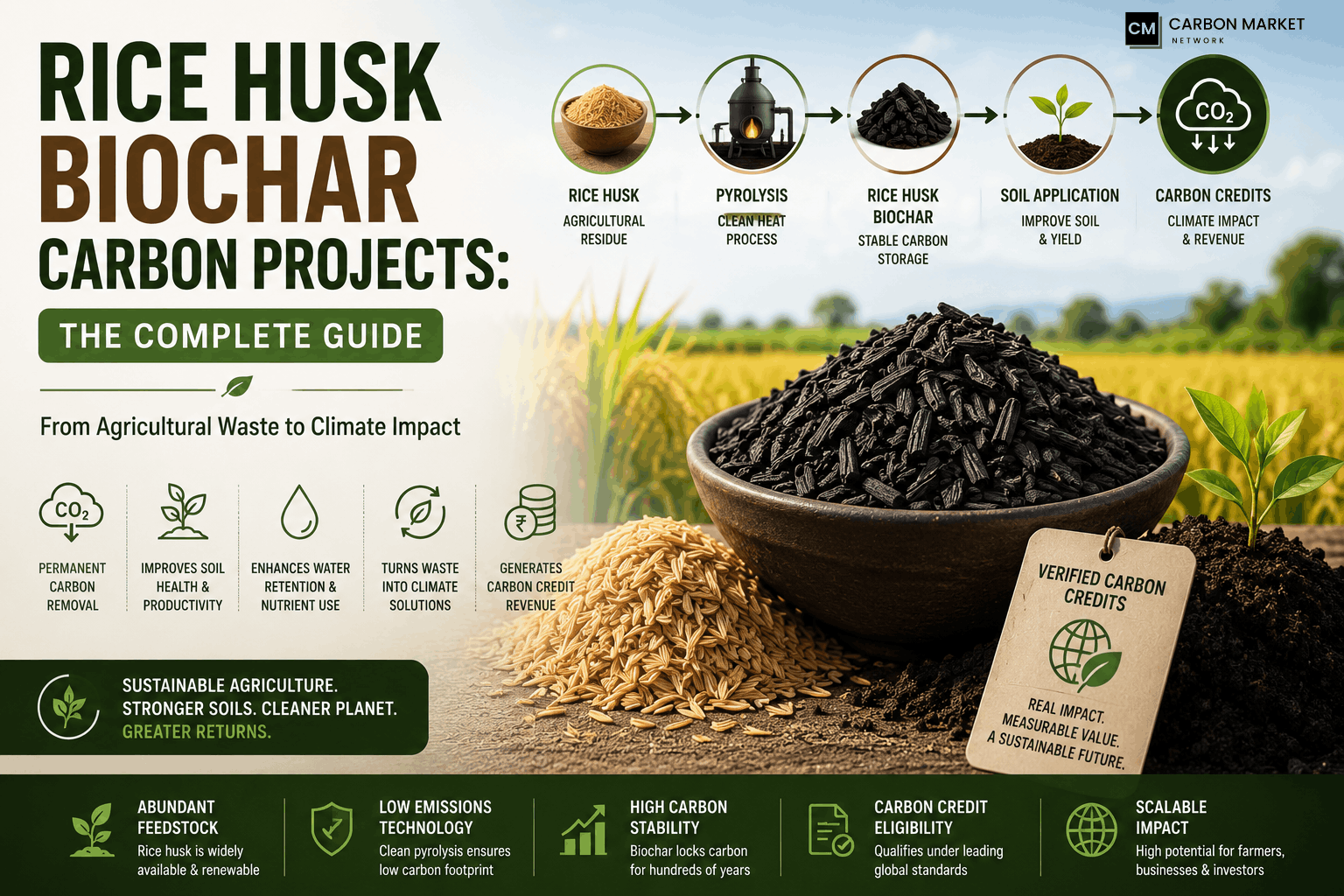
Every year, the global rice industry generates more than 150 million tonnes of rice husks — a dry, papery byproduct that most mills don’t know what to do with.
Burn it? That pollutes the air and releases CO₂. Dump it? It rots and still releases greenhouse gases. But what if this overlooked waste could lock carbon into the soil for hundreds of years and generate verified carbon credits in the process?
That’s exactly what rice husk biochar carbon projects do.
This guide breaks down how these projects work, why they matter, what the science says, which standards govern them, and how real companies are already turning this humble agricultural waste into a credible, high-value carbon removal solution.
What Is Rice Husk Biochar?
Rice husk biochar is the stable, carbon-rich material you get when rice husks are heated to high temperatures in an oxygen-limited environment — a process called pyrolysis.
During pyrolysis, the organic matter in the husk doesn’t burn. Instead, it thermally decomposes into three co-products:
- Biochar — a solid, porous, carbon-rich material
- Bio-oil — a liquid that can be refined into fuels or chemicals
- Syngas — a combustible gas that is often looped back to power the reactor itself
The biochar is the star of the show for carbon markets. Once it is applied to soil, it resists microbial decomposition for hundreds to thousands of years. The carbon that the rice plant originally captured from the atmosphere stays locked in the ground instead of returning to it.
That’s the core climate benefit of rice husk biochar carbon projects.
Carbon Market Insider Newsletter
Weekly insights on carbon markets, climate policy, carbon credits, and sustainability.
Why Rice Husks Make Excellent Biochar Feedstock
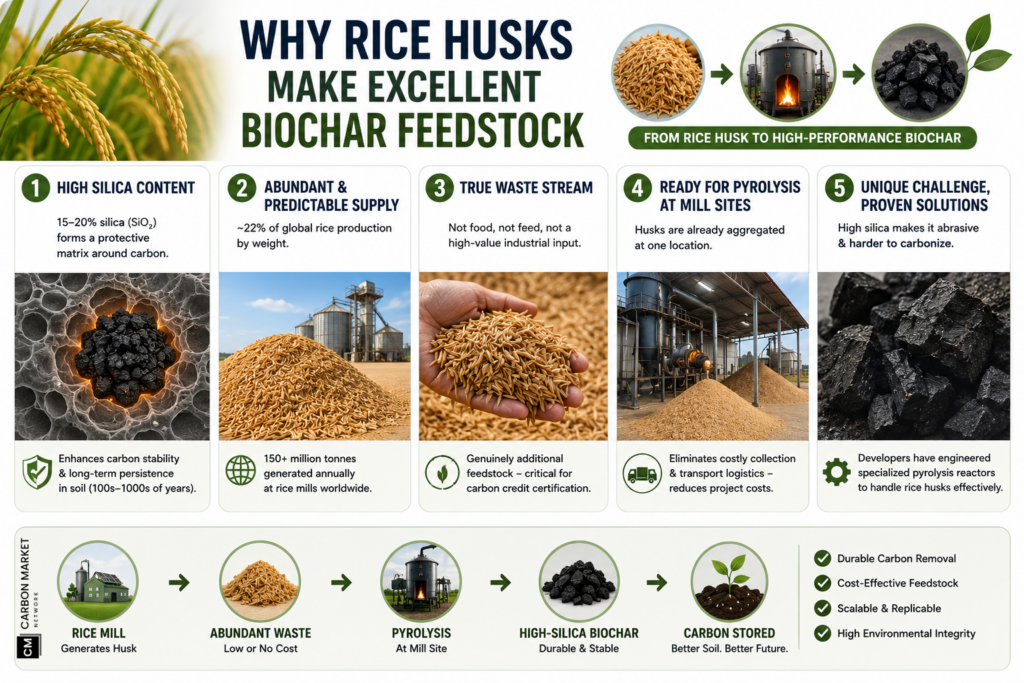
Not all biomass is equal when it comes to making biochar. Rice husks have a unique chemical profile that sets them apart.
High silica content: Rice husks contain 15 to 20% silica (SiO₂), which is unusually high for agricultural residues. This silica forms a protective matrix around the carbon in the biochar, making it more resistant to biological degradation in soil over long time periods.
Abundant and predictable supply: Rice husks account for roughly 22% of global rice production by weight. With over 150 million tonnes generated annually at rice mills worldwide, the supply is consistent, co-located at processing facilities, and largely available at zero or very low cost.
True waste stream: Rice husks have limited alternative uses in most regions. They are not food, not feed, and not widely used as a high-value industrial input. This makes them a genuinely additional feedstock for carbon projects, which is a critical requirement for carbon credit certification.
Ready for pyrolysis at mill sites: Rice mills already aggregate the husks in one place. This eliminates expensive biomass collection and transport logistics, which are often the biggest cost driver for biochar projects using field-based residues like straw.
The main technical challenge is that the same silica content that improves permanence also makes rice husk biochar abrasive on reactor equipment and more difficult to carbonize than wood-based feedstocks. Project developers have spent years refining pyrolysis reactor designs specifically for this feedstock.
How Rice Husk Biochar Carbon Projects Work: Step by Step
Understanding the full project lifecycle helps you see exactly where the carbon removal happens and how credits get generated.
Step 1: Feedstock Sourcing and Verification
The project developer signs agreements with one or more rice mills to collect husks that would otherwise be burned in the open or dumped.
Carbon registries now demand proof that the feedstock is a genuine waste stream. If the rice husks were already going to a cement kiln, a power boiler, or any other beneficial use, using them for biochar doesn’t count as additional carbon removal. This feedstock traceability check happens before project registration and at every subsequent audit.
Step 2: Pyrolysis
The husks are fed into a reactor and heated to temperatures typically between 400°C and 600°C in the absence of oxygen.
For carbon credit-grade biochar, slow pyrolysis is the standard process:
| Parameter | Slow Pyrolysis (Standard for Credits) |
|---|---|
| Heating rate | 5 to 10°C per minute |
| Temperature | 400 to 600°C |
| Residence time | 30 minutes to several hours |
| Biochar yield | Approximately 35% of input mass |
| Sequestration rate | 1.5 to 2.1 kg CO₂-eq per kg of biochar |
Continuous reactor designs, including screw reactors, rotary kilns, auger reactors, and fluidized bed reactors, are increasingly used at industrial scale because they achieve 60 to 75% energy efficiency and produce more consistent biochar quality than batch systems.
Step 3: Biochar Quality Testing
Before any carbon credits can be issued, the biochar must be tested against laboratory standards.
Carbon registries and certification standards focus on several key properties:
- Carbon content: Typically 30 to 45% for rice husk biochar (lower than wood-based biochar due to silica dilution, but still significant)
- H/C and O/C ratios: These measure how stable the carbon is. Lower ratios mean more aromatic, stable carbon that will persist in soil for longer
- Contaminant levels: Heavy metals, polycyclic aromatic hydrocarbons (PAHs), and dioxins must fall below threshold limits set by the certification standard
- pH: Usually alkaline, which can benefit acidic soils but needs to match application site conditions
Step 4: Application and MRV
Once produced and tested, the biochar is applied to agricultural land, blended into soil amendments, or sold to farmers as a biofertilizer component.
Monitoring, Reporting, and Verification (MRV) systems track:
- The quantity of feedstock processed
- Pyrolysis temperature logs (time-stamped and continuous)
- Biochar yield and quality test results
- Application records showing where the biochar went
Modern projects use digital MRV platforms to maintain a full chain of custody that auditors can review at any time.
Step 5: Third-Party Verification and Credit Issuance
An accredited third-party verifier audits the project records, reviews lab results, and confirms the reported sequestration volume. Upon successful verification, the carbon registry issues credits, typically as CO₂ Removal Certificates (CORCs) or Verified Carbon Units (VCUs), depending on the standard used.
Each credit represents the verified, permanent removal of one tonne of CO₂ equivalent.
Key Certification Standards for Rice Husk Biochar Carbon Projects
Carbon credits are only as credible as the standard that certifies them. Several methodologies now explicitly recognize rice husk as an eligible feedstock.
Puro.earth (CORC Standard)
Puro.earth pioneered the first dedicated biochar carbon removal methodology in 2019 and has since become the dominant registry for biochar credits globally.
Its 2025 updated methodology, now a 142-page framework, covers rice husks explicitly under the “non-field agricultural residues” feedstock category. Key requirements include:
- Feedstock must come from the primary processing of food crops at a factory (rice husks from rice mills qualify directly)
- Continuous, time-stamped monitoring records for all pyrolysis parameters
- Independent third-party audits before credit issuance
- Quantification of gross and net removals, accounting for production energy emissions and transport
The Puro standard has also expanded to allow mobile production units, making it viable for projects that want to serve multiple mill sites with portable pyrolysis equipment.
Verra (VCS) VM0044
Verra’s Voluntary Carbon Standard includes Methodology VM0044 for biochar projects. This methodology uses a rigorous quantification approach based on biochar stability classes and feedstock carbon content.
Projects registered under VM0044 generate Verified Carbon Units (VCUs). Verra is more widely recognized across the broader voluntary carbon market, which can improve credit liquidity for project developers who want access to a wider buyer base.
European Biochar Certificate (EBC)
The EBC is a quality standard for biochar rather than a carbon credit methodology per se. However, many European buyers use EBC certification as a prerequisite or quality signal when purchasing biochar-based carbon credits.
EBC defines a positive list of approved feedstocks. Rice husks appear on this list as an approved agricultural residue.
Gold Standard Biochar Methodology
Gold Standard has introduced its own biochar methodology with a strong emphasis on co-benefits and sustainable development goals. This standard is particularly relevant for projects in lower-income countries that want to document social and environmental co-benefits alongside the carbon removal claim.
| Standard | Credit Type | Key Strength | Main Market |
|---|---|---|---|
| Puro.earth | CORC | Most common for biochar, rigorous MRV | Global, corporate buyers |
| Verra VM0044 | VCU | Broad buyer recognition, liquid market | Global |
| EBC | Quality certificate | Trusted European quality signal | European buyers |
| Gold Standard | VER | Strong co-benefit documentation | Impact-focused buyers |
The Carbon Math: How Much CO₂ Does Rice Husk Biochar Remove?
This is one of the most common questions buyers and project developers ask, and the answer depends on several variables.
Gross removal: Studies and project data show that slow pyrolysis of rice husks produces biochar that sequesters 1.5 to 2.1 kg of CO₂-equivalent per kg of biochar produced (in continuous reactor systems).
Net removal after deductions: Carbon registries require developers to subtract:
- Emissions from the energy used to run the pyrolysis reactor (unless the syngas powers the unit itself, which dramatically reduces this deduction)
- Emissions from transporting the feedstock to the reactor
- Emissions from applying the biochar to the land
- Any emissions from biogenic methane or nitrous oxide released during biochar storage or application
After these deductions, well-run rice husk biochar projects typically achieve net removals in the range of 1.0 to 1.6 kg CO₂-eq per kg of biochar.
Permanence factors: Standards apply a permanence factor to account for the small fraction of biochar carbon that will decompose over time. For rice husk biochar, which has a relatively high mineral (silica) stabilization of its carbon, permanence factors typically range from 0.80 to 0.90 depending on the H/C ratio of the specific biochar batch.
Example calculation for a medium-scale project:
A facility processing 3,000 tonnes of rice husks per month produces approximately 1,050 tonnes of biochar (35% yield). At a net sequestration rate of 1.2 kg CO₂-eq per kg of biochar, this translates to roughly 1,260 tonnes of verified net CO₂ removal per month, or approximately 15,000 tonnes per year. At current market prices, that represents significant revenue for the project.
The Unique Soil Benefits of Rice Husk Biochar
Rice husk biochar isn’t just a carbon removal tool. When applied to soil, it delivers a range of agricultural co-benefits that make it attractive to farmers and add commercial value beyond carbon credits.
Water retention: Rice husk biochar can retain water up to 2.7 times its own weight due to its highly porous structure. In sandy or degraded soils, this significantly reduces irrigation requirements and improves drought resilience.
Improved nutrient efficiency: The porous structure of biochar provides a surface area for nutrient adsorption and slow release. Research shows that biochar application improves nitrogen use efficiency by approximately 14% and reduces fertilizer leaching into waterways.
pH buffering: Rice husk biochar is generally alkaline. Applied to acidic tropical soils, it raises pH toward more crop-friendly ranges, improving nutrient availability without needing lime.
Methane and nitrous oxide reduction in paddy fields: Research from rice-growing regions shows that rice husk biochar application at rates of 5 to 10 tonnes per hectare can reduce cumulative methane (CH₄) emissions from flooded paddy fields by 24 to 28%. This is a significant additional benefit in rice cultivation systems where methane is a major source of agricultural greenhouse gas emissions.
Microbial habitat: The porous microstructure of biochar provides a physical habitat for beneficial soil microorganisms. This supports improved nutrient cycling, organic matter decomposition, and disease suppression.
These co-benefits are increasingly documented in project validation reports and attract buyers looking for carbon credits that deliver demonstrable sustainable development outcomes beyond CO₂ numbers.
Real-World Rice Husk Biochar Carbon Projects
Several organizations are already running commercially active rice husk biochar carbon projects. These examples show the range of scales, geographies, and business models that make sense for this feedstock.
HUSK Ventures (Cambodia and Vietnam)
HUSK Ventures, headquartered in Spain, operates rice husk biochar production at a rice mill in Kampong Thom province, Cambodia. The company processes rice husks directly from an adjacent rice mill, eliminating transport costs and ensuring traceability.
HUSK has developed a proprietary pyrolysis process specifically optimized for the high-silica characteristics of rice husks. The biochar is processed into nutrient-rich biofertilizers sold to smallholder farmers growing rice, coffee, cashew, and sugarcane. Farmers using HUSK’s products have reported 15 to 20% increases in crop yields and up to 50% reductions in chemical fertilizer use.
HUSK has developed carbon credit certification under recognized standards and has secured international funding, including a US$5 million investment from Mekong Capital. In partnership with atmosfair, HUSK is constructing a pyrolysis plant in Cambodia expected to produce approximately 3 tonnes of biochar daily from 6 tonnes of rice husks.
GSAD Cambodia (Puro.earth Registered)
A Puro.earth-registered project in Cambodia uses Beston pyrolysis technology to produce biochar from rice husks sourced from the province’s rice mills. The facility produces 1,500 tonnes of biochar per month from 3,000 tonnes of rice husks. The project draws from a province that generates approximately 450,000 tonnes of rice husks annually as waste, providing ample feedstock with verified waste-stream status.
Shonaikomekobo and Nomura (Japan)
In a notable partnership, Nomura Holdings signed a memorandum of understanding with Shonaikomekobo, an agricultural group in Yamagata, Japan, to launch a rice husk biochar initiative. The group cultivates rice on approximately 780 hectares and had surplus rice husks with no viable disposal option. They now produce biochar from these husks and spread it across their fields, generating carbon credits under Japan’s J-Credit Scheme. Nomura’s goal is to scale this local production-consumption model across Japan, targeting 10,000 tonnes of biochar annually with longer-term potential of up to 100,000 tonnes per year nationally.
Marubeni Corporation (Japan)
Japanese trading conglomerate Marubeni has signed a partnership with one of Japan’s largest rice husk biochar producers to scale production capacity and create carbon credits, signaling that major corporate players see rice husk biochar as a credible component of their net-zero supply chains.
Australian Developer (Vietnam)
Australian carbon project developers have announced rice husk biochar projects in Vietnam, targeting the country’s large rice milling sector as a feedstock source and its degraded agricultural soils as an end-use market.
The Business Case: Why Rice Husk Biochar Carbon Credits Are Commercially Attractive
The economics of rice husk biochar carbon projects compare favorably to most other carbon removal technologies.
Credit price: Biochar carbon credits currently trade at approximately $125 to $165 per tonne of CO₂ on leading platforms. High-quality, verified credits from established projects command prices toward the top of this range. This is significantly above nature-based offsets like forest credits but well below engineered removals like direct air capture.
Multiple revenue streams: Rice husk biochar projects generate income from three sources:
- Carbon credit sales (primary revenue for most projects)
- Sale of biochar or biochar-based fertilizer products to farmers
- Bio-oil and heat/energy recovered from the pyrolysis process
This diversified income makes the business model more resilient than single-revenue-stream carbon projects.
Low capital entry barriers: Unlike direct air capture or enhanced weathering at scale, mid-scale biochar pyrolysis facilities can be built for capital expenditure below $1.5 million USD. This makes the technology accessible to a wider range of project developers, particularly in regions with abundant rice husk supply.
Strong buyer demand: The market signal from major corporate buyers is unambiguous. Biochar Carbon Removal (BCR) has led all durable carbon dioxide removal (CDR) methods in delivery volume. Microsoft, JPMorgan Chase, Swiss Re, Google, and Shopify have all purchased biochar credits. As of late 2025, over 90% of available industrial biochar supply was contracted by large buyers, indicating a supply-constrained market where new high-quality projects can find buyers quickly.
Market growth trajectory: The BCR market grew from $14.6 million in transaction volume to $181.5 million in a span of just two years, representing a compound annual growth rate exceeding 130%. The market is projected to continue growing as corporate net-zero commitments create sustained demand for durable, verifiable removals.
| Metric | Figure |
|---|---|
| Average biochar credit price | ~$125 to $165 per tonne CO₂ |
| BCR market CAGR (recent years) | >130% |
| Share of durable CDR delivered | Biochar leads all methods (>89% of Q2 deliveries) |
| Largest single biochar deal | 1.24 million tonnes (Microsoft / Exomad Green) |
| Typical project CAPEX (mid-scale) | Below $1.5 million USD |
| Net sequestration per kg biochar | ~1.0 to 1.6 kg CO₂-eq (rice husk, slow pyrolysis) |
Challenges and Risks in Rice Husk Biochar Carbon Projects
No opportunity comes without risks. Understanding these challenges helps developers and buyers make better decisions.
The Silica Challenge
Rice husk biochar’s high silica content (15 to 20% of the feedstock) creates abrasion on reactor components and makes the carbonization process technically more demanding than wood-based feedstocks. Projects that underestimate equipment wear rates can face unexpected maintenance costs and production downtime.
Feedstock Displacement Risk
This is arguably the most critical risk for carbon credit integrity. If the rice husks that go into a biochar project were previously being used for another purpose, such as fueling a rice mill boiler or selling to a brick kiln, then converting them to biochar doesn’t create additional carbon removal. It just redirects biomass from one use to another.
Carbon registries are tightening feedstock traceability requirements dramatically. Projects must provide documented proof that the husks are a genuine waste stream with no competing demand. Developers who skip this due diligence often fail their first audit.
Carbon Content Variability
Rice husk biochar typically has lower total carbon content than wood-based biochar, due to silica dilution. Carbon content usually falls in the range of 31 to 38% by mass compared to 70 to 85% for wood biochar. This affects the per-unit carbon credit yield and makes careful quality monitoring essential throughout production.
Biochar Quality Consistency
The quality of biochar, including its carbon stability, pH, and contaminant levels, varies with pyrolysis temperature and residence time. Projects operating at inconsistent temperatures may produce biochar that fails quality tests, resulting in batches that cannot be credited. Investment in automated temperature monitoring and control systems is non-negotiable for serious projects.
Market Integrity Scrutiny
The broader biochar carbon credit market has faced questions about quality. Credits from projects that did not meet rigorous verification standards have sold at discounts of 30% or more compared to quality-vetted credits. As buyers become more sophisticated, underdocumented or poorly verified projects will struggle to find buyers at premium prices.
Regulatory Evolution
Carbon market methodologies are actively evolving. Puro.earth released a substantially revised 142-page methodology in 2025. Developers who built projects under older methodologies may face compliance costs when transitioning to new requirements, including more detailed information systems, expanded feedstock documentation, and additional auditing for facility expansions.
Who Can Develop Rice Husk Biochar Carbon Projects?
Rice husk biochar carbon projects suit a range of actors depending on scale and context.
Rice mills and agricultural processors: Mills that already generate husks as waste are natural project developers. They can invest in on-site pyrolysis equipment, use syngas to power the reactor, and sell the biochar to nearby farmers while earning carbon credits.
Carbon project developers: Specialized firms that develop, register, and operate carbon projects can partner with multiple mills, aggregate feedstock volumes, and build economies of scale in verification and credit sales.
Agricultural cooperatives: Groups of smallholder farmers with collective access to rice processing facilities can develop aggregated projects under methodologies that allow multi-site structures.
Corporate sustainability teams: Large food and beverage or agricultural companies with rice in their supply chains can integrate biochar projects into their Scope 3 decarbonization strategies, generating credits internally while improving soil health in their sourcing regions.
Climate finance and impact investors: The capital-efficient nature of biochar projects, with CAPEX below $1.5 million for mid-scale facilities and diversified revenue streams, makes them attractive to impact investors seeking both financial returns and verified climate outcomes.
How to Start a Rice Husk Biochar Carbon Project
If you are considering developing a project, here is the practical pathway:
1. Assess feedstock availability. Identify rice mills in your target geography. Quantify annual husk volumes and verify that the husks are a genuine waste stream with no existing commercial demand. A feedstock availability study is the foundation of any feasibility analysis.
2. Choose a pyrolysis technology partner. Select a reactor supplier with demonstrated experience processing rice husks specifically. Not all pyrolysis systems handle the silica content well. Ask for references from existing rice husk projects and request performance data on carbon content, biochar yield, and equipment lifespan.
3. Select a carbon standard. Decide whether Puro.earth, Verra VM0044, or another methodology best fits your geography, business model, and buyer relationships. Each standard has different registration costs, auditing requirements, and credit market access.
4. Conduct a preliminary assessment. Most standards offer a preliminary assessment service that reviews your project concept before full registration. Puro.earth, for example, publishes preliminary assessment summaries publicly, which also helps attract buyers early.
5. Engage an MRV solution. Implement a digital monitoring system that logs all pyrolysis parameters in real time, time-stamps the data, and links each batch of biochar to its feedstock source. This is now mandatory under current Puro.earth methodology and increasingly expected by other registries.
6. Commission third-party verification. Once production is operational, commission an accredited verifier to audit your first monitoring period. This typically covers 6 to 12 months of production data and results in the first batch of carbon credits being issued.
7. Plan your biochar end-use market. Carbon credits are the primary revenue driver, but the biochar itself needs a market. Identify farmers, agricultural input distributors, or corporate buyers willing to purchase biochar-enriched fertilizer products. Having a clear end-use market improves project viability and demonstrates additionality to auditors.
Rice Husk Biochar vs Other Biochar Feedstocks: Key Differences
It helps to understand how rice husk biochar compares to other common feedstocks used in carbon credit projects.
| Property | Rice Husk Biochar | Wood-Based Biochar | Crop Straw Biochar | Manure Biochar |
|---|---|---|---|---|
| Carbon content | 31 to 38% | 70 to 85% | 40 to 60% | 20 to 40% |
| Silica content | 15 to 20% | Very low | Low | Very low |
| Permanence | High (silica stabilization) | Very high | Moderate | Lower |
| Feedstock cost | Very low to zero | Variable | Low | Very low |
| Soil nutrient benefit | Moderate (good for pH, water) | Moderate | Good | High |
| Typical credit yield | 1.0 to 1.6 t CO₂/t feedstock | 1.2 to 2.5 t CO₂/t feedstock | 0.8 to 1.4 t CO₂/t feedstock | 0.5 to 0.9 t CO₂/t feedstock |
| Reactor compatibility | Requires adapted reactors | Widely compatible | Moderate | High moisture challenges |
Rice husk biochar sits in a commercially attractive position: very low feedstock costs, genuinely additional waste streams, and good permanence characteristics, at the cost of somewhat lower carbon content and requiring specialized reactor designs.
The Link Between Rice Husk Biochar and the Circular Bioeconomy
Rice husk biochar carbon projects are a near-perfect example of circular economy principles applied to agriculture.
The rice plant grows by absorbing CO₂ from the atmosphere. The grain is harvested and consumed. The husk, instead of being burned or rotted, goes into a pyrolysis reactor. The biochar goes back to the field, improving the soil that will grow the next rice crop. The syngas powers the reactor itself. The bio-oil can offset fossil fuel use. And carbon credits fund the whole cycle.
This closed loop converts what was an environmental liability, open burning of rice husks releases CO₂ and toxic particulates, into a carbon-negative system that improves agricultural productivity at the same time.
It is also worth noting that rice paddy fields are a significant source of methane emissions from global agriculture. Applying biochar to these same fields can reduce methane and nitrous oxide emissions by measurable amounts, adding to the overall climate benefit of the project beyond the direct carbon sequestration from the biochar itself.
What Buyers Look for in Rice Husk Biochar Carbon Credits
If you are a corporate buyer evaluating rice husk biochar credits, here are the key quality signals to look for:
Certified under a recognized standard: Puro.earth, Verra VM0044, or Gold Standard certification is non-negotiable. Self-certified credits with no third-party validation do not meet corporate procurement standards.
Documented feedstock provenance: The project should be able to demonstrate with records that the rice husks came from a genuine waste stream with no higher-value alternative use. Ask for feedstock sourcing documentation.
Consistent biochar quality test results: Look for lab results covering carbon content, H/C and O/C ratios, and contaminant levels for each production batch. Random spot-testing is insufficient; strong projects test every significant batch.
Digital MRV system: Real-time, time-stamped monitoring of pyrolysis parameters is the current gold standard. Projects that still rely on manual logs carry higher verification risk.
Clear end-use documentation: Where did the biochar go? Soil application records, fertilizer product sale receipts, or distribution records to farmers should be part of the project documentation.
Ex-post credits where possible: Ex-post credits, issued after the carbon removal has already occurred, carry less risk than forward contracts. For risk-averse buyers, prioritize ex-post issuances over advance purchases.
Frequently Asked Questions
What is rice husk biochar and why is it used in carbon projects?
Rice husk biochar is a stable, carbon-rich solid produced by heating rice husks in a low-oxygen environment through pyrolysis. It is used in carbon projects because it locks CO₂ that rice plants originally captured from the atmosphere into a form that stays in the soil for hundreds to thousands of years, generating verifiable carbon removals that can be sold as carbon credits.
How many carbon credits can a rice husk biochar project generate?
A medium-scale facility processing 3,000 tonnes of rice husks per month typically generates approximately 15,000 tonnes of verified net CO₂ removal per year, which translates to 15,000 carbon credits. Output varies depending on reactor efficiency, biochar quality, and the net emissions deductions required by the certification methodology.
How long does carbon stay locked in rice husk biochar?
When applied to soil, rice husk biochar can retain its carbon for several hundred to over a thousand years. The high silica content helps stabilize the aromatic carbon structure against microbial decomposition. This long-term stability is one of the key reasons biochar commands premium prices in the carbon market compared to biological offsets with higher reversal risk.
Which carbon standards certify rice husk biochar projects?
The main standards are Puro.earth (which issues CORCs), Verra VM0044 (which issues VCUs), the European Biochar Certificate (EBC), and Gold Standard’s biochar methodology. Puro.earth is currently the dominant registry for biochar carbon credits globally. Japan’s J-Credit Scheme also certifies biochar farmland application domestically.
What is the typical price of rice husk biochar carbon credits?
Biochar carbon credits currently trade at approximately $125 to $165 per tonne of CO₂ for verified, high-quality credits. Quality-vetted credits from established projects can command prices toward or above the higher end of this range. Credits from projects that failed rigorous vetting sell at significant discounts.
Is rice husk biochar safe to apply to farmland?
When produced within certified temperature ranges and tested for contaminants, rice husk biochar is safe for agricultural use and is applied globally. Certification standards set strict limits on heavy metals and organic contaminants like PAHs. Projects that follow standard protocols produce biochar that meets agricultural safety requirements in major markets.
What is the biggest challenge facing rice husk biochar carbon projects?
Feedstock displacement risk is currently the most significant integrity challenge. Projects must rigorously document that their rice husks are genuine waste with no competing demand. The technical challenge of silica-induced equipment wear is real but manageable with the right reactor design. Market integrity scrutiny is increasing, so projects that invest in robust MRV and transparent documentation will be better positioned over time.
Can small-scale or community-based rice husk biochar projects earn carbon credits?
Yes, but they require aggregation approaches. Some methodologies, including Puro.earth’s updated 2025 framework, allow mobile pyrolysis units and multi-site projects under a single registration. Aggregating multiple small mills or deploying portable reactors across a region can make smaller-scale projects economically viable for carbon credit generation.
How do rice husk biochar projects benefit farmers?
Farmers benefit in multiple ways. The biochar improves soil water retention, raises pH in acidic soils, reduces fertilizer leaching, and supports microbial soil health. Studies show that biochar application improves crop yields on average by around 14% while improving water and nitrogen use efficiency. Farmers in rice-growing regions who receive biochar-enriched fertilizers from project operators benefit from these agricultural gains at reduced chemical input costs.
Is there enough rice husk supply globally to scale this market?
The global supply of rice husks exceeds 150 million tonnes annually. Even converting a small fraction of this into biochar would generate hundreds of millions of tonnes of verified CO₂ removal over time. Supply is not the limiting factor. The limiting factors are project development capacity, reactor capital investment, MRV system implementation, and the pace of carbon credit buyer market growth.
Final Thoughts
Rice husk biochar carbon projects represent one of the most compelling and underutilized opportunities in the carbon market today.
They sit at the intersection of a genuine agricultural waste problem, a proven carbon removal technology, and a rapidly growing corporate demand for durable, verifiable carbon credits.
The science is solid. The standards are maturing. The buyers are real, and major ones at that. And the feedstock is available at scale in every rice-producing region on the planet.
For project developers, the opportunity is to build rigorous, well-documented projects that can command premium prices. For buyers, rice husk biochar credits offer a middle path between low-cost but reversal-prone nature-based offsets and high-cost engineered solutions. For farmers and rural communities, these projects create an income stream from waste while improving the soils they depend on.
As the voluntary carbon market continues its shift toward higher-quality, more permanent removals, rice husk biochar carbon projects are positioned to play a significant and growing role.
Whether you are a carbon project developer, a corporate sustainability lead, an investor, or simply a curious reader learning how carbon markets work, this is a sector worth watching closely.
This article is published by Carbon Market Network. For more in-depth resources on biochar carbon credits, voluntary carbon market standards, and carbon project development, explore our guides at carbonmarketnetwork.com.