Carbon Market Network


A single farmer with two acres cannot run a carbon project. A farmer producer organization with 1,000 members can.
That simple fact explains why carbon credits for FPOs are getting so much attention. Buyers want large, well-documented volumes. Smallholders have small plots and thin margins. An FPO sits right in the middle and can connect the two.
But the opportunity comes with real costs, real risks and a lot of hype. This guide walks you through how farmer producer organization carbon credits actually work, which practices qualify, how money flows, and how to build a fair FPO carbon farming program step by step.
It uses simple language and examples from India, Kenya and other countries. The ideas apply to any farmer group, cooperative or producer company anywhere in the world.
What Are Carbon Credits for FPOs?
A carbon credit represents one tonne of carbon dioxide equivalent (tCO2e) that was reduced, avoided or removed from the atmosphere. A third party verifies it, and a registry issues it. Companies and other buyers then purchase it to support their climate goals.
In farming, credits come from changing how land is managed. Farmers might store more carbon in soil, grow trees on farms, cut methane from rice fields or capture methane from manure.
Carbon credits for FPOs simply means that the farmer group, not each farmer alone, organizes the project. The FPO signs up members, supports training, collects data, works with verifiers and shares the income.
This model is also called a collective carbon project. Many farms are bundled under one project, one methodology and one verification process.
Carbon Market Insider Newsletter
Weekly insights on carbon markets, climate policy, carbon credits, and sustainability.
What Is an FPO?
A farmer producer organization is a farmer-owned business entity. In India, FPOs are usually registered as producer companies or cooperatives. Similar groups exist worldwide as cooperatives, farmer associations and producer groups.
They already help members buy inputs, access credit, process crops and sell produce together. Carbon is one more service they can add.
Why FPOs Are a Natural Fit for Carbon Projects
Carbon markets reward scale and paperwork. Smallholders have neither on their own.
In India, for example, around 86 percent of farmers are small and marginal. Most hold too little land to make a standalone project worth the cost. The same pattern shows up across Africa and Asia.
An FPO fixes this by pooling many small plots into one project.
| Factor | Individual smallholder | FPO-led collective project |
|---|---|---|
| Volume of credits | Very small | Large enough to attract buyers |
| Cost per farmer | High | Shared across all members |
| Technical support | Rarely available | Training and extension through the FPO |
| Data and records | Informal | Organized, member-wise records |
| Bargaining power | Weak | Stronger, with a single negotiating party |
| Trust | Limited | Built on existing membership relationships |
FPOs also bring something money cannot buy: local trust. Farmers listen to people they already know. That matters a lot when a project asks them to change practices for several years.
Which Farming Practices Can Earn Carbon Credits?
Not every good farming practice earns credits. A practice qualifies only if an approved methodology covers it and the project can prove the climate benefit.
Here are the main categories that suit FPOs.
| Practice | How it creates a credit | Typical crops or systems |
|---|---|---|
| Improved rice water management | Cuts methane from flooded paddies | Rice |
| Soil carbon practices | Stores more carbon in soil | Cereals, pulses, vegetables |
| Agroforestry | Trees on farms store carbon in biomass and soil | Mixed cropping, boundaries, orchards |
| Manure and livestock methane capture | Captures methane from manure at households and small farms | Dairy and livestock |
| Reduced or no tillage | Reduces soil disturbance and emissions | Wheat, maize, soybean |
| Cover crops and residue management | Adds organic matter and avoids burning | Most field crops |
Rice: The Fastest Moving Opportunity
Rice paddies release methane when they stay continuously flooded. Methane traps far more heat than carbon dioxide over a short period.
Three changes can cut those emissions:
- Alternate wetting and drying (AWD): Farmers let the field dry out for short periods instead of keeping it flooded.
- Aerobic rice cultivation: Farmers grow rice without standing water.
- Direct seeded rice (DSR): Farmers sow seeds directly instead of transplanting seedlings into flooded fields.
These practices often save water and labor as well. That makes them easier to sell to farmers.
Soil Carbon and Regenerative Practices
Practices like reduced tillage, cover crops, crop rotation and better residue management can raise soil organic carbon. They can also lower fertilizer-related emissions.
Soil credits are harder to measure than rice methane credits. Soil changes slowly and varies from field to field. Projects usually need soil sampling, modeling and careful baselines.
Agroforestry
Trees planted on farms store carbon in trunks, roots and soil. They also give shade, fodder, fruit and timber.
Agroforestry credits often last longer and pay more per tonne, but trees take years to grow. Farmers wait longer for returns.
The Standards and Rules Behind Agricultural Carbon Credits
Buyers do not trust claims. They trust standards. A recognized standard sets rules, approves methodologies and runs the registry where credits are issued.
Global Voluntary Market Standards
Several registries and standards accept agricultural projects, including Verra, Gold Standard, Plan Vivo, Climate Action Reserve and American Carbon Registry. Each has its own rules.
Verra’s methodology for improved agricultural land management, known as VM0042, is one of the most widely used for farm projects. Its latest version has been approved by the Integrity Council for the Voluntary Carbon Market (ICVCM) under the Core Carbon Principles. Approval comes with conditions, such as specific soil measurement techniques.
That approval matters. Credits that carry the CCP label are easier to sell to buyers who care about quality.
India’s Carbon Credit Trading Scheme
India runs a domestic carbon market called the Carbon Credit Trading Scheme (CCTS). It has two parts:
- Compliance mechanism: Large industrial emitters face legal targets.
- Offset mechanism: Farmers, FPOs, businesses and project developers can generate Carbon Credit Certificates voluntarily.
Farm projects belong to the offset mechanism. So far, two agriculture methodologies have been approved under it:
- Methane recovery from livestock and manure management at households and small farms.
- Emission reduction through improved management practices in rice cultivation.
The rice methodology recognizes alternate wetting and drying, aerobic cultivation and a shift from transplanted to direct seeded rice.
The government has also published a draft procedure for a Programme of Activities (PoA). This lets FPOs, NGOs and project developers combine many small farm-level activities under one umbrella. Farmers do not need to build individual projects.
The Agriculture Ministry is also backing pilot projects through ICAR institutes and state agricultural universities. These pilots aim to build technical capacity and develop methodologies for more regenerative practices.
Important: Not every farming practice qualifies automatically. If no approved methodology covers your practice, you cannot issue credits for it yet.
How an FPO Carbon Farming Program Works: Step by Step
Here is a simple roadmap. Timelines vary, and the process often takes a year or more before the first credits appear.
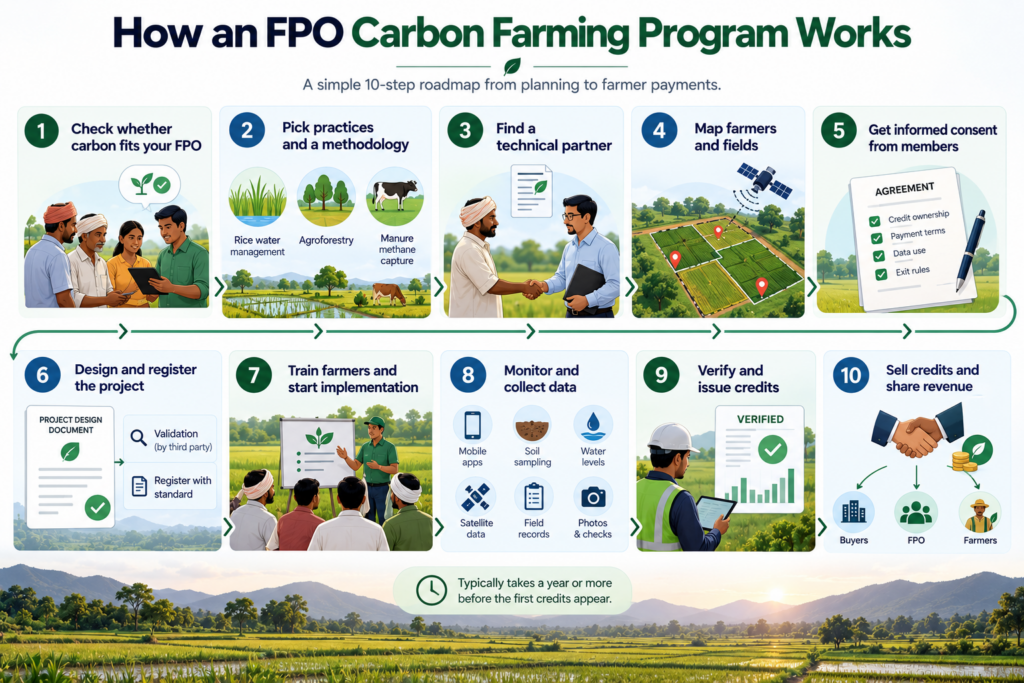
Step 1: Check Whether Carbon Fits Your FPO
Start with honest questions. Do members already grow crops that match an approved methodology? Does the FPO have records, trust and basic management strength?
If the FPO is struggling with basic operations, fix that first. Carbon adds complexity.
Step 2: Pick Practices and a Methodology
Choose practices that farmers can adopt easily and that an approved methodology covers. Rice water management, agroforestry and manure methane capture are common starting points.
Prefer practices that also save money or raise yields. Farmers stay committed when they see direct benefits.
Step 3: Find a Technical Partner
Most FPOs lack carbon accounting skills. A project developer, NGO or research institution can help with design, baselines, software and verification.
Compare partners carefully. Ask about fees, revenue share, contract length and who owns the credits.
Step 4: Map Farmers and Fields
Collect land records, field boundaries, crop history and current practices. Use GPS or satellite mapping to confirm plot locations.
This baseline shows what happens without the project. Credits are only valid for improvements beyond that baseline.
Step 5: Get Informed Consent from Members
Explain the project in the local language. Cover credit ownership, commitment length, payment timing, data use and exit rules.
Get written agreements. Never rush this step.
Step 6: Design and Register the Project
The developer prepares a project design document. It describes the activity, boundaries, baseline, monitoring plan and expected reductions.
The document then goes through validation by an approved third party and registration with the chosen standard or scheme.
Step 7: Train Farmers and Start Implementation
Train members on the new practices. Use demonstration plots, field days and peer farmers as trainers.
Appoint village-level coordinators. They keep records and answer questions.
Step 8: Monitor and Collect Data
Monitoring is the heart of the project. Common methods include:
- Field records and farmer diaries
- Water level tubes for rice fields
- Soil sampling for soil carbon
- Satellite and remote sensing
- Mobile apps for photos and geotagged data
- Random spot checks by FPO staff
Good data protects credit quality and farmer payments.
Step 9: Verify and Issue Credits
An independent verifier checks the data and confirms the emission reductions. The registry then issues credits into the project account.
Verification usually happens at set intervals, not every season.
Step 10: Sell Credits and Share Revenue
The project developer or FPO sells credits to buyers through contracts or brokers. Then the money flows back to farmers according to the agreed benefit sharing plan.
Publish a clear statement showing credits sold, price, deductions and farmer-wise payments.
Who Does What in a Collective Carbon Project
| Role | Main responsibilities |
|---|---|
| Farmers | Adopt practices, keep basic records, allow field checks |
| FPO | Recruit members, train, coordinate, store data, handle payments |
| Project developer | Design the project, manage registration, support verification, find buyers |
| Independent verifier | Check data and confirm emission reductions |
| Registry or scheme authority | Approve the project and issue credits |
| Buyers | Purchase credits and pay for them |
| Government and funding bodies | Provide policy, pilots, finance and technical support |
Costs, Revenue and the Truth About Income
Let us be honest. Carbon credits alone rarely transform a farmer’s income. They work best as an extra income stream on top of better farming economics.
Indian agriculture officials have also noted that no formal assessment of farmer income potential from carbon credits exists yet. Treat any big income claim with caution.
What a Project Costs
| Cost item | What it covers |
|---|---|
| Feasibility and design | Baseline studies, methodology selection, project documents |
| Farmer training | Field days, materials, local trainers |
| Mapping and data systems | GPS, satellite data, apps, databases |
| Monitoring | Staff time, soil tests, field checks |
| Validation and verification | Fees for independent auditors |
| Registry charges | Registration and issuance fees |
| Marketing | Broker fees and sales costs |
| FPO overhead | Staff, administration, accounting |
Many of these costs arrive years before the first sale. That is why upfront finance and grants matter. India’s NABARD, for example, has announced a Rs 300 crore Carbon Fund to support early stage carbon projects, including those led by FPOs and cooperatives.
A Simple Illustrative Example
The numbers below are hypothetical. They show how the math works, not what you will earn. Real credit prices and volumes vary widely by practice, region and buyer.
| Item | Example value |
|---|---|
| Land enrolled | 1,000 hectares |
| Credits per hectare per year | 1.5 |
| Total credits per year | 1,500 |
| Assumed price per credit | USD 10 |
| Gross revenue per year | USD 15,000 |
| Project costs (assumed 40 percent) | USD 6,000 |
| Net revenue | USD 9,000 |
| Farmer share at 70 percent | USD 6,300 |
| Average per hectare | USD 6.30 |
This tiny per-hectare figure shows why carbon should not be the only reason to join. It also shows why keeping costs low and choosing high-value practices matters.
Higher credit prices, larger volumes or practices that also cut input costs can change the picture. Always run your own numbers.
How to Share Carbon Revenue Fairly
Benefit sharing decides whether farmers trust the project. Unfair deals destroy participation fast.
Many experts suggest that farmers should receive a clear majority of net carbon revenue, with some recommending at least 60 percent. One reported government-linked framework in India described a split of 75 percent to farmers and 25 percent to the verifying agency. Splits vary by project, so read every contract.
A Three-Part Payment Model
Farmers carry risk before any credit exists. A three-part model reduces that risk:
- Practice payment: A small payment for adopting the practice, regardless of credit sales.
- Verification payment: A payment once credits are verified and issued.
- Carbon dividend: A final share paid after credits are sold. This part depends on the carbon price.
This approach shares risk more fairly and keeps farmers motivated.
Common Benefit Sharing Options
| Model | How it works | Main benefit | Main risk |
|---|---|---|---|
| Per-hectare payment | Fixed amount per enrolled hectare | Simple and predictable | May ignore actual results |
| Per-credit payment | Payment based on credits generated | Rewards performance | Payment delays |
| Revenue share | Percentage of net sales | Aligns everyone | Needs transparent accounting |
| Hybrid model | Upfront plus dividend | Balances risk | More complex to manage |
| Community fund share | Part of revenue goes to FPO services | Builds shared assets | Farmers may feel less direct benefit |
Real-World Examples
Kenya: Smallholder Soil Carbon at Scale
The Kenya Agricultural Carbon Project in the Lake Victoria region became one of the first large efforts to turn smallholder soil carbon into certified credits. It was implemented by Vi Agroforestry with World Bank BioCarbon Fund support. Farmers worked in groups, and the project initially aimed to reach around 60,000 smallholders across about 45,000 hectares.
It issued its first credits under the Verified Carbon Standard, a milestone for agricultural carbon worldwide.
The project also taught hard lessons. The target number of farmers was later reduced. Researchers found that the poorest households struggled most to adopt the new practices. Inclusion needs deliberate design.
Kenya: Agroforestry Under VM0042
Trees for the Future runs an agroforestry carbon project around Lake Victoria that applies VM0042 to smallholder farms across about 75,000 hectares. The project estimates it could generate around 20.7 million credits over its life. It shows how group-based tree planting can reach large scale.
India: Rice Carbon Programs
Bayer announced up to 250,000 tonnes of CO2e credits from its Rice Carbon Program in India. The program spanned 11 states and encouraged practices like direct seeded rice and alternate wetting and drying. Farmers reportedly gained from lower water and labor needs.
India has also now published a formal rice methodology under its domestic carbon market. That creates a path for FPOs to register rice projects locally, without relying only on private programs.
India: Government Pilots
The Agriculture Ministry supports 11 pilot projects through seven ICAR institutes and four state agricultural universities. They test how regenerative practices can enter carbon markets and help build methodologies. Their results will guide future FPO projects.
Challenges and How FPOs Can Handle Them
| Challenge | Why it matters | Practical response |
|---|---|---|
| Low credit income per farmer | Payments may be small | Pick practices that also save costs; keep overheads low |
| Long wait for revenue | Farmers bear upfront effort | Use grants, advances or practice payments |
| Complex monitoring | Errors reduce credit volume | Use simple apps and train village coordinators |
| Unclear carbon rights | Disputes over who owns credits | Sign plain-language agreements |
| Price uncertainty | Credit prices change | Use dividend sharing and diversified buyers |
| Permanence risk | Soil or trees may lose carbon later | Choose long-term practices and follow buffer rules |
| Leakage and additionality | Credits may not be real | Follow approved methodologies strictly |
| Exclusion of the poorest | They adopt practices last | Provide support, tenant and women inclusion rules |
| Weak FPO governance | Loss of trust | Publish accounts and run open member meetings |
One warning deserves extra attention. An FPO must not become merely a channel for collecting signatures and land records. If members do not understand the deal, the project is already in trouble.
What to Look for in a Carbon Project Partner
Many companies now approach FPOs with offers. Some are excellent. Others are not.
Good signs:
- Clear contract in the local language
- Transparent revenue split and cost deductions
- Use of a recognized standard or approved scheme
- Independent third-party verification
- Reasonable contract length and fair exit terms
- Regular reports on credits sold and prices
- Training and field support, not just paperwork
Red flags:
- Pressure to sign quickly
- No clear statement of who owns the credits
- Large upfront fees charged to farmers
- Vague promises of high income
- No explanation of costs or deductions
- Refusal to share sale prices
- Lock-in for many years with no exit
Ask for sample contracts and have a trusted legal advisor review them before the FPO signs.
FPO Carbon Readiness Checklist
Use this quick checklist before you begin.
- The FPO has active members and regular meetings.
- Accounts are clean, audited and shared with members.
- Members grow crops that match an approved methodology.
- Land records and farmer contact data are available.
- A trained staff member can manage data and coordination.
- Farmers understand and support the project.
- A technical partner has been vetted.
- Funding exists for early costs.
- Benefit sharing rules are agreed in writing.
- The FPO has a plan to handle complaints.
If you tick most boxes, you are ready to explore a collective carbon project.
Practical Tips to Make Carbon Credits for FPOs Work
- Start small. Run a pilot with one village or one crop before scaling.
- Bundle services. Combine carbon with training, inputs, credit and market access.
- Use women and youth leaders. They often strengthen outreach and record keeping.
- Keep farmers informed. Share simple dashboards or regular updates.
- Protect farmer data. Use consent forms and explain how data is used.
- Track success beyond credits. Measure net income, water saved, yields and payment timing.
- Plan for exit. Decide what happens when a farmer leaves or changes crops.
The Future of FPO Carbon Farming Programs
Three trends will shape the next few years.
First, standards are tightening. Approved methodologies and quality labels will push projects toward better measurement and stronger integrity.
Second, domestic markets are growing. Countries like India are building their own offset systems, which gives FPOs local routes to market.
Third, digital tools are improving. Satellite data, mobile apps and sensors can cut monitoring costs. Lower costs make small farm projects more viable.
Still, the core idea will not change. Credits only create value when farmers get fair, timely and transparent payment.
Conclusion: Is Carbon Credits for FPOs Worth It?
Carbon credits for FPOs offer a real opportunity, but not a shortcut to riches. They work best when an FPO treats carbon as a service for its members, backed by honest numbers, fair contracts and strong local trust.
Start by choosing practices that already help farmers. Then check that an approved methodology covers them. Find a credible technical partner, protect farmer rights and keep every payment transparent.
Done well, a farmer producer organization carbon credits project can add income, improve soil and water, and give smallholders a seat in the carbon market. Done badly, it can drain trust and waste years.
The difference lies in the design. Build your FPO carbon farming program around farmers first, and the credits will follow.
Frequently Asked Questions
What are carbon credits for FPOs?
They are carbon credits generated when a farmer producer organization brings many member farms together in one project. The group changes farming practices, proves the climate benefit through verification and sells the credits together.
Can an FPO sell carbon credits directly?
Yes, in principle. In practice, most FPOs partner with a project developer or NGO for technical design, verification and sales. Some larger FPOs build in-house skills over time.
How much money can farmers earn from carbon credits?
Income varies widely by practice, location, credit price and project costs. For most smallholders, carbon is a modest extra income, not a replacement for crop income. Ask every partner for a clear written estimate.
Which practices qualify for agricultural carbon credits?
Only practices covered by an approved methodology qualify. Common examples include improved rice water management, soil carbon practices, agroforestry and manure methane capture.
What is a collective carbon project?
A collective carbon project groups many small farms under one project, one methodology and one verification process. It lowers costs and makes small plots commercially viable.
How long does it take to earn the first credits?
Often a year or more. The process includes mapping farmers, designing the project, validation, implementation, monitoring and verification. Revenue arrives only after credits are issued and sold.
Do farmers lose ownership of their land in a carbon project?
No. Farmers keep their land. They commit to specific practices for an agreed period. Always read the contract carefully, especially clauses on credit ownership, duration and exit.
Are carbon credits for farmers safe and legitimate?
They can be, when projects use recognized standards, independent verification and transparent contracts. Avoid partners who hide costs, rush signatures or promise unrealistic income.
Does India allow FPOs to take part in carbon markets?
Yes. India’s offset mechanism under its Carbon Credit Trading Scheme lets farmers, FPOs and project developers take part. A draft framework also allows FPOs to aggregate many small farm activities under one programme.
What should an FPO do first?
Check member interest, review available methodologies, pick a practical practice and speak with credible technical partners. Run a small pilot before scaling up.
Explore more guides, tools, and resources on Carbon Market Network to deepen your understanding of carbon markets and emissions measurement.