Carbon Market Network


Where you buy a carbon credit matters almost as much as which credit you buy.
Two buyers can pay the same price for what looks like the same credit. One gets a verified, traceable tonne. The other gets a headache and a reputational risk.
That is why choosing among the voluntary carbon marketplaces is a real decision, not a formality.
This guide walks you through the main voluntary carbon marketplaces operating around the world. You will see how each one works, who it suits, and what to check before you spend a single dollar.
It works for beginners and for readers who already know the basics.
What Are Voluntary Carbon Marketplaces?
Voluntary carbon marketplaces are platforms where buyers and sellers trade carbon credits that no law forces anyone to buy.
A company, a project developer, an airline, or an individual can use them. Each credit represents one tonne of carbon dioxide equivalent that a project avoided, reduced, or removed.
The “voluntary” part is important. Nobody has to buy these credits to comply with a cap-and-trade law.
Buyers choose to purchase them to support climate goals, meet customer expectations, or prepare for future rules.
Marketplace, Exchange, Registry: What’s the Difference?
People mix these words up constantly. They do different jobs.
| Term | What it does | Simple example |
|---|---|---|
| Registry | Issues credits, assigns serial numbers, and tracks ownership and retirement | Verra, Gold Standard, American Carbon Registry, Climate Action Reserve |
| Exchange | Matches buyers and sellers through an order book with standard contracts and price discovery | Xpansiv CBL, Carbon Trade eXchange |
| Marketplace or platform | Lets buyers browse, compare, and purchase credits, often with vetting and advice | Patch, Supercritical, Carbonfuture |
| Broker or trading desk | Negotiates large deals privately, often over the counter | Specialist trading firms and advisers |
| Rating agency | Scores project quality but does not sell credits | Sylvera, BeZero, Calyx Global |
Many modern platforms blur these lines. Some exchanges also run auctions and clearing. Some marketplaces also give ratings data and advice.
The core idea stays the same. A registry creates the credit. A marketplace helps you buy it. A retirement permanently takes it off the market once you claim it.
Carbon Market Insider Newsletter
Weekly insights on carbon markets, climate policy, carbon credits, and sustainability.
Who Uses Voluntary Carbon Marketplaces?
- Corporate buyers who want credits for net zero programs and beyond value chain mitigation
- Airlines and aviation groups buying credits for compliance under CORSIA or for voluntary programs
- Project developers selling credits from forestry, cookstove, methane, or removal projects
- Traders and financial firms who provide liquidity and price discovery
- Small businesses and individuals who buy smaller volumes, usually through retail-friendly platforms
How Voluntary Carbon Marketplaces Work
Every platform has its own design. The basic journey of a credit looks similar everywhere.
- A project is developed. A team plants trees, captures landfill methane, distributes clean cookstoves, or stores carbon underground.
- An independent auditor verifies it. A third party checks that the climate benefit is real and measured correctly.
- A registry issues credits. Each credit gets a unique serial number.
- The credits are listed. They appear on an exchange, a marketplace, or with a broker.
- A buyer purchases them. The deal happens on the spot, through a forward contract, or through a long-term offtake.
- The buyer retires the credits. Retirement removes them from circulation so nobody can sell or claim them again.
Retirement is the step that counts. A credit you own but have not retired has not offset anything yet.
Spot, Forward, and Offtake Deals
Marketplaces support different deal types. Knowing them helps you pick the right platform.
| Deal type | How it works | Best for |
|---|---|---|
| Spot | You buy existing credits and settle quickly | Buyers who need credits now |
| Forward | You agree today to buy credits delivered later | Buyers locking in future supply and price |
| Offtake | You commit to buy future output from a project, often over several years | Buyers who want removal credits and want to help projects get built |
Forward and offtake deals matter more every year. High-quality supply is limited, so buyers increasingly reserve it early.
The Voluntary Carbon Market Today: What the Data Shows
The voluntary carbon market has changed a lot in a few years. Understanding the trend helps you read what the marketplaces are doing.
Sylvera, a carbon ratings and data provider, publishes quarterly snapshots. They show a pattern many analysts describe as volume versus value.
| Recent quarterly indicator | What it shows |
|---|---|
| Retirements | Roughly 30 to 50 million credits per quarter, with year-on-year volumes often slightly lower |
| Total value of retirements | About $210 million to $290 million per quarter |
| Average price per retired credit | Rising, reaching nearly $7 in a recent quarter, up from around $5.60 a year earlier |
| Investment-grade credits (BBB or higher) | A small share of rated volume but a much larger share of rated value |
In one recent quarter, investment-grade credits made up 18% of rated retirement volume but 42% of rated market value.
In plain words, buyers pay noticeably more for credits that rate well.
Two other signals stand out.
- Integrity labels are gaining ground. The Integrity Council for the Voluntary Carbon Market (ICVCM) created the Core Carbon Principles (CCP) label. AlliedOffsets estimated that about 15% of newly issued credits in a recent half year carried the label.
- CCP-labelled credits earn a premium. The ICVCM reports an average premium of around 25%, based on market data from ClearBlue Markets and Calyx Global.
Different data providers report different totals, because each tracks different registries and uses different methods. Always check which source a number comes from before you quote it.
Top Voluntary Carbon Marketplaces
Here are the platforms that matter most today, grouped by what they do best.
1. Xpansiv CBL: The Largest Spot Exchange
Best for: institutional buyers, traders, and airlines that want deep liquidity and standard contracts.
Xpansiv’s CBL is widely described as the world’s largest and most active spot marketplace for environmental commodities. Estimates of its share of exchange-traded voluntary carbon volume vary by source, but it clearly leads that segment.
CBL is known for standardized contracts that work like benchmarks:
- GEO (Global Emissions Offset): a broad standardized voluntary contract
- N-GEO: a nature-based contract
- C-GEO: a technology-based contract
- GEO CP1: a contract aligned with the first compliance phase of CORSIA, the aviation offsetting scheme
CME Group lists futures linked to the GEO family, which gives the market a way to hedge and discover prices.
CBL also trades project-specific credits. Xpansiv says more than 100 million tonnes have moved through the GEO spot and futures contracts.
The wider Xpansiv network powers other venues too, including IATA’s Aviation Carbon Exchange and the carbon market run by the Johannesburg Stock Exchange.
Watch out for: access usually requires onboarding as a member or working through a broker. It is built for professionals, not for someone buying one tonne.
2. Carbon Trade eXchange (CTX): The Long-Running Spot Platform
Best for: buyers and sellers who want an electronic spot market with a wide range of project listings.
CTX is one of the oldest electronic exchanges for voluntary carbon credits. It is based in London and has operated for well over a decade.
The exchange reports that it has traded more than one billion tonnes of CO2e since launch. It supports credits from major standards such as Verra and Gold Standard, along with credits from the UN’s Clean Development Mechanism.
CTX has also kept adapting. It introduced a flat-fee tier for large institutional members, with free account opening and a fee of about ten cents per credit. It has also launched an API so other software platforms can connect to its live listings.
Watch out for: the platform lists a wide range of projects. Quality varies, so apply your own screening or use ratings.
3. Climate Impact X (CIX) and Carbonplace: Trading Meets Settlement
Best for: institutional buyers who want trading, bank-grade settlement, and multi-registry access in one place.
CIX is a Singapore-based exchange and marketplace founded by DBS, Singapore Exchange, Standard Chartered, and Temasek. Its spot exchange runs on Nasdaq technology. It also offers auctions and a clearing service for privately negotiated deals.
Carbonplace is a London-based platform backed by several large banks. It focuses on settlement, custody, and portfolio management across multiple registries.
The two companies have announced plans to merge, subject to regulatory approval. They plan to keep their own brands during integration.
The idea is to cover the whole transaction cycle: sourcing, trading, settlement, custody, and retirement.
Why it matters: the voluntary carbon market has long suffered from fragmentation. This move reflects a wider push toward financial-market-style infrastructure.
Watch out for: better plumbing does not fix credit quality on its own. You still need to vet what you buy.
4. Patch: Marketplace Plus Software
Best for: corporate sustainability teams that want help sourcing, comparing, and managing credits across many suppliers.
Patch started as an API-first marketplace for carbon removal. It has since grown into a procurement platform that combines data, software, and advisory support.
Patch says it works with more than 500 sellers worldwide and uses AI tools to speed up sourcing. Its customers have included well-known technology and consulting firms.
Patch also lets companies embed carbon purchases into their own products, such as checkout flows and shipping.
Watch out for: as with any advised platform, ask how it earns money so you understand any fees or markups.
5. Supercritical: Durable Removal for Corporate Buyers
Best for: companies that want carbon removal credits with strong vetting and flexible deal structures.
Supercritical is a UK-based marketplace focused on durable carbon removal. Buyers can transact on the spot market, through forwards, or through long-term offtakes.
It screens projects against a detailed science framework. One example is a 20,000 tonne portfolio of biochar and enhanced rock weathering credits that Boeing arranged through the platform.
Watch out for: removal credits cost far more than most avoidance credits. They often sell for well over a hundred dollars per tonne, and delivery can take years.
6. Carbonfuture: Traceability for Durable Removal
Best for: buyers who care deeply about measurement, chain of custody, and audit-ready records.
Carbonfuture, based in Freiburg with offices in Zurich and San Francisco, calls itself digital trust infrastructure for durable carbon removal.
It covers pathways such as biochar, bioenergy with carbon capture and storage, direct air capture, and mineralization.
Every credit comes with traceable data and legal title. Customers include large corporations such as Microsoft, Swiss Re, and SAP.
Watch out for: it specializes in removals, so it will not suit a buyer looking for low-cost avoidance credits.
7. Regional Exchanges: HKEX Core Climate, Bursa Carbon Exchange, and More
Best for: buyers who want regional access, local currency settlement, or alignment with a national policy goal.
Several stock exchanges have built voluntary carbon venues.
| Venue | Location | Notable feature |
|---|---|---|
| HKEX Core Climate | Hong Kong | Credits from internationally verified projects, with settlement in Hong Kong dollars or yuan |
| Bursa Carbon Exchange | Malaysia | Exchange for carbon credits and renewable energy certificates |
| JSE carbon market | South Africa | Uses Xpansiv technology for carbon credits and certificates |
| IDXCarbon | Indonesia | Separate structures for allowances and offsets, with a strong domestic focus |
Rules differ from venue to venue. Some limit participation to local entities, so check eligibility first.
8. Other Platforms Worth Knowing
- Abatable: offers a carbon marketplace along with market research and data on supply, demand, and quality.
- Puro.earth: a crediting platform for engineered carbon removal, whose credits also appear on other marketplaces.
- Toucan: an infrastructure provider that now focuses on biochar credits through a product called CHAR.
New platforms appear and old ones consolidate often. Confirm that any platform is still active and check its latest terms before you commit.
Comparing the Top Voluntary Carbon Marketplaces
| Platform | Type | Best for | Main strength | Typical buyer |
|---|---|---|---|---|
| Xpansiv CBL | Spot exchange | Liquidity and benchmarks | Standard contracts, futures link | Institutions, airlines |
| CTX | Spot exchange | Wide listings | Long track record, API access | Corporates, brokers |
| CIX and Carbonplace | Exchange and settlement | End-to-end institutional flow | Multi-registry, bank-grade settlement | Financial institutions |
| Patch | Marketplace and software | Procurement support | Data, advisory, integrations | Corporate sustainability teams |
| Supercritical | Removal marketplace | Durable removals | Vetting, spot and offtake | Technology and industrial firms |
| Carbonfuture | Removal marketplace | Traceability | Digital chain of custody | Corporates buying removals |
| HKEX Core Climate | Regional exchange | Asia access | Local currency settlement | Asia-based buyers |
Which Type of Marketplace Fits You?
Start with your goal, not the platform name.
If You Are a Large Corporate Buyer
You need volume, documentation, and defensible quality. Look at exchanges for liquidity and at advised marketplaces for sourcing help. Many large buyers use both.
If You Want Carbon Removal
Choose a removal specialist. Supercritical and Carbonfuture focus here. Plan for higher prices, longer delivery, and offtake contracts.
If You Are an Airline or Aviation Buyer
Look for platforms that support CORSIA eligible emissions units. CBL and IATA’s Aviation Carbon Exchange both support this segment.
In a recent compliance year, airlines in CORSIA had to cover roughly 68 million tonnes of CO2. Procurement events on these platforms offer millions of eligible units at a time.
If You Are a Small Business or Individual
Most major exchanges are not built for you. Look for retail-friendly marketplaces, API-based offsetting tools, or reputable project developers that sell directly.
How to Choose the Right Voluntary Carbon Marketplace
Use this checklist before you register anywhere.
| Question to ask | Why it matters |
|---|---|
| Which registries and standards does it connect to? | Credits should come from recognized programs like Verra, Gold Standard, ACR, or CAR |
| Does it show CCP labels and ratings? | These help you filter for higher integrity |
| How transparent are prices and fees? | Hidden markups erode value |
| How does settlement and retirement work? | You need proof of retirement in your name |
| Who can trade there? | Some venues limit access to members or local entities |
| What project types does it list? | Make sure it fits your strategy, whether avoidance or removal |
| Is it financially and legally stable? | Platforms merge, pivot, and shut down |
| Does it support your claim? | Check the platform’s guidance on how you can describe your purchase |
How to Buy Carbon Credits on a Marketplace: Step by Step
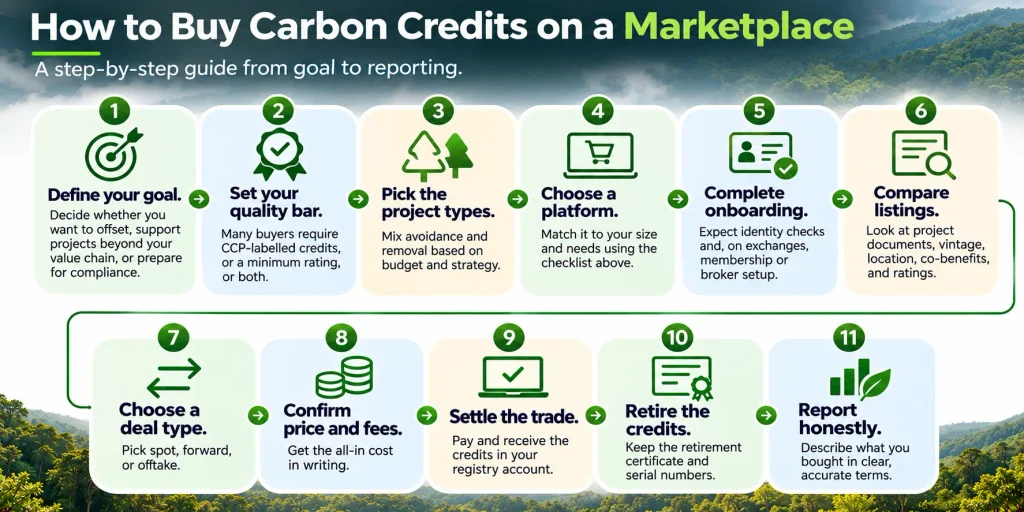
- Define your goal. Decide whether you want to offset, support projects beyond your value chain, or prepare for compliance.
- Set your quality bar. Many buyers require CCP-labelled credits, or a minimum rating, or both.
- Pick the project types. Mix avoidance and removal based on budget and strategy.
- Choose a platform. Match it to your size and needs using the checklist above.
- Complete onboarding. Expect identity checks and, on exchanges, membership or broker setup.
- Compare listings. Look at project documents, vintage, location, co-benefits, and ratings.
- Choose a deal type. Pick spot, forward, or offtake.
- Confirm price and fees. Get the all-in cost in writing.
- Settle the trade. Pay and receive the credits in your registry account.
- Retire the credits. Keep the retirement certificate and serial numbers.
- Report honestly. Describe what you bought in clear, accurate terms.
Quality First: How to Avoid Weak Credits
A marketplace gives you access. It does not guarantee quality.
Use the CCP Label
The ICVCM runs a two-step approach. A crediting program must be CCP-eligible, and the specific methodology must be CCP-approved.
The major programs, including Verra, Gold Standard, ACR, and CAR, are CCP-eligible. Only credits from approved methodologies can carry the label.
The ICVCM has declined to label credits from current grid-connected renewable energy methodologies. That decision removed a large block of older supply from the high-integrity category.
Check Independent Ratings
Rating agencies such as Sylvera, BeZero, and Calyx Global assess project quality. Many marketplaces now show these ratings on screen.
Read the Project Documents
Look at the methodology, monitoring reports, and any issues flagged by auditors.
Be Careful With Your Claims
The Voluntary Carbon Markets Integrity Initiative (VCMI) offers guidance on how companies can make credible claims about their use of credits. Many buyers treat credits as a supplement to emission cuts, not a replacement.
Red Flags
- Prices far below similar credits with no clear reason
- No serial numbers or registry link
- Vague project descriptions
- Pressure to buy quickly
- Platforms that cannot show proof of retirement
What Do Voluntary Carbon Credits Cost?
Prices vary widely by project type, quality, vintage, and deal structure.
| Credit type | Typical price pattern |
|---|---|
| Older or lower-rated avoidance credits | Low prices, often a few dollars per tonne |
| CCP-labelled and highly rated credits | A clear premium over comparable credits |
| Nature-based credits with strong co-benefits | Mid-range, often above basic avoidance |
| Durable removals (biochar, direct air capture, mineralization) | Far higher, often well above $100 per tonne |
The average price paid per retired credit has been climbing, as the quarterly data shows. That average hides a wide spread.
How Platforms Make Money
- Commissions on trades
- Account or membership fees
- Flat per-credit fees
- Markups on credits sold from inventory
- Software and advisory subscriptions
Ask for a clear fee breakdown before you trade.
Trends Shaping Voluntary Carbon Marketplaces
Consolidation
The planned CIX and Carbonplace merger is one example. Expect more partnerships as platforms try to offer trading, settlement, and custody together.
Convergence With Compliance Markets
CORSIA is pulling voluntary platforms into compliance-linked trading. Abatable estimates that first-phase CORSIA demand could reach roughly 200 to 220 million tonnes.
Article 6 of the Paris Agreement is also creating links between national programs and credit markets.
Quality Over Quantity
Retirement volumes have been flat or lower in some quarters while value has risen. Buyers want fewer, better credits.
Growth in Removals and Forward Deals
Companies increasingly sign multi-year offtake agreements for removal credits. Marketplaces now build products around that need.
AI in Procurement
Some platforms, including Patch, now use AI tools to screen suppliers and compare prices faster. Expect this to spread.
Better Data and Transparency
Ratings on trading screens, live price data, and digital chain of custody are becoming standard.
Common Mistakes Buyers Make
- Choosing on price alone. The cheapest credit often carries the highest risk.
- Skipping retirement. Owning a credit is not the same as using it.
- Ignoring vintage and methodology. Older credits and outdated methods can fail new quality tests.
- Buying from one project type only. Diversify to spread delivery and reputation risk.
- Forgetting fees. Compare the all-in cost, not just the headline price.
- Over-claiming. Describe your purchase accurately.
Conclusion
Voluntary carbon marketplaces now range from deep institutional exchanges like Xpansiv CBL and CTX to advised platforms like Patch and specialist removal marketplaces like Supercritical and Carbonfuture.
Regional exchanges, and the planned CIX and Carbonplace merger, show where the infrastructure is heading: more connected, more auditable, and closer to traditional finance.
The best voluntary carbon marketplace is the one that fits your goal, your size, and your quality standards.
Start with the credit you want. Check CCP labels and ratings. Compare fees. Retire your credits and keep the proof.
Do that, and the marketplace works for you instead of the other way around.
Frequently Asked Questions
What are voluntary carbon marketplaces?
They are platforms where buyers and sellers trade carbon credits that no law requires anyone to buy. They include exchanges, advised marketplaces, and removal platforms.
What is the biggest voluntary carbon marketplace?
Xpansiv’s CBL is widely described as the largest and most active spot marketplace for environmental commodities. Its exact share of volume varies by source.
What is the difference between a carbon registry and a carbon marketplace?
A registry issues credits, tracks ownership, and records retirement. A marketplace helps you find and buy those credits.
Can individuals buy carbon credits on these platforms?
Most major exchanges are built for institutions and require onboarding or a broker. Individuals usually buy through retail-friendly marketplaces or directly from project developers.
How do I know if a carbon credit is high quality?
Check for the CCP label, look at independent ratings, and read the project documents. Confirm the credit comes from a recognized registry.
What does retiring a carbon credit mean?
Retiring a credit permanently removes it from the registry so nobody can sell or claim it again. It is the step that lets you make a claim.
Are carbon removal credits different from other credits?
Yes. Removal credits take carbon out of the atmosphere, often with long-term storage. They cost more and usually involve longer delivery times.
Are voluntary carbon credits the same as compliance credits?
No. Voluntary credits are bought by choice. Compliance credits or allowances are required under laws or schemes such as cap-and-trade or CORSIA.
Do voluntary carbon marketplaces charge fees?
Most do. Fees can include commissions, flat per-credit charges, membership costs, or markups. Always ask for a full fee breakdown.
Are voluntary carbon marketplaces regulated?
Regulation depends on the venue and country. Some exchanges sit inside regulated financial infrastructure, while others operate under lighter rules. Check the platform’s status where you operate.
Ready to go deeper? Explore more guides at Carbon Market Network.