Carbon Market Network


Why Everyone Is Talking About Carbon Credits
Climate change is no longer a distant threat. Governments, companies, and investors are scrambling to find real solutions fast. That is where carbon credits come in.
Whether you have seen the term in a news headline, a company’s sustainability report, or a LinkedIn post, carbon credits are becoming one of the most talked-about tools in the fight against climate change.
But what exactly is a carbon credit? How does it work? And why should you care?
This guide answers all of that in plain, simple language. No jargon, no fluff.
What Is a Carbon Credit?
A carbon credit is a tradable certificate that represents the reduction or removal of one metric ton of carbon dioxide (CO2) or an equivalent greenhouse gas from the atmosphere.
Think of it like a permission slip, but in reverse.
Instead of giving someone permission to pollute, a carbon credit proves that someone has already prevented or removed pollution. That proof can then be sold to companies or individuals who want to offset their own emissions.
One carbon credit = one metric ton of CO2 reduced, avoided, or removed.
Carbon Market Insider Newsletter
Weekly insights on carbon markets, climate policy, carbon credits, and sustainability.
How Did Carbon Credits Come About?
The idea behind carbon credits was born out of international climate negotiations.
The Kyoto Protocol of 1997 was the first major global agreement to introduce carbon trading as a mechanism to control emissions.
Countries that emitted less than their allowed limit could sell their surplus to countries that exceeded theirs.
Over time, this concept expanded beyond governments to include businesses and individuals.
Today, carbon credits are used by airlines, banks, tech companies, oil producers, and even small businesses to manage their carbon footprints.
How Does a Carbon Credit Work?
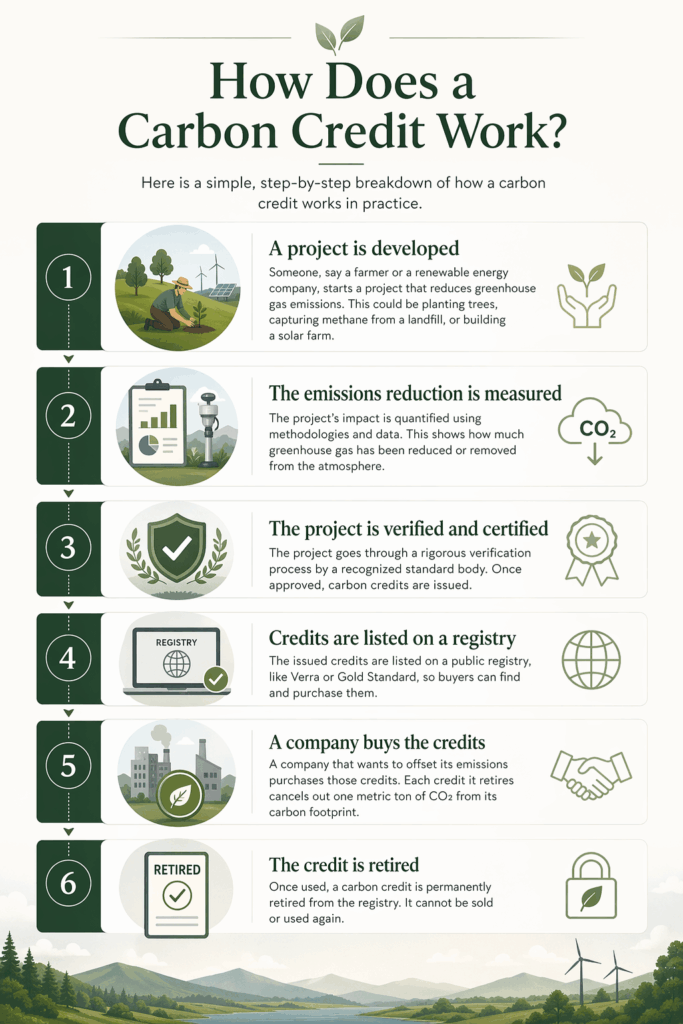
Here is a simple, step-by-step breakdown of how a carbon credit works in practice.
- A project is developed
Someone, say a farmer or a renewable energy company, starts a project that reduces greenhouse gas emissions. This could be planting trees, capturing methane from a landfill, or building a solar farm.
- The emissions reduction is measured
Someone, say a farmer or a renewable energy company, starts a project that reduces greenhouse gas emissions. This could be planting trees, capturing methane from a landfill, or building a solar farm.
- The project is verified and certified
The project goes through a rigorous verification process by a recognized standard body. Once approved, carbon credits are issued.
- Credits are listed on a registry
The issued credits are listed on a public registry, like Verra or Gold Standard, so buyers can find and purchase them.
- A company buys the credits
A company that wants to offset its emissions purchases those credits. Each credit it retires cancels out one metric ton of CO2 from its carbon footprint.
- The credit is retired
Once used, a carbon credit is permanently retired from the registry. It cannot be sold or used again.
Types of Carbon Credits
Not all carbon credits are the same. They fall into two main categories.
1. Compliance Carbon Credits
These exist within regulated carbon markets, also called cap-and-trade systems.
Governments set a limit (a cap) on how much CO2 industries can emit. Companies that emit less than their cap can sell their unused allowances to companies that exceed theirs.
Examples of compliance markets include:
- EU Emissions Trading System (EU ETS) in Europe
- California Cap-and-Trade Program in the USA
- India’s Carbon Credit Trading Scheme (CCTS), launched in 2023
2. Voluntary Carbon Credits
These exist within the voluntary carbon market (VCM).
Companies or individuals choose to buy voluntary carbon credits, not because a law forces them to, but because they want to meet sustainability goals or net-zero commitments.
Voluntary credits are issued by standard-setting bodies like:
- Verra (Verified Carbon Standard)
- Gold Standard
- American Carbon Registry
- Climate Action Reserve
What Projects Generate Carbon Credits?
Carbon credits can come from a wide range of project types. Here are the most common ones.
Forestry and Land Use
- Avoiding deforestation (REDD+ projects)
- Reforestation and afforestation
- Improved forest management
Renewable Energy
- Solar and wind energy projects
- Replacing fossil fuel-based power with clean energy
Methane Capture
- Capturing methane from landfills, coal mines, or livestock farms
- Converting the captured gas into usable energy
Energy Efficiency
- Industrial efficiency upgrades
- Clean cookstoves replacing traditional wood-burning stoves in developing countries
- Direct Air Capture (DAC)
- Biochar application in soil
- Blue carbon projects (protecting mangroves and seagrasses)
What Makes a Carbon Credit High Quality?
Not every carbon credit is trustworthy. A high-quality carbon credit must meet five key criteria.
1. Real The emission reduction must have actually happened, not just been projected or promised.
2. Additional The project must prove that the emission reduction would not have happened without carbon finance. This is called “additionality.”
3. Permanent The carbon must be stored or avoided in a way that lasts. A forest that gets cut down five years later is not a valid carbon offset.
4. Verified An independent, accredited third party must confirm the emission reductions.
5. Unique Each credit must only be counted once. No double-counting across registries or buyers.
What Is the Price of a Carbon Credit?
Carbon credit prices vary widely depending on the type, quality, and market.
Here is a general price range to give you an idea:
| Market/Type | Price Range (per ton CO2) |
|---|---|
| EU ETS (compliance) | $50 to $90 |
| California Cap-and-Trade | $30 to $40 |
| High-quality voluntary credits | $10 to $50+ |
| Low-quality voluntary credits | $1 to $5 |
| Direct Air Capture credits | $200 to $600+ |
Prices in compliance markets are driven by government policy and emission caps.
In voluntary markets, prices depend heavily on the project type, certification standard, and co-benefits like biodiversity or community development.
Carbon Credits vs Carbon Offsets: What Is the Difference?
These two terms are often used interchangeably, but there is a subtle difference.
Carbon credits is the broader term. It includes both compliance allowances and verified emission reductions.
Carbon offsets specifically refer to credits generated by projects that reduce or remove emissions elsewhere to compensate for emissions produced in another place.
In simple terms: all carbon offsets are carbon credits, but not all carbon credits are carbon offsets.
Who Buys Carbon Credits?
A wide range of buyers participate in carbon markets.
Large corporations use credits to meet net-zero pledges and ESG targets. Companies like Microsoft, Delta Airlines, and Shell have all purchased carbon credits.
Airlines use carbon credits under the CORSIA scheme to offset international aviation emissions.
Small and medium businesses use voluntary credits to market themselves as carbon neutral.
Governments use compliance credits to meet their nationally determined contributions (NDCs) under the Paris Agreement.
Individuals can also buy carbon credits to offset personal activities like flying or driving.
Who Sells Carbon Credits?
The supply side of carbon markets includes:
- Project developers who build and manage carbon projects
- Indigenous communities and landowners who protect forests
- Farmers who adopt sustainable land management practices
- Renewable energy companies in developing countries
- Municipalities running landfill gas capture programs
In India, projects registered under the Bureau of Energy Efficiency (BEE) and the PAT (Perform, Achieve, and Trade) scheme can generate carbon credits under the domestic CCTS framework.
How Are Carbon Credits Traded?
Carbon credits are traded through several channels.
Exchanges Organized exchanges like the Chicago Voluntary Carbon Markets Exchange and Xpansiv CBL allow buyers and sellers to trade standardized credits.
Over-the-Counter (OTC) Many trades happen directly between buyers and sellers, often through carbon brokers or trading desks.
Auctions In compliance markets, governments auction off emission allowances to regulated companies.
Online Platforms Newer platforms like Pachama, South Pole, and Cloverly allow businesses to browse, compare, and purchase verified credits online.
What Are Co-Benefits of Carbon Credits?
Beyond reducing CO2, many carbon projects deliver additional social and environmental benefits. These are called co-benefits.
Common co-benefits include:
- Biodiversity protection by preserving natural ecosystems
- Clean water access for rural communities near project sites
- Job creation in forestry, renewable energy, or agriculture
- Women’s empowerment through clean cookstove projects
- Food security through soil improvement and regenerative farming
Credits with strong co-benefits are often labeled with additional certifications like the CCB (Climate, Community, and Biodiversity) Standards.
Criticisms and Challenges Facing Carbon Credits
Carbon credits have faced serious criticism over the years. It is important to understand the limitations too.
Greenwashing concerns Some companies use carbon credits to claim climate neutrality without actually reducing their own emissions. This is called greenwashing.
Permanence risk A forest that gets destroyed by wildfire or illegal logging eliminates the carbon it was supposed to store.
Additionality issues Some projects have been accused of claiming credits for emission reductions that would have happened anyway, even without carbon finance.
Verification quality Not all verification bodies are equally rigorous. Weak auditing can lead to inflated or fraudulent credits.
Lack of standardization The voluntary carbon market has historically lacked a unified global standard, making it hard for buyers to compare credits.
To address these issues, initiatives like ICVCM (Integrity Council for the Voluntary Carbon Market) and VCMI (Voluntary Carbon Markets Integrity Initiative) are working to set higher global standards.
The Future of Carbon Credits
Carbon markets are growing fast.
The Paris Agreement’s Article 6 created a framework for international carbon trading between countries. This is expected to unlock a significant scaling of global carbon markets.
Analysts at BloombergNEF and McKinsey have projected that voluntary carbon markets could grow to $50 billion or more annually by 2030.
Emerging trends shaping the future include:
- Tokenized carbon credits on blockchain for greater transparency
- Nature-based solutions gaining more investment and credibility
- Carbon removal credits becoming more mainstream as removal technology scales
- Mandatory corporate disclosure pushing more companies into carbon markets
- India’s CCTS becoming operational, creating a significant new compliance market in Asia
Real-World Example: How a Company Uses Carbon Credits
Here is a practical example to bring it all together.
Company: A mid-sized logistics company in India.
The problem: The company emits 10,000 tons of CO2 per year from its truck fleet.
The action: It reduces emissions by upgrading to more fuel-efficient trucks and switching part of its fleet to CNG. After these changes, it still emits 7,000 tons.
The offset: It purchases 7,000 voluntary carbon credits from a verified reforestation project in Madhya Pradesh.
The outcome: The company can now claim carbon neutrality for that year. It also retires the credits publicly on a registry to back up its claim.
This is how carbon credits work in the real world, as a tool used alongside, not instead of, direct emission reductions.
Conclusion: Why Carbon Credits Matter
Carbon credits are not a silver bullet for climate change. But they are a powerful tool when used correctly.
They fund real-world projects that reduce emissions, protect forests, bring clean energy to underserved communities, and create economic value from environmental protection.
Understanding what a carbon credit is, how it works, and where it comes from is the first step toward participating meaningfully in the global transition to a low-carbon economy.
Whether you are a business looking to offset your footprint, a professional exploring carbon market careers, or simply a curious reader, carbon credits are a topic worth knowing well.
The carbon economy is growing. And those who understand it early will be best placed to act on it.
Frequently Asked Questions (FAQ)
What is a carbon credit in simple terms?
A carbon credit is a certificate that represents one metric ton of CO2 reduced or removed from the atmosphere. Companies buy these credits to offset their own greenhouse gas emissions.
How much is one carbon credit worth?
The price of one carbon credit ranges from as low as $1 for low-quality voluntary credits to over $600 for high-quality removal-based credits like Direct Air Capture. Compliance market credits typically range from $30 to $90.
Are carbon credits the same as carbon offsets?
Not exactly. Carbon offsets are a type of carbon credit that compensates for emissions made elsewhere. All offsets are credits, but not all credits are offsets.
Do carbon credits actually help the environment?
High-quality, verified carbon credits do help. They fund projects that reduce or remove real emissions. However, poorly designed credits can lead to greenwashing without genuine climate benefit.
Can individuals buy carbon credits?
Yes. Individuals can purchase carbon credits through platforms like Gold Standard Marketplace or Terrapass to offset personal emissions from activities like flying or driving.
What is the voluntary carbon market?
The voluntary carbon market (VCM) is a marketplace where companies and individuals choose to buy carbon credits to meet sustainability goals, even when not legally required to do so.
How are carbon credits verified?
Carbon credits are verified by independent, accredited third-party auditors using approved scientific methodologies. Standard bodies like Verra and Gold Standard oversee this process.
What is India’s carbon credit scheme?
India launched its Carbon Credit Trading Scheme (CCTS) in 2023 under the Energy Conservation (Amendment) Act. It is administered by the Bureau of Energy Efficiency (BEE) and aims to create a domestic compliance carbon market.