Carbon Market Network


Germany runs one of the most sophisticated carbon pricing systems in the world. If you search for Germany carbon credits, you will find a mix of European rules, national laws, and voluntary market options, all working together to push the country toward its climate goals.
This guide breaks it all down in plain language. Whether you run a business in Germany, work in sustainability, or simply want to understand carbon credits Germany style, you will find clear answers here.
Let’s dig into how carbon pricing actually works in Germany, who needs to pay, how the prices are set, and what opportunities exist for companies and individuals who want to take climate action seriously.
What Are Carbon Credits, In Simple Terms
A carbon credit represents the right to emit one tonne of carbon dioxide, or an equivalent amount of another greenhouse gas.
Companies either receive these credits for free, buy them at auction, or purchase them on a secondary market.
Governments use carbon credits to put a price on pollution. When emitting carbon costs money, companies have a real financial reason to cut emissions.
There are two broad categories worth knowing:
- Compliance carbon credits: These are mandatory. Governments or regional bodies like the European Union require certain industries to hold and surrender credits that match their actual emissions.
- Voluntary carbon credits: These are optional. Businesses and individuals buy them to offset emissions they cannot yet eliminate, often to support climate goals or brand reputation.
Germany carbon credits fall into both categories, and understanding the difference is the first step to making sense of the whole system.
Carbon Market Insider Newsletter
Weekly insights on carbon markets, climate policy, carbon credits, and sustainability.
Germany’s Carbon Pricing Landscape: Two Systems Working Together
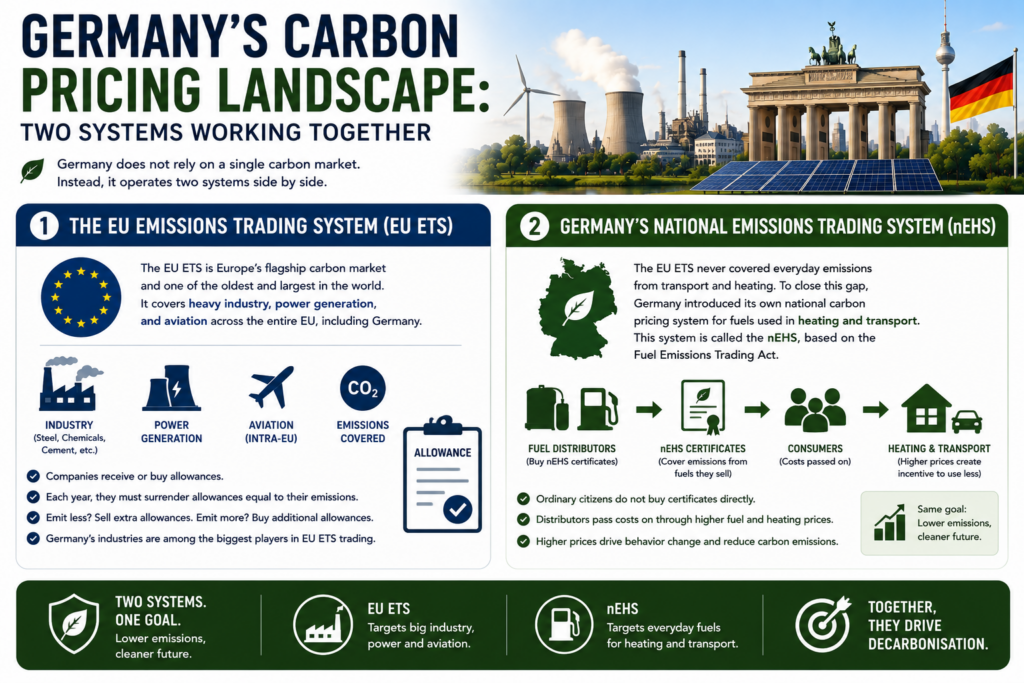
Germany does not rely on a single carbon market. Instead, it operates two systems side by side.
1. The EU Emissions Trading System (EU ETS)
The EU ETS is Europe’s flagship carbon market and one of the oldest and largest in the world. It covers heavy industry, power generation, and aviation across the entire European Union, including Germany.
Under the EU ETS, large industrial plants and power stations receive or buy allowances. Each year, they must surrender enough allowances to cover their actual emissions. If they emit less, they can sell their spare allowances. If they emit more, they need to buy additional ones.
Germany, as Europe’s largest economy, plays an outsized role in this market. Its steel plants, chemical factories, cement producers, and power stations are among the biggest participants in EU ETS trading.
2. Germany’s National Emissions Trading System (nEHS)
The EU ETS never covered everyday emissions from transport and heating. That is a huge gap, because these sectors make up a large share of Germany’s total carbon footprint.
To close this gap, Germany introduced its own national carbon pricing system for fuels used in heating and transport. This system is called the nEHS (website), short for the national emissions trading system, and it is built on Germany’s Fuel Emissions Trading Act.
Here is the important part: ordinary citizens do not buy nEHS certificates directly. Instead, fuel distributors, meaning the companies that sell petrol, diesel, heating oil, natural gas, and other fossil fuels, must buy certificates to cover the emissions from the fuel they sell.
Distributors then pass these costs on to consumers through higher prices at the pump or on the heating bill.
This creates a simple but powerful incentive. When fossil fuels cost more because of the carbon price built into them, people and businesses look for ways to use less. That might mean better insulation, an electric vehicle, or a heat pump.
How the nEHS Actually Works: A Step-by-Step Breakdown
Understanding this system in steps makes it far less confusing.
- The government sets a cap. Regulators calculate the total emissions allowed from fuels used in transport and heating, based on Germany’s climate targets.
- Fuel distributors are the obligated parties. Companies that place petrol, diesel, heating oil, liquefied gas, and natural gas onto the market must hold enough nEHS certificates to match the emissions from the fuel they sell.
- Certificates are priced in phases. The system started with a fixed and predictable price that rose gradually year after year, giving businesses and households time to adjust.
- The system moves to a market-based auction phase. After the fixed-price years, certificates move into an auction system with a defined price corridor, meaning a minimum and maximum price within which the market decides.
- A ceiling price applies if demand is very high. If auction demand outpaces supply, additional certificates become available at a higher backstop price, so the system never runs out of certificates.
- Distributors pass the cost downstream. The extra cost of holding certificates gets added to the retail price of fuel.
- Consumers respond to price signals. Higher fuel and heating costs push households and companies toward efficiency upgrades, electric vehicles, and renewable heating.
This structure means carbon pricing in Germany reaches almost every sector of the economy, not just heavy industry.
Germany Carbon Credits Price Trends: What the Numbers Show
While exact figures shift as auctions and policy reviews continue, the broad pattern tells an important story.
| Phase | Approximate Price Range | What It Means |
|---|---|---|
| Early fixed-price years | Around 25 to 30 EUR per tonne | Predictable, low starting price to ease in businesses and households |
| Mid fixed-price years | Around 30 to 45 EUR per tonne | Steady, planned increases as the country builds toward higher targets |
| Later fixed-price years | Around 45 to 55 EUR per tonne | Noticeably higher costs passed through to fuel and heating bills |
| Auction phase | A defined corridor, roughly 55 to 65 EUR per tonne | Market-based pricing with a floor and a ceiling |
| Backstop or ceiling sales | A higher fixed rate above the corridor | Ensures certificate availability if auction demand is very strong |
The overall direction is clear. Carbon prices in Germany have risen steadily and are expected to keep climbing as the country transitions toward a fully market-based European system for heating and transport emissions.
For households, this typically shows up as small but steady increases in fuel and heating oil prices. For businesses, especially those with high fuel or gas consumption, the cumulative cost can be significant over several years.
Why Germany Built a National System Instead of Waiting for Europe
You might wonder why Germany did not just wait for a Europe-wide solution for heating and transport emissions.
The answer comes down to timing and ambition. Germany has some of the most aggressive climate targets in Europe, driven by its Climate Change Act. Waiting for a broader European agreement would have meant losing valuable years of emissions reductions.
By building its own system early, Germany created a bridge. Eventually, national systems like the nEHS are expected to merge into a new EU-wide emissions trading system, often referred to as ETS 2, which will apply the same logic across the entire European Union for buildings, road transport, and small industry.
Once that transition happens, Germany’s national certificates will gradually be phased out in favor of the broader European market. Analysts expect European-wide prices in that new system to be shaped by supply and demand, and some studies suggest they could eventually run well above Germany’s current national price corridor.
This matters for businesses planning ahead. If you operate in Germany and rely heavily on fossil fuels, it makes sense to plan for carbon costs that keep rising over the coming years, regardless of which specific system administers them.
The Carbon Border Adjustment Mechanism and Germany
No discussion of carbon credits Germany businesses face would be complete without mentioning the Carbon Border Adjustment Mechanism, commonly called CBAM.
CBAM is a European Union policy designed to prevent carbon leakage. Carbon leakage happens when companies move production to countries with weaker climate rules just to avoid paying for carbon.
Here is how CBAM affects German importers:
- Companies importing goods like steel, cement, aluminum, fertilizers, and electricity into the EU must account for the carbon emitted during production.
- Importers must purchase certificates that reflect the carbon price already paid by EU producers under the EU ETS.
- This levels the playing field so that foreign producers cannot undercut German manufacturers simply by ignoring carbon costs.
For German companies that import energy-intensive materials, CBAM compliance is now a real operational requirement, not a future concern. Import documentation, emissions reporting, and certificate purchases have become part of standard procurement processes for many manufacturers.
Carbon Leakage Protection for German Industry
Germany’s carbon pricing system does not simply pile costs onto every business equally. Policymakers built in protections for industries that compete internationally.
Under Germany’s Carbon Leakage Ordinance, companies in sectors exposed to intense global competition can apply for compensation. This helps offset the extra costs they face under national carbon pricing, so they are not put at a disadvantage against competitors operating in countries with cheaper or no carbon pricing.
This matters for sectors like:
- Steel and metals production
- Chemical manufacturing
- Cement and building materials
- Glass and ceramics
- Paper and pulp
If your business operates in one of these sectors, it is worth checking eligibility for carbon leakage compensation, since it can meaningfully reduce your net carbon cost exposure.
Voluntary Carbon Credits in Germany: Beyond Compliance
Compliance markets are not the whole story. Germany also has a thriving voluntary carbon market, where businesses and individuals buy carbon credits without being legally required to.
Companies choose to buy voluntary carbon credits for several reasons:
- To offset emissions that are hard to eliminate right now, such as certain logistics or manufacturing processes
- To meet corporate sustainability commitments and net zero pledges
- To strengthen brand trust with environmentally conscious customers
- To support supply chain decarbonization goals set by larger corporate partners
German companies buying voluntary carbon credits typically look for projects certified under recognized standards such as Verra’s Verified Carbon Standard or the Gold Standard. These certifications verify that a project actually reduces or removes carbon, rather than simply claiming to.
Popular voluntary project types include:
- Renewable energy projects, such as wind and solar installations in developing regions
- Forestry and reforestation projects, which absorb carbon as trees grow
- Methane capture projects, often linked to landfills or agriculture
- Energy efficiency projects, such as improved cookstoves or industrial efficiency upgrades
- Direct air capture and carbon removal, an emerging category gaining attention among German industrial buyers
Germany is also home to a growing number of carbon project developers, verification bodies, and carbon trading platforms that connect German buyers with credible international projects.
Compliance vs Voluntary Carbon Credits in Germany: A Quick Comparison
| Feature | Compliance Credits (EU ETS / nEHS) | Voluntary Carbon Credits |
|---|---|---|
| Legal requirement | Mandatory for covered sectors | Optional, chosen by the buyer |
| Who buys them | Industrial plants, power stations, fuel distributors | Any company or individual |
| Price mechanism | Auctions, price corridors, fixed phases | Market-driven, varies by project type and quality |
| Oversight | Government regulators (EU and German authorities) | Independent certification bodies |
| Purpose | Meet legal emissions caps | Support climate goals beyond legal requirements |
| Common buyers in Germany | Steel, cement, chemicals, power, fuel distributors | Corporates with sustainability targets, SMEs, individuals |
Who Actually Pays for Carbon Credits in Germany
It helps to break down exactly who feels the financial impact of carbon pricing.
Heavy industry and power generators buy allowances directly under the EU ETS. These costs are built into their operating budgets and often influence long-term investment decisions toward cleaner technology.
Fuel distributors buy nEHS certificates and pass the cost through fuel and heating prices. This means the true payer, in practical terms, is every household and business that uses petrol, diesel, natural gas, or heating oil.
Importers of carbon-intensive goods now face CBAM obligations, adding a new layer of cost for materials like steel and cement brought into the EU.
Voluntary buyers, including corporations with sustainability targets, pay separately in the open voluntary carbon market, based on project type and credit quality.
In short, carbon pricing in Germany touches nearly everyone, directly or indirectly, whether through a factory’s compliance costs, a fuel bill, an import invoice, or a corporate sustainability budget.
Practical Steps for German Businesses to Manage Carbon Costs
If you run a business in Germany, rising carbon costs do not have to be a pure burden. Smart planning can turn compliance into a competitive advantage.
- Measure your actual emissions first. You cannot manage what you do not measure. Start with a clear Scope 1, Scope 2, and Scope 3 emissions inventory.
- Check your carbon leakage eligibility. If you operate in an internationally exposed sector, apply for available compensation under the Carbon Leakage Ordinance.
- Model your future fuel and energy costs. Build carbon price increases into your financial forecasting rather than treating them as a surprise expense.
- Invest in efficiency early. Every euro spent reducing fuel and energy use today reduces your exposure to rising carbon prices tomorrow.
- Explore voluntary carbon credits strategically. Use them to cover emissions you genuinely cannot eliminate yet, not as a substitute for real reduction efforts.
- Watch the transition to the new EU-wide system closely. As national systems merge into broader European carbon markets, pricing dynamics will shift, and early awareness gives you planning time.
- Work with carbon market specialists. Whether it is compliance reporting or sourcing credible voluntary credits, expert guidance reduces risk and saves time.
Common Criticisms and Challenges of Germany’s Carbon Pricing System
No system is perfect, and Germany’s approach faces real criticism worth understanding.
- Impact on lower-income households. Rising fuel and heating costs hit households with fewer alternatives harder, sparking calls for climate rebates or targeted subsidies.
- Complexity for businesses. Companies must navigate EU ETS rules, national nEHS obligations, CBAM requirements, and carbon leakage applications all at once.
- Transition uncertainty. As national systems merge into a broader European framework, businesses face some uncertainty about long-term pricing and administrative changes.
- Voluntary market quality concerns. Not all voluntary carbon credits are created equal. Buyers need to check certification standards carefully to avoid low-quality or poorly verified projects.
Germany has responded to some of these concerns with proposals for climate dividends and targeted support for vulnerable households, showing that the system continues to evolve based on real-world feedback.
Real-World Impact: How Carbon Pricing Changes Behavior
Carbon pricing works because it changes decisions at scale. In Germany, this shows up in concrete ways:
- Homeowners increasingly choose heat pumps over old oil boilers when replacing heating systems, partly because of long-term fuel cost expectations.
- Fleet operators and logistics companies evaluate electric and low-carbon vehicle options more seriously as fuel costs rise.
- Manufacturers invest in energy efficiency upgrades to reduce exposure to both EU ETS costs and nEHS-driven fuel prices.
- Corporate buyers increasingly demand transparency on supply chain emissions, partly driven by CBAM reporting requirements.
These behavioral shifts are the entire point of carbon pricing. The goal is not simply to collect revenue, but to make cleaner choices the more economically sensible ones.
How Germany Compares Globally on Carbon Pricing
Germany’s dual system puts it among the more advanced carbon pricing economies in the world. Globally, carbon pricing instruments now cover a meaningful and growing share of global greenhouse gas emissions, a dramatic increase compared to just a decade ago.
Germany stands out for a few reasons:
- It combines a mature regional market, the EU ETS, with an innovative national system covering sectors many countries still leave unpriced.
- Its phased approach to pricing, moving from fixed prices to market-based auctions, offers a model other countries study when designing their own systems.
- Its carbon leakage protections show a thoughtful attempt to balance climate ambition with industrial competitiveness.
For businesses and policymakers elsewhere, Germany’s system offers a practical case study in scaling carbon pricing across an entire economy without abandoning industrial competitiveness.
The Road Ahead for Carbon Credits in Germany
Looking forward, a few clear trends are shaping the future of carbon credits in Germany.
Integration with the broader European market. Germany’s national system is designed as a bridge toward a unified European approach covering heating, transport, and small industry across all member states.
Rising baseline prices. Every phase of Germany’s carbon pricing history has moved in one direction, upward, and most analysts expect that trend to continue as climate targets tighten.
Growing corporate demand for voluntary credits. As more German companies adopt net zero targets, demand for high-quality voluntary carbon credits is likely to keep growing, alongside stronger scrutiny of credit quality.
Expansion of carbon removal technologies. Germany’s strong engineering and industrial base positions it well to become a leader in carbon capture and removal projects, which are gaining attention in both compliance and voluntary markets.
Continued policy refinement. Expect ongoing adjustments to household support measures, carbon leakage rules, and reporting requirements as the system matures.
Businesses and individuals who understand these trends early will be far better positioned to manage costs and find opportunities as Germany’s carbon markets continue to evolve.
Frequently Asked Questions About Carbon Credits in Germany
What are carbon credits in Germany used for?
Carbon credits in Germany put a price on greenhouse gas emissions. They apply either through the EU-wide emissions trading system for heavy industry and power, or through Germany’s national system covering fuels used in heating and transport.
Do German citizens buy carbon credits directly?
No. Ordinary citizens do not buy carbon certificates directly. Fuel distributors buy them and pass the cost through fuel and heating prices, so households feel the effect indirectly through higher bills.
How is the price of nEHS certificates decided?
The price started fixed and predictable, rising gradually each year. It later moved into an auction system with a defined minimum and maximum price range, plus a higher backstop price if demand is very strong.
Are carbon credits in Germany mandatory for all businesses?
Only certain sectors face mandatory compliance, mainly heavy industry, power generation, and fuel distribution. Other businesses can participate voluntarily by purchasing voluntary carbon credits.
What is the difference between EU ETS and nEHS?
The EU ETS covers heavy industry, power stations, and aviation across the entire European Union. The nEHS is Germany’s own national system, covering fuel emissions from heating and transport that the EU ETS does not directly cover.
Can German companies buy international voluntary carbon credits?
Yes. Many German companies purchase voluntary carbon credits from certified international projects, often verified under standards like Verra or the Gold Standard, to support net zero commitments.
How does CBAM affect German companies?
CBAM requires importers of carbon-intensive goods like steel, cement, and aluminum to purchase certificates reflecting the carbon cost already paid by EU producers, ensuring fair competition and discouraging carbon leakage.
Will carbon prices in Germany keep rising?
Historical trends and current policy direction both point toward continued price increases, especially as Germany’s national system merges into a broader European framework for heating and transport emissions.
What can businesses do to reduce their carbon cost exposure?
Businesses can measure emissions accurately, check eligibility for carbon leakage compensation, invest early in efficiency, and use voluntary carbon credits strategically alongside genuine emissions reduction efforts.
Key Industries Affected by Germany Carbon Credits
Some sectors feel the impact of carbon pricing far more than others. Understanding where your business sits on this list helps you plan realistically.
Power and energy generation. As one of the original targets of the EU ETS, power producers have adjusted their fuel mix for years, shifting investment toward renewables and gas over coal.
Steel and metals. Highly energy intensive and internationally competitive, this sector relies heavily on carbon leakage protections while also investing in green steel technologies.
Cement and building materials. Cement production is naturally carbon intensive due to the chemical process involved, making this sector a consistent focus of both EU ETS rules and CBAM.
Chemicals. German chemical manufacturers face both EU ETS obligations for large plants and nEHS-related fuel costs for smaller operations and logistics.
Transport and logistics. Trucking, shipping, and delivery companies feel nEHS costs directly through fuel prices, pushing many toward electrification and route optimization.
Real estate and building management. Property owners and landlords face rising heating costs passed through the nEHS, creating strong incentives for insulation upgrades and modern heating systems.
Aviation. German airlines and airports operate under EU ETS rules for flights within Europe, alongside separate international carbon offset frameworks for longer routes.
How German Companies Can Source Voluntary Carbon Credits Step by Step
If your business wants to move beyond compliance and start buying voluntary carbon credits, a structured approach reduces risk and improves credibility.
- Set a clear internal goal. Decide whether you are offsetting a specific product line, your entire operational footprint, or a defined portion of unavoidable emissions.
- Calculate your emissions accurately. Work out exactly how many tonnes of carbon dioxide equivalent you need to cover before shopping for credits.
- Choose a recognized certification standard. Look for credits verified under standards such as Verra’s Verified Carbon Standard, the Gold Standard, or similar internationally recognized bodies.
- Evaluate project types against your values. Decide whether renewable energy, reforestation, methane capture, or carbon removal projects best match your sustainability story and stakeholder expectations.
- Check for co-benefits. Many buyers in Germany prefer projects that also support biodiversity, local communities, or clean water access alongside carbon reduction.
- Verify additionality. Make sure the project would not have happened anyway without carbon credit revenue. This is one of the most important quality markers in the voluntary market.
- Retire the credits properly. Once purchased, credits should be formally retired on the relevant registry so they cannot be resold or double counted.
- Communicate transparently. Clearly explain to customers and stakeholders what percentage of emissions the credits cover and what steps you are taking to reduce emissions directly, rather than relying on offsets alone.
Following this process protects your business from greenwashing accusations and builds genuine trust with increasingly carbon literate customers and partners across Germany and the wider European market.
Carbon Credits and Germany’s Renewable Energy Transition
Carbon pricing does not operate in isolation. It works alongside Germany’s broader renewable energy strategy, often referred to as the Energiewende, or energy transition.
As carbon costs rise across the nEHS and EU ETS, renewable energy sources become comparatively cheaper and more attractive. This creates a reinforcing cycle:
- Higher carbon costs make fossil fuel power and heating less competitive.
- Renewable electricity, solar heating, and heat pumps become financially more appealing by comparison.
- Growing renewable capacity further reduces the carbon intensity of Germany’s electricity grid over time.
- A cleaner grid then reduces the effective carbon footprint of electric vehicles and electric heating systems.
This connection between carbon pricing and renewable energy investment is one of the clearest examples of how Germany carbon credits function as more than a tax. They act as a coordinated policy tool pushing the entire economy toward lower emissions infrastructure.
Final Thoughts on Carbon Credits in Germany
Carbon credits in Germany represent one of the most comprehensive carbon pricing frameworks anywhere in the world. Between the EU ETS, the national nEHS, CBAM, and a growing voluntary carbon market, Germany has built a system that touches industry, transport, heating, and international trade all at once.
For businesses, understanding carbon credits Germany style is no longer optional. It shapes fuel costs, import decisions, compliance obligations, and long-term investment planning.
For individuals, it means fuel and heating bills increasingly reflect the true cost of carbon, encouraging a shift toward cleaner alternatives.
As Germany’s national system continues merging into a wider European framework, and as voluntary carbon markets mature, staying informed is the best strategy. Whether you are a business owner planning ahead or simply curious about how carbon pricing shapes everyday costs, Germany’s carbon credit system offers a clear example of climate policy in action, at national scale, with real economic consequences.
If you want to keep learning about carbon markets, ESG strategy, and sustainability trends, explore more resources on Carbon Market Network.