Carbon Market Network


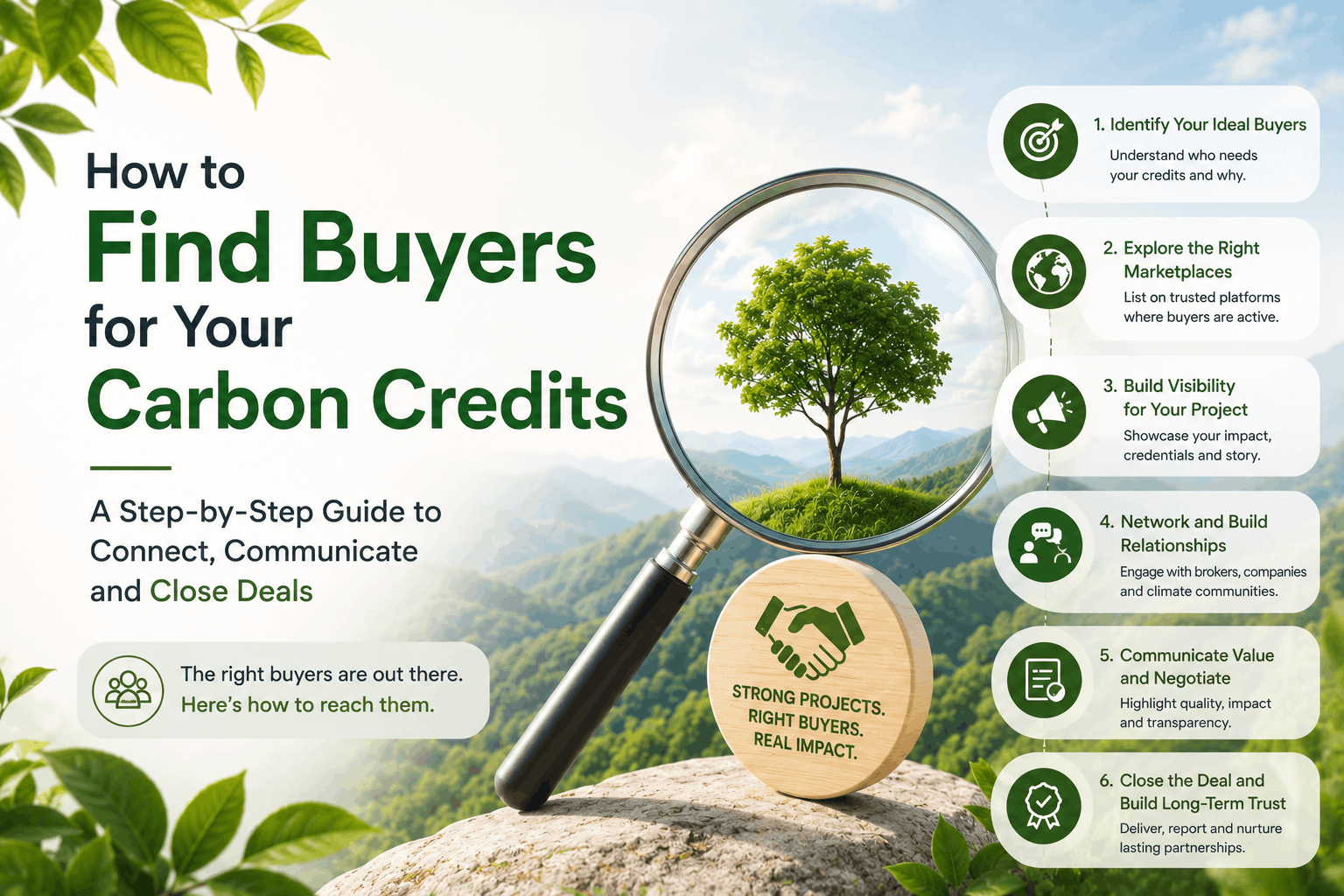
You have a verified carbon project. The credits are registered. Now comes the part that trips up most project developers: finding someone who will actually buy them.
It sounds like it should be simple. Carbon markets are growing. Corporate climate commitments are everywhere. But getting your credits in front of the right buyers, at the right price, through the right channel takes real strategy.
This guide breaks it all down in plain language. Whether you are a first-time project developer or someone who has been generating credits for years and wants better results, this article gives you a clear, step-by-step path forward.
First, Understand Who Actually Buys Carbon Credits
Before you go looking for buyers, you need to understand who they are and what they want.
The voluntary carbon market has a surprisingly wide range of buyers. Each group has different motivations, different quality requirements, and different ways of doing business.
Large Corporations With Net-Zero Targets
This is the biggest buyer segment in the market. Companies like Microsoft, Apple, Shell, Amazon, and hundreds of others purchase carbon credits as part of their climate strategies.
They buy credits to address residual emissions that are hard to eliminate, support climate goals beyond their own value chains, and meet commitments made under frameworks like the Science Based Targets initiative (SBTi) or the Voluntary Carbon Market Integrity Initiative (VCMI).
These buyers tend to purchase in large volumes and prefer long-term supply relationships over one-off spot purchases.
Airlines and Aviation Companies
CORSIA (Carbon Offsetting and Reduction Scheme for International Aviation) requires airlines to offset their international emissions growth above a baseline level. This creates a consistent, regulation-driven demand from the aviation sector.
Airlines need CORSIA-eligible credits, which must meet specific quality criteria. If your project qualifies, aviation is a steady and sizable buyer pool.
Financial Institutions and Investors
Banks, asset managers, and investment funds have entered the carbon markets in a big way. Some purchase credits to offset their financed emissions. Others buy as an investment, expecting prices to rise as demand grows and high-quality supply tightens.
Institutions like HSBC, J.P. Morgan, and Macquarie all have active carbon desks. Getting on their radar can open doors to large volume transactions.
SMEs and Mid-Size Companies
Small and medium-sized businesses increasingly want to act on climate, often driven by customer expectations, investor pressure, or supply chain requirements from larger corporate partners.
They typically buy smaller volumes. They often go through brokers or retail platforms rather than approaching project developers directly. But they represent a growing share of the overall buyer base.
Governments and Public Entities
Some national and sub-national governments purchase carbon credits to contribute to their Nationally Determined Contributions (NDCs) or domestic net-zero targets. Under Article 6 of the Paris Agreement, countries can use internationally traded carbon credits to meet climate goals, creating a new and potentially large category of sovereign buyers.
Individual Buyers and Consumers
Individuals can and do buy carbon credits, though this remains a small fraction of the total market. Some platforms allow individuals to retire credits on behalf of flights, events, or personal emissions.
Carbon Market Insider Newsletter
Weekly insights on carbon markets, climate policy, carbon credits, and sustainability.
Why the Current Market Rewards Quality Above Everything
Before getting into the how-to, this point deserves its own section because it shapes every strategy that follows.
The carbon market has gone through a quality revolution. Buyers today are not just looking for the cheapest credit. They are looking for the most credible one.
Here is what is driving this shift:
The ICVCM’s Core Carbon Principles (CCPs) have become the market’s reference standard for high-integrity credits. As of mid-2026, CCP-approved credit issuances jumped 64% year over year, while issuances from rejected methodologies fell 67%. Buyers are clearly voting with their money in favor of high-integrity credits.
Credit rating agencies like BeZero Carbon, Sylvera, and Calyx Global now rate individual projects, much like bond ratings in financial markets. Credits rated BBB and above command significant price premiums over lower-rated credits.
Anti-greenwashing regulations are tightening globally. The EU’s Empowering Consumers Directive, entering force in September 2026, bans generic “climate neutral” claims based on unverified offsetting. Corporate buyers need credits that can withstand regulatory and public scrutiny.
What this means for you as a seller: Your credits need to meet modern quality standards. If they carry a CCP label, have strong third-party ratings, and are verified under a credible standard like Verra’s VCS or Gold Standard, you will find buyers faster and at better prices.
The Main Channels to Find Carbon Credit Buyers
There is no single best way to find buyers for your carbon credits. The best approach depends on your project’s size, credit type, certification status, and how hands-on you want to be. Most developers use a combination of the channels below.
1. Carbon Credit Exchanges and Trading Platforms
Exchanges are digital marketplaces where buyers and sellers can transact carbon credits. They offer price transparency, faster transactions, and access to a wide pool of buyers.
Key exchanges to know:
| Platform | Focus | Best For |
|---|---|---|
| Xpansiv (CBL Market) | Nature-based and other VCM credits | Large-volume spot transactions |
| ACX (Air Carbon Exchange) | Global voluntary market | Asia-Pacific access |
| Carbonmark | Open marketplace, registry-linked | Project developers listing credits publicly |
| Puro.earth | Engineered carbon removal (CORCs) | Biochar, BECCS, mineralization projects |
| Carbonfuture | Durable removal credits | Biochar and high-permanence projects |
Exchanges work well when you want to sell at market price quickly and do not need to establish a direct relationship with the end buyer. The trade-off is that you need to do your own due diligence, and prices are market-driven rather than negotiated.
2. Carbon Credit Brokers
Brokers act as intermediaries between project developers and buyers. They have established networks of corporate clients looking for credits, and they handle much of the relationship management and negotiation on your behalf.
In return, they charge a commission, usually a percentage of the transaction value or a per-tonne fee.
When brokers make sense:
- Your project is smaller and you cannot attract large institutional buyers directly
- You want access to a buyer network without building one from scratch
- You prefer to focus on your project rather than sales
- You are new to the market and want guidance on pricing and deal structure
Notable brokers active in the voluntary market include:
- Evolution Markets
- 3Degrees
- South Pole (also a project developer and distributor)
- ClimeCo
- BGC Partners
- Everland
Quality brokers do more than just connect buyers and sellers. The best ones help you position your project correctly, negotiate pricing, and structure deals that work for both sides.
One important note: When working with a broker, clarify whether they are buying credits from you directly and reselling them, or acting as an agent connecting you to end buyers. Both models exist and both have implications for your pricing and relationship with the end buyer.
3. Carbon Credit Marketplaces and Retail Platforms
These are digital platforms that aggregate carbon credits from multiple projects and sell them to corporate and individual buyers. They handle the buyer relationships, compliance documentation, and retirement tracking.
Key platforms in this category:
| Platform | What It Does | Best For |
|---|---|---|
| ClimateSeed | Curated marketplace, impact-focused | Projects with strong co-benefits |
| Patch | API-driven, tech-company focused | Developers wanting scalable reach |
| Abatable | End-to-end sourcing and advisory | Corporate buyers and developers |
| CNaught | Curated portfolios for corporate buyers | Developers who want bundled placement |
To list on these platforms, you typically go through a vetting process where the platform reviews your project’s certification, methodology, and documentation. If accepted, your credits become available to their buyer base.
4. Direct Offtake Agreements With Corporate Buyers
This is the gold standard for project developers looking for long-term revenue security.
An offtake agreement is a contract between a project developer and a corporate buyer. The buyer commits to purchasing a set volume of credits over a defined period, usually at a fixed or pre-agreed price. Think of it as a subscription for carbon credits.
Why offtake agreements are valuable:
- They provide revenue certainty before or during project implementation
- They lock in prices, protecting you from market volatility
- They build long-term buyer relationships that can be renewed and expanded
- They can help you secure project finance, as lenders see committed revenue as lower risk
How to approach direct offtake:
- Identify target buyers. Look at companies in sectors with high emissions (energy, transport, manufacturing) and those with public net-zero commitments.
- Research their sustainability reports. These tell you whether they already buy credits, what types they prefer, and what frameworks they follow.
- Reach out at the right level. Target the Head of Sustainability, Chief Sustainability Officer, or VP of ESG. Not procurement, not investor relations.
- Tailor your pitch. Show how your project aligns with their specific climate commitments, preferred credit types, and co-benefits priorities.
- Start with a Letter of Intent. Even before a formal contract, a signed LOI gives both parties a starting point and demonstrates mutual commitment.
Forward purchase commitments by corporations surged dramatically in recent years as companies work to secure high-quality supply ahead of expected price increases.
5. Carbon Credit Aggregators and Developers-for-Hire
Some organizations, like South Pole and Verra-accredited project developers, act as both developers and distributors. They partner with landowners, farmers, or communities to build projects, then place the resulting credits with their existing buyer networks.
If you own land or manage a natural resource but lack market access, partnering with an aggregator gives you immediate distribution at the cost of sharing revenue.
Step-by-Step: How to Start Finding Buyers Today
Here is a practical, actionable sequence you can follow to begin reaching buyers.
Step 1: Get Your Credentials Right
Before approaching any buyer, make sure your project’s paperwork is solid.
- Verified under a recognized standard: Verra VCS, Gold Standard, ACR, Climate Action Reserve, or another credible program
- Registered on the relevant registry with your credits properly serialized and traceable
- Documentation ready: Project Design Document (PDD), Validation Report, Verification Reports
- Co-benefits documented if applicable (biodiversity, community impact, water)
If your credits can carry the ICVCM’s CCP label, pursue that. CCP-approved credits are commanding clear premiums and are increasingly preferred by institutional buyers.
Step 2: Know Your Credit Profile
Buyers want to know exactly what they are buying. Be ready to answer these questions clearly:
| Question | Why Buyers Ask |
|---|---|
| What standard is used? | Determines credibility and eligibility |
| What is the vintage? | Older credits may be less desirable |
| What is the project type? | Nature-based vs. technology-based affects use case |
| What is the geographic location? | Some buyers prefer specific regions |
| Are co-benefits certified? | SDG alignment, biodiversity labels increase value |
| What is the third-party rating? | BeZero, Sylvera, or Calyx Global ratings affect pricing |
| Are there unsold or “on-buffer” credits? | Transparency on this builds trust |
The clearer and more complete your answers, the more confident buyers will feel in transacting with you.
Step 3: List on a Registry and a Marketplace
If you have not already done so, make sure your credits are listed and visible on at least one public marketplace. Carbonmark, for example, allows developers to list credits from supported registries for free.
Visibility is the first step to inbound buyer interest.
Step 4: Use Buyer Identification Tools
Tools like AlliedOffsets’ Buyer Module allow sellers and developers to generate targeted outreach lists by filtering for companies by location, purchase history, project type preferences, and co-benefits interest. This is one of the fastest ways to build a qualified prospect list.
Similarly, Xpansiv and other exchanges publish data on trading activity that can help you understand who is buying and what they are paying.
Step 5: Attend Industry Events
In-person events remain one of the most effective ways to meet corporate buyers, sustainability officers, and traders looking for supply.
Key events to target:
- Carbon Forward (annual, Europe): brings together 1,500+ attendees including end-buyers, traders, and industrial emitters; past attendees include Shell, Cargill, Goldman Sachs, Mitsui, and Verra
- NACW (North American Carbon World): premier gathering for North American carbon market practitioners
- S&P Global Carbon Markets Conference: post-COP gathering for the full carbon markets value chain
- IETA European Climate Summit: Barcelona-based event for compliance and voluntary market participants
- Carbon Unbound: focused on CDR, brings together buyers, investors, and developers
- Innovate4Climate: World Bank’s annual carbon pricing and markets conference
Do not treat these as passive networking events. Come with a clear pitch, printed one-pagers on your project, and a specific list of the types of buyers you want to meet.
Step 6: Build a Direct Outreach List
Identify corporations in your target sectors that have public net-zero commitments and have already purchased carbon credits. Sustainability reports, CDP disclosures, and ESG filings are rich sources of this information.
Research from AlliedOffsets shows that the most active carbon credit buyers tend to come from technology and telecommunications, professional services, and financial services. Energy and utilities represent the largest share of retirements by volume.
Craft personalized outreach emails that speak directly to each company’s climate strategy. Avoid generic pitches. Show that you understand their commitments and explain how your specific credits support their specific goals.
Step 7: Work With a Carbon Consultant or Advisory Firm
If direct outreach and platform listing are not generating results, consider engaging a specialist advisory firm. These firms know the buyer landscape, have relationships with corporate sustainability teams, and can position your project much more effectively than a cold email ever could.
Firms like Abatable, Carbon Direct, and Regreener work across both the buy and sell sides, helping developers find the right buyers for their specific credit type and quality level.
How to Price Your Carbon Credits Competitively
Getting buyers interested is only half the equation. Pricing your credits correctly determines whether deals actually close.
Here is a quick snapshot of where voluntary carbon credit prices currently stand:
| Credit Type | Approximate Price Range |
|---|---|
| REDD+ / Nature-based avoidance | $3 to $15 per tonne |
| Renewable energy (older vintage) | $1 to $5 per tonne |
| Improved Forest Management (IFM) | $10 to $25 per tonne |
| Biochar and durable removals | $50 to $200+ per tonne |
| Direct Air Capture (DAC) | $300 to $1,000+ per tonne |
| CCP-labeled credits (any type) | 15 to 20% premium on average |
| Credits rated BBB or above (MSCI) | Averaging $6.80 vs. $3.50 market average |
Prices vary based on project type, vintage, certification status, quality ratings, geographic location, and co-benefits.
Key pricing principles:
- Do not underprice to move volume fast. It signals low quality and sets a bad precedent for future transactions.
- Seek third-party ratings. A strong rating from BeZero, Sylvera, or Calyx justifies a higher price and removes uncertainty for buyers.
- Consider spot vs. forward pricing. Forward offtake agreements often carry a discount to projected future spot prices, but they give you certainty. Weigh the trade-off based on your cash flow needs.
- Know your floor. Calculate the minimum price that covers your project development, verification, and registration costs before entering negotiations.
- Watch the benchmarks. Subscribe to pricing data from MSCI Carbon Markets, Xpansiv, or Sylvera to stay current on where similar credits are trading.
Common Mistakes Sellers Make (and How to Avoid Them)
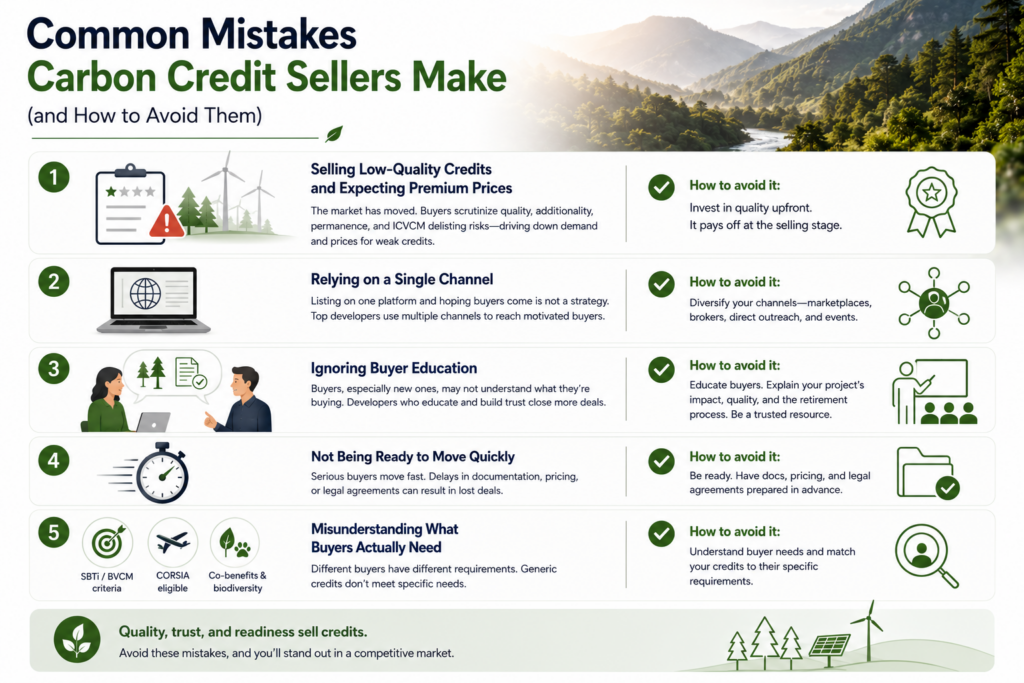
Selling Low-Quality Credits and Expecting Premium Prices
The market has moved. Buyers who used to accept any verified credit now scrutinize project quality intensely. If your credits lack modern additionality standards, have permanence risks, or come from methodologies that have been de-listed by the ICVCM, expect difficulty finding buyers and very low prices.
Invest in quality upfront. It pays off at the selling stage.
Relying on a Single Channel
Listing on one platform and hoping buyers come is not a strategy. The best-performing project developers combine marketplace presence, broker relationships, direct outreach, and event participation.
Ignoring Buyer Education
Many corporate buyers, especially those new to the market, do not fully understand what they are buying. Developers who take the time to educate buyers, explain additionality, permanence, and co-benefits, and walk them through the retirement process close more deals. Become a trusted resource, not just a vendor.
Not Being Ready to Move Quickly
When a serious buyer expresses interest, they often want to act within days or weeks, not months. Have your documentation ready, your pricing model prepared, and your legal agreements drafted in advance. Delays in due diligence lose deals.
Misunderstanding What Buyers Actually Need
A buyer with an SBTi target needs specific credit types that meet the Beyond Value Chain Mitigation (BVCM) criteria. A CORSIA buyer needs specifically eligible credits. A company chasing biodiversity claims needs co-benefit labels. Do not pitch generic credits to buyers with specific requirements. Match your offering to their actual need.
Special Approaches for Different Project Types
The right buyer-finding strategy also depends on what kind of project you have.
Nature-Based Solutions (Forests, Wetlands, Agriculture)
Nature-based credits are the most abundant in the market. To stand out, emphasize your co-benefits: biodiversity metrics, community impact, water security. Use standards like the Climate, Community and Biodiversity Standards (CCBS) or Rainforest Alliance certification to make your project more distinct.
Target buyers with explicit biodiversity or deforestation commitments. Consumer-facing brands in food, retail, and apparel often prefer nature-based credits because they align with their public narratives.
Engineered and Durable Removal Credits (Biochar, DAC, BECCS)
This is the fastest-growing segment in the market. Corporate buyers building long-term net-zero portfolios are actively seeking durable removal credits, and supply is tight.
Go directly to Puro.earth or Carbonfuture, which are designed specifically for this credit type. Reach out to buyers who have publicly committed to durable removals, such as technology companies and financial institutions following the Oxford Principles for Net Zero Aligned Offsetting.
Direct offtake agreements work especially well here because buyers want to secure supply early, knowing that prices will rise as more corporate buyers enter this space.
Agricultural and Soil Carbon Credits
Soil carbon credits are complex to verify but command growing interest from food companies, agricultural input businesses, and consumer brands trying to address scope 3 emissions in their supply chains.
Target buyers in the food and beverage sector. The co-benefits of regenerative agriculture, including soil health, water retention, and farmer income, are compelling to these buyers. Look at programs like the Soil Carbon Initiative and registries like ACR and CAR.
Building Long-Term Buyer Relationships
Finding your first buyer is an achievement. Keeping them and growing the relationship is a business.
Tips for building lasting buyer relationships:
- Communicate proactively. Send annual project updates with verified results, not just invoices. Buyers want to know their money is creating real impact.
- Invite site visits. Buyers who have visited a project are significantly more likely to renew and expand their commitment. Remote verification is standard, but a site visit builds trust no report can match.
- Offer flexibility. If a buyer’s needs change, work with them to adjust volume, vintage, or credit type where possible. Rigidity loses long-term partners.
- Co-create content. Offer to feature buyer logos and quotes in your project communications. Buyers appreciate recognition, and it helps their public communications around climate action.
- Keep your documentation current. Expired verification reports or lapsed certifications create unnecessary friction at renewal time.
The Role of Article 6 in Opening New Buyer Markets
Article 6 of the Paris Agreement has opened a new category of buyer: sovereign governments.
Under Article 6.4, countries can trade carbon credits internationally, with appropriate accounting adjustments to avoid double-counting. This creates demand from governments that want to use high-quality project-based credits to meet their NDC targets.
For project developers, this means a potential new class of large-volume, creditworthy buyers beyond the corporate market. Projects in developing countries with strong government support and Corresponding Adjustments in place are particularly well-positioned to tap this demand.
Watch the development of the Article 6.4 Supervisory Body’s registry and approved methodologies closely. Early movers in this space could access government buyers at meaningful scale.
Quick-Reference Summary: Where and How to Find Buyers
| Method | Best For | Speed | Effort |
|---|---|---|---|
| Carbon exchanges (Xpansiv, ACX) | Spot sales, price discovery | Fast | Medium |
| Online marketplaces (Carbonmark, ClimateSeed) | Inbound buyer interest | Medium | Low |
| Brokers (Evolution Markets, 3Degrees) | Established buyer networks | Medium | Low |
| Specialty platforms (Puro.earth, Carbonfuture) | Removal credits | Medium | Medium |
| Direct corporate outreach | Large volumes, offtake agreements | Slow | High |
| Industry events and conferences | Relationship-building, large buyers | Slow | High |
| Aggregators (South Pole, ClimeCo) | Distribution without sales effort | Medium | Low |
| Advisory firms (Carbon Direct, Abatable) | Complex deals, large projects | Medium | Medium |
Frequently Asked Questions
How long does it take to find buyers for carbon credits?
It depends heavily on your project type, quality, and how you approach the market. Spot sales on exchanges can happen within days if your credits meet quality requirements. Direct offtake agreements with corporations can take three to twelve months to negotiate from first contact to signed contract. The higher your credit quality and the more channels you use, the faster you will find buyers.
Do I need a broker to sell carbon credits?
No, but brokers significantly simplify the process, especially for first-time developers. They bring buyer relationships you have not had to build yourself. If you have a small project or limited bandwidth to manage buyer outreach and negotiations, working with a broker is usually worth the commission.
What types of companies buy carbon credits?
Large corporations with net-zero targets are the main buyers. Energy companies, airlines, technology firms, consumer brands, financial institutions, and manufacturers are all active in the voluntary carbon market. Government entities also purchase credits under Article 6 arrangements.
What makes carbon credits easier to sell?
Credits that are certified under a recognized standard, carry the ICVCM’s CCP label, have strong third-party ratings from agencies like BeZero or Sylvera, and have documented co-benefits sell faster and at better prices. High additionality, permanence, and transparent MRV documentation all increase buyer confidence.
Can small project developers find buyers without a broker?
Yes, but it takes more effort. Listing on online marketplaces, attending industry events, using buyer identification tools like AlliedOffsets, and doing targeted direct outreach are all viable paths. Many small developers start with a marketplace listing and add direct outreach once they understand the buyer landscape better.
What is an offtake agreement and should I pursue one?
An offtake agreement is a contract where a buyer commits to purchasing a defined volume of your credits over a set period, usually at an agreed price. They are worth pursuing if you have a project with predictable, verifiable credit generation and you want revenue certainty. They are especially valuable for new projects that need committed demand to secure finance.
Are compliance market buyers different from voluntary market buyers?
Yes. Compliance buyers, such as companies covered by the EU ETS or California’s cap-and-invest program, must buy allowances set by regulators. Voluntary buyers choose to purchase credits on their own initiative. Compliance markets generally have higher prices but accept only specific types of instruments. Voluntary market buyers have more flexibility but are increasingly quality-conscious.
How do I know if my credits are priced correctly?
Check trading data on exchanges like Xpansiv. Subscribe to pricing indices like MSCI Carbon Markets or Sylvera’s Market Data. Talk to brokers about recent transaction prices for comparable credits. Price ranges vary widely by project type, vintage, and quality, so compare to credits that match your profile, not the market average.
Final Thoughts
Finding buyers for your carbon credits is not about luck. It is about positioning your project correctly, showing up in the right places, and building real relationships with the people and organizations that need what you offer.
The market has changed. Quality now drives everything. Credits that meet modern integrity standards, carry third-party ratings, and align with buyers’ specific climate frameworks will always find a home. Those that do not will struggle regardless of how many channels you try.
Start with solid certification. Get your documentation in order. Pick two or three channels and work them consistently. Attend events where buyers gather. Build relationships rather than chasing transactions.
The buyers are out there. The demand is real. Your job is to make it easy for them to find you, trust you, and work with you for the long term.
For more in-depth resources on carbon markets, credit quality, and project development, visit Carbon Market Network.