Carbon Market Network


Picture this. A customer clicks “offset my order.” A few seconds later, a real carbon credit is retired in a public registry. Your app shows the proof. That is the promise of a carbon credit API.
Instead of emailing brokers and waiting days for a quote, your software can search projects, check prices, place orders and fetch retirement certificates on its own.
The catch is that the market is crowded and confusing. Some providers sell credits. Some rate them. Some connect registries and exchanges. Each one calls its endpoints something different.
This guide cuts through the noise. You will learn what a carbon credit API does, how the workflow runs, and which 10 providers are worth your time.
By the end, you will know:
- How a carbon offset API handles quotes, orders and retirements
- Which providers suit startups, enterprises, exchanges and data teams
- How to compare pricing, registry coverage and proof of retirement
- Which legal and claims risks to watch before you ship
Quick answer: For buying and retiring credits through code, start with Carbonmark, Patch or Cloverly. For checkout-style offsetting, look at ClimateTrade. For exchange and registry connectivity, look at Carbon Trade Exchange and Xpansiv. For quality ratings and market data, compare BeZero Carbon, Sylvera, Calyx Global and MSCI Carbon Markets.
What Is a Carbon Credit API?
A carbon credit API is a set of web endpoints that lets software buy, sell, rate, track or retire carbon credits without manual work.
One carbon credit represents one tonne of carbon dioxide equivalent that a project avoided, reduced or removed.
The API acts as a bridge. On one side sits your app, website or finance system. On the other side sits the voluntary carbon market, with its projects, registries, exchanges and price data.
Developers often call this a carbon offset API, a carbon credit marketplace API, or a carbon offsetting API. The names differ, but the goal is the same: make climate action a function call.
Carbon Market Insider Newsletter
Weekly insights on carbon markets, climate policy, carbon credits, and sustainability.
What a Carbon Credit API Can Do
Depending on the provider, a carbon credit API can:
- Search inventory by project type, country, vintage or methodology
- Return live prices per tonne
- Create quotes before you commit to a purchase
- Place orders and reserve credits
- Retire credits in a registry on your behalf
- Return certificates that prove the retirement
- Deliver ratings that score project quality
- Feed market data such as prices, issuances and retirements into your dashboards
No single provider does all of this well. That is why many teams combine two or three.
The Four Types of Carbon APIs
Most “carbon API” searches mix four different product types. Knowing the difference saves weeks of research.
| API type | What it does | Example providers | Who needs it |
|---|---|---|---|
| Offset and retirement APIs | Buy and retire credits from your code | Carbonmark, Patch, Cloverly, ClimateTrade | E-commerce, fintech, travel, SaaS, procurement tools |
| Exchange and infrastructure APIs | Trade credits, connect registries, automate transfers | Carbon Trade Exchange, Xpansiv | Brokers, traders, large corporates, platforms |
| Ratings and data APIs | Score project quality, share prices and retirement data | BeZero Carbon, Sylvera, Calyx Global, MSCI Carbon Markets | Marketplaces, investors, analysts, ESG software |
| Footprint APIs | Calculate how many tonnes of emissions an activity creates | Climatiq | Carbon accounting tools, logistics platforms |
Footprint APIs sit upstream. They tell you how many tonnes to deal with. The other three types help you act on that number.
How a Carbon Credit API Works Step by Step
The details vary by provider, but the flow looks similar almost everywhere.
- Define the amount. Your app either knows the tonnes it wants to offset or calculates them from an activity such as a shipment, a flight or a purchase.
- Search or request a quote. The API returns matching projects and a price. Some providers call this an estimate. Others call it a quote.
- Place the order. You confirm the quote. The provider reserves the credits and takes payment through the method you set up.
- Retire the credits. The provider cancels the credits in the registry that issued them. Retirement means the credit is permanently removed from circulation, so nobody can resell or claim it again.
- Receive proof. The API returns a certificate, a receipt or an order record that you can store and show to customers or auditors.
- Track and reconcile. You list past orders, match them to your finance records and report them in your sustainability disclosures.
Here is how the same journey looks with a few popular providers:
| Provider | Typical flow |
|---|---|
| Carbonmark | Create a retirement quote, submit an order, then confirm completion with a retirement receipt |
| Cloverly | Create an estimate, then promote it into a purchase that reserves and retires credits |
| Patch | Create an order by mass or by budget, then place it and track its status |
You can see the pattern. Quote first, order second, proof last.
Who Uses Carbon Credit APIs? Real-World Examples
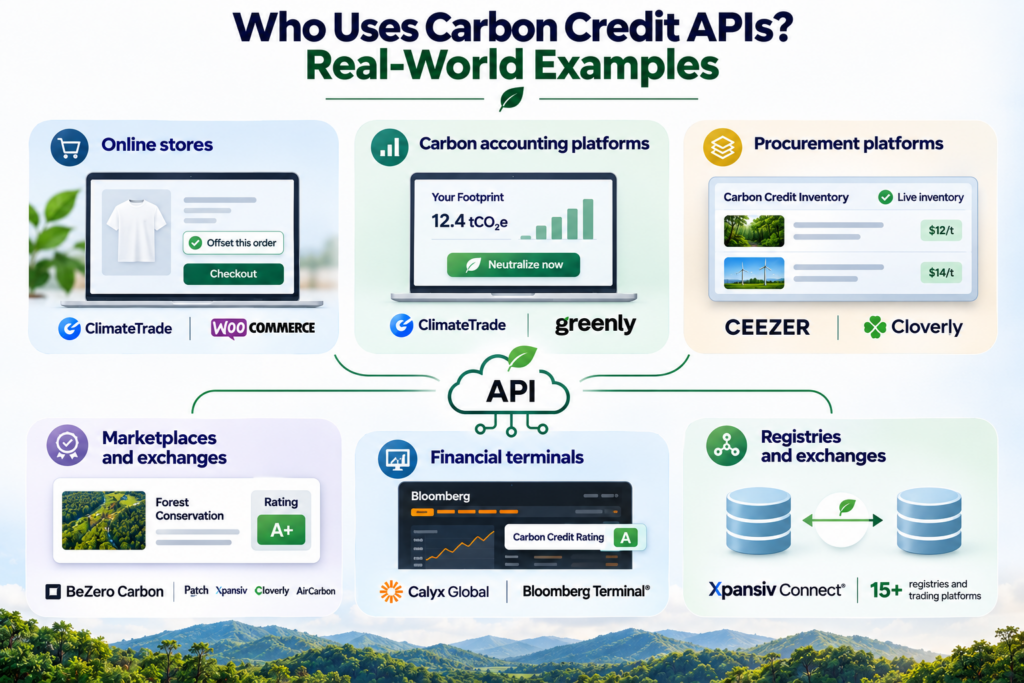
A carbon credit API is not only for climate startups. These are the use cases that show up most often.
- Online stores add an “offset this order” option at checkout. ClimateTrade, for example, offers an API and a WooCommerce plugin for this.
- Carbon accounting platforms add a “neutralize now” button next to the footprint report. ClimateTrade has partnered with the carbon accounting company Greenly on this kind of end-to-end journey.
- Procurement platforms pull live supplier inventory into a buyer workflow. CEEZER, an enterprise platform for climate assets, integrates with Cloverly’s API to show real-time inventory, pricing and project data from more than 100 suppliers.
- Marketplaces and exchanges show quality ratings beside each project. BeZero Carbon lists Patch, Xpansiv, Cloverly and AirCarbon among the platforms where its ratings appear.
- Financial terminals bring carbon data into the tools traders already use. Calyx Global ratings are available inside the Bloomberg Terminal.
- Registries and exchanges connect to each other so trades settle faster. Xpansiv Connect links more than 15 registries and trading platforms through one interface.
Different jobs, same idea. Replace emails and spreadsheets with an API call.
Best 10 Carbon Credit API Providers
How We Picked These Providers
We looked at what each provider actually publishes and does. Four questions guided the list:
- Does the provider offer a real, documented API or developer integration?
- Does it solve a clear problem, such as buying, retiring, trading or rating credits?
- Is it relevant to a global audience rather than one local market?
- Does it fit a recognizable type of buyer, from solo developers to large enterprises?
The order moves from the providers that suit most builders (buy and retire credits) to the ones that suit data teams (ratings and market intelligence).
One honest note. Many providers do not publish prices or full documentation. Details also change fast, so always confirm the latest in each provider’s developer docs before you commit.
Quick Comparison Table
| # | Provider | Type | What the API is best at | Best for |
|---|---|---|---|---|
| 1 | Carbonmark | Marketplace and API | Inventory, live prices, quotes, orders, retirements | Developers and small to mid-sized volumes |
| 2 | Patch | Procurement platform and API | Orders by mass or budget, project data, enterprise sourcing | Buyers who want expert guidance |
| 3 | Cloverly | API and supplier software | Estimates, purchases, retirement, supplier inventory | Product teams and platforms |
| 4 | ClimateTrade | Marketplace, API and white-label | Checkout offsetting with footprint calculation | E-commerce and app checkouts |
| 5 | Carbon Trade Exchange | Spot exchange with API | Live listings and programmatic trading | Brokers, platforms and corporate buyers |
| 6 | Xpansiv | Exchange, registry connectivity and data | Portfolio, transfers, retirements, pricing feeds | Institutions and trading desks |
| 7 | Sylvera | Ratings and data | Credit ratings, retirement analytics | Buyers, investors and ESG software |
| 8 | BeZero Carbon | Ratings and data | Ratings display, ratings feed, project reference data | Marketplaces and risk teams |
| 9 | Calyx Global | Ratings and data | GHG and SDG ratings via API | Traders, brokers and marketplaces |
| 10 | MSCI Carbon Markets | Ratings, pricing and data | Project ratings, price indexes, data feeds | Financial institutions and large corporates |
1. Carbonmark
Carbonmark runs a carbon credit marketplace and a developer API that share the same engine. In other words, the API is not an afterthought. The marketplace is built on it.
What the API does
- Lets you explore projects by country, vintage, methodology category, or a text search
- Creates retirement quotes and submits retirement orders
- Confirms completion with a retirement receipt
- Offers a checkout service that creates hosted payment links for purchases and retirements
- Provides integrations for carbon accounting software
What stands out
Carbonmark says it supports retirement in very small amounts on credits where the underlying registry allows it, down to 1 kilogram. That makes per-order, per-shipment and round-up features practical, because you do not need to round every customer up to a whole tonne.
It also says each completed retirement produces a public certificate with a blockchain transaction reference. An auditor can open that record without asking you for anything.
Carbonmark has also built routes for AI agents, named x402 and MCP, so software agents can discover, quote and retire credits on their own.
Best for: Developers and product teams that want self-serve access, public pricing and a free sandbox before going live.
Watch out for: Registry coverage depends on what Carbonmark lists. It names registries such as Verra, Puro.earth, ICR and Cercarbono, so check that your required project types are available.
2. Patch
Patch started as one of the first carbon removal APIs. Today it describes itself as a platform for sourcing, purchasing and managing carbon credits, with expert support wrapped around the software.
What the API does
- Places orders by mass or by total budget
- Returns project data with filters such as country, project type and available inventory
- Supports routing preferences so orders go to the projects you choose
- Offers test keys for a safe sandbox, a published OpenAPI specification and official client libraries such as Node and Python
What stands out
Patch covers more than carbon credits. It also works with renewable energy certificates and sustainable aviation fuel certificates. It reports that more than 500 companies use it.
It also partnered with Cloverly to connect enterprise procurement with supplier-side inventory. Buyers get more responsive visibility into availability and pricing.
Best for: Companies that want a procurement partner, not only an endpoint. Think of corporate sustainability teams running a formal credit program.
Watch out for: Patch does not publish fixed pricing tiers. Expect a sales conversation. Its focus has also moved toward advisory-led procurement, so check that its API fits a simple checkout use case before you build around it.
3. Cloverly
Cloverly was among the first companies to market a carbon credit API for product teams. Its buyer API still supports estimates, purchases and retirement, with a sandbox for testing.
What the API does
- Creates estimates for activities such as shipping, vehicles, electricity or a known amount of carbon
- Promotes an estimate into a purchase that reserves and retires credits
- Lists past estimates and purchases for reconciliation
- Returns a digital certificate for each purchase
What stands out
Cloverly’s strategy has shifted toward supplier infrastructure. Its Catalyst software helps carbon project developers manage inventory, pricing and sales. The buyer API remains available, and the supplier-side data now powers partner platforms.
The company states that its API follows SOC 2 security practices and offers a production-grade sandbox.
Best for: Platforms that want inventory and retirement handled for them, and procurement tools that need supplier-verified project data.
Watch out for: Pricing is not published. Confirm which registries it covers for your target projects, and ask how and when the registry certificate follows the digital certificate.
4. ClimateTrade
ClimateTrade blends a marketplace, an API and a white-label option. Its main pitch is simple: calculate the footprint of a single transaction and let the customer fund a project right at checkout.
What the API does
- Calculates emissions for individual transactions in real time
- Lets customers choose and fund a mitigation project during or after checkout
- Issues certificates for completed offsets
- Offers a ready-made WooCommerce plugin that connects through an API key
What stands out
ClimateTrade also sells carbon, plastic and biodiversity offsets and renewable energy certificates through the same marketplace. That breadth helps brands that want several impact types in one integration.
Best for: E-commerce stores, apps and point-of-sale systems that want a quick, embedded offsetting option.
Watch out for: Access runs on paid plans, and public documentation is limited. Ask how the registry retirement proof reaches you and whether very small retirements are supported.
5. Carbon Trade Exchange (CTX)
Carbon Trade Exchange is a long-running spot exchange for environmental commodities. It recently launched an Exchange API Solution that connects outside software to its live market.
What the API does
- Lets external platforms, corporate buyers and brokers connect directly to the exchange
- Supports live listing access and programmatic trading
- Includes a fee calculator, according to reports on the launch
What stands out
CTX says an API key can be issued within minutes, and that its core endpoints have been verified through initial retail partners and live transactions. For a company that has operated for many years, this opens the exchange to developers for the first time.
Best for: Brokers, platforms and corporate buyers that want exchange access without building a manual trading workflow.
Watch out for: The API is new, so its track record is short. Ask about uptime, rate limits, retirement options and onboarding steps before you plan a big integration.
6. Xpansiv (Connect and Data)
Xpansiv runs the CBL spot exchange and a wider infrastructure stack for environmental markets. Two products matter for API buyers: Xpansiv Connect and Xpansiv Data.
What Xpansiv Connect does
- Links more than 15 registries and trading platforms through one API or interface
- Automates transfers, retirements and reconciliations
- Exposes endpoints for accounts, portfolios, projects, reports, retirements, transfers and forward deals
- Provides sandbox, test and production environments
- Runs on SOC 2 certified infrastructure with token-based authentication and audit logs
What Xpansiv Data does
- Delivers live and end-of-day pricing feeds
- Draws on verified trade and order data from CBL and Evolution Markets
- Delivers through API, SFTP or a cloud data warehouse
Best for: Institutions, trading desks and large corporates that manage many registry accounts and need automation and audit trails.
Watch out for: It is built for institutional workflows, not per-order checkout offsetting. Onboarding takes more effort, and the Connect API specification was labeled beta when we reviewed it.
7. Sylvera
Sylvera is a London-based carbon data company known for independent credit ratings. Its Carbon Credit Analytics API adds market data to the mix.
What the API does
- Shares retirement analytics, which show what companies retire and how that changes over time
- Covers retirement data for more than 1,500 companies, refreshed weekly, according to Sylvera
- Lets you filter and slice the data inside your own systems
- Supports ratings and pricing data for marketplaces and ESG tools
What stands out
Sylvera combines satellite data, machine learning and on-the-ground assessment to produce project ratings. That makes its API useful when you need to answer a simple question: how good is this credit?
Best for: Buyers, investors and software companies that want ratings and retirement benchmarks inside their own products.
Watch out for: Access is enterprise-focused and pricing is not public. Documentation also appears to sit behind customer access.
8. BeZero Carbon
BeZero Carbon is a carbon ratings agency. Its ratings estimate how likely a project is to avoid or remove one tonne of carbon dioxide equivalent, on a scale from AAA (highest likelihood) to D (lowest).
What the API does
- Display ratings: Shows BeZero ratings on your marketplace or app through an API integration
- Ratings data feed: Delivers bespoke data streams for in-house analysis
- Reference data: Includes project names and IDs, registry IDs, location, vintage dates, developer, issuance and retirement data, plus eligibility flags for CCP and CORSIA
What stands out
BeZero ratings already appear on Patch, Xpansiv, Cloverly and AirCarbon, and on financial platforms such as Bloomberg and ICE. If you build a marketplace, that ecosystem is a big plus.
Best for: Marketplaces, trading platforms and risk teams that want a recognized quality signal on every listing.
Watch out for: Ratings are a risk assessment, not a guarantee. Pair them with your own due diligence and your claims policy.
9. Calyx Global
Calyx Global is an independent ratings agency. It rates carbon credits on greenhouse gas integrity and on sustainable development impact, and it does not buy or sell credits.
What the API does
- Brings GHG and SDG ratings into your own platform
- Supports traders, brokers and marketplaces that want to analyze ratings in their own systems
- Offers a display license so marketplaces can show ratings to their users
- Includes onboarding support from its team
What stands out
Calyx opened its platform to the public with core ratings available to everyone, while API access and deeper research sit behind subscriptions. Its ratings also reached the Bloomberg Terminal through a collaboration.
Best for: Marketplaces and trading firms that want a second, independent rating source beside BeZero or Sylvera.
Watch out for: The API sits in the subscription tier. Confirm coverage for the project types you care about.
10. MSCI Carbon Markets
MSCI is best known for financial indexes, but it also runs a carbon markets data business. That business grew after its acquisition of the research firm Trove Research.
What the offering includes
- Carbon Project Ratings for more than 4,000 projects, backed by geospatial analysis
- Price indexes for specific types of carbon credits
- Project and transaction data, plus corporate climate data
- Direct data feeds and APIs among its access options
What stands out
MSCI works with other market infrastructure. For example, Climate Impact X added its trade database to the MSCI Carbon Markets suite, and the supplier platform BlueLayer integrated with MSCI to deliver standardized supply-side project data through an API.
Best for: Banks, asset managers and large corporates that already use MSCI data and want carbon data in the same workflows.
Watch out for: This is an institutional data product. It does not help you buy and retire credits in a checkout flow. Confirm the exact API coverage with MSCI before you build.
Carbon Footprint APIs That Pair With Credit APIs
A carbon credit API handles the offset side. A footprint API handles the measurement side.
Climatiq is a popular example. It offers a REST API that turns activity data, such as distance traveled or energy used, into carbon dioxide equivalent estimates using close to a million emission factors. It also includes endpoints for freight, travel, cloud computing and spend-based estimates.
Climatiq does not sell or retire credits. It tells you how many tonnes you are dealing with.
A smart stack often looks like this:
- Climatiq (or a built-in calculator) estimates the tonnes
- A carbon credit API such as Carbonmark, Patch or Cloverly buys and retires credits
- A ratings API such as BeZero or Calyx Global scores the projects
- Your finance and reporting tools store the proof
How to Choose the Right Carbon Credit API Provider
You do not need to compare every feature. Answer these seven questions, and the shortlist builds itself.
1. What is the minimum order size?
This question removes more vendors than price does. If you need to retire a few kilograms per order, an exchange built for large lots will not work.
2. Is the price published?
A public price is easier to defend inside your company. A quote on request works for large deals but slows down small ones.
3. What proof of retirement do you get?
Ask whether the certificate is public, whether it names your organization, and whether it links back to the original registry record.
This is the question vendors most often answer vaguely.
4. Which registries and project types does the provider reach?
Coverage decides what you can buy. If you need biochar, direct air capture or a specific standard, confirm it before you integrate.
5. Does the API expose retirement, or only purchase?
Buying a credit through code is the easy part. Retiring it and returning proof is where some integrations stall.
6. Do you get a sandbox?
A free sandbox lets your developers build and test before spending money. Carbonmark, Cloverly and Patch all publish sandbox or test environments.
7. Do you need ratings?
If your users compare projects, add a ratings API. BeZero, Sylvera, Calyx Global and MSCI all offer ways to display or analyze ratings.
Which Provider Fits Which Project?
| Your situation | Start with |
|---|---|
| Startup adding offsets to an app or checkout | Carbonmark, Cloverly or ClimateTrade |
| Online store on WooCommerce | ClimateTrade |
| Corporate team building a formal credit program | Patch |
| Carbon accounting software adding a “neutralize” button | Carbonmark or ClimateTrade |
| Procurement platform showing supplier inventory | Cloverly |
| Broker or platform wanting exchange access | Carbon Trade Exchange or Xpansiv |
| Institution automating registry transfers and retirements | Xpansiv Connect |
| Marketplace that wants quality scores on every listing | BeZero Carbon, Sylvera or Calyx Global |
| Bank or asset manager that needs market intelligence | MSCI Carbon Markets or Xpansiv Data |
Carbon Credit API Pricing: What to Expect
Pricing is the murkiest part of this market. Most providers do not publish full price lists, and many quote only after onboarding.
Still, the cost usually has three layers:
| Cost layer | What it covers | What to ask |
|---|---|---|
| Credit price | The cost per tonne of the credits you buy | Is the price live, fixed or negotiated? |
| Platform or transaction fee | The provider’s margin or per-order fee | Is it a percentage, a flat fee or built into the price? |
| Subscription or license | Access to the API, ratings or data | Is there a minimum contract, and which features does each tier include? |
Credit prices vary enormously. They range from under a dollar to several hundred dollars per tonne depending on project type, quality and vintage. Engineered removals usually cost far more than avoidance projects.
Ratings and data APIs follow a different model. Sylvera, BeZero, Calyx Global and MSCI generally sell subscriptions or licenses rather than per-tonne fees.
A practical tip: start in the sandbox, estimate your annual tonnage, and then ask for a written quote that shows every fee.
Trends Shaping the Carbon Credit API Market
The market moves quickly. These shifts matter for anyone planning an integration.
Registries are going API-native
Verra, the largest voluntary carbon crediting program, has launched a next-generation registry powered by S&P Global Energy. The company says later upgrades will add transaction-ready APIs for certain transfers and retirements, along with Article 6 functionality.
Gold Standard has announced a new Impact Registry with the technology company Trovio, built on an API-first design. It aims to let issuance, transfer and retirement run through secure, standardized APIs.
Registry accounts usually require identity checks, so expect KYC rules to carry over into any registry-level integration.
Institutions are consolidating
Climate Impact X, a Singapore-based exchange, and Carbonplace, a bank-backed settlement platform in London, announced plans to merge. The deal needs regulatory approval, and both brands run separately for now.
Carbonplace already connects 14 registries. Together, the companies want to combine exchange, price discovery and bank-grade settlement.
Suppliers are getting better software
Cloverly’s move toward supplier tools shows where the market is heading. Developers want to list and manage inventory through software, and buyers want live data straight from the supplier’s system of record.
Ratings are moving everywhere
Quality scores no longer sit on separate websites. They now appear inside marketplaces, exchanges and financial terminals. Expect more platforms to show two or more ratings side by side.
AI agents are entering the picture
Carbonmark now offers routes built for software agents to discover, quote and retire credits. Expect more providers to follow as agent-based workflows grow.
Legal and Claims Risks to Check Before You Launch
A carbon credit API makes buying easy. It does not make every claim safe.
The biggest example is the EU’s Empowering Consumers for the Green Transition directive. It applies across member states and bans product-level claims such as “carbon neutral” or “climate neutral” when the claim rests on offsetting alone.
The directive does not ban buying carbon credits. It restricts how you describe them to consumers.
So an “offset this order” button is fine, but a “carbon neutral shipping” label may not be. Contribution-style wording is safer, such as describing the projects you fund.
Other regions have their own rules on green claims, and those rules keep changing. Speak with a qualified adviser about the markets where you sell.
A few more habits protect your brand:
- Use credits from projects with strong third-party ratings and clear methodologies
- Retire credits in the correct name, whether that is your company or your customer
- Keep every certificate, order ID and registry link
- Avoid double counting the same retirement in more than one claim
- Explain your reduction efforts alongside any offsetting
Integration Best Practices
Good integrations feel boring. They work every time. Use this checklist.
- Build in the sandbox first. Test quotes, orders, failures and cancellations before you touch live money.
- Make retries safe. Design your calls so a network retry cannot create a second order.
- Store proof, not only status. Save the certificate link, the order ID and the registry reference in your database.
- Handle small amounts carefully. Check whether your provider supports fractional retirement or rounds up to whole tonnes.
- Plan for delays. Some providers return a digital certificate immediately and the registry record later.
- Reconcile monthly. Match API order lists against your finance records.
- Show customers the truth. Display the project, the amount and the retirement proof, not vague climate slogans.
- Monitor provider changes. Registries and platforms are upgrading their systems, so watch release notes.
Common Mistakes to Avoid
- Picking a provider only because it has an API, without checking whether it exposes retirement
- Ignoring minimum order sizes until after the build
- Relying on a single rating source for every decision
- Treating tree planting APIs and carbon credit APIs as the same thing
- Using “carbon neutral” language without checking the rules in your target markets
- Skipping KYC and compliance planning for registry-level integrations
Real-World Stack Examples
Here are four ways teams put these providers together.
| Scenario | Likely stack | Why it works |
|---|---|---|
| Online shop offsets every order | Cloverly or Carbonmark for retirement, plus a built-in footprint estimate | Small, frequent orders need quotes, retirement and proof in one flow |
| Carbon accounting app adds a “neutralize” feature | Carbonmark or ClimateTrade, plus BeZero ratings on projects | The app already knows the tonnes and only needs execution and quality signals |
| Procurement platform for enterprises | Cloverly supplier data, plus Calyx Global or Sylvera ratings | Buyers see live inventory with an independent quality score |
| Trading desk or large corporate treasury | Xpansiv Connect, plus Xpansiv Data and MSCI data | Automation across registries with price feeds and market intelligence |
Frequently Asked Questions
What is a carbon credit API?
A carbon credit API is a set of web endpoints that lets software search, buy, retire, rate or track carbon credits. It replaces manual emails and spreadsheets with automated requests and responses.
What is the best carbon credit API for developers?
Carbonmark, Patch and Cloverly are strong starting points because they publish developer documentation and support sandbox or test environments. Carbonmark and Cloverly lean toward self-serve integrations. Patch leans toward guided procurement.
Is there a free carbon credit API?
Several providers offer free sandbox or test access, which lets you build without spending money. Buying real credits always costs money, and production access usually requires onboarding.
Can I retire carbon credits through an API?
Yes. Providers such as Carbonmark, Cloverly and Xpansiv Connect expose retirement through their APIs. Patch supports orders and tracks their lifecycle. Always check what proof of retirement the API returns.
What is the difference between a carbon credit API and a carbon footprint API?
A carbon footprint API, such as Climatiq, calculates how many tonnes of emissions an activity creates. A carbon credit API buys, retires or rates the credits that compensate for those tonnes.
Do carbon credit ratings APIs sell credits?
No. Ratings APIs from BeZero Carbon, Sylvera, Calyx Global and MSCI provide quality scores and data. Calyx Global states that it does not buy or sell credits.
How do I verify that a credit was really retired?
Ask for the retirement record itself. Look for a certificate with the project, amount, beneficiary and a link to the registry or transaction record. Public certificates are easier to audit.
How much does a carbon credit API cost?
It depends on the provider. Costs usually include the credit price per tonne, a platform or transaction fee, and sometimes a subscription. Many providers quote prices only after onboarding, so request a written breakdown.
Can AI agents buy carbon credits through an API?
Some providers now support it. Carbonmark, for example, offers routes designed for AI agents to discover, quote and retire credits. Set clear spending limits and approval rules before you let an agent transact.
Are tree planting APIs the same as carbon credit APIs?
No. Tree planting APIs fund planting projects and report trees planted. Carbon credit APIs deal with credits issued under registry standards. Trees count toward restoration impact, and they do not automatically back carbon claims.
Conclusion: Choose the Carbon Credit API That Matches Your Job
The best carbon credit API is the one that fits what you actually need to do.
If you want to buy and retire credits from your app, start with Carbonmark, Patch or Cloverly. If you need checkout-style offsetting, look at ClimateTrade. If you need exchange and registry connectivity, compare Carbon Trade Exchange and Xpansiv. If you want quality scores and market data, evaluate BeZero Carbon, Sylvera, Calyx Global and MSCI Carbon Markets.
Most teams end up with a small stack: a footprint calculator, a carbon credit API for execution, and a ratings feed for confidence.
Before you commit, test the sandbox, confirm what proof of retirement you receive, and check your claims against the rules in your target markets.
Carbon credit APIs are making climate action faster and more transparent. Pick the right providers, build with care, and your product can turn good intentions into verifiable results.
Looking for more guides on carbon markets, registries and carbon credit buying? Explore the resources on Carbon Market Network.