Carbon Market Network


Every carbon credit you buy or sell comes with a promise: that a real, measurable amount of greenhouse gas was reduced or removed from the atmosphere.
But how does anyone actually prove that?
The answer is MRV — Monitoring, Reporting, and Verification. It is the backbone of every credible carbon market in the world today. Without it, carbon credits would be nothing more than paper certificates with no real environmental value.
If you are new to carbon markets, or if you have heard the term MRV thrown around and wondered what it actually means, this guide is for you. We will break it down from the ground up – what it is, how it works, why it matters, and what is changing in 2026.
What Does MRV Stand For?
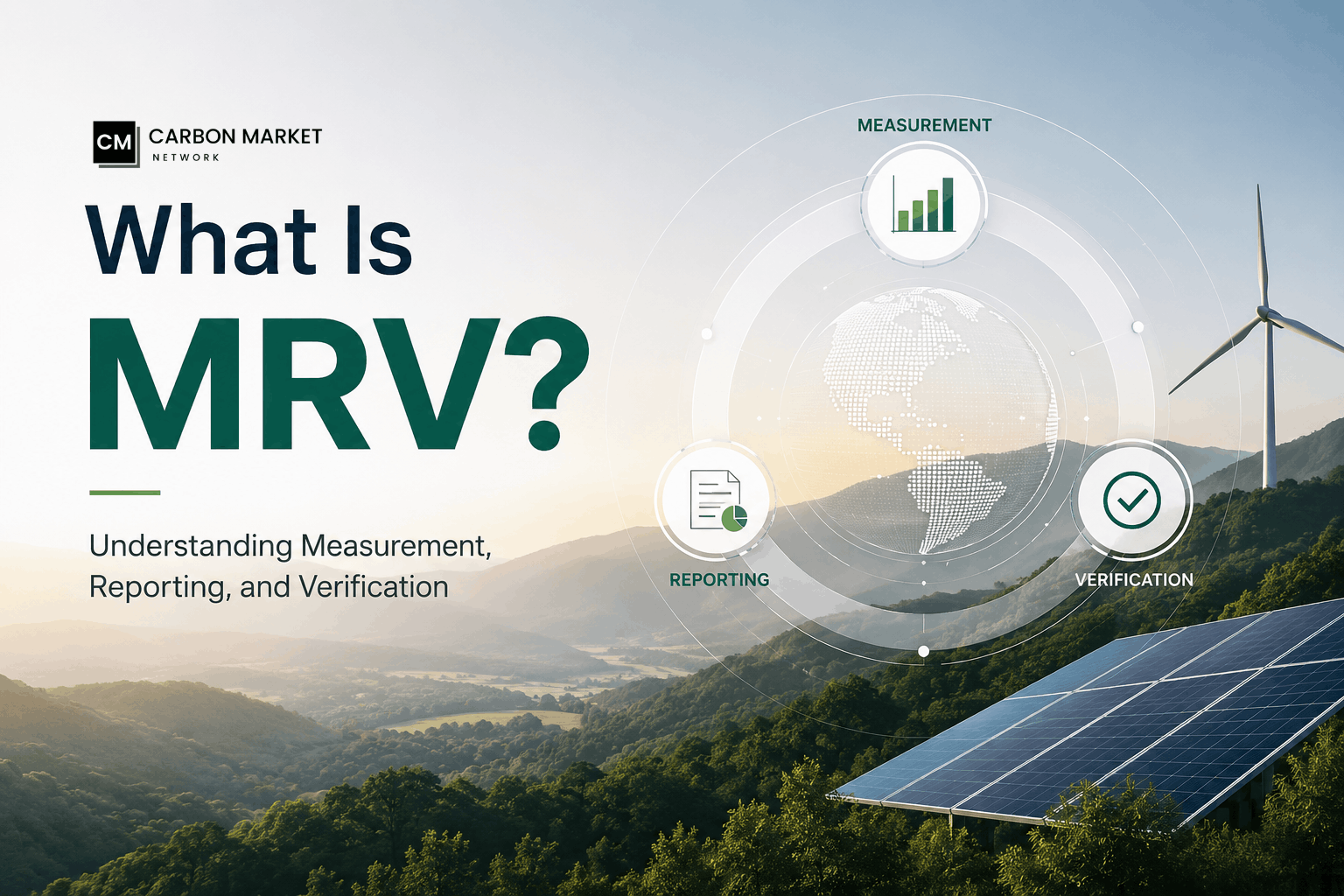
MRV stands for Monitoring, Reporting, and Verification.
It is a three-part system used to track, document, and confirm greenhouse gas (GHG) emissions reductions or removals from a carbon project. Each letter in the acronym represents a distinct and essential step in the process.
Think of it as quality control for carbon credits.
Before a carbon credit gets issued and sold, it must pass through MRV. This process confirms that the emission reductions being claimed are real, accurate, and independently confirmed. No MRV means no credible carbon credit.
Carbon Market Insider Newsletter
Weekly insights on carbon markets, climate policy, carbon credits, and sustainability.
Why MRV Matters in Carbon Markets
Carbon markets operate on trust. Buyers pay real money for carbon credits expecting those credits to represent real climate impact.
Without a rigorous MRV system, that trust falls apart.
Here is why MRV is so critical:
- It prevents greenwashing by ensuring companies cannot claim false or inflated emission reductions.
- It provides transparency so buyers, investors, governments, and civil society can independently assess project quality.
- It enables the issuance of verifiable carbon credits through registries like Verra, Gold Standard, and the Global Carbon Council.
- It supports national climate targets by feeding verified data into countries’ Nationally Determined Contributions (NDCs) under the Paris Agreement.
- It builds market integrity, which is essential for the long-term growth of both voluntary and compliance carbon markets.
Without MRV, the voluntary carbon market’s integrity collapses. With it, buyers can trust that their climate investments are doing what they claim.
The Three Pillars of MRV Explained
Let us look at each component in detail.
1. Monitoring: Tracking What Is Happening on the Ground
Monitoring is the first and ongoing step in the MRV process.
It involves the systematic collection of data and information about what a carbon project is actually doing — how much carbon it is sequestering, how much fuel it is saving, or how much forest it is protecting.
What gets monitored depends on the type of project:
- In a forest project, monitoring tracks tree growth, canopy cover, deforestation rates, and biomass accumulation.
- In a renewable energy project, monitoring records how much electricity is generated and how many fossil fuel emissions are avoided.
- In an industrial efficiency project, monitoring measures energy consumption, production volumes, and emission intensities.
- In a cookstove project, monitoring records fuel use, stove adoption rates, and hours of use.
A monitoring plan is created at the very start of the project. It spells out exactly what data will be collected, how often, using what tools, and by whom.
This plan must be approved by the relevant carbon standard (such as Verra’s VCS or Gold Standard) before the project gets underway.
Good monitoring answers the key question: How much greenhouse gas has this project actually reduced or removed compared to what would have happened without it?
This “without it” scenario is called the baseline, and establishing a credible baseline is one of the most technically demanding parts of MRV.
2. Reporting: Documenting and Disclosing the Data
Once monitoring data is collected, it must be documented and reported in a structured, transparent way.
Reporting involves preparing a formal emissions report that presents all the collected data, the methodologies used, the calculations performed, and the final estimate of emission reductions or removals.
A well-prepared MRV report typically includes:
- A description of the project and its boundaries
- The monitoring methodology and data sources used
- The baseline scenario and how it was calculated
- Actual emission reductions achieved during the reporting period
- Any leakage (unintended emissions caused elsewhere by the project)
- Uncertainty estimates and sensitivity analyses
- Supporting documentation, raw data, and evidence
This report is submitted to the relevant carbon standard body or regulatory authority. In compliance markets like the EU ETS, operators must submit their verified emissions report to the competent authority by 31 March each year.
Transparency is non-negotiable here. The report must be detailed enough that an independent third party can review every claim and verify it against the underlying data.
3. Verification: Independent Third-Party Confirmation
Verification is the final and arguably most important step.
An accredited, independent third-party auditor known as a Validated and Verified Body (VVB) reviews the reported data and the project’s claimed emission reductions to confirm their accuracy and compliance with the relevant standard.
What does the verification process involve?
- Reviewing the monitoring plan and checking that the project followed it correctly
- Conducting site visits to inspect equipment, processes, and records
- Cross-checking raw data against reported figures
- Assessing whether the baseline scenario is realistic and well-supported
- Checking for errors, inconsistencies, or gaps in the data
- Evaluating the project’s additionality (would the emission reductions have happened anyway without the carbon finance?)
If the VVB is satisfied, it issues a verification statement confirming the amount of emissions reduced or removed.
That verification statement then goes to the carbon registry, which issues the actual carbon credits. Each credit represents one tonne of CO2 equivalent (tCO2e) that has been verified.
Once a carbon credit is issued and recorded on a registry like Verra’s VCS Registry, Gold Standard Registry, or India’s new Indian Carbon Market Portal, it carries a unique identifier and a full audit trail showing exactly how it was verified.
The MRV Cycle: How It All Fits Together
MRV is not a one-time event. It is a continuous cycle that runs throughout the life of a carbon project.
Here is a simplified view of how the cycle works:
Step 1 — Project Design: The project developer designs the project, chooses an approved methodology, and creates a detailed monitoring plan. The plan defines what data will be collected, how, and by whom.
Step 2 — Validation: Before the project starts, an independent VVB validates the project design. They confirm that the monitoring plan is robust and that the project methodology is appropriate.
Step 3 — Project Implementation and Monitoring: The project begins and starts collecting data according to the approved monitoring plan. This continues throughout the project’s life.
Step 4 — Reporting: At regular intervals (typically every one to five years), the project developer compiles all monitoring data into a formal emissions report.
Step 5 — Verification: The VVB reviews and verifies the emissions report. They conduct site visits, review documentation, and confirm the emission reduction figures.
Step 6 — Credit Issuance: The carbon standard reviews the verified report and issues carbon credits to the project’s registry account. These credits can then be sold to buyers.
Step 7 — Retirement or Trading: Buyers purchase the credits and either retire them (to claim the environmental benefit) or trade them on the secondary market. The registry records every transaction publicly.
This cycle repeats regularly for the lifetime of the project, which can run for decades.
MRV in Different Carbon Market Settings
MRV is used across all types of carbon markets, but the specific rules and requirements differ depending on the context.
MRV in Voluntary Carbon Markets
In the voluntary carbon market (VCM), MRV requirements are set by independent carbon standards like:
- Verra (Verified Carbon Standard / VCS): The world’s largest voluntary carbon standard. Verra has been actively updating its methodologies to align with ICVCM Core Carbon Principles. Verra’s VM0042 methodology for agricultural projects was CCP-approved in 2025.
- Gold Standard: Gold Standard launched a Digital MRV Pilot Programme in 2025, running until October 2026, to assess how digital technologies can enhance the accuracy and efficiency of monitoring and reporting for carbon credits.
- Global Carbon Council (GCC): GCC published the first formal Procedure for Approval of dMRV Solution Providers in 2026, a pioneering step in integrating digital infrastructure into carbon market verification workflows.
- American Carbon Registry (ACR) and Climate Action Reserve (CAR): These US-based standards govern projects like Indigo Carbon’s soil sequestration programme, which has issued over 2.1 million verified soil carbon credits through the CAR across multiple US issuances.
In the VCM, MRV is the primary mechanism for ensuring that voluntary carbon credits carry genuine environmental value. Buyers increasingly demand detailed MRV documentation before purchasing credits.
MRV in Compliance Carbon Markets
In compliance carbon markets, MRV is a legal requirement.
The EU Emissions Trading System (EU ETS) is the world’s largest compliance carbon market and operates one of the most rigorous MRV frameworks in existence. Industrial installations and aircraft operators covered by the EU ETS must get their monitoring plan approved before the start of each monitoring period. They must then submit a verified emissions report every year by 31 March. The EU developed the ETS Reporting Tool (ERT) (a free digital resource) to help operators carry out their MRV procedures efficiently. The ERT was recently expanded to also cover ETS2, the EU’s new carbon market for buildings and road transport.
California’s Cap-and-Trade Program uses CARB-accredited verifiers, and its alignment with ISO 14065 standards supports credible cross-border carbon trading.
China’s national ETS, the world’s largest by covered emissions, has been aligning its MRV protocols with ISO standards. After the pilot phase aligned with ISO, verification errors dropped from 15% to below 5%.
MRV in India’s Carbon Market
India’s emerging carbon market is placing MRV front and center.
India’s Carbon Credit Trading Scheme (CCTS) which entered its first compliance period in April 2025, covers approximately 490 industrial entities across seven energy-intensive sectors including aluminum, cement, chlor-alkali, petroleum refining, petrochemicals, textiles, and pulp and paper.
The Bureau of Energy Efficiency (BEE) manages the CCTS and oversees MRV, accredits Carbon Verification Agencies (CVAs), and issues Carbon Credit Certificates (CCCs).
India’s MRV compliance timeline under CCTS is as follows:
- April 2025: First compliance period begins. Emission intensity targets take effect for all notified sectors.
- July 2026: MRV reporting deadline. Facilities must submit verified emission data for FY 2025–26 including fuel consumption, production volumes, electricity purchases, and calculated emission intensity verified by a BEE-accredited agency.
- October 2026: CCC trading opens on the designated exchange.
In March 2026, India launched the Indian Carbon Market Portal– a central digital backbone for the entire Indian Carbon Market. The portal handles everything from entity registration to credit issuance, including validation, verification, and accreditation of third-party MRV bodies. It also includes provisions for interacting with international carbon markets under Article 6 of the Paris Agreement.
Analysts point out that robust MRV infrastructure for CCTS also directly satisfies the EU’s Carbon Border Adjustment Mechanism (CBAM) reporting requirements – a significant commercial benefit for Indian exporters of steel, cement, and aluminum.
MRV in REDD+ and Forest Projects
In REDD+ (Reducing Emissions from Deforestation and Forest Degradation) projects, MRV is especially complex due to the dynamic nature of forest carbon stocks.
The Forest Carbon Partnership Facility (FCPF), administered by the World Bank, supports countries in developing robust MRV and carbon accounting systems, including land-use change analysis, forest degradation monitoring, and preparation of national Forest Reference Levels.
Forest MRV typically uses a combination of satellite remote sensing, ground-based field measurements, and biomass models to estimate forest carbon stocks. The accuracy of forest MRV has improved dramatically with the rise of high-resolution satellite data and machine learning-based analysis tools.
The Baseline: The Foundation of Any MRV System
One concept that sits at the heart of MRV is the baseline, also called the reference scenario or counterfactual.
The baseline represents what would have happened to emissions if the carbon project had never existed.
This matters because carbon credits are not calculated based on total emissions or total carbon stored. They are calculated based on the difference between what happened with the project and what would have happened without it.
Example: A forest project in India protects 10,000 hectares of forest that was at risk of being cleared for agriculture. The MRV system first establishes the baseline deforestation rate for that area – say, 2% per year based on historical trends. It then monitors actual deforestation in the project area over time. The difference between the baseline scenario (projected deforestation) and the monitored outcome (actual deforestation) represents the emission reductions that can be credited.
Baseline challenges in 2026: A significant integrity concern in current carbon markets is the use of inflated or outdated baselines. The ICVCM and various stakeholders are pushing for a transition from static baselines to dynamic baselines – ones that update over time based on current conditions rather than historical averages. This shift is expected to sharpen the accuracy and credibility of carbon credit claims across both voluntary and compliance markets.
Key MRV Concepts You Should Know
Additionality
Additionality asks: Would the emission reductions have happened anyway, even without carbon finance?
If the answer is yes, the project is not additional and should not generate credits. MRV systems test for additionality rigorously, often through investment tests, barrier analyses, and common practice assessments.
Permanence
Permanence refers to how long the carbon stored or emission reductions achieved will last. A forest project must demonstrate that the carbon sequestered will remain locked away for decades or centuries, not just a few years.
MRV systems use buffer pools (a reserve of unissued credits held aside) to account for the risk of reversal — for example, if a forest burns down or is logged.
Leakage
Leakage occurs when a carbon project displaces emissions rather than reducing them.
Example: A forest protection project in one area might cause deforestation to shift to another nearby area. MRV frameworks require project developers to estimate leakage and deduct it from their claimed emission reductions.
Double Counting
Double counting happens when the same emission reduction is counted by more than one party – for instance, both the country where the project is located and the company that purchased the credits. MRV systems and registry tracking are designed to prevent double counting. This is also a core reason why Article 6 of the Paris Agreement introduced the concept of corresponding adjustments for international carbon trades.
Uncertainty
All measurements carry some degree of uncertainty. Good MRV systems quantify this uncertainty explicitly and use conservative estimates to ensure that only well-supported emission reductions are credited.
Common MRV Methodologies and Standards
Different carbon standards approve different MRV methodologies for different project types. Here are some of the most widely used:
VM0007 (Verra): Used for REDD+ activities in tropical forests. It provides detailed protocols for monitoring forest carbon stocks using satellite imagery and ground-based sampling.
VM0042 (Verra): Used for improved agricultural land management (carbon farming). This methodology was CCP-approved by the ICVCM in 2025, and Verra launched a consultation for VM0042 v3.0 in February 2026.
AMS-II.J (CDM/UNFCCC): Covers demand-side efficiency activities for specific technologies.
IPCC Tier 1, 2, and 3 approaches: Used widely in national GHG inventories and some project-level MRV. Tier 1 uses default emission factors, Tier 2 uses country-specific factors, and Tier 3 uses direct measurements and high-resolution models.
GHG Protocol Corporate Standard: Used by companies for measuring and reporting their Scope 1, Scope 2, and Scope 3 emissions.
ISO 14064: An international standard for quantifying and reporting GHG emissions and removals. Widely used for both project-level and corporate MRV.
MRV Challenges: Why It Is Not Always Easy
Despite its importance, MRV is not without problems. Here are the most significant challenges facing the MRV system today.
High Cost and Complexity
Traditional MRV can be expensive, particularly for small-scale projects in developing countries. Field surveys, laboratory analysis, third-party verification visits, and lengthy documentation processes all add up.
For small farmer carbon projects in India or Africa, the MRV cost can sometimes equal or exceed the value of the credits generated, making participation economically unviable.
Measurement Uncertainty
Some carbon pools are inherently difficult to measure accurately. Soil organic carbon is a prime example. Measuring how much carbon a farm has added to the soil requires extensive soil sampling, laboratory analysis, and complex modeling all of which carry significant uncertainty.
Baseline Setting Disputes
As discussed earlier, the choice of baseline has a huge impact on how many credits a project generates. Critics have pointed out that some projects have used overly optimistic baselines that exaggerate emission reductions. This is a key driver of the “integrity crisis” that rocked the voluntary carbon market in recent years.
Verification Delays
The verification process can take months. For carbon projects that need regular cash flows to operate, long gaps between monitoring periods and actual credit issuance can strain finances. A 12-month delay in credit issuance translates directly to lost revenue and can make capital-intensive projects like carbon capture and storage financially unviable without innovation in MRV processes.
Lack of Qualified Verifiers
In emerging markets like India, there is a shortage of accredited Carbon Verification Agencies. Industry experts note that India currently has only 50 to 60 active verifiers available for CCTS verification work – a pool that may be insufficient for the scale of the compliance market launching in 2026.
Data Consistency Across Standards
Different carbon standards use different monitoring methodologies, making it difficult to compare credits across standards or combine data from multiple projects. The push for standardization led by bodies like the ICVCM and UNFCCC is addressing this, but harmonization remains a work in progress.
The Rise of Digital MRV (dMRV): A Game Changer for Carbon Markets
The biggest development in MRV in recent years is the shift toward digital MRV (dMRV) using technology to automate and improve the monitoring, reporting, and verification process.
dMRV is not just an upgrade. It is a fundamental transformation of how carbon project integrity is established and maintained.
What Is dMRV?
Digital MRV uses a combination of:
- Satellite imagery and remote sensing: High-resolution satellites can monitor forest cover, cropland, wetlands, and coastal ecosystems continuously and at scale. In 2025, a satellite dedicated exclusively to blue carbon observation was launched, designed to track carbon stored in mangroves, seagrass meadows, and tidal wetlands.
- IoT sensors: Internet of Things sensors installed on equipment or in the field collect real-time data on energy consumption, gas flows, soil moisture, and other key metrics.
- Machine learning and AI: Algorithms analyze massive datasets to detect changes in land use, predict carbon stocks, validate emission reduction claims, and flag anomalies.
- Blockchain: Used in some systems to create immutable, tamper-proof audit trails for carbon credit issuance and transfer.
- Biogeochemical models: Used in agricultural and forestry MRV to model how ecosystems store and release carbon based on observed conditions.
Why dMRV Matters
The case for dMRV is compelling:
Lower costs: Satellite and AI-enabled dMRV has reduced the cost of per-farm MRV by 70 to 90 percent compared to traditional soil-sampling-intensive approaches over the period 2018 to 2025. Traditional soil sampling can cost USD 50 to 200 per hectare per year. dMRV-enabled approaches can bring that down to USD 5 to 20 per hectare.
Faster credit issuance: Conventional MRV typically issues credits annually. Digital MRV allows for more frequent or even near-continuous credit issuance. Research from 2025 shows that moving from annual to monthly issuance can save a capital-intensive BECCS project up to USD 100,000 per year in financing costs, enabling projects to reach break-even earlier.
Higher accuracy: Real-time satellite monitoring catches deforestation events as they happen. AI-driven analysis can distinguish between natural forest growth and human-led reforestation, improving the accuracy of carbon stock estimates.
Greater transparency: When monitoring data is captured digitally and automatically, it is far harder to manipulate or misreport than data collected through manual field surveys.
Scalability: dMRV can handle thousands of small projects simultaneously – a critical feature for scaling agricultural carbon markets in countries like India.
Key dMRV Milestones in 2025 and 2026
The transition from traditional to digital MRV is accelerating rapidly:
- Gold Standard launched its Digital MRV Pilot Programme in 2025, which runs until October 2026. It is assessing how digital tools can enhance accuracy, transparency, and efficiency of monitoring and reporting for carbon credits verified under its framework.
- Global Carbon Council (GCC) published the first formal framework for approving dMRV Solution Providers in 2026 — the first such framework in the voluntary carbon market. It enables trusted technology partners to be pre-approved and integrated with GCC project workflows.
- Verra has been investing in registry digitalization, using built-in algorithms to automate calculations and reduce manual processing time.
- SustainCERT has proposed two blueprints for new digital verification approaches, including a paradigm-shift model where project developers simply capture raw data and automated systems handle analysis and reporting.
- The consensus among industry leaders is that the transition from traditional MRV to dMRV is inevitable. The only question is how and when, not if.
MRV and Article 6 of the Paris Agreement
Article 6 of the Paris Agreement, which governs international carbon trading between countries, places enormous demands on MRV systems.
Under Article 6.2, countries that trade Internationally Transferred Mitigation Outcomes (ITMOs) must fulfill rigorous reporting obligations. These include initial reports, annual information submissions, and biennial transparency reports (BTRs). As of March 2025, 97 bilateral agreements between 59 countries had been adopted under Article 6.2, with 155 pilot projects recorded.
Under Article 6.4, the new Paris Agreement Crediting Mechanism (PACM) is designed with high environmental integrity standards, including robust MRV systems and safeguards against double counting. The PACM is expected to become fully operational in 2025 to 2026 as registries and methodologies are finalized.
MRV quality will determine the credibility of Article 6 trades. Countries and companies buying ITMOs need confidence that the emission reductions they are paying for are real and verified. Weak MRV equals weak climate action, regardless of what the paperwork says.
MRV Across Different Project Types
MRV requirements vary significantly depending on the type of carbon project. Here is a quick overview:
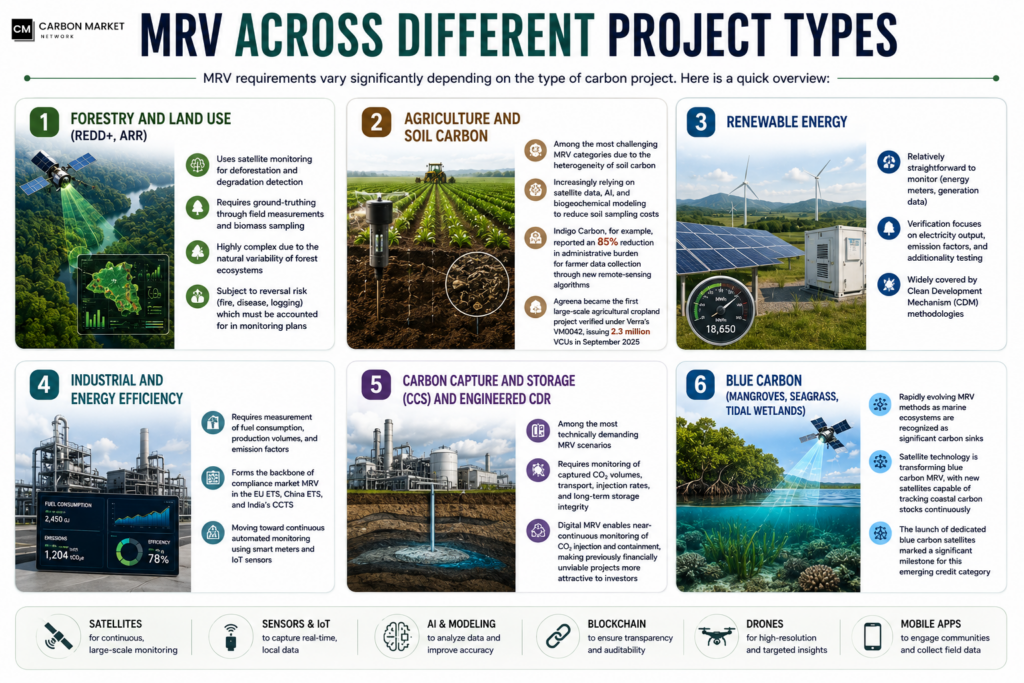
Forestry and Land Use (REDD+, ARR)
- Uses satellite monitoring for deforestation and degradation detection
- Requires ground-truthing through field measurements and biomass sampling
- Highly complex due to the natural variability of forest ecosystems
- Subject to reversal risk (fire, disease, logging) which must be accounted for in monitoring plans
Agriculture and Soil Carbon
- Among the most challenging MRV categories due to the heterogeneity of soil carbon
- Increasingly relying on satellite data, AI, and biogeochemical modeling to reduce soil sampling costs
- Indigo Carbon, for example, reported an 85% reduction in administrative burden for farmer data collection through new remote-sensing algorithms
- Agreena became the first large-scale agricultural cropland project verified under Verra’s VM0042 in 2025, issuing 2.3 million VCUs in September 2025
Renewable Energy
- Relatively straightforward to monitor (energy meters, generation data)
- Verification focuses on electricity output, emission factors, and additionality testing
- Widely covered by Clean Development Mechanism (CDM) methodologies
Industrial and Energy Efficiency
- Requires measurement of fuel consumption, production volumes, and emission factors
- Forms the backbone of compliance market MRV in the EU ETS, China ETS, and India’s CCTS
- Moving toward continuous automated monitoring using smart meters and IoT sensors
Carbon Capture and Storage (CCS) and Engineered CDR
- Among the most technically demanding MRV scenarios
- Requires monitoring of captured CO2 volumes, transport, injection rates, and long-term storage integrity
- Digital MRV enables near-continuous monitoring of CO2 injection and containment, making previously financially unviable projects more attractive to investors
Blue Carbon (Mangroves, Seagrass, Tidal Wetlands)
- Rapidly evolving MRV methods as marine ecosystems are recognized as significant carbon sinks
- Satellite technology is transforming blue carbon MRV, with new satellites capable of tracking coastal carbon stocks continuously
- The 2025 launch of dedicated blue carbon satellites marked a significant milestone for this emerging credit category
What Makes a Good MRV System?
Whether you are evaluating a carbon project as a buyer, an investor, or a developer, a robust MRV system should have the following characteristics:
Transparency: All monitoring data, methodologies, and calculations should be publicly available on the relevant registry for independent review.
Accuracy: The monitoring methods should be scientifically sound, use appropriate emission factors, and explicitly quantify uncertainty.
Completeness: The MRV system must cover all significant sources of emissions and removals within the project boundary. Missing data is a red flag.
Consistency: The same methodologies and approaches should be applied consistently across all reporting periods so that results can be compared over time.
Conservative estimates: Where there is uncertainty, good MRV systems err on the side of caution, claiming fewer credits rather than more, to protect environmental integrity.
Independent verification: Verification should always be conducted by a qualified, accredited third party with no financial interest in the outcome of the project.
Dynamic baselines: Modern MRV best practice is moving toward baselines that are updated regularly to reflect current conditions rather than fixed historical trends.
How to Evaluate Carbon Credits Based on MRV Quality
If you are buying carbon credits, MRV quality should be one of your top evaluation criteria. Here is how to assess it:
1. Check the standard: Credits issued under Verra VCS, Gold Standard, GCC, or ACR come with standardized MRV requirements. Credits with ICVCM CCP labels meet additional quality benchmarks.
2. Review the verification report: Every verified carbon project should have a publicly available verification report on the registry. Read it. Look for the VVB’s conclusions, any material discrepancies they found, and how they were resolved.
3. Assess the baseline methodology: A project with a conservative, dynamic baseline is generally more credible than one using a high, static baseline.
4. Look for third-party ratings: Platforms like Sylvera and BeZero Carbon publish independent quality ratings for carbon credits, including assessments of MRV robustness.
5. Check the monitoring plan: Is the monitoring plan detailed, approved by the relevant standard, and actually being followed? Gaps between what was planned and what was actually monitored are a serious concern.
6. Evaluate the verifier: Was the VVB accredited and independent? Is there any conflict of interest between the verifier and the project developer?
The Future of MRV: Where Things Are Heading
MRV is evolving fast. Here are the key trends shaping the future of monitoring, reporting, and verification in carbon markets.
From Periodic to Continuous Monitoring
Traditional MRV involves discrete monitoring events every one to five years. The future is continuous, real-time monitoring – sensors, satellites, and AI working around the clock to track project performance. This shift reduces uncertainty, catches problems early, and enables faster credit issuance.
AI-Powered Data Analysis at Scale
Machine learning is transforming what is possible in MRV. AI can process satellite imagery across millions of hectares, detect illegal deforestation within days, identify anomalies in industrial emissions data, and validate monitoring reports automatically. As AI capabilities improve, MRV costs will continue to fall and accuracy will rise.
Integrated Digital Platforms
The future of MRV lies in end-to-end digital platforms that connect data collection, reporting, and verification into a single seamless workflow. Verra’s registry digitalization, GCC’s dMRV approval framework, and India’s Indian Carbon Market Portal all represent steps in this direction.
Convergence of Voluntary and Compliance MRV
The line between voluntary and compliance MRV is blurring. Companies operating under both voluntary commitments (like net zero pledges) and regulatory obligations (like CCTS in India or EU ETS in Europe) increasingly need a single integrated MRV infrastructure that satisfies all requirements simultaneously.
MRV Under CBAM Pressure
The EU’s Carbon Border Adjustment Mechanism (CBAM), which is reshaping trade flows for carbon-intensive goods, is creating new demand for product-level MRV in India and other exporting nations. Indian companies exporting steel, cement, aluminum, and chemicals to Europe must now report detailed, verified product carbon intensity data, essentially extending the reach of MRV into global supply chains.
FAQ: Common Questions About MRV
Q: Is MRV the same as carbon accounting?
Not exactly. Carbon accounting refers broadly to the process of measuring and tracking GHG emissions at the company, sector, or national level. MRV is a more specific term that refers to the three-step process of monitoring, reporting, and verifying emission reductions or removals — particularly in the context of carbon credit projects and compliance markets.
Q: Who pays for MRV?
The project developer or obligated entity typically bears the cost of MRV. In some programs, carbon standard bodies or governments subsidize MRV costs for small-scale projects to improve access for developing-country participants.
Q: How long does MRV verification take?
It depends on the project size and complexity. Simple renewable energy projects may complete verification in one to two months. Large, complex forestry or carbon capture projects can take six months or longer. Digital MRV is reducing these timelines by streamlining data collection and reporting.
Q: What is the difference between validation and verification in MRV?
Validation happens before a project starts — it confirms that the project design, methodology, and monitoring plan are sound. Verification happens after the project has been running and data has been collected — it confirms that the project actually delivered the claimed emission reductions.
Q: Can small farmers participate in carbon markets through MRV?
Yes, but traditionally it was difficult due to high MRV costs. Digital MRV is changing this by dramatically reducing per-farmer monitoring costs through satellite imagery and AI. Programs like Agreena in Europe and Indigo Carbon in the US are demonstrating that smallholder-scale agricultural carbon crediting is becoming viable at scale.
Q: What does dMRV mean?
dMRV stands for digital Monitoring, Reporting, and Verification. It refers to the use of digital technologies — satellites, IoT sensors, AI, and automated data systems — to make MRV faster, cheaper, more accurate, and more transparent compared to traditional manual approaches.
Q: Is MRV required for India’s CCTS?
Yes. MRV is the compliance backbone of India’s Carbon Credit Trading Scheme. Without a verified MRV report from a BEE-accredited Carbon Verification Agency, a facility cannot demonstrate compliance, earn Carbon Credit Certificates, or participate in trading. The first MRV reporting deadline for FY 2025–26 data is July 2026.
Q: How does MRV connect to Article 6 of the Paris Agreement?
Under Article 6, countries that trade carbon credits internationally (called ITMOs) must have transparent, robust MRV systems that prevent double counting. The quality of MRV determines whether international carbon trades are recognized as legitimate contributions to national climate targets. Digital MRV is considered essential for meeting Article 6’s requirements at scale.
Conclusion: MRV Is the Trust Engine of Carbon Markets
Every credible carbon credit starts with a question: Did this project actually reduce or remove greenhouse gases from the atmosphere?
MRV is how that question gets answered.
It combines systematic monitoring, transparent reporting, and independent verification to confirm that carbon credits represent real climate impact, not just hopeful accounting.
As carbon markets grow in ambition and complexity, the importance of robust MRV only increases.
At the same time, the rapid rise of digital MRV is making the process faster, cheaper, and more reliable than ever. Satellites, AI, and real-time data systems are transforming MRV from a costly manual process into a scalable, automated infrastructure for climate accountability.
Whether you are a carbon project developer, an industrial company facing compliance obligations, a buyer evaluating credits, or simply someone trying to understand how carbon markets work, MRV is the concept you need to understand first.
Without it, climate claims are just claims.
With it, they become verified, tradable, and genuinely meaningful.
Explore more resources on carbon markets, carbon credit verification, and climate finance on Carbon Market Network.