Carbon Market Network


Use up and down arrow keys to resize the meta box pane.
Use up and down arrow keys to resize the meta box pane.
A carbon credit is only worth what you can prove about it.
Did the forest really grow? Did the farm field really store more carbon? Did the stove really replace open fires?
For years, people answered those questions with clipboards, field crews, and long audit cycles. That approach works, but it is slow, expensive, and hard to scale.
This is where AI MRV companies step in. They use satellites, machine learning, sensors, and cloud software to measure carbon outcomes faster and across far bigger areas.
If you are a project developer, a corporate buyer, an investor, or just curious about carbon markets, this guide is for you. You will learn how AI MRV works, who the leading AI MRV companies are, what each one does best, and how to choose the right partner.
Let’s start with the basics.
What Are AI MRV Companies?
MRV stands for monitoring, reporting, and verification. It is the process that proves a carbon project delivers the climate benefit it claims.
- Monitoring: collecting data on emissions or removals.
- Reporting: packaging that data in the format a carbon standard requires.
- Verification: an independent auditor checking that the data and the claim hold up.
AI MRV companies build technology that automates and sharpens the first two steps. They also make the third step easier for auditors.
You will often see the term digital MRV, or dMRV. The two phrases overlap heavily. “AI MRV” simply stresses that machine learning does much of the heavy lifting.
One important point. AI does not replace the independent verifier. It gives the verifier better data to check.
Carbon Market Insider Newsletter
Weekly insights on carbon markets, climate policy, carbon credits, and sustainability.
Traditional MRV vs AI-Powered MRV
| Factor | Traditional MRV | AI-powered MRV |
|---|---|---|
| Data collection | Field crews, plot measurements, paper records | Satellites, drones, sensors, and digital records |
| Update frequency | Often once a year or less | Monthly, quarterly, or near real time, depending on the data |
| Cost at scale | Rises sharply as projects grow | Falls per hectare as coverage grows |
| Coverage | Samples a small share of the land | Can cover the whole project and its surroundings |
| Audit trail | Documents and spreadsheets | Timestamped, traceable digital records |
| Main weakness | Slow, costly, hard to repeat | Needs ground data to train and check the models |
How AI MRV Works, Step by Step
Every platform has its own twist. Most follow the same basic path.
- Collect data. The system pulls in satellite images, drone footage, sensor readings, soil samples, and activity records from farmers or plant operators.
- Train models on ground truth. Scientists teach machine learning models using real field measurements, often paired with airborne LiDAR scans.
- Estimate carbon and uncertainty. The models predict biomass, soil carbon, or avoided emissions. Good platforms also show how uncertain each number is.
- Report in the registry’s format. The software turns results into documents that match a standard, such as Verra’s VCS or Gold Standard.
- Verify independently. An accredited auditor reviews the data, the model, and the claim.
- Repeat on a schedule. New data flows in, and the estimates update.
That last step is the real prize. Instead of one snapshot every few years, you get a moving picture.
The Data Sources Behind AI MRV
| Data source | What it captures | Best for | Main limit |
|---|---|---|---|
| Optical satellites | Color and greenness of land | Canopy cover, land use change, crop type | Clouds block the view |
| Radar (SAR) satellites | Surface structure, even through clouds | Tropical forests, flooded fields | Harder to interpret |
| LiDAR | 3D height and structure | Tree height, biomass calibration | Costly, usually airborne or sampled |
| Drones | Very sharp images | Small projects, plantation checks | Limited area per flight |
| IoT sensors | Direct readings from equipment | Cookstoves, biochar kilns, water systems, solar | Needs hardware on site |
| Soil samples and field plots | Ground truth | Training and checking models | Slow and expensive |
| Farm and operational records | Practices and activity data | Soil carbon, agriculture | Depends on honest input |
Why AI MRV Companies Matter Right Now
Carbon markets face a trust problem. Buyers want proof, and regulators want clean data. AI MRV companies sit right in the middle of that demand.
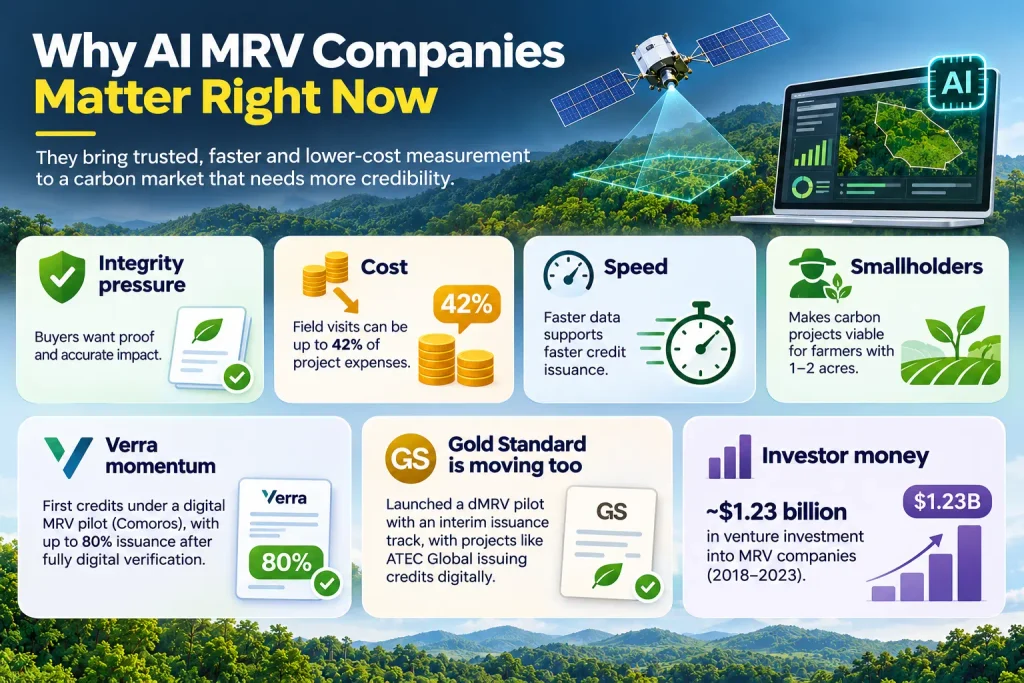
Here is what is pushing the shift.
- Integrity pressure. Buyers have grown wary of credits that overstate their impact. Better measurement is the most direct fix.
- Cost. Field work eats a big share of project budgets. Kanop, one of the companies below, says field visits can account for up to 42 percent of nature-based project expenses.
- Speed. Waiting years for a verification cycle ties up cash. Faster data supports faster issuance.
- Smallholders. Farmers with one or two acres cannot afford manual sampling. Remote sensing opens the door for them.
- Registry momentum. Verra approved its first credits under a digital MRV pilot, from a solar farm in the Comoros. Under that pilot, a project can request 80 percent of approved credits after a fully digital verification. The rest follows after a traditional check.
- Gold Standard is moving too. It opened its own dMRV pilot programme with an interim issuance track, and projects such as ATEC Global have issued credits through it using fully digital verification.
- Investor money. According to the Nature Tech Collective, venture investors put about $1.23 billion into MRV companies between 2018 and 2023.
Methodologies are also getting sharper. Verra’s soil carbon methodology VM0042 tightened its rules on baselines, additionality, and soil organic carbon measurement in its latest version. Stricter rules mean better measurement tools matter even more.
How We Picked These AI MRV Companies
There is no official ranking of AI MRV companies. So we set clear filters.
- Real use of AI or machine learning, not just a dashboard with a trendy label.
- A link to carbon standards, such as Verra, Gold Standard, Climate Action Reserve, or SustainCERT.
- Track record, including projects, partners, or credits tied to the technology.
- Honesty about uncertainty, because every model has error bars.
- Global relevance, so readers on any continent can use the list.
- Recent momentum, such as funding, acquisitions, or new products.
The order below groups companies by what they measure. It is not a score. A company at number eight might be a better fit for you than the one at number two.
A quick note on categories. Some companies on this list are measurement and data providers. Others run their own carbon projects and use MRV as their engine. Both types matter, and we flag which is which.
Top 10 AI MRV Companies at a Glance
| # | Company | HQ | Main focus | AI and data approach | Best for |
|---|---|---|---|---|---|
| 1 | Upstream Tech (Lens) | USA (remote-first) | Remote monitoring platform | Machine learning on satellite imagery, plus data from Planet, Chloris, and others | Project monitoring and portfolio oversight |
| 2 | Sylvera | London, UK | Carbon ratings and geospatial data | Machine learning, remote sensing, lidar research | Buyers, investors, and traders |
| 3 | Chloris Geospatial | Boston, USA | Satellite biomass data | Machine learning calibrated against airborne LiDAR | Forest MRV and ratings partners |
| 4 | Planet Labs | San Francisco, USA | Satellite forest carbon data | Deep learning on daily imagery, trained with LiDAR | Large-scale and jurisdictional monitoring |
| 5 | Kanop | Paris, France | MRV software for nature projects | Machine learning on optical, radar, and LiDAR data | Developers and investors |
| 6 | Treefera | London, UK | First-mile intelligence for commodities and nature | AI on satellite, drone, and ground data | Insurers, lenders, and commodity buyers |
| 7 | Regrow | Durham, USA | Agriculture MRV | Satellite data, machine learning, DNDC soil model | Food companies and programme managers |
| 8 | Agreena | Copenhagen, Denmark | Soil carbon programmes | AI, satellite imagery, field data | Farmers and corporate buyers |
| 9 | Boomitra | California, USA | Soil carbon from space | Machine learning trained on over a million soil samples | Smallholder and grassland projects |
| 10 | Varaha | Gurugram, India | Biochar, ARR, regenerative agriculture | Remote sensing, machine learning, in-house MRV platform | Industrial partners and removal buyers |
The Top 10 AI MRV Companies in Detail
1. Upstream Tech (Lens)
- Based in: USA (remote-first team)
- Founded: 2016
- Best known for: Lens, a remote monitoring platform that applies machine learning to satellite imagery
Upstream Tech builds Lens, a platform that pulls satellite imagery and forest carbon datasets into one place so teams can watch land change over time. Machine learning powers its change detection and alerts.
Lens brings in forest carbon data from Planet Labs and Chloris Geospatial, plus land cover data from partners such as Space Intelligence and CTrees. It shows pixel-level uncertainty next to each estimate, which helps users judge how far to trust a number.
The company has also launched a Lens agent, an AI-powered monitor that flags the most important changes across a portfolio and guides a human reviewer through them. Upstream Tech offers outsourced monitoring services too.
Real programs rely on it. The American Forest Foundation has used Lens since 2021 for its Family Forest Carbon Program, and corporate buyers such as Apple’s Restore Fund use it for diligence and monitoring.
Why it stands out: It is data-source neutral. You can compare several datasets side by side instead of trusting a single vendor.
Worth knowing: Lens is a monitoring tool, not a verifier or a registry. It also serves governments and conservation groups, so carbon is one use case among several.
2. Sylvera
- Based in: London, UK, with teams in New York and Sao Paulo
- Best known for: Independent carbon credit ratings and market data
Sylvera is a data company first. It rates carbon projects on a scale from AAA to D, using machine learning, satellite data, and ground evidence.
Its ratings help buyers see how much carbon a project really delivers, whether the impact is additional, and how lasting it is.
Sylvera also invests in the science underneath. A multi-scale lidar team uses machine learning, Earth observation data, and 3D laser scanning to measure carbon stored in trees.
The company recently launched an Open Carbon Data Project in the Brazilian Atlantic Forest. It is backed by The Rockefeller Foundation and Meta, and it aims to produce a high-resolution, open-access forest carbon dataset. Sylvera has also expanded into carbon intensity data for commodities such as steel and cement.
Why it stands out: Open data and independent ratings raise the quality bar for everyone, not just paying customers.
Worth knowing: Sylvera is not a registry or a verifier. It sits beside MRV and helps buyers judge the results. Think of it as a second opinion.
3. Chloris Geospatial
- Based in: Boston, USA
- Best known for: Satellite measurement of forest biomass and carbon
Chloris takes a simple idea and makes it measurable. Instead of counting trees or mapping forest area, it estimates how much trees weigh from space.
Why weight? Because carbon lives in biomass. A weight-based view can show growth, loss, and slow degradation that area-only maps often miss.
Chloris checks its machine learning estimates against airborne laser measurements, including data from NASA and academic partners. It also applies statistical smoothing to filter noise from year to year.
The company raised an $8.5 million Series A to scale this work. It partners with BeZero Carbon and Upstream Tech, and it is the exclusive dMRV data provider for the Equitable Earth Coalition’s forest carbon standard.
Why it stands out: Its sole focus is measurement. That gives it a neutral, science-first position in a market full of sellers.
Worth knowing: Chloris supplies data. For a full project workflow, you will likely pair it with a monitoring platform and a verifier.
4. Planet Labs
- Based in: San Francisco, USA (listed on the NYSE as PL)
- Best known for: Daily satellite imagery and global forest carbon data
Planet runs one of the largest fleets of Earth observation satellites. Its Forest Carbon Monitoring product turns that imagery into quarterly, 3 meter resolution estimates of above-ground carbon, canopy height, and canopy cover.
The models behind it use deep learning trained on airborne LiDAR data. Coverage is global, and the archive reaches back to late 2020. A separate Forest Carbon Diligence product offers a longer 30 meter history.
Planet designed the data for project and jurisdictional MRV, and for supply chain checks under the EU Deforestation Regulation. BeZero Carbon had early access to the data, and Upstream Tech offers it inside its Lens platform.
Why it stands out: Planet owns the satellites, so it controls the data from sky to model. Few rivals can say that.
Worth knowing: Planet sells data, not a finished MRV workflow. Planet’s own documentation says the product is strong at tracking forest loss and sensitive to young tree growth, and that users can combine it with field data for reforestation MRV.
5. Kanop
- Based in: Paris, France
- Founded: 2021
- Best known for: AI-powered MRV software for nature-based projects
Kanop builds a software platform that turns satellite data into forest metrics. Its machine learning models read optical, radar, and LiDAR data to estimate forest cover, canopy height, above-ground and below-ground biomass, and species patterns.
Users reach the results through a web app or an API. Kanop built the platform to support Verra and Gold Standard requirements, and to help with reporting under ESRS, TNFD, the GHG Protocol, and EUDR.
It also offers an AI agent that checks whether a site is eligible under standards such as Verra’s VM0047. That kind of check can cut early-stage diligence time from weeks to days.
Kanop was among the first companies in this space to publish its pricing. The European Space Agency has also funded its work on biodiversity monitoring.
Why it stands out: Transparent pricing and fast turnaround make it friendly to smaller developers who cannot afford a big consulting engagement.
Worth knowing: It is a young, small team. Ask for validation reports and check how its estimates compare with your own field plots.
6. Treefera
- Based in: London, UK
- Founded: 2022
- Best known for: AI first-mile intelligence for agricultural commodities and nature-based assets
Treefera blends satellite, drone, and ground-truth data and runs AI models over the lot. The goal is continuous monitoring, assurance, and risk checks on forests.
Its early customers included assurers, insurers, traders, and landowners. At its Series A, the platform covered more than 500 registered forest projects and harvest sites, and it plugs into client systems through an API.
Treefera has raised a $12 million Series A led by AlbionVC and a $30 million Series B. It also partnered with Anew Climate to assess biomass change and harvesting in forest carbon projects.
Why it stands out: Its database of registered projects gives buyers a quick way to compare what a project claims with what satellites see.
Worth knowing: Treefera now calls itself an AI-native first-mile intelligence platform for agricultural and soft commodities, and it has launched risk products for lenders and insurers. Its nature-based roots remain, but carbon MRV is no longer the main story. Confirm its current carbon offering before you plan around it.
7. Regrow
- Based in: Durham, New Hampshire, USA
- Formed: Through the merger of FluroSat and Dagan
- Best known for: MRV for agriculture supply chains
Regrow measures what happens on farms. It combines satellite data, machine learning, and a scientific soil model called DNDC to estimate soil carbon and emissions at field level.
That hybrid approach matters. The soil model explains how carbon moves through the ground, while AI fills in crop types and farming practices from satellite imagery and grower data.
The Climate Action Reserve approved the DNDC model under its Soil Enrichment Protocol, which Regrow describes as the first generalized approval of its kind. Regrow also supported the first smallholder soil carbon credits issued under Verra’s VM0042. That project, run with India’s Grow Indigo program, issued 57,463 credits.
Big food brands rely on it. Unilever used Regrow’s MRV platform to contract 300,000 hectares for climate-smart farming. A partnership with SustainCERT links Regrow’s field data to Scope 3 verification.
Why it stands out: Peer-reviewed science and registry approvals give auditors something solid to review.
Worth knowing: Regrow provides infrastructure for companies and programme managers. It does not enroll farmers into its own marketplace. Soil sampling choices also still matter, because any model needs good starting data.
8. Agreena
- Based in: Copenhagen, Denmark
- Best known for: Soil carbon programmes backed by its own dMRV platform
Agreena pays farmers for regenerative practices and measures the results with its own digital MRV platform. The system uses AI, satellite imagery, and field data to monitor carbon storage across large areas.
Its biggest proof point came when the AgreenaCarbon Project became the first large-scale soil carbon project verified under VM0042 v2.0. It issued 2.3 million Verra-verified credits across 1.6 million hectares of farmland.
BeZero Carbon later gave the project a BBB ex post rating. SustainCERT also validated Agreena’s methodology, data model, and MRV framework for Scope 3 reporting.
Agreena has since announced what it calls the largest publicly communicated agreement in agricultural carbon. The credits will come from AgreenaCarbon Kazakhstan, which is still in Verra validation.
Why it stands out: It shows that AI-supported soil carbon can pass a full registry verification at real scale.
Worth knowing: Agreena acts as both technology provider and programme operator. You buy the credits and the data together. Also remember that the Kazakhstan deal is a commitment. It is not yet issued credits.
9. Boomitra
- Based in: California, USA
- Best known for: AI and satellite measurement of soil carbon
Boomitra reads soil carbon from space. It trains machine learning models on more than a million soil samples and links them to multispectral and radar satellite data.
The company says it now works across roughly 10 million acres in India, Africa, and Latin America. It also says it built the first Verra-approved remote sensing approach for soil organic carbon, and that it can cut measurement costs by more than 90 percent. Treat these as company claims and ask to see the evidence.
Verra has registered several Boomitra projects. Its northern Mexico grassland project won approval for 3.03 million credits across roughly 4 million acres and 158 ranchers, which Verra says will be the largest soil carbon issuance to date once fully issued. Other projects include croplands in East Africa and a project in India with more than 23,000 farmers across 88,000 acres. Boomitra won the Earthshot Prize and has signed a purchase agreement for 625,000 tonnes with the Government of Singapore.
Why it stands out: Remote sensing lets farmers with a single acre join a carbon program. Manual sampling would price them out.
Worth knowing: Experts still debate how far models can replace physical soil sampling. Ask Boomitra how it validates its estimates against field samples, and how often.
10. Varaha
- Based in: Gurugram, India
- Founded: 2022
- Best known for: Carbon removal projects run on an in-house MRV platform
Varaha develops carbon removal projects in four areas: biochar, afforestation and reforestation, regenerative agriculture, and enhanced rock weathering. Its MRV platform uses remote sensing, machine learning, and scientific research to quantify results.
The company runs more than 20 projects across India, Nepal, Bangladesh, Bhutan, and Ivory Coast. It has long-term offtake agreements with buyers including Microsoft, Google, and Lufthansa.
Varaha raised a Series B of about $45 million, with a first tranche of $20 million led by WestBridge Capital. It plans to use part of the money to strengthen its MRV systems.
It also launched the Varaha Industrial Partners Program. Factories with biomass and gasification capacity can use Varaha’s digital MRV and credit origination to produce verified removals.
Why it stands out: It proves that AI MRV companies can grow outside Europe and North America, and that durable removals can come from the Global South.
Worth knowing: Varaha is a project developer first. Its MRV engine comes bundled with its projects and partner programs, so it is not a pure software vendor.
Another AI MRV Company Worth Watching
The top 10 AI MRV companies above are not the whole field. One more name deserves a look: Carbonfuture, a Germany-based digital MRV and marketplace platform for durable removals such as biochar, BECCS, and DACCS. SIX led its Series A, and it works with buyers including Microsoft, Swiss Re, and Boeing. It is strong on traceability and lighter on AI, so treat it as a dMRV specialist rather than an AI-first tool.
AI MRV Companies by Use Case
Still not sure where to start? Match your need to the right group.
| If you need | Start with |
|---|---|
| Forest carbon data and diligence | Upstream Tech (Lens), Chloris Geospatial, Planet Labs, Kanop |
| Independent quality ratings | Sylvera |
| Soil carbon and farm supply chains | Regrow, Agreena, Boomitra |
| Biochar and durable removal tracking | Varaha, Carbonfuture |
| Raw satellite data for your own tools | Planet Labs, Chloris Geospatial |
| One dashboard across many data sources | Upstream Tech (Lens) |
| Projects in South Asia and Africa | Varaha, Boomitra |
| Scope 3 and supply chain reporting | Regrow, Agreena, Kanop, Treefera |
How to Choose Between AI MRV Companies
Picking a partner is not about the flashiest demo. Follow these steps.
- Define your project type. Forest, soil, biochar, and cookstoves all need different tools.
- Check your standard and methodology. Confirm which monitoring approaches it allows. Some require field sampling alongside models.
- Separate the AI from the field work. Ask what the model estimates and what people still measure on the ground.
- Ask for validation results. Look for comparisons against independent field plots or airborne LiDAR.
- Look at uncertainty. A platform that shows error ranges is more trustworthy than one that shows a single clean number.
- Talk to your verifier early. Make sure your validation and verification body will accept the outputs.
- Review independence. If the vendor also sells credits or advice, ask how conflicts get handled.
- Pilot before you commit. Run a small area first and compare results with your own data.
Questions Worth Asking Every Vendor
- Which registries and methodologies have accepted your outputs?
- How do you validate your models, and how often do you retrain them?
- What happens in cloudy regions or dense forest where satellites struggle?
- Who owns the data, and can I export it?
- How do you price the service, and what is included?
- Can you share an audit trail a third party can check?
The Limits of AI MRV
AI MRV is powerful, but it is not magic. Smart buyers keep these points in mind.
- Models need ground truth. Without good field data, even the best algorithm drifts.
- Every estimate has error. Small errors across millions of hectares can add up to a lot of carbon.
- Soil carbon is hard. Soil changes slowly and varies a lot, so the debate over modeled versus sampled results continues.
- Measurement does not fix permanence. Fires, droughts, and land use change can still reverse stored carbon.
- Leakage still needs checking. A project can shift emissions elsewhere, and satellites must look beyond the fence line to catch it.
- Black boxes erode trust. Auditors and buyers need to see how a number was produced.
- Ratings can differ. Two independent providers may score the same project differently because their methods differ.
The healthiest view is simple. Treat AI as a better set of eyes, not a final judge.
Where AI MRV Is Heading
The field is changing fast. These trends look the most important.
- More registry pilots. Verra and Gold Standard are both testing digital verification, and more project types are joining.
- Faster, more frequent issuance. Verra’s pilot lets projects request most credits soon after a digital verification, instead of waiting through long audit cycles.
- Open datasets. Efforts such as Sylvera’s Open Carbon Data Project could give small developers free, benchmark-grade data.
- Multi-source monitoring. Platforms such as Lens pull several datasets into one view, so buyers can cross-check estimates.
- AI agents. Tools like Kanop’s eligibility agent hint at software that handles early diligence on its own.
- Regulation crossover. Rules on deforestation, corporate reporting, and Scope 3 push the same measurement tools into supply chains.
- Beyond nature. Pilots now include solar, electric cooking, and IoT-based water treatment, not just forests and farms.
Frequently Asked Questions About AI MRV Companies
What are AI MRV companies?
AI MRV companies build software and data products that use machine learning, satellites, and sensors to monitor, report, and verify carbon projects. They make measurement faster, cheaper, and easier to audit.
What is the difference between MRV and dMRV?
MRV is the overall process of proving a carbon outcome. dMRV, or digital MRV, does that with digital tools such as remote sensing, sensors, and automated reporting. AI MRV is a type of dMRV that leans on machine learning.
Do Verra and Gold Standard accept AI MRV?
In defined ways, yes. Verra issued its first credits under a digital MRV pilot, and Gold Standard runs its own dMRV pilot programme. Methodologies such as VM0042 also allow modeling and remote sensing within set rules. Each project must still follow its methodology and pass independent verification.
Can AI replace human verifiers?
Not today. AI produces better data and speeds up checks, but an accredited third party still reviews the evidence and signs off on the credits.
Which AI MRV company is best for forest carbon?
It depends on your need. Upstream Tech and Kanop offer monitoring and MRV software for forest projects. Chloris Geospatial and Planet Labs supply satellite biomass data. Sylvera rates project quality.
Which AI MRV company is best for soil carbon?
Regrow suits food companies and programme managers. Agreena runs soil carbon programmes with its own platform. Boomitra focuses on satellite-based soil carbon for smallholders and grasslands.
How much do AI MRV platforms cost?
Most vendors do not publish prices, and costs vary by project size and data needs. Kanop and Planet have both published pricing in some form, so they are good starting points for budgeting.
How accurate is AI MRV?
Accuracy depends on the model, the data, and the landscape. Ask each vendor for validation against field plots or airborne LiDAR, and for uncertainty ranges on every estimate.
Does AI MRV work beyond forests and farms?
Yes. Digital MRV pilots already cover solar farms, electric cooking, and water treatment, and companies like Carbonfuture and Varaha track biochar and other durable removals.
Conclusion: Picking the Right AI MRV Companies
Carbon markets run on trust, and trust runs on data. AI MRV companies are building that data layer, one satellite pass and one soil model at a time.
The ten companies in this guide each solve a different piece of the puzzle. Upstream Tech, Chloris, Planet, and Kanop focus on forests and land monitoring, while Treefera brings AI data to supply chains. Regrow, Agreena, and Boomitra tackle farmland. Sylvera helps buyers judge quality, and Varaha shows how the model works for durable removals in South Asia and beyond.
Here are the key takeaways.
- Match the tool to the project. Forest, soil, and biochar need different strengths.
- Demand proof. Ask for validation, uncertainty ranges, and registry track records.
- Keep humans in the loop. AI sharpens the evidence, and auditors still decide.
- Start small. Pilot on a limited area before you scale.
- Watch the standards. Registry pilots are moving fast, and today’s experiment may be tomorrow’s requirement.
Choose carefully, ask hard questions, and the right AI MRV companies can turn carbon claims into carbon facts. For more practical guides on carbon markets, keep exploring Carbon Market Network.