Carbon Market Network


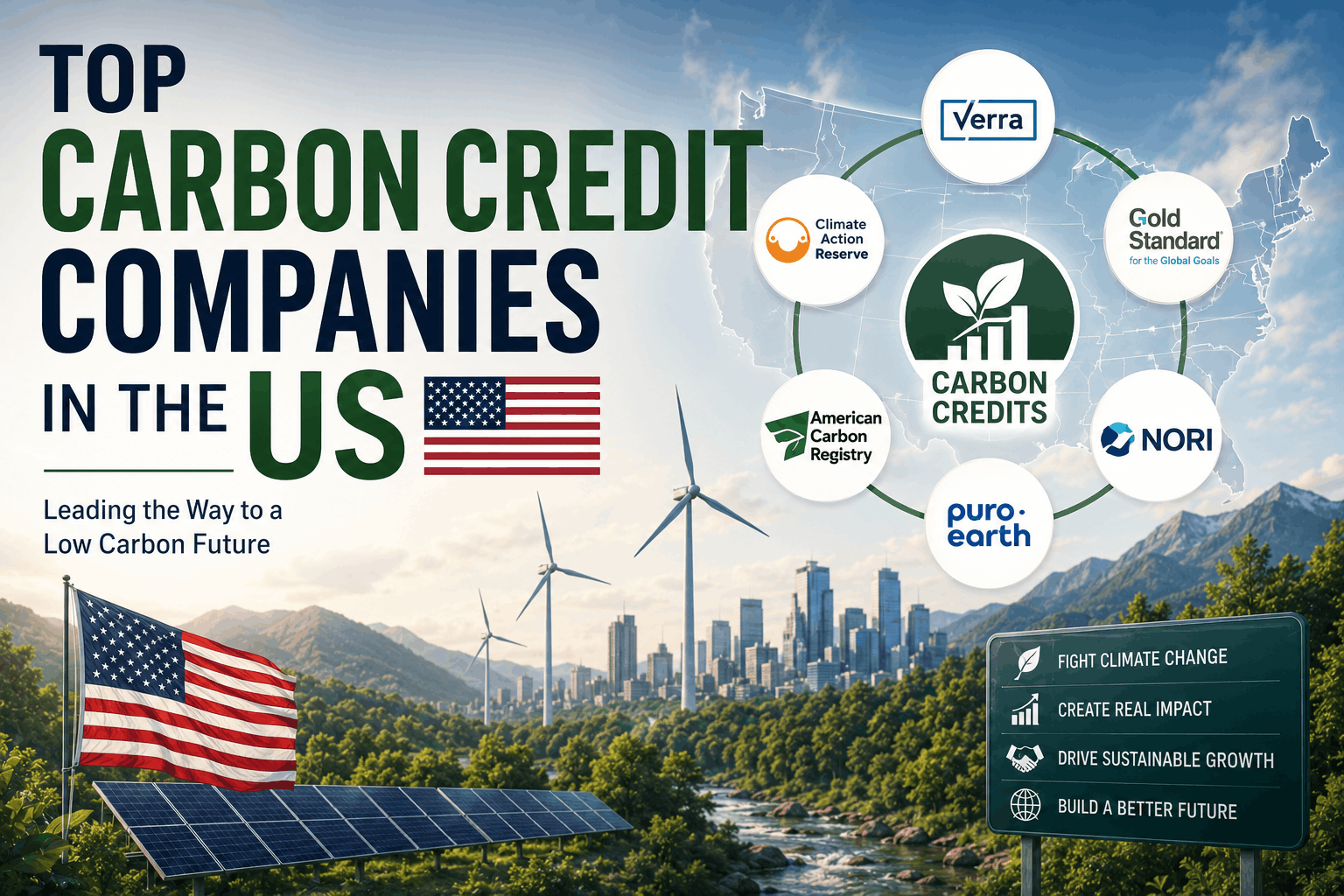
If your company wants to cut its carbon footprint, you have probably heard one phrase again and again: buy carbon credits.
But here is the problem. The carbon credit market in America is large, fast moving, and full of different types of players.
Some companies grow forests. Some pull carbon straight out of the air. Some just run the marketplace where credits change hands.
Picking the wrong partner can waste your budget and hurt your brand. Picking the right one can turn your climate goals into real, measurable impact.
This guide breaks down the top carbon credit companies in America today. You will learn what each one actually does, who they work best for, and how to choose a partner that fits your business.
Whether you are a Fortune 500 sustainability lead or a small business dipping a toe into carbon offsetting for the first time, this article has something useful for you.
What Are Carbon Credit Companies and Why Do They Matter
A carbon credit represents one metric ton of carbon dioxide that has been avoided, reduced, or removed from the atmosphere.
Carbon credit companies are the businesses that make this system work. Some develop the actual climate projects. Others verify the results. Others simply connect buyers with sellers.
Without these companies, carbon markets would not function at all. They provide the structure, technology, and trust that turns a forest or a factory upgrade into a tradable, verifiable credit.
The United States plays a massive role in this space. It has:
- Thousands of active carbon offset projects across forestry, agriculture, and industrial sectors
- Several major crediting registries that set the rules for quality and verification
- A growing number of engineered carbon removal companies backed by serious venture capital
- Strong corporate demand from tech, finance, and retail giants working toward net zero targets
Because of this scale, American carbon credit companies often set the tone for the rest of the global voluntary carbon market.
Carbon Market Insider Newsletter
Weekly insights on carbon markets, climate policy, carbon credits, and sustainability.
Compliance Market vs Voluntary Market: A Quick Distinction
Before diving into specific companies, it helps to understand the two markets they operate in.
Compliance carbon markets are regulated systems where companies are legally required to hold allowances or credits to cover their emissions. California Cap-and-Invest and the Regional Greenhouse Gas Initiative (RGGI) are examples active in the US.
Voluntary carbon markets are used by companies that choose to buy credits on their own, usually to support net zero pledges, ESG reporting, or brand commitments. Participation is optional, but demand keeps rising as more corporations set climate targets.
Most of the companies covered in this article operate primarily in the voluntary space, though a few also support compliance-linked programs.
Types of Carbon Credit Companies in the US
Not every carbon credit company does the same job. Understanding the different categories makes it much easier to pick the right partner.
1. Project Developers
These companies design, build, and manage the actual climate projects that generate credits. Think forest management, methane capture, or soil carbon programs.
2. Engineered Removal Companies
These businesses use technology, not nature, to pull carbon out of the air or lock it away permanently. Direct air capture and biomass carbon removal and storage fall into this group.
3. Marketplaces and Exchanges
These platforms let buyers browse, compare, and purchase credits, sometimes with a human advisory layer and sometimes fully self-service.
4. Verification and Ratings Companies
These firms do not sell credits directly. Instead, they assess project quality, monitor outcomes, and help buyers avoid low-integrity credits.
5. Registries
Registries are not exactly “companies” in the traditional sense, but they are the backbone of the entire system. They set methodologies, issue serial numbers for credits, and track retirement so credits cannot be double counted.
Now let’s get into the actual list.
Top Carbon Credit Companies in the US
Here is a detailed look at the companies shaping the American carbon credit landscape right now, across project development, engineered removal, marketplaces, and verification.
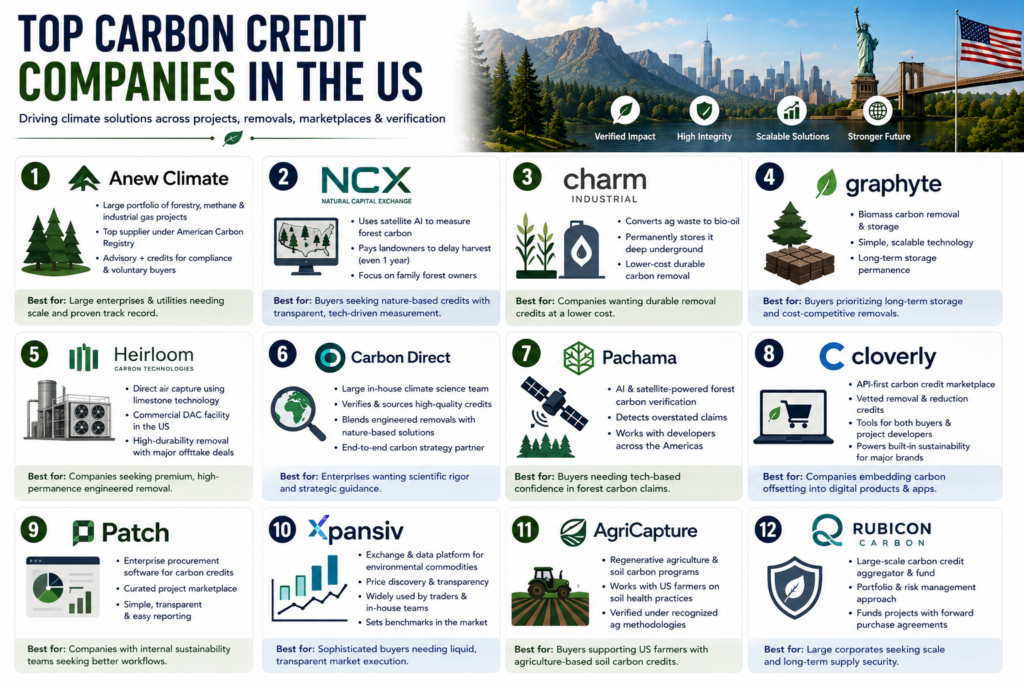
1. Anew Climate
Anew Climate (website) stands out as one of the largest environmental commodity companies in North America. It formed through the merger of two well known carbon market players and now manages a huge portfolio of forestry, methane, and industrial gas destruction projects.
What makes Anew Climate notable:
- One of the biggest suppliers of credits verified under the American Carbon Registry
- Strong presence in forest carbon projects across the US, including improved forest management programs in states like Maine
- Works with both compliance and voluntary market buyers
- Offers advisory services alongside credit supply, helping companies build a full carbon strategy rather than a one-time purchase
Best for: Large enterprises and utilities that need scale, established project relationships, and a long track record in North American forest and industrial credits.
2. NCX (Natural Capital Exchange)
NCX built its reputation on making forest carbon accessible to smaller, private landowners across the United States, not just massive timber companies.
What makes NCX notable:
- Uses satellite imagery and machine learning to measure forest carbon on a huge number of parcels
- Allows landowners to earn income by delaying harvest for even a single year, lowering the barrier to entry compared to traditional 20 or 40 year forest carbon contracts
- Focuses heavily on family forest owners, a segment that traditional carbon programs often overlooked
- Provides corporate buyers with credits tied to real, mapped, and monitored American forestland
Best for: Buyers who want nature-based credits with a strong US forestry story and transparent, tech-driven measurement.
3. Charm Industrial
Charm Industrial takes an unusual but effective approach to carbon removal. It converts agricultural waste into a stable bio-oil and injects it deep underground for long term storage.
What makes Charm Industrial notable:
- Focuses on permanent carbon removal rather than avoidance credits
- Uses existing crop waste that would otherwise decompose and release carbon anyway
- Has worked with major corporate buyers seeking high durability removal credits
- Operates primarily in the American Midwest, close to agricultural waste supply chains
Best for: Companies that want durable, engineered removal credits with a lower cost profile than direct air capture.
4. Graphyte
Graphyte runs biomass carbon removal and storage facilities in the United States, turning waste wood and agricultural residue into compressed blocks that get buried in engineered storage sites.
What makes Graphyte notable:
- Backed by major climate-focused investors
- Uses simple, off-the-shelf equipment, which keeps costs lower than many high tech removal methods
- Offers carbon storage with an extremely long durability profile, addressing one of the biggest weaknesses in nature-based credits
- Based in Arkansas, with plans to expand facility count across the country
Best for: Buyers prioritizing long term storage permanence and a scalable, cost-competitive removal pathway.
5. Heirloom Carbon Technologies
Heirloom is one of the more prominent direct air capture companies operating on American soil. It uses limestone based technology to capture CO2 straight from the atmosphere.
What makes Heirloom notable:
- Operates one of the first commercial direct air capture facilities built specifically for permanent CO2 removal in the US
- Uses a mineral-based capture process that lowers energy requirements compared to some competing DAC methods
- Has secured offtake agreements with major corporate buyers seeking premium, high-durability removal credits
- Supported by significant federal and private investment tied to next generation carbon removal technology
Best for: Companies willing to pay a premium for engineered, high-permanence removal credits as part of a diversified portfolio.
6. Carbon Direct
Carbon Direct operates as a science-led carbon management firm rather than a simple credit seller. It combines a large in-house science team with both advisory services and direct credit procurement support.
What makes Carbon Direct notable:
- Employs a large team of climate scientists who screen and monitor project quality before recommending them to clients
- Expanded its nature-based credit expertise significantly after acquiring an AI powered forest carbon verification platform
- Balances engineered removal options like direct air capture and biomass carbon removal with vetted nature-based credits
- Works closely with large corporations on end-to-end carbon strategy, not just one-off purchases
Best for: Enterprises that want scientific rigor, a broad project portfolio, and hands-on strategic guidance rather than a pure marketplace experience.
7. Pachama
Pachama built its name using artificial intelligence and satellite data to verify forest carbon projects, aiming to solve one of the biggest trust problems in nature-based credits.
What makes Pachama notable:
- Applies machine learning models to satellite imagery to independently estimate forest carbon stock and change over time
- Helps flag projects with overstated carbon claims before buyers commit funds
- Works with a wide range of forest carbon developers across the Americas
- Now operates as part of a larger carbon management group, broadening its reach into corporate procurement
Best for: Buyers who want extra confidence in forest carbon claims through independent, technology-based verification.
8. Cloverly
Cloverly runs an API-first marketplace that lets companies embed carbon credit purchases directly into their own products, checkouts, or supply chain software.
What makes Cloverly notable:
- Popular with financial services, e-commerce, and travel companies that want automated, transaction-level offsetting
- Offers a vetted marketplace of both removal and reduction credits, screened by an in-house climate team
- Provides software tools for project developers to manage inventory and distribution, not just a buyer-facing storefront
- Has worked with well known payment and technology brands to power built-in sustainability features
Best for: Companies that want to embed carbon offsetting directly into digital products, apps, or checkout flows.
9. Patch
Patch focuses on enterprise procurement software, giving sustainability teams a streamlined way to research, compare, and manage carbon credit purchases in one dashboard.
What makes Patch notable:
- Provides tools built specifically for internal sustainability and procurement teams
- Offers access to a curated set of both removal and avoidance projects
- Focuses heavily on making the buying process simple, transparent, and easy to report on
- Popular with companies that already have some internal carbon expertise but want better workflow tools
Best for: Mid-size to large companies with an internal sustainability function looking for a smoother procurement process.
10. Xpansiv
Xpansiv operates as a major exchange and data platform for environmental commodities, including carbon credits, renewable energy certificates, and other climate-linked assets.
What makes Xpansiv notable:
- Functions as core market infrastructure rather than a curated boutique provider
- Offers price discovery and transparency for high-volume, standardized carbon credit trading
- Widely used by traders, brokers, and companies with dedicated in-house carbon procurement teams
- Plays a significant role in setting benchmark pricing across the voluntary carbon market
Best for: Sophisticated buyers and traders who already understand project quality and simply need liquid, transparent execution.
11. AgriCapture
AgriCapture specializes in regenerative agriculture and soil carbon programs, working directly with American farmers to generate verified soil carbon credits.
What makes AgriCapture notable:
- Focuses specifically on Mid-South row crop farming, helping generate credits through practices like reduced tillage and cover cropping
- Provides farmers with data collection and monitoring tools to track soil carbon changes over time
- Credits are verified under recognized agricultural methodologies, giving buyers confidence in additionality
- Represents a growing category of American agricultural carbon programs that pay farmers for climate-friendly practices
Best for: Buyers who want to support US farmers directly while sourcing agriculture-based soil carbon credits.
12. Rubicon Carbon
Rubicon Carbon entered the market as a large-scale carbon credit aggregator and fund, buying up portfolios of high-quality credits and offering them to corporate buyers with built-in risk management.
What makes Rubicon Carbon notable:
- Structures large forward purchase agreements to help fund new project development
- Uses portfolio construction and risk pooling to reduce the impact of any single project underperforming
- Targets enterprise buyers looking for scale and long term supply security
- Reflects a newer trend of financially structured carbon credit vehicles entering the American market
Best for: Large corporations wanting long-term, contractually secured credit supply with built-in diversification.
Comparison Table: Top Carbon Credit Companies in the US
| Company | Category | Main Focus | Best For |
|---|---|---|---|
| Anew Climate | Project developer | Forestry, methane, industrial gas | Large enterprises needing scale |
| NCX | Project developer | Family forest carbon | Nature-based buyers wanting US forestry |
| Charm Industrial | Engineered removal | Bio-oil sequestration | Durable removal at lower cost |
| Graphyte | Engineered removal | Biomass carbon removal and storage | Long-term storage permanence |
| Heirloom | Engineered removal | Direct air capture | Premium, high-durability removal |
| Carbon Direct | Advisory and procurement | Science-led portfolio management | Enterprises wanting strategic guidance |
| Pachama | Verification | AI-based forest monitoring | Extra assurance on forest credits |
| Cloverly | Marketplace and API | Embedded offsetting | Digital products and checkouts |
| Patch | Procurement software | Enterprise workflow tools | Internal sustainability teams |
| Xpansiv | Exchange | Market infrastructure | Sophisticated traders and buyers |
| AgriCapture | Project developer | Soil carbon in agriculture | Supporting US farmers directly |
| Rubicon Carbon | Aggregator and fund | Portfolio-based credit supply | Long-term secured supply at scale |
Major US Carbon Credit Registries
Registries are not typically called “companies” in the traditional sense, but no discussion of carbon credit companies in America is complete without them. They set the methodologies and rules that every project must follow.
| Registry | Known For | Typical Project Types |
|---|---|---|
| Verra (VCS) | Largest global registry by volume | Forestry, renewable energy, industrial |
| American Carbon Registry (ACR) | One of the oldest US registries | Forestry, methane, industrial gas destruction |
| Climate Action Reserve (CAR) | Strong US regulatory ties | Forestry, agriculture, ozone-depleting substances |
| Isometric | Focused on rigorous, science-based removal | Engineered carbon removal, biomass storage |
If you are evaluating any carbon credit company, always check which registry backs its credits. This single detail tells you a lot about transparency and credibility.
How to Choose the Right Carbon Credit Company
With so many options, choosing a partner can feel overwhelming. Use this checklist to narrow things down.
Step 1: Define Your Goal First
Are you trying to hit a net zero pledge, satisfy investor ESG questions, or simply reduce your footprint as a brand story? Your goal shapes everything else.
Step 2: Decide Between Avoidance and Removal Credits
Avoidance credits prevent emissions that would have otherwise happened. Removal credits actively pull carbon out of the atmosphere. A balanced portfolio often includes both.
Step 3: Check the Registry and Methodology
Make sure the credits are verified under a recognized standard like Verra, the American Carbon Registry, Climate Action Reserve, or Isometric.
Step 4: Look at Permanence and Reversal Risk
Nature-based credits like forestry face risks from wildfire or land-use change. Ask whether the project uses buffer pools or insurance mechanisms to cover potential losses.
Step 5: Review Pricing Transparency
Ask how much of your payment actually reaches the project versus covering broker margins. Transparent providers will walk you through this without hesitation.
Step 6: Match the Company Type to Your Internal Capacity
- If you have no internal carbon expertise, work with an advisory-led provider like Carbon Direct
- If you already know exactly what you want, a marketplace or exchange like Xpansiv may suit you better
- If you want to embed offsetting into your product, look at an API-first platform like Cloverly
Step 7: Ask for Real-World Case Studies
A credible carbon credit company should be able to point to named clients, published project pages, and public registry listings, not vague promises.
Common Mistakes Companies Make When Buying Carbon Credits
Avoiding these pitfalls can save your business money and protect your reputation.
- Buying the cheapest credits available without checking registry backing or additionality
- Relying only on nature-based credits without any durable removal in the portfolio
- Skipping due diligence on permanence for forestry and soil projects
- Treating credits as a replacement for internal emissions reduction instead of a complement to it
- Failing to track retirement of purchased credits, which is necessary to avoid double counting claims
The Growing Role of Engineered Carbon Removal in the US
One clear trend across the American carbon credit market is the rise of engineered removal companies like Charm Industrial, Graphyte, and Heirloom.
Nature-based credits still dominate by volume, but buyers increasingly want durability that measures in centuries, not decades.
This shift is driven by a few factors:
- Corporate buyers facing more scrutiny over greenwashing claims tied to short-lived forest credits
- Frameworks like the Oxford Principles encouraging companies to shift toward removal over time
- Federal investment supporting next-generation removal technology development in the US
- Growing willingness among large tech and finance companies to pay a premium for high-durability credits
Expect this category to keep expanding as costs come down and more facilities come online across the country.
Why American Companies Are Central to Global Carbon Markets
The United States holds a unique position in this industry for a few reasons.
Scale of projects. With thousands of active projects across forestry, agriculture, and industrial sectors, the US offers more project diversity than almost any other single country.
Registry maturity. American registries publish detailed public documentation, giving buyers confidence that a project is real and actively issuing credits, not just a proposal on paper.
Innovation in removal technology. Many of the most talked-about engineered removal companies in the world are headquartered in the US, backed by serious venture capital and federal support.
Corporate demand. Major American tech, finance, and retail companies continue to be some of the largest voluntary buyers globally, which keeps pushing quality standards higher.
Frequently Asked Questions
What is the biggest carbon credit company in the US?
Anew Climate ranks among the largest by portfolio size and project count, with a broad footprint across forestry, methane, and industrial gas credits. However, “biggest” can also depend on whether you measure by credit volume, project count, or market infrastructure like Xpansiv.
Are carbon credits from US companies more reliable than international ones?
Not automatically. Reliability depends on the registry, methodology, and monitoring behind a specific project rather than the country alone. That said, American registries tend to publish detailed public documentation, which makes due diligence easier.
What is the difference between a carbon credit company and a carbon credit registry?
A company develops, sells, verifies, or trades credits. A registry sets the rules, approves methodologies, and issues the official serial numbers that prevent double counting. Companies operate within the framework registries create.
How much do carbon credits typically cost?
Prices vary widely depending on project type. Nature-based avoidance credits often sell for a modest price per ton, while engineered removal credits with high durability can cost significantly more due to the technology and permanence involved.
Can small businesses buy carbon credits, or is this only for large corporations?
Small businesses can absolutely participate. Several marketplaces and API-first platforms are built specifically to make purchasing simple and affordable at smaller volumes.
Should a company buy removal credits or avoidance credits first?
Most experts recommend a balanced approach. Start with high-quality avoidance credits while gradually increasing removal credits as your budget and strategy mature, since durable removal typically costs more per ton.
How do I verify that a carbon credit company is legitimate?
Check whether their credits are listed on a recognized registry, whether they publish named corporate clients, and whether project documentation is publicly searchable rather than only available on request.
Final Thoughts
The American carbon credit market has grown into a genuinely diverse ecosystem. You have project developers restoring forests, engineers pulling carbon straight out of the sky, and software platforms making the entire process easier to manage.
There is no single “best” carbon credit company for every business. The right choice depends on your budget, your appetite for removal versus avoidance credits, and how much internal expertise your team already has.
Take time to match your climate goals with the right type of partner from this list. A thoughtful carbon credit strategy, built on credible American companies and verified projects, will always outperform a rushed, price-driven purchase.
If you are just getting started, begin with a clear goal, check the registry behind any credit you consider, and build your portfolio gradually rather than all at once. That approach will serve your business, and the climate, far better in the long run.
For more updates, guides, and resources on carbon markets, explore Carbon Market Network.