Carbon Market Network


Somewhere in Punjab, a farmer is burning less crop residue because a company pays him for it instead. Somewhere in Bihar, a family cooks dinner on a smarter stove because another company installed it for free.
Both of these stories exist because of carbon project developers, the organisations that turn climate action into a working business model.
India now has some of the most active carbon project developers in the world, ranging from publicly listed giants to fast growing climate tech startups.
This guide walks through the top carbon project developers in India, what sets each one apart, and how you can choose the right one whether you are a corporate buyer, an investor, or a landowner exploring carbon income.
What Makes a Carbon Project Developer Worth Watching
Before ranking anyone, it helps to know what actually separates a strong developer from an average one.
- Registered project track record. Real credits issued and retired on a recognised registry, not just projects claimed on a website.
- Strong monitoring systems. Satellite data, geotagging, or mobile field audits that make results verifiable.
- Genuine community participation. Especially important for forestry, cookstove, and agri-carbon projects.
- Diverse buyer relationships. Partnerships with credible global or domestic corporates signal trust in the market.
- Financial stability. Carbon projects run for years, so a developer needs the balance sheet to support long term delivery.
- Regulatory alignment. Developers who actively engage with India’s Carbon Credit Trading Scheme and international standards tend to be better positioned for the future.
With these criteria in mind, here are the developers currently leading India’s carbon project development space.
Carbon Market Insider Newsletter
Weekly insights on carbon markets, climate policy, carbon credits, and sustainability.
Top Carbon Project Developers in India
1. EKI Energy Services
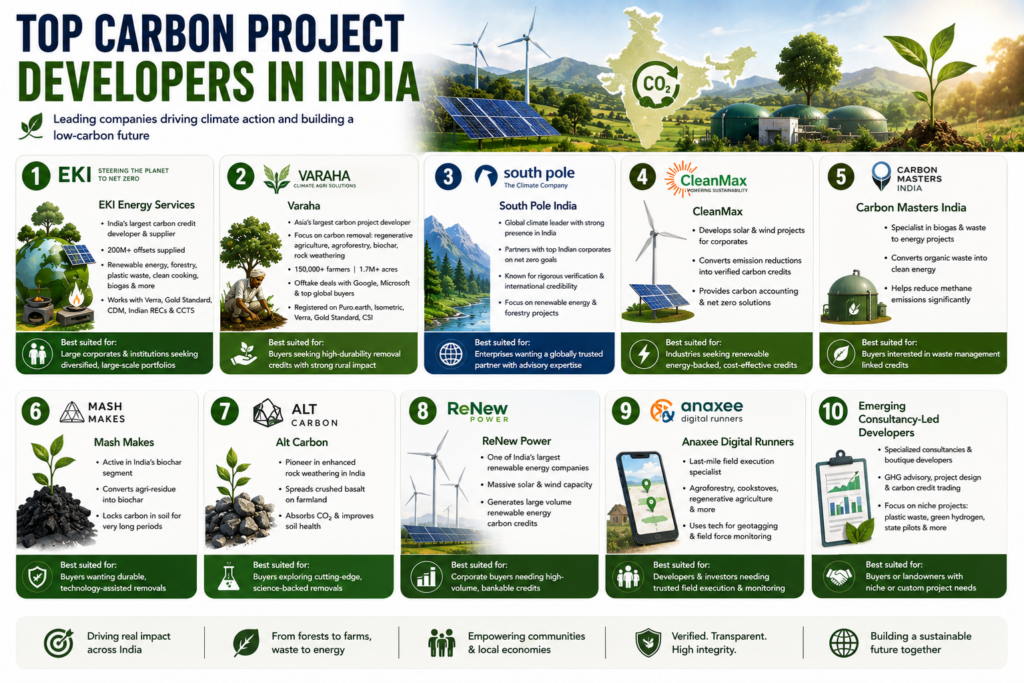
EKI Energy Services (website), formerly known as EnKing International, is widely regarded as India’s largest carbon credit developer and supplier.
The Indore headquartered, publicly listed company has supplied well over 200 million carbon offsets and works with thousands of clients across dozens of countries.
Its project portfolio spans renewable energy, forestry and land use, plastic waste management, and community based initiatives such as clean cookstoves and biogas systems.
EKI runs flagship clean cooking programs like Surya Nutan solar cookstoves and Oorja Biogas systems, both aimed at reducing firewood dependence in rural India.
The company works across major standards including Verra, Gold Standard, CDM, and Indian RECs, and has also aligned itself with India’s evolving CCTS framework and Article 6 developments.
Best suited for: corporates and institutional buyers looking for a large scale, diversified project portfolio with strong international registry experience.
2. Varaha
Varaha has quickly become one of the most talked about names in Indian carbon markets, and industry observers now describe it as the largest carbon project developer in Asia.
The company focuses on carbon removal through regenerative agriculture, agroforestry, biochar, and enhanced rock weathering, working mostly with smallholder farmers.
Varaha operates across India, Nepal, Bangladesh, Bhutan, and beyond, working with well over 150,000 farmers across roughly 1.7 million acres of farmland.
It was the first Indian developer to issue carbon credits from biochar projects and the first in Asia to issue enhanced rock weathering credits through an international registry.
Varaha has signed major offtake deals with global buyers including Google and Microsoft, and counts Mirova, RTP Global, and Omnivore among its investors.
Its projects are registered across Puro.earth, Isometric, Verra, Gold Standard, and Carbon Standards International.
Best suited for: buyers seeking high durability carbon removal credits with strong farmer income and rural development co-benefits.
3. South Pole India
South Pole is a global climate consultancy and project developer with a well established presence in India.
The India arm has partnered with major domestic technology companies to help them meet ambitious net zero commitments through renewable energy and forestry backed credits.
South Pole is known for rigorous project verification and a strong international reputation, which gives its credits added credibility among global buyers.
Best suited for: large enterprises that want a globally recognised partner with deep advisory capabilities alongside project development.
4. CleanMax
CleanMax is a leading renewable energy company that has built a strong parallel business in carbon credit generation.
The company develops solar and wind projects for corporate clients and converts the resulting emission reductions into verified carbon credits.
CleanMax has worked with major Indian corporates on renewable energy backed carbon offsetting and also provides detailed carbon accounting support to its clients.
Best suited for: manufacturing and industrial buyers looking for cost effective, renewable energy backed credits alongside actual clean power infrastructure.
5. Carbon Masters India
Carbon Masters focuses on biogas and waste to energy projects, converting organic waste from farms, food processing units, and municipal sources into clean energy.
This developer plays a meaningful role in India’s methane reduction efforts, since organic waste left untreated releases significant amounts of methane into the atmosphere.
Best suited for: buyers interested in waste management linked credits with a strong local environmental impact story.
6. Mash Makes
Mash Makes is an active player in India’s fast growing biochar segment, converting agricultural residue into biochar instead of letting it go up in smoke through open field burning.
Biochar projects are increasingly popular with global carbon removal buyers because the carbon gets locked into a stable form that can last in soil for a very long time.
Best suited for: buyers who want durable, technology assisted carbon removal credits rather than shorter term avoidance credits.
7. Alt Carbon
Alt Carbon is one of India’s pioneers in enhanced rock weathering, a newer carbon removal technique that spreads crushed basalt rock on farmland to absorb carbon dioxide from the atmosphere over time.
This category is still emerging in India, but it is drawing strong interest from global carbon removal buyers who prioritise permanence.
Best suited for: buyers exploring cutting edge, science backed carbon removal technology with long term storage potential.
8. ReNew Power
ReNew Power is one of India’s largest renewable energy companies, with an enormous wind and solar capacity that generates carbon credits at scale alongside its core power generation business.
Because of its scale, ReNew Power can supply large volumes of renewable energy backed credits, which appeal to buyers who need consistent, high volume offsetting.
Best suited for: corporate buyers needing large volume renewable energy credits with a proven, bankable track record.
9. Anaxee Digital Runners
Anaxee is not a traditional standalone project developer in the same sense as the others on this list, but it plays a critical execution role for many Indian carbon projects.
The company specialises in last mile field execution for agroforestry, cookstove distribution, and regenerative agriculture projects, using its own field force management systems and geotagging tools.
Anaxee works with project developers, carbon finance investors, and CSR teams who need reliable, verifiable field data across rural India.
Best suited for: developers and investors who need trustworthy on-ground execution and monitoring rather than project origination itself.
10. Emerging Consultancy Led Developers
Alongside the larger names, a growing set of specialised consultancies and boutique developers are building focused portfolios in India, often working across GHG advisory, project design, and carbon credit trading simultaneously.
Firms in this category typically pair carbon project development with broader climate advisory services such as carbon footprinting, ESG reporting support, and Green Credit Programme alignment.
Their smaller size often makes them more flexible for niche project types, such as plastic waste management credits, green hydrogen linked projects, or state specific pilot programs.
Best suited for: buyers or landowners with a specific niche project type that larger developers may not prioritise.
Why This Ranking Looks the Way It Does
A few patterns stand out when you look closely at India’s leading carbon project developers.
First, scale and diversification tend to go together. EKI Energy’s dominance comes largely from spreading across renewable energy, forestry, waste, and community projects rather than betting on a single category.
Second, the fastest growing names right now are carbon removal specialists. Varaha, Mash Makes, and Alt Carbon are all riding a wave of global demand for durable, technology assisted removal credits that command higher prices than traditional avoidance credits.
Third, execution partners like Anaxee matter more than people expect. Even the best designed project fails if field data cannot be trusted, which is why last mile execution capability increasingly separates credible developers from risky ones.
Finally, regulatory alignment is becoming a genuine differentiator. Developers actively building CCTS registration into their workflow are better positioned as India’s domestic compliance market grows alongside the voluntary market.
What Corporate Buyers Should Know Before Approaching These Developers
If you represent a company exploring carbon credit purchases from any of these developers, a few practical points will save you time.
Most top developers work with minimum purchase volumes, so very small one time purchases may be easier through a broker or aggregator rather than directly with a large developer.
Ask each shortlisted developer for their current registry links rather than PDFs or brochures, since registry listings update in real time and reflect the true status of a project.
Request a breakdown of co-benefits alongside carbon impact, such as farmer income generated, health improvements from cookstoves, or biodiversity outcomes from forestry work, since these numbers matter increasingly for ESG disclosures.
Where possible, speak directly with the developer’s monitoring or MRV team rather than only the sales team, since this often reveals how seriously a developer takes data quality.
Comparison Table of Top Carbon Project Developers in India
| Developer | Primary Focus | Notable Strength | Standards Used |
|---|---|---|---|
| EKI Energy Services | Renewable energy, forestry, cookstoves, waste | Largest diversified portfolio in India | Verra, Gold Standard, CDM, CCTS alignment |
| Varaha | Regenerative agriculture, agroforestry, biochar, enhanced rock weathering | Largest carbon project developer in Asia by scale | Puro.earth, Isometric, Verra, Gold Standard |
| South Pole India | Renewable energy, forestry, advisory | Global credibility and rigorous verification | Verra, Gold Standard |
| CleanMax | Solar and wind energy | Deep renewable infrastructure expertise | Verra and similar renewable methodologies |
| Carbon Masters India | Biogas and waste to energy | Strong methane reduction impact | Verra, Gold Standard |
| Mash Makes | Biochar | Growing durable carbon removal portfolio | Verra, Puro.earth |
| Alt Carbon | Enhanced rock weathering | Early leader in a high permanence removal category | International removal registries |
| ReNew Power | Large scale renewable energy | High volume, bankable credit supply | Verra and renewable frameworks |
| Anaxee Digital Runners | Field execution and monitoring | Best last mile rural execution network | Supports multiple methodologies |
This is not an exhaustive list, and new developers keep entering the space as India’s domestic carbon market matures. Always verify a developer’s current project registrations directly on the relevant registry before entering any agreement.
Types of Carbon Projects These Developers Build
Top developers in India generally specialise in one or more of the following project categories.
| Project Type | What It Involves | Typical Developers Active Here |
|---|---|---|
| Renewable energy | Solar, wind, and hydro projects that displace fossil fuel power | CleanMax, ReNew Power, EKI Energy |
| Forestry and afforestation | Planting trees, restoring degraded land, protecting forests | EKI Energy, South Pole India |
| Improved cookstoves | Efficient stoves that cut firewood use and indoor smoke | EKI Energy, Anaxee |
| Biochar | Converting crop residue into biochar that locks carbon in soil | Varaha, Mash Makes |
| Biogas and waste management | Capturing methane from waste and farm residue | Carbon Masters India, EKI Energy |
| Agroforestry and regenerative agriculture | Combining trees or better farming practices with carbon income for farmers | Varaha, Anaxee |
| Enhanced rock weathering | Spreading crushed rock on farmland to absorb carbon dioxide | Alt Carbon, Varaha |
How Top Developers Actually Build a Carbon Project
Every credible developer, regardless of size, follows a broadly similar process.
- Idea and feasibility study. The developer checks whether a project concept fits an approved carbon methodology.
- Methodology selection. The right protocol gets chosen based on project type, such as a specific methodology for biochar, cookstoves, or agroforestry.
- Project design document. A detailed document explains the baseline emissions and the expected emission reductions.
- Validation. An independent third party auditor reviews the design before anything moves forward.
- Registration. The validated project gets listed on a recognised registry such as Verra, Gold Standard, Puro.earth, or the Indian Carbon Market registry.
- Implementation. The developer executes the actual project on the ground, whether that means planting trees or distributing cookstoves.
- Monitoring. Field data, satellite imagery, or sensor readings track ongoing project performance.
- Verification. An auditor confirms the real emission reductions achieved during the monitoring period.
- Credit issuance. Verified credits get issued on the registry and become available for sale.
- Sale and retirement. Buyers purchase the credits and retire them, meaning each credit gets used exactly once.
This cycle repeats every monitoring period, which can range from one year to several years depending on the project type.
The Regulatory Landscape: CCTS and the Offset Mechanism
India’s own carbon market, the Carbon Credit Trading Scheme or CCTS, now shapes how every developer on this list operates domestically.
CCTS runs on two separate pillars.
Compliance Mechanism
This mechanism applies to large industrial entities in energy intensive sectors such as aluminium, cement, chlor alkali, pulp and paper, petroleum refining, petrochemicals, textiles, iron and steel, and fertiliser.
Companies that beat their emission intensity target earn Carbon Credit Certificates. Companies that miss their target must buy certificates to cover the gap, and these certificates trade on supervised power exchanges.
Offset Mechanism
This is the pillar most relevant to independent project developers and their clients. It is voluntary and open to entities not covered under the compliance mechanism.
Farmers, farmer producer organisations, MSMEs, NGOs, and clean energy developers can register eligible projects here and earn Carbon Credit Certificates through the Indian Carbon Market registry.
Approved sectors currently include energy, industries, agriculture, waste handling and disposal, forestry, and transport, with more sectors expected in later phases.
Credits earned through the offset mechanism cannot currently be used to meet compliance obligations. The two systems run in parallel rather than being interchangeable.
Many top developers now register projects under both an international voluntary standard and the domestic offset mechanism, depending on their buyer base.
Carbon Standards and Registries Used by Top Developers
- Verra (VCS): The most widely used international voluntary standard, covering forestry, renewable energy, cookstoves, and more.
- Gold Standard: Known for strong sustainable development criteria alongside carbon impact.
- Puro.earth and Isometric: Popular among newer carbon removal focused developers working in biochar and enhanced rock weathering.
- Indian Carbon Market registry: The domestic registry under CCTS, now active for both compliance certificates and offset mechanism credits.
How to Choose Among Top Carbon Project Developers
Use this checklist before signing on with any developer from this list or elsewhere.
- Check registration status directly on the registry, not just on the developer’s marketing material.
- Review the methodology to confirm it matches the project type and is genuinely approved.
- Ask about monitoring systems, favouring developers who use satellite data, geotagging, or regular field audits.
- Look at community engagement, especially for forestry, cookstove, and agri-carbon projects.
- Verify track record, asking specifically about credits already issued and retired, not just projects under development.
- Understand pricing and payment terms, since carbon credit prices vary significantly by project type and quality.
- Check exclusivity rules, since offset mechanism projects generally cannot double claim credits under other government schemes such as the Green Credit Programme.
Carbon Credit Pricing Across Project Types
Pricing varies significantly depending on the developer, project type, and standard used.
| Project Type | Typical Price Positioning | What Drives the Price |
|---|---|---|
| Forestry and afforestation | Moderate to high | Biodiversity and community co-benefits push prices up |
| Renewable energy | Lower to moderate | Wide supply keeps prices competitive |
| Cookstoves and biogas | Moderate | Strong health and social impact appeals to premium buyers |
| Biochar and enhanced rock weathering | High | Durable carbon removal commands a premium |
| Compliance mechanism CCCs | Set by exchange trading | Driven by industrial demand and supply among obligated entities |
A cheap credit from a poorly monitored project carries more risk than a slightly costlier credit from a well verified one, so price should never be the only deciding factor.
Challenges Even Top Developers Face in India
Even the most established developers deal with real operational hurdles.
- Last mile execution. Reaching remote villages and maintaining equipment like cookstoves or biogas units takes ongoing effort.
- Data verification. Collecting accurate, tamper proof monitoring data across thousands of scattered project sites is genuinely difficult.
- Building trust. Farmers and rural communities need confidence that carbon income will actually reach them.
- Regulatory transition. With CCTS rolling out in phases, developers need to track new rules constantly.
- Financing gaps. Many projects need upfront capital years before credit revenue arrives, creating cash flow pressure.
- Market quality concerns. Global scrutiny of voluntary carbon markets is pushing developers to invest more in rigorous, science backed methodologies.
Future Outlook for Carbon Project Developers in India
The outlook for India’s top carbon project developers remains strong.
The CCTS offset mechanism has opened a formal, government recognised pathway for farmers, MSMEs, and local developers to participate in carbon markets.
Corporate demand within India is rising steadily as more Indian companies set net zero targets and look for domestic project options alongside international offsets.
Carbon removal categories such as biochar and enhanced rock weathering are attracting global buyers who value permanence and are willing to pay premium prices, which is pushing developers like Varaha, Mash Makes, and Alt Carbon into the spotlight.
Technology is also lowering costs across the board. Satellite monitoring, mobile based field data collection, and AI powered analysis are making verification faster and more transparent, helping smaller developers compete with larger, better funded players.
Matching Your Goal to the Right Developer
Different buyers and landowners have different priorities, so it helps to match your specific goal to the developer type most likely to deliver it.
| Your Goal | Developer Type to Prioritise | Example From This List |
|---|---|---|
| Large volume, cost effective offsetting | Renewable energy specialists | CleanMax, ReNew Power |
| Durable, premium carbon removal | Biochar and enhanced rock weathering specialists | Varaha, Mash Makes, Alt Carbon |
| Strong social and health impact story | Cookstove and community project developers | EKI Energy, Anaxee |
| Farmer income and rural development focus | Agri-carbon and agroforestry platforms | Varaha, Anaxee |
| Diversified portfolio with global reach | Large, publicly listed developers | EKI Energy Services |
| Advisory support alongside project sourcing | Consultancy led developers | South Pole India, boutique consultancies |
| Reliable last mile field execution | Execution and monitoring partners | Anaxee Digital Runners |
If you are unsure where to start, begin by clarifying whether your priority is cost, permanence, social impact, or a mix of all three. That single decision narrows the shortlist considerably.
Due Diligence Steps Before Signing With Any Developer
Even a well known name on this list deserves proper due diligence before you commit funds or land.
- Request the project ID and look it up directly on the registry website rather than trusting a shared screenshot or PDF.
- Ask for the validation and verification reports, which are usually public documents on the registry once a project is registered.
- Confirm the payment structure for farmers or landowners if the project involves their participation, and get this in writing.
- Check for any active disputes or flagged issues connected to the developer’s past projects through independent carbon market news sources.
- Clarify the contract duration and exit terms, since some carbon projects lock in participation for many years.
- Understand who owns the credits at each stage, especially in projects involving multiple partners such as a developer, an execution partner, and a technology provider.
Following these steps takes a little extra time upfront, but it protects you from the two most common problems in carbon markets, weak project quality and unclear ownership of credits.
Red Flags to Watch For When Evaluating a Developer
A few warning signs consistently point to weaker or riskier developers, regardless of how polished their marketing looks.
- Vague or missing registry links. A genuine developer can point you to the exact project page on Verra, Gold Standard, or the Indian Carbon Market registry within minutes.
- Guaranteed high returns for farmers or landowners. Carbon income depends on verified performance, so guarantees that ignore this reality are a serious concern.
- Pressure to sign quickly. Credible developers expect due diligence and rarely rush a serious buyer or landowner into a decision.
- No clarity on additionality. If a developer cannot clearly explain why the project would not have happened without carbon finance, the credit’s credibility is questionable.
- Overlapping claims across multiple schemes. Be cautious if a project claims credits under CCTS offset mechanism while also claiming benefits under other government schemes without clear exclusivity documentation.
Trusting your instincts here matters. If a developer cannot answer these questions clearly and confidently, it is worth looking elsewhere on this list.
Frequently Asked Questions
Who is the largest carbon project developer in India?
EKI Energy Services is widely considered India’s largest carbon credit developer and supplier by volume of offsets supplied, while Varaha has emerged as the largest carbon removal focused project developer in Asia.
Which developer is best for farmers looking to earn carbon income?
Varaha and Anaxee Digital Runners both work closely with farmers and rural communities, offering revenue sharing models tied to agroforestry, regenerative agriculture, and biochar projects.
Are carbon project developers regulated in India?
Yes. Developers working under the offset mechanism must follow rules set by the Bureau of Energy Efficiency and register projects on the Indian Carbon Market registry, alongside any international standard requirements they choose to follow.
What is the difference between a carbon project developer and a carbon credit broker?
A developer designs, builds, and manages the physical project that generates emission reductions, while a broker connects developers with buyers and facilitates the sale of already issued credits.
Which standards do top Indian developers typically use?
Most rely on Verra and Gold Standard for broad project types, while carbon removal focused developers increasingly use Puro.earth and Isometric alongside the domestic Indian Carbon Market registry.
How do I verify that a developer’s projects are genuine?
Search for the project directly on the relevant registry website using the project name or ID the developer provides, and confirm its current status rather than relying on claims alone.
Can a small business or landowner work with these top developers?
Yes. Several developers, particularly those focused on agroforestry, biochar, and cookstoves, actively work with smallholder farmers, MSMEs, and local landowners through structured partnership programs.
Conclusion
India’s top carbon project developers now range from publicly listed giants like EKI Energy Services to fast growing carbon removal specialists like Varaha, Mash Makes, and Alt Carbon.
Each developer brings a different strength, whether that is scale, farmer reach, technological innovation, or execution capability on the ground.
With CCTS now operational and global demand for high quality Indian carbon credits rising, these developers are shaping how the country turns its climate ambitions into real, measurable action.
Whether you are a corporate buyer, an investor, or a landowner exploring carbon income, understanding who leads this space and what makes them credible is the first step toward making a confident, informed decision.
For more updates, guides, and resources on carbon markets, explore Carbon Market Network.