Carbon Market Network


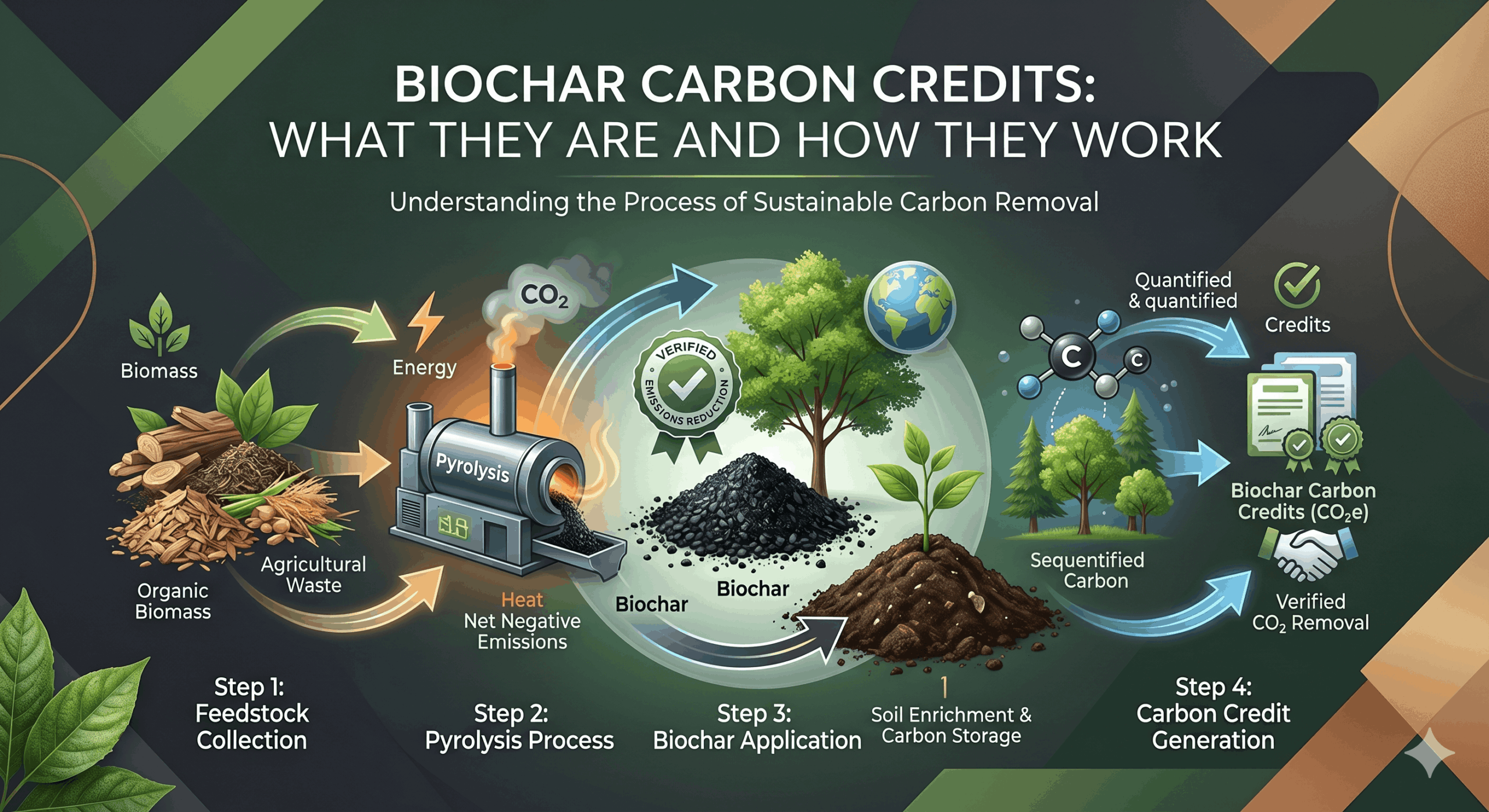
Every year, the planet loses the climate battle a little bit more. Glaciers shrink. Temperatures rise. Deadlines for net-zero commitments get closer. And yet, most carbon removal solutions either cost a fortune, take decades to show results, or both.
Biochar carbon credits are quietly changing that story.
They combine ancient science with modern carbon markets.
They turn agricultural waste into a climate solution. And they produce something that can lock carbon away for hundreds, sometimes thousands, of years.
If you’ve heard the term “biochar carbon credits” but aren’t sure what it actually means or how it works, you’re in the right place. This guide breaks it all down from scratch.
What Is Biochar? A Simple Explanation
Before understanding the credits, you need to understand the material behind them.
Biochar is a carbon-rich, charcoal-like substance made by heating organic material at high temperatures in an environment with little or no oxygen.
Think of it like this. When you burn wood normally, the carbon inside the wood combines with oxygen in the air and escapes as CO2.
That carbon goes straight into the atmosphere and contributes to global warming.
But when you heat the same wood without oxygen, something very different happens. The carbon in the organic material doesn’t combust. It transforms into a stable, solid form. That stable solid is biochar.
Biochar locks carbon from biomass into a stable, charcoal-like form that can persist in soils for centuries to millennia, instead of returning to the atmosphere as CO2.
It looks like crushed charcoal. It feels dry and lightweight. And once it’s applied to soil or used in building materials, the carbon inside it stays put for an extremely long time.
That carbon storage is what makes biochar so valuable in the fight against climate change.
Carbon Market Insider Newsletter
Weekly insights on carbon markets, climate policy, carbon credits, and sustainability.
Where Does the Organic Material (Feedstock) Come From?
The organic material used to make biochar is called feedstock.
Good quality feedstock usually comes from waste biomass. This keeps the process sustainable and avoids creating demand for new land clearing. Common feedstocks include:
- Agricultural waste such as rice husks, wheat straw, corn cobs, and sugarcane bagasse
- Forestry residues like wood chips, sawdust, and bark
- Crop residues left over after harvests
- Municipal green waste such as garden clippings
- Sewage sludge (in some advanced systems)
Quality feedstock comes from sustainably sourced and/or waste biomass.
The type of feedstock used plays a big role in the quality of the biochar produced and the number of carbon credits it can generate.
Projects that source feedstock from genuinely waste materials score higher on credibility assessments.
Projects that use freshly cut roundwood or timber-grade logs raise red flags because that wood could have stored carbon in a long-lived product instead.
How Is Biochar Made? The Pyrolysis Process Explained
The process used to make biochar is called pyrolysis. It’s a thermal decomposition process, and it’s the engine behind every biochar carbon credit.
Here is how it works, step by step.
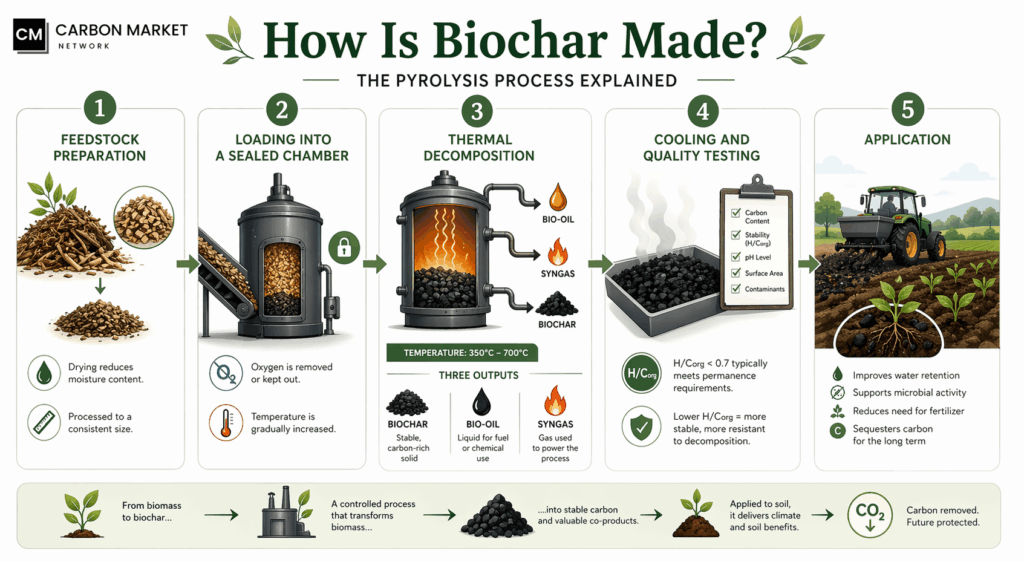
Step 1: Feedstock Preparation
The raw biomass is first dried and processed into a consistent size. Consistent preparation of the feedstock is important. It ensures that each cycle runs smoothly and that the quality of the biochar remains high.
Moisture content matters a lot here. Wet feedstock produces lower-quality biochar and reduces the efficiency of the process.
Step 2: Loading into a Sealed Chamber
Once prepared, the feedstock goes into a sealed reactor or kiln.
The key feature of this chamber is that oxygen is removed or kept out.
Once the feedstock is prepared, it is placed in a sealed chamber where oxygen is removed or kept out.
The temperature is gradually increased. Unlike burning, which happens when oxygen is present, this process prevents flames and instead causes the material to break down slowly.
Step 3: Thermal Decomposition
As the temperature rises, typically between 350°C and 700°C, the biomass begins to break apart chemically rather than burn.
As the temperature rises, the biomass begins to release vapours and gases. These are collected and separated into bio-oil and syngas. What remains in solid form becomes biochar.
The three outputs of pyrolysis are:
- Biochar – the stable, carbon-rich solid
- Bio-oil – a thick liquid that can be refined into fuel or chemicals
- Syngas – a combustible gas that can be used to power the pyrolysis process itself, making the system partially self-sustaining
Step 4: Cooling and Quality Testing
After pyrolysis is complete, the biochar is cooled and tested.
Scientists measure its carbon content, stability, surface area, pH levels, and potential for contamination.
One of the most important measurements is the H/Corg ratio (hydrogen to organic carbon ratio).
Puro.earth typically requires H/Corg below 0.7 for soil-applied biochar. Verra VM0044 v1.2 and Isometric’s Biochar protocol similarly define permanence periods based on H/Corg and other stability tests.
A lower H/Corg ratio means the carbon is more aromatic and resistant to decomposition, which is exactly what you want for long-term storage.
Step 5: Application
Finally, the biochar is applied. Most commonly, it goes into agricultural soil as a soil amendment.
Biochar carbon removal also involves the subsequent application of biochar in soils or durable materials such as cement and tar.
When applied to soil, biochar improves water retention, supports microbial activity, reduces the need for fertilizer, and of course, sequesters the carbon locked inside it.
How Long Does Biochar Store Carbon?
This is one of the most important questions in the entire biochar debate, and it’s also one of the most frequently misunderstood.
The answer depends on the quality of the biochar and the environment where it’s applied. But the short version is: a very long time.
Biochar can store carbon captured from the atmosphere for hundreds or even thousands of years. This makes it a highly effective carbon sink.
To give you a sense of scale, most nature-based carbon credits (like forest protection credits) store carbon for 20 to 100 years at best. Biochar comfortably outlasts those.
Different certification bodies apply different timeframes:
- CAR, Puro.earth, and VCS each state that the biochar carbon they credit will last 100 years in soil.
- Under its primary methodology, Isometric credits 200 years of storage, and under the alternate method, if a project provides the required reflectance data showing very stable carbon, it will credit up to 1,000 years.
This durability is a major selling point for companies with serious net-zero commitments. Carbon removal that lasts a century or more is much harder to reverse than a forest that could burn next year.
What Are Biochar Carbon Credits?
Now that you understand the material, the credits make perfect sense.
A biochar carbon credit represents one tonne of CO2 equivalent (tCO2e) that has been durably removed from the atmosphere and stored in biochar.
When a biochar producer creates verified biochar and applies it properly, independent auditors measure exactly how much carbon has been permanently removed.
That verified removal gets converted into a tradeable credit.
One credit equals one ton of CO2e durably removed.
Once certified, credits are listed on registries and sold to corporates, investors, or governments seeking to offset emissions or meet net zero goals.
Biochar carbon credits belong to a category called Carbon Dioxide Removal (CDR) credits.
This is different from traditional carbon offset credits, which usually work by avoiding or reducing emissions (for example, protecting a forest that would have been cut down).
CDR credits actually remove CO2 that’s already in the atmosphere. This distinction matters a lot to buyers and regulators who are increasingly skeptical about avoidance credits.
Biochar Carbon Removal: Why It’s Different From Regular Carbon Offsets
The carbon market contains two broad categories of credits:
1. Avoidance or reduction credits
These prevent emissions from happening. Examples include clean cooking stoves, wind farms replacing coal plants, or REDD+ projects that pay communities not to cut down forests.
The problem with many of these is that the carbon “saved” often isn’t truly permanent. A forest can burn. A project can be abandoned. The emissions reduction may never have been as large as claimed.
2. Carbon removal or CDR credits
These physically pull CO2 out of the atmosphere and store it. Biochar is one of the most accessible and scalable CDR methods currently available.
Some traditional “emissions-avoidance” credits are criticized. They often lack permanence and strong verification.
Biochar has a co-benefit: it can boost soil health, water retention, and agricultural yields when added to soil.
Biochar carbon credits sit firmly in the removal category. That’s a big reason why companies with high-integrity climate commitments are increasingly choosing them over cheaper avoidance credits.
How the Biochar Carbon Credit Process Works: From Production to Sale
Here’s the full journey of a biochar carbon credit, step by step.
1. Project Development
A biochar producer or developer identifies a suitable feedstock source, builds or installs a pyrolysis system, and designs the project. At this stage, they also choose which carbon standard (Puro.earth, Verra, Isometric, etc.) they want to certify under.
2. Baseline and Additionality Assessment
The project needs to prove two things:
- Baseline: What would have happened to the feedstock if this project didn’t exist? If the biomass would have decomposed naturally or been burned openly, that releases carbon. The biochar project stops that from happening.
- Additionality: The project must show that the carbon removal would not have happened without the financial incentive from selling credits. In other words, the credits must be the reason the project exists.
3. Biochar Production and Data Collection
The pyrolysis facility runs, and detailed data is collected throughout. Data is collected on feedstock types, reactor efficiency, biochar yield, and final application.
This data forms the evidence base for the credits.
4. Lifecycle Emissions Assessment
Every step of the biochar production process has its own carbon footprint. The machines, the transport, the energy used. The total carbon removed by the biochar must be significantly greater than the emissions produced to make it.
This full accounting is called a lifecycle assessment (LCA). A good biochar project typically removes several times more carbon than it emits in production.
5. Third-Party Verification
An independent auditor reviews all the data, visits the site if necessary, and verifies that the claimed carbon removal is real, measurable, and permanent. Independent auditors verify this data. Registries like Verra, Puro.earth, Isometric, or Carbon Standards International certify the credits after audit.
6. Credit Issuance
Once verified, the registry issues the credits. Each credit has a unique serial number, is listed on a public registry, and is traceable.
7. Trading and Retirement
Buyers purchase the credits on carbon marketplaces or directly from developers. When a company uses a credit to meet its climate commitment, the credit is retired, meaning it can never be sold again. This prevents double counting.
Who Certifies Biochar Carbon Credits? Key Standards and Registries
Not all biochar credits are created equal. The quality of a credit depends heavily on the methodology it was issued under.
These are the main certification frameworks operating in 2025 and 2026.
Puro.earth
In 2019, Puro.earth brought the first carbon removal crediting methodology for biochar to the market. Under the Puro Standard, they issue CO2 Removal Certificates (CORCs) to carbon removal suppliers through the Puro Registry.
Puro.earth has been a pioneer in this space. By March 2025, it had issued over 1 million CORCs since its founding, with biochar being one of the two largest categories by issuance.
Verra (VM0044)
Verra is the world’s largest voluntary carbon standard. Its biochar methodology, VM0044 Methodology for Biochar Utilization in Soil and Non-Soil Applications, is widely used globally, including by smallholder farming projects.
Verra registered its first biochar project under this standard in October 2024.
Isometric
Isometric’s Biochar Production and Storage protocol takes a particularly rigorous approach to durability. As noted above, it credits carbon storage of 200 to 1,000 years depending on biochar stability.
As of August 2025, twenty-five projects are registered under Isometric Biochar Production and Storage with 500,000 credits expected to be issued in 2026. ICVCM
CAR (Climate Action Reserve)
CAR has an approved methodology for biochar projects in the US and Canada, which also received ICVCM’s Core Carbon Principles (CCP) label in 2025.
ICVCM and the Core Carbon Principles
The Integrity Council for the Voluntary Carbon Market (ICVCM) is an independent governance body that assesses whether carbon credit methodologies meet its high-integrity Core Carbon Principles (CCP) standards.
Biochar as a carbon dioxide removal method has emerged as the most sought-after solution by buyers, with biochar deliveries dominating the voluntary carbon market in 2025.
To ensure credits are issued credibly and transparently, the ICVCM has approved the following three biochar CDR methodologies: CAR – U.S. and Canada Biochar (V 1.0), Isometric Biochar Production and Storage (V 1.0), and Verra VM0044 Methodology for Biochar Utilization in Soil and Non-Soil Applications (V 1.2).
Getting the CCP label is significant. It tells buyers that a credit meets gold-standard integrity requirements, which is increasingly important as corporate sustainability claims come under greater scrutiny.
Gold Standard
Gold Standard is currently developing a dedicated biochar methodology as of 2025. Once launched, this will add another major credentialing option to the market.
European Biochar Certificate (EBC)
The EBC, based in Switzerland, operates mainly in Europe. It certifies both the physical quality of biochar and the carbon removal claims associated with it. It’s widely used by European producers who supply biochar for soil and construction applications.
How Much Do Biochar Carbon Credits Cost?
Biochar credits are not cheap. But they’re not the most expensive either.
Biochar credits currently trade between USD $100 and $200 per tonne, which is less expensive than technologies like direct air capture, but still a premium compared to traditional avoidance credits.
More specifically, recent data shows:
- The average biochar carbon credit price in 2025 is $164 per tonne, up from $131 per metric tonne in 2023.
- For 2026, biochar credits have been estimated to average around $177 per tonne.
- In October 2025, U.S. biochar credits for delivery in 2025 stayed at around $150 per tonne of CO2e. Credits for next year’s delivery were about $148 per tonne.
The variation in price comes down to several factors:
Feedstock quality. Credits from clean, sustainable waste feedstocks command higher prices.
Durability claims. Credits certified for longer storage periods (like Isometric’s 1,000-year credits) trade at a premium.
Certification standard. ICVCM-approved (CCP-labelled) credits trade at a premium over non-CCP equivalents.
Delivery timing. Spot delivery credits (available now) sometimes differ in price from forward contracts (delivery in future years).
Project geography. Where the project operates can affect both price and perceived quality.
For comparison, traditional avoidance credits like REDD+ protection projects can trade as low as $5 to $15 per tonne.
Biochar credits sit in a different tier entirely, closer in value to direct air capture credits but far more accessible in terms of supply.
The Biochar Carbon Credit Market in 2025 and 2026
The biochar carbon removal market has grown rapidly and is now the dominant segment of the durable CDR marketplace.
A total of 3.04 million tonnes of biochar carbon removal credits have been contracted between 2022 and 2025, with 1.6 million tonnes sold in the first half of 2025 alone. Deliveries have grown rapidly, accounting for a total of 658 thousand tonnes of BCR delivered since the start of 2022, while retirements have also surged, with 302 thousand tonnes of BCR retired by the end of Q2 2025. Both deliveries and retirements have approximately doubled each year since the start of 2022.
Biochar Carbon Removal continued as the delivery leader in durable CDR, with 89.4% of the total 116.8 thousand tonnes delivered in Q2 2025.
That is a remarkable market share. For every tonne of durable CDR credit delivered in Q2 2025, almost 9 out of 10 tonnes came from biochar.
The global biochar carbon credit market also saw significant year-on-year growth, with volume rising more than 40% in 2025. However, this growth hasn’t come without tension.
Supply Constraints Are a Real Issue
On the supply side, biochar credits remain constrained. Many projects face delays in certification or in building out production capacity. This limits the credits available for immediate delivery or sale.
New analysis found that 93% of 2025 industrial biochar supply had been snapped up by buyers.
That level of forward contracting leaves very little room for new buyers who haven’t already locked in agreements.
A Small Group of Big Buyers Dominates
Microsoft, Google, BCG, and JPMorgan lead as the top purchasers of BCR, accounting for 57% of total BCR purchases, while Exomad Green stands out as the leading supplier, accounting for 60% of all BCR credits sold since 2022.
Some of the headline deals include:
- Microsoft’s 1.24 million tonne, 10-year agreement with Exomad Green, Google’s 100,000 tonne contract with Varaha, Swiss Re’s 70,000 tonne agreement via Carbonfuture, and BCG’s 50,250 tonne durable CDR purchase including biochar from Exomad and Euthenia Energy.
These large multi-year offtakes are locking up significant portions of high-quality supply, which means buyers who wait too long may find the best projects already fully committed.
The Push Toward Smaller Buyers
Many biochar developers are rethinking their strategies. Some are trying to expand the market beyond a few large corporations.
There is a rising push to reach smaller buyers, including small companies and possibly individuals.
This could help broaden demand, reduce concentration risk, and create a more stable base for biochar credits.
This is a meaningful shift. For much of its early market history, biochar CDR was essentially an enterprise product.
Increasingly, platforms and marketplaces are making it accessible to mid-sized businesses and even individual climate-conscious buyers.
Real-World Biochar Carbon Credit Projects You Should Know
Knowing that biochar projects exist is one thing. Seeing what they actually look like in the real world makes the concept much more concrete.
Aperam BioEnergia (Brazil)
Aperam BioEnergia, certified by Puro.earth, is one of the largest biochar projects globally, producing 10,000 tonnes of biochar annually in 2025, with plans to triple production by 2026.
The project uses pyrolysis technology to convert forestry residues into biochar, supporting sustainable forest management and carbon removal in Minas Gerais, Brazil.
It has sold over 100,000 tonnes of carbon removal credits since 2021.
Pacific Northwest Project (USA)
Based in the Pacific Northwest, this Verra-certified project converts wood waste from sustainable forestry operations into biochar.
The initiative partners with Indigenous communities to restore degraded lands, making it a leader in community-driven CO2 compensation.
Its scalable model has already removed thousands of tons of CO2 annually, with plans to expand in 2026.
Carboneers (Ghana)
Developed by Carboneers, this project in Ghana converts agricultural waste into biochar, reducing open burning and improving soil health.
Projects like this demonstrate that biochar isn’t limited to wealthy nations with industrial infrastructure. Small-scale, community-level projects in the Global South are a growing part of the biochar credit supply.
Carbonfuture (Switzerland/Global)
In 2025, Carbonfuture facilitated the world’s first megatonne Biochar Carbon Removal agreement, expanded coverage across durable CDR technologies, strengthened its multi-year supply pipeline, and advanced its digital Trust Infrastructure to support growing volumes of high-integrity carbon removal.
This milestone underscores how quickly the market is scaling. A megatonne deal would have seemed implausible just five years ago.
Why Biochar Carbon Credits Are Better Than Many Other Carbon Offsets
Buyers increasingly scrutinize the quality of what they purchase. Biochar performs well on nearly every major quality dimension.
Permanence
Most forest-based credits carry reversal risks. Fires, pests, illegal logging, and political instability can all wipe out the carbon stored in a forest. Biochar doesn’t have that problem.
Once biochar is incorporated into soil or a construction material, the carbon is chemically stable and extremely resistant to biological decomposition. Durability timescales range from 100 years at minimum to over 1,000 years for the highest quality biochar.
Measurability and Transparency
The carbon content of biochar can be directly measured in a laboratory. There’s no need to model a complex forest ecosystem or project what might have happened without the project.
The amount of carbon removed is directly quantifiable.
Co-Benefits
Beyond carbon removal, biochar applied to agricultural soil delivers tangible benefits:
- Improved soil water retention, reducing irrigation needs
- Enhanced microbial activity, supporting healthier crops
- Reduced need for synthetic fertilizers
- Better crop yields, especially on degraded soils
- Reduction in nitrous oxide (N2O) emissions from soil, which is itself a powerful greenhouse gas
Biochar has a co-benefit: it can boost soil health, water retention, and agricultural yields when added to soil.
These co-benefits make biochar projects genuinely useful at the local level, not just as a financial instrument for large corporations.
Scalability
Unlike direct air capture (DAC) machines, which require massive industrial infrastructure and cost hundreds of dollars per tonne, biochar can be produced at multiple scales.
Unlike Direct Air Capture, which requires billions in CapEx, biochar projects can be small-scale and modular.
In comparison, mid-scale industrial facilities often have CAPEX requirements below 1.5 million USD.
This makes biochar suitable for a much wider range of project developers around the world.
Who Buys Biochar Carbon Credits and Why?
Understanding the buyer side helps explain how the market works and where it’s heading.
Large Corporations With Net-Zero Commitments
The biggest buyers are companies that have made public net-zero pledges and need high-quality removals to back those claims.
Microsoft, Google, JPMorgan Chase, Swiss Re, and BCG have all made major biochar credit purchases.
These companies typically care about:
- Durability: They need credits that won’t be reversed.
- Additionality: They need removals that wouldn’t have happened otherwise.
- Verification: They need independently certified, traceable credits.
- Co-benefits: Many want projects that also help local communities or improve agricultural land.
Biochar scores well on all four counts, which is why it has attracted this tier of buyer.
Companies With Science-Based Targets
The Science Based Targets initiative (SBTi) is pushing companies to reduce their own emissions drastically and use high-quality removals only for residual emissions that can’t be eliminated.
If you wait until 2026 or 2027 to start procurement, you may find that the highest-quality, best-documented biochar projects are already fully contracted to multi-year offtakes.
Prices will also likely continue rising as demand grows and regulatory mandates take effect.
Institutional Investors
Some investors now buy and hold biochar carbon credits as part of diversified portfolios, treating them as an asset class with strong long-term demand fundamentals.
Governments and Municipalities
Certain national and regional governments are using voluntary carbon markets to meet climate commitments beyond what their compliance systems require.
Biochar’s durability makes it attractive for government procurement, particularly in countries where policy frameworks value long-term carbon storage.
How to Buy Biochar Carbon Credits
Whether you’re a business looking to offset residual emissions or an investor exploring the carbon market, here’s a practical guide to buying biochar credits.
Step 1: Define Your Goal
Are you buying to offset a specific amount of emissions? To meet a compliance or voluntary target? To diversify a carbon portfolio? Your goal will shape which type and quality of credits you need.
Step 2: Choose a Registry or Marketplace
Credits can be purchased through:
- Registries directly: Puro.earth, Verra, Isometric, and CAR all have platforms where you can view project listings.
- Carbon marketplaces: Platforms like Carbonfuture, Climate Impact X (CIX), Xpansiv, and others aggregate credits from multiple registries.
- Direct from developers: Some project developers sell directly to buyers, often through long-term offtake agreements.
Step 3: Evaluate Credit Quality
When assessing a specific project or credit, look for:
- Certification standard: Is it certified under a recognized methodology like Verra VM0044, Puro.earth, or Isometric? Does it carry the CCP label from ICVCM?
- Feedstock source: Is the biomass genuinely waste material? Is it sustainably sourced?
- Durability claims: What is the certified storage period? What is the H/Corg ratio of the biochar?
- MRV robustness: How was the carbon removal measured, reported, and verified? By whom?
- Track record: Has the project issued and delivered credits before? Check public registry records.
- Co-benefits: Does the project have additional social or environmental benefits?
Step 4: Decide on Spot vs. Forward Contracts
Spot credits are available for immediate purchase and retirement. They typically come from projects that have already issued verified credits.
Forward contracts are agreements to buy credits from future production. These often come at lower prices but involve delivery risk (the project might face delays).
Given current supply constraints, many buyers are locking in forward contracts now to secure access to high-quality biochar credits in 2026 and beyond.
Step 5: Retire and Report
Once you purchase credits, retire them on the registry.
Retirement permanently removes them from circulation so no one else can claim them. Keep the serial numbers and retirement certificates for your sustainability reporting.
How Biochar Producers Earn Carbon Credits
If you’re on the other side of the market, as a farmer, project developer, or entrepreneur, here’s how the credit generation side works.
What You Need to Get Started
- A reliable, sustainable source of waste biomass (feedstock)
- A pyrolysis system (kiln, retort, or industrial reactor)
- Energy infrastructure to power the system
- Land or agreements for biochar application
- Capital to cover setup costs and certification fees
Choosing a Certification Pathway
You’ll need to choose which standard to certify under based on your location, project scale, and feedstock type.
Each has different documentation requirements, fees, and verification timelines.
Puro.earth, Verra, and Isometric are the most established options globally. European producers often work with the European Biochar Certificate alongside a registry standard.
Documentation and Monitoring
From the moment production begins, you’ll need to track:
- Feedstock origin, quantity, and type
- Pyrolysis temperatures and residence times
- Biochar yield and quality measurements (carbon content, H/Corg ratio, moisture, contaminants)
- Where and how the biochar was applied
- Any emissions from the production process
This is called MRV: Monitoring, Reporting, and Verification. Strong MRV is the foundation of any credible carbon credit.
Third-Party Audit
An accredited auditor will review your documentation and may conduct a site visit. They verify that the carbon removal claims are accurate and that the project meets the chosen methodology’s requirements.
Credit Issuance and Revenue
Once the audit passes, the registry issues credits, and you can list them for sale. Revenue from credits can be used to offset production costs, expand operations, or fund additional projects.
Many biochar developers are now focusing on the actual biochar product instead of just selling carbon credits.
They sell it as soil amendments, bio-fertilizers, and for other uses.
This strategy can boost the bankability of projects. Diversifying revenue in this way reduces reliance on carbon credit prices and makes projects more financially resilient.
Challenges and Limitations of Biochar Carbon Credits
No carbon removal solution is perfect. Biochar has real strengths, but it also has genuine challenges that buyers and developers need to understand.
Supply Is Still Constrained
The market is growing fast, but production capacity hasn’t kept pace with demand.
Certification processes take time, and building new pyrolysis infrastructure requires capital.
This explains why over 90% of 2025 industrial biochar supply was already pre-contracted before the year began.
Not All Biochar Is Equal
The carbon content, stability, and purity of biochar vary significantly based on feedstock and production conditions.
Low-quality biochar produced from questionable feedstocks at incorrect temperatures may decompose far faster than claimed.
Buyers who don’t do proper due diligence on feedstock sourcing and production methodology risk purchasing credits that don’t deliver the permanence they paid for.
Feedstock Sourcing Risks
Using biomass that would have stored carbon in long-lived products, like construction timber, actually shifts carbon rather than removing it.
Projects need to demonstrate that their feedstock is genuinely waste material that would have decomposed or been burned anyway.
Scaling Faces Real-World Constraints
Researchers, investors, and policymakers are no longer asking whether biochar works. They are asking how quickly it can be deployed at scale.
That shift is encouraging, but scaling requires solving problems around feedstock aggregation, logistics, quality consistency, and market infrastructure that take years to build out.
Market Concentration
The current market is dominated by a small number of large buyers and suppliers. This creates fragility.
If a few key players exit or reduce purchasing activity, the market could contract quickly. Diversifying the buyer and supplier base is a critical priority for long-term stability.
Permanence Uncertainty Over Very Long Timescales
While biochar is demonstrably stable for decades, the exact behavior of biochar in soil over centuries or millennia under changing climate conditions introduces some uncertainty.
Certification standards use conservative modeling approaches to address this, but it remains an evolving area of science.
The Future of Biochar Carbon Credits
The trajectory for biochar carbon credits is broadly positive, but the market is maturing rather than just growing.
Regulatory Tailwinds Are Building
Governments globally are creating frameworks that acknowledge and value carbon removal.
Article 6 of the Paris Agreement, which governs international carbon markets, is increasingly being implemented in ways that allow biochar credits to play a role.
National carbon markets in Japan, the UK, and others are exploring biochar-specific methodologies.
A Switzerland-based carbon standard has opened a public consultation on an updated methodology for biochar carbon removal credits, introducing changes to how carbon storage durability is assessed and expanding participation in projects.
This kind of methodological refinement is a sign of market maturity, not instability.
More Buyers Will Enter
As corporate net-zero timelines approach (most major companies have targets in the 2030 to 2050 range), demand for high-quality, durable removals will intensify.
Biochar’s combination of affordability, scalability, and proven durability positions it well to capture a significant share of that demand.
Technology Improvements Will Lower Costs
Advances in pyrolysis reactor efficiency, feedstock logistics, and automated monitoring systems will reduce production costs over time.
This should gradually bring biochar credit prices down while improving quality and consistency.
Non-Soil Applications Are Growing
Beyond soil amendment, biochar is increasingly being incorporated into concrete, asphalt, and other building materials.
These applications potentially offer even longer storage timescales than soil application, opening new project types and geographies.
Integration With Agriculture
The most promising long-term vision for biochar is its integration into agricultural systems globally.
Farmers receive a premium for using biochar (via credit revenue or subsidized access), they get better yields, and the climate gets durable carbon removal. It’s a genuinely positive-sum outcome.
How to Evaluate the Quality of a Biochar Carbon Credit: A Checklist
Before purchasing any biochar carbon credit, run through this checklist.
Certification and Methodology
- Is the credit certified under Verra VM0044, Puro.earth, Isometric, or CAR?
- Does it carry the ICVCM’s Core Carbon Principles (CCP) label?
- Has the methodology been independently reviewed?
Feedstock
- What is the feedstock? Is it verified waste biomass?
- Is it sustainably sourced and third-party audited?
- Does the project avoid using high-value timber or roundwood?
Permanence
- What is the certified storage period (100 years, 200 years, 1,000 years)?
- What is the H/Corg ratio? Is it below the standard’s threshold?
- What is the risk adjustment applied to account for potential degradation?
MRV
- How was the carbon removal measured?
- Who conducted the third-party verification? Are they ICROA-accredited?
- Are the results publicly available on the registry?
Additionality
- Would this project have happened without carbon credit revenue?
- Has the additionality assessment been independently verified?
Track Record
- How many credits has this project already issued and delivered?
- Are delivery timelines being met?
- Are credits being retired, not just sold?
Co-Benefits
- Does the project benefit local communities?
- Does it improve soil health or agricultural productivity?
- Does it reduce other greenhouse gas emissions (like methane or N2O)?
Frequently Asked Questions About Biochar Carbon Credits
What is a biochar carbon credit in simple terms?
A biochar carbon credit is a verified certificate representing one tonne of CO2 that has been removed from the atmosphere and permanently stored in biochar. Companies buy these credits to compensate for their own greenhouse gas emissions as part of their climate commitments.
How long does biochar store carbon?
Most certified biochar stores carbon for at least 100 years. The most stable biochars, certified under standards like Isometric, can store carbon for 1,000 years or more. This makes it one of the most durable carbon removal options currently available.
How is biochar different from charcoal?
Both biochar and charcoal are made through pyrolysis. The key difference is intent and quality. Charcoal is made for fuel, often with less controlled conditions. Biochar is specifically engineered for soil application and carbon storage, with tightly controlled production parameters and quality testing.
Are biochar carbon credits expensive?
Biochar credits trade in the range of $100 to $200 per tonne, with an average around $164 to $177 per tonne in 2025 to 2026. This is more expensive than traditional avoidance credits but significantly cheaper than direct air capture, which can exceed $300 to $500 per tonne.
Who are the biggest buyers of biochar carbon credits?
Microsoft, Google, JPMorgan Chase, Swiss Re, and BCG are among the largest buyers by volume. These companies have multi-year forward purchase agreements in place to secure long-term supply.
Can small businesses buy biochar carbon credits?
Yes, increasingly so. While the market was historically dominated by large corporations, platforms like Puro.earth, Carbonfuture, and Climate Impact X now allow smaller buyers to purchase credits in smaller volumes. Individual purchasing is also becoming more common.
How do I know a biochar credit is legitimate?
Look for credits certified under recognized standards (Verra, Puro.earth, Isometric, CAR) that carry the ICVCM’s CCP label where available. Verify the credit’s serial number on the public registry, check the third-party verification report, and confirm it has been or will be properly retired.
What happens to biochar after it’s applied to soil?
Biochar becomes part of the soil structure. It improves the soil’s water-holding capacity, supports microbial communities, and reduces the leaching of nutrients. The carbon within the biochar remains stable for decades to centuries, depending on biochar quality and soil conditions.
Can I invest in biochar carbon projects?
Yes. Several ways to participate include: buying forward contracts directly from project developers, investing in biochar companies or funds that develop projects, or purchasing credits through marketplaces. Given the tight supply and rising demand, early-stage offtake agreements can be financially attractive.
Is biochar environmentally safe?
High-quality biochar from clean feedstocks is considered safe to apply to agricultural land and is endorsed by numerous scientific and regulatory bodies. However, biochar produced from contaminated feedstocks (like industrial waste) can introduce pollutants into soil, which is why feedstock quality controls are a critical part of certification.
Conclusion
Biochar carbon credits are one of the most credible, durable, and scalable solutions in the voluntary carbon market today.
They work by turning organic waste into a carbon-rich solid through pyrolysis, locking atmospheric CO2 into a stable form that can persist in soil or building materials for centuries.
Each tonne of verified carbon removed becomes a tradeable credit that companies can use to support their net-zero goals.
The market is growing fast. From 2022 to mid-2025, around 3.04 million tonnes of biochar carbon removal credits were contracted.
Major corporations like Microsoft and Google are already locked into multi-year supply agreements.
Certification bodies like ICVCM have given their stamp of approval to key methodologies. And the science behind biochar’s durability continues to strengthen.
If you’re a company looking for high-quality carbon removals, a developer exploring project opportunities, or simply someone trying to understand how the voluntary carbon market is evolving, biochar carbon credits deserve serious attention.
The ground beneath your feet might just be the best carbon vault the planet has.