Carbon Market Network


Carbon markets are going through their biggest AI transformation yet.
For years, buying and selling carbon credits was slow, expensive, and riddled with trust problems. Verification took months. Fraud was hard to catch. Pricing was opaque. And small project developers often could not compete with large players who had armies of consultants.
Now, artificial intelligence is changing all of that.
AI in carbon markets is not just a buzzword. It is actively reshaping how carbon credits are measured, verified, traded, and priced. And as the world’s biggest tech companies pour hundreds of billions of dollars into AI infrastructure, carbon markets are becoming more important and more complex than ever before.
This article breaks down everything you need to know about AI in carbon markets, from the basics to the cutting edge, in plain language.
What Are Carbon Markets? A Quick Refresher
Before diving into AI, let us quickly recap what carbon markets are.
A carbon market is a system where companies, governments, or individuals can buy and sell carbon credits. One carbon credit represents the reduction, avoidance, or removal of one metric ton of carbon dioxide (or an equivalent greenhouse gas) from the atmosphere.
There are two main types of carbon markets:
Compliance Markets are mandatory. Governments create them to enforce emission limits. Companies that emit more than their allowed limit must buy credits from those who emit less. The EU Emissions Trading System (EU ETS) is the largest compliance market in the world.
Voluntary Carbon Markets (VCM) are optional. Companies buy credits here to offset emissions beyond what any law requires. Many corporations with net-zero pledges rely heavily on the VCM.
The voluntary carbon market was valued at approximately $2.5 billion in 2025. Market analysts at Roots Analysis project it will grow to around $1.7 billion to $47.5 billion by 2035, depending on the growth scenario used. Other estimates from firms like Mordor Intelligence put the 2025 voluntary market as high as $15.83 billion, with projections reaching $120 billion by 2030. The wide range reflects how fast and unevenly this market is growing.
Carbon credits come from many types of projects:
- Reforestation and forest protection (REDD+ projects)
- Renewable energy installations
- Methane capture from landfills or farms
- Soil carbon sequestration
- Direct air capture and other carbon removal technologies
- Biochar production
- Blue carbon (mangroves, seagrass)
The core promise of carbon markets is simple: let money flow to the most efficient carbon reduction projects, wherever they are in the world. AI is now making that promise much more achievable.
Carbon Market Insider Newsletter
Weekly insights on carbon markets, climate policy, carbon credits, and sustainability.
Why Carbon Markets Needed a Tech Upgrade
Carbon markets have faced serious trust problems.
A 2024 study by Benedict Probst at the Max Planck Institute, published in Nature Communications, reviewed 14 studies covering around 2,346 climate projects and roughly one billion tonnes of issued credits. The study found that fewer than 16% of carbon credits issued represented genuine emissions reductions. The remaining 84% failed on additionality, baseline inflation, leakage, or permanence.
That is a massive credibility problem.
Here is why the old system struggled:
Manual verification was slow and expensive. Traditional monitoring, reporting, and verification (MRV) relied on field visits, paper records, and consultant reports. This process often took one to two years per project. It was too slow for a market that needed to scale rapidly.
Baseline manipulation was common. Some project developers inflated their baseline emissions (the emissions level that would have occurred without the project) to claim more credits than they actually deserved.
Double counting happened. The same carbon reduction was sometimes counted twice, once by a project developer and once by a host country government.
Greenwashing was widespread. Companies made bold climate claims backed by low-quality credits that had no real environmental value.
Small project developers were excluded. The cost of running a full MRV process was too high for small farmers, community forestry groups, or small businesses in developing countries.
All of these problems called for better technology. And AI arrived just in time.
What Is AI and Why Does It Matter for Carbon Markets?
Artificial intelligence refers to computer systems that can learn from data, identify patterns, make decisions, and improve over time without being explicitly programmed for every task.
For carbon markets, the most relevant types of AI include:
Machine Learning (ML): Algorithms that learn from historical data and make predictions. In carbon markets, ML models can predict credit prices, detect anomalies in project data, and classify credit quality.
Deep Learning: A subset of machine learning that uses neural networks with many layers. Deep learning powers satellite image analysis, which is crucial for monitoring forest cover and land-use change.
Natural Language Processing (NLP): AI that reads and understands human language. NLP tools can analyze project documentation, corporate sustainability reports, and registry filings to check for inconsistencies or greenwashing.
Computer Vision: AI that interprets images and video. Combined with satellite data, computer vision can measure forest density, track soil changes, and monitor industrial emissions from above.
Generative AI: AI that can generate text, code, and analysis. Generative AI tools help automate reporting, draft verification-ready documents, and summarize complex market data.
Together, these technologies address nearly every weak point in the traditional carbon market system.
How AI Is Used in Carbon Markets Today
AI now touches almost every part of the carbon market value chain. Here is a clear overview of the main use cases.
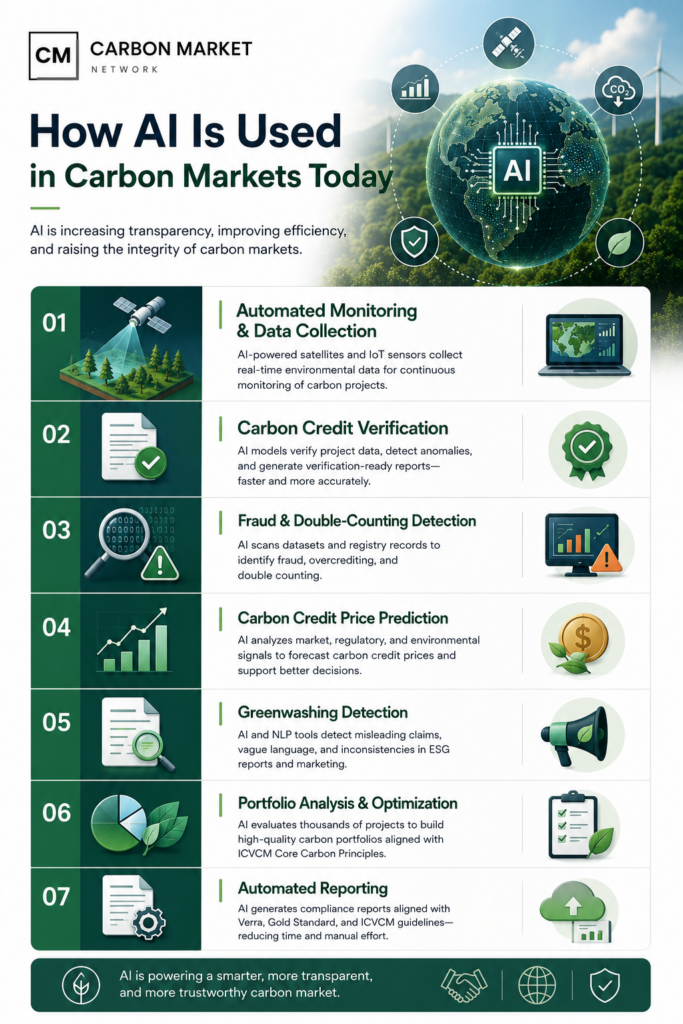
1. Automated Monitoring and Data Collection
AI-powered sensors and satellite systems continuously monitor carbon projects in real time.
Instead of waiting for a field inspector to visit a forest once a year, AI systems can track tree cover, biomass, and deforestation risk every single day using satellite imagery.
IoT (Internet of Things) sensors in the field collect data on soil carbon levels, air quality, soil moisture, and other variables. This data feeds directly into AI systems that process it instantly.
2. Carbon Credit Verification
AI automates large parts of the verification process. Machine learning models check project data against established baselines, flag anomalies, and generate verification-ready reports.
What used to take months of manual work can now be done in days or even hours with AI-assisted verification tools.
3. Fraud and Double-Counting Detection
AI algorithms scan transaction records, project data, and registry entries to detect patterns that indicate fraud, overcrediting, or double counting.
A 2025 research study found that machine learning models achieved 78% fraud detection correlation in carbon credit datasets, with price prediction accuracy reaching an R-squared of 0.89.
4. Carbon Credit Price Prediction
AI models analyze supply and demand signals, regulatory changes, weather patterns, and market sentiment to forecast carbon credit prices. This helps buyers and sellers make better decisions.
5. Greenwashing Detection
Large language models and NLP tools scan corporate sustainability reports, ESG disclosures, and marketing claims to detect vague language, inconsistencies, and outright false claims.
6. Portfolio Analysis and Optimization
AI tools help corporate buyers build high-quality carbon credit portfolios by analyzing thousands of projects simultaneously and screening them against quality standards like the ICVCM Core Carbon Principles.
CarbonAI is an AI-powered platform designed for the carbon market ecosystem. It helps businesses and sustainability professionals analyze carbon projects, market trends, and climate data with faster, data-driven insights, making carbon markets more transparent and efficient.
7. Automated Reporting
AI systems generate compliance reports in formats aligned with Verra’s Verified Carbon Standard, Gold Standard, and ICVCM guidelines, removing one of the most labor-intensive parts of the MRV process.
AI-Powered MRV: The Game Changer for Carbon Credits
MRV stands for Monitoring, Reporting, and Verification. It is the backbone of any credible carbon market.
Without strong MRV, there is no way to know if a carbon credit represents real, additional, and permanent emissions reductions. Bad MRV is what allowed 84% of issued credits to lack genuine environmental value.
Traditional MRV was built on:
- Annual field visits by human inspectors
- Manual data entry into spreadsheets
- PDF reports submitted to standards bodies
- Long verification cycles (often 12 to 24 months)
Digital MRV (dMRV) replaces much of this with technology. And AI is the engine that makes dMRV work at scale.
How Digital MRV Works
Step 1: Continuous Monitoring
Satellites, drones, and IoT sensors collect real-time data on project activities. For a reforestation project, this means tracking tree growth, forest cover, and land use every few days. For an industrial project, sensors measure emissions at the source.
Step 2: AI-Powered Data Processing
AI algorithms process the raw data, compare it to baselines, detect anomalies, and estimate carbon sequestration or emission reductions. Machine learning models trained on thousands of similar projects can identify whether numbers look realistic or suspicious.
Step 3: Automated Reporting
AI systems compile the processed data into structured reports aligned with the relevant standard’s methodology. These reports can be automatically formatted for Verra, Gold Standard, or ICVCM submission.
Step 4: Third-Party Verification (Assisted by AI)
Human verifiers review AI-generated reports rather than starting from scratch. This dramatically reduces verification time. AI tools like anomaly detectors flag any data points that need closer human examination, so verifiers can focus their attention on what matters most.
Why dMRV Is a Game Changer in 2025 and 2026
According to South Pole, a leading climate solutions firm, 2025 was a breakthrough year for dMRV as key standards bodies including Gold Standard and Verra officially approved dMRV technologies in their methodology workflows.
Verra has invested in registry digitalization that uses built-in algorithms to automate calculations, establishing itself as a leader in digital carbon crediting infrastructure.
The cost reduction from AI-assisted MRV versus traditional manual measurement is typically 40 to 60% per project site over a five-year monitoring horizon, according to analysis from the carbon credit platform development sector.
This cost drop is especially significant for small project developers in developing countries. AI-powered dMRV is opening the carbon market to participants who were previously priced out.
AI and Carbon Credit Fraud Detection
Carbon credit fraud is a serious problem. It takes many forms:
- Overcrediting: Issuing more credits than a project actually deserves by inflating baselines or exaggerating results.
- Double counting: Selling the same credit to two different buyers, or a project developer and a host government both counting the same reduction.
- Phantom projects: Projects that exist only on paper, with no real climate activity.
- Leakage: When emissions are not reduced but simply relocated to another site outside the project boundary.
AI tackles all of these issues.
How AI Detects Fraud in Carbon Markets
Anomaly Detection with Machine Learning
Generative AI models trained on historical project data can detect overcrediting risks, baseline drift, and methodology deviations before they become audit failures.
For platform operators, catching a compromised credit before it is listed and sold is the difference between a routine correction and a significant regulatory penalty. In the EU and California markets, the documented average penalty for double-counting failures is around $40 million.
Cross-Registry Scanning
AI systems can scan multiple carbon registries simultaneously to detect the same credit appearing in more than one registry or being retired in two different systems.
Satellite-Based Verification
For nature-based projects, AI-powered satellite analysis can verify whether claimed reforestation is actually happening, whether forest cover is increasing or decreasing, and whether land use matches project documentation.
NLP-Based Document Review
Natural language processing tools can read thousands of project documents and flag inconsistencies between reported numbers and the language used to describe project activities.
Research published in 2025 consistently shows that firms with higher levels of AI adoption exhibit significantly lower rates of misleading environmental reporting, regardless of how AI is measured or implemented.
AI for Carbon Credit Price Prediction and Trading
Carbon credit prices are notoriously difficult to predict.
In the voluntary market, prices vary enormously based on project type, vintage year, location, and quality certification. In 2026, voluntary carbon credit prices range from around $5 to $10 per tonne for legacy avoidance credits all the way to over $400 per tonne for high-quality removal credits like biochar, and even higher for premium projects like enhanced rock weathering.
AI is helping buyers and traders navigate this complexity.
How AI Improves Carbon Market Trading
Price Forecasting Models
Machine learning models analyze regulatory signals, corporate net-zero commitments, credit supply pipelines, climate policy announcements, and macroeconomic conditions to forecast price movements.
Research has demonstrated price prediction accuracy with an R-squared value of 0.89 using ML models on carbon credit datasets. This means the model can explain 89% of the variance in price movements, which is a strong result for a volatile commodity market.
Automated Credit Screening
When a corporate buyer wants to purchase 500,000 carbon credits, they used to have to manually review dozens of project documents. AI can now screen thousands of projects in seconds, ranking them by quality, price, and fit with the buyer’s portfolio strategy.
Real-Time Market Intelligence
AI-powered platforms track real-time trading data from carbon exchanges, voluntary registries, and over-the-counter deals. They generate instant market intelligence that helps buyers identify price trends and procurement opportunities.
Algorithmic Trading
In compliance markets like the EU ETS, algorithmic trading systems powered by AI already execute transactions automatically based on preset rules. Similar approaches are emerging in voluntary markets as the infrastructure matures.
The Voluntary Carbon Market in 2026
The voluntary carbon market is on a strong growth trajectory. Estimates for the 2026 market size range from $1.7 billion to over $23 billion, depending on the methodology used. High-integrity removal credits are commanding price premiums of more than 300% compared to avoidance credits, as corporate buyers prioritize quality over volume.
AI-driven credit screening tools are central to this quality shift. Platforms that use AI to rate credit quality are helping buyers identify credits aligned with ICVCM Core Carbon Principles and avoid the low-quality credits that still flood parts of the market.
AI and Greenwashing Detection
Greenwashing is when a company makes environmental claims that are misleading, exaggerated, or outright false.
In carbon markets, greenwashing often looks like this:
- A company claims to be carbon neutral based on low-quality credits
- A project developer claims large emission reductions with inflated baselines
- A corporation publishes a sustainability report full of vague language with no verifiable backing
AI is becoming one of the most powerful tools to detect and deter greenwashing.
How AI Detects Greenwashing
Semantic Analysis with LLMs
Large language models can detect semantic vagueness, emotional tone inflation, and inconsistencies between textual and numerical ESG disclosures. This exposes subtle forms of greenwashing that human reviewers might miss.
Cross-Referencing Claims with Data
AI systems can cross-reference corporate sustainability claims with satellite data, energy consumption records, and supply chain emissions. If a company claims its emissions dropped by 40% but its energy consumption stayed the same, AI flags the inconsistency.
Automated ESG Disclosure Auditing
Under Europe’s Corporate Sustainability Reporting Directive (CSRD) and the EU Carbon Border Adjustment Mechanism (CBAM, which entered its definitive period in January 2026), companies must now provide much more granular emissions data. AI tools are helping both companies report accurately and regulators verify those reports.
Research published in 2025 and 2026 shows that AI assistance, by enabling automated analysis of disclosures and real-time monitoring of environmental data, can objectively improve the accuracy and credibility of ESG reporting. This narrows the space for misleading claims.
The same research shows that firms with higher AI adoption exhibit significantly lower greenwashing behavior.
How Big Tech’s AI Boom Is Driving Carbon Market Demand
One of the most important carbon market trends of 2025 and 2026 is the role of AI data centers in driving demand for carbon credits.
Amazon, Google (Alphabet), Microsoft, and Meta are together expected to invest nearly $700 billion in AI technology in 2026. All of this infrastructure requires enormous amounts of electricity and generates significant carbon emissions.
According to the International Energy Agency, electricity use from AI data centers increased by 50% in 2025. The IEA projects that energy use linked to AI will double by 2030. By 2030, global data center energy capacity is expected to grow from 25 gigawatts to 120 gigawatts.
These companies have aggressive net-zero commitments. As their emissions rise with AI expansion, they are buying more carbon credits to offset the gap.
The Numbers Tell the Story
Purchases of permanent carbon removal credits by Big Tech companies rose from just 14,200 in 2022 (before the ChatGPT launch sparked the modern AI race) to 11.92 million in 2023. They rose another 104% to 24.4 million in 2024 and then jumped a further 181% to 68.4 million in 2025.
Microsoft is the largest single buyer. The company’s growing carbon credit purchases are largely attributed to its AI data center buildout. Microsoft has also invested in companies developing low-carbon materials, including Sublime Systems and Stegra, to reduce emissions as its infrastructure scales.
This surge in demand from tech giants is one of the biggest structural forces reshaping carbon markets today. It is driving up prices for high-quality, durable removal credits and accelerating innovation in carbon removal technologies.
Real-World Examples of AI in Carbon Markets
Here are some concrete examples of how AI is being applied in the real world.
South Pole and Digital MRV
South Pole, one of the world’s largest carbon project developers and consultants, has deployed digital MRV systems across its project portfolio. The company uses satellite imagery and AI-powered analysis to continuously monitor forest cover, emissions reductions, and project integrity across thousands of projects.
Verra’s Registry Digitalization
Verra, operator of the Verified Carbon Standard (the world’s largest voluntary carbon standard), is investing in registry digitalization that uses built-in algorithms to automate calculations. This reduces manual processing time, improves accuracy, and makes the registry more transparent for buyers and sellers.
Sylvera and AI-Powered Credit Ratings
Sylvera is a carbon credit ratings firm that uses AI to analyze satellite imagery, project documentation, and market data. It generates independent ratings for carbon projects that help corporate buyers identify high-quality credits and avoid poor-performing ones. In 2026, Sylvera is scaling its AI capabilities to cover thousands of projects with greater speed and consistency.
Anaxee’s Digital MRV in India
In India, Anaxee Digital Runners has built a large-scale dMRV platform that combines IoT sensors, satellite imagery, AI pattern recognition, and mobile data collection to monitor carbon projects across rural India. The platform supports nature-based solution projects and connects small farmers and communities to carbon markets.
GreenIQ: AI for Integrated Carbon Market Data
GreenIQ, described in a March 2025 research paper, is an AI-driven platform that integrates structured and unstructured data from multiple sources in carbon markets. The platform uses machine learning to cross-reference project claims with satellite and registry data, creating a more complete and reliable picture of credit quality.
AI-MRV Platforms for Compliance Reporting
Multiple carbon credit platform developers have deployed AI-MRV systems that generate verification-ready reports in formats aligned with ICVCM Core Carbon Principles, with automated report generation removing the most labor-intensive element of traditional MRV.
Key AI Tools and Platforms in the Carbon Market Space
Here is an overview of the key categories of AI-powered tools operating in carbon markets as of 2026.
Satellite and Remote Sensing Platforms
- ESA Sentinel Satellites: Provide free, high-resolution satellite data used by dozens of carbon market AI tools.
- NASA Earth Science Division tools: Used for land-use change detection and biomass estimation.
Carbon Intelligence and Analytics Platforms
- Sylvera: AI-powered carbon credit ratings and portfolio analytics.
- Allied Offsets: Carbon market data and analytics with AI-assisted price discovery.
- Ceezer: Carbon credit management platform with AI-assisted portfolio optimization.
- BeZero Carbon: Science-based ratings for carbon projects using AI analytics.
Digital MRV Tools
- Pachama: Uses satellite imagery and machine learning to monitor forest carbon projects.
- Terrasos: Biodiversity and carbon credit monitoring with digital systems.
- Verra’s Digital Registry: Automated calculation and verification workflows.
- GCC Digital MRV Hub (Global Carbon Council): Uses satellite imagery, drones, IoT devices, and AI-powered analytics for continuous project monitoring.
Carbon Accounting and Reporting
- Watershed: AI-powered corporate carbon accounting and supply chain emissions tracking.
- Persefoni: AI carbon accounting platform used by large enterprises for CSRD-compliant reporting.
- Salesforce Net Zero Cloud: Integrated carbon accounting with AI-assisted reporting.
Trading and Price Discovery
- Xpansiv CBL: The world’s largest spot exchange for environmental commodities, now integrating AI pricing tools.
- AirCarbon Exchange (ACX): Digital carbon credit exchange with data-driven pricing.
Benefits of AI in Carbon Markets
The advantages of AI in carbon markets are substantial and growing. Here is a summary of the most important ones.
Faster and Cheaper Verification
AI-assisted MRV can reduce verification time from months to days and cut per-project monitoring costs by 40 to 60% over five years. This makes carbon markets accessible to smaller projects and reduces the overhead for larger ones.
Higher Market Integrity
Better data, better anomaly detection, and better cross-registry scanning all reduce fraud and overcrediting. This makes carbon credits more trustworthy and more valuable to buyers with serious climate commitments.
Real-Time Monitoring
Instead of annual snapshots, AI-powered systems provide near-continuous monitoring of project performance. This means problems can be caught and corrected early, before they undermine the integrity of issued credits.
Greater Market Access for Small Projects
Digital MRV tools lower the entry barrier for small project developers in developing countries who previously could not afford the cost of traditional verification. This brings more supply into the market and supports climate action in regions that need it most.
Better Buying Decisions
AI-powered credit ratings, screening tools, and portfolio analytics help corporate buyers select higher-quality credits. This improves the environmental credibility of corporate net-zero strategies.
Reduced Greenwashing Risk
AI-powered ESG disclosure auditing and greenwashing detection tools help regulators, investors, and the public hold companies accountable for the claims they make.
Price Transparency
AI-driven price discovery tools make carbon markets more transparent. Buyers and sellers have access to better pricing data, which reduces information asymmetry and makes markets more efficient.
Challenges and Limitations of AI in Carbon Markets
AI is not a perfect solution. It comes with its own set of challenges.
Data Quality Problems
AI models are only as good as the data they are trained on. In carbon markets, especially in developing regions, data quality can be poor. Missing data, inconsistent records, and gaps in satellite coverage can undermine AI models.
High Initial Costs
While AI reduces long-term MRV costs, the initial investment in building or deploying AI-powered systems is significant. Smaller project developers and registries in low-income countries may struggle to afford these tools.
Model Bias and Errors
AI models can make systematic errors if they are trained on biased datasets. For example, a model trained mostly on temperate forest projects may perform poorly when applied to tropical mangrove or dryland projects.
Regulatory Acceptance
Standards bodies and regulators have been slow to formally accept AI-generated data as the primary basis for credit issuance. While 2025 was a breakthrough year with Gold Standard and Verra approving dMRV technologies, full regulatory integration is still evolving.
Explainability Issues
Some AI models, especially deep learning systems, are difficult to explain. When a model says a project deserves fewer credits, it needs to be able to show why in terms that human verifiers, project developers, and regulators can understand.
Cybersecurity Risks
AI-powered carbon trading platforms handle large volumes of financial transactions and sensitive project data. They are potential targets for hacking and manipulation. Security must be built into AI systems from the start.
Risk of Overconfidence
There is a danger that buyers and regulators will trust AI outputs too much without sufficient human oversight. AI tools should be seen as decision-support systems, not as fully autonomous arbiters of credit quality.
The Future of AI in Carbon Markets
The role of AI in carbon markets will only grow. Here are the most important trends to watch.
Generative AI for Carbon Project Management
Generative AI tools will help project developers draft methodology documents, generate compliance reports, communicate with buyers, and manage project operations. This will dramatically reduce the administrative burden on project teams.
Decentralized Autonomous Organizations (DAOs) for Carbon Credits
Market research from firms like Verified Market Reports suggests that generative AI will facilitate the emergence of decentralized autonomous organizations where AI algorithms govern project validation, credit issuance, and trading operations with minimal human intervention. This would democratize access to carbon markets and lower barriers for small-scale project developers.
AI-Driven Policy Development
AI systems that analyze global climate data, project performance trends, and market dynamics will increasingly inform carbon market policy development. Regulators will be able to use AI to stress-test proposed rules and anticipate market responses.
Integration of AI with Blockchain
Blockchain provides an immutable, transparent ledger for recording carbon credit transactions. Combined with AI-powered verification, blockchain-based carbon credit systems could offer a level of transparency and fraud-resistance that neither technology could achieve alone.
Smart contracts on blockchain networks can automatically trigger credit issuance when AI-verified project milestones are met. This reduces processing time and eliminates many manual steps.
Satellite Constellation Expansion
Private satellite operators like Planet Labs and Maxar are continuously expanding their satellite constellations. As resolution improves and revisit times decrease (some satellites now revisit any point on Earth every few hours), the quality of AI-powered remote sensing for carbon monitoring will keep improving.
AI and Article 6 of the Paris Agreement
Article 6 of the Paris Agreement created a framework for international carbon markets. As this framework is implemented through Corresponding Adjustments (which prevent double counting between countries), AI systems will play a critical role in tracking credit flows across borders and ensuring that national accounting and voluntary market transactions do not conflict.
Responsible Scale in 2026 and Beyond
As Carbon Direct noted in a January 2026 analysis, the new mandate for AI-era companies is responsible scale: reconciling the voracious power demands of AI with aggressive net-zero commitments. Companies that integrate power procurement, hardware choices, and carbon strategy into a unified system from the start will have a competitive advantage. AI itself will be central to managing this complexity.
What This Means for Developers, Buyers, and Investors
For Carbon Project Developers
If you are developing a carbon project, AI changes the economics significantly.
- Lower MRV costs: Deploying digital MRV tools can cut your monitoring costs by up to 60% over a project’s lifetime.
- Faster credit issuance: AI-assisted verification can speed up the time from project registration to credit issuance.
- Better access to buyers: AI-powered platforms connect small projects with corporate buyers more efficiently than traditional broker networks.
- Higher credit integrity: Projects with AI-verified data attract more credible buyers and can command higher prices.
The key action item is to build data infrastructure from day one. Projects that capture high-quality, AI-processable data from the start will be better positioned in a market where data quality increasingly determines credit value.
For Corporate Carbon Credit Buyers
If you are buying carbon credits to meet net-zero commitments, AI tools give you more power to make informed decisions.
- Use AI-powered rating platforms like Sylvera or BeZero Carbon to independently assess credit quality before buying.
- Demand dMRV-backed credits where monitoring is continuous and AI-verified, not just periodically spot-checked.
- Screen for ICVCM Core Carbon Principles compliance using automated tools.
- Monitor your portfolio in real time using carbon accounting platforms with AI-powered dashboards.
In 2026, buying the cheapest credits available without quality screening is a reputational risk. AI tools that help you identify high-integrity credits are worth investing in.
For Investors and Market Participants
The AI-driven transformation of carbon markets creates real investment opportunities.
- Carbon market tech companies building AI MRV platforms, rating tools, and trading infrastructure are early-stage but rapidly growing.
- High-quality carbon removal projects that use digital MRV will attract premium buyers and hold value as market integrity standards rise.
- Carbon credit indices and funds that use AI-powered screening methodologies offer more defensible investment strategies than unscreened credit pools.
The voluntary carbon credit trading platform market was valued at $0.92 billion in 2025 and is projected to grow to $5.26 billion by 2034 at a compound annual growth rate of 20.8%. AI capabilities are a central driver of this growth.
Key Takeaways
Here is a quick summary of the most important points:
- AI in carbon markets is transforming verification, fraud detection, price prediction, and greenwashing detection.
- Digital MRV powered by AI reduces monitoring costs by 40 to 60% and speeds up credit issuance dramatically.
- Fewer than 16% of older carbon credits represented genuine emissions reductions. AI-powered tools are fixing this integrity problem.
- Big Tech’s AI infrastructure buildout is driving explosive growth in carbon credit demand. Permanent removal credit purchases jumped 181% in 2025.
- 2025 was a breakthrough year for dMRV as Gold Standard and Verra officially approved digital technologies in their methodology workflows.
- AI tools like Sylvera, Pachama, and AI-powered MRV platforms are already operational and commercially deployed.
- Challenges remain around data quality, regulatory acceptance, and AI explainability.
- The future will see AI integrated with blockchain, satellite networks, and possibly autonomous DAOs to manage carbon projects.
FAQ
What is AI in carbon markets?
AI in carbon markets refers to the use of artificial intelligence technologies, including machine learning, natural language processing, computer vision, and generative AI, to improve how carbon credits are monitored, verified, traded, and priced. AI helps carbon markets become more accurate, transparent, and accessible.
How does AI help with carbon credit verification?
AI automates the MRV (Monitoring, Reporting, and Verification) process using satellite imagery, IoT sensors, machine learning, and automated report generation. This replaces slow manual field inspections with continuous, real-time monitoring that is faster and up to 60% cheaper.
Can AI detect carbon credit fraud?
Yes. Machine learning models can detect anomalies in project data, flag overcrediting risks, scan for double counting across registries, and verify satellite imagery against project claims. Research has shown ML models achieving 78% fraud detection correlation in carbon credit datasets.
What is digital MRV (dMRV)?
Digital MRV uses technology like satellites, drones, IoT sensors, and AI to monitor, report, and verify carbon project performance. It replaces periodic manual inspections with near-continuous automated monitoring. In 2025, both Gold Standard and Verra officially approved dMRV technologies in their methodology workflows.
How is AI used to detect greenwashing?
AI tools use natural language processing to analyze corporate ESG disclosures for vague language, inconsistencies between text and data, and exaggerated claims. Large language models can detect subtle semantic patterns that indicate greenwashing. Cross-referencing corporate claims with satellite and emissions data is another powerful AI-driven approach.
Why is AI adoption in carbon markets accelerating in 2025 and 2026?
Several factors are driving acceleration: Big Tech’s AI-driven energy consumption has sharply increased demand for high-quality carbon credits, regulatory requirements like CSRD and CBAM have raised the bar for emissions data accuracy, and key standards bodies have formally approved dMRV technologies. Combined, these forces are making AI tools essential rather than optional.
What are the challenges of using AI in carbon markets?
Key challenges include data quality in developing regions, high initial deployment costs, AI model bias, regulatory acceptance barriers, explainability issues with complex models, and cybersecurity risks. AI is best seen as a powerful decision-support tool that still requires human oversight, not a fully autonomous system.
How does the Big Tech AI boom affect carbon markets?
Big Tech companies (Microsoft, Google, Amazon, Meta) are together expected to invest nearly $700 billion in AI in 2026. This requires massive amounts of energy and generates significant carbon emissions. As these companies pursue net-zero commitments, they are buying far more carbon credits. Permanent carbon removal credit purchases by these companies jumped 181% in 2025 alone, dramatically increasing demand and prices for high-quality credits.
What is the future of AI in carbon markets?
The future includes generative AI for automated project management and reporting, AI-governed decentralized carbon credit systems, deeper integration with blockchain for fraud-proof transactions, and AI-assisted carbon market policy development. AI will also play a critical role in implementing Article 6 of the Paris Agreement, ensuring accurate cross-border carbon accounting.
What carbon market AI tools should I know about?
Key platforms include Sylvera (AI credit ratings), Pachama (forest carbon monitoring), BeZero Carbon (science-based project ratings), Verra’s digital registry, Ceezer (portfolio management), Watershed and Persefoni (corporate carbon accounting), and Xpansiv CBL (digital carbon trading). The Global Carbon Council’s Digital MRV Hub is also an important emerging platform for project-level monitoring.
This article was last updated in May 2026. Carbon market regulations, standards, and technology platforms evolve rapidly. Always verify current details with official sources like Verra, Gold Standard, ICVCM, and your national carbon market regulator.