Carbon Market Network


The carbon credit market is going through one of the biggest technological transformations in its history.
Just a few years ago, carbon credits were verified through slow, manual processes. Auditors traveled to project sites. Data was recorded on paper. Verification took months, sometimes years.
Today, satellites scan forests in real time. AI detects emission anomalies within hours. Blockchain creates tamper-proof records of every credit issued, traded, and retired. And entirely new ways to remove carbon from the atmosphere are earning credits that did not even exist five years ago.
If you want to understand where the carbon market is heading, you need to understand these technologies. This guide covers every major emerging carbon credit technology shaping the market in 2026, why each one matters, and how they work together to build a more credible, scalable, and high-integrity carbon market.
Why Technology Is Reshaping the Carbon Credit Market
The carbon credit market has a credibility problem. Or rather, it had one.
Between 2021 and 2023, a wave of reports questioned whether forest carbon projects were actually delivering the reductions they claimed. Some projects overstated their impact. Others saw reversals, where forests burned or were logged after credits had already been sold.
The market needed better tools.
That need sparked a wave of investment in technology. Today, the carbon market sits at roughly $1 billion in actual annual retirements, with the broader market valued at $838 billion in 2025 and projected to grow at a compound annual growth rate of 32.5% through 2034.
What is driving that growth? Three things: regulatory pressure, corporate net-zero commitments, and technology that makes high-integrity credits cheaper and faster to produce.
Technology is not just improving existing carbon credit systems. It is creating entirely new categories of credits based on engineered carbon removal methods that permanently lock CO2 away for centuries or longer.
Understanding these technologies is no longer optional for anyone working in sustainability, climate finance, or carbon markets.
Learn more about carbon markets: https://carboncreditcourse.com/
Carbon Market Insider Newsletter
Weekly insights on carbon markets, climate policy, carbon credits, and sustainability.
Digital MRV: The Backbone of Modern Carbon Verification
What Is MRV?
MRV stands for Monitoring, Reporting, and Verification. It is the process of measuring how much carbon a project actually reduces or removes, reporting that data, and having an independent party verify it.
Traditional MRV was slow and expensive. Auditors visited sites once or twice a year. Data collection was manual. The verification process could take 12 to 24 months. And roughly one-third of credits had quality issues related to inaccurate measurement.
What Is Digital MRV (dMRV)?
Digital MRV, or dMRV, replaces manual processes with technology. It combines satellite imagery, AI, IoT sensors, and blockchain to collect, process, and verify carbon data in real time.
The results are significant. According to research from TracexTech, dMRV systems:
- Boost accuracy by up to 79% compared to traditional manual methods
- Cut verification costs by 50 to 70%
- Reduce verification timelines from years to days, as noted by the World Bank
- Enable much more frequent credit issuance, improving cash flow for project developers
How dMRV Works Step by Step
- Data collection: Satellites capture imagery of forests, croplands, or industrial sites. IoT sensors record real-time emissions data. Drones equipped with LiDAR map biomass in reforestation projects.
- Data processing: AI algorithms analyze the collected data, identify changes, flag anomalies, and estimate carbon stocks or emissions reductions.
- Reporting: The processed data is formatted into reports that meet the requirements of carbon standards like Verra’s Verified Carbon Standard (VCS) or the Gold Standard.
- Verification: Instead of an auditor flying to the site, a remote reviewer checks the digital data trail. Blockchain anchors the data to an immutable record.
- Credit issuance: Once verified, credits are issued and recorded on a registry.
Real-World Impact
The World Bank notes that dMRV creates standardized data flows that cut verification timelines from years to days. For project developers in developing countries, this is transformative. It means faster access to carbon finance and lower costs to participate in global markets.
For buyers, dMRV means credits backed by continuous, real-time data rather than an annual site visit snapshot.
Blockchain and Tokenized Carbon Credits
Why the Carbon Market Needs Blockchain
The traditional carbon credit system has a transparency problem. Credits can be double-counted. Retired credits can sometimes be re-listed. Ownership chains are opaque.
Blockchain solves these problems by creating an immutable, decentralized ledger where every credit issuance, transfer, and retirement is permanently recorded.
By early 2026, on-chain carbon credit retirements surpassed 45 million tonnes of CO2 equivalent for the first time. That figure still represents less than 8% of total voluntary carbon market volume, but it signals the direction of travel.
How Blockchain Works in Carbon Markets
A blockchain is a distributed database where records are stored in linked blocks. Once data is written to a block and the block is added to the chain, it cannot be altered.
In carbon markets, this creates:
- Transparent credit lifecycles: Every step from issuance to retirement is publicly visible
- Prevention of double-counting: A credit retired on-chain cannot be used again
- Smart contracts: Automated agreements that execute when pre-set conditions are met, for example, automatically purchasing and retiring a carbon credit when a shipping container’s IoT sensor confirms a completed delivery
Tokenized Carbon Credits
Tokenization takes a real-world carbon credit and represents it as a digital token on a blockchain.
Each token corresponds to one tonne of CO2 reduced or removed. Tokens can be traded on digital platforms, fractionalized (allowing partial credit purchases), and used as financial collateral.
By 2026, major companies like Maersk and Amazon have begun integrating tokenized fuel-offsetting credits into their logistics APIs, automating carbon neutrality for shipping operations.
Analysts estimate the tokenized carbon market will grow from $5.3 billion in 2025 to $13.4 billion by 2033.
Article 6.4 and Blockchain Infrastructure
One of the most significant near-term developments is the operationalization of Article 6.4 under the Paris Agreement. The Article 6.4 Supervisory Body approved initial methodologies in late 2025, and the first credits under this mechanism are expected in 2026.
Countries including Singapore, Switzerland, and Japan have explicitly signaled interest in blockchain-based corresponding adjustment mechanisms to support Article 6.4 trading. The digital infrastructure built for Article 6.4 is likely to set the template for global carbon market architecture for decades to come.
Challenges with Blockchain in Carbon Markets
Blockchain adoption still faces real challenges:
- Fragmentation: Multiple competing blockchain platforms and tokenization standards reduce liquidity
- Regulatory uncertainty: Governments are still developing frameworks for tokenized assets
- “Garbage in, garbage out” risk: A blockchain record is only as credible as the real-world data behind it. If the underlying MRV is flawed, tokenizing the credit does not fix that
The convergence of blockchain with AI-powered MRV and satellite data is the most promising path to addressing the data credibility challenge.
Artificial Intelligence in Carbon Markets
How AI Is Transforming Carbon Credit Verification
Artificial intelligence is becoming a central tool in the carbon credit ecosystem. It processes data at a scale no human auditor can match and identifies patterns that manual inspection would miss.
Key applications of AI in carbon markets include:
- Anomaly detection: AI systems flag unexpected changes in forest cover, methane readings, or emissions patterns that might indicate data manipulation or project reversals
- Biomass estimation: Machine learning models analyze satellite images to estimate tree density, height, and carbon stock with a high degree of accuracy
- Price forecasting: AI tools model carbon credit price trends based on policy changes, supply and demand data, and climate news
- Automated reporting: AI generates MRV reports from raw sensor and satellite data, reducing the time and cost of compliance
AI and Satellite Data Combined
When AI and satellite data work together, the results are powerful. A system can scan millions of hectares of forestland every week, flag areas of concern, and update carbon stock estimates continuously.
This kind of continuous monitoring was impossible with manual systems. It is now becoming standard practice for high-integrity forest carbon projects.
AI-driven analytics can improve carbon credit traceability by up to 50%, significantly boosting investor confidence in the credits they purchase.
AI in Trading Platforms
Carbon trading platforms are integrating AI to provide buyers with better credit selection tools. These tools screen credits against quality criteria, score projects based on integrity indicators, and flag low-quality credits before a purchase is made.
Satellite and Remote Sensing Technology
The Satellite Revolution in Carbon Markets
Satellites have become one of the most important tools in the carbon credit verification toolkit.
Satellites equipped with advanced sensors can monitor greenhouse gas emissions from virtually anywhere on the planet. This global coverage is especially important for large-scale projects like reforestation, blue carbon, and methane capture that are often located in remote areas.
Modern satellite systems can:
- Map forest biomass and detect deforestation in near real time
- Track methane plumes from oil and gas operations
- Monitor soil carbon changes in agricultural projects
- Verify the health and extent of blue carbon ecosystems like mangroves and seagrasses
Specific Satellite Technologies in Use
Several remote sensing tools are now widely used in carbon credit projects:
- Synthetic Aperture Radar (SAR): Penetrates cloud cover to map forests in all weather conditions. Critical for tropical reforestation projects where cloud cover is persistent.
- LiDAR (Light Detection and Ranging): Measures tree height and canopy structure with extreme precision. Often used from drones for high-resolution biomass mapping.
- Hyperspectral imaging: Identifies vegetation health, species composition, and soil properties at a level of detail beyond standard optical cameras.
- Greenhouse Gas satellites: Dedicated satellites like the European Space Agency’s Sentinel-5P track atmospheric CO2 and methane concentrations at a global scale.
Satellite Data and Greenwashing Prevention
One of the biggest benefits of satellite monitoring is its role in preventing greenwashing.
When a project claims to have preserved a forest that was never actually under threat of deforestation, satellite data can reveal that. Historical imagery going back decades allows analysts to compare what a project claims against what the satellite record shows.
This “permanence monitoring” capability is transforming accountability in nature-based carbon credit projects.
IoT Sensors for Real-Time Emissions Monitoring
What Are IoT Sensors in Carbon Markets?
The Internet of Things (IoT) refers to networks of physical devices that collect and transmit data wirelessly. In carbon markets, IoT sensors monitor environmental variables in real time and feed that data directly into MRV systems.
IoT devices used in carbon projects include:
- Eddy covariance towers: Measure the net exchange of CO2 between an ecosystem and the atmosphere
- Soil carbon sensors: Track carbon content in agricultural soils over time
- Industrial emissions monitors: Attached to factory smokestacks or industrial equipment to measure CO2, methane, or nitrous oxide output
- Water quality sensors: Used in blue carbon projects to monitor ecosystem health
IoT and Direct Air Capture
IoT sensors play a particularly important role in engineered carbon removal projects like Direct Air Capture (DAC). At a DAC facility, every machine has sensors tracking how much CO2 it is capturing, at what rate, and under what conditions.
This level of operational data makes DAC credits among the most verifiable in the market. Every tonne captured is logged automatically, with no reliance on modeling or projections.
The IoT-Blockchain Connection
IoT data can be fed directly into blockchain systems through what are called “oracle” networks. These oracle networks take real-world data from IoT sensors and translate it into inputs for smart contracts on blockchain platforms.
The result is a seamless pipeline from physical carbon capture to digital credit issuance, with minimal human intervention and a complete, tamper-proof audit trail.
Direct Air Capture (DAC): Engineering Carbon Removal
What Is Direct Air Capture?
Direct Air Capture is a technology that pulls CO2 directly from the atmosphere using chemical processes. It is one of the most important emerging carbon credit technologies because it offers permanent, verifiable, and highly durable carbon removal.
Unlike nature-based solutions, which can reverse if a forest burns or a wetland degrades, DAC captures carbon and stores it permanently underground in geological formations. Climeworks, the leading DAC company, operates a facility in Iceland where CO2 is mixed with water and pumped underground, where it is expected to turn to stone within two years.
How DAC Works
- Air intake: Large fans draw ambient air into the capture system
- Chemical binding: CO2 binds to a sorbent material, either liquid solvent (in liquid DAC systems) or solid adsorbent (in solid DAC systems)
- CO2 release: Heat regenerates the sorbent and releases a concentrated stream of CO2
- Storage or use: The CO2 is either injected underground for permanent geological storage, or used in industrial applications like concrete or synthetic fuels
DAC and Carbon Credits
DAC projects generate high-durability carbon removal credits. These are increasingly valued by corporate buyers pursuing science-based net-zero targets, because they offer permanence that many nature-based solutions cannot guarantee.
Microsoft is the clear market leader in forward offtake agreements for high-durability CDR credits, accounting for more than 80% of high-durability offtakes with a named buyer as of 2025.
The Cost Challenge
The main barrier to DAC at scale is cost. Current DAC costs range from $300 to $1,000+ per tonne of CO2, far above the price of nature-based offsets.
However, costs are falling as the technology matures. Multiple governments, including the United States and the European Union, have provided substantial subsidies to accelerate DAC deployment. The US Inflation Reduction Act includes a 45Q tax credit providing up to $180 per tonne for captured and stored CO2.
New electrochemical approaches to DAC are also emerging as potentially lower-cost alternatives to thermal regeneration systems, and are gaining investment attention in 2025 and 2026.
DAC in the Voluntary Carbon Market
In the voluntary carbon market (VCM), CDR credits (including DAC) accounted for only 5% of 2025 retirements, but the forward purchase pipeline is growing rapidly. The VCM’s spot market for high-durability CDR credits grew significantly, with large-scale geological CDR projects capable of delivering hundreds of thousands of tonnes annually beginning to shift the supply balance.
Biochar Carbon Credits: Turning Waste into Climate Action
What Is Biochar?
Biochar is a stable, carbon-rich material produced by heating organic waste (biomass like wood chips, rice husks, coffee shells, or crop residues) in a low-oxygen environment through a process called pyrolysis.
During pyrolysis, the carbon that plants absorbed from the atmosphere during their growth becomes locked in a highly stable form. When biochar is added to soil, that carbon stays there for decades to centuries.
Why Biochar Generates Carbon Credits
When biomass decomposes naturally, it releases its carbon back into the atmosphere as CO2. Biochar prevents this release by converting that carbon into a stable solid. The net result is carbon removal.
Projects that produce biochar and apply it to agricultural land can generate carbon credits for the difference between the carbon that would have been released and the carbon now stored in biochar.
Biochar credits are currently one of the most commercially active carbon dioxide removal pathways, priced at roughly $75 to $200 per tonne of CO2 in recent markets. Demand currently exceeds supply.
A major new development: a large-scale biochar facility developed under the Puro.earth Biochar Methodology (2025, v2) commenced operations in Q1 2026 in Turkey, with first credit issuance expected in Q3 2026. The facility integrates renewable energy recovery, distributes biochar to local farmers, and operates under a comprehensive monitoring and verification framework.
Co-Benefits of Biochar
Beyond carbon storage, biochar improves:
- Soil fertility by retaining nutrients and water
- Agricultural productivity for smallholder farmers
- Reduced need for synthetic fertilizers, cutting associated emissions
- Soil biodiversity by creating habitat for beneficial microbes
Biochar and the Superpollutant Trend
Superpollutant projects (those targeting short-lived climate pollutants like methane and nitrous oxide) have grown dramatically in the VCM. In 2025, superpollutant issuances increased by roughly 180% compared to 2020, and these projects now make up approximately 20% of all credits issued in the VCM.
Biochar projects that avoid methane emissions from biomass decomposition contribute to this trend.
Enhanced Rock Weathering (ERW)
What Is Enhanced Rock Weathering?
Enhanced Rock Weathering is a carbon removal method based on accelerating a natural geological process.
In nature, when rain falls on silicate rocks like basalt, the water and CO2 slowly dissolve the rock. The resulting chemical reaction permanently binds atmospheric CO2 into stable minerals that wash into the ocean.
ERW speeds this process up by grinding silicate rocks into fine powder and spreading that powder on agricultural land. The increased surface area dramatically accelerates the weathering reaction, pulling CO2 from the atmosphere at a much faster rate than natural erosion.
How ERW Works on Farmland
- Rock crushing: Basalt or other silicate rocks are ground into fine powder
- Agricultural application: The powder is spread on cropland, often using standard farming equipment
- Chemical reaction: Rainfall dissolves the rock powder, pulling CO2 from the air and converting it into dissolved bicarbonates
- Ocean transport: Bicarbonates eventually wash into rivers and oceans, where they are stored for thousands of years
Studies have shown that applying basalt to agricultural fields can remove 4 to 10 tonnes of CO2 per hectare per year, depending on climate, soil type, and rock composition. In tropical regions with high rainfall and warm temperatures, the weathering process is significantly faster.
ERW and Carbon Credits in 2026
ERW issued its first carbon credits in 2025. The market is still small but growing fast.
UNDO, one of the leading ERW companies, won the $100 million XPRIZE Carbon Removal competition (funded by the Musk Foundation) in 2025. By early 2026, UNDO had enriched over 54,000 acres of farmland and permanently removed roughly 69,000 tonnes of CO2.
UNDO uses blockchain technology to track carbon removal and ensure transparency, making it one of the most trusted ERW providers in the voluntary carbon market.
InPlanet, a German company, operates ERW projects in Brazil with tropical farming communities, and in December 2025 signed an agreement with Microsoft to remove more than 28,500 tonnes of CO2 between 2026 and 2028 using this technology.
Co-Benefits of ERW
- Improves soil pH, reducing the need for agricultural lime
- Increases crop yields by improving soil nutrient availability
- Reduces the need for synthetic fertilizers
- Can help combat ocean acidification in coastal areas by increasing seawater alkalinity
- Carbon stored via ERW lasts over 1,000 years, placing it in the same permanence category as geological storage
Ocean-Based Carbon Removal Technologies
Blue Carbon Projects
Blue carbon refers to carbon stored in coastal and marine ecosystems: mangroves, seagrasses, and salt marshes.
These ecosystems are among the most carbon-dense on Earth. Mangrove forests store three to five times more carbon per hectare than tropical rainforests.
Blue carbon projects earn credits by protecting, restoring, or expanding these ecosystems. Technology plays a major role here. Satellite imagery tracks mangrove extent and health. IoT sensors monitor water quality and sediment carbon. And blockchain frameworks (like those proposed in the 2025 paper “Securing Blue Carbon: A Framework for Transparent MRV in Mangrove Restoration”) create transparent, auditable records.
Ocean Alkalinity Enhancement (OAE)
Ocean Alkalinity Enhancement is an emerging technology that adds alkaline minerals (or electrochemically produced alkalinity) to seawater. This increases the ocean’s capacity to absorb CO2 from the atmosphere.
OAE is closely related to ERW but applies the principle directly to the ocean.
OAE issued its first carbon credits in 2025, totaling roughly 12,000 tonnes along with Enhanced Rock Weathering, according to Carbon Direct’s 2026 VCM trends report. The technology is still largely in the research and development phase, but it is moving toward pilot-scale deployment.
Direct Ocean Capture
Direct Ocean Capture (DOC) works similarly to Direct Air Capture but draws CO2-rich seawater through a system that extracts the dissolved CO2. The ocean naturally absorbs CO2 from the atmosphere, so removing dissolved CO2 from seawater creates space for more atmospheric CO2 to be absorbed.
DOC is still at an early research stage, but it represents one of the most promising long-term scalable carbon removal pathways given the ocean’s vast surface area.
BECCS: Bioenergy with Carbon Capture and Storage
What Is BECCS?
BECCS combines two established technologies: bioenergy production and carbon capture and storage (CCS).
Here is how it works:
- Biomass (such as woody crops, agricultural residues, or purpose-grown energy crops) is burned to generate electricity or heat
- The CO2 emitted from burning is captured at the point of emission using CCS technology
- The captured CO2 is injected underground for permanent geological storage
Because the biomass absorbed atmospheric CO2 while growing, and that CO2 is then permanently stored underground, BECCS achieves net carbon removal when done correctly.
BECCS and Carbon Credits
BECCS can generate carbon credits for the net removal achieved. When biomass is sustainably sourced and storage is permanent, the process can deliver verified carbon removals.
Key considerations for BECCS projects include:
- Feedstock sustainability: Using invasive species, crop waste, or dedicated energy crops grown on degraded land avoids land-use conflicts
- Storage permanence: Geological storage in well-characterized formations is essential
- Energy efficiency: The energy used to run the capture process must be accounted for in the carbon balance
The Scale Challenge
BECCS faces significant scaling challenges related to land use, water use, and feedstock availability. It will not be a dominant carbon removal pathway in the near term. However, in specific industrial contexts, such as cement or ethanol production where biogenic CO2 is already concentrated, BECCS offers a cost-effective carbon removal route.
Article 6.4 and the Digital Infrastructure of International Carbon Markets
What Is Article 6.4?
Article 6.4 of the Paris Agreement establishes the Paris Agreement Crediting Mechanism (PACM), a UN-supervised carbon crediting system that succeeds the Kyoto Protocol’s Clean Development Mechanism (CDM).
Under PACM, countries and companies can generate internationally recognized carbon credits for verified emissions reductions and removals. Credits are called A6.4 Emission Reductions (6.4ERs).
Key 2025 to 2026 Developments
The Article 6.4 Supervisory Body approved initial methodologies in late 2025. The first credits are expected to be issued in mid-2026.
Over 60 countries now reference Article 6 mechanisms in their updated Nationally Determined Contributions (NDCs), including Japan, South Korea, Switzerland, and many nations across Africa, Asia, and Latin America.
Technology and Article 6.4
The digital infrastructure being built for PACM will likely define global carbon market architecture for decades. Key technology elements include:
- Digital registry: A centralized UN registry for 6.4ER issuance, transfer, and retirement
- Corresponding adjustment tracking: Technology to ensure credits are not counted toward both national targets and voluntary market claims
- Blockchain integration: Singapore, Switzerland, and Japan have signaled interest in blockchain-based corresponding adjustment mechanisms
The CDM to PACM Transition
CDM projects that have transitioned to PACM must adopt new PACM methodologies. Nearly 80% of transitioning CDM projects previously used grid-connected renewable energy methodologies that were rejected by the ICVCM and are no longer accepted by major registries due to additionality concerns.
This transition is raising the quality bar for international carbon credits and aligning them with the higher standards now expected by institutional buyers.
The ICVCM Core Carbon Principles and Technology Standards
What Are the Core Carbon Principles?
The Integrity Council for the Voluntary Carbon Market (ICVCM) introduced its 10 Core Carbon Principles (CCPs) to establish a global standard for high-integrity carbon credits.
Credits that meet the CCPs and receive the CCP label are considered the highest quality in the voluntary carbon market. They are often described as the “AAA rating” of carbon credits.
How Technology Supports the CCPs
Meeting CCP requirements demands robust data infrastructure. The key technology-related principles include:
- Robust quantification: Requires credits to be based on accurate, conservative measurement methods. dMRV technology is increasingly how this is achieved.
- Additionality: Credits must represent emissions reductions that would not have happened without carbon finance. Satellite historical data helps verify this.
- Permanence: Credits must represent durable storage. High-durability CDR technologies (DAC, biochar, ERW) are gaining favor over reversible nature-based solutions.
- Robust independent third-party validation and verification: Digital audit trails on blockchain systems make this faster and more reliable.
Technology as a Quality Signal
In 2026, the market is rewarding technological sophistication. Credits backed by dMRV systems, continuous satellite monitoring, and blockchain records command higher prices than credits verified only through annual site audits.
The market is professionalizing, as Sylvera noted in their 2026 carbon market trends analysis: “2026 will be the professionalization phase, more data, more regulation, and clearer segmentation between high- and low-quality assets.”
Challenges Facing Emerging Carbon Credit Technologies
Technology is making carbon markets better. But it is not a perfect solution. The following are the main challenges the sector needs to address.
1. High Cost of Engineered Removal
Direct Air Capture and other engineered removal technologies still cost far more per tonne than nature-based solutions. Until costs fall significantly, these technologies will serve only a small segment of the market.
2. Blockchain Fragmentation
Multiple blockchain platforms for carbon credits compete with each other. This fragmentation reduces liquidity and makes it harder for buyers to access a unified, liquid market. Interoperability standards are emerging but have not yet been widely adopted.
3. Data Quality and the “Garbage In, Garbage Out” Problem
Technology improves verification, but only if the underlying data collection is honest and rigorous. Blockchain records a transaction permanently, but if the carbon measurement that generated that credit was wrong, the blockchain record preserves the error forever.
Robust MRV methodology must precede tokenization, not follow it.
4. Infrastructure Gaps in Developing Countries
Many of the world’s most valuable carbon project locations (tropical forests, degraded agricultural land) are in developing countries with limited technology infrastructure. Mobile connectivity, power access, and technical expertise are barriers to deploying dMRV systems at scale in these regions.
Trading platforms are working to address this through mobile-first solutions and simplified onboarding processes.
5. Regulatory Uncertainty
Governments are still developing frameworks for tokenized assets, carbon credit quality standards, and Article 6.4 implementation. Companies investing in carbon credit technology must remain flexible as regulations evolve.
6. Scale Limitations of New CDR Technologies
ERW, OAE, and DAC are all early-stage or early-commercial. The total volume of credits from these technologies is still tiny relative to the market’s overall needs. Scaling these methods to hundreds of millions of tonnes per year will take time, investment, and policy support.
The Future of Carbon Credit Technologies
The next five to ten years will bring several major shifts to the carbon market technology landscape.
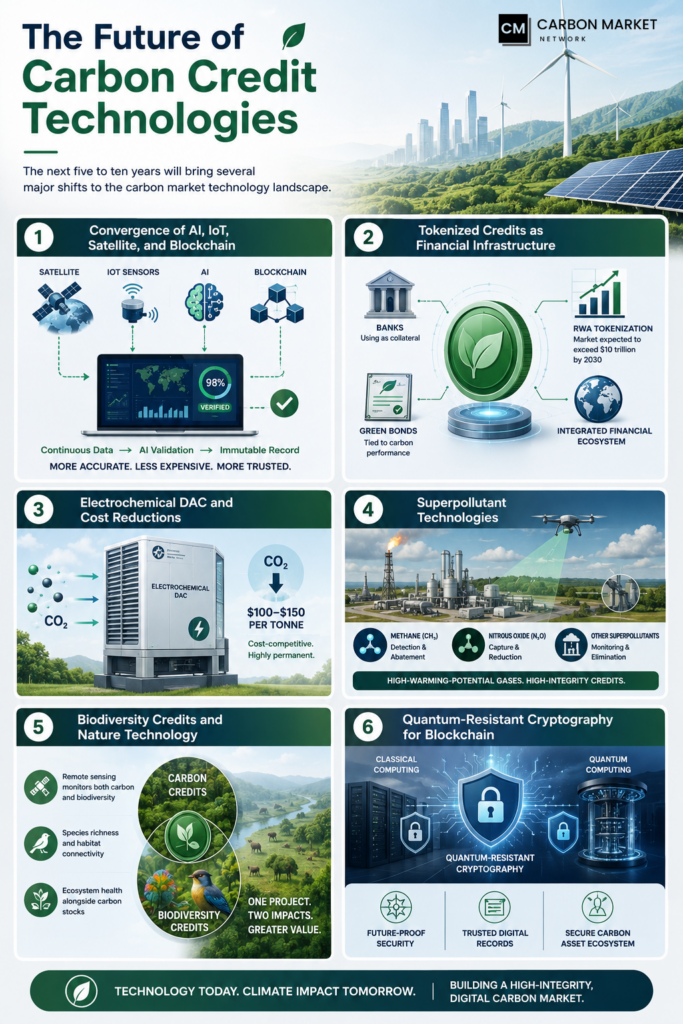
Convergence of AI, IoT, Satellite, and Blockchain
These four technologies are becoming increasingly integrated. In a mature dMRV system, satellites and IoT sensors collect continuous data, AI processes and validates it, and blockchain records the verified outputs. Each technology strengthens the others.
The result is a verification system that is more accurate, less expensive, and more tamper-resistant than anything the manual era could produce.
Tokenized Credits as Financial Infrastructure
Tokenized carbon credits are beginning to integrate with mainstream financial systems. Banks are using them as collateral. Green bonds are being tied to carbon performance. The convergence of carbon markets with real-world asset (RWA) tokenization, a market expected to exceed $10 trillion by 2030, positions carbon credits as a core asset class in the digital financial system.
Electrochemical DAC and Cost Reductions
New electrochemical approaches to Direct Air Capture are showing promise as potentially lower-cost alternatives to thermal regeneration systems. If costs fall to $100 to $150 per tonne, DAC would become cost-competitive with many nature-based solutions while offering far greater permanence.
Superpollutant Technologies
Methane abatement, nitrous oxide capture, and other superpollutant projects are the fastest-growing segment of the VCM. Technologies that detect, quantify, and eliminate these high-warming-potential gases will generate increasing volumes of high-integrity carbon credits.
Biodiversity Credits and Nature Technology
Carbon and biodiversity are becoming linked. Technology platforms are beginning to combine carbon credit generation with biodiversity credit generation for the same project, using remote sensing to monitor species richness, habitat connectivity, and ecosystem health alongside carbon stocks.
Quantum-Resistant Cryptography for Blockchain
As quantum computing advances, the cryptographic systems underlying carbon credit blockchains will need upgrading. The transition to quantum-resistant cryptography is already being planned in leading carbon market blockchain platforms, ensuring long-term security of digital carbon asset records.
Actionable Takeaways
If you are a carbon market professional, investor, project developer, or corporate sustainability manager, here is what you should do with this information:
- Prioritize dMRV-backed credits. When purchasing carbon credits, look for projects that use satellite monitoring, IoT sensors, or AI-powered verification alongside traditional audit methods.
- Understand the durability spectrum. Not all credits are equal. High-durability CDR credits from DAC, biochar, or ERW offer significantly better permanence than nature-based offsets. Match your purchase to your net-zero commitment timeline.
- Follow Article 6.4 closely. The first 6.4ERs are expected in 2026. Understanding how PACM works will be essential for companies with international supply chains.
- Look for the CCP label. Credits with the ICVCM Core Carbon Principles label meet the highest current integrity standards. Treat this as a minimum quality threshold for serious climate commitments.
- Do not ignore smaller CDR pathways. ERW and biochar are small today but growing fast. Forward purchase agreements with reputable developers can secure supply at lower prices than will be available once the market scales.
- Watch tokenization standards. As tokenized carbon credit standards converge, platforms that offer CCP-labeled credits with dMRV backing and blockchain records will become the preferred infrastructure for institutional buyers.
Conclusion
Emerging carbon credit technologies are not just making the market more efficient. They are fundamentally changing what it means to buy and sell a carbon credit.
A credit backed by continuous satellite monitoring, AI-powered verification, IoT sensors, and blockchain records is a different product from one backed only by an annual site visit. It is more credible, more transparent, and harder to manipulate.
At the same time, new carbon removal technologies like Direct Air Capture, biochar, Enhanced Rock Weathering, and ocean-based approaches are creating entire new categories of credits with permanence and durability that nature-based solutions alone cannot match.
The market is shifting from hype to professionalization. High-quality credits backed by technology are commanding premium prices. Low-quality credits without robust verification are losing buyers.
For anyone working in carbon markets in 2026 and beyond, understanding these emerging carbon credit technologies is not optional. It is the foundation of sound climate strategy, credible investment decisions, and real-world impact.
Frequently Asked Questions (FAQ)
What are the most important emerging carbon credit technologies in 2026?
The most impactful emerging carbon credit technologies include Digital MRV (dMRV) systems, blockchain-based credit tracking and tokenization, AI-powered verification, satellite remote sensing, Direct Air Capture (DAC), biochar carbon credits, Enhanced Rock Weathering (ERW), and ocean-based carbon removal methods like Ocean Alkalinity Enhancement (OAE).
How does blockchain improve carbon credit integrity?
Blockchain creates an immutable, transparent ledger where every carbon credit issuance, transfer, and retirement is permanently recorded. It prevents double-counting, ensures credit ownership is clearly tracked, and enables smart contracts that automate credit retirement processes in real time.
What is dMRV and why does it matter for carbon credits?
Digital Monitoring, Reporting, and Verification (dMRV) uses satellite data, AI, IoT sensors, and blockchain to verify carbon credits faster, cheaper, and more accurately than traditional manual methods. dMRV cuts verification costs by 50 to 70%, boosts accuracy by up to 79%, and reduces verification timelines from years to days.
What is the difference between high-durability and low-durability carbon credits?
High-durability credits come from carbon removal methods that store CO2 for hundreds to thousands of years, such as DAC with geological storage, biochar, and ERW. Low-durability credits come from nature-based projects like forests, where stored carbon can be released back into the atmosphere through fires, disease, or land conversion.
How much do Direct Air Capture carbon credits cost?
DAC credits currently cost between $300 and $1,000+ per tonne of CO2, significantly more than nature-based offsets. Costs are expected to fall as the technology scales and as new electrochemical DAC approaches mature. Government subsidies like the US 45Q tax credit are helping to accelerate this cost reduction.
What is Enhanced Rock Weathering (ERW) in carbon markets?
ERW involves spreading finely crushed silicate rock (usually basalt) on agricultural land. Rainfall reacts with the rock powder, pulling CO2 from the atmosphere and converting it into stable bicarbonates that eventually wash into the ocean. ERW can remove 4 to 10 tonnes of CO2 per hectare per year and issued its first carbon credits in 2025.
What is Article 6.4 and how does it relate to carbon technology?
Article 6.4 of the Paris Agreement establishes the Paris Agreement Crediting Mechanism (PACM), a UN-supervised carbon crediting system. It is building digital infrastructure for international carbon credit tracking, including registry systems and potentially blockchain-based corresponding adjustment mechanisms. The first Article 6.4 credits are expected in 2026.
Are tokenized carbon credits the same as regular carbon credits?
Tokenized carbon credits represent the same underlying unit of one tonne of CO2 reduced or removed, but they exist as digital tokens on a blockchain. They can be traded on digital platforms, used as financial collateral, and integrated into automated business systems via smart contracts. Tokenization adds transparency and liquidity but does not by itself improve the quality of the underlying carbon reduction.
What is biochar and how does it generate carbon credits?
Biochar is produced by heating organic waste (biomass) in a low-oxygen environment through pyrolysis. This locks the carbon from the biomass into a stable solid rather than letting it decompose and release CO2. When biochar is added to soil, the carbon stays locked away for decades to centuries. Carbon credits are generated for this carbon storage, and current prices range from $75 to $200 per tonne.
How can a company identify high-quality carbon credits backed by technology?
Look for credits that carry the ICVCM Core Carbon Principles (CCP) label, are verified using dMRV methods including satellite and IoT monitoring, have a transparent and auditable data trail (ideally on blockchain), come from projects with independent third-party verification, and represent either high-durability carbon removal or clearly additional emissions reductions.
This article reflects market conditions and technology developments as of May 2026. The carbon market evolves rapidly. Always verify current credit prices, regulatory standards, and project details with updated sources before making purchasing or investment decisions.