Carbon Market Network


A carbon credit is only as trustworthy as the data behind it.
For years, that data came from clipboards, spreadsheets, and site visits every few years. Buyers had to take a lot on faith.
Digital MRV changes that. Sensors, satellites, drones, and smart software now collect and check project data far more often.
The UK sits at the center of this shift. It now has a strong group of digital MRV companies UK developers, investors, and buyers can work with today.
This guide lists the top 10 digital MRV companies in the United Kingdom. You will see what each one does, who it suits, and what to watch for.
You will also learn why UK policy is pushing demand for better data, and how to choose the right partner step by step.
What Are Digital MRV Companies in the UK?
MRV stands for monitoring, reporting, and verification. It is how a carbon project proves it really cut or removed greenhouse gases.
Digital MRV, often written as dMRV, does that job with technology. It cuts manual work and gives verifiers stronger evidence.
The digital MRV companies UK projects rely on fall into four groups:
- Registries and certifiers that accept live data streams from projects
- Remote sensing and satellite analytics firms that measure forests, peat, and land from space
- Ground measurement and sensor-led platforms that capture soil, biochar, and production data
- Ratings and data providers that test whether credits match what projects claim
Not every company on this list is a pure dMRV vendor. Some supply the data and analysis that make dMRV work. That mix is normal in this young industry.
Carbon Market Insider Newsletter
Weekly insights on carbon markets, climate policy, carbon credits, and sustainability.
Traditional MRV vs Digital MRV
Here is how the two approaches compare in practice.
| Area | Traditional MRV | Digital MRV |
|---|---|---|
| Data collection | Manual surveys and periodic site visits | Sensors, satellites, drones, and automated logs |
| Update frequency | Every few years in many cases | Continuous or frequent |
| Cost of each check | High, because of travel and labor | Lower at scale, though setup takes effort |
| Audit trail | Paper files and spreadsheets | Time-stamped, searchable digital records |
| Speed to credit | Slow | Faster when the data is clean |
| Main risk | Gaps and human error | Poor data quality and weak governance |
The UK Woodland Carbon Code shows the old model well. Projects are verified at year five and year fifteen to measure the carbon stored.
That leaves long stretches with little fresh data. Digital tools aim to fill those gaps.
How Digital MRV Works Step by Step
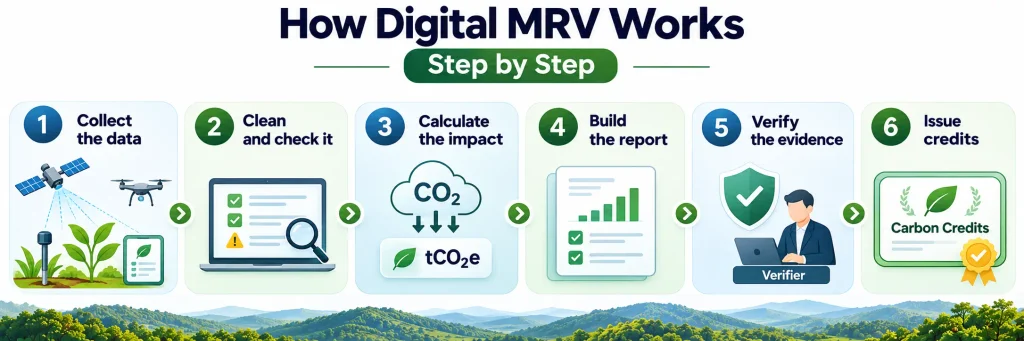
- Collect data. Satellites, drones, IoT sensors, and machine logs capture raw project data.
- Clean and check it. Software flags gaps, errors, and odd readings.
- Model the result. Algorithms convert data into tonnes of CO2 equivalent.
- Package the evidence. The platform builds a report that follows the project methodology.
- Verify independently. A third party audits the data and the claim.
- Issue and track credits. A registry records the credit and its supporting evidence.
One point matters a lot. Digital MRV does not replace independent verification. It gives verifiers better evidence to work with.
Why the UK Is a Hotspot for Digital MRV
Three forces are pushing demand for digital MRV companies in the UK. Each one rewards better data.
The Woodland Carbon Code and Peatland Code
The Woodland Carbon Code is a government-backed framework for verified woodland projects. More than 93,000 hectares of UK woodland are now registered under it.
Its team is testing how drones, planes, and satellites can support verification. It has also run a trial that uses drone photography for the year five check.
The Peatland Code, run by the IUCN UK Peatland Programme, offers the UK’s only official peatland carbon units. Peatland projects also need strong evidence of restoration and emissions change.
Both codes need verification by accredited bodies. That work follows ISO 17029 and ISO 14065, with accreditation through the UK Accreditation Service.
UK ETS and Carbon Removals
The UK plans to bring engineered greenhouse gas removals into the UK Emissions Trading Scheme. The plan targets the end of this decade, after new laws pass.
Here are the key design points announced so far:
- Only removals that happen in the UK qualify at the start
- Allowances arrive after removal is verified, not before
- Projects must show a minimum storage period of 200 years
- Buffer pools and operator liability cover the risk of carbon release
- The overall cap stays in place, so removals do not dilute ambition
The government has not yet decided whether high-quality UK woodland removals will join. That question is still open at the time of writing.
One thing is clear. A compliance market for removals needs strict, auditable data. That is exactly what digital MRV supplies.
Integrity Principles and Standards
The UK government has published six principles for voluntary carbon and nature market integrity. They urge organizations to use credits in addition to ambitious cuts, and to use high-integrity credits.
A consultation on putting those principles into practice has since closed, and the government has published a summary of the responses.
The British Standards Institution is also developing UK-wide requirements for voluntary carbon and nature markets. Better standards mean buyers will ask tougher questions about data.
A Deep Science and Tech Base
Edinburgh and London anchor the UK dMRV scene. Space Intelligence and Earth Blox both grew out of the University of Edinburgh.
The UK Space Agency also funds climate projects that use satellite data. Treeconomy and New Gradient have both received that kind of support.
How We Selected the Top Digital MRV Companies in the UK
We looked at each company against five simple questions:
- Does it have a UK base or a core UK team?
- Does it offer real digital MRV or the data that powers it?
- Does it work on projects that matter in UK and global markets?
- Does it publish enough detail for buyers to judge its approach?
- Is it actively building and launching products?
The order below reflects how directly each company supports digital MRV. Offerings change fast, so confirm current details with each provider before you commit.
Quick Comparison: Top 10 Digital MRV Companies in the UK
| # | Company | Base | Core strength | Best for |
|---|---|---|---|---|
| 1 | Isometric | London | Registry and certification with dMRV integrations | Carbon removal developers |
| 2 | Treeconomy | UK | Satellite and drone dMRV for nature projects | Woodland developers and investors |
| 3 | Space Intelligence | Edinburgh | Satellite forest carbon maps | Forest projects and supply chains |
| 4 | New Gradient (Calterra) | Edinburgh | AI-based peatland and woodland dMRV | UK peatland and woodland projects |
| 5 | Sylvera | London | Carbon data and ratings with remote sensing | Buyers and investors |
| 6 | BeZero Carbon | London | Ratings with geospatial analysis | Risk and procurement teams |
| 7 | Earth Blox | Edinburgh | No-code satellite analytics | Analysts and nature investors |
| 8 | ecometric | UK | Measured soil carbon MRV | Farms and food supply chains |
| 9 | CapChar | UK | On-farm biochar with dMRV software | Farmers and biochar producers |
| 10 | CO2OC | UK | CarbonOps cloud platform | Developers needing cloud workflows |
The Top 10 Digital MRV Companies in the United Kingdom
1. Isometric
Headquarters: London, with a team in New York
Best for: Carbon removal developers that need registry-grade digital data
Isometric is a certification company built around public evidence. Its registry records issued, delivered, transferred, and retired credits, along with protocol versions and calculation data.
The company also offers Registry and MRV APIs. Marketplaces, buyers, and dMRV providers can use them to stream project data straight into certification.
Isometric has announced partnerships with several dMRV providers. Sensors and machines send data into its registry, verifiers check it, and credits appear with the supporting data open to the public.
Its biochar protocol modules also include a dMRV framework built on automated data collection and secure cloud storage.
What stands out:
- A public registry with the evidence behind each credit
- Buyer-funded fees, which separate payment from the credits a developer receives
- A network of more than 400 outside scientists and experts
- Approval from the ICVCM, CORSIA, and ICROA, which Carbon Herald reported when it covered the milestone
Keep in mind: Isometric is a certifier and registry, not a sensor vendor. Developers still need a dMRV provider to collect field data.
2. Treeconomy
Headquarters: United Kingdom
Best for: Woodland developers, landowners, and natural capital investors
Treeconomy is an earth-tech company that builds dMRV for nature-based projects. It combines satellite imagery, drone data, and machine learning to measure carbon in restored land.
Its Sherwood platform powers a due diligence tool built with Octopus Investments. The tool uses high-resolution imagery and more than 60 geospatial datasets to judge the viability of carbon projects.
Treeconomy also leads a UK Space Agency funded project called QUBIST. It combines data from several satellites with statistical models to measure and reduce uncertainty in forest carbon estimates.
What stands out:
- Strong focus on uncertainty, which buyers and verifiers care about
- Tools for both project developers and investors
- Close fit with UK woodland and natural capital finance
Keep in mind: Its strength is nature-based projects. Engineered removal teams will need a different partner.
3. Space Intelligence
Headquarters: Edinburgh, Scotland
Best for: Forest carbon developers, investors, and supply chain teams
Space Intelligence is a University of Edinburgh spinout. It turns satellite data into maps of land cover, forest carbon, and deforestation.
Its team uses space-based LiDAR to track canopy height. It then links those readings to local field data to show whether a forest is gaining or losing carbon.
Verra selected the company to produce data for Kenya and Tanzania. That work covered roughly 150 million hectares.
The firm also built GOOD-COP, a free interactive atlas of forest carbon projects. A company leader has said deforestation rules have become a very large part of the business.
What stands out:
- Deep science roots and published research
- Jurisdiction-scale mapping experience
- Useful for both project monitoring and independent checks by buyers
Keep in mind: It supplies maps and monitoring data. You still need a verifier and a registry pathway.
4. New Gradient and the Calterra Platform
Headquarters: Edinburgh, Scotland
Best for: UK peatland and woodland projects
New Gradient is an AI consultancy founded in Edinburgh. It runs Calterra, a joint venture with peatland restoration specialist Caledonian Climate.
Calterra already deploys dMRV for peatland. New Gradient has now built a woodland tool with UK Space Agency backing and plans to bring it into Calterra for commercial use.
The company says its model can assess every individual tree. It reports growing measurement coverage from under one percent of trees to all of them.
It also argues the tool can move verification from decade-long cycles to annual reporting. That claim comes from the company, so ask for validation data.
What stands out:
- Built for the exact codes UK developers use
- Peatland and woodland capability on one platform
- Aimed at faster, richer reporting for investors
Keep in mind: The woodland product is newer. Check how far standards bodies and verifiers accept its outputs.
5. Sylvera
Headquarters: London
Best for: Buyers, investors, and developers who need independent carbon data
Sylvera is best known as a carbon credit ratings provider. It applies machine learning to satellite imagery and other data to judge how well projects perform.
It sells its data through a web platform and an API. Its team also works on remote sensing methods for soil carbon, with research funding from UK Research and Innovation.
Sylvera recently launched an Open Carbon Data Project for the Brazilian Atlantic Forest. Supporters include The Rockefeller Foundation and Meta.
The project aims to create open, high-resolution forest carbon data. Sylvera says dMRV systems need strong underlying data to model carbon accurately.
What stands out:
- Independent view of project quality, which complements project-side dMRV
- Strong use of LiDAR and field data to improve biomass estimates
- Open data work that helps the whole market
Keep in mind: Ratings and monitoring serve different jobs. Sylvera helps you judge credits, not run a project’s daily data capture.
6. BeZero Carbon
Headquarters: London
Best for: Procurement, risk, and finance teams buying or financing credits
BeZero Carbon rates the quality of carbon credits. A dedicated geospatial team supports those ratings with satellite-based analysis.
One example is its dynamic baselines. They use statistical matching to compare pixels inside a project area with similar pixels outside it. That helps flag the risk of over-crediting.
Its team also tracks fire hazards near carbon projects using remote sensing. The firm lists more than 3,000 expert-assessed nature-based project boundaries in its data products.
BeZero has also been mandated by the Swiss Federal Office for the Environment to assess Article 6.2 credits.
What stands out:
- Clear methodology documents that buyers can study
- Geospatial checks that test project claims from outside the project
- Data licensing for platforms and marketplaces
Keep in mind: Like Sylvera, it supports due diligence. It does not replace a project’s own monitoring system.
7. Earth Blox
Headquarters: Edinburgh, Scotland
Best for: Analysts and investors who want satellite insight without coding
Earth Blox is a University of Edinburgh start-up with a no-code platform. Users build satellite analyses with a drag and drop interface.
The platform draws on large public datasets such as Google Earth Engine and European Space Agency sources. It covers deforestation tracking, carbon monitoring, and land use analysis.
Company listings name customers such as Shell Nature Based Solutions, The Nature Conservancy, WWF, and Greenpeace.
What stands out:
- Low barrier to entry for teams without remote sensing staff
- Fast, repeatable analysis of project areas
- Useful for monitoring nature-based investments
Keep in mind: It is an analytics platform, not a certification route. Treat its output as one input to your MRV file.
8. ecometric
Headquarters: United Kingdom
Best for: Farms, estates, and food companies that want measured soil carbon
ecometric measures soil organic carbon change over each production cycle. It combines physical soil samples with spectral data and an artificial neural network.
Samples are tested with the Dumas method. The model then links those results to spectral readings across the whole project area.
The company supported Blaston Farm in Leicestershire, described as the first UK project to generate certificates from high-density direct soil sampling. Respira International signed an offtake deal for those certificates.
What stands out:
- Real soil measurement instead of only modeled estimates
- Clear fit for regenerative agriculture programs
- Practical output for farmers and supply chain buyers
Keep in mind: Soil carbon is hard to measure. Ask how the company handles uncertainty and re-sampling.
9. CapChar
Headquarters: United Kingdom
Best for: Farmers and biochar producers who want a connected system
CapChar builds on-farm biochar units and a dMRV software platform to go with them. Its platform captures data such as feedstock origin, biochar production, and where the biochar is applied.
The company has run pilot plants in Cornwall and North Wales. It has also put a UK-focused Biochar Carbon Code out for public consultation.
Because CapChar offers hardware, software, and a proposed code together, it markets itself as a turnkey option for UK farms.
What stands out:
- One supplier for production and data capture
- A UK-specific approach to biochar carbon units
- Good fit for distributed, farm-scale projects
Keep in mind: Buyers and registries may prefer recognized standards. Check which standard your credits will use.
10. CO2OC
Headquarters: United Kingdom
Best for: Developers and climate finance programs that want a cloud dMRV workflow
CO2OC runs its technical hub from the UK. According to the company, it builds CarbonOps, a cloud platform for automated digital MRV workflows.
The company says CarbonOps handles satellite data processing, remote sensing analytics, and compliance tracking. Its wider network also runs field operations in Mozambique and Eswatini.
What stands out:
- Cloud-based approach that links UK data work to field projects abroad
- Focus on agriculture and climate finance programs
- Dashboards aimed at enterprise clients
Keep in mind: Most public detail comes from the company itself. Ask for pilot results and verifier feedback before you commit.
Other UK Projects Putting Digital MRV to Work
Some UK developers pair with vendors from outside the country. Carbon Capture Scotland is a good example.
It partnered with Mangrove Systems, a Toronto-based dMRV provider, to track CO2 from biogenic carbon removal in real time. The two described it as the first digital MRV system built for biogenic carbon removal projects.
The lesson is simple. The UK market welcomes global tools, so look at international options when no UK firm fits your project type. Our guides on the top digital MRV companies in the world and the top carbon MRV companies in the world cover that wider field.
How to Choose Digital MRV Companies in the UK: Step by Step
Use this checklist when you compare providers.
- Name your project type. Woodland, peatland, soil, biochar, and engineered removal each need different tools.
- Pick your standard first. Decide whether you will use the Woodland Carbon Code, the Peatland Code, an international registry, or a removal registry. Then ask each vendor how its data fits.
- Ask what data it collects and how often. Look for clear answers on sensors, satellites, sampling, and update frequency.
- Test the uncertainty. Good providers explain error ranges instead of hiding them.
- Check verifier fit. Ask whether accredited verifiers have worked with the outputs.
- Confirm data ownership and export. You should keep access to your raw data if you switch vendors.
- Review the audit trail. Records should be time-stamped, searchable, and hard to alter.
- Run a small pilot. Start with one site or one season before you scale.
Match Your Project to the Right Type of Company
| Project or need | Company type to look for | Examples from this list |
|---|---|---|
| Woodland creation | Remote sensing dMRV | Treeconomy, New Gradient |
| Peatland restoration | Peatland-focused dMRV | New Gradient (Calterra) |
| Forest protection or REDD+ | Satellite forest mapping | Space Intelligence |
| Soil carbon | Measured soil MRV | ecometric |
| Biochar | Production data capture plus registry | CapChar, Isometric |
| Engineered removals | Registry with sensor integrations | Isometric |
| Buyer due diligence | Ratings and independent data | Sylvera, BeZero Carbon |
| In-house geospatial analysis | No-code analytics | Earth Blox |
Common Mistakes When Hiring Digital MRV Companies in the UK
- Treating dMRV as a full replacement for verification. Standards still need independent audits.
- Buying software before choosing a standard. The wrong fit can force costly rework.
- Ignoring data quality. The International Council for the Voluntary Carbon Market (ICVCM) has pointed out that digital tools can raise integrity risks without proper governance.
- Relying on one data source. Satellites work best with ground truth from field plots or sensors.
- Skipping the exit plan. Check data portability before you sign.
Trends Shaping Digital MRV in the UK
Registries Are Plugging In Live Data
Registries such as Isometric now accept direct data feeds from dMRV providers. Expect more of this as removal markets grow.
Standards Bodies Are Testing Remote Sensing
The Woodland Carbon Code is trialing drone-based verification. Carbon Pulse has reported that both UK land codes could adopt remote sensing and an online management platform.
Open Data Is Gaining Ground
Projects like Sylvera’s open carbon dataset and Space Intelligence’s free project atlas show a shift toward shared data. That helps smaller developers.
Compliance Pressure Is Building
The planned entry of removals into the UK ETS will push buyers to demand tougher evidence. The UK and EU have also agreed to work toward linking their emissions trading schemes, which could raise the bar further.
Investors Want Faster Evidence
Natural capital investors want updates more often than every few years. Tools like Treeconomy’s due diligence product and New Gradient’s annual reporting approach respond to that demand.
Frequently Asked Questions
What are digital MRV companies in the UK?
They are UK-based firms that use satellites, sensors, drones, and software to monitor, report, and verify carbon project data. Some run platforms. Others supply data, ratings, or certification.
Which UK company is best for digital MRV?
It depends on your project. Isometric suits carbon removal developers. Treeconomy and New Gradient suit woodland and peatland work. ecometric suits soil carbon. Sylvera and BeZero help buyers check credit quality.
Is digital MRV accepted by UK carbon standards?
Acceptance is growing but not complete. The Woodland Carbon Code is testing remote sensing and drone methods. Always confirm what each standard accepts today.
Does the UK ETS cover carbon removals?
Not yet. The government plans to bring engineered removals in toward the end of this decade, with strict monitoring and verification rules. A decision on woodland removals has not been made at the time of writing.
How much do digital MRV services cost?
Prices vary by project size, method, and data needs. Most providers quote per project, so request a written estimate and ask about setup, subscription, and data fees.
Can small landowners use digital MRV?
Yes. Several UK firms target farms, estates, and small woodland owners. Ask each provider about minimum project size before you start.
What is the difference between a dMRV platform and a ratings agency?
A dMRV platform helps a project collect and prove its own data. A ratings agency judges credit quality from the outside. Many serious buyers use both.
Conclusion
The UK has built one of the most interesting groups of digital MRV companies in the world. They cover satellites, soil, biochar, registries, and independent ratings.
No single firm fits every project. Start with your project type and your standard, then test each provider on data quality, uncertainty, and audit trail.
Pick a partner that makes your evidence easier to verify, not just easier to collect. That is what turns a good project into a credit buyers trust.
Use this list of digital MRV companies UK developers and investors rely on as your starting point. Then run a small pilot and let the data prove the fit.
If you want to learn more about how carbon markets work, how credits are issued, and what makes a high-quality carbon project, explore the resources at Carbon Market Network.