Carbon Market Network


Solar energy is no longer just about saving money on electricity bills. It is now a powerful tool in the global effort to fight climate change. And at the heart of that effort are solar carbon credit companies that turn clean energy into tradable environmental certificates worth real money.
If you’ve landed here, you’re probably wondering: which companies are leading this space? How do solar carbon credits actually work? And how do you pick the right company for your needs?
This article answers all of that. Whether you’re a business looking to offset your emissions, a solar project developer wanting to monetize your output, or simply someone curious about where climate finance meets clean energy, this guide is for you.
What Are Solar Carbon Credits?
Before diving into the companies, let’s get the basics straight.
A carbon credit represents the verified reduction or removal of one metric ton of carbon dioxide (or equivalent greenhouse gases) from the atmosphere.
Solar carbon credits are generated when a solar energy project displaces fossil fuel electricity. By producing clean power instead of relying on coal or gas, a solar project avoids a measurable amount of CO2 emissions. Those avoided emissions are then certified, verified, and turned into credits that can be sold.
There are two main types of certificates connected to solar energy:
1. Solar Renewable Energy Credits (SRECs) These are issued based on electricity generation. One SREC equals one megawatt-hour (MWh) of solar electricity fed into the grid. Utilities buy them to comply with Renewable Portfolio Standards (RPS) in certain states or countries.
2. Voluntary Carbon Credits from Solar Projects These are broader carbon offsets generated by solar projects registered under standards like Verra’s Verified Carbon Standard (VCS) or Gold Standard. They’re sold in the voluntary carbon market to companies and individuals wanting to reduce their carbon footprint.
Both types represent the environmental value of solar energy. But they operate in slightly different markets with different buyers and pricing structures.
Carbon Market Insider Newsletter
Weekly insights on carbon markets, climate policy, carbon credits, and sustainability.
How Solar Carbon Credits Work: Step by Step
Here’s how the process works from start to finish:
Step 1: Install and operate a solar project The project must be generating real, measurable electricity from solar panels, whether it’s a rooftop system, a utility-scale farm, or a floating solar installation.
Step 2: Measure the emissions avoided Calculate how much CO2 would have been emitted if the same amount of electricity had been generated from fossil fuels. This depends on the regional grid’s emission factor.
Step 3: Get verified by an accredited body A third-party validation and verification body (VVB) reviews the project’s documentation, methodology, and monitoring reports to confirm the claimed emission reductions are real.
Step 4: Register with a carbon standard The project registers on a recognized registry such as Verra, Gold Standard, or a domestic compliance registry. Credits are issued and listed publicly.
Step 5: Sell the credits The project developer can then sell credits to companies, brokers, or platforms. Buyers retire the credits to offset their own emissions or meet regulatory requirements.
The Two Markets Where Solar Carbon Credits Trade
Understanding the two main markets helps you understand what each type of solar carbon credit company does.
| Feature | Voluntary Carbon Market | Compliance (Regulatory) Market |
|---|---|---|
| Who participates | Any company or individual | Regulated industries (power, heavy industry) |
| What drives demand | Corporate net-zero pledges, ESG goals | Government-mandated emissions caps |
| Price range | $3 to $25 per ton (typical VCM) | $15 to $90+ per ton (e.g., EU ETS) |
| Key standards | Verra VCS, Gold Standard | EU ETS, California Cap-and-Trade, RGGI |
| Role of solar credits | Avoidance credits (additionality scrutinized) | SREC markets, renewable portfolio compliance |
It’s worth noting that the market is shifting. The Integrity Council for the Voluntary Carbon Market (ICVCM) has raised its standards significantly and has flagged that older, legacy renewable energy methodologies no longer meet its Core Carbon Principles (CCPs). This means the bar for solar carbon credits in the voluntary market has risen, and project quality now matters more than ever.
Top Solar Carbon Credit Companies in the World
Here’s a detailed look at the companies shaping the solar carbon credit space globally.
1. South Pole Group
Headquarters: Zurich, Switzerland Focus: Renewable energy, nature-based solutions, Article 6-aligned projects
South Pole is one of the most recognized names in the entire carbon markets industry. Founded in 2006, it has grown into a global powerhouse with operations across more than 50 countries and a portfolio that includes hundreds of renewable energy projects, including solar.
South Pole has helped develop and register solar projects in countries like Vietnam, where it supported developers in certifying solar power plants under the Verified Carbon Standard. The company has facilitated over 24 million MWh of renewable energy to clients through its own projects and traded energy credits.
What makes South Pole stand out is its full-service model. It doesn’t just sell credits. It acts as a project developer, climate strategy consultant, and distribution partner all in one. For a company trying to build a credible net-zero roadmap that includes solar carbon credits, South Pole offers one of the most complete solutions available.
South Pole works with leading standards including Verra VCS, Gold Standard, CDM, and Article 6 methodologies under the Paris Agreement.
Best for: Large corporations, institutional buyers, and solar project developers looking for global reach and full-service carbon strategy support.
2. EKI Energy Services (EnKing International)
Headquarters: Indore, India (listed on BSE) Focus: Renewable energy carbon credits, solar, wind, waste management
EKI Energy Services is India’s largest carbon credit developer and one of the most significant players in the global renewable energy carbon credit space. The company has supplied over 200 million carbon offsets globally and has clients across 40+ countries including the World Bank Group, Siemens, Shell, and Volkswagen.
EKI made headlines by registering the world’s first floating solar project under the Verified Carbon Standard. This 24.7 MW project, developed by Greenam Energy in Tamil Nadu, broke new ground in bringing innovative solar technology into the voluntary carbon market.
The company was ranked among the top global renewable energy carbon credit developers by Abatable’s market intelligence reports and has held a commanding share of the global VCM’s issued renewable energy credits.
EKI covers the entire value chain: project identification, development, validation, verification, issuance, trading, and retirement. It operates across renewable energy, waste management, clean cooking, and nature-based solutions.
Best for: Asian project developers, global buyers seeking renewable energy credits at scale, and companies looking for an established India-based partner.
3. 3Degrees
Headquarters: San Francisco, California, USA Focus: Renewable energy certificates (RECs), solar SRECs, carbon offsets, consulting
3Degrees is one of North America’s most trusted environmental commodity providers. The company specializes in renewable energy certificates, carbon offsets, and sustainability consulting, and has helped over 4,000 organizations transition to cleaner energy practices.
Clients include some of the world’s biggest names in tech: Google, Microsoft, and LinkedIn all rely on 3Degrees for their renewable energy and carbon strategies. 3Degrees has facilitated over 10 gigawatts of renewable energy transactions globally, supporting solar, wind, and other clean energy projects.
3Degrees also has a direct marketplace where buyers can purchase solar RECs and carbon offsets with transparent pricing and project documentation. Its in-house project operations team manages verification directly, and all credits comply with the ICROA Code of Best Practice.
On the solar side, 3Degrees has been involved in projects including a Solar Water Heater Initiative in India that combines clean energy with community development. This mix of solar RECs, carbon offsets, and renewable project development makes 3Degrees a uniquely versatile company.
Best for: North American corporations, tech companies, and businesses that need both renewable energy credits and carbon offsets managed under one roof.
4. NativeEnergy (Native)
Headquarters: Vermont, USA Focus: Solar, wind, agricultural methane, community-scale projects
NativeEnergy, now operating as Native, has been active since 2000. It pioneered what it calls a “Help Build” model, which channels upfront capital into new clean energy and carbon projects before they’re built. This means buyers don’t just buy existing credits. They co-finance the construction of new projects that genuinely would not exist without that funding.
Native works with Gold Standard, Verra VCS, Climate Action Reserve, and American Carbon Registry. Its portfolio includes solar projects, wind turbines, biogas systems at family farms, and community-scale renewable installations.
This model appeals to buyers who want to demonstrate that their carbon credit purchases are creating real additional climate impact. That additionality story is increasingly important as corporate sustainability claims face more scrutiny.
Best for: Companies that want to tell a strong impact story and co-finance new solar and clean energy projects rather than purchasing pre-existing credits.
5. ClimatePartner
Headquarters: Munich, Germany Focus: End-to-end corporate carbon management, solar and nature-based projects
ClimatePartner is a leading European platform for corporate carbon management, working with more than 6,000 clients worldwide and having retired over 57 million verified carbon credits to date.
The company provides an end-to-end solution: measuring a company’s carbon footprint, developing a reduction roadmap, and then sourcing carbon credits from a curated portfolio that includes solar and other renewable energy projects.
ClimatePartner has developed over 15 in-house projects and operates digital tools that make tracking and reporting transparent. It’s known for combining accessibility with credibility, making it a popular choice for small and medium businesses as well as large enterprises.
However, like other established providers with older legacy portfolios, ClimatePartner has faced increased scrutiny under the rising standards of the voluntary carbon market. Buyers working with ClimatePartner today should focus on its newer, higher-integrity project offerings.
Best for: European companies seeking an all-in-one digital platform for carbon management that includes solar credits alongside other project types.
6. Sterling Planet
Headquarters: Georgia, USA Focus: Solar and wind RECs, carbon offsets, green power supply
Sterling Planet is one of the most recognized retail providers of renewable energy credits in the US market, with a long track record of being recognized by the US EPA as an award-winning green power supplier.
The company helps both residential and commercial buyers access solar and wind RECs as well as carbon offsets. Its SterlingWind and SterlingClimate products allow buyers to offset their electricity use and personal carbon footprint through verified credits.
Sterling Planet also develops renewable energy projects and has deep expertise in compliance and voluntary markets. Its certifications through Green-e and alignment with major US environmental attribute standards make it a reliable and transparent choice.
Best for: US businesses and individuals seeking verified solar RECs and carbon offsets from a long-established, EPA-recognized provider.
7. Regreener
Headquarters: Amsterdam, Netherlands Focus: High-integrity portfolio curation, Verra, Gold Standard, ICVCM-aligned credits
Regreener is one of the newer generation platforms that has built its reputation on rigorous quality standards. The company screens every project through a 100+ indicator quality framework and holds B Corp certification.
Regreener works with both avoidance and removal credits and aligns its portfolio with ICVCM Core Carbon Principles, Verra, Gold Standard, and Puro.earth standards. It also cross-references projects with independent ratings from BeZero, Sylvera, and Calyx Global.
While Regreener is not exclusively focused on solar, its curation model means solar projects in its portfolio have passed extremely thorough due diligence. For buyers who want solar credits that will hold up to CSRD reporting requirements or board-level scrutiny, Regreener offers significant assurance.
Best for: European mid-market and enterprise buyers who need defensible, audit-ready carbon credit portfolios that may include solar projects.
8. Solar Offset (Alberta, Canada)
Headquarters: Alberta, Canada Focus: Small-scale grid-connected solar and wind carbon credits in Alberta
Solar Offset is a niche but innovative company that serves a very specific market: small-scale solar and wind system owners in Alberta, Canada, who want to monetize their carbon offset credits.
Alberta has one of the world’s most mature provincial carbon markets, and Solar Offset has spent years developing expertise in navigating it. Homeowners, farmers, school boards, and municipalities with solar installations can register with Solar Offset, and the company handles the entire process of credit creation, verification, and sales. System owners receive an annual payment for up to 10 years.
This model breaks down a major barrier. Creating carbon offset credits is typically expensive and complex, putting it out of reach for individual small-scale solar producers. Solar Offset aggregates these small systems into a scalable portfolio, making the market accessible.
Best for: Residential, agricultural, and small commercial solar system owners in Alberta, Canada, looking to generate passive income from carbon credits.
9. First Climate
Headquarters: Germany (with global operations) Focus: Renewable energy, solar, efficiency, and nature-based carbon credits
First Climate is a European carbon market veteran with a strong track record in renewable energy carbon credits, including solar. The company operates across project development, carbon credit supply, and corporate climate solutions.
First Climate works with Gold Standard and Verra VCS and has a particularly strong presence in developing markets where solar projects can demonstrate clear additionality. Its project portfolio spans Africa, Asia, and Latin America, regions where solar development is rapidly expanding and where the emissions displacement impact is most significant.
Best for: European corporates and sustainability managers looking for verified solar and renewable energy credits from emerging markets.
Comparison Table: Top Solar Carbon Credit Companies
| Company | Country | Market | Key Standards | Best For |
|---|---|---|---|---|
| South Pole Group | Switzerland | Global | Verra, Gold Standard, Article 6 | Large corporates, full strategy |
| EKI Energy Services | India | Global | Verra VCS, CDM, Gold Standard | Renewable energy credits at scale |
| 3Degrees | USA | North America | ICROA, Verra, Gold Standard | Tech companies, REC + offset bundles |
| NativeEnergy | USA | North America + Global | Gold Standard, VCS, CAR, ACR | Impact-first buyers, project co-financing |
| ClimatePartner | Germany | Europe + Global | Verra, Gold Standard | SMEs, end-to-end platform users |
| Sterling Planet | USA | USA | Green-e, EPA recognized | Retail RECs, small-medium businesses |
| Regreener | Netherlands | Europe + Global | Verra, Gold Standard, ICVCM | High-integrity portfolio buyers |
| Solar Offset | Canada | Alberta, Canada | Alberta Carbon Offset System | Small-scale solar owners in Alberta |
| First Climate | Germany | Global | Verra, Gold Standard | Emerging market solar credits |
What Makes a Good Solar Carbon Credit?
Not all solar carbon credits are equal. Here’s what separates the genuinely impactful ones from the rest.
Additionality
The most important test. A solar project is “additional” only if it would not have been built without the carbon credit revenue. In regions where solar is already highly economical without any subsidies, the case for additionality is weaker. The best solar carbon credit companies are upfront about this and prioritize projects in areas where credits genuinely make a difference.
Verified by a Recognized Standard
Look for credits certified under Verra VCS, Gold Standard, or a recognized national standard. The ICVCM’s Core Carbon Principles (CCPs) are now considered the gold standard for quality. Credits carrying a CCP label have passed the highest scrutiny available in the market.
Independently Rated
The top corporate buyers today require independent ratings from BeZero Carbon, Sylvera, or Calyx Global. These rating agencies assess project quality the way credit rating agencies assess bonds. A rating of BeZero BBB or higher or Sylvera Tier 2 or higher is the benchmark most serious buyers now follow.
Transparent Documentation
A quality solar carbon credit company should openly share the project design document (PDD), monitoring reports, and issuance data on a public registry. If a company can’t point you to a public registry listing, that’s a red flag.
Co-Benefits
Strong solar carbon credit projects deliver benefits beyond just CO2 reduction. These include job creation, energy access in underserved areas, clean water, and biodiversity protection. The Gold Standard in particular requires projects to demonstrate contributions to multiple UN Sustainable Development Goals (SDGs).
Solar Carbon Credits vs. Solar RECs: Key Differences
People often confuse these two instruments. Here’s a clear side-by-side breakdown.
| Factor | Solar Carbon Credits | Solar RECs (SRECs) |
|---|---|---|
| What they represent | CO2 reduction (1 credit = 1 ton of CO2e avoided) | Solar electricity generation (1 REC = 1 MWh generated) |
| Market type | Voluntary carbon market or compliance carbon market | Compliance REC market (and voluntary) |
| Who buys them | Companies with net-zero or carbon neutrality goals | Utilities, corporates buying renewable electricity |
| Price range | $3 to $25+ per ton (VCM); higher in compliance markets | $10 to $400+ per SREC depending on state and demand |
| Verification standard | Verra, Gold Standard, CDM, etc. | Green-e, PJM-GATS, WREGIS (US), other REC tracking systems |
| Global applicability | Yes, global market | Primarily market-specific (state/country level) |
The key takeaway: if you’re a business in the US buying SRECs to meet a renewable energy commitment, that’s different from buying Verra-verified carbon credits to offset emissions on your sustainability report. Both involve solar, but they answer different questions.
SREC Pricing by US State
For businesses and homeowners in the United States, solar SREC values vary significantly by state depending on local renewable energy policy.
| State | Approximate SREC Price Range |
|---|---|
| Washington D.C. | $300 to $410 per SREC |
| Massachusetts | $250 to $350 per SREC |
| New Jersey | $180 to $250 per SREC |
| Maryland | $60 to $90 per SREC |
| Pennsylvania | $35 to $50 per SREC |
| Ohio | $8 to $15 per SREC |
Prices fluctuate with supply, demand, and state policy changes. Always check current market rates through a verified SREC aggregator or broker.
How to Choose a Solar Carbon Credit Company: 7 Key Questions to Ask
Shopping for a solar carbon credit company can feel overwhelming. These seven questions simplify the process.
1. Are the credits verified by a recognized standard? Look for Verra VCS, Gold Standard, ICVCM-approved methodologies, or a recognized national standard. Avoid any company that can’t name its verification standard.
2. Are the credits listed on a public registry? Every credible carbon credit should have a public listing on Verra, Gold Standard, or an equivalent registry. You should be able to look up the project, its issuance history, and its retirement status online.
3. Does the project demonstrate clear additionality? Ask the company to explain why the solar project wouldn’t have been built without carbon credit revenue. This is especially important for credits in markets where solar is already highly subsidized.
4. Has the credit been independently rated? Companies like BeZero Carbon, Sylvera, and Calyx Global provide independent project-level ratings. A credit with a strong independent rating is much safer for use in sustainability reporting.
5. What are the co-benefits? Does the project create jobs? Deliver energy to underserved communities? Support biodiversity? Co-benefits matter for ESG reporting and stakeholder communication.
6. Is the pricing transparent? Avoid companies that are vague about fees, margins, or how project revenue is distributed. Leading platforms now disclose how money flows from buyer to project developer.
7. What happens if a project underperforms? Ask about buffer pools, insurance mechanisms, or replacement policies. Reputable companies have systems in place to handle underperforming projects without leaving buyers exposed.
Emerging Trends in Solar Carbon Credits
The solar carbon credit space is evolving fast. Here are the trends reshaping it.
Digital Monitoring and Verification (DMRV)
Verra recently approved its first carbon credits under a fully digital monitoring, reporting, and verification (DMRV) pilot for a solar project in the Comoros Islands. This breakthrough allows projects to receive credit issuances on a monthly or bi-monthly basis instead of waiting for annual verification cycles. It makes the market faster, more accurate, and harder to manipulate.
Floating Solar Projects Enter the Carbon Market
EKI Energy’s registration of the world’s first floating solar project under Verra’s VCS shows that innovative solar formats are now finding pathways into the carbon market. Floating solar is particularly valuable in land-scarce regions and carries additional ecological advantages by reducing water evaporation.
Rising Standards Push Quality Up
The ICVCM’s rejection of legacy renewable energy methodologies has created a clear quality divide in the market. Older solar carbon credits from markets where renewables were already cost-competitive face additionality challenges. New projects in underserved regions with stronger additionality arguments are commanding higher prices.
Article 6 Opens New Pathways
The rules for Article 6 of the Paris Agreement, finalized at COP29, create new mechanisms for internationally transferred carbon credits. Solar projects in developing countries can now potentially generate credits that flow into both voluntary and compliance frameworks under these new rules, expanding the buyer pool significantly.
AI and Satellite Monitoring
Several companies are beginning to use satellite imagery and AI-powered monitoring to verify solar project output remotely. This reduces the cost and time of verification while increasing the reliability of the data behind each credit.
How Solar Project Developers Can Generate Carbon Credits
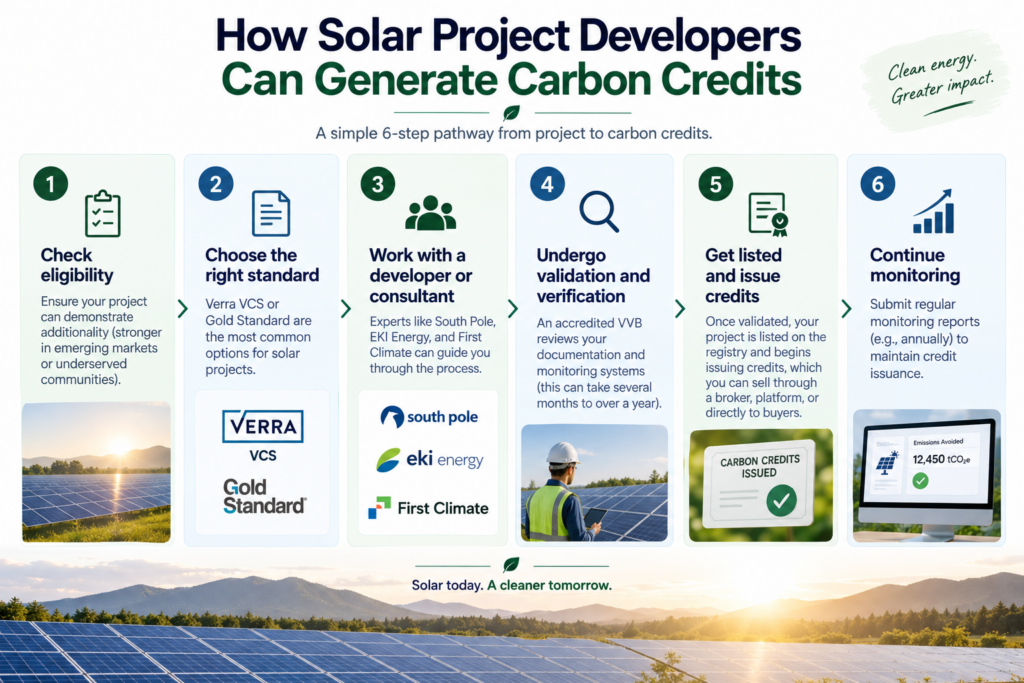
If you’re a solar developer looking to enter the carbon credit market, here’s a simplified pathway:
Step 1: Check your project’s eligibility Not every solar project qualifies. Projects in markets where solar is already fully cost-competitive without additional revenue may struggle to prove additionality. Projects in emerging markets or underserved communities tend to have stronger cases.
Step 2: Choose the right standard For global buyers, Verra VCS and Gold Standard are the two dominant choices. Verra is more widely used for renewable energy projects. Gold Standard requires more community engagement but may command a premium due to its rigorous co-benefit requirements.
Step 3: Hire a project developer or consultant Companies like South Pole, EKI Energy, and First Climate specialize in helping project developers navigate the registration process. This includes preparing the project design document, hiring a validation and verification body (VVB), and registering on the relevant registry.
Step 4: Undergo validation and verification An accredited VVB will review your documentation, inspect monitoring systems, and confirm that your project meets the standard’s requirements. This process can take anywhere from several months to over a year for complex projects.
Step 5: Get listed and issue credits Once validated, your project goes live on the registry and begins issuing credits based on verified emission reductions. You can then sell these credits through a broker, platform, or direct agreement with a corporate buyer.
Step 6: Continue monitoring Carbon credit standards require ongoing monitoring throughout the project’s lifetime. Annual or periodic verification reports must be submitted to maintain issuance.
Red Flags to Watch Out For
The carbon credit market, including the solar segment, has seen its share of controversy. Watch out for these warning signs.
Vague claims about verification: If a company says its credits are “certified” without specifying which standard, push for details.
No public registry listing: Every legitimate credit should be traceable to a public registry entry. If you can’t find the project online, be cautious.
Legacy renewable energy credits without additionality review: Older solar credits from mature markets where solar needed no financial help to survive are increasingly seen as low-integrity. Independent rating agencies have flagged many of these.
Prices that seem too good to be true: Very cheap credits ($1 to $3 per ton) almost always come with significant quality concerns. The market has moved decisively toward pricing quality over volume.
No disclosure of fees or margins: Transparent providers show exactly how your money flows to the project. Hidden margins are common in older brokerage models.
Frequently Asked Questions
Q: What is a solar carbon credit company? A solar carbon credit company is a business that develops, sells, trades, or manages carbon credits generated by solar energy projects. These companies connect solar project developers with buyers who want to offset their carbon emissions using verified solar-generated carbon certificates.
Q: Can I earn carbon credits from my rooftop solar panels? Yes, in some markets. If you’re a small-scale solar owner in a place like Alberta, Canada, companies like Solar Offset help you monetize your solar output as carbon credits. In the US, the equivalent mechanism is typically SRECs (Solar Renewable Energy Credits), which exist in states with Solar Carve-Outs in their Renewable Portfolio Standards.
Q: Are solar carbon credits the same as SRECs? No, but they’re related. SRECs represent one MWh of solar electricity and are traded primarily in compliance markets for renewable energy policy. Solar carbon credits (or solar carbon offsets) are issued based on CO2 avoided and traded in voluntary or compliance carbon markets. Both relate to solar’s environmental value but through different mechanisms and markets.
Q: How much are solar carbon credits worth? It depends on the market and credit quality. In the voluntary carbon market, solar avoidance credits typically trade between $3 and $25 per ton. SRECs vary widely by US state from under $10 in Ohio to over $400 in Washington D.C. High-integrity credits with strong additionality and independent ratings command premiums at the higher end.
Q: Which is the biggest solar carbon credit company in the world? South Pole Group is widely regarded as one of the largest global carbon project developers and has one of the most extensive renewable energy and solar project portfolios globally. EKI Energy Services holds the distinction of having been ranked among the top global developers of renewable energy carbon credits by volume. The landscape is competitive and spans multiple company types: project developers, brokers, and platforms.
Q: Are solar carbon credits reliable for corporate sustainability reports? They can be, but only if they meet current quality standards. Credits verified under Verra VCS or Gold Standard with current methodologies, carrying ICVCM CCP labels, and rated by independent agencies like BeZero or Sylvera are generally considered reliable for corporate reporting. Older legacy solar credits without strong additionality evidence are increasingly questioned.
Q: How do I know if a solar carbon credit company is legitimate? Check three things. First, verify that the credits are listed on a public registry like Verra or Gold Standard. Second, confirm the verification standard and methodology used. Third, look for independent ratings from BeZero Carbon, Sylvera, or Calyx Global. Any reputable solar carbon credit company will welcome these questions.
Q: What role does Article 6 play in solar carbon credits? Article 6 of the Paris Agreement creates an international framework for trading carbon credits across borders. Solar projects in developing countries can generate credits that transfer between countries’ nationally determined contributions (NDCs) under Article 6. With the rules finalized at COP29, this opens new commercial pathways for solar developers and buyers in international markets.
The Bottom Line
The solar carbon credit space is more dynamic and important than ever. From floating solar projects breaking new ground in India and the Comoros to small rooftop systems in Alberta generating passive carbon income, solar energy is proving its value far beyond just electricity generation.
The top solar carbon credit companies including South Pole, EKI Energy Services, 3Degrees, NativeEnergy, ClimatePartner, Sterling Planet, Regreener, Solar Offset, and First Climate are each carving out their own piece of this growing market, serving different buyer types, geographies, and quality standards.
What they all have in common is a recognition that the market is maturing. Quality, transparency, and additionality now matter more than ever. Whether you’re buying solar carbon credits to meet your company’s net-zero goals or you’re a solar developer looking to unlock a new revenue stream, the framework is clearer and the tools are better than they’ve ever been.
Start by asking the right questions. Check the registry. Demand independent ratings. And choose a company that treats credit quality as a feature, not an afterthought.
That’s how you make solar carbon credits work for you and for the planet.
Explore more resources on carbon markets, carbon credits, and climate finance at carbonmarketnetwork.com.