Carbon Market Network


A carbon credit is only as strong as the data behind it. That is why digital MRV exists.
If you develop projects, buy credits, or build climate tech, you have probably asked one question. Which digital MRV companies USA teams can actually trust?
Digital MRV (dMRV) means digital monitoring, reporting, and verification. It swaps slow spreadsheets and site visits for software, sensors, and satellites.
The United States has a strong mix of dMRV players. Some measure soil. Some track forests from space. Others connect project data to registries and buyers.
In this guide, you will find the top 10 digital MRV companies in the United States, a side-by-side table, honest limits, and a simple way to choose a partner.
What Is Digital MRV and Why Does It Matter?
MRV stands for measurement, reporting, and verification. It is how a carbon project proves what it removed or avoided.
Digital MRV does the same job with technology. It collects data automatically, checks it with software, and passes it to a verifier or registry.
The goal is simple: faster proof, lower cost, and data that buyers can trace.
How Digital MRV Works, Step by Step
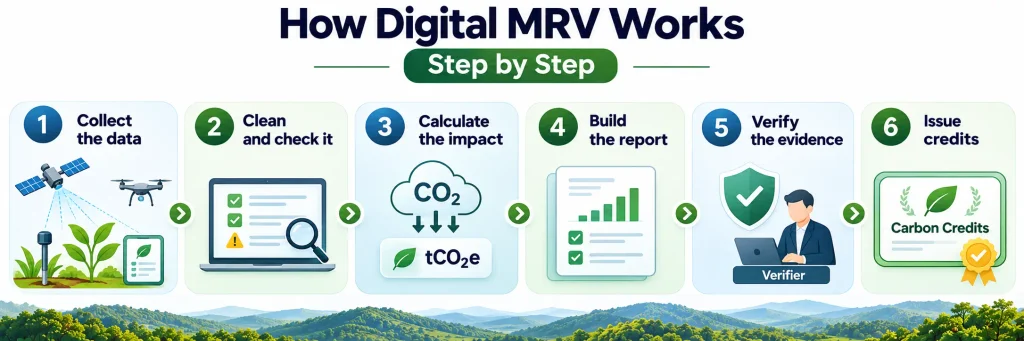
- Collect the data. Satellites, drones, soil probes, sensors, and farm records supply the raw inputs.
- Clean and check it. Software flags gaps, odd values, and duplicates.
- Calculate the impact. Models turn data into tonnes of CO2 removed or avoided, following a registry methodology.
- Build the report. The platform creates an audit-ready record.
- Verify the evidence. An independent verifier reviews the data, often inside the same system.
- Issue credits. The registry issues credits, sometimes in smaller and more frequent batches.
Traditional MRV vs Digital MRV
| Area | Traditional MRV | Digital MRV |
|---|---|---|
| Data collection | Manual and periodic | Automated and more frequent |
| Reporting | Spreadsheets and documents | Dashboards and structured data |
| Verification | Long audits after the fact | Faster review with a traceable record |
| Credit issuance | Often once a year or less | Moving toward monthly in some programs |
| Labor cost | High per project | Lower at scale |
| Buyer visibility | Mostly limited to auditors | Buyers can often see the underlying data |
Carbon Market Insider Newsletter
Weekly insights on carbon markets, climate policy, carbon credits, and sustainability.
Why the United States Is a Major Market for Digital MRV Companies
The US offers three things dMRV firms need: land, buyers, and projects.
Huge areas of cropland and forest create demand for soil carbon and forest carbon tools. Corporate buyers sign large, long deals. Industrial carbon removal projects keep growing, especially in the Midwest.
A few real examples show the pull:
- Microsoft agreed to buy 2.85 million soil carbon removal credits from Indigo Carbon over 12 years.
- Super6 Carbon picked a dMRV platform to manage data across its US Midwest carbon removal network.
- Charm Industrial runs operations and storage partners across the United States. It moved to a shared dMRV system to speed up credit issuance.
Registries Are Opening the Door
Registries now build digital paths into their own rules. That matters, because a dMRV tool is only useful when a registry accepts its data.
Verra approved its first credits under a dMRV pilot designed for high-frequency issuance. SustainCERT ran a fully digital verification for that project.
Under the pilot, a project can request 80 percent of approved credits right away. The remaining credits follow after a standard verification.
Puro.earth launched a dMRV interface so platforms can send data straight to its registry. Cula Technologies completed the first automated submission through it.
Isometric also issued its first credits through automated data sharing. Mangrove Systems fed the data, and Charm Industrial received 291 credits.
Buyers Want Proof They Can Trace
Buyers have grown cautious about credit quality. They ask where the numbers come from and how often they are checked.
Digital MRV answers those questions with a data trail. That trail is a big reason the best digital MRV companies USA buyers recognize keep growing.
How We Picked These Digital MRV Companies in the USA
We used a simple filter. Each company had to meet most of these points:
- US headquarters. We kept this list to US-based companies. A separate section covers international firms that serve US projects.
- A real dMRV product. The company offers monitoring, measurement, or reporting technology, not only advice.
- Registry or standard alignment. The tools connect to recognized standards or registries.
- Proven deployments. The company works with named programs, buyers, or projects.
- Clear focus. The company knows which project types it serves.
This is not a paid ranking. The order groups companies by what they do, not by a score.
Products change fast in this space. Always confirm current features with each vendor before you buy.
Quick Comparison: Top 10 Digital MRV Companies USA
| Company | Headquarters | Main focus | Core approach | Best for |
|---|---|---|---|---|
| Carbon Direct (with Pachama) | New York | Forest carbon and project diligence | Satellite and AI monitoring plus science review | Buyers and developers of forest projects |
| Indigo Carbon | Boston, Massachusetts | US cropland soil carbon | Sampling, modeling, and remote sensing | Farmers and corporate soil carbon buyers |
| Regrow | United States | Agriculture supply chains | Practice tracking and soil and emissions modeling | Food and agriculture companies |
| Perennial | Boulder, Colorado | Soil carbon quantification | Remote sensing and modeling | Soil carbon project developers |
| Yard Stick | United States | In-field soil measurement | Handheld probe and software | Projects that need ground truth |
| Chloris Geospatial | Boston, Massachusetts | Forest biomass | Satellite biomass estimates with uncertainty data | Forest developers, buyers, and standards bodies |
| Planet Labs | San Francisco, California | Forest carbon data | Satellite imagery with canopy and carbon layers | Teams that need raw monitoring data |
| Upstream Tech | Somerville, Massachusetts | Land monitoring platform | Lens dashboards and change alerts | Managers of nature-based projects |
| Boomitra | California | Soil carbon from space | Satellite imagery and machine learning | Ranchers and landowners in soil projects |
| Truterra | Arden Hills, Minnesota | Farm data and carbon programs | Insights Engine platform | Farmers working through ag retailers |
The Top 10 Digital MRV Companies in the United States
1. Carbon Direct (Including Pachama)
Headquarters: New York
Focus: Forest carbon dMRV, project diligence, and carbon management
Carbon Direct acquired Pachama, a California climate tech company that built digital MRV tools for forest carbon projects. Pachama launched in 2018 and became a well-known name in satellite and AI forest monitoring.
Carbon Direct has a team of more than 70 scientists and market experts. It has advised over 150 major clients on carbon removal, measurement, and clean energy.
The deal puts Pachama’s technology next to Carbon Direct’s science-led project review. Pachama’s co-founder and CEO joined the Carbon Direct team after the acquisition.
Before the deal, Isometric picked Pachama as its first dMRV partner for reforestation credits. That gave the platform early registry credibility.
Best for: Corporate buyers and developers who want forest monitoring and expert diligence in one place.
Keep in mind: Pachama’s tools now sit inside a larger advisory business. Ask how the products are packaged.
2. Indigo Carbon (Indigo Ag)
Headquarters: Boston, Massachusetts
Focus: Soil carbon credits from US cropland
Indigo Carbon is the carbon arm of Indigo Ag. Farmers adopt practices like cover cropping and reduced tillage. Indigo measures the results with soil sampling, modeling, remote sensing, and machine learning.
The Climate Action Reserve issues the credits under its Soil Enrichment Protocol. Indigo’s fifth US carbon crop added 1.1 million verified credits and pushed its total past 2 million tonnes.
The Reserve also issued the first sustainable agriculture credits to carry the Integrity Council’s Core Carbon Principles label. Those credits came from Indigo’s program.
Indigo also works with Truterra on a registered carbon program for farmers.
Best for: Farmers who want to earn from soil carbon, and buyers who want large volumes of registry-issued soil credits.
Keep in mind: Indigo runs its own program. It is not a neutral software vendor you license for a separate project.
3. Regrow Ag
Headquarters: United States
Focus: Agriculture MRV and supply chain programs
Regrow builds software for food and agriculture companies. Its MRV platform helps them enroll growers, track farm practices, model soil carbon and emissions, and report results.
Cargill’s RegenConnect program runs on Regrow’s MRV platform. Scoular also uses Regrow to handle MRV for its regenerative agriculture sourcing program.
The platform is built to follow standards such as Verra, SustainCERT, and the Climate Action Reserve. That helps companies turn farm data into certifiable results.
Best for: Food, beverage, and agribusiness companies that run farmer programs or want to back up Scope 3 claims.
Keep in mind: Regrow serves enterprises. Individual farmers usually join through a company program.
4. Perennial
Headquarters: Boulder, Colorado
Focus: Soil carbon measurement, reporting, and verification
Perennial started life as Cloud Agronomics and was founded in 2018. It builds an MRV platform that quantifies soil organic carbon from remote sensing and modeling.
The goal is to reduce how much physical soil sampling a project needs. That can lower the cost of generating soil carbon credits.
Perennial raised an $18 million Series A from investors that include Temasek, Bloomberg, and Microsoft. It also announced a soil carbon quantification software that Verra approved as tool VT0014.
Best for: Soil carbon project developers who want lower sampling costs.
Keep in mind: Remote methods still need field data to calibrate the models. Ask how many samples your project will need.
5. Yard Stick
Headquarters: United States (public benefit corporation)
Focus: In-field soil carbon measurement
Yard Stick tackles the most expensive part of soil carbon: measurement. Its handheld probe uses spectroscopy to read soil organic carbon in the field.
The company says it can measure to a depth of one meter and cut costs by 70 to 90 percent compared with other providers. Its software also builds sample plans that match major carbon methodologies.
Yard Stick raised a $12 million Series A to scale its measurement work.
Best for: Projects and programs that need trusted ground truth data.
Keep in mind: Yard Stick is a measurement specialist. You may need another platform for reporting and registry workflows.
6. Chloris Geospatial
Headquarters: Boston, Massachusetts
Focus: Satellite biomass and forest carbon monitoring
Chloris estimates forest biomass directly from space. It combines satellite data, machine learning, and field measurements to track carbon stocks over time.
Its data covers both losses from deforestation and gains from regrowth. Clients include project developers, standards bodies, credit buyers, and insurers.
Chloris has published guidance on using its data for afforestation and reforestation projects under Verra’s VM0047 method. Equitable Earth also uses Chloris data as its exclusive dMRV provider.
Best for: Forest developers, buyers, and raters who need independent biomass data.
Keep in mind: Satellite biomass estimates carry uncertainty. Check how the company reports it and how it validates against field data.
7. Planet Labs
Headquarters: San Francisco, California
Focus: Satellite data for forest carbon monitoring
Planet is a public company known for daily Earth imagery. It sells two forest carbon products that serve as digital MRV building blocks.
Forest Carbon Diligence is an archive at 30 meter resolution that reaches back to 2013. Forest Carbon Monitoring gives quarterly updates at 3 meter resolution. Both include canopy cover, canopy height, and aboveground carbon.
Planet designed these products for project and jurisdictional MRV. Carbon rating firm BeZero Carbon uses them, and platforms like Upstream Tech’s Lens offer them.
Best for: Teams that need high-quality monitoring data to feed their own tools.
Keep in mind: Planet supplies data, not a full project workflow. Pair it with a reporting platform.
8. Upstream Tech
Headquarters: Somerville, Massachusetts
Focus: Lens, a remote monitoring platform for land projects
Upstream Tech is a public benefit corporation. Its Lens platform turns satellite data into maps, change alerts, and reports for nature-based projects.
Lens supports project diligence, reversal monitoring, and landscape change detection. It brings in forest carbon data from Chloris and Planet.
More than 170 organizations used Lens at last report. The U.S. Forest Service has also partnered with Upstream Tech to give state agencies access to Lens through the Forest Legacy Program.
Best for: Project managers, land trusts, and developers who want one monitoring dashboard.
Keep in mind: Lens relies on third-party data layers. Ask which layer fits your methodology.
9. Boomitra
Headquarters: California
Focus: Soil carbon measured from space
Boomitra reads soil carbon with satellite imagery and machine learning models trained on a very large set of ground samples. It was the first remote sensing project to win Verra approval for soil carbon.
Its Northern Mexico grassland project received approval for 3.03 million credits. Verra called it the first North American project verified under its VM0042 soil carbon method. The project covers about 4 million acres and 158 ranchers.
Boomitra plans to use Verra’s digital soil mapping tool, VT0014, for future verifications.
Best for: Landowners and buyers who want satellite-based soil carbon measurement at large scale.
Keep in mind: Boomitra is US-based, but its flagship projects sit outside the United States. It also acts as a project developer, not only a software provider.
10. Truterra (Land O’Lakes)
Headquarters: Arden Hills, Minnesota
Focus: Farm data and carbon programs through ag retailers
Truterra is the sustainability business of Land O’Lakes, a large farmer-owned cooperative. Its Truterra Insights Engine collects field-level data on conservation practices and their results.
Truterra has paid more than $21 million to farmers for soil carbon storage. It also runs a registered carbon program together with Indigo Ag.
The program reaches farmers through trusted agronomy advisers at ag retailers. That local network helps with data collection, which is often the hardest part of farm MRV.
Best for: Farmers who prefer working through a local retailer and a familiar cooperative.
Keep in mind: Truterra focuses on its own programs. It is not a general MRV platform for outside developers.
International Digital MRV Providers Serving US Projects
Some of the busiest names in carbon removal dMRV sit outside the United States. They still support American projects, so they belong in any honest look at digital MRV companies USA developers use.
| Company | Headquarters | Focus | US connection |
|---|---|---|---|
| Mangrove Systems | Toronto, Canada | dMRV for carbon removal, carbon capture and storage, and low carbon fuels | Works with Charm Industrial and Super6 Carbon, and bought operating assets from the US biochar platform Grain Ecosystem |
| Isometric | United Kingdom | Carbon removal registry with its own dMRV platform | Issued credits to Charm Industrial through an automated data link with Mangrove |
| Carbonfuture | Germany | MRV+ platform for carbon removal | Serves developers and buyers of removal credits across several pathways |
Mangrove Systems in the US
Mangrove’s platform collects detailed data from Charm Industrial’s production sites and storage partners. It then sends that data straight to Isometric for verification.
For Super6 Carbon, Mangrove acts as a single system of record. Super6 supplies captured CO2 to ADM’s carbon capture and storage operations in Decatur, Illinois.
The platform also uses AI to pre-check reports before they reach a registry. That cuts back-and-forth and helps credits arrive sooner.
Isometric as a dMRV Hub
Isometric built its own dMRV platform and opened an API so outside providers can plug in. It works with more than a dozen dMRV providers.
Suppliers send data through a partner, and Isometric publishes the calculations behind each credit on its public registry. That gives buyers a permanent audit trail.
Digital MRV by Project Type
The right tool depends on what you are measuring. This table maps common US project types to the companies above.
| Project type | What dMRV tracks | Companies to look at |
|---|---|---|
| Soil carbon and regenerative agriculture | Farm practices, soil carbon stock, and emissions | Indigo Carbon, Regrow, Perennial, Yard Stick, Boomitra, Truterra |
| Forest carbon and reforestation | Biomass, canopy cover, forest loss, and regrowth | Carbon Direct (Pachama), Chloris, Planet Labs, Upstream Tech |
| Carbon capture, biochar, and BECCS | Operational data, CO2 stored, and lifecycle emissions | Mangrove Systems, Carbonfuture, Isometric |
| Registry connection | Data submission and credit issuance | Verra pilot, Puro.earth dMRV interface, Isometric Certify API |
How to Choose a Digital MRV Company: A Practical Process
Picking a vendor feels hard at first. A clear process makes it easier.
- Name your project type and methodology. Soil, forest, and carbon removal projects need very different tools.
- Check registry acceptance. Ask which registries and methodologies the vendor supports today.
- Ask about data sources and uncertainty. Good vendors show their error ranges and explain how they validate against field data.
- Test the integrations. Look for API links to your registry, your verifier, and your farm or plant systems.
- Review the audit trail. Your verifier should be able to trace every number back to its source.
- Clarify data ownership and pricing. Know who owns the data, what happens if you leave, and how fees are charged.
- Start with a pilot. Run one project or one season before you commit your whole portfolio.
Questions to Ask Every Vendor
| Question | Why it matters |
|---|---|
| Which registries accept your outputs? | A tool that no registry accepts adds cost, not value. |
| How do you report uncertainty? | Remote estimates carry error, and verifiers need to see it. |
| How much field data do we still need? | This drives your real cost per credit. |
| Can our verifier access the platform? | It speeds up review and cuts rework. |
| Who owns the data? | You need access to your records even if you switch vendors. |
| Can you name similar customers? | References prove the tool works on projects like yours. |
Red Flags to Watch For
- No named registry or methodology support
- No uncertainty numbers
- Claims that software removes the need for verification
- Locked data that you cannot export
- No customers who run projects like yours
What Digital MRV Cannot Do (Yet)
Digital MRV is powerful, but it is not magic. It does not create carbon removal. It only measures and records it.
Bad inputs still produce bad outputs. A clean dashboard cannot fix a weak methodology or poor field data.
Registries also keep humans in the loop. In Verra’s pilot, projects can request most credits right away, but the rest still waits for a standard verification.
Analysts have warned that carbon removal developers face operational and verification risks if they rely only on software-based monitoring. Sensors fail. Data feeds break. People still need to check.
Remote sensing has limits too. Satellite and model-based estimates carry error, which is why companies like Chloris share uncertainty data and why Yard Stick focuses on ground truth.
The smart approach blends both: digital tools for speed and scale, and field checks for trust.
Trends Shaping Digital MRV Companies in the USA
The market moves fast. These shifts matter most right now.
- Faster issuance. Registries are testing monthly or bi-monthly credit issuance backed by digital data.
- API-first connections. Platforms now send data straight to registries, as Puro.earth and Isometric support.
- AI pre-checks. Software reviews reports before a verifier sees them, which saves time.
- Consolidation. Carbon Direct bought Pachama, and Mangrove took over Grain Ecosystem’s operating assets.
- Digital tools inside methodologies. Verra’s VT0014 shows registries will approve digital tools for specific jobs.
- Wider pilots. Verra is testing its dMRV process on carbon capture and storage and clean cookstove projects.
- Remote plus ground data. The winners combine satellite scale with real field measurements.
Conclusion: Choosing Among Digital MRV Companies in the USA
Digital MRV is quickly becoming the backbone of credible carbon markets. The best digital MRV companies USA projects use today make data faster, cheaper, and easier to trust.
The ten companies above cover the main needs. Carbon Direct, Chloris, Planet, and Upstream Tech serve forest projects. Indigo, Regrow, Perennial, Yard Stick, Boomitra, and Truterra serve soil and agriculture. International players like Mangrove and Isometric lead in carbon removal.
Here are your next steps:
- Define your project type and methodology first.
- Confirm registry acceptance before you sign anything.
- Ask every vendor for uncertainty data and customer references.
- Pilot on one project before you scale.
- Keep field checks in your plan.
Start there, and you will cut risk, speed up verification, and give buyers the proof they want.
Frequently Asked Questions About Digital MRV Companies in the USA
What are digital MRV companies?
Digital MRV companies build software, sensors, and data tools that measure, report, and verify climate impact. They help carbon projects prove removals or reductions faster and with a clear data trail.
Which are the top digital MRV companies in the USA?
Strong US names include Carbon Direct (with Pachama), Indigo Carbon, Regrow, Perennial, Yard Stick, Chloris Geospatial, Planet Labs, Upstream Tech, Boomitra, and Truterra. Each one focuses on a different project type.
How is digital MRV different from traditional MRV?
Traditional MRV relies on manual data collection and periodic audits. Digital MRV automates data collection, checks it with software, and shares it with verifiers and registries more often.
Does Verra accept digital MRV?
Verra runs a dMRV pilot and has approved its first credits under it. It has also approved a digital soil mapping tool, VT0014. Rules differ by project type, so check the methodology you plan to use.
Which digital MRV company is best for soil carbon?
It depends on your role. Indigo and Truterra work through farmer programs. Regrow suits food and agriculture companies. Perennial, Boomitra, and Yard Stick focus on measuring soil carbon itself.
Which digital MRV companies suit carbon removal projects?
Mangrove Systems, Carbonfuture, and Isometric lead in biochar, BECCS, and other engineered removal. None of them is headquartered in the United States, but all can support US projects.
Can digital MRV replace third-party verification?
No. Digital MRV makes verification faster and more transparent, but registries still require independent verifiers.
How much do digital MRV platforms cost?
Pricing varies by project size, data needs, and vendor. Some charge per hectare, others per project or per credit, so ask for a written quote and compare the full cost, including field data.
If you want to learn more about how carbon markets work, how credits are issued, and what makes a high-quality carbon project, explore the resources at Carbon Market Network.