Carbon Market Network


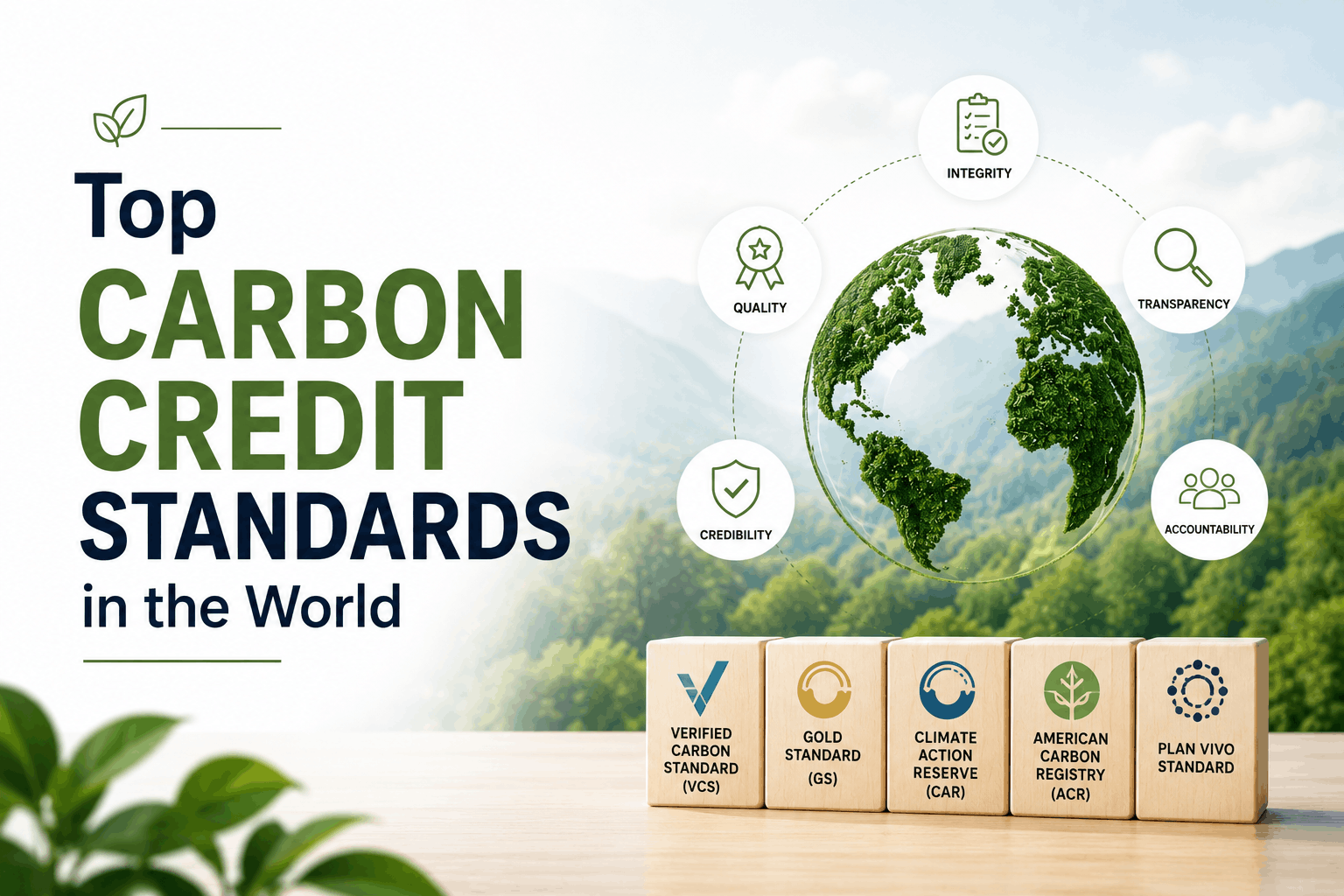
If you have ever wondered whether a carbon credit is actually worth anything, the answer comes down to one thing: the standard behind it.
Carbon credit standards are the rulebooks that determine how a carbon project is designed, measured, verified, and approved before it can issue a credit. Without these standards, any company could claim to have reduced emissions without proof. The standards make the whole system trustworthy.
This guide covers all the major carbon credit standards in the world, how they work, what makes them different, and why they matter to buyers, project developers, and anyone trying to understand the carbon market.
What Are Carbon Credit Standards?
A carbon credit standard is a set of rules and methodologies that a carbon project must follow to get certified and issue carbon credits.
Think of it like a quality certification. Just as food products carry safety certifications, carbon credits carry the label of the standard that approved them.
These standards define:
- What kinds of projects qualify (forests, renewable energy, methane capture, etc.)
- How emissions reductions are measured (the methodology)
- How projects are verified by independent auditors
- How credits are tracked in a registry to prevent double-counting
- What safeguards must be in place for local communities and ecosystems
A carbon credit without a recognized standard behind it is essentially unverifiable. That is why standards sit at the heart of every serious carbon market discussion.
Why Carbon Credit Standards Matter
The voluntary carbon market grew fast, and not all of it grew well. Some early projects were found to be over-crediting. Others did not deliver the benefits they promised. Poor-quality credits damaged trust in the entire system.
Standards are the response to that problem.
When a carbon credit carries a recognized standard, it means:
- The emissions reduction is real and measured accurately
- An independent third party verified the project
- The reduction is additional, meaning it would not have happened without carbon finance
- The credit is registered in a transparent, publicly searchable database
- The project does not harm local communities or biodiversity
High-quality carbon credit standards raise the bar so that only genuine climate action gets rewarded.
The 5 Core Quality Criteria Behind Every Standard
Before diving into the specific standards, it helps to understand what every serious carbon credit standard tries to achieve. Most standards are built around five core quality criteria.
| Quality Criterion | What It Means |
|---|---|
| Additionality | The project would not have happened without carbon credit revenue |
| Permanence | The emissions reductions or removals last long-term |
| Measurability | Reductions can be accurately quantified using approved methods |
| No Leakage | Reducing emissions in one place does not simply push them elsewhere |
| No Double Counting | The same credit is not counted by two different entities |
These five criteria form the foundation of all major carbon credit standards. The standards differ mainly in how strictly they apply each criterion, what project types they cover, and what additional benefits they require.
The Major Carbon Credit Standards in the World
1. Verra Verified Carbon Standard (VCS)
Overview: Verra’s Verified Carbon Standard is the largest carbon crediting program in the world by volume.
Founded: 2007 Headquarters: Washington D.C., USA Credits issued: Over 1 billion Verified Carbon Units (VCUs) across 2,300+ projects in 80+ countries Unit name: Verified Carbon Unit (VCU)
Verra’s VCS program covers an enormous range of project types: REDD+ (protecting forests from deforestation), renewable energy, sustainable agriculture, cookstoves, waste management, wetlands, and more.
Each VCU represents one metric ton of CO2 equivalent that has been reduced or removed from the atmosphere.
How Verra Works:
- A project developer designs a project following a VCS-approved methodology
- An accredited third-party auditor validates the project before it starts
- The project carries out its activities and monitors results
- A different third-party auditor verifies the emissions reductions
- Verra registers the project and issues VCUs on its public registry
Key Strengths of Verra VCS:
- Largest global reach and project diversity
- Deep liquidity in the market
- Accepted in compliance markets in Colombia, South Africa, and for aviation under CORSIA
- Publicly searchable registry at public.verra.org
- VCS Version 5 introduced tightened requirements on rights, safeguards, and baseline reassessment
Who Uses Verra:
Verra is used by Fortune 500 companies, financial institutions, airlines, and governments worldwide. Its scale makes it the default choice for large buyers seeking volume and variety.
Recent Development: Verra has received CCP-Eligible status from the ICVCM (Integrity Council for the Voluntary Carbon Market), meaning Verra projects using approved methodologies can now carry the CCP label, the market’s emerging quality benchmark.
2. Gold Standard
Overview: Gold Standard is the premium carbon crediting standard known for combining climate action with verified social and economic benefits.
Founded: 2003 (by WWF and other NGOs) Headquarters: Geneva, Switzerland Projects: 3,500+ projects in 80+ countries Unit name: Gold Standard Verified Emission Reduction (GS-VER)
Gold Standard was created specifically to raise the bar above the Clean Development Mechanism (CDM). Its founders wanted carbon projects to do more than just reduce emissions. They had to improve lives too.
The Gold Standard Difference:
Every Gold Standard project must demonstrate contributions to the UN Sustainable Development Goals (SDGs) beyond just climate. This makes it particularly attractive to buyers who want to show social and environmental co-benefits alongside emissions reductions.
Project types include:
- Clean cooking solutions
- Solar and wind energy
- Safe water access
- Forest and land use projects
- Energy efficiency programs
How Gold Standard Works:
- Projects follow Gold Standard’s Foundation for Global Goals (GS4GG) framework
- Stakeholder consultation is mandatory before project approval
- SDG impacts are identified, monitored, and reported
- Independent auditors verify both climate and development outcomes
- Credits are issued on the Gold Standard registry
Recent Development: Gold Standard introduced stronger additionality requirements and updated baseline conservativeness rules as part of its latest rule refresh. It also joined Verra and Singapore to publish a joint Article 6.2 Crediting Protocol, actively bridging voluntary and compliance markets.
For Paris-aligned buyers, all Gold Standard projects minted from the latest cycle must demonstrate alignment with host country NDC goals.
Who Uses Gold Standard:
Gold Standard is favored by ESG-focused corporates, foundations, and buyers who want to tell a richer story about the projects behind their credits.
3. American Carbon Registry (ACR)
Overview: ACR is the oldest voluntary greenhouse gas registry in the world, with a strong track record in North America.
Founded: 1996 Headquarters: Nashville, Tennessee, USA Unit name: Emission Reduction Tonne (ERT)
ACR was founded before carbon markets even had a mainstream existence. It built its reputation on rigorous methodology development for forestry, agriculture, and industrial gas projects.
Key Features of ACR:
- First voluntary GHG registry globally
- First registry to receive full program-level CCP-Eligible approval from the ICVCM
- Accepted in California’s cap-and-trade program and the Regional Greenhouse Gas Initiative (RGGI)
- Strong compliance market bridge for US-based projects
- Known for rigorous, science-based methodologies
How ACR Works:
- Project developers submit projects against ACR’s approved protocols
- Mandatory independent third-party validation is required before registration
- Strict Monitoring, Reporting, and Verification (MRV) protocols govern each project
- Additionality must be proven: the reduction would not have happened without ACR’s crediting
- For forestry projects, buffer pools protect against reversal from fires or disease
ICVCM CCP Status: ACR was the first program globally to receive full program-level approval from the ICVCM under the Core Carbon Principles. This first-mover integrity advantage has made ACR the integrity incumbent in North America.
Who Uses ACR:
US-based companies looking for compliance-grade voluntary credits, agricultural sector participants, and those seeking California-linked offsets.
4. Climate Action Reserve (CAR)
Overview: CAR is a leading carbon offset program focused on North American projects, with a strong emphasis on environmental integrity and policy alignment.
Founded: 2001 (as the California Climate Action Registry) Headquarters: Los Angeles, California, USA Unit name: Climate Reserve Tonne (CRT)
CAR grew directly out of California’s climate policy ecosystem and has remained tightly aligned with regulatory compliance. It focuses on sectors where emissions reductions are measurable and meaningful.
Project Types Covered:
- Forests (the largest category)
- Livestock and manure management
- Ozone-depleting substance destruction
- Urban forests
- Mine methane capture
How CAR Works:
- Developers follow CAR’s published protocols, which include eligibility criteria and quantification methods
- All projects undergo accredited third-party verification before any credits are issued
- CAR issues CRTs and registers them on its transparent online registry
- Projects must adhere to monitoring and reporting requirements throughout their lifetime
Key Strengths:
- Strong link to California’s cap-and-trade program
- Rigorous protocol development process with public comment periods
- CCP-Eligible status from the ICVCM
- Widely accepted in CORSIA-eligible aviation offsets
Who Uses CAR:
Companies managing compliance obligations in California, US-focused project developers, and buyers seeking North American provenance.
5. Plan Vivo
Overview: Plan Vivo is the oldest smallholder-focused carbon standard in the world, built specifically for community-based land use projects.
Founded: 1994 Headquarters: Edinburgh, Scotland Unit name: Plan Vivo Certificate (PVC)
Plan Vivo was created to channel climate finance directly to smallholder farmers and rural communities. It is not a standard for industrial projects. It is designed for grassroots, community-owned initiatives in agroforestry, reforestation, and sustainable land management.
What Makes Plan Vivo Unique:
- 60% of income from credit sales goes directly to local communities
- Projects are designed by and for local stakeholders
- Supports ex-ante crediting: projects can issue credits based on future sequestration projections, enabling early-stage funding
- Strong safeguards for indigenous and local communities
- Aligns with CSRD, SBTi, and TCFD reporting frameworks
How Plan Vivo Works:
- Communities develop their own land management plans with technical support
- Projects are independently validated by Plan Vivo-approved auditors
- Serialized credits are issued in a transparent registry
- Buffer pools manage reversal risk
- Ongoing monitoring ensures the community continues to benefit
Recent Development: Plan Vivo received CCP-Eligible status from the ICVCM in August 2026, confirming that its governance, transparency, safeguards, and quality-assurance systems meet the global benchmark for high-integrity carbon credits.
Who Uses Plan Vivo:
Buyers who prioritize community development alongside climate impact, fashion and consumer goods companies wanting Scope 3 credits with a strong human story, and ESG buyers targeting biodiversity and livelihood co-benefits.
6. Architecture for REDD+ Transactions (ART TREES)
Overview: ART TREES is the leading standard for jurisdictional REDD+ credits, meaning it works at the national or subnational government level rather than individual project level.
Founded: 2018 Full Name: Architecture for REDD+ Transactions, The REDD+ Environmental Excellence Standard (TREES) Unit name: TREES Emission Reduction (TER)
Most carbon standards work project-by-project. ART TREES works differently. It certifies entire countries or states that have committed to reducing deforestation across their jurisdiction.
Why Jurisdictional REDD+ Matters:
Individual forest projects can have a leakage problem: protecting one forest might push logging to the next valley. A jurisdictional approach covers the whole landscape and eliminates this issue.
Key Features:
- Designed for national governments and subnational entities (states, provinces)
- Requires host governments to have robust forest monitoring systems (usually satellite-based)
- CCP-Eligible status from the ICVCM
- Approved for use under CORSIA for aviation carbon offsets
- Several major sovereign credits have been issued under ART TREES (e.g., Guyana, Ghana)
Who Uses ART TREES:
Airlines seeking CORSIA-eligible credits, large buyers wanting sovereign-grade nature-based credits, and countries looking to monetize national forest stewardship.
7. Puro.earth
Overview: Puro.earth is the world’s leading standard exclusively for engineered and durable carbon removal.
Founded: 2019 Headquarters: Helsinki, Finland Unit name: CO2 Removal Certificate (CORC)
Puro.earth is fundamentally different from most other standards. It does not certify emissions avoidance. It only certifies carbon dioxide removal that is durable, meaning the carbon is stored for a long period.
Project Types Supported:
- Biochar (carbon locked into soil amendments for hundreds of years)
- Bioenergy with carbon capture (BECCS)
- Timber in building (storing carbon in long-lived wooden structures)
- Biogenic carbonation of concrete
- Enhanced weathering
Each CORC represents one metric ton of CO2 permanently removed and stored, verified by independent third-party auditors.
Why Puro.earth Is Important:
The world cannot reach net zero through avoidance credits alone. Physical removal of CO2 is also necessary. Puro.earth fills a gap that most traditional standards leave open.
Recent Development: Puro.earth received CCP-Eligible status from the ICVCM, recognizing its governance, tracking, transparency, and verification systems as meeting the Core Carbon Principles.
Who Uses Puro.earth:
Tech companies with net-zero commitments, buyers looking for high-durability removal credits, and organizations whose supply chains are hard to decarbonize.
8. Global Carbon Council (GCC)
Overview: The Global Carbon Council is the first carbon crediting standard established in the Middle East and North Africa (MENA) region.
Founded: 2016 Headquarters: Doha, Qatar (under AASRTG) Unit name: Approved Carbon Unit (ACU)
GCC was created to develop carbon markets in regions that were previously underserved by major global standards. It has grown rapidly and now operates across MENA, Asia, and Africa.
Key Features:
- Follows UNFCCC and ISO-aligned methodologies
- Projects span renewable energy, energy efficiency, and waste management
- CCP-Eligible status from the ICVCM, announced in 2026
- CORSIA-approved for aviation offset use
- Transparent registry with publicly searchable project data
Who Uses GCC:
Companies and project developers in the Gulf region and broader developing world, airlines seeking CORSIA credits, and buyers looking to support emerging market projects.
9. Cercarbono
Overview: Cercarbono is the largest carbon crediting standard headquartered in Latin America, and the most influential program in the region.
Founded: 2013 Headquarters: Bogotá, Colombia Unit name: Cercarbono Carbon Unit (CCU)
Cercarbono has certified over 200 registered projects across 25+ countries and issued approximately 130 million credits, representing about 7% of the global voluntary carbon market.
Key Features:
- Accepted in compliance mechanisms in Colombia, Mexico, Chile, Ecuador, and Peru
- Covers nature-based solutions, biodiversity credits, circular economy projects
- CCP-Eligible status from the ICVCM, approved in August 2026
- The only Latin America-headquartered program approved under the CCP framework
Why It Matters:
Cercarbono’s CCP approval signals that high-integrity carbon crediting is no longer just a story from the Global North. Latin America’s natural capital is now accessible through a fully recognized, internationally benchmarked standard.
Who Uses Cercarbono:
Project developers across Latin America, regional compliance buyers, and global buyers seeking nature-based credits from Amazonian and Andean ecosystems.
10. Isometric
Overview: Isometric is a newer carbon removal registry focused on scientific rigor and transparency, specifically designed for the emerging carbon removal industry.
Founded: 2021 Headquarters: San Francisco, California, USA
Isometric stands apart by publishing its full protocols and all project data publicly, enabling independent scientific scrutiny. It targets high-quality carbon removal methodologies including enhanced rock weathering and direct air capture.
Key Features:
- Science-first approach with fully open protocols
- CCP-Eligible status from the ICVCM
- Focus on durable removal methods
- Designed to earn trust from the scientific community, not just buyers
Who Uses Isometric:
Tech companies purchasing high-quality removal credits, researchers and buyers who demand full scientific transparency, and removal project developers seeking credible certification.
The ICVCM Core Carbon Principles: The New Global Quality Benchmark
No article on carbon credit standards is complete without discussing the Integrity Council for the Voluntary Carbon Market (ICVCM) and its Core Carbon Principles (CCPs).
The ICVCM is an independent governance body created to set a global quality floor for voluntary carbon credits. It developed ten Core Carbon Principles that any crediting program must meet to receive the CCP label.
The Ten Core Carbon Principles:
| Pillar | Core Carbon Principles |
|---|---|
| Governance | Effective governance, tracking, transparency, robust third-party validation and verification |
| Emissions Impact | Additionality, permanence, robust quantification, no double counting |
| Sustainable Development | Sustainable development safeguards, net global emission reductions |
The Two-Tick System:
The ICVCM uses what it calls a “two-tick” process:
- CCP-Eligible: The crediting program itself meets the governance and transparency requirements
- CCP-Approved: Individual methodologies within that program also pass the rigor test
A credit only earns the CCP label when both ticks are in place.
Programs Approved as CCP-Eligible (as of September 2026):
- ACR (American Carbon Registry)
- ART TREES
- CAR (Climate Action Reserve)
- Cercarbono
- Equitable Earth
- Gold Standard
- GCC (Global Carbon Council)
- Isometric
- Plan Vivo
- Puro.earth
- Rainbow
- Verra (VCS)
These twelve programs collectively represent approximately 98% of voluntary carbon market volume.
Why the CCP Label Matters:
Credits without the CCP label are increasingly seen as higher risk by auditors, investors, and regulators. Buyers subject to CSRD disclosure requirements, SBTi targets, or EU greenwashing rules are under pressure to source CCP-aligned credits.
The Paris Agreement Crediting Mechanism (PACM): The UN Standard
While most standards above operate in the voluntary market, the Paris Agreement Crediting Mechanism (PACM) operates at the international government level under the United Nations.
What Is PACM?
PACM is the successor to the Clean Development Mechanism (CDM), which was the UN’s previous carbon crediting system under the Kyoto Protocol. PACM was established under Article 6.4 of the Paris Agreement and is governed by the Article 6.4 Supervisory Body under the UNFCCC.
Key Facts:
- The CDM officially closed at the end of 2026 after issuing nearly 2.5 billion credits since 2001
- PACM issued its first credits in February 2026
- Credits under PACM are called Article 6.4 Emission Reductions (A6.4 ERs)
- Stricter baseline rules mean PACM projects issue fewer credits than equivalent CDM projects, but each credit is more credible
What Makes PACM Different:
| Feature | CDM | PACM |
|---|---|---|
| Governing Agreement | Kyoto Protocol | Paris Agreement |
| Baseline stringency | Moderate | Stricter |
| Host country requirement | Developing countries only | All countries |
| NDC alignment required | No | Yes |
| Double-counting prevention | Weak | Mandatory corresponding adjustments |
Why PACM Matters:
PACM brings government-to-government accountability into carbon crediting. When a credit is issued under Article 6.4, the host country must apply a “corresponding adjustment,” removing that emission reduction from its own national accounting. This prevents the same reduction being counted twice.
This is the standard that will govern sovereign carbon trading between nations going forward.
Compliance Standards vs. Voluntary Standards
It is worth understanding the two broad categories of carbon credit standards.
| Feature | Voluntary Standards | Compliance/Regulatory Standards |
|---|---|---|
| Who uses them | Corporates, individuals, projects | Governments, regulated industries |
| Examples | Verra, Gold Standard, Plan Vivo, Puro.earth | CDM (retired), California ARB, EU ETS, PACM |
| Legal requirement | No (but increasingly expected) | Yes |
| Market | Voluntary carbon market (VCM) | Compliance carbon markets |
| Credit price drivers | Brand, quality, buyer preference | Regulatory supply/demand |
Many leading standards now bridge both worlds. Verra, ACR, CAR, Gold Standard, and ART TREES are all accepted in one or more compliance markets in addition to the voluntary market.
How to Choose the Right Carbon Credit Standard
The right standard depends on what you are trying to do.
If you are a project developer:
- For global reach and broad project types, choose Verra VCS
- For projects with strong SDG and community impact, choose Gold Standard
- For US-based forestry or agriculture projects, choose ACR or CAR
- For community-run smallholder projects, choose Plan Vivo
- For jurisdictional REDD+ at the government level, choose ART TREES
- For engineered carbon removal, choose Puro.earth or Isometric
- For Latin American projects, consider Cercarbono
- For MENA and Asia projects, consider GCC
If you are a corporate buyer:
- Prioritize programs with CCP-Eligible status from the ICVCM
- Look for methodologies with CCP-Approved status for even higher confidence
- Choose a standard that matches your reporting framework (CSRD, SBTi, VCMI)
- For aviation compliance, check CORSIA eligibility
If you are a beginner learning the market:
Start with Verra and Gold Standard. They are the two most widely known, most researched, and most discussed standards globally. Understanding these two gives you the foundation to understand all others.
Quick Comparison of Major Carbon Credit Standards
| Standard | Founded | Region Focus | Project Types | CCP-Eligible |
|---|---|---|---|---|
| Verra VCS | 2007 | Global | Nature, energy, waste, agriculture | Yes |
| Gold Standard | 2003 | Global | SDG-linked energy and community | Yes |
| ACR | 1996 | North America | Forestry, agriculture, industrial | Yes |
| CAR | 2001 | North America | Forestry, livestock, ODS | Yes |
| Plan Vivo | 1994 | Global (community) | Agroforestry, smallholder land use | Yes |
| ART TREES | 2018 | Global | Jurisdictional REDD+ | Yes |
| Puro.earth | 2019 | Global | Engineered carbon removal | Yes |
| GCC | 2016 | MENA and Asia | Renewable energy, efficiency | Yes |
| Cercarbono | 2013 | Latin America | Nature-based, biodiversity | Yes |
| Isometric | 2021 | Global | Durable carbon removal | Yes |
| PACM (Article 6.4) | 2024 | Global (sovereign) | All sectors | UN-governed |
What the Future Looks Like for Carbon Credit Standards
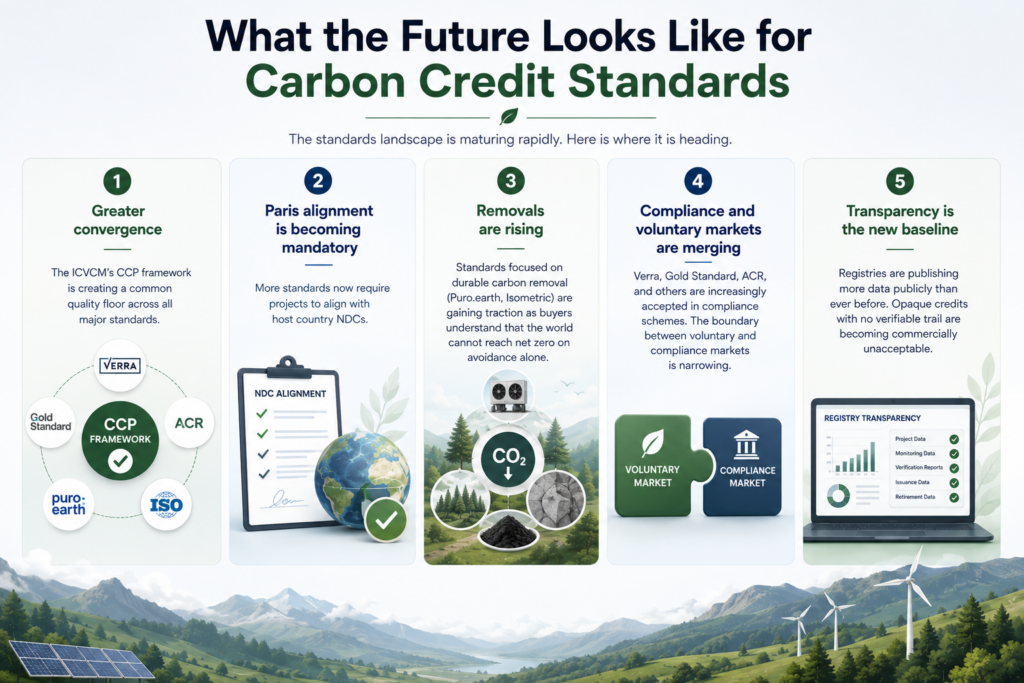
The standards landscape is maturing rapidly. Here is where it is heading.
Greater convergence: The ICVCM’s CCP framework is creating a common quality floor across all major standards. Buyers no longer have to choose between standards based on guesswork.
Paris alignment is becoming mandatory: More standards now require projects to align with host country NDCs. This prevents the voluntary market from undermining national climate commitments.
Removals are rising: Standards focused on durable carbon removal (Puro.earth, Isometric) are gaining traction as buyers understand that the world cannot reach net zero on avoidance alone.
Compliance and voluntary markets are merging: Verra, Gold Standard, ACR, and others are increasingly accepted in compliance schemes. The boundary between voluntary and compliance markets is narrowing.
Transparency is the new baseline: Registries are publishing more data publicly than ever before. Opaque credits with no verifiable trail are becoming commercially unacceptable.
FAQ: Carbon Credit Standards
What is the most widely used carbon credit standard in the world?
Verra’s Verified Carbon Standard (VCS) is the largest by volume, having issued over one billion credits across more than 2,300 projects worldwide.
What is the difference between Verra and Gold Standard?
Verra focuses on scale, diversity of project types, and global market liquidity. Gold Standard requires projects to demonstrate verified social and environmental co-benefits alongside emissions reductions. Both are globally recognized and CCP-Eligible.
What does CCP-Eligible mean?
It means the carbon crediting program meets the governance, transparency, tracking, and verification requirements of the ICVCM’s Core Carbon Principles. It is the global quality benchmark for voluntary carbon programs.
Are there carbon credit standards just for carbon removal?
Yes. Puro.earth and Isometric specialize in durable, engineered carbon removal. They certify projects like biochar, timber buildings, and enhanced weathering, not emissions avoidance.
What is the difference between a carbon credit standard and a carbon credit registry?
A standard sets the rules and methodologies. A registry is the database where credits are issued, tracked, and retired. Some organizations (like Verra) run both a standard and a registry. Others keep them separate.
What happened to the CDM (Clean Development Mechanism)?
The CDM was the UN’s previous carbon crediting system under the Kyoto Protocol. It was formally closed at the end of 2026, and the funds were transferred to support the Paris Agreement Crediting Mechanism (PACM), its successor.
Do carbon credit standards work for beginners and small projects?
Plan Vivo is specifically designed for small-scale, community-run projects and is an excellent starting point for smallholders. Gold Standard also has simplified pathways for smaller projects.
How do I verify if a carbon credit is real?
Check the public registry of the standard that issued it. Verra, Gold Standard, ACR, CAR, and others all maintain searchable online databases where you can look up any registered project and see its status, vintage, and retirement history.
Conclusion
Carbon credit standards are not paperwork. They are the foundation of trust in the carbon market.
Without standards like Verra, Gold Standard, ACR, Plan Vivo, Puro.earth, and the ICVCM’s Core Carbon Principles, there is no way to know whether a carbon credit represents real climate action or just creative accounting.
The market has changed dramatically. The days of ambiguous, unverified credits are over. Today, the best carbon credit standards in the world compete not just on volume but on integrity, scientific rigor, and real-world impact.
Whether you are a project developer looking to certify your first forest, a corporate buyer building a credible climate portfolio, or a curious reader trying to make sense of all the acronyms: start with the standards. They tell you everything you need to know about the quality of the credit in your hand.
Want to learn more about how carbon markets work? Explore the free resources at Carbon Market Network and join thousands of learners who are building real carbon market knowledge from the ground up.