Carbon Market Network



India’s farmers have always worked hard to feed a nation of 1.4 billion people. But what if the very way they farm could also pay them for fighting climate change?
That is exactly what agricultural carbon credits make possible. Farmers who adopt practices that reduce greenhouse gas emissions or capture carbon in the soil can now earn credits and sell them to companies that need to offset their own emissions. It is a second income stream built right into the farm.
India is at a turning point. With the Indian Carbon Market (ICM) now live, the Union Budget 2026-27 committing Rs 20,000 crore to a Carbon Capture, Utilisation, and Storage (CCUS) programme, and global giants like Amazon already signing deals with Indian farmers, agricultural carbon credits have moved from concept to reality.
This guide explains everything you need to know about agricultural carbon credits in India: what they are, how they work, how farmers earn them, how much they pay, and what to do right now to get started.
What Are Agricultural Carbon Credits?
A carbon credit represents one tonne of carbon dioxide (CO2) or its equivalent in other greenhouse gases that has been reduced or removed from the atmosphere.
When a farmer changes their farming practice in a way that either stores more carbon in the soil or reduces methane and nitrous oxide emissions from their fields, those reductions can be measured, verified, and converted into carbon credits.
Those credits are then sold to companies, governments, or organisations that need to compensate for their own emissions. The farmer earns money. The buyer meets their climate goals. And the atmosphere benefits.
This is why agricultural carbon credits are often called a win-win.
Carbon Market Insider Newsletter
Weekly insights on carbon markets, climate policy, carbon credits, and sustainability.
Why India Is a Big Opportunity for Agricultural Carbon Credits
India has close to 170 million hectares of agricultural land, making it one of the largest farming nations in the world.
Agriculture contributes roughly 14 to 15 percent of India’s total greenhouse gas emissions, with paddy fields, livestock, and the use of synthetic fertilisers being major sources.
At the same time, Indian soils have lost significant organic carbon over decades of intensive farming. That means there is enormous room to restore carbon and earn credits in the process.
Here is why the opportunity is growing fast:
- Scale: With over 140 million hectares of cultivable land, regenerative agriculture and biochar projects could generate millions of credits each year.
- Policy momentum: The Carbon Credit Trading Scheme (CCTS) is now operational, and farmers can participate through its Offset Mechanism.
- Market growth: India’s carbon credit market was estimated at USD 4.17 billion in 2025 and is projected to grow to USD 48.24 billion by 2032.
- Global buyers: Companies like Amazon, Google, and Indian corporates are actively purchasing agricultural carbon credits from India.
- Government support: Budget 2026-27 introduced a Rs 20,000 crore CCUS support programme that directly brings farmers into the carbon market.
How Do Agricultural Carbon Credits Work in India?
The basic idea is straightforward. A farmer adopts a practice that reduces greenhouse gas emissions or increases carbon storage. This change is measured, reported, and verified by an accredited third party. Once verified, the carbon credits are issued and can be sold.
Let us break this down step by step.
Step 1: Adopt an Eligible Farming Practice
Not all farming activities qualify. The practice must result in a measurable change compared to what the farmer was doing before. Common eligible practices in India include:
- Switching from transplanted rice to Direct Seeded Rice (DSR)
- Using Alternate Wetting and Drying (AWD) in paddy fields to reduce methane
- Reducing or eliminating stubble burning
- Adopting zero tillage or conservation tillage
- Using biochar in the soil
- Planting trees on farmland (agroforestry)
- Applying biological fertilisers instead of synthetic nitrogen inputs
- Natural farming and regenerative agriculture practices
Step 2: Establish a Baseline
Before credits can be calculated, someone must document what the farm looked like before the practice changed. This is called the baseline.
For soil carbon projects, this involves soil tests and records of current farming practices. For tree planting, maps, land status, and plantation plans are documented.
The baseline is critical because carbon credits represent the difference between what emissions were before and what they are now.
Step 3: Register the Project
The project is registered with an approved carbon standard or registry. In India, two main channels exist:
- Indian Carbon Market (ICM) / CCTS Offset Mechanism: Managed through Grid-India, India’s official registry. Projects registered here earn Carbon Credit Certificates (CCCs) that can be sold to compliance buyers (large industries) or voluntary buyers.
- International Standards like Verra (VCS): For projects seeking global buyers, international standards like Verra’s Verified Carbon Standard (VCS) offer recognition and access to global markets.
Step 4: Implement the Practice and Monitor Results
The farmer carries out the registered activities, whether planting trees, reducing tillage, changing irrigation methods, or adopting natural farming.
Over the monitoring period, data is collected on soil carbon, methane emissions, or other relevant metrics. This can involve soil sampling, satellite imagery, IoT sensors, and field measurements.
Step 5: Verification by an Accredited Third Party
An independent, accredited auditor reviews the data collected during the monitoring period. They verify that the emission reductions or carbon removals are real, measurable, and additional (meaning they would not have happened without the carbon credit incentive).
Verification is the most rigorous step. It can take several months and is the main cost involved in the process.
Step 6: Credits Are Issued and Sold
Once verified, the carbon credits are issued and deposited into the farmer’s registry account. The farmer or their aggregator can then sell these credits to buyers.
Buyers can include:
- Indian industries obligated under CCTS that need to meet emission targets
- Indian companies purchasing voluntarily for their net-zero goals
- Global corporations buying on international voluntary carbon markets
Types of Agricultural Carbon Credits in India
Not all agricultural carbon credits are the same. They differ based on the farming practice involved and what kind of emission reduction or removal is happening.
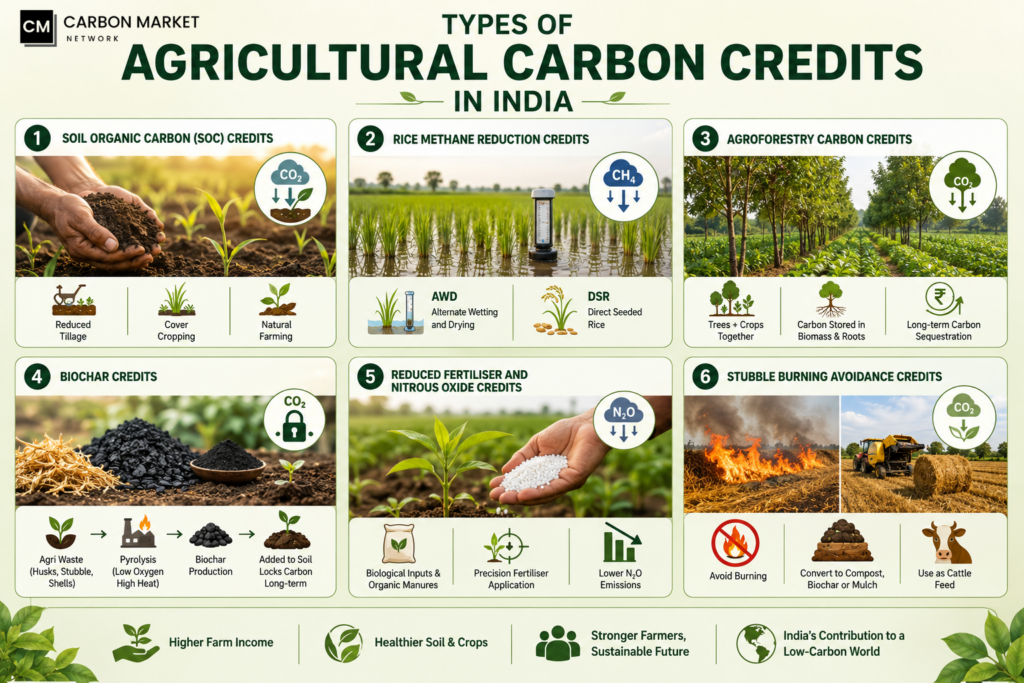
1. Soil Organic Carbon (SOC) Credits
These come from practices that increase the amount of organic carbon stored in the soil. Practices like reduced tillage, cover cropping, and natural farming build up soil organic matter over time.
Soil carbon credits are among the most valued because they also improve soil health, water retention, and fertility. The Grow Indigo Aadi project in Punjab and Haryana is India’s most prominent example, issuing over 50,000 verified soil carbon credits under Verra’s VM0042 methodology in January 2026.
2. Rice Methane Reduction Credits
Paddy fields are a major source of methane, a greenhouse gas roughly 27 times more potent than CO2 over a 100-year period. When farmers reduce flooding duration through AWD or switch to DSR, methane emissions fall sharply.
Studies show improved water management and better nutrient practices can reduce methane emissions from rice fields by 30 to 50 percent. The Amazon-TGRA deal signed in April 2026 is the biggest real-world example of this in India: Amazon committed to buying over 685,000 tonnes of carbon credits from 13,000 Indian rice farmers across 35,000 hectares.
3. Agroforestry Carbon Credits
When farmers plant trees on their land alongside or between crops, the trees sequester carbon as they grow. This is agroforestry, and it generates carbon credits tied to the biomass accumulated in trees and roots.
Agroforestry credits in India currently range from Rs 1,400 to Rs 1,900 per tonne, with rates for Miyawaki-style dense plantations reaching higher premiums.
4. Biochar Credits
Biochar is produced by heating agricultural waste (rice husks, crop stubble, coconut shells) at high temperatures in a low-oxygen environment. When mixed into the soil, biochar locks carbon away for hundreds or even thousands of years.
Google announced a major deal to buy 100,000 tonnes of carbon credits from India’s Biochar Initiative in 2025, turning agricultural waste into a revenue source for Indian farmers.
5. Reduced Fertiliser and Nitrous Oxide Credits
Synthetic nitrogen fertilisers release nitrous oxide (N2O), a greenhouse gas nearly 300 times more potent than CO2. When farmers shift to biological inputs, precision fertiliser application, or organic manures, nitrous oxide emissions drop and those reductions can generate credits.
6. Stubble Burning Avoidance Credits
Every year, millions of acres of crop residue are burned in India, especially in Punjab, Haryana, and Uttar Pradesh. Stopping this burning avoids a significant amount of CO2 and black carbon emissions. Projects that help farmers avoid burning residues by converting it to compost, biochar, or cattle feed can earn verified credits.
Key Policies and Programmes Supporting Agricultural Carbon Credits in India
The Carbon Credit Trading Scheme (CCTS)
Notified in June 2023 under the Energy Conservation Act, the CCTS is India’s first mandatory emissions trading framework. Its Offset Mechanism is open to non-obligated sectors, including agriculture and forestry.
Through this mechanism, farmers and Farmer Producer Organisations (FPOs) can register eligible projects and earn Carbon Credit Certificates (CCCs). As of early 2026, the voluntary Offset Mechanism is already being operationalised, with compliance trading expected to begin by October 2026.
The Indian Carbon Market (ICM)
The ICM, launched in 2025, is the formal national carbon market framework overseen by the Indian Carbon Market Governing Board. The Grid-India registry manages the issuance and tracking of Carbon Credit Certificates.
The Green Credit Programme (GCP)
Run by the Ministry of Environment, Forest and Climate Change and managed by the Indian Council of Forestry Research and Education (ICFRE), the Green Credit Programme rewards actions like tree planting and soil improvement. It runs parallel to CCTS and offers another channel for farmers to earn recognition and value from climate-positive actions.
Union Budget 2026-27: Rs 20,000 Crore CCUS Programme
The Union Budget 2026-27 announced a Rs 20,000 crore Carbon Capture, Utilisation, and Storage (CCUS) support programme. This is a landmark development for Indian agriculture. The programme formalises India’s carbon market and directly integrates farmers into the system through structured processes involving FPOs, cooperatives, and aggregators.
Ministry of Agriculture Framework (January 2024)
A framework launched in January 2024 promotes sustainable farming practices and enables farmers to earn from carbon credits. This framework provides guidelines for farmer participation and sets the stage for scaling agricultural carbon programmes across the country.
IIT Roorkee and Uttar Pradesh Pilot Programme
In December 2025, IIT Roorkee and the Uttar Pradesh government launched a farmer carbon credit programme expected to deliver Rs 5,000 to Rs 8,000 per hectare in supplementary income to participating farmers.
Real-World Examples of Agricultural Carbon Credits in India
Grow Indigo’s Aadi Project
The Aadi project (VCS2590) is one of the most significant milestones in India’s agricultural carbon journey. Developed by Grow Indigo (a Bayer company), it was approved by Verra in January 2026, making it the first VM0042 soil carbon programme-based issuance in India available to smallholder farmers.
The project covers approximately 30,000 acres across Punjab and Haryana. It generated over 50,000 verified carbon credits in its first issuance, with the monitoring period covering 2019 to 2022.
Participating farmers are guided to shift from transplanted rice to Direct Seeded Rice (DSR), reducing water use and methane emissions. For the next crop (usually wheat), reduced tillage systems are promoted to build soil carbon. Farmers could expect payments ranging from Rs 15,000 to Rs 50,000 per farmer for the three-year monitoring period, depending on market prices.
Grow Indigo’s broader footprint already spans over one million acres with thousands of participating farmers, with a pathway to expand to more than three million acres.
Amazon and The Good Rice Alliance (TGRA)
In April 2026, Amazon signed a long-term offtake agreement with The Good Rice Alliance (TGRA), a Bayer-backed initiative. Amazon committed to buying over 685,000 metric tonnes of carbon credits worth approximately USD 30 million (Rs 280 crore) generated through sustainable rice cultivation in India.
The programme covers 35,000 hectares and involves over 13,000 smallholder farmers. Farmers adopt AWD and DSR techniques that reduce continuous flooding and cut methane production by 30 to 50 percent. Credits are verified via Verra’s VM0051 methodology using a three-layer audit: on-ground measurements, biogeochemical modelling, and satellite-based soil moisture tracking.
This deal, according to experts, signals that agricultural carbon is now being taken seriously at the highest level of corporate procurement.
IIT Roorkee and UP Government Programme
In December 2025, this initiative launched a pilot to pay farmers Rs 5,000 to Rs 8,000 per hectare for adopting practices that sequester carbon and reduce emissions in Uttar Pradesh. The programme targets smallholder farmers who often lack access to formal financial markets, making this a model for scaling inclusive carbon market participation.
How Much Can Indian Farmers Earn from Carbon Credits?
The income depends on the type of practice, the number of credits generated, and the market price at the time of sale.
Current price ranges (2026):
- Agricultural soil carbon credits: Rs 1,400 to Rs 1,900 per tonne (voluntary market)
- Agroforestry credits: Rs 1,500 to Rs 2,000 per tonne
- Rice methane reduction credits: Comparable to international prices of USD 15 to USD 40 per tonne
- General carbon credit rates in India: Rs 1,350 to Rs 2,800 per tonne depending on project type and quality
Farmer income estimates:
- Aadi project farmers (Punjab/Haryana): Rs 15,000 to Rs 50,000 per farmer over a three-year monitoring period
- UP pilot programme: Rs 5,000 to Rs 8,000 per hectare per year
- Global smallholder pilots: USD 20 to USD 70 per hectare per year (roughly Rs 1,700 to Rs 5,900)
Note: These are estimates. Actual earnings depend on farm size, the number of credits generated, the specific methodology used, and prevailing market prices. The formal CCTS compliance market is expected to begin trading by October 2026, which will create a regulated price floor and potentially higher rates for verified agricultural credits.
How Can Indian Farmers Get Started with Carbon Credits?
Most individual smallholder farmers cannot participate alone because the costs of monitoring and verification are too high for a single small farm. The practical path is to join through an aggregator.
Option 1: Join Through an FPO or Cooperative
Farmer Producer Organisations (FPOs) and cooperatives aggregate many farmers into a single project. This reduces per-farmer costs and makes verification economically viable.
The Budget 2026 programme explicitly integrates farmers through FPOs, cooperatives, and aggregators. If you are part of an FPO, ask your FPO leadership whether they have registered or plan to register a carbon project.
Option 2: Partner with an Agri-Carbon Company
Several companies in India now offer farmer-facing carbon programmes where they handle the registration, monitoring, and verification in exchange for a share of the credit revenue. Leading players include:
- Grow Indigo: Focuses on soil carbon and regenerative agriculture in Punjab, Haryana, and other states.
- The Good Rice Alliance (TGRA): Focuses on rice methane reduction across multiple states.
- Boomitra: Works with smallholder farmers on soil carbon measurement and credit generation.
- Varaha: An Indian climate-tech company helping farmers earn carbon credits through regenerative agriculture.
- Earthtree: Works on agroforestry and soil carbon projects in India.
When evaluating a partner, ask these questions:
- Which registry or standard are they using (CCTS/ICM or Verra/Gold Standard)?
- What percentage of the credit revenue goes to the farmer?
- What are the monitoring and verification requirements for the farmer?
- How long is the minimum commitment period?
- What happens if the carbon stored is lost due to drought or crop failure?
Option 3: Register Directly Under CCTS Offset Mechanism
For larger operations, FPOs with significant scale, or farmers with sizeable landholdings, it is possible to register projects directly through the CCTS Offset Mechanism on the Grid-India registry.
This requires:
- Selecting an approved methodology (BEE has approved several for agriculture)
- Preparing a Project Design Document (PDD)
- Getting the project validated by an accredited verification body
- Implementing the project and monitoring results
- Submitting to third-party verification after the monitoring period
- Applying for credit issuance
This route requires technical support, ideally from a carbon project developer or consultancy.
Approved Methodologies for Agricultural Carbon Credits in India
Methodologies are the rulebooks that govern how credits are calculated. Using an approved methodology is mandatory for issuing verified credits.
Under international standards:
- VM0042 (Verra): Improved Agricultural Land Management, used by Grow Indigo’s Aadi project for soil carbon in the rice-wheat-maize system.
- VM0051 (Verra): Used by The Good Rice Alliance for rice methane reduction.
- Gold Standard Methodologies: Several Gold Standard methodologies cover soil carbon, agroforestry, and cookstove projects relevant to Indian agriculture.
Under CCTS / Indian Carbon Market: The Bureau of Energy Efficiency (BEE) has approved offset methodologies, and further development is advancing in biogas, biochar, soil carbon, and agroforestry. The Ministry of Agriculture’s framework (January 2024) also supports farmer participation under domestic methodologies.
Key Challenges Facing Agricultural Carbon Credits in India
The promise is real, but so are the obstacles. Knowing the challenges helps farmers and policymakers address them.
1. High MRV Costs
Monitoring, Reporting, and Verification (MRV) is expensive. Transaction costs can sometimes exceed the value of the credits generated, especially for small landholdings. As of 2025, only 4.5 percent of eligible smallholder farms are connected to verified carbon credit platforms.
What is changing: Blockchain-based solutions like AgriLedger are reducing MRV costs by up to 40 percent. ISRO’s Bhuvan Geo-Analytics platform integrated with IoT soil sensors has reduced carbon verification time from 28 days to just over 3 days per acre.
2. Fragmented Landholdings
India’s average farm size is under 1.1 hectares. At this scale, a single farmer cannot generate enough credits to cover the cost of verification on their own.
What is changing: Aggregation through FPOs and cooperatives pools small farms together into a single programme-based project, making verification economically viable.
3. Awareness and Capacity Gaps
Many farmers are unaware that carbon credits exist, let alone how to access them. Even when they are part of projects, many do not fully understand what they have signed up for.
What is changing: Government programmes, NGOs, and agri-carbon companies are investing in farmer education. The Budget 2026 CCUS programme includes capacity building as a component.
4. Additionality Requirements
A credit is only valid if the practice is “additional,” meaning it would not have happened without the carbon incentive. Farmers who have been farming sustainably for years may struggle to prove additionality because they cannot show a change from a less sustainable baseline.
5. Permanence Risk
Carbon stored in soil or trees can be released back if the farmer reverts to old practices, a drought kills trees, or a fire destroys biomass. Carbon markets require permanence buffers and reversal provisions to manage this risk, which reduces the number of credits that can actually be sold.
6. Transparency and Double Counting
There are concerns about whether reductions are real or whether the same credit might be counted twice. India is working to address this through the Grid-India registry system and improved MRV infrastructure, but gaps remain.
7. Long Credit Cycles
The monitoring period for Grow Indigo’s Aadi project ran from 2019 to 2022, with issuance completed only in 2026 after multiple cycles of review. That is a seven-year cycle. Farmers need to be prepared for a long wait before the first payment arrives.
The Role of Technology in India’s Agricultural Carbon Market
Technology is the backbone that makes agricultural carbon credits scalable.
Remote sensing and satellite data allow continuous monitoring of crop types, biomass, and soil moisture at farm level without requiring expensive field visits.
IoT soil sensors provide real-time data on soil organic carbon, moisture, and temperature, reducing the cost and time of soil carbon measurement.
AI and machine learning models help predict carbon sequestration based on farm practices, local climate, and soil type, improving accuracy of credit calculations.
Blockchain creates tamper-proof records of credit issuance and transfer, preventing double counting and building buyer confidence.
Digital MRV (dMRV) platforms combine these technologies into integrated systems that dramatically cut verification costs and timelines.
India has an advantage here. ISRO’s Bhuvan platform, existing agricultural data infrastructure, and a strong agri-tech startup ecosystem position India well to build cost-effective dMRV systems tailored to Indian farm conditions.
India’s Position in the Global Agricultural Carbon Market
India is emerging as one of the world’s most important testing grounds for agricultural carbon markets.
India issued 278 million carbon credits in the voluntary carbon market between 2010 and 2022, accounting for 17 percent of global supply.
Agriculture is currently 0.2 to 1.5 percent of issued carbon credits globally, but it is among the fastest-growing segments, driven by regenerative agriculture, agroforestry, soil organic carbon enhancement, and improved water stewardship.
Experts say India’s combination of a large farm base, strong research backing, and growing private sector capability makes it a credible near-term hub for agricultural carbon credits, ahead of regions like Southeast Asia or Africa.
The Amazon-TGRA deal in April 2026 is a significant signal to global markets. When a company like Amazon commits to a rice methane programme in India, it tells the market that Indian agricultural carbon is ready for serious corporate procurement.
Difference Between Voluntary and Compliance Agricultural Carbon Credits in India
Understanding this distinction matters because it affects who buys your credits and what price you can get.
| Feature | Voluntary Market | Compliance Market (CCTS) |
|---|---|---|
| Who buys? | Companies voluntarily meeting net-zero goals | Industries legally obligated under CCTS |
| Registry | Verra, Gold Standard, ICM | Grid-India (ICM) |
| Price range | Variable, driven by demand | Regulated, with initial estimates of Rs 600 to Rs 1,200/tonne |
| Eligibility | Any verified project | Projects under BEE-approved methodologies |
| Current status | Active | Compliance trading expected October 2026 |
Many agricultural projects in India currently sell into the voluntary market through Verra or Gold Standard. As CCTS compliance trading begins and obligated industries look for offset credits, agricultural projects registered on the ICM registry will have an additional pool of buyers, potentially pushing prices higher.
What Indian Farmers Should Do Right Now
If you are a farmer, FPO leader, or agri-entrepreneur interested in carbon credits, here is a practical action plan.
1. Learn the basics. Understand what carbon credits are, what practices qualify, and which registries operate in India. Resources from the Indian Carbon Market (ICM), BEE, and the Ministry of Agriculture are publicly available.
2. Assess your farm. Identify which practices on your farm could qualify for carbon credits. Paddy cultivation, agroforestry potential, and soil health improvement are the most accessible entry points in India.
3. Connect with an aggregator or FPO. If you are a smallholder, working alone is not practical. Contact local FPOs or agri-carbon companies like Grow Indigo, Varaha, or Boomitra to understand their programmes and revenue-sharing models.
4. Document your baseline now. Even if you are not yet enrolled in a programme, start keeping records of your current farming practices, input use, and soil conditions. A documented baseline is valuable when you enrol in a project later.
5. Avoid greenwashing traps. Work only with companies or programmes that use recognised, internationally accepted methodologies and independent verification. If a company promises unrealistically high earnings with no verification process, treat it as a red flag.
6. Think long-term. Carbon credit cycles are long. The first payment may take two to four years after project registration. Budget accordingly and treat carbon credits as a supplementary income stream, not an immediate cash flow source.
Future Outlook for Agricultural Carbon Credits in India
The next five years are likely to see rapid growth in India’s agricultural carbon market.
Several developments point strongly in this direction:
- CCTS compliance trading beginning by October 2026 will create new domestic buyers for agricultural offset credits.
- Carbon Credit Certificates starting to trade by mid-2026 will bring price discovery and liquidity to the market.
- Expanding methodologies under BEE will cover more agricultural practices, including biochar, improved paddy management, and agroforestry.
- Corporate net-zero commitments from Indian and global companies will continue driving demand for high-quality agricultural credits.
- EU Carbon Border Adjustment Mechanism (CBAM), which taxes imports based on carbon footprint, will push Indian exporters to measure and reduce emissions, creating indirect demand for carbon credits from supply chains.
- Budget 2026 CCUS programme will inject Rs 20,000 crore into the ecosystem, financing infrastructure, capacity building, and farmer onboarding.
India’s carbon credit market is projected to grow from USD 33.69 billion in 2025 to USD 405.47 billion by 2034. Even a small share of this going to the agricultural sector would translate into significant income for millions of farmers.
Conclusion
Agricultural carbon credits in India are no longer an idea for the future. They are happening right now.
From Grow Indigo’s verified soil carbon credits in Punjab and Haryana to Amazon’s Rs 280 crore deal with rice farmers across 35,000 hectares, real money is flowing to Indian farmers who adopt climate-smart practices.
The Indian Carbon Market, the CCTS Offset Mechanism, and the Budget 2026 CCUS programme together create the policy backbone that farmers need to participate. The technology for measurement and verification is advancing fast. And global demand for credible, farmer-positive agricultural carbon credits is growing.
The barriers are real, including high MRV costs, small landholdings, long payment cycles, and awareness gaps. But aggregation through FPOs, digital MRV technology, and government support are steadily addressing each of them.
For Indian farmers, agricultural carbon credits offer something genuinely new: income not just from what the farm produces, but from how the farm is managed.
The land has always been a source of food. Now, it can also be a source of climate finance.
Frequently Asked Questions (FAQ)
Q1. What are agricultural carbon credits in India?
Agricultural carbon credits are tradable certificates earned when farmers adopt practices that reduce greenhouse gas emissions or store more carbon in the soil. Each credit represents one tonne of CO2 or equivalent reduced or removed. Farmers sell these credits to companies that need to offset their own emissions.
Q2. Can Indian farmers earn money from carbon credits?
Yes. Farmers who adopt verified practices such as direct seeded rice, reduced tillage, agroforestry, or biochar application can earn carbon credits and sell them through voluntary markets or India’s formal Indian Carbon Market. Earnings can range from Rs 5,000 to Rs 50,000 per farmer per monitoring period depending on farm size, practice type, and market price.
Q3. Which farming practices qualify for carbon credits in India?
Qualifying practices include: Direct Seeded Rice (DSR), Alternate Wetting and Drying (AWD) in paddy fields, reduced or zero tillage, agroforestry, biochar application, avoiding stubble burning, natural farming, and using biological inputs instead of synthetic nitrogen fertilisers.
Q4. What is the CCTS and how does it apply to farmers?
The Carbon Credit Trading Scheme (CCTS), notified in June 2023, is India’s mandatory emissions trading framework. Its Offset Mechanism allows farmers and FPOs to register eligible projects and earn Carbon Credit Certificates (CCCs) that can be sold to obligated industries or voluntary buyers. Compliance trading is expected to begin by October 2026.
Q5. How does a farmer register for carbon credits in India?
Most smallholder farmers participate through FPOs, cooperatives, or agri-carbon companies that aggregate multiple farmers into a single project. They handle registration, monitoring, and verification. For larger operations, direct registration through the Grid-India registry under the CCTS Offset Mechanism is also possible.
Q6. What is the price of agricultural carbon credits in India in 2026?
Agricultural soil carbon credits trade between Rs 1,400 and Rs 1,900 per tonne on the voluntary market. Agroforestry credits range from Rs 1,500 to Rs 2,000 per tonne. The formal CCTS compliance market is expected to price credits between Rs 600 and Rs 1,200 per tonne initially, with analysts expecting prices to rise as demand grows.
Q7. How long does it take to earn carbon credits from farming?
The process takes time. The monitoring period typically spans two to three years. After monitoring, verification and registry review add several more months. The Grow Indigo Aadi project, for example, had a monitoring period from 2019 to 2022 with credits issued in 2026. Farmers should plan for a two-to-five-year cycle before receiving the first payment.
Q8. Are there any risks in participating in agricultural carbon credit programmes?
Yes. Key risks include: the project failing verification due to insufficient emission reductions, carbon being reversed due to weather events or return to old practices, low market prices at the time of credit sale, and unfair revenue-sharing by aggregators. Farmers should work only with transparent, accredited programmes and read all agreements carefully before enrolling.
Q9. Is natural farming eligible for carbon credits in India?
Natural farming can qualify if it results in verifiable changes to greenhouse gas emissions or soil carbon levels. Key practices like reducing synthetic inputs, increasing soil organic matter, and avoiding crop burning can all contribute. The practice needs to be linked to an approved methodology to generate tradable credits.
Q10. Which companies are buying agricultural carbon credits from India?
Major buyers include Amazon (rice methane credits from 13,000 farmers through TGRA), Google (biochar credits through the Indian Biochar Initiative), and several Indian and multinational companies meeting voluntary net-zero targets. As CCTS compliance trading begins in late 2026, large Indian industries in cement, aluminium, textiles, and other sectors will also become buyers.