Carbon Market Network


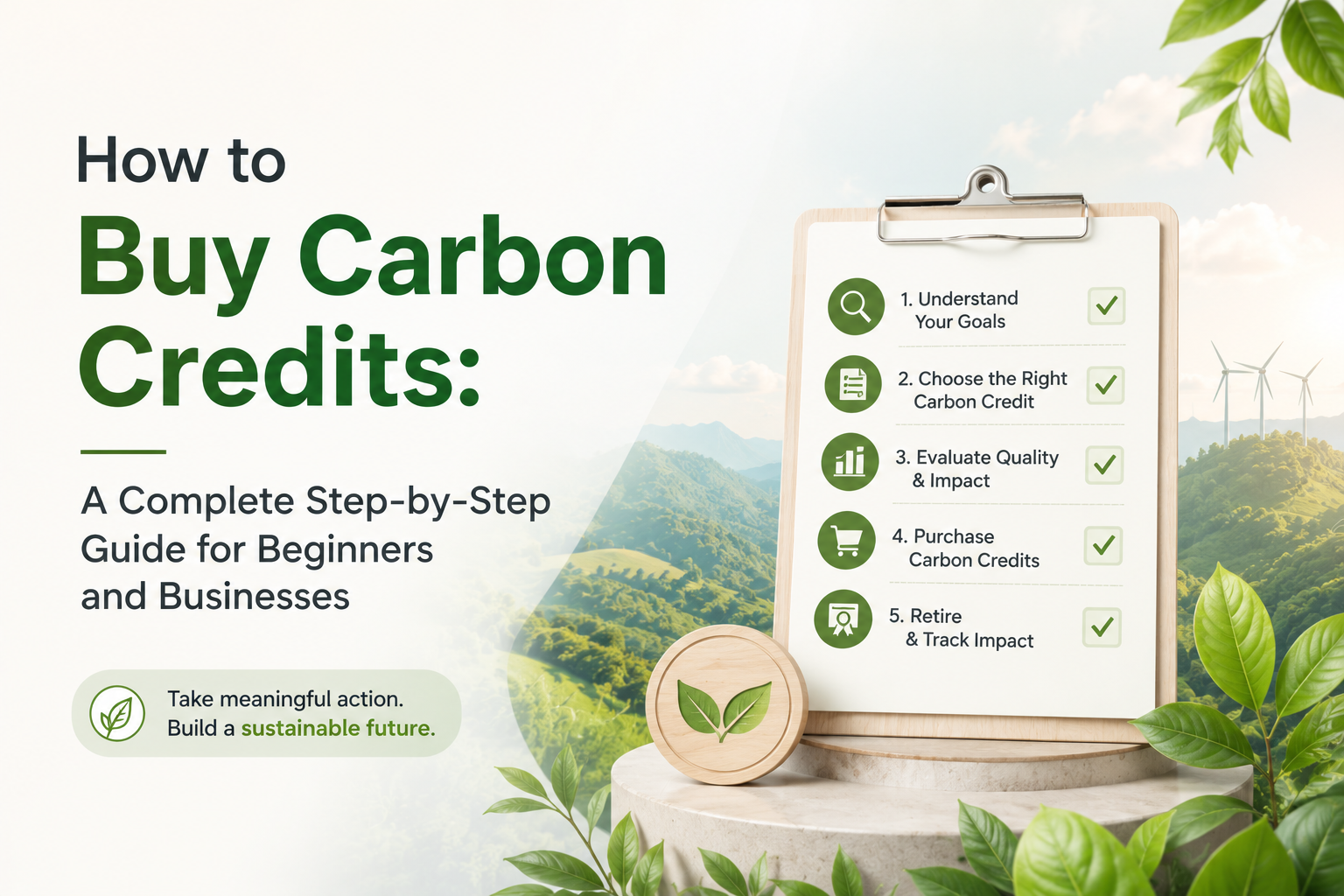
You want to buy carbon credits. Maybe your business has made a net-zero commitment. Maybe you want to offset the footprint of a long-haul flight. Maybe you just want your money to do something real for the climate.
Either way, you have landed in the right place.
The problem is that carbon markets can feel intimidating. You hear words like “Verra,” “additionality,” “vintage,” and “Core Carbon Principles”, and suddenly what sounded like a simple purchase feels like a finance exam.
It does not have to be that way.
This guide breaks down exactly how to buy carbon credits in plain English. We cover what carbon credits actually are, who sells them, how much they cost, what to look for to avoid low-quality credits, and how to make a purchase that stands up to scrutiny.
Whether you are an individual buying your first offset or a sustainability team building a corporate portfolio, this guide gives you the clarity you need to move forward with confidence.
What Is a Carbon Credit?
Before you buy anything, you need to understand what you are actually buying.
A carbon credit is a certificate that represents one metric tonne of carbon dioxide (CO2), or its equivalent in other greenhouse gases, that has either been reduced or removed from the atmosphere.
When you buy and retire a carbon credit, you are funding a project that has either prevented emissions from happening or actively pulled CO2 out of the air.
Here is the simplest way to think about it:
1 carbon credit = 1 tonne of CO2 reduced or removed
Once a credit is “retired,” it is permanently taken off the market. No one else can use it to make a climate claim. That retirement record is logged in a public registry, so you can verify it happened.
Carbon credits are not the same as simply paying a carbon tax. They are linked to a real-world project, a forest being protected, a factory switching to clean energy, a machine pulling CO2 directly from the air.
Carbon Market Insider Newsletter
Weekly insights on carbon markets, climate policy, carbon credits, and sustainability.
Why Do People Buy Carbon Credits?
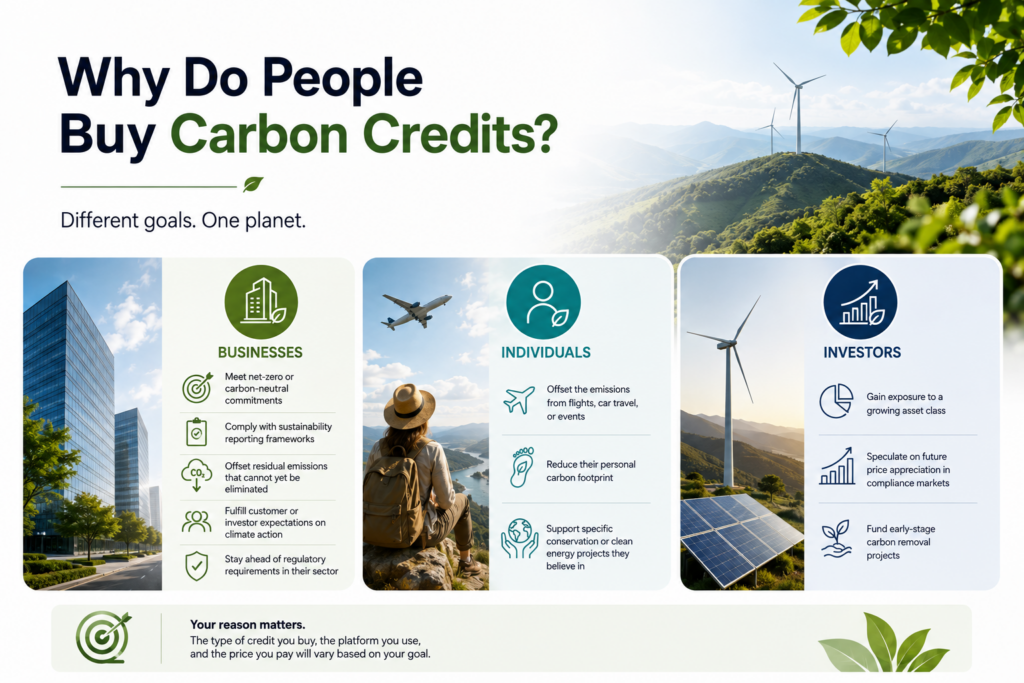
People and organizations buy carbon credits for several distinct reasons. Knowing which category you fall into will shape exactly how you go about buying.
Businesses buy carbon credits to:
- Meet net-zero or carbon-neutral commitments
- Comply with corporate sustainability reporting frameworks (like CSRD or SBTi)
- Offset residual emissions that cannot yet be eliminated
- Fulfill customer or investor expectations on climate action
- Stay ahead of regulatory requirements in their sector
Individuals buy carbon credits to:
- Offset the emissions from flights, car travel, or events
- Reduce their personal carbon footprint
- Support specific conservation or clean energy projects they believe in
Investors buy carbon credits to:
- Gain exposure to a growing asset class
- Speculate on future price appreciation in compliance markets
- Fund early-stage carbon removal projects
The reason matters because the type of credit you buy, the platform you use, and the price you pay will vary significantly depending on your goal.
The Two Types of Carbon Markets You Need to Know
There are two fundamentally different worlds in carbon markets. Buying in one versus the other is a completely different experience.
Compliance Carbon Markets
Compliance markets are run by governments. They are mandatory systems where companies in certain industries must hold enough carbon allowances to cover their emissions.
The big ones operating globally today include:
| Market | Region | Who It Covers |
|---|---|---|
| EU Emissions Trading System (EU ETS) | European Union | Power, industry, aviation |
| UK ETS | United Kingdom | Power, industry, aviation |
| California Cap-and-Trade | USA (California) | Power plants, industrial facilities |
| China National ETS | China | Power sector |
| RGGI | Northeast USA | Power plants |
If your company is legally covered by one of these systems, you do not choose whether to participate. You must buy allowances.
If you exceed your cap and do not have enough allowances, you face steep financial penalties, in the EU ETS, that can mean over €100 per excess tonne.
Voluntary Carbon Markets
Voluntary carbon markets (VCMs) are for everyone who is not legally required to act but wants to offset emissions anyway.
Companies with voluntary net-zero targets, individuals, airlines looking to go beyond CORSIA requirements, event organizers, they all operate in the VCM.
The VCM is not government-run. Standards bodies like Verra, Gold Standard, ACR, and the American Carbon Registry set the rules. Third-party auditors verify projects. Registries track credit issuance and retirement.
The VCM gives you more choice and flexibility. It also demands more careful due diligence, because quality varies enormously.
How Much Do Carbon Credits Cost?
This is one of the most common questions, and the answer is “it depends.”
Carbon credit prices vary based on the type of credit, the quality, the market, and the project. Here is a realistic overview of where prices sit today:
Voluntary Carbon Market Prices
| Credit Type | Typical Price Range |
|---|---|
| Low-quality older avoidance credits | $3 to $7 per tonne |
| Standard nature-based credits (forests, land use) | $8 to $30 per tonne |
| High-integrity, independently rated credits | $15 to $80 per tonne |
| Biochar credits | $100 to $200 per tonne |
| Direct air capture (DAC) | $150 to $500+ per tonne |
Compliance Market Prices
| Market | Approximate Price |
|---|---|
| EU ETS allowances | €60 to €93 per tonne |
| UK ETS allowances | £30 to £60 per tonne |
| California cap-and-trade | $20 to $40 per tonne |
Why does price vary so much in the voluntary market?
The wide spread is intentional. A cheap credit priced at $4 per tonne and a premium credit at $60 per tonne are not the same product. They represent different levels of confidence that the emissions reduction actually happened, will last, and would not have occurred without the project.
High-quality, independently rated credits now cost roughly four times more than low-quality alternatives. That premium reflects the evidence behind the claim, not a marketing markup.
If a deal looks suspiciously cheap, that is usually a sign the underlying project has not been held to the highest standards.
Step-by-Step: How to Buy Carbon Credits
Now let us get into the actual process.
Step 1: Understand Your Carbon Footprint
Before you buy anything, figure out what you are trying to offset.
For individuals, this might be the emissions from a return flight, a year of car travel, or your household energy use. Free carbon calculators exist online to help you estimate your footprint in tonnes of CO2.
For businesses, this means measuring your Scope 1 (direct emissions), Scope 2 (purchased energy), and ideally Scope 3 (supply chain and product use) emissions. Many sustainability reporting frameworks now require this baseline as a starting point before offsetting comes into the picture.
The number you produce tells you how many carbon credits you need. Remember: 1 credit = 1 tonne of CO2.
Practical tip: Overestimate slightly rather than underestimate. If your calculation lands at 95 tonnes, buying 100 gives you a small buffer.
Step 2: Choose Your Market
Decide whether you are buying in the compliance market or the voluntary market.
If you are a regulated company in the EU, UK, California, or China, your regulator tells you which market you participate in. You buy allowances or credits in that system.
If you are acting voluntarily, whether as an individual or a business with sustainability goals, you are in the voluntary carbon market.
Most first-time buyers start in the VCM. That is what the rest of this guide focuses on.
Step 3: Decide What Kind of Project You Want to Support
Not all carbon credits come from the same type of project. The major categories are:
Avoidance/Reduction projects: These prevent emissions from happening.
- Forest conservation (REDD+)
- Renewable energy projects
- Methane capture from landfills
- Cookstove programs in developing regions
Removal projects: These actively pull CO2 out of the atmosphere.
- Reforestation and afforestation (planting trees)
- Soil carbon sequestration
- Biochar (converting biomass into stable carbon)
- Enhanced weathering
- Direct air capture (DAC)
The scientific and corporate consensus is shifting toward removal projects, especially durable removals with long storage periods. Frameworks like the Oxford Principles encourage buyers to move toward high-durability removals over time.
That said, for many buyers, a well-verified avoidance credit from a strong project is still a meaningful and legitimate purchase, especially while removal technology scales and costs come down.
Step 4: Look for Verified, High-Integrity Credits
This is the most important step in the entire process.
Not all carbon credits are created equal. Buying a credit that does not represent genuine emissions reductions is not just a waste of money, it can damage your organization’s reputation if it comes out later.
Here is what to look for:
Check the Registry
All legitimate voluntary carbon credits are registered with a recognized registry. The five major registries that are currently approved under the ICVCM’s Core Carbon Principles (CCP) framework are:
| Registry | Short Name | Notes |
|---|---|---|
| Verra Verified Carbon Standard | VCS | World’s largest voluntary registry; released VCS Version 5.0 |
| Gold Standard | GS | Strong sustainable development focus |
| American Carbon Registry | ACR | Oldest voluntary registry, founded 1996 |
| Climate Action Reserve | CAR | North American focus |
| Architecture for REDD+ Transactions | ART | Focused on jurisdictional REDD+ |
These five programs together account for roughly 98% of all voluntary carbon credit volume. Staying within this group gives you a strong starting point.
Look for the ICVCM CCP Label
The Integrity Council for the Voluntary Carbon Market (ICVCM) has established the Core Carbon Principles (CCP) as a global benchmark for quality. Credits that meet the CCPs can carry a CCP label in their registry listing.
The CCP label means the credit has passed rigorous tests for:
- Additionality (the reduction would not have happened without the project)
- Permanence (the reduction will last)
- Quantification accuracy
- Robust monitoring, reporting, and verification
- No double-counting
As of now, only a small fraction of credits on the market carry the CCP label, but the approved programs cover the vast majority of market volume. Prioritize CCP-labeled credits where possible, especially if your purchase is for corporate sustainability reporting.
Check Independent Ratings
Beyond the registry, several independent agencies rate the quality of individual carbon projects. The leading ones are:
- BeZero Carbon: rates projects from AAA down to D
- Sylvera: rates projects on a tier system
- Calyx Global: provides risk scoring
- MSCI Carbon Markets: analysis and ratings
According to market data, about 79% of serious corporate buyers now require a BeZero BBB rating or higher, and 83% require a Sylvera Tier 2 or higher.
If you are making a significant purchase, cross-checking a project’s rating from at least one of these agencies adds a meaningful layer of confidence.
Key Quality Signals to Check
When you look at any specific project, ask these questions:
- Additionality: Would the emissions reduction have happened anyway without carbon credit funding?
- Permanence: Is the carbon stored for the long term, or could it be released again (e.g., a forest that could burn)?
- Vintage: When were the credits issued? Older credits from legacy renewable energy projects often no longer meet current quality standards.
- Leakage: Does the project accidentally push emissions elsewhere?
- Co-benefits: Does the project support biodiversity, local communities, or water security in addition to carbon?
- Corresponding adjustment: For cross-border claims, does the host country adjust its national inventory to avoid double counting?
Step 5: Choose How You Will Buy
There are four main ways to purchase carbon credits, each suited to different buyer types.
Option A: Carbon Credit Marketplaces (Best for Most Buyers)
Online marketplaces let you browse verified projects, see prices per tonne, and purchase credits directly. Many handle the retirement process for you and send a certificate confirming the retirement.
Popular platforms include:
| Platform | Best For |
|---|---|
| Patch | Enterprise buyers, large portfolios |
| CNaught | SMEs wanting curated, diversified portfolios |
| Xpansiv (CBL) | Sophisticated buyers, exchange-based trading |
| Terrapass | Individuals and small businesses |
| South Pole | Corporate buyers with complex needs |
| Carbon Trade eXchange (CTX) | Spot trading and exchange access |
For individuals making small purchases (offsetting a few tonnes from travel), a straightforward platform like Terrapass or Gold Standard’s own marketplace makes the process simple.
For businesses buying hundreds or thousands of tonnes annually, enterprise platforms like Patch or CNaught offer broader project selection, portfolio management tools, and audit-ready reporting.
Option B: Directly from Project Developers
Some buyers prefer to buy directly from the organization running the project, the forest manager, the clean cookstove program, or the biochar producer.
Direct purchases can offer lower prices and closer connection to the project. They can also come with less liquidity and less standardization. If you go this route, your own due diligence becomes even more important, because there is no marketplace acting as a quality filter.
Option C: Through a Broker or Advisor
Carbon brokers source credits from multiple projects and sellers. For larger purchases, typically 10,000 tonnes or more, a broker can help you negotiate better pricing, manage offtake agreements, and access projects not listed on public marketplaces.
Well-regarded brokers operating globally include Redshaw Advisors, ClearBlue Markets, and various commodity trading houses that have built carbon desks.
The benefit: access to a wider range of projects and pricing. The risk: not all brokers apply the same quality standards, so you still need to ask the right questions.
Option D: Carbon ETFs and Funds (For Investors)
If your goal is investment exposure to carbon markets rather than retiring credits against actual emissions, carbon ETFs and funds are a different avenue.
These products typically track compliance market prices (like EU ETS allowance prices) and do not involve actually retiring a credit. They are financial instruments for investors, not for companies making corporate climate claims.
Step 6: Verify Retirement
Retirement is the final and non-negotiable step.
When you retire a credit, it is permanently cancelled in the registry database. No one can ever use it again. The registry entry is public, so you or anyone else can look it up.
Do not consider a purchase complete until you have:
- Received a retirement certificate
- Confirmed the retirement serial number in the registry
- Stored that documentation for your records
For businesses, this documentation forms part of your climate disclosure records. For individuals, it gives you verifiable proof that your offset was genuine.
How to Avoid Greenwashing When Buying Carbon Credits
Greenwashing in carbon markets is real. Buying credits from a low-quality project and claiming to be “carbon neutral” is exactly the kind of practice that regulators and journalists are increasingly scrutinizing.
Here are the key mistakes to avoid:
Buying the Cheapest Credits You Can Find
Price and quality correlate in carbon markets. A credit priced at $2 per tonne is almost certainly from a legacy project with questionable additionality. Bargain credits are rarely a bargain.
Relying Only on Registry Certification
Registry verification is a necessary minimum, not a sufficient guarantee. As independent analysis has found, registry-certified credits still vary enormously in actual climate impact. Pair registry certification with an independent rating from BeZero, Sylvera, or Calyx Global.
Ignoring Vintage
Vintage refers to the year the emissions reduction occurred. Older credits, particularly from legacy renewable energy projects issued in previous years, may no longer meet current quality standards and have been delisted or discredited in some programs. Prefer recent vintages and projects using current methodologies.
Offsetting Instead of Reducing
Carbon credits should complement emissions reduction, not replace it. The global consensus is clear: companies should prioritize cutting their own emissions first and use credits only for residual emissions that cannot yet be eliminated.
If your company claims to be “carbon neutral” while making no effort to reduce actual emissions, that is a reputational risk, and increasingly a legal one, as regulations around climate claims tighten globally.
Not Checking for Double Counting
Under the Paris Agreement’s Article 6, host countries can issue corresponding adjustments to ensure an emissions reduction is only counted once, either by the country toward its national target or by a company for its own claims, but not both.
Credits without a corresponding adjustment can still be legitimate purchases, but for companies making public net-zero claims, you should ask your supplier about this. Credits with corresponding adjustments carry more weight under emerging regulatory frameworks.
Carbon Credit Quality Checklist: Before You Buy
Use this checklist before finalizing any carbon credit purchase:
| Check | What to Look For |
|---|---|
| Registry verification | Credit listed on Verra, Gold Standard, ACR, CAR, or ART |
| ICVCM CCP label | Credit carries Core Carbon Principles label (if available for that methodology) |
| Independent rating | BeZero BBB or higher / Sylvera Tier 2 or higher |
| Additionality | Credible evidence the project would not exist without carbon funding |
| Permanence | Long-term carbon storage with buffer pools or insurance |
| Vintage | Recent vintage, issued under current methodology rules |
| Verification body | Accredited, third-party VVB (validation and verification body) has signed off |
| Retirement proof | Certificate and registry entry confirming permanent cancellation |
| Corresponding adjustment | Confirmed if used for Paris-aligned claims |
| Co-benefits | Biodiversity, community, or SDG benefits documented |
Types of Carbon Projects Worth Knowing
When you browse a marketplace, you will see dozens of project types. Here is a quick guide to the most common ones and what to know about each:
REDD+ (Reducing Emissions from Deforestation and Degradation)
These projects protect standing forests in tropical regions. The carbon benefit comes from preventing deforestation that would otherwise release stored carbon.
REDD+ projects have been controversial because of past methodology weaknesses. The newer standards and ICVCM-approved methodologies are significantly more rigorous. Buyers should prioritize projects on current ICVCM-approved methodologies and avoid legacy projects with older baselines.
Reforestation and Afforestation
These projects plant new trees or restore degraded land. They are straightforward in concept but require careful permanence checks. If a planted forest burns or is harvested, the carbon benefit is reversed. Good projects include buffer pools of extra credits to account for reversal risk.
Cookstove Projects
These distribute clean-burning cookstoves in regions where wood or charcoal burning for cooking is a major emissions source. A cleaner cookstove means less fuel burned and less CO2 released.
Cookstove projects have had methodological challenges around monitoring how much the stoves are actually used. Newer projects with remote monitoring technology (dMRV) are significantly more reliable.
Soil Carbon / Agricultural Carbon
These projects change farming practices to store more carbon in the soil. Permanence is the key concern, soil carbon can be released if land use changes.
Biochar
Biochar involves converting organic biomass into a stable, charcoal-like material that locks carbon into the soil for hundreds to thousands of years. It is a high-durability removal pathway that has gained significant market interest.
Direct Air Capture (DAC)
DAC technology uses machines to pull CO2 directly out of the ambient air and store it underground. It offers the highest permanence of any carbon removal pathway. It is also the most expensive, currently ranging from $150 to $500+ per tonne.
DAC credits are bought by companies like Microsoft and Stripe as part of their long-term climate portfolios. For most buyers today, they represent a smaller portion of a diversified credit portfolio.
Buying Carbon Credits as an Individual
You do not need to be a corporation to buy carbon credits. The process for individuals is significantly simpler.
Here is how most individuals do it:
- Use a carbon footprint calculator to estimate your annual emissions (or the emissions from a specific activity like a flight)
- Visit a platform like Terrapass, Atmosfair, Gold Standard’s marketplace, or similar
- Select a verified project you want to support
- Enter the number of tonnes you want to offset
- Complete the purchase and receive your retirement certificate
The cost for individual purchases is often quite accessible. Offsetting a long-haul return flight might cost between $10 and $40, depending on the platform and the credit quality you choose.
For personal purchases, the main thing to verify is that the credits are from a recognized registry (Verra, Gold Standard, ACR) and that retirement happens at the time of purchase. Avoid platforms that offer vague “carbon neutral” claims without giving you a specific registry serial number.
Buying Carbon Credits as a Business
Corporate purchases involve more complexity, but also more structure to help you navigate it.
The corporate buying journey typically looks like this:
- Measure: Complete a GHG inventory covering Scope 1 and 2 emissions, and ideally Scope 3.
- Reduce: Implement all feasible emissions reduction measures. This comes before any offsetting.
- Set a target: Align with a recognized framework like the Science Based Targets initiative (SBTi) or set your own internal net-zero target.
- Determine residual emissions: These are the emissions you cannot yet eliminate that carbon credits will address.
- Build a credit portfolio: Select credits that align with your industry, your reporting framework requirements, and your quality standards.
- Retire and report: Retire credits in a registry and document the retirement for your sustainability report or climate disclosure.
Large corporate buyers often work with an advisory firm or use an enterprise platform that integrates with their sustainability reporting workflows. Many also enter into multi-year offtake agreements with project developers to lock in supply and price certainty.
Important note for companies reporting under CSRD: Under the European Sustainability Reporting Standards (ESRS E1), carbon credits sit in the “beyond-value-chain mitigation” category. They cannot be used to reduce reported Scope 1, 2, or 3 emissions figures. They are a supplement, not a substitute, for actual emissions reduction. This is worth understanding clearly before making any public claims.
Article 6 and What It Means for Buyers
You will increasingly hear about “Article 6” when shopping for carbon credits.
Article 6 of the Paris Agreement established the framework for international carbon markets. The key concept for buyers is the “corresponding adjustment.”
When a host country authorizes a carbon credit for international use and issues a corresponding adjustment, it adjusts its own national emissions inventory to avoid the same reduction being counted twice, once by the buying company and once by the country toward its own climate targets.
Credits with corresponding adjustments are becoming the preferred choice for companies making strong public net-zero claims, particularly where those claims must withstand regulatory or auditor scrutiny.
Not every purchase requires a corresponding adjustment, domestic credits, credits used for internal tracking, and many standard voluntary purchases can proceed without one. But if you are building a CSRD-compliant portfolio or making Paris-aligned claims, it is worth asking your supplier whether the credits carry Article 6 authorization.
Common Mistakes Buyers Make
Even experienced teams sometimes stumble. Here are the most frequent mistakes in carbon credit purchasing and how to avoid them:
Treating Carbon Credits as “One Size Fits All”
The market offers credits ranging from $3 to $500+ per tonne. Treating them as interchangeable units is a major error. The price difference reflects fundamentally different levels of evidence and permanence.
Skipping Independent Verification
Registry certification alone is no longer enough. Supplement it with independent ratings from BeZero, Sylvera, or Calyx Global, especially for significant purchases.
Making Claims Before Retiring Credits
Some companies announce carbon neutral status before credits are actually retired. This creates reputational and legal risk. Only make claims after retirement is confirmed in the registry.
Buying Only Nature-Based Credits
Nature-based credits are valuable, but a portfolio weighted entirely toward them carries permanence risk (forests can burn, be cleared, or face political risk). A well-structured portfolio typically balances nature-based with engineered removals.
Ignoring the Methodology
Every project follows a specific methodology that governs how emissions reductions are measured. Older methodologies have been updated or retired because they overstated reductions. When possible, look for projects using current, ICVCM-approved methodologies.
The Future of Carbon Credit Buying
The carbon market is maturing rapidly, and the direction of travel is clear.
Quality over quantity is the dominant trend. High-integrity credits command a growing price premium. Buyers who built portfolios of cheap, low-rated credits are reassessing them ahead of stricter disclosure requirements.
Regulatory pressure is intensifying. The EU’s Empowering Consumers Directive bans generic “climate neutral” claims based on unverified offsetting. Companies making public climate claims must be able to back them up with evidence.
Article 6 implementation is reshaping supply. As host countries implement corresponding adjustments, some credits that previously counted toward voluntary claims are being redirected into compliance pathways, tightening supply in the voluntary market.
Engineered removals are scaling. Direct air capture, biochar, enhanced weathering, and other durable removal technologies are bringing more high-permanence credits to market. Prices remain high but are expected to decline as technology matures and production scales.
Transparency is improving. New tools from independent raters, registry upgrades (Verra’s new Project Hub, VCS Version 5.0), and AI-powered due diligence platforms are making it easier than ever to assess credit quality before buying.
If you are entering this market today, you are entering at a time when standards are higher, accountability is stronger, and the evidence bar is rising. That is good news for buyers who want their money to matter.
Frequently Asked Questions
Q: Can anyone buy carbon credits, or is it only for companies?
Anyone can buy carbon credits. Individuals can offset personal emissions from travel, home energy use, or daily activities through consumer-friendly platforms. Businesses, governments, and investors all participate as well. The platforms and price points vary by buyer type, but there is no minimum size or legal requirement to participate in the voluntary carbon market.
Q: How do I know my carbon credit is real and not a scam?
Buy only from credits registered on recognized registries such as Verra, Gold Standard, ACR, CAR, or ART. Always confirm that your purchase results in the retirement of a specific credit, not just a donation to a vague fund. Ask for the retirement serial number and verify it directly in the public registry database. If a seller cannot provide this, walk away.
Q: What is the minimum number of carbon credits I can buy?
Most voluntary market platforms let you buy fractional amounts, you are not limited to purchasing in whole tonnes. Some platforms allow purchases starting from just a few dollars, covering a fraction of a tonne. This makes carbon credit purchasing accessible to individuals with modest budgets.
Q: Are carbon credits tax deductible?
Tax treatment varies significantly by country and how the credits are used. In some jurisdictions, carbon credit purchases by businesses may qualify as a business expense. However, tax rules for voluntary carbon credits are not universally established, and you should consult a qualified tax advisor in your specific jurisdiction. Do not rely on this guide for tax advice.
Q: What is the difference between a carbon credit and a carbon offset?
The terms are often used interchangeably in everyday conversation. Technically, a “carbon offset” refers to a reduction or removal project in the voluntary market that compensates for emissions elsewhere. A “carbon credit” can refer to both voluntary offsets and compliance allowances. In compliance markets, “allowances” are the technical term for the credits companies must hold. For most practical purposes, when people say “I want to buy carbon credits to offset my emissions,” they mean voluntary carbon offsets.
Q: How long does it take to buy carbon credits?
On a self-serve marketplace, you can complete a purchase in under ten minutes. For large corporate purchases involving negotiation, due diligence, and offtake agreements, the process can take weeks to months. For most individuals and small businesses, it is as quick as an online retail transaction.
Q: Is buying carbon credits enough to call my business carbon neutral?
Not on its own. Credible carbon neutrality claims require measuring your full emissions footprint, making genuine efforts to reduce those emissions, and then offsetting remaining emissions with high-quality, retired credits. Simply buying credits without a reduction plan does not meet the standards required by frameworks like SBTi or the emerging regulatory definitions in the EU. Offsetting works best as the final step in a genuine decarbonization strategy, not as a shortcut.
Q: What happens if the carbon project I funded fails or is fraudulent?
Reputable registries maintain buffer pools, a reserve of additional credits set aside to cover project failures. If a project under-delivers, credits from the buffer pool are used to compensate. This is why buying from projects on recognized registries matters. That said, buffer pools are sized for typical risk, not catastrophic failure. For large purchases, adding independent ratings and contractual protections (such as replacement clauses in offtake agreements) provides additional security.
Final Thoughts
Buying carbon credits is not complicated once you understand the basics. The market has matured significantly, and the tools available to buyers today, independent ratings, better registries, transparent pricing platforms, make it easier than ever to make a purchase you can stand behind.
The key principles to carry with you:
- Measure before you buy: know your footprint
- Reduce first, offset what remains: credits are not a substitute for action
- Stick to recognized registries: Verra, Gold Standard, ACR, CAR, ART
- Check independent ratings: BeZero, Sylvera, and Calyx Global add a second layer of quality assurance
- Retire and verify: always get your retirement certificate and confirm it in the registry
- Prioritize quality over price: the cheapest credit is rarely the best one
The carbon market is imperfect, but it is also one of the few tools available right now to channel significant capital toward climate action at scale. A well-chosen carbon credit genuinely funds real-world work, trees planted, forests protected, clean cookstoves distributed, carbon pulled from the air.
Do your homework, buy well, and your purchase can make a real difference.
Ready to explore carbon credit projects and stay informed on the market? Visit Carbon Market Network for in-depth guides, market updates, and the latest on carbon standards and pricing.