Carbon Market Network


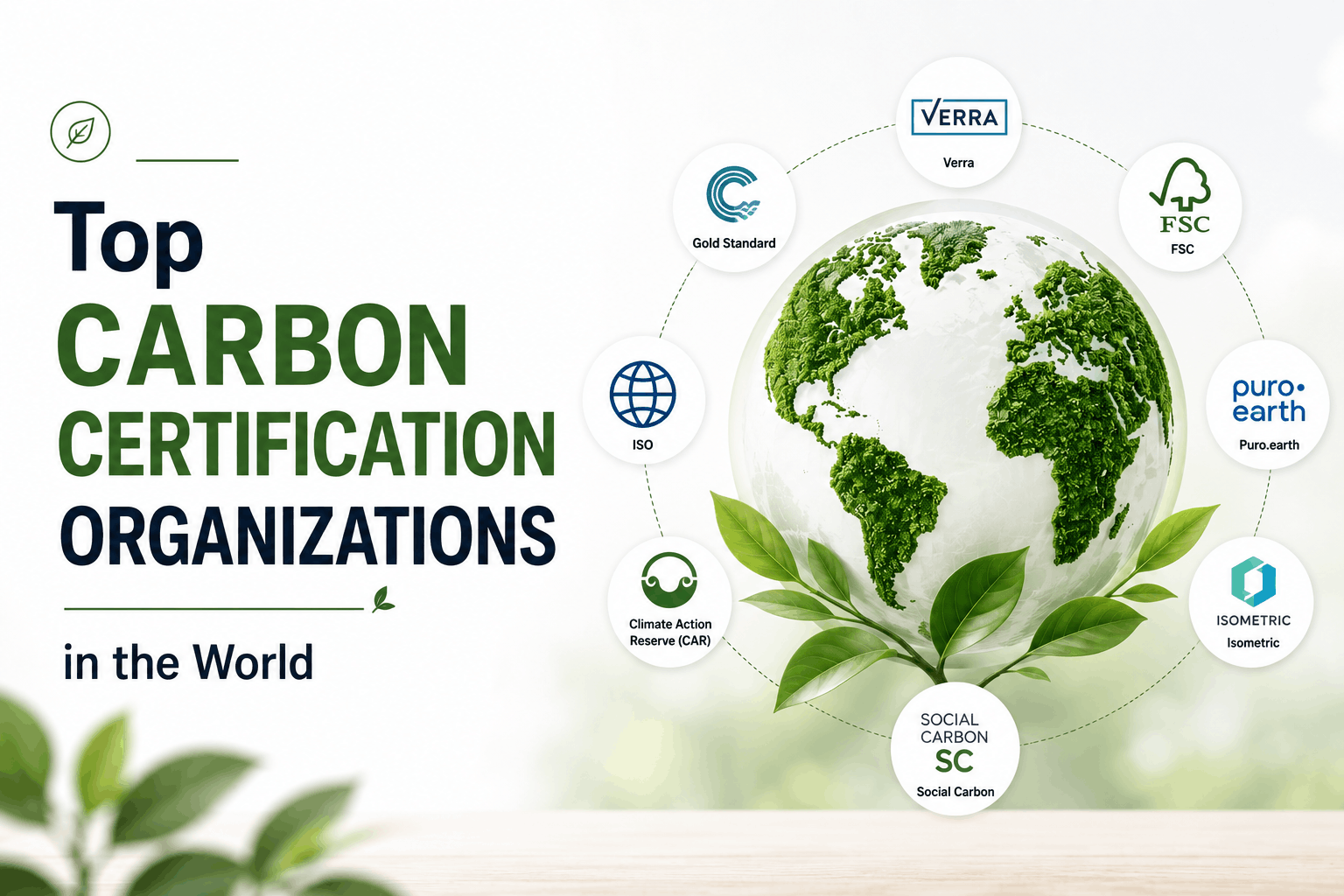
Carbon markets are growing fast. More companies, governments, and individuals want to take real climate action. But how do you know if a carbon credit is actually worth something?
That is exactly where carbon certification organizations come in.
These organizations set the rules, verify the results, and make sure every carbon credit on the market represents a genuine reduction in greenhouse gas emissions. Without them, the carbon market would be a free-for-all with no way to separate real climate action from empty claims.
In this guide, you will learn about the top carbon certification organizations in the world, what they do, how they are different from each other, and how to choose the right one for your needs.
What Are Carbon Certification Organizations?
Carbon certification organizations are independent bodies that develop standards and oversee the process of verifying carbon offset projects.
They make sure that when a project claims to reduce one tonne of CO2, it actually does exactly that.
Their job includes:
- Setting rules for how projects must measure and report emissions reductions
- Accrediting third-party verifiers who audit projects on the ground
- Issuing carbon credits to projects that pass verification
- Running public registries where every credit is tracked and retired
Think of them as the quality control gatekeepers of the carbon market. A carbon credit without certification from a recognized organization carries very little credibility with serious buyers.
Carbon Market Insider Newsletter
Weekly insights on carbon markets, climate policy, carbon credits, and sustainability.
Why Carbon Certification Matters
Not all carbon credits are created equal. In the early days of voluntary carbon markets, some projects overclaimed their impact. Others were not truly additional, meaning the emissions would have been reduced even without the carbon project.
This is where certification organizations proved their value.
A certified carbon credit must meet specific criteria. The most widely accepted criteria in the industry are:
| Criterion | What It Means |
|---|---|
| Real | The emission reductions actually happened |
| Measurable | They can be quantified using approved scientific methods |
| Additional | They would not have occurred without carbon finance |
| Permanent | The reductions are long-lasting, not reversed later |
| Independently Verified | A third party has confirmed the results |
| No Double Counting | The same credit cannot be claimed by two parties |
When you buy a certified carbon credit, you have confidence that every one of these boxes has been checked.
The Global Landscape of Carbon Certification
The carbon certification world includes several types of organizations:
Standards bodies develop the rules that projects must follow. Verra and Gold Standard are the best-known examples.
Registries maintain public databases of all credits issued, transferred, and retired. Most standards bodies also run their own registries.
Oversight bodies like the ICVCM sit above the standards and set benchmarks that certifiers must meet.
Verification bodies are accredited auditors who inspect projects and confirm that they deliver real results.
This guide focuses on the organizations that set standards and run registries, since these are the ones that give a carbon credit its credibility.
Top Carbon Certification Organizations in the World
1. Verra (Verified Carbon Standard)
Headquarters: Washington D.C., USA
Verra is the largest carbon certification organization in the world by volume. It runs the Verified Carbon Standard (VCS) program, which is the most widely used voluntary carbon crediting standard on the planet.
Verra has certified over 2,300 registered projects across more than 80 countries. It has issued credits representing over 1.1 billion tonnes of CO2 equivalent reduced or removed.
What Makes Verra Stand Out:
- It covers the widest range of project types, including forestry, agriculture, renewable energy, waste, and industrial processes
- Its registry is fully public, so anyone can look up any project and see exactly how many credits were issued and retired
- It received CCP-Eligible status from the ICVCM, meaning it meets the global high-integrity benchmark for carbon credits
- Large corporations like Fortune 500 companies frequently buy Verra-certified credits for their net-zero and ESG commitments
The Credit Unit: Verified Carbon Units (VCUs)
Every VCU represents exactly one metric tonne of CO2 equivalent reduced or removed. VCUs carry unique serial numbers and are tracked through their full lifecycle from issuance to retirement.
Project Types Certified by Verra:
| Sector | Examples |
|---|---|
| Forests and Land Use | REDD+, improved forest management, reforestation |
| Agriculture | Soil carbon, agricultural methane reduction |
| Renewable Energy | Solar, wind, hydro |
| Waste Management | Landfill methane capture, composting |
| Industrial | Energy efficiency, fuel switching |
| Blue Carbon | Mangroves, wetlands |
Verra also runs supplementary programs:
- CCB Standards (Climate, Community and Biodiversity) for projects that want to demonstrate social and biodiversity co-benefits
- Sustainable Development Verified Impact Standard (SD VISta) for tracking SDG contributions
Who Should Use Verra:
Verra is the best fit for large-scale projects seeking global buyers, developers working in the forestry and land-use space, and companies that want the highest liquidity in the voluntary carbon market.
2. Gold Standard
Headquarters: Geneva, Switzerland
Gold Standard is widely considered the premium certification for projects that deliver both climate impact and strong social benefits. It was founded in 2003 by WWF, SouthSouthNorth, and Helio International.
The full name of the standard is Gold Standard for the Global Goals (GS4GG), reflecting its deep alignment with the United Nations Sustainable Development Goals (SDGs).
Every Gold Standard certified project must demonstrate a verified contribution to at least three SDGs on top of reducing emissions. This dual mandate for climate and development makes Gold Standard particularly attractive to ESG-focused buyers, development finance institutions, and NGOs.
Gold Standard’s projects span 114 countries and have collectively reduced or removed over 445 million tonnes of CO2 equivalent.
The Credit Unit: Gold Standard Verified Emission Reductions (GSVERs)
Each GSVER represents one tonne of CO2 equivalent, with mandatory SDG co-benefit documentation attached.
Project Types Certified by Gold Standard:
| Category | Examples |
|---|---|
| Community Services | Clean cookstoves, safe drinking water, biogas |
| Renewable Energy | Solar, wind, small hydro, biomass |
| Land Use and Forestry | Reforestation, agroforestry, blue carbon |
Why Gold Standard Is Trusted:
- It requires third-party SDG impact verification, not just carbon accounting
- It has ICVCM CCP-Eligible status, meeting the highest integrity benchmark
- It is the go-to standard for projects in sub-Saharan Africa and South Asia where sustainable development co-benefits matter most
- Clean cookstove and clean water projects under Gold Standard are among the most popular credits for retail buyers and impact investors
Who Should Use Gold Standard:
Gold Standard is ideal for projects that want to demonstrate social impact alongside carbon reductions, ESG-focused corporate buyers, and development organizations in the Global South.
3. American Carbon Registry (ACR)
Headquarters: Little Rock, Arkansas, USA
The American Carbon Registry was founded in 1996, making it the first independent GHG crediting registry in the world. It is managed by Winrock International, a nonprofit organization focused on sustainable development.
ACR operates in both voluntary and compliance carbon markets. It is one of four registries approved by the California Air Resources Board (CARB) to administer compliance offsets under California’s cap-and-trade program, which is one of the world’s largest carbon pricing systems.
ACR holds ICVCM CCP-Eligible status and has approved over 40 methodologies covering a diverse range of project types.
The Credit Unit: Emission Reduction Tonnes (ERTs)
Each ERT represents one metric tonne of CO2 equivalent reduced or removed under an approved ACR methodology, tracked through a publicly available registry.
Project Types Certified by ACR:
| Sector | Examples |
|---|---|
| Forestry | Reforestation, improved forest management, REDD+ |
| Agriculture | Soil carbon sequestration, livestock methane |
| Energy | Renewable energy, fuel switching |
| Waste | Landfill methane, dairy digesters |
| Industrial | Ozone-depleting substance destruction, mine methane |
| Emerging | Direct air capture, enhanced rock weathering |
ACR credits can be used in both voluntary markets and California’s compliance system. Developers registered with ACR can also transfer credits to the Verra VCS platform, giving them access to a broader buyer pool.
Who Should Use ACR:
ACR is best suited for North American project developers, particularly those working in forestry and agriculture, and those seeking access to California’s compliance market.
4. Climate Action Reserve (CAR)
Headquarters: Los Angeles, California, USA
The Climate Action Reserve was launched in 2008, growing out of the California Climate Action Registry which was established by California state legislation in 2001. CAR has a uniquely deep connection to compliance markets because its protocols directly shaped the California cap-and-trade program.
CAR has issued its 250 millionth carbon credit, covering 1,174 projects across 45 US states and 17 Mexican states under 27 different project types. It is approved as an Offset Project Registry in California and Washington, and its credits are recognized in compliance systems in Chile and Tamaulipas, Mexico.
CAR holds ICVCM CCP-Eligible status, and two of its protocols, the Mexico Forest Protocol and the US Soil Enrichment Protocol, received CCP-Approved methodology status.
The Credit Unit: Climate Reserve Tonnes (CRTs)
Each CRT represents one metric tonne of CO2 equivalent and is tracked in a publicly available registry system.
Project Types Certified by CAR:
| Sector | Protocol Examples |
|---|---|
| Forestry | US Forest, Urban Forest, Mexico Forest |
| Agriculture | Soil Enrichment, Rice Cultivation, Livestock |
| Waste | Landfill Gas, Mine Methane Capture |
| Industrial | Ozone-Depleting Substances (ODS) |
Why CAR Stands Out:
- Its protocols were built through multi-stakeholder workgroups, including local community engagement
- The California Air Resources Board adopted many CAR protocols as the basis for its compliance offset rules
- CAR credits can be transferred to Verra’s VCS platform, giving developers flexibility in marketing
- It has the most rigorous compliance-focused verification track record of any North American registry
Who Should Use CAR:
CAR is the top choice for North American project developers who want their credits to be usable in California’s compliance market, and for agricultural and forestry projects in the US and Mexico.
5. Plan Vivo Foundation
Headquarters: Edinburgh, Scotland, UK
Plan Vivo is the oldest carbon certification standard in the world, originating from a University of Edinburgh research project in the mid-1990s and first piloted with smallholder farmers in Chiapas, Mexico.
It is operated by the Plan Vivo Foundation, a Scottish charity, and is specifically designed for community-led, smallholder land-use projects in the Global South. No other major standard focuses as specifically on the rights, livelihoods, and agency of local farming communities.
Plan Vivo runs two schemes:
- PV Climate for carbon projects
- PV Nature for biodiversity projects
It has certified projects involving over 1,700 communities and over 10.8 million tonnes of CO2 equivalent in planned emission reductions.
The Credit Unit: Plan Vivo Certificates (PVCs)
Each PVC represents one tonne of CO2 equivalent. Unlike most other standards, Plan Vivo issues credits ex-ante, meaning projects can receive upfront financing based on expected future carbon sequestration, rather than waiting until after the work is done.
This upfront funding model is particularly valuable for smallholder communities in developing countries who cannot afford to wait years for income from their land-use activities.
What Makes Plan Vivo Different:
- A minimum share of revenue must flow directly to project communities
- Projects must operate in developing countries and work with small-scale land users
- Ex-ante credit issuance provides upfront capital to communities
- Every project undergoes third-party verification every five years
- Emphasis on biodiversity, livelihoods, and ecosystem restoration alongside carbon
Notable Plan Vivo Projects:
The Trees for Global Benefits programme in Uganda, run by ECOTRUST since 2003, is one of the longest-running Plan Vivo certified projects, paying smallholder farmers for agroforestry-based carbon sequestration.
Who Should Use Plan Vivo:
Plan Vivo is the ideal standard for community-based nature projects in developing countries, impact investors who prioritize community livelihoods, and buyers who want the highest confidence that local communities genuinely benefit.
6. Puro.earth
Headquarters: Helsinki, Finland
Puro.earth is the world’s first certification standard and marketplace dedicated exclusively to carbon removal. While most standards certify both emission avoidance and carbon removal projects, Puro.earth only certifies activities that physically remove CO2 from the atmosphere and store it durably.
The ICVCM recognized Puro.earth as CCP-Eligible, making it the eighth program to achieve this status and bringing it firmly into the high-integrity mainstream.
The Credit Unit: CO2 Removal Certificates (CORCs)
Each CORC represents one metric tonne of CO2 physically removed from the atmosphere and stored for at least 100 years. This focus on permanence and durability sets Puro.earth apart from standards that accept shorter storage timeframes.
Technologies Certified by Puro.earth:
| Technology | Description |
|---|---|
| Biochar | Converts organic waste into stable carbon stored in soil |
| Timber in Construction | Long-lived wooden buildings that store carbon |
| Bio-based Construction Materials | Biomass materials that lock away carbon |
| Enhanced Weathering | Accelerated mineral weathering that sequesters CO2 |
| Bioenergy with Carbon Capture | BECCS combining biomass energy with carbon storage |
Puro.earth also partnered with BeZero Carbon, an independent carbon ratings agency, to enable projects on its platform to receive independent quality ratings. The first biochar project rated by BeZero was a Puro.earth certified project in Germany, which received an A rating.
Who Should Use Puro.earth:
Puro.earth is best for technology-based carbon removal projects, companies building net-zero strategies that prioritize permanent removal over avoidance, and buyers who want the highest confidence in long-term carbon storage.
7. Architecture for REDD+ Transactions (ART / TREES)
Headquarters: Arlington, Virginia, USA (operated by Winrock International)
ART runs the TREES standard (The REDD+ Environmental Excellence Standard), which is designed for national and subnational governments that want to certify jurisdictional REDD+ programs rather than individual project activities.
ART/TREES is specifically designed for large-scale forest conservation at the country or regional level, making it fundamentally different from project-level standards like Verra or Gold Standard.
ART/TREES holds ICVCM CCP-Eligible status and, together with ACR, CAR, Gold Standard, and Verra, represents roughly 98% of all voluntary carbon market volume.
Who Uses ART/TREES:
ART is used by national governments and state or provincial governments that manage large forest jurisdictions. Countries like Ecuador, Costa Rica, and several others have used ART/TREES as a framework for generating high-integrity REDD+ credits that can be sold to corporate buyers or used under Article 6 of the Paris Agreement.
Why ART/TREES Matters:
Jurisdictional approaches to forest conservation are increasingly preferred because they can address concerns about leakage more effectively than individual project approaches. When an entire country or region manages its forest under a single standard, emissions do not simply shift from one project boundary to a neighboring area.
8. The Integrity Council for the Voluntary Carbon Market (ICVCM)
Headquarters: London, UK
The ICVCM sits at the top of the carbon certification hierarchy. It is not a certifier itself. Instead, it is an independent global governance body that sets the quality threshold that all other carbon crediting programs must meet.
The ICVCM was established in 2021 and launched its Core Carbon Principles (CCPs) in March 2023. These are 10 fundamental principles that define what a high-integrity carbon credit must deliver.
The 10 Core Carbon Principles:
| # | Principle |
|---|---|
| 1 | Effective governance |
| 2 | Tracking |
| 3 | Transparency |
| 4 | Robust independent third-party validation and verification |
| 5 | Additionality |
| 6 | Permanence |
| 7 | Robust quantification of emission reductions and removals |
| 8 | No double counting |
| 9 | Sustainable development benefits and safeguards |
| 10 | Net atmospheric benefit |
Programs that meet these principles receive CCP-Eligible status. When specific methodologies within those programs are also approved, credits generated under those methodologies can carry the CCP label, which is the highest quality signal currently available in voluntary carbon markets.
Current CCP-Eligible Programs:
As of mid-2026, eight programs hold CCP-Eligible status: ACR, ART/TREES, CAR, Equitable Earth, Gold Standard, Isometric, Puro.earth, and Verra.
Together, these programs account for roughly 98% of all voluntary carbon market volume.
Why the CCP Label Matters:
Research from Sylvera, an independent carbon ratings agency, shows that in 2026, 76% of CCP-labeled projects scored BBB or above on independent quality ratings, compared with just 13% of non-CCP projects. CCP-labeled credits also command a price premium of up to 25% compared to other credits.
For corporate buyers navigating new disclosure requirements under the EU’s Corporate Sustainability Reporting Directive (CSRD) and Science Based Targets initiative (SBTi) guidelines, buying CCP-labeled credits is increasingly becoming the baseline requirement.
9. Isometric
Headquarters: San Francisco, California, USA
Isometric is a newer entrant to carbon certification but has quickly established itself as one of the most rigorous platforms in the market, with a specific focus on carbon removal credits.
Isometric achieved CCP-Eligible status from the ICVCM, joining the ranks of Puro.earth and Verra as certified high-integrity programs.
Isometric is particularly known for its work with direct air capture projects. The Climeworks Mammoth facility in Iceland, which is the world’s largest direct air capture plant, uses Isometric as its certification standard. It was also the first project to receive BeZero Carbon’s highest AAA rating.
What Isometric Does Differently:
Isometric publishes all its data publicly, including detailed technical documentation on how each tonne of CO2 was measured and verified. This radical transparency is designed to help buyers understand exactly what they are purchasing and make it easier for independent auditors to review.
Isometric focuses on the most scientifically rigorous approaches to carbon removal, including direct air capture and storage, where the permanence and measurability of removal are extremely high.
Comparison of Top Carbon Certification Organizations
| Organization | Founded | Focus Area | Credit Type | ICVCM Status | Best For |
|---|---|---|---|---|---|
| Verra (VCS) | 2005 | Broad (all project types) | VCUs | CCP-Eligible | Large-scale global projects |
| Gold Standard | 2003 | Climate + SDGs | GSVERs | CCP-Eligible | Social impact, ESG buyers |
| ACR | 1996 | North America, compliance | ERTs | CCP-Eligible | US compliance market |
| CAR | 2008 | North America, compliance | CRTs | CCP-Eligible | California compliance market |
| Plan Vivo | 1994 | Community, smallholder | PVCs | Not assessed | Rural communities in Global South |
| Puro.earth | 2019 | Technology removal only | CORCs | CCP-Eligible | Engineered carbon removal |
| ART/TREES | 2011 | Jurisdictional REDD+ | TREES Credits | CCP-Eligible | National/subnational governments |
| ICVCM | 2021 | Market governance (oversight) | CCP Label | N/A (Oversight body) | All buyers seeking quality assurance |
| Isometric | 2021 | Carbon removal | Removal Credits | CCP-Eligible | Direct air capture and removals |
How Carbon Certification Works: Step by Step
Understanding the certification process helps you appreciate why certified credits carry so much more credibility than uncertified ones.
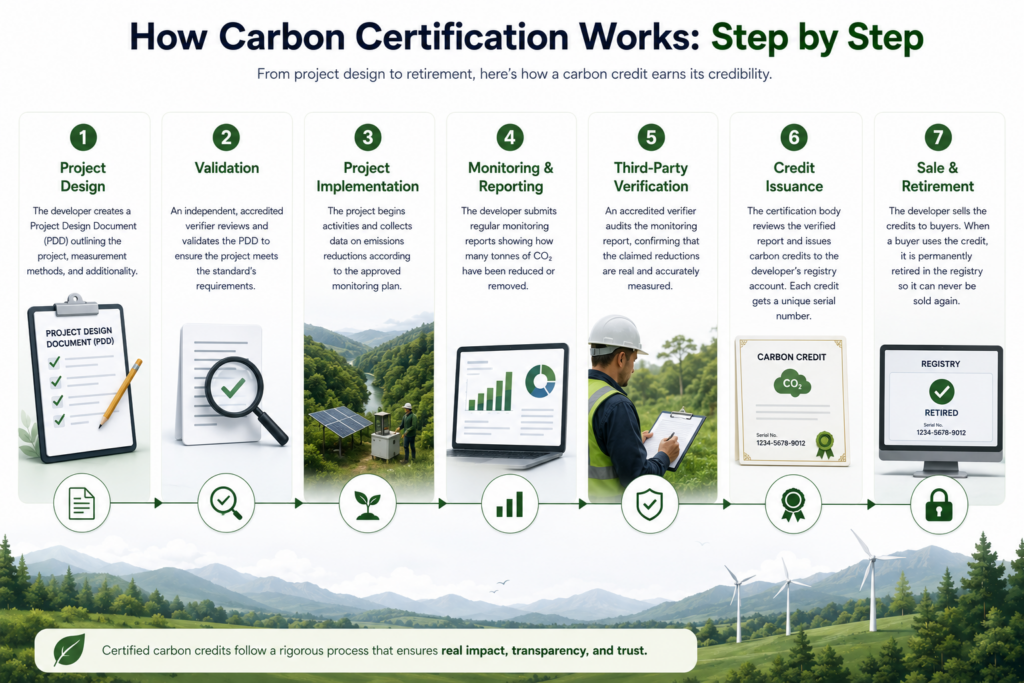
Step 1: Project Design
The project developer designs a project following the rules of a chosen standard. They write a Project Design Document (PDD) that explains what the project does, how emissions reductions will be measured, and why the project is additional.
Step 2: Validation
An accredited, independent third-party verification body (VVB) reviews the Project Design Document and validates that the project meets all the requirements of the standard before it starts generating credits.
Step 3: Project Implementation
The project begins its activities, whether that is protecting a forest, distributing cookstoves, or building biochar systems. It collects data on its emissions reductions according to its approved monitoring plan.
Step 4: Monitoring and Reporting
The project developer submits regular monitoring reports showing how many tonnes of CO2 have been reduced or removed during a specific reporting period.
Step 5: Third-Party Verification
An accredited verifier audits the monitoring report, independently confirming that the claimed reductions are real and accurately measured.
Step 6: Credit Issuance
The certification body reviews the verified report and issues carbon credits to the project developer’s registry account. Each credit receives a unique serial number.
Step 7: Sale and Retirement
The project developer sells the credits to buyers. When a buyer uses the credit toward its climate commitments, the credit is permanently retired in the registry so it can never be sold again.
How to Choose the Right Carbon Certification Organization
Choosing the right standard depends on several factors.
Consider your project type first. If you are running a large-scale forestry or REDD+ project, Verra is the most liquid option. If your project serves communities in developing countries, Gold Standard or Plan Vivo may be a better fit. If you are building a direct air capture facility, look at Puro.earth or Isometric.
Think about your target buyer. Buyers in California’s compliance market need credits from ACR or CAR. Buyers focused on ESG and SDG alignment prefer Gold Standard. Buyers who want the highest technical rigor for removal credits tend to gravitate toward Puro.earth or Isometric.
Check ICVCM status. If you want the broadest market access and the highest credibility with sophisticated buyers, choose a program that holds ICVCM CCP-Eligible status. This is becoming the baseline expectation for institutional and corporate buyers.
Look at methodology availability. Make sure the standard you choose has an approved methodology for your specific project type. Using an approved methodology speeds up the validation process and increases buyer confidence.
Assess co-benefit requirements. If your project delivers strong community or biodiversity benefits and you want those recognized, Gold Standard and Plan Vivo offer the most robust co-benefit verification frameworks.
The Growing Importance of Carbon Certification in Global Climate Policy
Carbon certification organizations are playing an increasingly important role in global climate policy, not just voluntary markets.
Under Article 6 of the Paris Agreement, countries can trade internationally transferred mitigation outcomes (ITMOs). High-integrity carbon credits certified by recognized standards are positioning themselves as key instruments in this emerging compliance landscape.
The CORSIA program (Carbon Offsetting and Reduction Scheme for International Aviation) uses approved carbon crediting programs to help airlines offset their aviation emissions. Verra, Gold Standard, and ACR are among the CORSIA-approved standards, meaning their credits can be used by airlines to meet international compliance obligations.
As new regulations like the EU Carbon Border Adjustment Mechanism (CBAM) and the EU’s corporate greenwashing rules put more pressure on companies to prove the quality of their climate claims, carbon certification organizations are becoming the gatekeepers that determine which claims hold up under scrutiny.
Emerging Trends in Carbon Certification
The carbon certification world is evolving quickly. A few trends are shaping what certification looks like today.
Digital MRV (Measurement, Reporting and Verification) is gaining traction. Satellite monitoring, drone surveys, and AI-powered forest inventory tools are reducing the cost and increasing the accuracy of carbon accounting. Several standards, including Verra, are developing digital MRV methodologies that allow near-real-time monitoring of project performance.
New-wave standards for carbon removal are rising fast. Beyond Puro.earth and Isometric, standards like Equitable Earth and Rainbow are emerging with specialized approaches for specific removal technologies. The ICVCM has already approved Equitable Earth as CCP-Eligible.
Jurisdictional approaches are growing. Rather than certifying individual forest projects, ART/TREES and similar frameworks certify entire national or subnational forest systems. This reduces the risk of leakage and makes it easier for governments to generate large volumes of high-integrity credits.
Independent ratings agencies like BeZero Carbon and Sylvera are adding a second layer of quality assessment on top of certification standards. More buyers now require both a recognized certification and a strong independent rating before purchasing credits.
Common Questions About Carbon Certification Organizations
FAQ
Q: What is the difference between a carbon certification standard and a carbon registry?
A: A certification standard sets the rules that projects must follow to generate verified carbon credits. A registry is the database that tracks which credits have been issued, who owns them, and when they are retired. Most major certification organizations, like Verra and Gold Standard, run both their own standard and their own registry.
Q: Which carbon certification organization is the most recognized globally?
A: Verra’s Verified Carbon Standard (VCS) is the most widely used certification standard globally by volume of credits issued. Gold Standard is the most recognized for projects that combine climate action with social development goals.
Q: What does ICVCM CCP-Eligible mean?
A: It means the carbon crediting program has been reviewed by the Integrity Council for the Voluntary Carbon Market and has been found to meet all 10 of the Core Carbon Principles, which represent the highest global quality benchmark for carbon credits.
Q: Are carbon certifications mandatory?
A: In voluntary carbon markets, certification is not legally mandatory. However, without recognized certification, carbon credits have essentially no market credibility or value with serious buyers. In compliance markets like California’s cap-and-trade, only credits from approved registries like ACR and CAR can be used to meet legal obligations.
Q: How long does carbon certification take?
A: The timeline varies by standard and project complexity. A typical certification process from project design through first credit issuance can take anywhere from 6 months to 2 years. The validation and verification steps require independent third-party audit time, which drives most of the timeline.
Q: Can a project be certified by more than one organization?
A: In some cases, projects can seek certification under multiple standards, provided there is no double counting of the same emissions reductions. For example, a project might seek VCS certification for its carbon credits and CCB Standards certification for its biodiversity and community co-benefits. ACR also allows projects registered elsewhere to transfer eligible credits to ACR under certain conditions.
Q: What is the difference between Verra VCS and Gold Standard?
A: Both are globally recognized high-integrity standards. The key difference is that Gold Standard requires every project to demonstrate a verified contribution to at least three UN Sustainable Development Goals, while Verra’s core VCS program focuses primarily on carbon accounting. Gold Standard tends to attract buyers who prioritize community development alongside carbon; Verra attracts buyers who want the widest range of project types and the highest market liquidity.
Q: What is a CCP label and how do I find credits that carry it?
A: The CCP label is a quality mark awarded by the ICVCM to carbon credits that were generated under an approved methodology within a CCP-Eligible program. You can find CCP-labeled credits in the public registries of programs like Verra, Gold Standard, ACR, and CAR. Look for the CCP tag on specific methodology categories when browsing registry listings.
Conclusion
Carbon certification organizations are the backbone of trustworthy climate action in global carbon markets.
From the scale and reach of Verra, to the community-first mission of Plan Vivo, to the removal-focused rigor of Puro.earth, each organization plays a specific and important role in making sure that carbon credits represent real, lasting climate impact.
The rise of the ICVCM and its Core Carbon Principles has added an overarching quality layer that is rapidly becoming the global standard for what high-integrity carbon credits look like. Eight programs now hold CCP-Eligible status, together covering roughly 98% of the voluntary carbon market.
Whether you are a project developer looking for the right standard to certify your work, a corporate buyer building a credible net-zero strategy, or a student learning how carbon markets function, understanding these top carbon certification organizations is your first step toward participating meaningfully in the global push for genuine climate action.
The carbon market is maturing fast. The organizations in this guide are leading that transformation, one verified tonne at a time.
This article is published by Carbon Market Network, your trusted source for carbon market education and resources.