Carbon Market Network

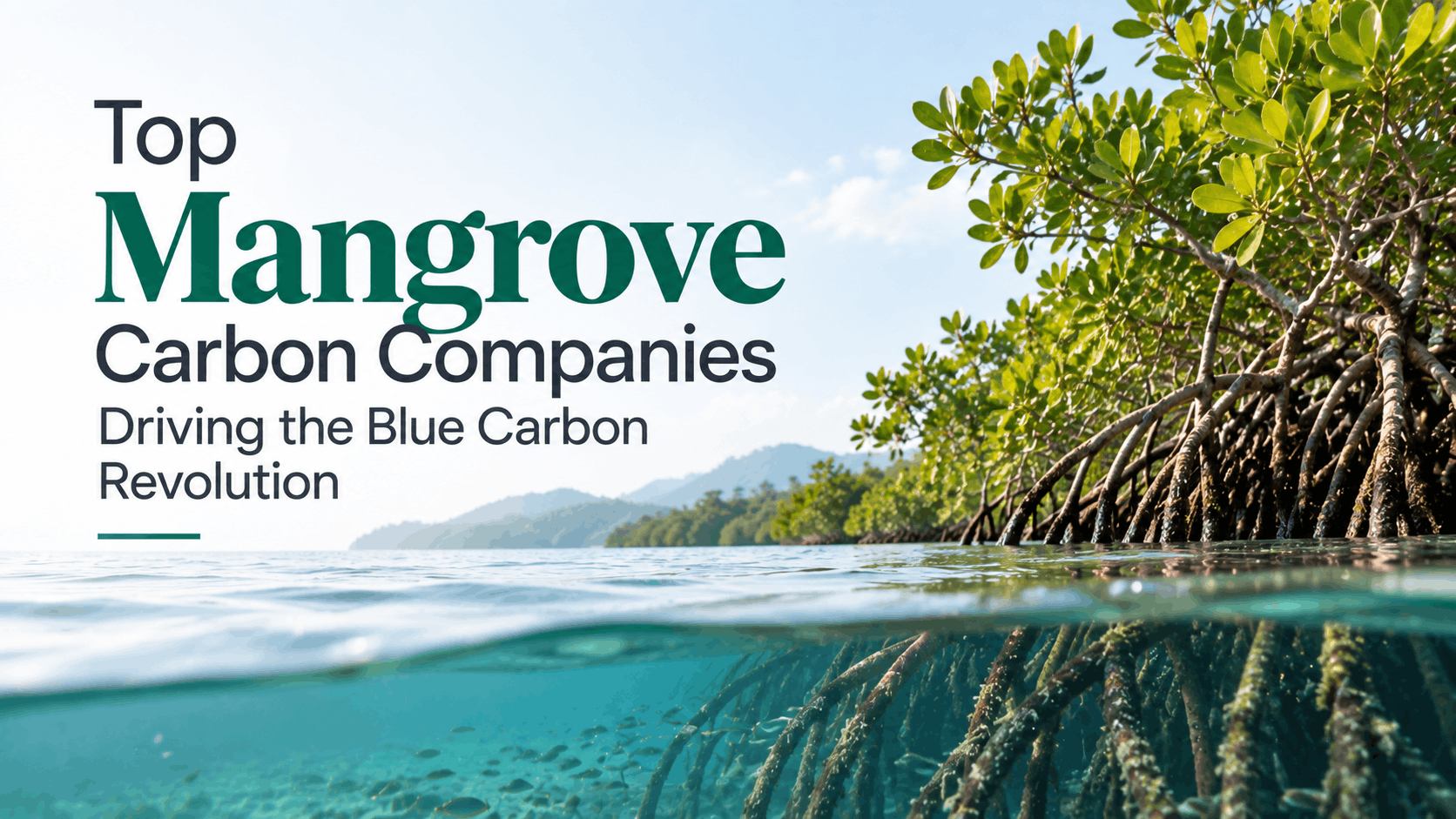
Mangroves are some of the most powerful carbon-storing ecosystems on the planet. And right now, a growing group of companies is racing to protect and restore them, turning coastal forests into carbon credits worth real money.
If you’ve heard the term “blue carbon” and wondered who the major players are, you’re in the right place.
This guide breaks down the top mangrove carbon companies, what they do, where they operate, and why they matter for the future of carbon markets.
What Are Mangrove Carbon Companies?
Mangrove carbon companies develop, fund, or manage projects that protect and restore mangrove forests. In return, these projects generate carbon credits that businesses around the world can buy to offset their greenhouse gas emissions.
The carbon stored in mangroves is called blue carbon because it comes from coastal and marine ecosystems. Mangroves store carbon in their above-ground biomass (trunks, branches, leaves) and, most importantly, in their deep, waterlogged soils.
These soil carbon stores are enormous. In fact, mangrove soils hold roughly 60% of the total carbon in a mangrove ecosystem. That’s a huge deal for carbon accounting.
Mangrove carbon companies sit at the intersection of climate finance, conservation, and community development. They bring together project developers, government partners, local communities, verification bodies, and corporate buyers.
Carbon Market Insider Newsletter
Weekly insights on carbon markets, climate policy, carbon credits, and sustainability.
Why Mangroves Matter So Much for Carbon Markets
Before diving into the companies, here’s the big picture on why mangroves are such a hot asset in carbon markets.
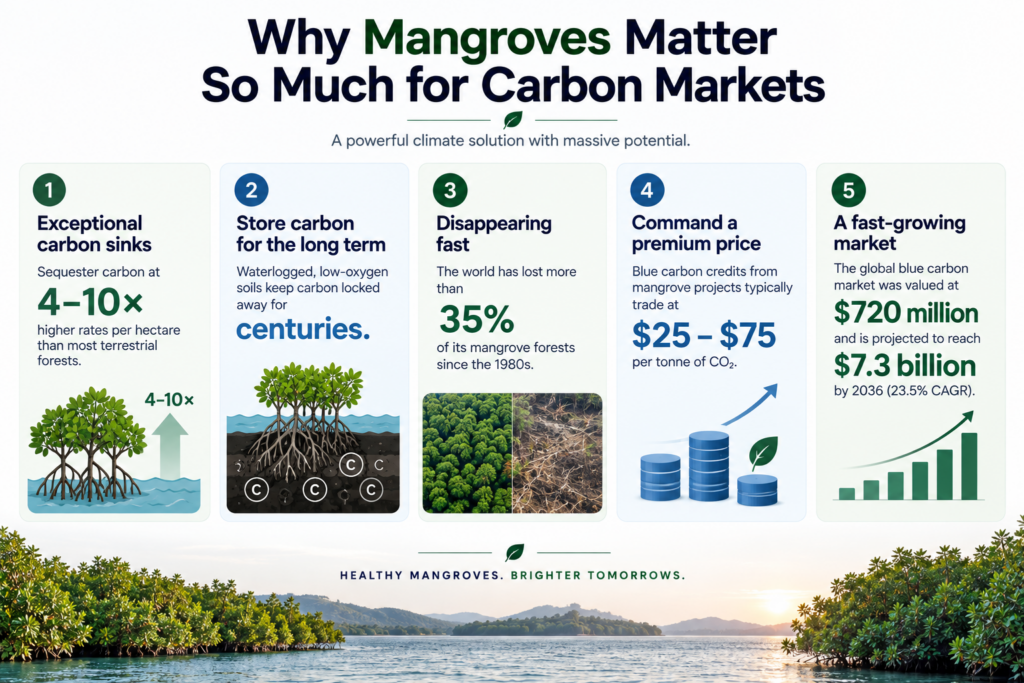
Mangroves are exceptional carbon sinks. They sequester carbon at rates 4 to 10 times higher per hectare than most terrestrial forests. Some estimates suggest they can store carbon at rates up to 10 times higher than tropical rainforests.
They store carbon for the long term. Because their soils are waterlogged and low in oxygen, organic matter decomposes slowly. This means carbon can stay locked away for centuries.
They are disappearing fast. The world has lost more than 35% of its mangrove forests since the 1980s. The pressure from aquaculture, agriculture, coastal development, and fuelwood harvesting continues today. Every hectare lost releases stored carbon back into the atmosphere.
Their credits command a premium price. Blue carbon credits from mangrove projects typically trade at $25 to $75 per tonne of CO2, well above the prices for most other nature-based credits. This premium reflects their scarcity, high integrity, and strong co-benefits.
The market is growing fast. The global blue carbon market was valued at around $720 million and is projected to reach $7.3 billion by 2036 at a compound annual growth rate of 23.5%. Mangrove projects account for roughly 68% of blue carbon market revenue.
How Do Mangrove Carbon Credits Work?
Understanding the process helps you evaluate which companies are doing it right.
Step 1: Identify the project area. A developer identifies a degraded or threatened mangrove area where intervention will make a measurable difference.
Step 2: Establish a baseline. The project team measures how much carbon currently exists and estimates how much would be lost without the project.
Step 3: Implement conservation or restoration. This includes replanting seedlings, community stewardship agreements, alternative livelihood programs, and monitoring systems.
Step 4: Measure carbon sequestration. Rigorous Monitoring, Reporting, and Verification (MRV) processes track how much carbon the mangroves are actually absorbing or protecting.
Step 5: Get third-party verification. An independent auditor validates the numbers.
Step 6: Issue carbon credits. For every verified tonne of CO2 avoided or removed, one carbon credit is issued.
Step 7: Sell credits to corporate buyers. Companies buy these credits to meet their net-zero commitments or sustainability pledges.
The main certification standard for mangrove carbon projects is Verra’s Verified Carbon Standard (VCS), which uses the VM0033 methodology for tidal wetland and seagrass restoration. Some projects also use Plan Vivo and Gold Standard.
Top Mangrove Carbon Companies and Projects Around the World
Here is a detailed look at the organizations and companies leading mangrove carbon work globally.
1. Indus Delta Capital (Pakistan)
Project: Delta Blue Carbon (DBC-1) Location: Indus River Delta, Sindh Province, Pakistan Scale: 350,000 hectares
Delta Blue Carbon is, by any measure, the world’s largest blue carbon project. It operates across 350,000 hectares of tidal wetlands in Pakistan’s Indus River Delta.
Founded by Surriekha Khan and Nadeem Raza Khan, Indus Delta Capital developed the project in partnership with the Government of Sindh through a public-private partnership arrangement.
Over its 60-year lifetime, the project is expected to remove approximately 142 million tonnes of CO2 equivalent from the atmosphere. That is the equivalent of taking 33 million gasoline-powered cars off the road for one full year.
The project is registered under Verra’s VCS program and the Climate, Community & Biodiversity (CCB) Standards, earning a “Triple Gold” CCB rating. It has already restored more than 73,000 hectares of degraded mangrove forests and benefits over 43,000 people across 60 villages.
Community benefits include access to clean drinking water, healthcare, education, and hundreds of new jobs.
Silvestrum Climate Associates provided key technical support, developing the initial version of the VM0033 methodology used for carbon quantification in this project.
A landmark transaction led by Respira International and Carbon Growth Partners brought DBC-1 to global attention. At auction, credits from the project achieved an average price of $29.72 per tonne.
| Key Detail | Information |
|---|---|
| Project Area | 350,000 hectares |
| Project Duration | 60 years (2015 to 2075) |
| Expected CO2 Removal | 142 million tonnes CO2e |
| Certification | Verra VCS + Triple Gold CCB |
| Community Beneficiaries | 43,000+ people, 60 villages |
| Developer | Indus Delta Capital + Government of Sindh |
2. Conservation International (Colombia)
Project: Vida Manglar (Gulf of Morrosquillo) Location: Cispatá Bay, Colombia Scale: 7,561 hectares
Conservation International developed Vida Manglar, the first blue carbon conservation project ever registered under Verra’s Verified Carbon Standard. This project was a milestone for the entire mangrove carbon industry.
The project protects and manages over 7,500 hectares of coastal mangrove ecosystem, marshes, and associated streams in Colombia’s Gulf of Morrosquillo.
What made this project historic is that it was the first to earn carbon credits for conserving existing mangroves rather than restoring degraded ones. It was also the first to account for carbon stored in underwater mangrove soils, not just above-ground biomass.
Conservation International developed the project with technical support from South Pole, one of the world’s leading carbon project developers. Implementing partners included Colombia’s Marine and Coastal Research Institute (INVEMAR) and the Omacha Foundation.
Technology company Apple became a key buyer and funder, retiring credits from the project as part of its comprehensive carbon footprint strategy.
Vida Manglar holds a BeZero Carbon AAA rating, the highest available from that independent rating agency.
Over its 30-year lifetime, the project will sequester close to one million tonnes of CO2.
| Key Detail | Information |
|---|---|
| Project Area | 7,561 hectares |
| Project Duration | 30 years |
| Expected CO2 Removal | ~1 million tonnes CO2e |
| Certification | Verra VCS (VM0007, revised) |
| Independent Rating | BeZero Carbon AAA |
| Developer | Conservation International |
| Technical Support | South Pole |
3. West Africa Blue (Sierra Leone and Guinea)
Project: Sherbro River Estuary and Yawri Bay Location: Sierra Leone, Guinea Scale: Up to 94,000 hectares
West Africa Blue is a community-focused developer working to originate and develop high-integrity blue carbon projects across West Africa. Its flagship project is in Sierra Leone’s Sherbro River Estuary, one of West Africa’s most important mangrove systems.
The company signed agreements with 124 communities on Sherbro Island to reward them financially for conserving and restoring their mangrove forests. Revenue from carbon credit sales gets shared equitably between the company, the communities, and the Government of Sierra Leone.
West Africa Blue’s Sierra Leone project has the potential to reduce more than 9 million tonnes of CO2e over the next 30 years. The project area covers up to approximately 92,000 hectares of coastal mangrove habitat.
The project has attracted backing from the US International Development Finance Corporation (DFC) and FSD Africa. It is registered with Verra as a pipeline project under development.
What sets West Africa Blue apart is its strong emphasis on community engagement. The company has been supporting communities in the Sherbro River Estuary for over 13 years, building trust and long-term relationships before carbon credits ever came into the picture.
The company also runs “Living Labs” to develop and share open-source solutions for practical challenges in mangrove blue carbon project development.
4. Mikoko Pamoja Community Organization (Kenya)
Project: Mikoko Pamoja Location: Gazi Bay, Kwale County, Kenya Scale: 117 hectares
Mikoko Pamoja, meaning “Mangroves Together” in Swahili, holds a unique and celebrated place in the history of blue carbon. It is the world’s first community-led project to successfully sell mangrove carbon credits.
Launched in 2013 at Gazi Bay on Kenya’s south coast, Mikoko Pamoja protects 117 hectares of mangroves and plants around 4,000 new seedlings every year. It trades approximately 2,500 to 3,000 tonnes of CO2 equivalent per year on the voluntary carbon market.
The project started under Plan Vivo certification and later registered under Verra’s VCS. Scientific support comes from the Kenya Marine and Fisheries Research Institute (KMFRI) and the Association for Coastal Ecosystem Services (ACES).
Carbon revenue goes directly back into the community. 30% funds community development projects, including clean water access for 3,500 residents, educational materials for 700 school children, and improvements to local health facilities. The rest supports conservation teams, project coordination, and independent verification.
Mikoko Pamoja is proof that small-scale, community-owned blue carbon projects can work. It serves as a global blueprint for community-led mangrove conservation.
| Key Detail | Information |
|---|---|
| Project Area | 117 hectares |
| Annual Credit Volume | ~2,500 to 3,000 tonnes CO2e |
| Certification | Verra VCS (formerly Plan Vivo) |
| Community Beneficiaries | 3,500+ residents |
| Scientific Partner | KMFRI + ACES |
5. Climate Impact Partners (Senegal)
Project: Mangrove Restoration in Senegal (with WeForest and Oceanium) Location: Senegal, West Africa
Climate Impact Partners has been active in voluntary carbon markets for more than 25 years. Its mangrove project in Senegal represents one of the first large-scale mangrove restoration efforts in West Africa to be developed under Verra’s latest tidal wetland restoration methodology.
The project was developed alongside WeForest (restoration implementation partner) and Oceanium (local NGO). Together, they planted nearly 8 million mangrove seedlings, with a total of 23 million expected to be planted.
The project is expected to deliver one million tonnes of carbon removals over 30 years while restoring habitats for more than 50 mammal species and hundreds of migratory birds.
Silvestrum Climate Associates, co-author of the VM0033 methodology, is involved in soil carbon analysis for this project.
This project is among the first to account for sea-level rise and soil organic carbon accumulation under Verra’s latest methodology, making it one of the most scientifically advanced mangrove carbon projects to date.
6. Silvestrum Climate Associates (Global Technical Leader)
Role: Methodology development, technical consulting Key Projects: Delta Blue Carbon (Pakistan), Vida Manglar (Colombia), Senegal mangrove project
Silvestrum Climate Associates is not a project developer in the traditional sense. It is one of the world’s leading technical consultancies for blue carbon and coastal ecosystem carbon accounting.
Silvestrum developed the initial version of Verra’s VM0033 Methodology for Tidal Wetland and Seagrass Restoration, the primary standard used for mangrove carbon projects globally. Without this methodology, most of the large-scale blue carbon projects operating today would not exist.
The company co-authored the methodology alongside Climate Impact Partners and has provided technical support to flagship projects including Delta Blue Carbon in Pakistan and the Gulf of Morrosquillo project in Colombia.
In the blue carbon world, Silvestrum occupies a critical behind-the-scenes role, setting the scientific standards that determine how carbon is measured, verified, and credited.
7. South Pole (Global Carbon Project Developer)
Role: Carbon project developer and technical support Key Projects: Vida Manglar (Colombia), various global mangrove projects
South Pole is one of the world’s largest carbon project developers and climate solutions companies. It provided technical support for the development of Vida Manglar in Colombia, the first blue carbon conservation project registered under Verra’s VCS.
South Pole works across project origination, technical development, carbon credit sales, and corporate sustainability advisory. Its involvement in the mangrove space reflects broader involvement in nature-based solutions globally.
South Pole’s expertise in navigating complex carbon accounting methodologies makes it a key partner for developing first-of-a-kind projects like Vida Manglar.
8. Sumitomo Corporation (Japan, Madagascar)
Project: Mangrove Reforestation in Madagascar (with VNV and Bondy) Location: Madagascar Scale: 21-year crediting period (2024 to 2044)
Japanese trading giant Sumitomo Corporation entered the mangrove carbon space through a joint venture with Value Network Ventures (VNV) and Malagasy social enterprise Bondy.
The Madagascar project focuses on mangrove reforestation and aims to generate 800,000 tonnes of carbon credits over 21 years. Sumitomo Corporation funds the project and takes responsibility for selling credits primarily to Japanese companies.
This project represents a growing trend of major Asian corporations investing directly in mangrove carbon as a credible tool for meeting their net-zero commitments.
VNV leads climate change mitigation initiatives across South Asia and East Africa and has impacted over 7 million rural households through community-driven nature projects.
9. Blue Ventures (Global, with a Focus on Africa and Southeast Asia)
Role: Coastal community conservation, mangrove monitoring tools Key Contribution: Google Earth Engine Mangrove Mapping Methodology (GEM)
Blue Ventures works with coastal communities to develop marine conservation tools and carbon projects. One of its most notable contributions is the Google Earth Engine Mangrove Mapping Methodology (GEM), a cloud-based tool for rapid monitoring of mangrove cover and historical land-use change.
Blue Ventures has supported the Vanga Blue Forest project in Kenya (near the Tanzania border) and has piloted Blue Carbon Resilience Credits (BCRC) in Belize. These credits are designed to attract buyers who want to offset carbon emissions and simultaneously support measurable flood-reduction benefits.
Blue Ventures works at the intersection of mangrove conservation, community empowerment, and innovative carbon market tools.
10. MarVivo (Mexico)
Project: MarVivo Blue Carbon Conservation Project, Baja California Sur Location: Magdalena Bay, Mexico Scale: ~22,000 hectares of mangroves, 137,000 hectares of marine environment
MarVivo is developing one of the largest blue carbon conservation projects in the world, focused on protecting mangrove forests and associated marine habitat in Mexico’s Baja California.
The project received an initial investment of $6 million from Carbon Streaming Corporation to implement a blue carbon conservation effort in Magdalena Bay. Over 30 years, the project aims to reduce estimated emissions by 26 million tonnes of CO2 equivalent by conserving and sustainably managing approximately 22,000 hectares of mangroves.
This project highlights how financial innovation, including carbon streaming investments, is bringing new capital into the mangrove carbon space.
Key Supporting Organizations in the Mangrove Carbon Ecosystem
Beyond project developers, several organizations play vital roles in enabling mangrove carbon markets to function.
| Organization | Role |
|---|---|
| Verra | Issues carbon credits through its VCS program; administers VM0033 methodology |
| Plan Vivo | Certification standard built for community-led nature projects; used by Mikoko Pamoja |
| IUCN | Co-leads the Blue Carbon Initiative alongside UNESCO IOC |
| BeZero Carbon | Independent credit rating agency; rates individual project integrity |
| Sylvera | Independent rating agency for carbon credits |
| Calyx Global | Research and ratings on blue carbon credit integrity |
| S&P Global Commodity Insights | Provides dedicated blue carbon price assessments |
| KMFRI (Kenya) | Scientific monitoring partner for Kenyan mangrove projects |
| ACES (Scotland) | Association for Coastal Ecosystem Services; supports community blue carbon projects |
What Makes a High-Quality Mangrove Carbon Company?
Not all mangrove carbon projects are equal. Here is what separates the best from the rest.
Strong community engagement. The best projects give local communities real ownership, meaningful income, and a genuine say in how the project runs. Community buy-in determines long-term success.
Rigorous MRV. Measuring carbon in mangrove soils is technically difficult. The top companies invest heavily in accurate Monitoring, Reporting, and Verification systems, including soil sampling, remote sensing, and third-party audits.
Credible certification. Look for projects certified under Verra VCS with VM0033, and ideally with additional certification under CCB Standards for community and biodiversity co-benefits.
Independent ratings. Agencies like BeZero Carbon, Sylvera, and Calyx Global rate individual projects for integrity. A high rating from one of these agencies is a strong signal of quality.
Long-term commitment. Mangrove carbon projects typically run for 30 to 60 years. Companies that demonstrate patient capital and long-term governance are more trustworthy than those chasing short-term credit volumes.
Additionality. The project must show that the carbon benefits would not have happened without the carbon finance. A credible baseline and additionality argument is non-negotiable.
Mangrove Carbon Credit Prices: What Buyers Are Paying
Blue carbon credits from mangrove projects trade at a significant premium over most other nature-based offsets. Here is a snapshot of where prices stand.
| Source | Price Range |
|---|---|
| Senken (West Africa mangroves) | €50 per tonne |
| Senken (Colombia mangroves) | €72 per tonne |
| Delta Blue Carbon auction (Pakistan) | $29.72 per tonne |
| S&P Global assessed price (Aug 2025) | $29.30 per tonne |
| Indonesian project (AA+ rated, 2025 vintage) | $32.75 per tonne |
| Digital mangrove tokens (Thailand, Jul 2026) | $36.50 per tonne |
| Regreener market range (Verra certified) | €15 to €40+ per tonne |
For comparison, standard REDD+ forest credits often trade in the $3 to $15 range. Mangrove credits trade at two to five times that price.
Why the premium?
- Only around 10 projects globally are actively issuing blue carbon credits
- Demand from corporate net-zero buyers consistently outpaces supply
- High MRV costs mean fewer, higher-quality credits
- Strong co-benefits (coastal protection, biodiversity, fisheries, community income) attract buyers willing to pay more
Mangrove Carbon Projects by Region
Mangrove forests are concentrated in tropical and subtropical coastlines. Here is where the major project activity is happening.
| Region | Key Countries | Notable Projects / Companies |
|---|---|---|
| South Asia | Pakistan, India | Delta Blue Carbon (Indus Delta Capital) |
| Southeast Asia | Indonesia, Malaysia, Philippines | Various pipeline projects (high priority) |
| East Africa | Kenya, Tanzania | Mikoko Pamoja, Vanga Blue Forest |
| West Africa | Sierra Leone, Guinea, Senegal | West Africa Blue, Climate Impact Partners |
| Latin America | Colombia, Mexico, Honduras | Vida Manglar (CI), MarVivo |
| South Asia / Indian Ocean | Madagascar | Sumitomo / VNV / Bondy |
Asia-Pacific holds the largest share. The region accounts for roughly 48% of the global blue carbon market, driven by Indonesia and Southeast Asia, which hold more than 50% of global mangrove carbon stocks. Indonesia alone holds approximately 24% of the world’s mangrove area.
Challenges Facing Mangrove Carbon Companies
The mangrove carbon sector is growing fast, but it faces real challenges that companies and buyers should understand.
Measuring soil carbon is hard. Most mangrove carbon sits in deep, waterlogged soils. Accurately measuring and verifying this carbon requires specialized expertise and is expensive.
Permanence risk. Mangroves face ongoing threats from rising sea levels, storm surges, deforestation pressure, and upstream water changes. A well-designed project must account for these risks in its buffer pool and carbon accounting.
Limited credit supply. As of late 2025, only about 10 blue carbon projects globally were actively issuing credits. This keeps prices high but limits access for smaller buyers.
Community rights and benefit sharing. Poor benefit-sharing arrangements create conflict and undermine project integrity. The best companies invest heavily in transparent, equitable agreements.
Greenwashing scrutiny. As with all carbon markets, mangrove projects face scrutiny over whether claimed benefits are real and additional. High-quality certification, independent ratings, and transparent reporting are essential defenses.
Sea-level rise. Climate change itself poses a threat to low-lying mangrove ecosystems. Projects must now model and account for sea-level impacts over their crediting periods, as required by the latest Verra methodology updates.
The Future of Mangrove Carbon Companies
The mangrove carbon space is entering a period of rapid expansion. Several trends are shaping its future.
More countries are entering the market. New projects are coming online across West Africa, Southeast Asia, and Latin America. Countries like Sierra Leone, Guinea, Senegal, and Madagascar are positioning themselves as key blue carbon destinations.
Methodology improvements are unlocking more projects. Updated versions of VM0033 now account for sea-level rise and better capture soil carbon dynamics. This increases the accuracy and credibility of credits.
Digital MRV is accelerating. AI-assisted monitoring and satellite-based remote sensing are making it cheaper and faster to verify mangrove carbon stocks. This will lower barriers and allow more projects to reach scale.
Corporate demand is rising. As net-zero deadlines approach and carbon accounting standards tighten (including under frameworks like the CSRD), corporate demand for high-integrity blue carbon is growing. Supply cannot keep up with demand.
Nature finance is maturing. Banks, development finance institutions, and impact investors are channeling more capital into blue carbon. Instruments like carbon streaming agreements (as in the MarVivo project) and blended finance structures are enabling larger projects.
Community-centric models are gaining traction. Buyers and regulators increasingly expect projects to demonstrate meaningful community co-benefits. Companies that put community ownership at the center of their model are better positioned for the future.
How to Evaluate Mangrove Carbon Companies as a Buyer
If you are looking to buy mangrove carbon credits or invest in a mangrove carbon project, here is a practical checklist.
Check the certification. Is the project registered under a credible standard like Verra VCS with VM0033 or Plan Vivo?
Look for an independent rating. Has the project been rated by BeZero Carbon, Sylvera, or Calyx Global? A high rating reduces your greenwashing risk.
Examine the community benefit sharing. Does the project give local communities real financial benefits, ownership, and participation in decision-making?
Assess the MRV quality. How does the project measure and verify its carbon? Is soil carbon included? Are third-party auditors conducting regular site visits?
Review additionality. Would the mangroves have been protected anyway without the carbon finance? The baseline needs to be clearly documented.
Consider the permanence risk. Does the project have a buffer pool? Does it account for climate change impacts on the mangroves over time?
Look at the credit vintage and volume. Older, established projects with a track record of issuing credits are generally lower risk than new pipeline projects.
FAQ: Mangrove Carbon Companies
What are mangrove carbon companies?
Mangrove carbon companies develop, fund, or implement projects that protect and restore mangrove forests and generate verified carbon credits from the carbon those forests store and absorb.
Who are the biggest mangrove carbon companies?
The biggest by scale is Indus Delta Capital, developer of the Delta Blue Carbon project in Pakistan, covering 350,000 hectares. Conservation International is the most prominent NGO in the space, having developed the world’s first registered blue carbon conservation project in Colombia.
How much do mangrove carbon credits cost?
Mangrove carbon credits typically trade at $25 to $75 per tonne of CO2 equivalent, depending on the project’s certification, quality, and co-benefits. This is significantly higher than standard REDD+ credits.
Are mangrove carbon credits high quality?
High-quality mangrove projects certified under Verra VCS and rated by independent agencies like BeZero Carbon or Sylvera are considered among the most credible nature-based credits available. However, quality varies by project, so due diligence is essential.
What is blue carbon?
Blue carbon is the carbon captured and stored by marine and coastal ecosystems, including mangroves, seagrasses, and salt marshes. Mangroves are by far the dominant source of blue carbon credits in global markets.
What is the VM0033 methodology?
VM0033 is Verra’s methodology for tidal wetland and seagrass restoration. It is the primary standard used to measure, report, and verify carbon sequestration in mangrove carbon projects. It was developed with input from Silvestrum Climate Associates and Climate Impact Partners.
Which countries have the most mangrove carbon projects?
Pakistan, Colombia, Kenya, Indonesia, Sierra Leone, and Senegal are among the most active countries for mangrove carbon projects. Indonesia holds the largest share of global mangrove area but remains largely untapped in terms of credit issuance.
What is the difference between mangrove conservation and restoration projects?
Conservation projects protect existing intact or degraded mangroves from further loss. Restoration projects actively replant and rehabilitate already-degraded areas. Vida Manglar in Colombia was the first project to earn credits for pure conservation. Most large projects combine both approaches.
How long do mangrove carbon projects last?
Most mangrove carbon projects have crediting periods of 20 to 60 years. Delta Blue Carbon in Pakistan has a 60-year lifespan. Longer projects require stronger governance and community partnerships.
Can individuals buy mangrove carbon credits?
Most mangrove carbon credits are sold to corporate buyers in volume. However, some platforms and marketplaces do allow smaller purchases. Platforms like Earthly, Compensate, and others aggregate and sell credits to individuals and smaller organizations.
Conclusion
The top mangrove carbon companies are doing more than just selling carbon credits. They are restoring coastlines, protecting biodiversity, supporting local communities, and developing the scientific tools that make the entire blue carbon market possible.
From Indus Delta Capital’s record-breaking project in Pakistan to the pioneering community model of Mikoko Pamoja in Kenya, these organizations show that mangrove carbon can deliver real climate impact at scale.
The market is still young. Only around 10 projects globally are actively issuing credits. But the pipeline is growing, methodologies are improving, corporate demand is rising, and investment is flowing in.
For buyers, the key is doing your homework: look for projects with strong certification, independent ratings, genuine community partnerships, and rigorous carbon accounting.
For the planet, mangrove carbon companies represent one of the most promising tools in the climate action toolkit. These coastal forests have been quietly doing the work for millennia. The world is finally starting to pay them what they’re worth.
Explore more resources on carbon markets, carbon credits, and climate finance at carbonmarketnetwork.com.