Carbon Market Network


Every carbon credit starts with a question: how do we know this emission reduction actually happened?
That is exactly what carbon MRV answers. And the companies that do it well are the ones shaping the future of carbon markets.
MRV stands for Monitoring, Reporting, and Verification. It is the quality-control system that sits beneath every credible carbon credit. Without it, carbon markets would collapse under the weight of greenwashing and unverified claims.
Right now, a fast-growing ecosystem of carbon MRV companies is building the infrastructure to measure, track, and certify emissions reductions at scale. Some use satellites. Some use AI. Some use decades of audit expertise. And increasingly, they are all being asked to do more, faster, and with greater accuracy.
This article walks you through the leading carbon MRV companies in the world, organized by type, with honest insights on what each one does and why it matters.
What Is Carbon MRV and Why Does It Matter?
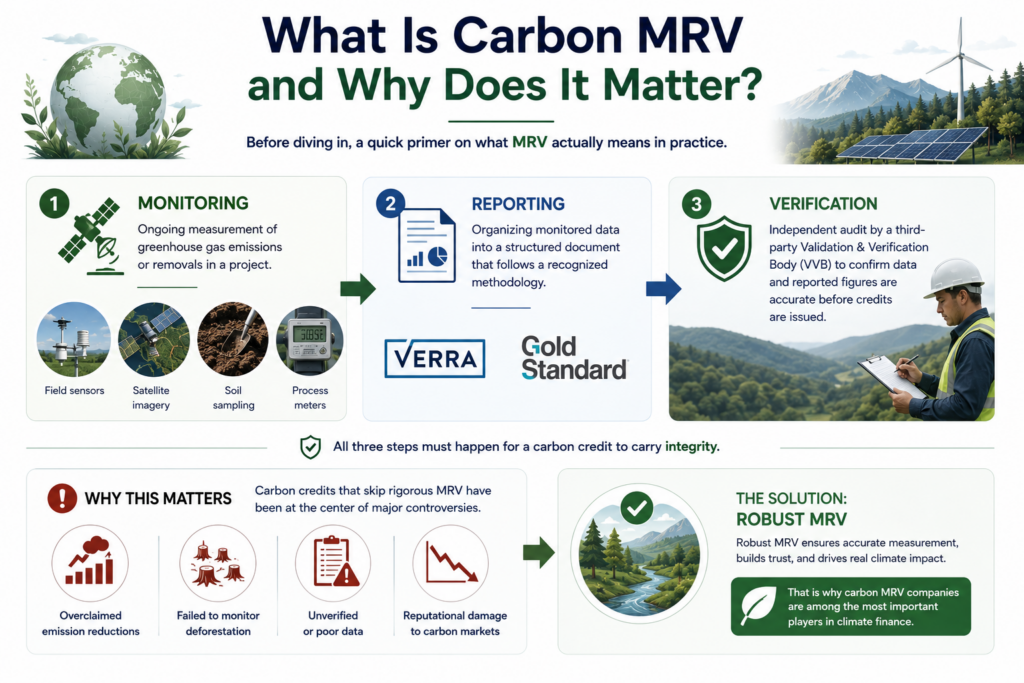
Before diving into the companies, a quick primer on what MRV actually means in practice.
Monitoring refers to the ongoing measurement of greenhouse gas emissions or removals in a carbon project. This can involve field sensors, satellite imagery, soil sampling, or process meters.
Reporting means organizing that monitored data into a structured document that follows a recognized methodology, such as those published by Verra or the Gold Standard.
Verification is the independent audit step. A third-party body, called a Validation and Verification Body (VVB), checks the monitoring data and the reported figures to confirm they are accurate before carbon credits are issued.
All three steps must happen for a carbon credit to carry integrity.
Why this matters: Carbon credits that skip rigorous MRV have been at the center of major controversies. Projects that overclaimed emission reductions, failed to monitor deforestation, or submitted unverified data caused significant reputational damage to voluntary carbon markets. The solution is robust MRV, and that is why carbon MRV companies have become some of the most important players in climate finance.
Carbon Market Insider Newsletter
Weekly insights on carbon markets, climate policy, carbon credits, and sustainability.
The Four Categories of Carbon MRV Companies
Carbon MRV companies do not all do the same thing. They fall into four broad categories:
| Category | Role | Examples |
|---|---|---|
| Standards and Registries | Set the rules, issue methodologies, and certify credits | Verra, Gold Standard, Puro.earth, Isometric |
| Third-Party Verifiers (VVBs) | Conduct independent audits of projects | DNV, Bureau Veritas, SGS, TÜV SÜD |
| Digital MRV (dMRV) Platforms | Use technology to automate monitoring | Pachama, Regrow, Boomitra, Agreena |
| Corporate MRV Software | Help companies measure and report their own emissions | Watershed, Persefoni, Normative, Greenly |
Understanding this distinction is critical. A company like DNV verifies project-level credits. Watershed helps a corporation measure its own carbon footprint. Both are carbon MRV companies, but they serve very different purposes.
Standards and Registries: The Rule-Setters of Carbon MRV
These organizations establish the methodologies that all other MRV players must follow. They are the regulatory backbone of the voluntary carbon market.
Verra
Verra is the world’s largest carbon crediting standard by volume. Its Verified Carbon Standard (VCS) has certified more carbon credits than any other program on the planet.
Verra publishes detailed methodologies for every type of project, from forest conservation (REDD+) to clean cookstoves to soil carbon. These methodologies specify exactly how projects must monitor, report, and get verified.
Verra is also a pioneer in digital MRV. It launched a dMRV working group and ran its first pilot credits under a digital MRV framework, issued under a solar energy project in 2026. This represents a shift away from expensive manual field surveys toward continuous, satellite-powered verification.
Verra held over 10% market share in the carbon credit market as of recent estimates, making it the dominant standard globally.
Headquarters: Washington, D.C., USA
Gold Standard
Gold Standard was founded by WWF and other NGOs and is widely respected for its focus on sustainable development co-benefits alongside carbon impact.
Gold Standard requires projects to demonstrate positive outcomes for people and the planet, not just carbon numbers. It runs rigorous MRV requirements and has been active in piloting digital MRV tools, including IoT sensors and blockchain-based real-time monitoring for clean cooking and sustainable agriculture projects.
Gold Standard launched a dMRV pilot program that ran through mid-2026, testing digital approaches to reduce verification costs and timelines.
Headquarters: Geneva, Switzerland
Puro.earth
Puro.earth is the leading standard specifically for engineered carbon removal (as opposed to nature-based offsets). It certifies durable removal pathways such as biochar, enhanced rock weathering, and bioenergy with carbon capture and storage.
Puro.earth issues CO2 Removal Certificates (CORCs) and operates a marketplace connecting buyers and suppliers. It is majority-owned by Nasdaq, which brings significant credibility and infrastructure to its operations.
Its MRV protocols focus on the permanence and durability of carbon removal, which is a much stricter standard than most nature-based projects.
Headquarters: Helsinki, Finland
Isometric
Isometric is a newer carbon registry that has quickly built a reputation for rigorous, scientifically transparent standards. It publishes its methodologies openly, with detailed reasoning for every decision.
Isometric has partnered with Pachama for digital MRV of reforestation credits, making it one of the first registries to fully embrace a dMRV-first approach for nature-based solutions.
Headquarters: United Kingdom
Third-Party Verifiers: The Auditors of Carbon Markets
These are the firms that actually go and check whether a carbon project did what it claimed. They are accredited by registries like Verra and Gold Standard, and their sign-off is required before credits can be issued.
DNV
DNV (formerly Det Norske Veritas) is consistently rated as the top verification body for carbon credits. It provides third-party validation and verification across both voluntary and compliance markets.
DNV specializes in technically demanding projects, particularly in hard-to-abate industrial sectors and carbon capture systems. It is accredited across multiple standards including Verra’s VCS, Gold Standard, and the Clean Development Mechanism.
A key strength is its rigorous methodology and experience with ISO 14064 certification audits. When buyers want the most defensible verification possible, DNV is usually the first name on the shortlist.
Score in independent rankings: 9.3 / 10 for overall carbon credit verification services
Headquarters: Høvik, Norway
SGS (Société Générale de Surveillance)
SGS holds the largest market share among verification bodies in the carbon credit space. It is one of the world’s leading testing, inspection, and certification companies, and its carbon practice benefits from an enormous global presence.
SGS is accredited by Verra, Gold Standard, and high-integrity registries including Isometric. It handles a wide range of project types from renewable energy to forestry to agriculture.
Its size means it can deploy verification teams almost anywhere in the world with minimal lead time.
Headquarters: Geneva, Switzerland
Bureau Veritas
Bureau Veritas is a major multinational assurance company with a strong carbon verification practice. It offers validation and verification for GHG project documentation and monitoring data across voluntary and compliance frameworks.
Bureau Veritas is particularly active in large-scale infrastructure and industrial carbon projects. Its global network of accredited auditors gives it reach across Europe, Asia, and the Americas.
Headquarters: Neuilly-sur-Seine, France
TÜV SÜD
TÜV SÜD is one of Europe’s premier technical auditing and certification companies. In the carbon market, it provides comprehensive validation under the Gold Standard, Climate Action Reserve, and Verra’s VCS.
TÜV SÜD has a particularly strong reputation in Germany and across the DACH region (Germany, Austria, Switzerland), where many major carbon buyers and project developers are headquartered.
Headquarters: Munich, Germany
SCS Global Services
SCS Global Services is an independent certification body that has been in the sustainability auditing space for decades. It is a strong runner-up to DNV in independent rankings, scoring 9.0 / 10 for carbon credit verification services.
SCS provides independent verification for carbon projects and climate-related claims, including assurance of monitoring results and conformance to applicable methodologies. It is particularly well-known in North America.
Headquarters: Emeryville, California, USA
Intertek
Intertek is globally recognized as an active VVB specifically approved for verifying compliance under the Verified Carbon Standard. It brings a background in quality and safety testing to the carbon verification space, giving it strong process credibility.
Headquarters: London, United Kingdom
Digital MRV Companies: The Tech Layer of Carbon Markets
This is where the real innovation is happening right now. Digital MRV (dMRV) companies use satellites, AI, remote sensing, and IoT sensors to reduce the cost and time of carbon verification while increasing accuracy.
Traditional MRV can take one to two years per verification cycle and cost tens of thousands of dollars per project. Digital MRV can cut that dramatically, sometimes to a matter of weeks and a fraction of the cost.
Pachama
Pachama is one of the most widely recognized dMRV companies in the world. Based in San Francisco, it has built a platform for forest carbon verification that uses satellite imagery, LiDAR data, and machine learning to assess carbon stocks continuously.
Pachama can assess carbon stocks across forest projects with accuracy that matches or exceeds expensive field surveys. Their platform has monitored more than 15 million hectares of forest.
A landmark moment for the company came when Verra selected Pachama as the first operational dMRV platform under its digital MRV pilot. Isometric also chose Pachama as its first dMRV partner for reforestation credits.
Carbon Direct acquired Pachama, positioning it as the science-led dMRV capability within a broader carbon advisory and removal firm.
Best for: Forest carbon projects, REDD+, reforestation, nature-based solutions
Headquarters: San Francisco, California, USA
Regrow Ag
Regrow Ag is the leading MRV platform for agricultural carbon. It uses process-based biogeochemical models, particularly the DNDC (Denitrification-Decomposition) model, combined with satellite data and farm-level management information to quantify soil carbon changes.
Regrow’s platform has been validated at scale across 17 countries and supports reporting to major frameworks including SBTi, CSRD, CDP, and carbon registries including Verra, SustainCert, and Climate Action Reserve. It claims a 100% audit success rate across these registries.
One of Regrow’s landmark projects involved the world’s first VM0042 smallholder soil carbon credits, issued to India’s Grow Indigo program. The project achieved the issuance of 57,463 carbon credits under Verra’s VM0042 methodology, making it the first smallholder soil carbon credit issuance under this standard globally.
Regrow also operates as an enterprise MRV software provider, selling its modeling and data infrastructure to agribusinesses and supply-chain operators.
Best for: Soil carbon, agricultural supply chains, Scope 3 emissions measurement
Headquarters: United States
Boomitra
Boomitra takes a satellite-first approach to soil carbon MRV. Its platform uses AI and remote sensing to measure soil carbon without expensive physical soil sampling, which it claims reduces MRV costs by more than 90% compared to traditional methods.
That cost reduction is critical for serving smallholder farmers in the Global South, who have historically been locked out of voluntary carbon markets because the economics did not work at small scale.
Boomitra has established a strong presence in India, with several Verra-registered soil carbon projects, and has successfully issued over 3 million carbon credits from a Mexico project covering approximately 4 million acres.
Best for: Smallholder farmers, emerging markets, soil carbon at scale
Headquarters: San Jose, California, USA
Agreena
Agreena is Europe’s leading agricultural MRV platform. It operates across multiple European countries including Denmark, Germany, France, the United Kingdom, Poland, and Romania.
Agreena achieved a landmark when it completed the first large-scale agricultural cropland project under Verra’s VM0042, with 2.3 million VCUs issued. SustainCERT validation was added subsequently, and the company has positioned itself for both carbon credit generation and supply-chain decarbonization claims.
With approximately 5 million hectares on platform, Agreena is one of the largest agricultural carbon programs in Europe by enrolled acreage.
Best for: European cropland farmers, supply-chain decarbonization, dual-use carbon and insetting
Headquarters: Copenhagen, Denmark
Indigo Ag
Indigo Ag operates what many consider the world’s largest soil carbon program by enrolled acreage. Its program covers more than 8 million enrolled acres across 28 U.S. states, verified through the Climate Action Reserve under the Soil Enrichment Protocol.
Indigo uses the DayCent-CR biogeochemical model combined with remote-sensing validation for its MRV. It has generated more than 2 million tonnes of verified soil-carbon impact and signed a significant offtake agreement with Microsoft.
Best for: Large-scale U.S. cropland, carbon credit generation for enterprise buyers
Headquarters: Boston, Massachusetts, USA
Varaha
Varaha is one of the fastest-growing carbon MRV companies in Asia, with a particular focus on India and Southeast Asia. It operates across multiple carbon removal pathways including biochar, enhanced rock weathering, and regenerative agriculture.
Varaha has built out programs covering more than 199,000 farms and has secured major project finance and corporate carbon demand partnerships, including with Microsoft. It has raised nearly $35 million in equity and grants.
Best for: India and Asia Pacific carbon projects, multi-pathway carbon removal, smallholder programs
Headquarters: Gurugram, India
Corporate MRV Software: Measuring Company-Level Emissions
This category covers companies that help businesses measure, report, and reduce their own Scope 1, 2, and 3 greenhouse gas emissions. These platforms are increasingly required for regulatory compliance under frameworks like the EU’s CSRD, ISSB standards, and CDP.
Watershed
Watershed is consistently recognized as the leading enterprise climate platform for carbon accounting. In the Verdantix Green Quadrant, it earned the top position across 21 evaluated carbon management solutions two years in a row, outperforming Sweep, Sphera, Salesforce, Persefoni, and Workiva on both capabilities and momentum.
Watershed combines granular carbon accounting with reduction planning and access to high-quality carbon removal projects. Its platform emphasizes data quality control, carbon calculation methodologies, regulated reporting, and net-zero strategy.
Its customers have included Airbnb, Stripe, and Sweetgreen, and it has since expanded to serve large enterprises across sectors.
Best for: Enterprise carbon accounting, decarbonization planning, SEC and CSRD reporting
Headquarters: San Francisco, California, USA (offices also in London)
Persefoni
Persefoni is an AI-powered carbon accounting and climate disclosure platform designed specifically for enterprises and financial institutions. It raised $179 million and built its reputation as the “ERP system for carbon.”
Persefoni’s core strength is in Scope 3, Category 15 (financed emissions), which makes it the platform of choice for banks, private equity firms, and asset managers that need to track and report portfolio-level carbon exposure.
Its platform automates complex carbon calculations and produces outputs aligned to ISSB/TCFD, CDP, CSRD, SECR, California SB 253/261, and Japan statutory reporting requirements. Its AI tools cover data ingestion, OCR, smart emission factor matching, anomaly detection, and sustainability reporting.
Best for: Financial institutions, portfolio carbon accounting, audit-ready regulatory reporting
Headquarters: Phoenix, Arizona, USA
Normative
Normative provides every client account with a dedicated climate expert who works with the client’s specific data, methodology, and business context. Its Carbon Network enables supplier engagement and verified value chain data collection.
The platform automates data ingestion, emission factor matching, and anomaly detection. Normative is particularly suited to enterprises with complex global supply chains and heavy Scope 3 exposure.
Best for: Large enterprises, complex supply chains, Scope 3 accuracy
Headquarters: Stockholm, Sweden
Greenly
Greenly is consistently ranked as one of the top carbon accounting platforms for its combination of automation, compliance tools, and user experience. It is particularly strong for small and medium enterprises and European mid-market businesses navigating CSRD.
Best for: SMEs, European businesses, CSRD alignment
Headquarters: Paris, France
Plan A
Plan A provides decarbonization tools tailored to SMEs and their suppliers. Its platform covers Scope 1, 2, and 3 emissions and aligns with CSRD, CDP, and SBTi frameworks.
Best for: SMEs, European regulatory compliance, supplier engagement
Headquarters: Berlin, Germany
Key MRV Frameworks These Companies Work Within
To understand what makes an MRV company credible, you need to know the frameworks that govern their work.
| Framework | What It Does | Who Uses It |
|---|---|---|
| Verra VCS | Sets rules for voluntary carbon project credits | Project developers, verifiers, buyers worldwide |
| Gold Standard | Sets rules with co-benefit requirements | NGOs, development-focused projects |
| Puro Standard | Governs engineered durable carbon removal | CDR project developers, tech companies |
| ISO 14064 | International GHG accounting standard | Corporates, verifiers, registries |
| GHG Protocol | Corporate emissions accounting framework | Companies measuring Scope 1, 2, 3 |
| CSRD / ESRS | EU mandatory sustainability reporting | All large EU-active companies |
| ISSB (IFRS S2) | International climate disclosure standard | Corporates in aligned jurisdictions |
| CDP | Voluntary corporate climate disclosure | Thousands of companies globally |
| SBTi | Science-based emissions reduction targets | Companies with net-zero commitments |
| Article 6 (Paris) | International carbon trading framework | Governments, compliance market actors |
Traditional MRV vs. Digital MRV: What Is the Difference?
This is one of the most important distinctions in the carbon market today.
| Feature | Traditional MRV | Digital MRV (dMRV) |
|---|---|---|
| Data collection method | Manual field surveys, physical sampling | Satellites, IoT sensors, remote sensing |
| Verification cycle | 1 to 2 years | Weeks to months |
| Cost per hectare | $50 to $200+ | As low as $5 to $20 |
| Coverage | Partial (sample areas only) | Entire project area continuously |
| Scalability | Limited by field team capacity | Highly scalable |
| Transparency | Periodic reports | Near real-time data streams |
| Error risk | Prone to human error and sampling gaps | Algorithmic consistency, but model risk |
| Standard acceptance | Universally accepted | Rapidly gaining acceptance |
Digital MRV is not yet a complete replacement for traditional verification. Standards still require third-party auditors to sign off. But dMRV is increasingly accepted as the monitoring layer, dramatically reducing costs and improving continuous oversight.
Verra issued its first dMRV-based credits in early 2026. Gold Standard ran active pilot programs through mid-2026. These milestones signal that dMRV is shifting from experiment to mainstream.
How to Choose the Right Carbon MRV Company
The right choice depends entirely on what you need MRV for. Here is a quick decision guide:
If you are a carbon project developer:
- You need a standard (Verra, Gold Standard, Puro.earth) and a verified third-party auditor (DNV, SGS, Bureau Veritas).
- If your project is a forest or nature-based solution, consider working with a dMRV platform like Pachama to reduce monitoring costs.
- If you run an agricultural project, platforms like Regrow, Boomitra, or Agreena can handle your monitoring layer.
If you are a corporation needing to measure your own emissions:
- For large enterprises and financial institutions, Watershed or Persefoni are the leading choices.
- For European SMEs navigating CSRD, Greenly or Plan A are well-suited.
- For complex supply chains and Scope 3 accuracy, Normative or Watershed offer the deepest capabilities.
If you are a carbon credit buyer who wants to assess quality:
- Sylvera provides independent ratings on carbon credits, covering project quality, additionality risk, and permanence. Think of it as the Moody’s of the carbon market.
- Pachama also provides independent project assessments alongside its dMRV work.
Emerging Trends Shaping Carbon MRV Companies
The carbon MRV space is moving fast. Here are the trends that are reshaping which companies lead:
1. Digital MRV is becoming the standard, not the exception. Registries like Verra and Isometric have moved from skepticism to active adoption of dMRV. Companies that build dMRV capabilities now have a significant competitive advantage.
2. AI and machine learning are reducing costs dramatically. Companies like Boomitra claim to cut MRV costs by over 90% using AI. That cost reduction opens markets to smaller projects and emerging economies that were previously unviable.
3. Regulatory pressure is creating a new corporate MRV market. CSRD in Europe now applies to tens of thousands of companies. ISSB standards are spreading globally. This regulatory wave is driving massive growth in corporate MRV software platforms.
4. Article 6 is creating demand for sovereign-level MRV. As governments use the Paris Agreement’s Article 6 mechanism to trade emission reductions internationally, the need for rigorous national-level MRV systems is growing, creating opportunities for both established verifiers and new technology providers.
5. Integrity standards are rising. After high-profile controversies over low-quality carbon credits, buyers and regulators are demanding better MRV. The ICVCM’s Core Carbon Principles (CCPs) set a higher bar that is filtering out projects with weak monitoring.
Quick Summary: Top Carbon MRV Companies by Category
Standards and Registries
- Verra (Washington D.C.) – World’s largest carbon standard by volume
- Gold Standard (Geneva) – Rigorous standard with sustainable development focus
- Puro.earth (Helsinki) – Leading standard for engineered carbon removal
- Isometric (UK) – High-integrity newer registry with open methodology
Third-Party Verifiers (VVBs)
- DNV (Norway) – Top-rated overall verifier, best for complex projects
- SGS (Switzerland) – Largest market share among verification bodies
- Bureau Veritas (France) – Strong in industrial and infrastructure projects
- TÜV SÜD (Germany) – Leading verifier in Europe, especially DACH region
- SCS Global Services (USA) – Strong runner-up in North America
Digital MRV Platforms
- Pachama (USA) – Forest and nature-based solution MRV leader
- Regrow Ag (USA) – Agricultural MRV with 100% audit success rate
- Boomitra (USA) – Satellite-first, low-cost smallholder soil carbon MRV
- Agreena (Denmark) – Europe’s leading agricultural MRV platform
- Indigo Ag (USA) – World’s largest enrolled soil carbon program
- Varaha (India) – Leading MRV company for Asia Pacific carbon projects
Corporate MRV Software
- Watershed (USA) – Top-rated enterprise carbon accounting platform
- Persefoni (USA) – Best for financial institutions and financed emissions
- Normative (Sweden) – Expert-led platform for complex supply chains
- Greenly (France) – Best for European SMEs and CSRD compliance
- Plan A (Germany) – Decarbonization tools for SMEs and their suppliers
Frequently Asked Questions About Carbon MRV Companies
What is a carbon MRV company?
A carbon MRV company is any organization that provides monitoring, reporting, or verification services for greenhouse gas emissions, either at the level of individual carbon projects or for corporate emissions reporting. The category includes standard-setting bodies, independent auditors, technology platforms, and software companies.
Which company is the best for carbon project verification?
For third-party project verification, DNV is consistently rated the top performer globally. For digital monitoring of forest projects, Pachama is the market leader. For agricultural MRV, Regrow Ag and Boomitra are the leading technology platforms.
What is the difference between MRV and dMRV?
Traditional MRV relies on manual field surveys, physical soil sampling, and in-person audits. Digital MRV (dMRV) uses satellites, AI, remote sensing, and IoT sensors to automate the monitoring layer, dramatically cutting costs and speeding up verification cycles.
Which MRV standard is the most widely used?
Verra’s Verified Carbon Standard (VCS) is the most widely used carbon crediting standard globally, and Verra held over 10% market share in the carbon credit market among certification bodies. Gold Standard is the second most recognized, particularly for projects focused on sustainable development co-benefits.
Do corporate companies need MRV?
Yes. Companies that need to report Scope 1, 2, and 3 emissions under frameworks like CSRD, ISSB, CDP, or SBTi need carbon accounting platforms that function as corporate MRV tools. Watershed and Persefoni are the leading enterprise options.
What is the role of a VVB in carbon markets?
A Validation and Verification Body (VVB) is an accredited, independent auditor that checks whether a carbon project’s monitoring reports are accurate and whether it complies with the relevant carbon standard’s methodology. No credits can be issued without a VVB sign-off.
Are carbon MRV companies regulated?
VVBs are accredited by the carbon registries they work with (such as Verra or Gold Standard), but there is no single global regulatory body for the voluntary carbon market. Compliance markets like the EU ETS have stricter oversight structures.
How much does MRV cost for a carbon project?
Traditional MRV can cost $50 to $200 or more per hectare for projects like forest carbon, depending on complexity and location. Digital MRV platforms are driving costs down to $5 to $20 per hectare in some contexts, making carbon markets viable for smaller projects and emerging economies.
Conclusion
Carbon MRV companies are the unsung heroes of the carbon market. They are the ones who turn promises into proof.
The ecosystem is expanding rapidly. Traditional auditors like DNV and SGS are reinforcing their leadership. Digital platforms like Pachama, Regrow, and Boomitra are transforming what monitoring looks like. Corporate software companies like Watershed and Persefoni are serving the millions of businesses now facing mandatory emissions reporting.
Choosing the right carbon MRV company depends on your specific need. Project developers need registries and VVBs. Agri-carbon programs need specialized dMRV platforms. Corporations need robust accounting software. And increasingly, buyers need independent rating tools to assess credit quality before they purchase.
One thing is certain: as carbon markets grow and scrutiny increases, the quality of MRV will define which projects succeed and which ones fail. The carbon MRV companies that get this right are building the foundation of a market worth trillions.
If you want to learn more about how carbon markets work, how credits are issued, and what makes a high-quality carbon project, explore the resources at Carbon Market Network.