Carbon Market Network


Every year, American companies spend billions of dollars buying and trading carbon credits. Yet most people still have no idea what a carbon credit actually is, or how the system works.
If you have ever wondered how carbon credits USA programs function, or how to buy carbon credits USA sellers offer, you are in the right place.
This guide breaks down everything you need to know about US carbon credits. No jargon. No fluff. Just clear, practical information you can actually use.
Whether you are a business owner trying to hit a sustainability target, an individual wanting to offset your travel footprint, or simply someone curious about how this market works, this article covers it all.
What Are Carbon Credits, Exactly?
A carbon credit represents one metric ton of carbon dioxide, or its equivalent in other greenhouse gases, that has been reduced, avoided, or removed from the atmosphere.
Think of it as a receipt for climate action. Someone did something that kept a ton of carbon out of the air. That action gets verified, and a credit gets issued to prove it happened.
Companies and individuals can then buy that credit to counterbalance emissions they cannot yet eliminate from their own operations or lifestyle.
Here is the simplest way to picture it:
- A landfill captures methane gas instead of letting it escape into the air.
- An independent auditor confirms the methane reduction actually happened.
- A registry issues a carbon credit for that verified reduction.
- A company buys that credit and “retires” it, claiming the environmental benefit.
One credit always equals one ton of CO2 or its equivalent. That standard unit is what makes trading possible across different industries and project types.
Carbon Market Insider Newsletter
Weekly insights on carbon markets, climate policy, carbon credits, and sustainability.
How Carbon Credits Work: A Step-by-Step Breakdown
Understanding the lifecycle of a carbon credit makes the entire system much easier to grasp. Here is how it actually works, from start to finish.
Step 1: A Project Reduces or Removes Emissions
This could be anything from planting trees, capturing methane from a farm, restoring wetlands, or injecting captured CO2 permanently into concrete.
Step 2: A Methodology Is Applied
Every project must follow an approved methodology that defines how emissions reductions are measured and calculated. Registries like Verra and the American Carbon Registry publish these methodologies publicly.
Step 3: Third-Party Verification
An independent auditor checks the project’s data and confirms the claimed reductions are real, measurable, and additional. Additional means the reduction would not have happened without the carbon credit revenue.
Step 4: Credit Issuance
Once verified, the registry issues carbon credits into the project developer’s account. Each credit gets a unique serial number to prevent duplication.
Step 5: Trading and Sale
The project developer sells the credits, either directly, through a broker, or on a trading platform, to a buyer who wants to offset emissions.
Step 6: Retirement
When a buyer uses a credit to make a claim, the credit gets permanently retired in the registry. Once retired, it can never be sold or used again.
This traceability is what separates a legitimate carbon credit from a vague, unverifiable promise.
Two Types of Carbon Markets in the United States
The US carbon credit landscape splits into two very different systems. Understanding this distinction is the single most important thing to know before buying or selling.
| Feature | Compliance Market | Voluntary Market |
|---|---|---|
| Who participates | Companies legally required to limit emissions | Businesses and individuals acting by choice |
| Governed by | State regulations and government agencies | Independent registries and standards bodies |
| Purpose | Meet legal emissions caps | Support climate goals, ESG targets, or personal values |
| Examples in the US | California Cap-and-Trade, RGGI, Washington Cap-and-Invest | Verra, American Carbon Registry, Climate Action Reserve, Isometric |
| Enforcement | Legally binding, penalties for non-compliance | No legal penalty, but reputational risk exists |
Both markets use the same basic unit of measurement, a ton of CO2 equivalent, but they operate under completely different rules.
Compliance Carbon Markets in the United States
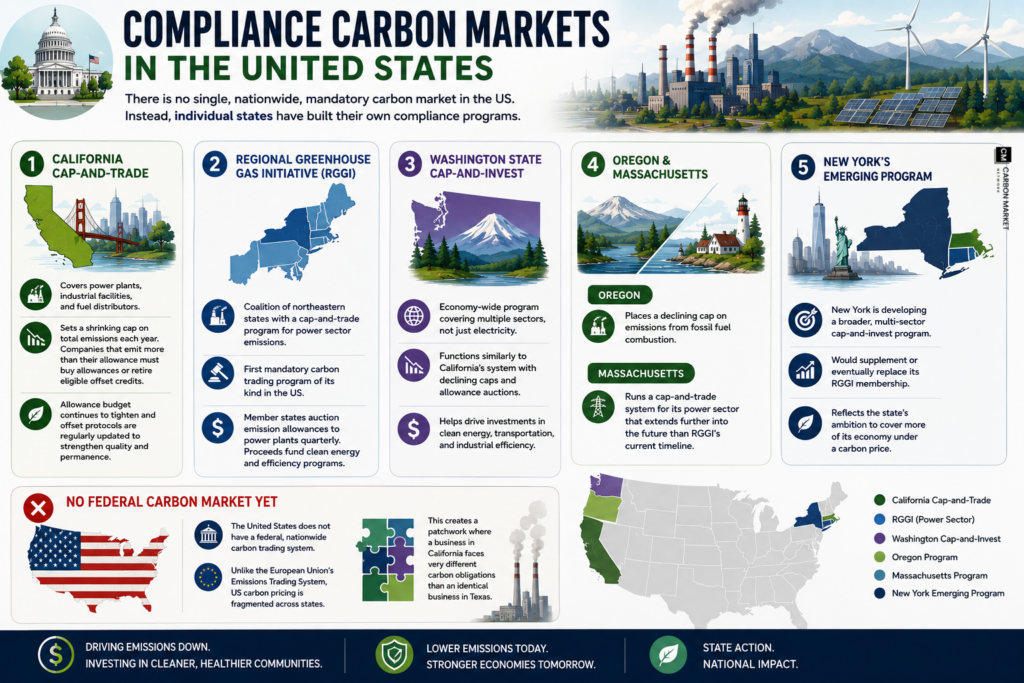
There is no single, nationwide, mandatory carbon market in the US right now. Instead, individual states have built their own compliance programs.
California Cap-and-Trade
California runs the largest and oldest multi-sector cap-and-trade program in the country. It covers power plants, industrial facilities, and fuel distributors.
The state sets a shrinking cap on total emissions each year. Companies that emit more than their allowance must buy extra allowances or retire eligible offset credits to cover the gap.
California’s program continues to tighten its allowance budget over time, and its offset protocols get updated regularly to strengthen quality and permanence requirements.
Regional Greenhouse Gas Initiative (RGGI)
RGGI (https://www.rggi.org/) is a coalition of northeastern states that runs a cap-and-trade program specifically for power sector emissions. It was the first mandatory carbon trading program of its kind in the country.
Member states auction emission allowances to power plants on a quarterly basis. Proceeds from those auctions typically fund state-level clean energy and efficiency programs.
Washington State Cap-and-Invest
Washington launched its own economy-wide cap-and-invest program covering multiple sectors, not just electricity. It functions similarly to California’s system, with declining caps and allowance auctions.
Oregon and Massachusetts
Oregon operates a program that places a declining cap on emissions tied to fossil fuel combustion. Massachusetts runs a parallel cap-and-trade system for its power sector that extends further into the future than RGGI’s current timeline.
New York’s Emerging Program
New York has been preparing a broader, multi-sector cap-and-invest program that would either supplement or eventually replace its RGGI membership, reflecting the state’s ambition to cover more of its economy under a carbon price.
No Federal Carbon Market Yet
Here is an important fact many people miss: the United States does not have a federal, nationwide carbon trading system. Unlike the European Union’s Emissions Trading System, US carbon pricing is fragmented across individual states.
This creates a patchwork where a business in California faces very different carbon obligations than an identical business in Texas.
Federal Policy Shaping the US Carbon Credit Market
Even without a national carbon price, federal policy still shapes how carbon credits function across the country. A few key pieces matter most.
Section 45Q Tax Credit
This federal tax credit rewards companies for capturing and permanently storing carbon dioxide, whether underground or through utilization in products like concrete. It has become one of the biggest financial drivers behind carbon capture projects nationwide.
Section 45Z Clean Fuel Production Credit
This credit supports domestic production of clean transportation fuels based on their lifecycle carbon intensity. Regulatory guidance continues to evolve around eligibility rules, which directly affects how fuel producers plan their carbon strategies.
The Greenhouse Gas Reporting Program (GHGRP)
Since its creation, this federal program has required thousands of the highest-emitting facilities in the country to report their emissions data annually. This dataset underpins the administration of tax credits like 45Q and gives buyers a way to verify corporate emissions claims.
International Pressure: The EU’s Carbon Border Adjustment Mechanism
The European Union’s carbon border tax will eventually require importers to pay a fee based on the embedded carbon in certain goods. US exporters without a domestic carbon pricing system face full exposure to this mechanism once it takes effect, which is pushing some American companies to voluntarily track and reduce their carbon footprint now, ahead of the requirement.
The Voluntary Carbon Market in the United States
The voluntary carbon market, often called the VCM, is where most individuals and many companies interact with US carbon credits. Nobody is legally forced to buy these credits. People choose to.
The United States is actually the most active country in the world for voluntary carbon market activity. It hosts thousands of registered projects across multiple registries.
The Major US Carbon Credit Registries
| Registry | Focus Area | Notable Feature |
|---|---|---|
| Verra (VCS) | Broadest range of project types globally | Largest issuer of voluntary credits worldwide |
| American Carbon Registry (ACR) | Forestry, agriculture, industrial projects | One of the oldest US-based registries |
| Climate Action Reserve (CAR) | North American projects, strong protocol development | Well known for rigorous offset protocols |
| Isometric | Engineered carbon removal | Focused on high-durability removal credits |
| Gold Standard | Sustainable development co-benefits | Popular for projects with strong community impact |
Each registry maintains public records of every credit issued, sold, and retired. Anyone can look up a specific project and see its verification history.
Common Carbon Credit Project Types in the US
| Project Type | How It Works | Typical Buyers |
|---|---|---|
| Forest management and conservation | Protects or restores forests that absorb CO2 | Corporations with net-zero pledges |
| Regenerative grazing and agriculture | Builds soil organic carbon through better land management | ESG-focused companies, agribusiness |
| Biochar production | Converts plant waste into stable carbon that resists decomposition | Tech companies, removal-focused buyers |
| Direct air capture and storage | Machines pull CO2 directly from the air for permanent storage | Large tech and energy companies |
| CO2 utilization in concrete | Injects captured CO2 into concrete, where it mineralizes permanently | Construction and infrastructure buyers |
| Methane capture from landfills or livestock | Captures methane before it escapes into the atmosphere | Utilities, food and beverage companies |
| Renewable energy | Funds wind, solar, or other clean power projects | Smaller buyers, though demand has shifted toward removals |
Nature-based projects, like forestry and regenerative agriculture, still account for a huge share of total voluntary credit demand. But engineered removal methods are growing fast because they offer more permanence and lower reversal risk.
Carbon Credits vs Carbon Offsets vs RECs
People often mix up these three terms, and the confusion causes real problems when businesses try to make accurate sustainability claims. Here is how they actually differ.
| Term | What It Represents | Common Use Case |
|---|---|---|
| Carbon credit | A tradable unit representing one ton of verified CO2 reduction or removal | Bought and sold on registries, then retired to make a claim |
| Carbon offset | The act of using a carbon credit to counterbalance a specific emission | Flight offsetting, event carbon neutrality claims |
| Renewable Energy Certificate (REC) | Proof that one megawatt-hour of electricity came from a renewable source | Corporate renewable energy claims, utility green power programs |
A REC does not represent an emissions reduction in the same way a carbon credit does. It only certifies the source of electricity. Many companies buy both RECs and carbon credits as part of a broader climate strategy, but they serve different accounting purposes and should never be confused with one another.
Understanding this distinction matters if you plan to buy carbon credits USA sellers market alongside renewable energy products, since bundling them incorrectly in a sustainability report can create compliance and credibility problems.
Which US Industries Rely Most on Carbon Credits
Carbon credit demand is not spread evenly across the economy. A handful of industries drive the majority of purchases, each for slightly different reasons.
Technology and data centers. Rising electricity demand from artificial intelligence workloads has pushed major tech companies toward aggressive carbon credit procurement, often favoring durable removal projects over cheaper nature-based options.
Airlines and travel. Aviation remains one of the hardest sectors to decarbonize directly, so airlines and travel booking platforms frequently offer carbon credit purchases at checkout to offset flight emissions.
Oil, gas, and heavy industry. Energy companies use carbon capture projects and 45Q tax credits together, blending compliance strategy with voluntary market participation.
Financial services and banks. Many banks purchase credits to address their own operational footprint while also financing carbon project developers as part of broader climate finance commitments.
Food, beverage, and agriculture. Companies in this space often invest directly in regenerative agriculture and soil carbon projects, since these align closely with their existing supply chains and land relationships.
Construction and building materials. The rise of CO2 utilization technology in concrete production has made construction an increasingly active buyer category, particularly for infrastructure projects with public sustainability commitments.
Each of these industries approaches the market with different priorities, whether that is cost, permanence, brand alignment, or regulatory preparation. Recognizing which category your business falls into can help narrow down the right project types and buying strategy.
Real-World Examples of US Carbon Credit Projects
Seeing actual projects makes this whole system feel less abstract. Here are a few examples that show the range of approaches happening across the country.
Concrete carbon mineralization: A widely used technology injects captured CO2 directly into concrete during mixing. The CO2 reacts chemically and becomes locked into the concrete permanently. Because the carbon becomes part of the structure itself, there is essentially no reversal risk.
Biomass carbon removal and storage: Some projects convert waste wood into compressed material and bury it in engineered storage sites, locking away carbon that would otherwise decompose and release CO2 back into the atmosphere.
Regenerative grazing on grasslands: Large-scale ranching projects in states like Montana work with cattle ranchers to implement rotational grazing practices. This restores grassland health and increases the amount of carbon stored in the soil, while also improving the land for livestock.
Improved forest management: Forestry projects across the eastern United States extend harvest cycles and protect older growth, allowing more carbon to stay stored in living trees over time.
Regenerative agriculture and soil carbon: Farming projects in the Mid-South region help farmers adopt practices like cover cropping and reduced tillage, which builds soil carbon while also improving long-term soil health.
These projects show that carbon credits are not just a financial abstraction. Real land, real farmers, and real infrastructure sit behind every legitimate credit.
How to Buy Carbon Credits in the USA
If you are ready to buy carbon credits USA sellers offer, the process looks a little different depending on whether you are an individual or a business.
For Individuals
- Calculate your footprint. Use a carbon footprint calculator to estimate emissions from flights, driving, home energy use, or daily habits.
- Choose a retailer. Established retail platforms sell small quantities of verified credits directly to consumers, often bundled into simple checkout experiences.
- Review the project. Reputable retailers disclose which specific project your money supports, along with its registry and certification standard.
- Complete the purchase and retirement. The retailer retires the credit on your behalf so it cannot be resold or reused.
- Keep your certificate. Most platforms provide a retirement certificate as proof of your purchase.
For Businesses
- Measure your emissions first. Buying credits should follow, not replace, genuine efforts to reduce your own emissions footprint.
- Set a clear strategy. Decide whether you need credits for compliance, voluntary net-zero goals, or Scope 3 emissions gaps.
- Choose your buying route. Businesses typically buy through procurement platforms that screen project quality, established offset providers with broad portfolios, or direct deals with project developers.
- Vet the registry and methodology. Confirm the credits come from a recognized registry and follow a scientifically sound, approved methodology.
- Check independent ratings. Third-party rating agencies now assess project quality, giving buyers an extra layer of due diligence beyond registry approval alone.
- Negotiate delivery terms. Larger buyers often sign forward purchase agreements, locking in future credit deliveries at a set price.
- Retire and report. Once purchased, retire the credits and disclose the purchase transparently in sustainability reporting.
Where to Actually Find Sellers
- Retail platforms built for individuals and small businesses buying limited volumes.
- Procurement platforms that combine quality screening with easy portfolio management for corporate buyers.
- Direct project developer deals, which offer the most control but require more procurement effort.
- Registry websites, which often list authorized retailers and brokers for each project.
- Carbon credit trading platforms, some of which now use digital infrastructure to make buying and tracking more efficient.
Current Carbon Credit Pricing in the US
Prices vary enormously depending on project type, permanence, and quality rating. Here is a general pricing snapshot to set realistic expectations.
| Project Type | Approximate Price Range (per ton) | Why the Price Varies |
|---|---|---|
| Renewable energy credits | Low, often under $5 | Widely available, lower additionality in mature grids |
| Forestry and REDD+ projects | $5 to $20 | Depends heavily on quality rating and permanence risk |
| Regenerative agriculture and grazing | $20 to $60 | Strong co-benefits but variable measurement methods |
| Biochar | $100 to $200 | High durability and strong scientific backing |
| Direct air capture and storage | $200 to $600 or more | Extremely high permanence but expensive technology |
| Concrete CO2 mineralization | Variable, often mid-range | Permanent storage with growing supply |
Compliance market allowances, like those traded under California’s cap-and-trade program or RGGI, trade on their own separate price track, driven by supply caps and auction results rather than project-level economics.
Why Businesses and Individuals Buy Carbon Credits
Carbon credits are not just a compliance checkbox. They serve several real purposes.
- They fund climate projects that might not otherwise get built. Revenue from credit sales often provides the financial bridge that makes a project viable.
- They help companies bridge the gap while reducing direct emissions. Very few businesses can eliminate emissions overnight, so credits offer a transitional tool.
- They support net-zero and ESG commitments. Public sustainability pledges increasingly rely on credible carbon credit purchases as part of a broader reduction strategy.
- They protect against future regulatory exposure. Building carbon credit experience now can prepare companies for stricter reporting rules or new compliance markets later.
- They allow individuals to take personal climate action. Not everyone can install solar panels or buy an electric vehicle, but almost anyone can fund a verified project.
Common Risks and How to Avoid Them
The voluntary carbon market went through a rough stretch of credibility concerns in recent years. Prices dropped and buyers grew skeptical after several high-profile investigations questioned whether certain forestry credits represented real reductions.
The market has since moved into what many analysts call a professionalization phase, with stronger data, tighter methodologies, and clearer separation between high- and low-quality credits. Still, buyers need to protect themselves.
Key Risks to Watch For
- Additionality problems. The reduction should not have happened anyway without the carbon revenue.
- Permanence risk. Forest carbon can be released again through fire, disease, or logging.
- Double counting. The same reduction gets claimed by more than one party.
- Over-crediting. Poor baseline calculations can inflate the number of credits issued for a given project.
- Greenwashing claims. Vague marketing language that overstates what a purchased credit actually achieved.
A Simple Quality Checklist
- Confirm the project is listed on a recognized registry with public documentation.
- Check whether the methodology has approval from an independent integrity body.
- Look for third-party ratings from independent carbon rating agencies.
- Review the project’s permanence plan and buffer pool contributions, especially for nature-based credits.
- Ask exactly how the retirement will be documented and reported.
Trends Shaping US Carbon Credits Right Now
A few forces are actively reshaping this market, and they are worth understanding if you plan to buy, sell, or simply follow the space.
Rising electricity demand is renewing interest in offsets. Data center growth driven by artificial intelligence is pushing electricity demand higher across many states. Utilities are pairing new capacity planning with carbon offsets as a near-term tool while longer-term infrastructure gets built.
Quality standards keep tightening. Independent bodies now assess methodologies against strict integrity principles, and only approved methodologies earn a recognized quality label. Buyers increasingly demand this label before purchasing.
Compliance demand is catching up to voluntary demand. For years, voluntary purchases dominated the market. That gap is narrowing as more state programs mature and more industries face reporting requirements.
Engineered removals are gaining ground. Technologies like direct air capture, biochar, and concrete mineralization offer stronger permanence guarantees than traditional forestry credits, and buyer interest is shifting accordingly.
Data and analytics are becoming essential infrastructure. Independent ratings, digital monitoring, and price benchmarking tools now play a central role in how sophisticated buyers evaluate and purchase credits.
International trade pressure is building. As foreign carbon border taxes move toward implementation, more US exporters are getting ahead of the curve by tracking and managing their carbon footprint voluntarily.
Actionable Takeaways
- Carbon credits USA programs split into compliance markets, run by individual states, and voluntary markets, open to anyone.
- There is currently no federal, nationwide carbon trading system in the United States.
- California, the RGGI states, Washington, Oregon, and Massachusetts each run their own compliance carbon pricing programs.
- Verra, the American Carbon Registry, Climate Action Reserve, and Isometric are the leading registries for US carbon credits.
- Prices range from just a few dollars per ton for renewable energy credits to several hundred dollars per ton for durable removal projects.
- Always verify registry listing, methodology approval, and independent ratings before buying carbon credits USA sellers advertise.
- Businesses should reduce emissions directly first, then use credits to address what remains.
- The market is shifting toward higher quality, more permanent, and more transparent credit types.
Frequently Asked Questions
What exactly is a carbon credit?
A carbon credit represents one metric ton of carbon dioxide, or an equivalent greenhouse gas, that has been reduced, avoided, or removed from the atmosphere through a verified project.
Is there a federal carbon market in the United States?
No. The United States does not currently operate a single, nationwide carbon trading system. Carbon pricing exists only at the state level, through programs like California’s cap-and-trade system and RGGI.
How do I buy carbon credits USA sellers offer as an individual?
Calculate your carbon footprint, choose a reputable retail platform, review the specific project you are funding, and complete the purchase. The platform will retire the credit on your behalf and typically provide a certificate.
Are carbon credits the same as carbon offsets?
The terms are often used interchangeably. Technically, a carbon offset usually refers to the act of using a carbon credit to compensate for emissions, while the credit itself is the tradable unit representing the verified reduction.
How much does a carbon credit cost?
Prices vary widely by project type. Renewable energy credits can cost just a few dollars per ton, while durable removal credits like direct air capture can cost several hundred dollars per ton.
Can individuals sell carbon credits, or only businesses?
Selling credits requires developing and registering an eligible project, which is usually done by landowners, farmers, or businesses rather than individuals acting alone. However, individuals who own land suitable for forestry or agricultural carbon projects can work with a project developer to participate.
What is the difference between compliance and voluntary carbon credits?
Compliance credits are used by companies legally required to limit emissions under a government program. Voluntary credits are purchased by choice, without any legal obligation, to support climate goals or personal values.
How do I know if a carbon credit is high quality?
Check that the project is listed on a recognized registry, follows an approved methodology, has third-party verification, and ideally carries an independent quality rating. Strong permanence plans and transparent reporting are also good signs.
Final Thoughts
Carbon credits USA programs are far more complex than a simple “pay to pollute” system. They represent a genuine, if imperfect, financial bridge between today’s emissions reality and tomorrow’s climate goals.
Whether you are exploring US carbon credits for compliance reasons, corporate sustainability targets, or personal climate action, the fundamentals stay the same. Understand the project behind the credit. Verify the registry and methodology. Choose quality over convenience.
The market is maturing quickly, with stronger data, clearer standards, and a growing menu of project types to choose from. That means better opportunities exist today to buy carbon credits USA sellers can actually stand behind, backed by real verification and real climate impact.
As you take your next step, whether that is calculating your own footprint or evaluating a corporate procurement strategy, keep quality at the center of every decision. That is what turns a carbon credit from a marketing line item into genuine climate action.
If you want to keep learning about carbon markets, ESG strategy, and sustainability trends, explore more resources on Carbon Market Network.