Carbon Market Network


Can you trust a carbon credit you cannot see? That question sits at the heart of every carbon deal.
A forest in Brazil, a farm in Kenya and a methane leak in Texas all sit far from the desk of the person buying the credit. Someone has to prove the climate benefit is real.
For years, that proof came from slow site visits and long PDF reports. Today, AI carbon market companies are changing the process. They read satellite images, scan project documents and model risk in hours instead of months.
This guide introduces the AI carbon market companies that matter most right now. You will see what each one does, how it uses AI, and who gets the most value from it.
You will also learn how to compare providers, where AI still falls short, and which trends will shape the next phase of the voluntary carbon market.
What Are AI Carbon Market Companies?
AI carbon market companies use artificial intelligence, machine learning and satellite data to measure, rate, monitor or verify carbon credits and the projects behind them.
Some rate credit quality. Others map forest carbon from space. A few measure soil carbon, track methane or help project developers prove their claims.
You will often see the term digital MRV, or dMRV. It stands for digital monitoring, reporting and verification. AI sits at the center of most dMRV tools.
Not every company in this guide sells carbon credits. Many sell data, ratings or software to the people who do.
That difference matters. A ratings firm that never sells credits has fewer conflicts of interest, and buyers tend to trust it more.
Carbon Market Insider Newsletter
Weekly insights on carbon markets, climate policy, carbon credits, and sustainability.
Why Carbon Markets Need AI
Carbon markets run on trust. A credit has value only if the tonne of CO2 it represents was truly avoided or removed.
Three problems make that hard to prove without technology:
- Cost. Field surveys cost a lot, especially for small farms and remote forests.
- Speed. Manual audits can take months, so projects wait a long time to earn credits.
- Trust. Investigations and academic studies have questioned the quality of some credits, mostly in avoided deforestation. Buyers now demand proof.
AI helps on all three fronts.
Satellites watch a project area all year, not just on audit day. Machine learning turns that stream of images into estimates of tree height, biomass or soil carbon.
Models can also predict what would have happened without the project. That estimate is called the baseline, and it decides how many credits a project earns.
Better baselines mean fairer credits.
Where AI Is Used in Carbon Markets
AI shows up at nearly every stage of a carbon project. The table below shows the main use cases and the companies in this guide that work on each one.
| Use case | What AI does | Example companies |
|---|---|---|
| Credit ratings | Reads project documents and satellite data to score risk | Sylvera, BeZero Carbon |
| Forest carbon mapping | Estimates biomass, tree height and canopy cover from satellites | Planet, Chloris Geospatial, Space Intelligence |
| Satellite verification | Detects land change to check project claims | Archeda, Space Intelligence |
| Soil carbon measurement | Predicts soil organic carbon with less field sampling | Agreena, Regrow, Boomitra, Perennial |
| Methane monitoring | Finds and sizes methane plumes in satellite images | Kayrros |
| Market intelligence | Combines ratings, prices and project data in one place | Sylvera |
Notice how often satellites appear. Earth observation data and AI work as a pair, and most companies below rely on both.
Carbon Credit Ratings and Intelligence Companies
Ratings agencies sit between buyers and projects. They work like credit rating agencies in finance, but they score carbon credits instead of bonds.
Two names lead the AI-driven side of this group.
1. Sylvera
Headquarters: London, United Kingdom
Focus: Carbon credit ratings, market data and geospatial analytics
Sylvera is one of the best known AI carbon market companies. It rates carbon projects using satellite imagery, machine learning, lidar data and expert review.
Its platform covers projects across forestry, energy and carbon removal. Sylvera assesses projects in more than 40 countries and across more than 20 methodologies.
How Sylvera uses AI
- Machine learning models estimate forest carbon stocks and deforestation from satellite data.
- Remote sensing checks whether a project’s baseline looks fair.
- Analysts review the model output, so a person signs off on each rating.
Recent moves worth knowing
Sylvera launched a Market Intelligence solution that puts quality ratings, real-time pricing and market analytics in one workspace. Buyers no longer need to stitch together three separate tools.
It also started the Open Carbon Data Project, backed by The Rockefeller Foundation and Meta. The project builds open-access forest carbon data for the Brazilian Atlantic Forest.
The goal is simple. Open, high-quality data should help new and community-led projects win carbon financing.
Sylvera ratings also appear inside the Bloomberg Terminal, which puts carbon quality data in front of institutional investors. Investors in the company include Balderton Capital, Index Ventures, Insight Partners and Salesforce Ventures.
Best for: Corporate buyers, traders and investors who want ratings, pricing and project data in one place.
2. BeZero Carbon
Headquarters: London, United Kingdom
Focus: Independent carbon credit ratings and risk analytics
BeZero Carbon rates the likelihood that a credit delivers one tonne of CO2 avoided or removed. It uses an eight-point scale that runs from AAA to D.
The company has rated hundreds of projects. They span forestry, direct air capture, biochar and more.
How BeZero uses AI
- Geospatial analysis and data science feed into each rating.
- BeZero was the first partner to use both of Planet’s forest carbon products to sharpen its methods.
- Fresh funding goes toward automation, including AI techniques, so the team can rate more projects at scale.
Recent moves worth knowing
BeZero raised a $32 million Series C led by GenZero, with Japan Airlines and Translink Innovation Fund also taking part. The money supports wider coverage, including compliance frameworks such as CORSIA and Article 6.
Its ratings reach buyers through more than 40 platforms, including Bloomberg. Rubicon Carbon even built a portfolio of credits evaluated by BeZero, called the Rubicon Rated Tonne.
Asset manager Mirova also signed agreements with both BeZero and Sylvera. Its reason matched a wider trend: the market is moving from volume toward quality.
Best for: Buyers who want a clear, widely used rating to support procurement and audit decisions.
Also Worth Knowing: Calyx Global
Calyx Global is the third major carbon ratings provider. Bloomberg added its ratings to the Terminal as well.
Singapore’s National Environment Agency picked BeZero Carbon, Calyx Global and Sylvera as the panel of independent rating providers for its International Carbon Credit framework.
That choice shows how far ratings have moved. Governments now use them, not just corporate buyers.
Calyx blends analyst research with data tools. Because AI is not the headline of its offer, it does not get a full profile in this list.
Why Ratings Often Disagree
Here is a lesson every buyer should learn early. Rating agencies do not always agree.
Carbon Market Watch asked Perspectives Climate Group to compare Sylvera, BeZero Carbon, Calyx Global and Renoster. The study found large gaps on the same project.
Take the Ecomapua Amazon REDD+ project. Sylvera placed it in its top tier, while BeZero and Calyx gave it low scores.
The takeaway is practical. Treat one rating as a strong input, not the final answer. Compare at least two ratings, and read the reasoning behind each score.
Satellite and Forest Carbon Data Companies
Ratings need data. The companies in this group build the maps and measurements that sit underneath carbon projects, ratings and audits.
Many of them sell to ratings agencies, project developers, banks and governments rather than to everyday carbon buyers.
3. Planet
Headquarters: San Francisco, United States
Focus: Daily satellite imagery and forest carbon datasets
Planet runs one of the largest fleets of Earth-imaging satellites. It is not a carbon-only company, yet its data now sits under many carbon products.
Its Forest Carbon Monitoring product delivers quarterly measurements at 3-meter resolution. It estimates aboveground carbon, tree height and canopy cover across the globe.
How Planet uses AI
- Planet trained AI models on its archive of satellite imagery and a global library of lidar data.
- The models then estimate forest carbon in places where no lidar data exists.
- A separate 30-meter Forest Carbon dataset offers a deeper archive for earlier years.
Real-world examples
BeZero Carbon gained early access to the product and used it to improve its rating methods.
Laconic, a platform for carbon securities, also receives both Planet datasets to support AI-powered verification. Companies that must follow the EU Deforestation Regulation can use the same data to track forest change.
Best for: Ratings agencies, platforms, project developers and governments that need trusted raw data.
4. Chloris Geospatial
Headquarters: Boston, United States
Focus: Satellite-based forest biomass and carbon data
Chloris Geospatial measures how much carbon sits in forests and woody vegetation. Its team combines satellite data, sensor fusion and machine learning to estimate aboveground biomass.
The data covers the globe at 30-meter and 10-meter resolution, with a record that reaches back more than two decades. That history helps users judge whether a project really beat its baseline.
Why it matters
- Chloris says its method costs a small fraction of traditional field-based measurement.
- Users can reach the data through a web app, a data license or an API.
- Customers include carbon project teams, supply chain programs and compliance reporters.
Recent moves worth knowing
Chloris raised an $8.5 million Series A led by Future Energy Ventures. It also opened a European hub to support growth in the region.
Co-founder Alessandro Baccini has spent more than two decades working on biomass measurement from space, which gives the science a long track record.
Best for: Companies tracking forest risk commodities, and developers who need audit-grade biomass data.
5. Space Intelligence
Headquarters: Edinburgh, United Kingdom
Focus: AI forest mapping for carbon projects and supply chains
Space Intelligence maps tropical forests using several types of satellite images, AI and ecological expertise. The mix matters, because a map without ecology often misreads dense forest.
Project developers use its data to design and finance forest carbon projects. Buyers use the same data to check deforestation rates and carbon storage on their own.
Recent moves worth knowing
The company raised a Series A led by AzurX Space Ventures, with Intercontinental Exchange taking part. The funds expand its mapping library and support carbon project development.
It also built GOOD-COP, an open map of forest carbon projects certified by Verra, Plan Vivo and the Woodland Carbon Code. The map shows carbon storage, biodiversity and past deforestation for each project area.
Best for: Forest project developers, investors and buyers who want independent forest data.
6. Kayrros
Headquarters: Paris, France
Focus: Satellite and AI monitoring of methane, carbon sinks and climate risk
Kayrros turns satellite images into emissions data. Its AI detects methane plumes, traces them to a source and estimates how big the leak is.
Methane matters to carbon markets because it traps far more heat than CO2 over short periods. Credible methane data helps governments, banks and buyers judge abatement claims.
How Kayrros uses AI
- Algorithms scan millions of satellite images from space agencies every day.
- Its Methane Watch platform, built with the European Space Agency, tracks methane across the planet.
- The United Nations Environment Programme uses Kayrros data in its methane observatory.
Real-world examples
Kayrros partnered with BeZero Carbon to monitor carbon stocks in the Amazon. It also runs an R&D partnership with BNP Paribas on methane abatement in oil and gas.
The company has offices in Paris, Houston, New York, London, Bangalore and Singapore.
Best for: Energy companies, banks, regulators and buyers who need methane and land monitoring at scale.
7. Archeda
Headquarters: Japan
Focus: AI and satellite verification of nature-based carbon credits
Archeda applies AI to satellite imagery to track environmental change and check carbon sequestration. Its tools also estimate baselines, so users can calculate real reductions.
The company uses data from the ALOS-2 satellite, which Mitsubishi Electric developed. That gives its models strong radar data for forests and land.
Why it matters
Mitsubishi Electric’s ME Innovation Fund invested in Archeda to strengthen trust in carbon credits. Japan is also preparing a national emissions trading scheme for companies that emit more than 100,000 tonnes of CO2 a year.
That scheme will raise demand for credible credits, and Archeda wants to supply the verification layer.
Best for: Buyers and developers of nature-based credits in Japan and across Asia.
AI Companies in Soil and Agricultural Carbon
Soil carbon is hard to measure. It sits underground, varies from field to field and changes slowly.
Traditional sampling costs a lot, which kept many small farms out of carbon markets. AI changes that by combining satellite data, soil samples and scientific models.
8. Agreena
Headquarters: Copenhagen, Denmark
Focus: Verified soil carbon credits from regenerative farming
Agreena runs a soil carbon program for farmers, mostly in Europe. Farmers adopt practices such as cover crops and reduced tillage, and Agreena issues credits after verification.
Its MRV system mixes AI, satellite imagery, soil sampling and field-level modeling. A third party then checks the results.
Real-world examples
The AgreenaCarbon project became the first large-scale cropland project verified under Verra’s VM0042 methodology. It issued 2.3 million credits.
Agreena also earned SustainCERT verification for a Scope 3 project, which opens a path for food companies that want to cut supply chain emissions.
The company brought the Hummingbird MRV technology in-house to tighten its measurement.
Best for: Farmers in Europe and corporates that want verified soil carbon from agricultural supply chains.
9. Regrow
Headquarters: United States
Focus: MRV software and data for agriculture
Regrow does not run its own credit marketplace. It builds the measurement layer that other programs rely on.
Its platform combines satellite data, farm practice records and biogeochemical models to estimate carbon and emissions changes at field level.
Why it matters
- Food companies and program administrators use Regrow to run auditable agricultural carbon programs.
- Regrow has published peer-reviewed validations of its approach.
- Large agribusiness names, including Cargill and Bayer, have backed or used the platform.
- It has worked with Embrapa to adapt carbon modeling for Brazilian agriculture.
Best for: Food and beverage companies, agribusinesses and program operators that need rigorous, auditable MRV.
10. Boomitra
Headquarters: California, United States
Focus: AI-powered soil carbon projects for smallholder farmers and ranchers
Boomitra develops soil carbon removal projects and measures them with satellites and machine learning. It was the first company to win Verra approval for a remote sensing approach to soil carbon.
Its models learn from more than one million soil samples combined with satellite data.
Real-world examples
- India: The URVARA project issued its first soil carbon credits, with more than 47,000 credits verified. The project supports over 6,000 smallholder farmers.
- India: The SOVIN project earned Verra registration for 88,000 acres and more than 23,000 farmers.
- East Africa and Mexico: Boomitra registered a cropland project in East Africa and a grassland project in northern Mexico.
Farmers with plots as small as one acre can join. That reach matters, because most carbon programs ignore tiny farms.
Best for: Buyers who want soil carbon removal credits from smallholder and grassland projects in emerging markets.
11. Perennial
Headquarters: Boulder, Colorado, United States
Focus: Soil carbon measurement, monitoring, reporting and verification
Perennial built VT0014, the first AI-powered soil carbon tool that Verra approved for its Verified Carbon Standard program. It works with Verra’s agricultural land management methodologies, including VM0042 and VM0032.
The tool rests on Perennial’s ATLAS-SOC model. The model learns from more than 350,000 soil samples, plus satellite and environmental data.
Why it matters
- Digital soil mapping reduces the number of field samples a project needs.
- It makes soil carbon projects possible in regions with little historical data.
- Partners include Bayer, Anthesis, rTek and Cool Path, and projects span six continents.
Verra and Perennial developed the tool together with support from TerraCarbon, and independent experts reviewed it. Verra also keeps a process to assess how projects use the tool.
Best for: Project developers, food companies and programs that need registry-approved soil carbon measurement.
AI Carbon Market Companies Compared
Use this table to see how the eleven companies differ at a glance.
| Company | Main focus | Headquarters | How it uses AI | Best for |
|---|---|---|---|---|
| Sylvera | Ratings, pricing and market data | London | Machine learning and satellite analysis feed project ratings | Buyers, traders, investors |
| BeZero Carbon | Independent ratings and risk analytics | London | Geospatial analysis, data science and automation | Procurement and audit teams |
| Planet | Satellite imagery and forest carbon data | San Francisco | AI models trained on satellite archives and lidar | Ratings firms, developers, governments |
| Chloris Geospatial | Forest biomass data | Boston | Machine learning and sensor fusion | Supply chain and project teams |
| Space Intelligence | Forest maps | Edinburgh | AI plus ecology on multi-satellite data | Forest project developers |
| Kayrros | Methane and land monitoring | Paris | AI detects and sizes emissions from images | Energy firms, banks, regulators |
| Archeda | Nature-based credit verification | Japan | AI on satellite imagery and baseline estimates | Buyers and developers in Asia |
| Agreena | Verified soil carbon credits | Copenhagen | AI, satellites and soil samples | Farmers and corporates in Europe |
| Regrow | Agricultural MRV | United States | Satellite data with crop and soil models | Food companies, program operators |
| Boomitra | Soil carbon removal projects | California | Machine learning on satellite and soil data | Buyers of smallholder soil credits |
| Perennial | Soil carbon MRV | Boulder | Digital soil mapping with the ATLAS-SOC model | Developers who need registry-approved tools |
No single company wins every category. A ratings firm and a data provider solve different problems, and many buyers use both.
How to Choose the Right AI Carbon Market Company
Picking a provider gets easier when you follow a simple process.
- Define your role. Buyers, developers, investors and regulators need different tools.
- Match the category. Use ratings firms for credit quality, data firms for maps and MRV firms for project measurement.
- Ask what trains the model. Good providers explain their data sources, such as satellites, lidar and field samples.
- Check independence. A provider that also sells credits may face conflicts of interest.
- Look for outside validation. Registry approval, third-party verification and peer-reviewed studies all count.
- Compare at least two ratings. One score can hide a lot of uncertainty.
- Test the integrations. Check for an API, Bloomberg access or links to your procurement platform.
- Start with a pilot. Run one project or one portfolio before you sign a long contract.
You can also use these questions when you talk to any vendor:
| Question to ask | Why it matters |
|---|---|
| What data feeds your model? | Weak inputs produce weak estimates |
| How do you validate against field data? | Ground truth keeps models honest |
| Does a human review the output? | Experts catch errors that models miss |
| Do you sell credits or only data? | Independence builds trust |
| Has a registry or auditor accepted your method? | Approval signals real-world acceptance |
| Can I see the reasoning behind a score? | Transparent logic helps audits |
Where AI Still Falls Short
AI makes carbon markets faster and cheaper to check. It does not make them perfect.
Buyers should know the limits before they rely on any tool.
- Models need ground truth. Satellites estimate carbon, but field measurements still train and test the models.
- Some models act like black boxes. If a provider cannot explain a score, an auditor cannot check it.
- Data gaps exist. Clouds, dense canopy and tiny plots can confuse satellite readings.
- Providers disagree. Different methods lead to different scores on the same project, as the rating study showed.
- Policy questions stay human. Deciding whether a project is truly additional involves law, finance and intent, not just imagery.
- Rules move slowly. Registries test new tools carefully. Verra, for example, recruits independent modeling experts to assess how projects use its digital soil mapping tool.
The best AI carbon market companies admit these limits. They pair models with field data, expert review and third-party checks.
Trends Shaping AI in Carbon Markets
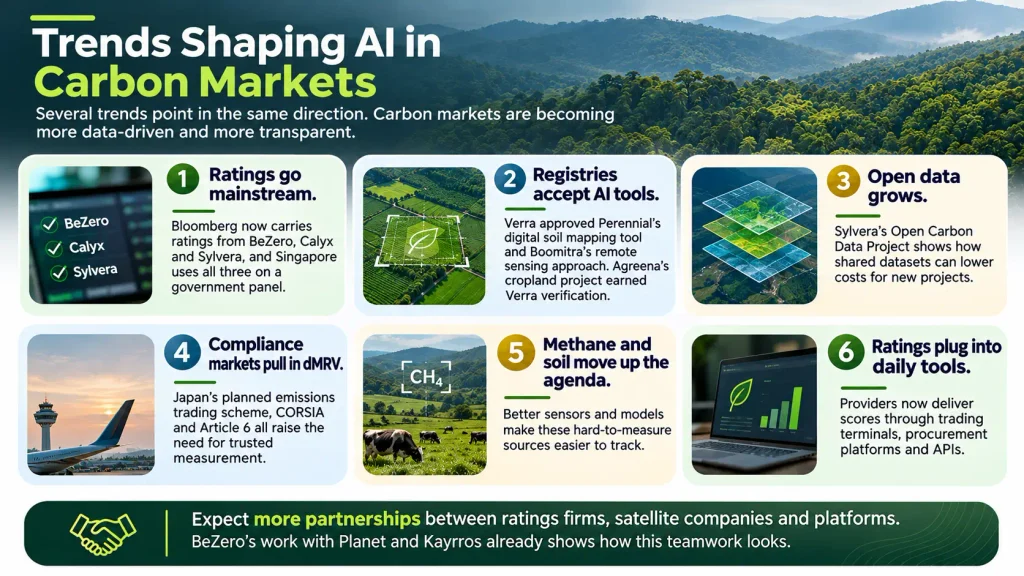
Several trends point in the same direction. Carbon markets are becoming more data-driven and more transparent.
- Ratings go mainstream. Bloomberg now carries ratings from BeZero, Calyx and Sylvera, and Singapore uses all three on a government panel.
- Registries accept AI tools. Verra approved Perennial’s digital soil mapping tool and Boomitra’s remote sensing approach. Agreena’s cropland project earned Verra verification.
- Open data grows. Sylvera’s Open Carbon Data Project shows how shared datasets can lower costs for new projects.
- Compliance markets pull in dMRV. Japan’s planned emissions trading scheme, CORSIA and Article 6 all raise the need for trusted measurement.
- Methane and soil move up the agenda. Better sensors and models make these hard-to-measure sources easier to track.
- Ratings plug into daily tools. Providers now deliver scores through trading terminals, procurement platforms and APIs.
Expect more partnerships between ratings firms, satellite companies and platforms. BeZero’s work with Planet and Kayrros already shows how this teamwork looks.
Practical Takeaways for Buyers, Developers and Investors
| If you are a… | Do this |
|---|---|
| Corporate buyer | Use two ratings before you buy, and ask for the data behind each score |
| Project developer | Use dMRV tools early, so your project design matches what auditors will check |
| Investor | Look for providers with registry approval and independent validation |
| Farmer or land manager | Ask whether a program uses registry-approved remote sensing to cut sampling costs |
| Policy maker | Study how Singapore built a panel of rating providers into its carbon credit framework |
Frequently Asked Questions
What are AI carbon market companies?
They are companies that use AI, machine learning and satellite data to rate, measure, monitor or verify carbon credits and the projects behind them.
How does AI verify carbon credits?
AI reads satellite images and other data to estimate forest carbon, soil carbon or emissions. It then compares those estimates with a project’s claims and baseline.
Humans and third-party auditors still review the result.
Which company is best for carbon credit ratings?
Sylvera and BeZero Carbon are the two best known AI-driven ratings providers. Calyx Global is a third major name.
Because their scores can differ, many buyers check more than one.
Can AI replace carbon auditors?
No. AI speeds up measurement and flags problems, but registries and auditors still approve projects. Independent review remains a core part of the process.
Do carbon registries accept AI-based verification?
Yes, in some cases. Verra approved a digital soil mapping tool that uses AI and a remote sensing approach for soil carbon. Cropland projects that use these methods have earned Verra verification.
Are AI carbon credit ratings reliable?
They give useful signals, but they are not guarantees. Studies show providers can rate the same project very differently, so compare ratings and read the reasoning.
How does AI help small farmers join carbon markets?
Traditional soil sampling costs too much for small plots. Companies such as Boomitra use satellites and machine learning to measure soil carbon remotely, so farmers with as little as one acre can take part.
What is dMRV in carbon markets?
dMRV stands for digital monitoring, reporting and verification. It uses remote sensing, AI and software to measure carbon stocks and emissions reductions without relying only on manual field work.
Conclusion
AI carbon market companies now sit at the center of the push for better carbon credits. They give buyers, developers and regulators the proof that the market has long lacked.
Ratings leaders like Sylvera and BeZero Carbon turn complex data into clear scores. Data builders like Planet, Chloris Geospatial, Space Intelligence, Kayrros and Archeda supply the maps and measurements underneath.
Soil specialists like Agreena, Regrow, Boomitra and Perennial open carbon markets to farmers who once stood outside them.
Still, AI is a tool, not a verdict. The smartest approach combines models, field data, expert review and more than one source of ratings.
Start by naming your role and your biggest risk. Then match it to the right provider from this list, run a small pilot and build from there.
As the market keeps moving toward quality over volume, the AI carbon market companies that earn trust will shape which credits deserve your money.
Ready to go deeper? Explore more guides at Carbon Market Network.