Carbon Market Network



If you have ever tried to buy or sell carbon credits, you know how confusing the market can feel at first.
Prices vary wildly. Projects look similar on paper but deliver very different results. And the process of actually completing a transaction can involve multiple registries, verification standards, and counterparties.
That is exactly where carbon credit brokers come in.
They sit in the middle of the market and help buyers find the right credits, help sellers find the right buyers, and make sure transactions actually close. The best brokers in the world do all of this while adding real value through market intelligence, risk management, and strategic advice.
This guide breaks down who the top carbon credit brokers are, what makes each one stand out, and how to choose the right one for your situation.
What Is a Carbon Credit Broker?
A carbon credit broker is a firm or individual that acts as an intermediary between buyers and sellers of carbon credits.
Think of them the way you would think of a real estate agent or a commodity trader. They do not own the underlying asset in every case. Instead, they use their market knowledge and relationships to connect the right parties and facilitate a deal.
In carbon markets, brokers operate across both the voluntary carbon market (VCM) and the compliance carbon market. The voluntary market lets companies buy credits to offset emissions beyond any legal requirement. The compliance market is driven by government regulations like the EU Emissions Trading System (EU ETS) or California’s cap-and-trade program.
Brokers help clients navigate both.
Carbon Market Insider Newsletter
Weekly insights on carbon markets, climate policy, carbon credits, and sustainability.
What Do Carbon Credit Brokers Actually Do?
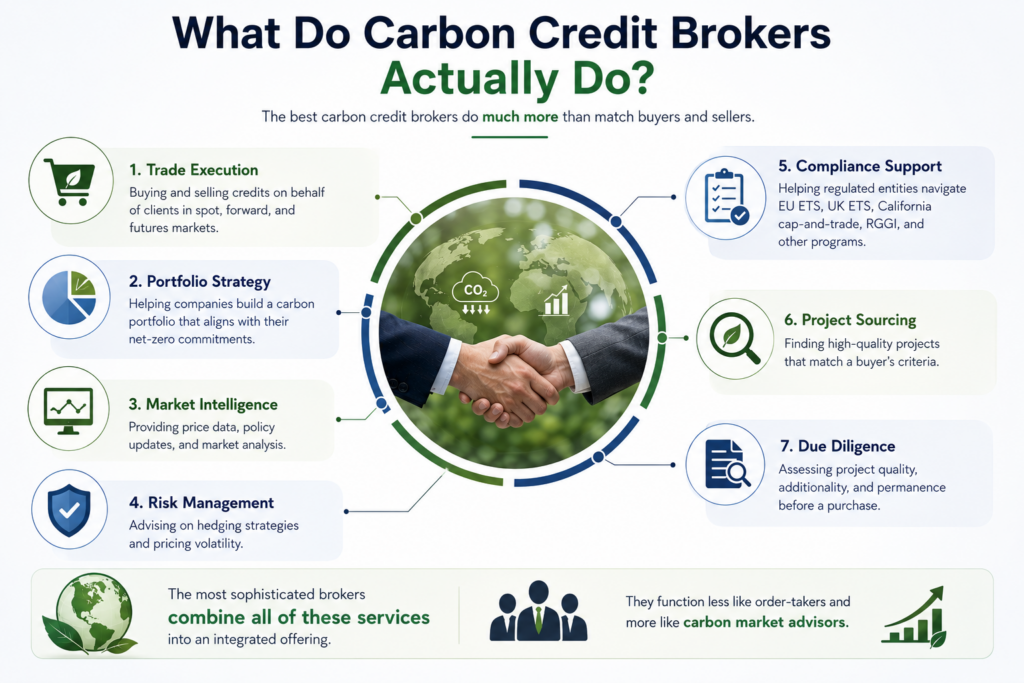
Many people assume brokers just match buyers and sellers. In practice, the best carbon credit brokers do much more than that.
Here is what the top firms typically offer:
- Trade execution — Buying and selling credits on behalf of clients in spot, forward, and futures markets
- Portfolio strategy — Helping companies build a carbon portfolio that aligns with their net-zero commitments
- Market intelligence — Providing price data, policy updates, and market analysis
- Risk management — Advising on hedging strategies and pricing volatility
- Compliance support — Helping regulated entities navigate EU ETS, UK ETS, California cap-and-trade, RGGI, and other programs
- Project sourcing — Finding high-quality projects that match a buyer’s criteria
- Due diligence — Assessing project quality, additionality, and permanence before a purchase
The most sophisticated brokers combine all of these services into an integrated offering. They function less like order-takers and more like carbon market advisors.
The Difference Between a Broker, a Retailer, and a Project Developer
Before we cover the top firms, it helps to understand how brokers fit into the broader market structure.
| Role | What They Do | Who They Serve |
|---|---|---|
| Project Developer | Creates and verifies carbon credits from emission-reduction projects | Sells credits to retailers, brokers, or directly to end buyers |
| Retail Trader | Buys large volumes of credits, bundles them, and sells to end buyers | Corporate buyers who want a simple procurement experience |
| Broker | Connects buyers and sellers, executes trades, provides advice | Both buyers and sellers across compliance and voluntary markets |
| Exchange/Platform | Provides infrastructure for standardized, transparent trading | Institutions, brokers, and large corporate buyers |
Some firms play multiple roles. South Pole, for example, develops projects, sells credits, and provides advisory services. STX Group trades, brokers, and advises. Understanding this overlap helps you know what you are actually buying when you work with a firm.
Top Carbon Credit Brokers in the World
The following firms are recognized as leaders in the global carbon brokerage space. The Environmental Finance Market Rankings, one of the most respected benchmarks in the industry, has recognized most of these firms across multiple categories and multiple years. Others have earned their reputation through transaction volume, geographic reach, or depth of expertise.
1. Evolution Markets (Xpansiv)
Headquarters: New York, USA Best for: Large-volume trades across compliance and voluntary markets, complex structured transactions
Evolution Markets is one of the oldest and most decorated carbon brokers in the world. The firm has been active in environmental commodity markets since the earliest days of cap-and-trade programs and has facilitated more than $800 billion in notional transaction value across carbon, renewable energy, clean fuels, and power markets.
Today, Evolution Markets operates as part of Xpansiv, the world’s leading exchange infrastructure provider for environmental commodities. This gives Evolution Markets a unique combination of brokerage expertise and direct exchange access.
The firm covers virtually every major compliance carbon program, including the EU ETS, UK ETS, California cap-and-trade, and RGGI in the northeastern United States. It also operates across the voluntary carbon market, covering forestry and land-use credits (REDD+), renewable energy projects, and technology-based removals like direct air capture and biochar.
Evolution Markets has offices in New York, London, Houston, and Dubai, making it one of the most geographically diverse carbon brokers in the world.
Key services:
- Spot, forward, and options trading across compliance and voluntary markets
- Structured offtake agreements and carbon financing
- Portfolio optimization and compliance strategy
- Consulting on emissions measurement and net-zero program design
- Cross-market integration with RECs and LCFS instruments
Evolution Markets has consistently ranked at or near the top of the Environmental Finance Market Rankings for carbon brokerage across Europe, North America, and the Asia-Pacific region. For any company that needs genuine depth of market access and a long track record, Evolution Markets is a first-tier choice.
2. STX Group (Strive by STX)
Headquarters: Amsterdam, Netherlands Best for: European compliance markets, large-volume voluntary credit sourcing, decarbonization advisory
STX Group is one of Europe’s largest environmental commodities traders and brokers. Founded in 2005 in Amsterdam, the firm started as a pure-play brokerage focused on EU Allowances (EUAs) and has grown into a global operation spanning carbon credits, renewable energy certificates (RECs), biofuels, and biogas.
The group now includes several brands. STX Group itself handles environmental commodity trading across compliance and voluntary markets. Strive by STX is the advisory arm that helps corporate clients build decarbonization strategies, measure their carbon footprint, and source high-quality offsets. Vertis Environmental Finance, which STX now owns, is a MiFID II-regulated trading firm focused specifically on EU ETS, UK ETS, CORSIA, and CBAM (the EU Carbon Border Adjustment Mechanism).
In December 2025, STX Group launched its STX Climate Tech platform, a digital tool designed to help companies manage their decarbonization journey end-to-end.
STX Group has offices across Europe, the Americas, and Asia-Pacific and consistently ranks among the top carbon trading firms in the Environmental Finance Market Rankings across multiple categories.
Key services:
- Physical and financial trading in EU ETS, UK ETS, and voluntary carbon markets
- Spot, forward, and long-term portfolio deals for corporate buyers
- CBAM and CORSIA compliance support
- Renewable energy certificates (RECs) and biofuels trading
- Decarbonization strategy and carbon footprint measurement (via Strive)
For European companies navigating compliance obligations, or for any company that wants a dedicated trading desk behind their carbon strategy, STX Group is a top-tier choice.
3. ClearBlue Markets
Headquarters: Toronto, Canada Best for: North American compliance markets, carbon pricing advisory, market intelligence
ClearBlue Markets is a carbon pricing advisory and brokerage firm with deep expertise across European and North American compliance markets. The firm combines strategic advice with credit sourcing and publishes regular market analysis that helps clients stay ahead of price movements and policy changes.
ClearBlue specializes in voluntary carbon markets, the Alberta TIER program, and California’s Low Carbon Fuel Standard (LCFS). It also tracks auction results across the EU ETS, UK ETS, Western Climate Initiative (WCI), RGGI, South Korea, and New Zealand, giving clients a genuinely global picture of carbon pricing dynamics.
In the Environmental Finance Market Rankings, ClearBlue has consistently won or placed in the Best Advisory/Consultancy category across multiple geographies, including North America and the Asia-Pacific region. In the most recent rankings, ClearBlue was recognized as the best broker across all North American markets and the best advisory firm in the APAC region.
Key services:
- Carbon pricing strategy and risk management
- Credit sourcing across voluntary and compliance markets
- Ongoing market intelligence and price analysis
- Compliance advisory for Canadian, US, and European programs
- Project development support
ClearBlue is the right fit for companies that want a partner who executes trades and also keeps them genuinely informed about where prices and policy are heading.
4. Redshaw Advisors
Headquarters: London, United Kingdom Best for: EU ETS and UK ETS compliance, voluntary credit sourcing, treating carbon as a financial risk
Redshaw Advisors is a carbon risk management and environmental markets specialist founded in 2014. The firm focuses specifically on helping corporate buyers navigate EU and UK compliance carbon markets while also sourcing voluntary carbon credits.
Redshaw’s flagship product is the Carbon Support Programme (CSP), which gives clients advanced, actionable market intelligence for EU ETS and UK ETS participants. The firm also provides training, expert witness services, and bespoke consultancy for companies navigating the Carbon Border Adjustment Mechanism (CBAM).
In the Environmental Finance Market Rankings, Redshaw has consistently ranked as the best advisory and consultancy firm for European carbon markets. The firm has clients in multiple countries and has hosted world-leading carbon market conferences since 2016.
Key services:
- EU ETS and UK ETS compliance strategy and procurement
- Voluntary carbon credit sourcing and retirement
- Carbon risk management and pricing strategy
- CBAM compliance support
- Carbon market training and expert witness services
Redshaw is best suited for companies in Europe that manage carbon as a financial risk, not just a sustainability checkbox. If your business participates in compliance markets and also wants to align voluntary purchases with a rigorous strategy, Redshaw is a strong fit.
5. Karbone
Headquarters: New York, USA Best for: North American compliance markets, options and futures trading, OTC spot transactions
Karbone is a US-based environmental markets brokerage firm with particular strength in North American compliance markets. The firm has consistently ranked as the best carbon broker for North American markets in the Environmental Finance Market Rankings, including top positions for California cap-and-trade brokerage, RGGI brokerage, and energy attribute certificate (EAC) brokerage.
Karbone covers both options and futures trading as well as OTC spot transactions in carbon allowances, RECs, and clean energy products. The firm serves regulated entities, project developers, and financial institutions.
Key services:
- Options and futures brokerage in California and RGGI carbon markets
- OTC spot carbon credit transactions
- Renewable energy certificate (REC) brokerage
- Advisory on North American compliance program strategy
For companies with compliance obligations under California’s cap-and-trade program or RGGI, Karbone is the most highly decorated broker in the market.
6. South Pole
Headquarters: Zurich, Switzerland Best for: Global net-zero strategy, carbon credit procurement, sustainability consulting for large multinationals
South Pole is one of the most recognized names in the global carbon market. Founded in 2006 by ETH Zurich graduates, the firm has grown into a full-service climate consultancy with offices in 23 locations and around 700 employees.
South Pole develops carbon projects, procures environmental certificates, provides climate consulting, and helps companies build net-zero strategies. The firm serves sectors including aviation, energy, fashion, finance, food and beverage, real estate, and the public sector.
South Pole is not purely a broker in the traditional sense. It acts as both a project developer and a credit distributor, which means it has deep insight into project quality at the source. This makes it a strong choice for companies that want an integrated approach, where the same firm that helps develop offset strategy also has access to the underlying projects.
Key services:
- Carbon credit procurement and portfolio management
- Net-zero strategy consulting and science-based target alignment
- Renewable energy certificate (REC) sourcing
- Climate risk and opportunity analysis
- Supply chain decarbonization advisory
- Climate policy consulting
South Pole works best for large multinationals that need end-to-end support, from measuring their emissions baseline to procuring high-quality credits and reporting on climate commitments.
7. Vertis Environmental Finance
Headquarters: Budapest, Hungary (now part of STX Group) Best for: EU ETS compliance, CORSIA, CBAM, cost-effective compliance for European companies
Vertis Environmental Finance was founded in 1998 and is one of the oldest environmental finance firms in Europe. Now operating as part of the STX Group, Vertis is a MiFID II-regulated trading firm that focuses on helping companies navigate European carbon compliance schemes in a cost-effective way.
The firm covers EU ETS, UK ETS, CORSIA (the aviation sector’s carbon offset scheme), and CBAM. It also provides services in emissions trading, energy efficiency, green finance consulting, and carbon footprint calculation.
In the Environmental Finance Market Rankings, Vertis has ranked as the best OTC/spot broker for EU carbon markets and among the top advisory firms for European markets.
Key services:
- EU ETS and UK ETS trading and compliance
- CORSIA compliance for airlines and aviation-related businesses
- CBAM advisory and certificate procurement
- Energy efficiency certificates
- Carbon footprint calculation and reduction consultancy
Vertis is a strong choice for European companies that want a MiFID II-regulated firm with deep compliance expertise and a cost-focused approach.
8. Anew Climate
Headquarters: Chicago, USA Best for: North American compliance markets, project development, sustainability advisory
Anew Climate is a US-based environmental commodity trading, project development, and advisory firm. The firm is active across North American compliance markets including California cap-and-trade, RGGI, and Canada, and also operates in voluntary carbon markets.
In the Environmental Finance Market Rankings, Anew Climate has consistently ranked among the top trading companies and project developers in North American markets. The firm combines trading capabilities with direct project development, which gives it an edge in sourcing credits from high-quality North American projects.
Key services:
- Carbon credit trading across California, RGGI, and voluntary markets
- Project development and credit origination in North America
- Compliance strategy and advisory for regulated entities
- Sustainability advisory and reporting support
Anew Climate is a good fit for companies operating in North America that want a broker with genuine on-the-ground project expertise.
9. CORE Markets
Headquarters: Sydney, Australia Best for: Asia-Pacific markets, APAC carbon credits, advisory for Australian and regional buyers
CORE Markets is the leading carbon broker in the Asia-Pacific region. The firm has consistently ranked as the best broker for APAC markets in the Environmental Finance Market Rankings, holding that position across multiple years.
CORE Markets operates across the Australian carbon market, including Australian Carbon Credit Units (ACCUs), as well as broader Asia-Pacific voluntary and compliance markets. The firm combines brokerage with advisory and verification services.
Key services:
- APAC carbon credit brokerage and trading
- Australian Carbon Credit Unit (ACCU) transactions
- Market intelligence and advisory for Asia-Pacific markets
- Verification and project support
For companies with operations in Australia or the broader Asia-Pacific region, CORE Markets is the specialist broker with the deepest regional expertise.
10. Carbon Direct
Headquarters: New York, USA Best for: Science-led carbon removal procurement, enterprise buyers focused on high-integrity durable removals
Carbon Direct takes a distinctly scientific approach to carbon brokerage and advisory. The firm pairs an in-house scientific team with carbon procurement services, helping enterprise buyers source high-integrity credits and, in particular, durable carbon removals.
Before any purchase, Carbon Direct’s scientists assess project quality independently. This rigour makes it a strong choice for buyers who put science at the centre of their climate strategy, especially those focused on durable removals like direct air capture, biochar, and enhanced weathering.
Carbon Direct also operates across nature-based projects following its acquisition of Pachama, a forestry carbon analytics company.
Key services:
- Science-led due diligence on carbon credit projects
- Durable carbon removal procurement (engineered and natural)
- Advisory on removal portfolio construction
- Enterprise carbon strategy consulting
Carbon Direct is the right fit for large enterprises that need rigorous scientific review of every credit they purchase and want to build a removal-heavy portfolio aligned with the Oxford Principles on Net Zero.
How These Brokers Compare at a Glance
| Broker | HQ | Market Focus | Best For |
|---|---|---|---|
| Evolution Markets | New York, USA | Global compliance + voluntary | Large-volume, complex transactions |
| STX Group (Strive) | Amsterdam, Netherlands | EU + voluntary, biofuels | European compliance + corporate advisory |
| ClearBlue Markets | Toronto, Canada | North American + European advisory | Carbon pricing strategy + market intelligence |
| Redshaw Advisors | London, UK | EU ETS + UK ETS + voluntary | European compliance + financial risk management |
| Karbone | New York, USA | North American compliance | California cap-and-trade + RGGI brokerage |
| South Pole | Zurich, Switzerland | Global voluntary + strategy | Large multinational net-zero programs |
| Vertis Environmental Finance | Budapest, Hungary | EU ETS + CBAM + CORSIA | Cost-focused European compliance |
| Anew Climate | Chicago, USA | North American compliance + voluntary | North American project development + trading |
| CORE Markets | Sydney, Australia | Asia-Pacific markets | APAC brokerage + Australian carbon |
| Carbon Direct | New York, USA | Durable carbon removals | Science-led enterprise removal procurement |
What Makes a Great Carbon Credit Broker?
Not every broker is the right fit for every company. The best broker for a large European industrial with EU ETS obligations is probably not the same firm that works best for a mid-sized US retailer looking to buy voluntary credits for the first time.
Here is what separates good brokers from great ones:
Market access and liquidity The best brokers have relationships on both sides of the market. They can find sellers quickly, and they know where prices are moving before clients do. Depth of access directly impacts the prices clients receive and the speed of execution.
Verification and credit quality standards Leading brokers apply screening beyond the minimum registry requirements. They look for projects that meet the Core Carbon Principles from the Integrity Council for the Voluntary Carbon Market (ICVCM). They work with independent ratings agencies like BeZero Carbon, Sylvera, and Calyx Global to validate project quality before recommending purchases.
Pricing transparency Older brokerage models charged hidden fees or marked up credit prices without disclosure. The best brokers today provide clear pricing that shows how costs are structured, including project cost, broker margin, and retirement fees.
Compliance expertise If your company operates in a regulated market, your broker needs to understand that market deeply. EU ETS rules change regularly. California’s cap-and-trade program has specific compliance cycles. CORSIA eligibility requirements for aviation are evolving. A broker who is not up to date on these changes can expose you to financial and regulatory risk.
Advisory depth The best brokers do not just execute trades. They help you build a long-term strategy, understand market price risk, align credit purchases with science-based targets, and document transactions for audit purposes.
Reporting and documentation Corporate buyers increasingly need to prove that carbon credit purchases are credible. The best brokers provide registry serial numbers, retirement certificates, and documentation that aligns with CDP reporting, SBTi frameworks, and the Oxford Principles.
How to Choose the Right Carbon Credit Broker
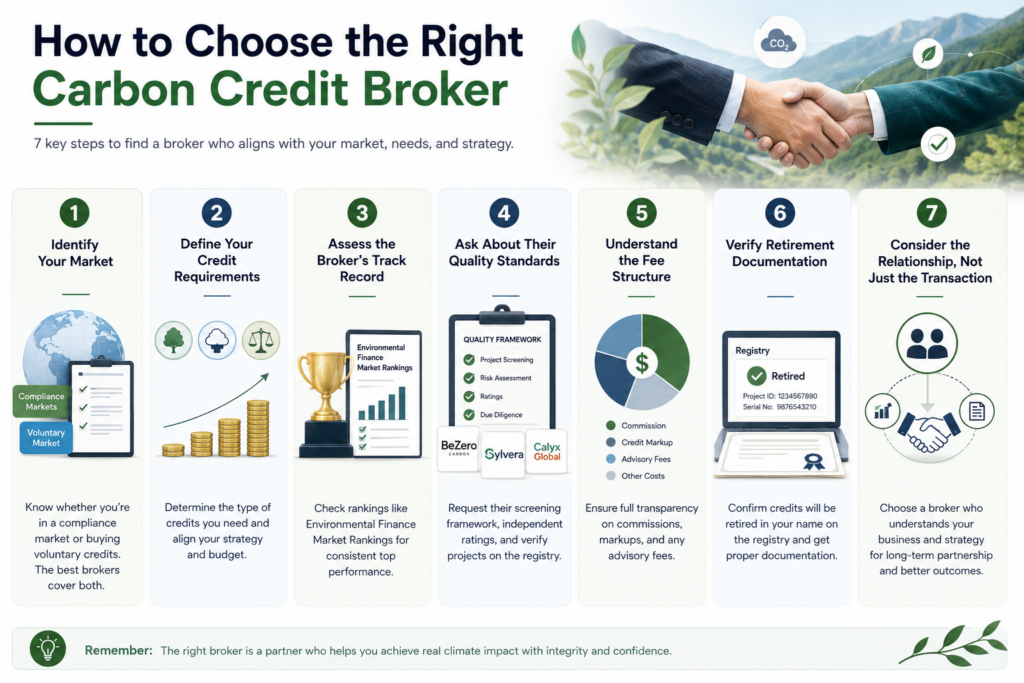
Choosing the right broker depends on where you operate, what type of credits you need, and how sophisticated your carbon strategy is.
Step 1: Identify your market
Are you in a compliance market like EU ETS, California cap-and-trade, or RGGI? Or are you buying voluntary credits to support net-zero commitments? Some brokers specialize in one or the other. The best ones cover both.
Step 2: Define your credit requirements
Do you need nature-based avoidance credits, durable engineered removals, or a mix? High-integrity removals like direct air capture cost significantly more than avoided deforestation credits. Your strategy and budget need to align.
Step 3: Assess the broker’s track record
Look at the Environmental Finance Market Rankings, which poll leading market participants annually and cover brokerage, trading, and advisory categories by geography and market type. A broker consistently appearing in top positions across multiple categories is a reliable signal of quality.
Step 4: Ask about their quality standards
Request the written framework the broker uses to screen projects. Ask whether they apply independent ratings from BeZero Carbon, Sylvera, or Calyx Global. Ask for the specific registry page of any project they recommend and verify the project ID.
Step 5: Understand the fee structure
Ask how the price breaks down. Is there a commission? Is the credit marked up from the wholesale price? Are there advisory fees separate from the transaction cost? Transparency here matters both for your budget and for the credibility of your climate claims.
Step 6: Verify retirement documentation
Ask for proof that credits will be retired in your name, with serial numbers, directly on the relevant registry. This is the document your auditors, investors, and stakeholders will ask for.
Step 7: Consider the relationship, not just the transaction
The best broker relationships are long-term partnerships, not one-off trades. A broker who understands your business, your reporting obligations, and your long-term strategy will consistently deliver better outcomes than a transactional counterparty who moves to the next deal as soon as your order closes.
Carbon Credit Pricing: What to Expect
One of the most common questions companies ask when approaching brokers is: how much does a carbon credit cost?
The honest answer is that it depends enormously on the project type, the vintage year, the certification standard, and the quality rating.
Here is a rough guide to where prices sit across different credit categories:
| Credit Type | Typical Price Range | Notes |
|---|---|---|
| Nature-based avoidance (e.g., REDD+) | $5 to $15 per tonne | Price varies significantly by project quality and vintage |
| High-integrity nature-based removal | $15 to $35 per tonne | Projects with ICVCM CCP label or high BeZero/Sylvera ratings |
| Soil carbon and agricultural credits | $15 to $50 per tonne | Methodology debates ongoing; permanence is a consideration |
| Engineered removal (biochar, enhanced weathering) | $50 to $200 per tonne | Rapidly growing supply; durable but not yet at scale |
| Direct air capture (DAC) | $400 to $600+ per tonne | Most durable removal type; very limited supply |
| EU ETS allowances | Market-priced; check live | Compliance instrument; tracks policy and energy markets |
A good broker will help you understand not just the price but the risk profile of different credit types. A cheap credit that carries reputational risk is not a bargain. A more expensive credit that withstands regulatory scrutiny and third-party audit is almost always worth the premium.
The Role of Registries and Standards in Brokered Transactions
Brokers do not work in isolation. Every carbon credit transaction ultimately involves a registry, a verification standard, and in many cases an independent quality rating.
Understanding these layers helps you ask better questions when working with a broker.
Key verification standards brokers work with:
- Verra (VCS) — The most widely used voluntary standard globally, covering forestry, land use, renewable energy, and industrial projects
- Gold Standard — Focuses on projects with strong sustainable development co-benefits and community impact
- American Carbon Registry (ACR) — Specializes in North American projects and is approved for some compliance markets
- Climate Action Reserve (CAR) — Focused on North American projects with rigorous methodologies
- Puro.earth — Focuses on engineered carbon removal projects
- Plan Vivo — Designed for community-led, smallholder land-use projects
- ICVCM Core Carbon Principles (CCP) — A quality benchmark that the world’s leading registries are adopting; credits with a CCP label have cleared a high bar for integrity
Independent credit rating agencies:
- BeZero Carbon — Rates projects on a scale from AAA to D; most corporate buyers now require BBB or higher
- Sylvera — Provides tier-based ratings; most buyers require Tier 2 or higher
- Calyx Global — Newer entrant providing additional independent ratings
When you work with a top broker, they should be able to tell you the rating of any project they are recommending. If a broker cannot explain the rating or does not use these independent agencies, that is a signal to ask more questions.
Common Mistakes When Working With Carbon Credit Brokers
Even companies with serious sustainability commitments sometimes make avoidable mistakes when engaging brokers.
Choosing on price alone
The cheapest credit usually carries the highest risk. A credit that fails a third-party audit or that Verra later invalidates is worse than no credit at all from a reputational standpoint. Focus on quality first, then negotiate price within that quality band.
Not asking for retirement proof
Some companies purchase credits but do not verify that the credits have been retired in their name on the registry. Retirement is what makes the offset claim legally valid. Always request the retirement certificate with serial numbers.
Working with a broker who does not disclose fees
If a broker is unwilling to tell you how the transaction price breaks down between project cost, broker margin, and other fees, that is a red flag. The best brokers in the world are transparent about how they are compensated.
Buying credits that are already retired or double-counted
Carbon credits must not be double-counted. When a credit is used to make a climate claim, it must be retired in the registry so it cannot be used again. Always verify the specific serial number of the credits you are buying has not already been retired by another buyer.
Treating carbon credits as a substitute for emission reduction
Credible brokers will tell you this themselves. Carbon credits are most defensible as a bridge while you reduce emissions, or as a way to address truly residual emissions that cannot be eliminated. They are not a substitute for operational decarbonization.
FAQ: Carbon Credit Brokers
What is the difference between a carbon credit broker and a carbon credit exchange?
A carbon exchange provides the trading infrastructure, a standardized platform where buyers and sellers transact directly or through brokers. A broker is the intermediary who helps clients access these exchanges or structure OTC (over-the-counter) deals directly between parties. Many brokers now work alongside exchanges rather than in competition with them.
Do I need a broker to buy carbon credits?
Not always. Large-volume buyers can access exchanges like CBL (operated by Xpansiv) directly. However, brokers add value through project selection advice, pricing intelligence, risk management, and compliance documentation. For most companies buying credits for the first time or managing complex compliance obligations, a broker is worth the cost.
How do carbon credit brokers make money?
Brokers typically earn a commission on each trade, a spread between the buy and sell price, or an advisory fee. Some charge a flat fee for structured advisory services. Always ask for fee transparency before engaging.
What certifications should a carbon credit broker have?
Brokers operating in compliance markets may need to be regulated financial services firms (for example, Vertis Environmental Finance is MiFID II regulated in Europe). For voluntary market transactions, there is no universal licensing requirement, which is why checking track records, market rankings, and client references is especially important.
How do I verify that my carbon credits are real and not double-counted?
Ask your broker for the project’s registry listing, the vintage year, and the serial numbers of the specific credits you are purchasing. You can then verify these on the relevant registry website (Verra’s website, Gold Standard’s Impact Registry, etc.) and confirm that the credits have not already been retired by another buyer.
What is the ICVCM and why does it matter for carbon credit brokers?
The Integrity Council for the Voluntary Carbon Market (ICVCM) is an independent governance body that has established the Core Carbon Principles (CCPs), a benchmark for high-integrity carbon credits. Credits that carry the CCP label have met a rigorous set of standards. The best brokers source credits aligned with the CCPs and will be able to confirm CCP eligibility for the projects they recommend.
Are carbon credit prices going up or down?
Carbon credit prices vary significantly by credit type and are influenced by policy developments, supply and demand dynamics, and market integrity concerns. Compliance market prices (like EU ETS) are driven by regulatory caps and energy market conditions. Voluntary market prices have been influenced by integrity scrutiny and the shift toward higher-quality credits. A good broker provides ongoing price intelligence to help clients time purchases and manage price risk.
Can individuals buy carbon credits through brokers?
Most top carbon credit brokers focus on corporate clients with significant volume requirements. Individual buyers are better served by consumer-facing platforms or retail-focused providers. If you are an individual, platforms focused on retail carbon offset purchases are a more appropriate starting point.
Conclusion
Carbon credit brokers play a central and increasingly sophisticated role in the global carbon market.
The best carbon credit brokers in the world do far more than match buyers with sellers. They bring market intelligence, credit quality analysis, compliance expertise, risk management, and long-term strategic support to every client relationship.
Whether you are a European industrial company navigating EU ETS obligations, a global brand building a voluntary offset portfolio, or a project developer looking for buyers, the right broker makes the process faster, more transparent, and more effective.
The firms profiled in this guide, including Evolution Markets, STX Group, ClearBlue Markets, Redshaw Advisors, Karbone, South Pole, Vertis Environmental Finance, Anew Climate, CORE Markets, and Carbon Direct, represent the current leadership in global carbon brokerage. Each excels in different geographies, market types, and service models.
The most important step is matching the broker’s strengths to your specific needs. Ask the right questions, demand transparency on fees and credit quality, and look for a partner who treats your carbon strategy as seriously as you do.
The carbon market is only getting more important. Getting the right broker in your corner makes all the difference.
For more in-depth guides on carbon markets, carbon credits, and sustainability strategies, explore the resources at Carbon Market Network.