Carbon Market Network

If you have ever wondered who makes sure a carbon credit is actually worth something, you are asking exactly the right question.
Anyone can claim that a project reduces carbon emissions. But without an independent body checking the numbers, reviewing the data, and confirming the results, those claims are just words. Carbon credit verification companies are the ones that turn claims into trust.
This article covers everything you need to know about carbon credit verification companies, how they operate, what they verify, and which organizations lead the world in this critical work.
What Is Carbon Credit Verification?
Before jumping into the companies, it helps to understand what verification actually means in this context.
When a company or project developer says their project removes or reduces greenhouse gases, they need to prove it. Verification is the independent audit that confirms those reductions happened, and that they happened at the scale claimed.
Think of it like a financial audit. Just as a company gets an external accountant to verify its accounts, a carbon project gets an external body to verify its emissions data.
There are two related but distinct steps involved:
Validation checks the project design before it begins. An independent auditor reviews the methodology, the baseline assumptions, and the monitoring plan to confirm the project is set up correctly.
Verification checks actual project performance after activities have taken place. The auditor reviews monitoring reports, field data, and supporting evidence to confirm that real emissions reductions occurred.
Together, these two steps form the backbone of carbon credit integrity.
Carbon Market Insider Newsletter
Weekly insights on carbon markets, climate policy, carbon credits, and sustainability.
Why Carbon Credit Verification Matters
Without robust verification, the carbon market falls apart.
A carbon credit is worth one tonne of CO2 equivalent reduced or removed. If that claim is not verified, buyers have no way to know whether they are getting what they paid for. That destroys trust, and a market without trust does not function.
Verification solves three critical problems:
- Greenwashing prevention: It stops companies from claiming climate action without delivering it.
- Buyer confidence: It gives corporations, governments, and individuals assurance that their offsets are real.
- Market integrity: It supports the credibility of the entire voluntary and compliance carbon market.
High-quality verification is now a baseline expectation. Corporate buyers, investors, and regulators increasingly demand it before any transaction takes place.
How the Carbon Credit Verification Process Works
The verification process follows a structured sequence. Every reputable carbon credit verification company follows a similar pathway, though the exact steps vary slightly across standards and project types.
Step 1: Project Design and Methodology Selection
The project developer creates a Project Design Document (PDD). This document outlines how the project will reduce or remove carbon, what methodology it follows, and how it will measure results over time.
The developer chooses an approved methodology from a recognized standard body such as Verra, Gold Standard, or the American Carbon Registry. Choosing the right methodology matters enormously. It determines how emissions are calculated and what evidence is required.
Step 2: Validation by an Accredited Body
Before the project starts, an accredited Validation and Verification Body (VVB) reviews the PDD. The validator checks:
- Whether the methodology is appropriate for the project type
- Whether the baseline (the emissions level without the project) is realistic and defensible
- Whether the monitoring plan is sound and measurable
- Whether the project is “additional,” meaning it would not have happened without carbon finance
Once the VVB is satisfied, it issues a validation opinion, and the project can be listed on the relevant registry.
Step 3: Project Implementation and Monitoring
The project runs. Data is collected according to the monitoring plan. Developers track emission reductions through field measurements, satellite imagery, IoT sensors, energy meters, or other approved methods depending on the project type.
Monitoring reports are compiled at regular intervals and submitted to the standard body.
Step 4: Verification of Actual Results
A VVB conducts an independent audit of the monitoring data. This typically involves:
- A desk review of all monitoring documentation
- Site visits or remote data checks
- Interviews with project personnel
- Cross-checking reported figures against independent sources
The VVB then issues a verification report confirming how many tonnes of CO2 equivalent were genuinely reduced or removed.
Step 5: Credit Issuance
The standard body (such as Verra or Gold Standard) reviews the verification report and, once satisfied, issues carbon credits onto the registry. Each credit is serialized and publicly tracked.
Step 6: Ongoing Monitoring and Periodic Re-Verification
Projects do not get verified once and then left alone. Ongoing monitoring continues, and re-verification happens at regular intervals, often every five years for long-duration projects.
This ensures permanence. If a forest burns down or a project fails, the credits can be cancelled or buffer pools activated to compensate buyers.
Who Are Validation and Verification Bodies (VVBs)?
VVBs are independent third-party organizations accredited by standard bodies and national accreditation organizations to conduct validation and verification services.
To become an approved VVB, an organization must:
- Hold accreditation under ISO 14065 (the international standard for GHG validation and verification)
- Demonstrate sector-specific technical expertise
- Pass an application review by the relevant standard body (e.g., Verra, Gold Standard, ACR)
- Maintain ongoing independence from project developers
VVBs are the auditors of the carbon world. Their name is attached to every verified credit, and their reputation is on the line with every assessment they sign off on.
Top Carbon Credit Verification Companies in the World
The following organizations are the most recognized, most widely used, and most trusted carbon credit verification companies operating globally today.
1. DNV (Det Norske Veritas) — Norway
Headquarters: Oslo, Norway Standards covered: Verra VCS, Gold Standard, ACR, UNFCCC CDM, GCC, ISO 14064
DNV is widely regarded as the global leader in carbon credit validation and verification. The company has over 20 years of experience in climate assurance and holds accreditation under ISO 14065 from multiple national accreditation bodies.
DNV operates across both voluntary and compliance markets. Its verification work spans industrial energy efficiency, carbon capture and storage, renewable energy, sustainable aviation fuel credits, and methane abatement.
DNV was the first Designated Operational Entity (DOE) accredited by the UNFCCC to verify all major CDM sectoral scopes. That breadth of technical expertise carries through into its current voluntary market work.
Key strengths:
- One of the largest and most experienced VVBs in the world
- Deep expertise in hard-to-abate industrial sectors (cement, chemicals, steel)
- Coverage across all major carbon standards globally
- Recognised as one of the best verification companies by readers of Environmental Finance
DNV is particularly well suited for complex industrial carbon projects where technical depth matters.
2. SCS Global Services — United States
Headquarters: Emeryville, California, USA Standards covered: Verra VCS, ACR, CAR, CARB (California Air Resources Board), CCB Standards
SCS Global Services is one of the longest-established carbon offset verification bodies in the world. The organization brings nearly four decades of environmental certification expertise to the carbon market.
SCS has verified more than 400 million tonnes of CO2 equivalent and conducted over 1,300 assessments across projects in 47 US states and 52 countries. That volume of experience makes them one of the most battle-tested VVBs available.
Their particular strength lies in forestry, land-use, and agriculture projects. SCS has deep expertise in Improved Forest Management, REDD+ (Reducing Emissions from Deforestation and Degradation), regenerative agriculture, and soil carbon methodologies.
Key strengths:
- Best-in-class expertise for AFOLU (Agriculture, Forestry, and Other Land Use) projects
- Accredited for California compliance market verification under CARB
- Multidisciplinary team covering forestry, biometrics, remote sensing, and soil carbon
- Strong track record across North American and global forestry projects
If your project involves forests, land, or agriculture, SCS Global Services is one of the top choices globally.
3. Bureau Veritas — France
Headquarters: Neuilly-sur-Seine, France Standards covered: Verra VCS, Gold Standard, ISO 14064
Bureau Veritas is one of the world’s largest testing, inspection, and certification companies with a history stretching back nearly two centuries. Its carbon and GHG verification services are part of a broader sustainability assurance offering that spans virtually every industry.
Bureau Veritas provides validation and verification for carbon offset projects and GHG removals. Their VCS certification confirms that emissions are actually being reduced, giving buyers and investors the confidence they need.
The company’s global footprint and recognition across industries make it a reliable partner for multinational corporations seeking carbon credit verification as part of a wider sustainability audit process.
Key strengths:
- Globally recognized brand trusted across industries
- Comprehensive sustainability assurance beyond just carbon credits
- Strong presence across Europe, Asia-Pacific, and the Americas
- Verification for both voluntary carbon markets and mandatory GHG reporting frameworks
Bureau Veritas suits large corporations that want a single trusted partner for both carbon verification and broader ESG assurance.
4. SGS — Switzerland
Headquarters: Geneva, Switzerland Standards covered: Verra VCS, Gold Standard, GCC, ISO 14064, Asia Carbon Institute
SGS is the world’s leading testing, inspection, and certification company by size, operating in over 140 countries. Its carbon verification services bring the same global reach and technical rigor that SGS applies across its other industry sectors.
SGS provides third-party carbon credit verification with established accreditation and audit rigor across multiple carbon standards. The company acquired Aster Global Environmental Solutions in early 2025, significantly strengthening its expertise in GHG validation and verification, forestry, and ecosystem services.
SGS is also an accredited VVB under the Asia Carbon Institute, reflecting its commitment to growing carbon markets across Asia.
Key strengths:
- Unmatched global footprint across 140+ countries
- Recent acquisition of Aster Global strengthened forestry and ecosystem expertise
- Recognized by multiple standard bodies across different regions
- Strong in Asia-Pacific where carbon markets are expanding rapidly
SGS is especially strong for projects that need verification across multiple jurisdictions or regions simultaneously.
5. TÜV SÜD — Germany
Headquarters: Munich, Germany Standards covered: Verra VCS, Gold Standard, ACR, CAR, UNFCCC CDM, EU ETS, CBAM
TÜV SÜD is one of the largest verification bodies in the world. The organization provides independent validation and verification across both voluntary and compliance carbon markets, with particular strength in regulatory compliance frameworks including the EU Emissions Trading System and the Carbon Border Adjustment Mechanism (CBAM).
TÜV SÜD holds ISO 14065 accreditation and is recognized by numerous national accreditation bodies across Europe, Asia, and the Americas. Its services cover GHG inventories, carbon offset project validation and verification, facility-level emissions verification, and product carbon footprint assurance.
In a landmark development, TÜV SÜD acquired SustainCERT in July 2026, combining TÜV SÜD’s broad assurance expertise with SustainCERT’s pioneering digital MRV platform. This acquisition positions TÜV SÜD as a leader in the next generation of digital carbon verification.
Key strengths:
- One of the largest and most globally accredited VVBs in the world
- Strong in compliance markets: EU ETS, CBAM, CDM
- The SustainCERT acquisition adds digital MRV and high-frequency issuance capabilities
- End-to-end coverage from Scope 1, 2, and 3 GHG assurance to carbon credit verification
TÜV SÜD is an ideal partner for companies navigating both voluntary and compliance carbon markets, especially in European regulatory contexts.
6. TÜV NORD — Germany
Headquarters: Hanover, Germany Standards covered: Verra VCS, UNFCCC CDM, ISO 14064, TN-CC 020 (proprietary carbon neutrality standard)
TÜV NORD is a separate organization from TÜV SÜD, though both carry the TÜV name and share German origins. TÜV NORD CERT offers greenhouse gas verification services across carbon neutrality declarations, product carbon footprints, and voluntary carbon market projects.
TÜV NORD developed its own in-house standard, TN-CC 020, which verifies carbon footprints and validates voluntary climate contributions through the purchase of CO2 certificates. This makes TÜV NORD a practical choice for organizations seeking both emissions quantification and carbon offset verification in one process.
Key strengths:
- Strong in Europe, particularly for corporate carbon neutrality claims
- Proprietary TN-CC 020 standard for integrated footprint and offset verification
- Accredited under Verra VCS and UNFCCC CDM frameworks
- Good option for product-level and event-level carbon verification
7. SustainCERT (now part of TÜV SÜD) — Luxembourg
Headquarters: Luxembourg (acquired by TÜV SÜD, July 2026) Standards covered: Verra VCS, Gold Standard, ACR, UNFCCC Article 6.4, ICR, GCC, JCM, Cercarbono
SustainCERT was founded in 2018 with a specific mission: to use digital technology to make carbon verification faster, more accurate, and more scalable. It became one of the most innovative VVBs in the voluntary carbon market.
SustainCERT developed some of the first verification rules for value chain interventions and built one of the first carbon management platforms for verifying Scope 3 emissions reductions across complex supply chains. It was also involved in Verra’s first-ever digital MRV pilot that enabled high-frequency credit issuance (monthly or bi-monthly), a significant breakthrough compared to the traditional annual verification cycle.
Following its acquisition by TÜV SÜD in July 2026, SustainCERT’s digital verification platform is being integrated into TÜV SÜD’s broader global operations. The combined entity is a powerful force in next-generation carbon verification.
Key strengths:
- Pioneer in digital MRV and high-frequency issuance
- First to develop verification rules for value chain (Scope 3) carbon interventions
- Approved under the widest range of standards including UNFCCC Article 6.4 and JCM
- Now backed by TÜV SÜD’s global scale and resource base
SustainCERT is at the cutting edge of where carbon verification is heading: digital, scalable, and high frequency.
8. BSI Group (British Standards Institution) — United Kingdom
Headquarters: London, United Kingdom Standards covered: Verra VCS, Gold Standard, ISO 14064, ISAE 3410
BSI is one of the world’s oldest and most respected standards bodies. Its assurance and verification division offers carbon credit verification services alongside its broader work in sustainability, energy management, and environmental standards.
BSI is accredited as a VVB under Verra’s VCS program and operates across a wide range of sectors globally. Its long history in standards development gives it a depth of methodological expertise that few other organizations can match.
Key strengths:
- Internationally trusted brand with over 100 years of standards expertise
- Strong in Europe, Middle East, and Asia-Pacific
- Breadth of sector knowledge across energy, manufacturing, and built environment
- Experienced in both voluntary market and compliance framework verification
9. RINA — Italy
Headquarters: Genoa, Italy Standards covered: ISO 14064-2, Verra VCS, Gold Standard
RINA is a global testing, inspection, and certification company with particular strength in the energy, marine, and infrastructure sectors. Its carbon verification services include digital verification capabilities, offering real-time monitoring and continuous verification opinions through its proprietary digital platform.
RINA’s platform allows project developers to monitor CO2 equivalent reduced, sequestered, or avoided in real-time, with verification opinions generated periodically. Results can be shared directly with stakeholders and used for carbon credit registry submissions.
Key strengths:
- Strong digital platform for real-time emissions monitoring and verification
- Deep expertise in energy, marine, and industrial sectors
- Well-positioned for CCUS (carbon capture) projects in industrial contexts
- Active across Europe, Middle East, and Asia
10. Carbon Check (India) Private Limited — India
Headquarters: India Standards covered: Verra VCS, Gold Standard, CDM
Carbon Check is an India-based VVB that plays an important role in the verification of carbon projects across South and Southeast Asia. It is an active VVB under Verra’s VCS program and serves the rapidly growing carbon market in emerging economies.
As India builds out its Carbon Credit Trading Scheme (CCTS), domestic VVBs like Carbon Check are becoming increasingly important. Their local knowledge, language capabilities, and familiarity with regional project conditions make them well suited to verify projects in agricultural, forestry, and renewable energy sectors across Asia.
Key strengths:
- Strong regional expertise in South and Southeast Asia
- Active across both VCS and Gold Standard frameworks
- Important for India’s domestic carbon market development
- Cost-effective option for smaller projects in emerging economies
Comparison Table: Top Carbon Credit Verification Companies
| Company | HQ | Standards Covered | Key Strength | Best For |
|---|---|---|---|---|
| DNV | Norway | VCS, Gold Standard, ACR, GCC, CDM | Industrial & hard-to-abate sectors | Complex industrial projects |
| SCS Global Services | USA | VCS, ACR, CAR, CARB, CCB | Forestry, AFOLU, land use | Forest and agricultural projects |
| Bureau Veritas | France | VCS, Gold Standard, ISO 14064 | Global brand, ESG assurance | Multinational corporate projects |
| SGS | Switzerland | VCS, Gold Standard, GCC, ISO 14064 | Global reach, 140+ countries | Cross-border multi-region projects |
| TÜV SÜD | Germany | VCS, Gold Standard, EU ETS, CBAM | Digital MRV (via SustainCERT) | Compliance and voluntary markets |
| TÜV NORD | Germany | VCS, CDM, TN-CC 020 | Corporate carbon neutrality claims | Product and event-level carbon |
| SustainCERT | Luxembourg | VCS, GS, ACR, Art. 6.4, ICR, JCM | Digital, high-frequency verification | Innovative digital MRV projects |
| BSI Group | UK | VCS, Gold Standard, ISO 14064 | Standards expertise, UK/EU focus | European energy and built environment |
| RINA | Italy | ISO 14064, VCS, Gold Standard | Real-time digital platform | Industrial, energy, and marine |
| Carbon Check | India | VCS, Gold Standard, CDM | Regional expertise in Asia | Emerging market projects |
Standard Bodies vs. Verification Bodies: What Is the Difference?
Many people confuse carbon credit standard bodies with verification bodies. They are not the same, and understanding the difference helps you navigate the market clearly.
Standard bodies (also called registries or standard setters) create the rules that projects must follow. They approve methodologies, list projects publicly, issue credits onto registries, and manage credit retirement. Examples include Verra, Gold Standard, and the American Carbon Registry.
Verification bodies (VVBs) are independent auditors who check whether projects comply with the standard body’s rules. They do not issue credits themselves. They confirm the data, then pass their verification reports to the standard body, which then issues the credits.
Think of it like this: the standard body writes the accounting rules, and the VVB is the auditor who checks that the books are correct.
| Role | Examples | What They Do |
|---|---|---|
| Standard Body / Registry | Verra, Gold Standard, ACR, CAR | Set rules, approve methodologies, issue and retire credits |
| Validation and Verification Body (VVB) | DNV, SGS, SCS Global, Bureau Veritas, TÜV SÜD | Independently audit projects against the standard’s rules |
| Project Developer | NGOs, landowners, corporates, government agencies | Design and operate the emission-reduction project |
| Credit Buyer | Companies, governments, individuals | Purchase and retire credits to offset emissions |
What Makes a Good Carbon Credit Verification Company?
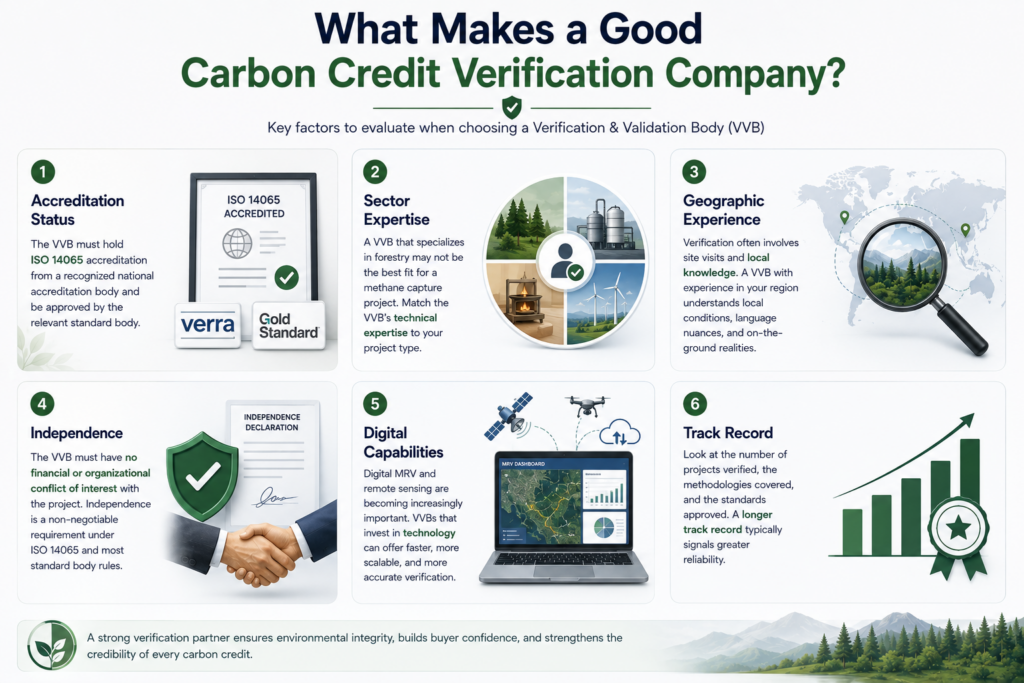
Not all VVBs are equal. When evaluating which verification body to work with, there are several factors worth considering.
Accreditation status: The VVB must hold ISO 14065 accreditation from a recognized national accreditation body. They must also be specifically approved by the standard body they will verify under (e.g., Verra’s active VVB list, Gold Standard’s approved auditors).
Sector expertise: A VVB that specializes in forestry may not be the best fit for a methane capture project. Match the VVB’s technical expertise to your project type.
Geographic experience: Verification often involves site visits and local knowledge. A VVB with experience in your region understands the local conditions, language nuances, and on-the-ground realities.
Independence: The VVB must have no financial or organizational conflict of interest with the project. Independence is a non-negotiable requirement under ISO 14065 and most standard body rules.
Digital capabilities: As the carbon market evolves, digital MRV and remote sensing are becoming increasingly important. VVBs that invest in technology can offer faster, more scalable, and more accurate verification.
Track record: Look at the number of projects verified, the methodologies covered, and the standards approved. A longer track record typically signals greater reliability.
The Rise of Digital MRV and What It Means for Verification
Traditional carbon credit verification relies heavily on periodic site visits, physical documentation, and annual review cycles. This model works, but it has limitations. It is slow, relatively expensive, and difficult to scale.
Digital MRV (Measurement, Reporting, and Verification) is changing this.
New technologies including satellite imagery, IoT sensors, machine learning, and remote monitoring are enabling continuous and real-time data collection. This data feeds directly into verification systems, reducing the need for manual data gathering and enabling more frequent credit issuance.
SustainCERT (now part of TÜV SÜD) demonstrated this potential when it partnered with Verra on the first digital MRV pilot that allowed monthly or bi-monthly credit issuance, compared to the traditional annual cycle. This is a significant leap forward for project developers who need faster access to carbon credit revenue.
Digital MRV benefits are clear:
- Faster verification cycles
- Lower verification costs over time
- More accurate and tamper-resistant data
- Ability to scale to thousands of small projects simultaneously
- Greater transparency for buyers and investors
The carbon credit verification companies that invest in digital capabilities today will be the dominant players in tomorrow’s market.
Carbon Credit Verification Across Different Project Types
Not all carbon projects are verified the same way. The methodology, data requirements, and verification complexity differ significantly depending on the project category.
Forestry and Land Use (AFOLU)
These projects include REDD+ (reducing deforestation), Improved Forest Management, reforestation, and soil carbon. They are among the most complex to verify because they require field measurement, remote sensing, and long-term permanence monitoring.
Top VVBs for AFOLU: SCS Global Services, Bureau Veritas, SGS (with the Aster acquisition), DNV.
Renewable Energy
Solar, wind, and hydro projects in high-carbon grids generate credits by displacing grid electricity. Verification focuses on energy generation data, grid emission factors, and additionality.
Top VVBs for renewable energy: DNV, TÜV SÜD, BSI Group, Bureau Veritas.
Industrial Decarbonization
Projects in cement, steel, chemicals, and manufacturing that reduce process emissions. These are technically complex and require specialized industrial expertise.
Top VVBs for industrial projects: DNV, TÜV SÜD, SGS.
Methane Capture (Livestock and Waste)
Projects that capture methane from landfills, wastewater, or livestock operations. Verification involves gas flow measurement, leak detection, and energy accounting.
Top VVBs for methane projects: SCS Global Services, DNV, Bureau Veritas.
Carbon Capture and Storage (CCUS)
Among the newest and most complex project types. Verification involves monitoring injected CO2, leakage detection, and long-term permanence assurance.
Top VVBs for CCUS: DNV (specialist in this space), TÜV SÜD.
Agriculture and Soil Carbon
Projects that sequester carbon through regenerative agriculture, no-till farming, or cover crops. Verification is challenging because soil carbon stocks are highly variable and difficult to measure accurately.
Top VVBs for agriculture/soil carbon: SCS Global Services, SustainCERT (now TÜV SÜD), SGS.
Key Standards That Shape How Verification Works
Understanding which standard a project is verified under matters enormously. Each standard has slightly different rules, VVB requirements, and buyer recognition.
| Standard | Operator | Focus | Key VVBs Accepted |
|---|---|---|---|
| Verra VCS | Verra (Washington DC, USA) | Widest range of project types globally | DNV, SCS, Bureau Veritas, SGS, TÜV SÜD, SustainCERT and many others |
| Gold Standard | Gold Standard Foundation (Geneva) | Renewable energy, community and social co-benefits | DNV, Bureau Veritas, SustainCERT, TÜV SÜD |
| American Carbon Registry (ACR) | Winrock International (USA) | North American projects | DNV, SCS Global, TÜV SÜD |
| Climate Action Reserve (CAR) | CAR (Los Angeles, USA) | North American compliance-linked projects | SCS Global, DNV |
| Global Carbon Council (GCC) | GORD (Doha, Qatar) | Middle East and international projects | DNV, SGS, SustainCERT |
| Puro.earth | Puro.earth (Helsinki) | Carbon removal (biochar, BECCS, enhanced weathering) | DNV and specialist VVBs |
| UNFCCC Article 6.4 | UNFCCC (Geneva) | International compliance and bilateral trading | SustainCERT, DNV |
Red Flags to Watch Out for When Choosing a Verification Company
The quality of verification varies. Certain warning signs should prompt a closer look before engaging a VVB.
Lack of accreditation: If a body cannot demonstrate ISO 14065 accreditation or approved status under the relevant standard, that is a serious concern.
Conflict of interest: A VVB should have no financial relationship with the project developer or project investor. Any conflict undermines independence.
Limited sector experience: A VVB with no prior experience in your project type is a risk. Verification requires deep technical knowledge. Hiring a generalist for a specialized project increases the chance of errors.
Unusually fast turnaround: Thorough verification takes time. A VVB that promises an extremely fast assessment may be cutting corners.
No site visit for field-based projects: For forestry, agriculture, and land-use projects, physical site visits are generally expected. Remote-only verification for these project types, without strong digital MRV infrastructure, is a weakness.
The Future of Carbon Credit Verification
The carbon credit verification industry is evolving rapidly. Several major trends are reshaping how verification works.
Consolidation: The acquisition of SustainCERT by TÜV SÜD is one example of a broader trend. Larger verification bodies are absorbing digital specialists to build full-stack verification capabilities. Expect more mergers and acquisitions in this space.
Digital-first verification: Remote sensing, satellite monitoring, and AI-powered data analysis are reducing the cost and time of verification. Within a few years, many project types that currently require annual site visits may shift to continuous digital monitoring with periodic spot checks.
Article 6 and compliance market growth: As countries implement UNFCCC Article 6 bilateral agreements, demand for verification under new compliance-linked standards will grow substantially. VVBs that hold Article 6.4 approval (like SustainCERT) are well positioned.
Rising quality standards: Corporate buyers now require independent quality ratings (from firms like BeZero Carbon, Sylvera, and Calyx Global) on top of registry verification. This dual-layer quality check is raising the bar for what counts as a high-integrity credit.
Scope 3 and value chain verification: Beyond direct project verification, companies increasingly need verification of emissions reductions across their entire supply chains. VVBs like SustainCERT built this capacity early and are ahead of the market.
How to Choose the Right Carbon Credit Verification Company
If you are a project developer, here is a practical checklist for selecting a VVB.
- Confirm accreditation: Check the VVB’s ISO 14065 accreditation and their approved status under your target standard (e.g., Verra’s active VVB list).
- Match expertise to project type: Find a VVB with verifiable experience in your sector and methodology.
- Check geographic coverage: Ensure they have the ability to conduct a site visit in your project country.
- Review their track record: Ask for case studies, methodology experience lists, and references from similar projects.
- Assess independence: Confirm there is no conflict of interest between the VVB and any party involved in your project.
- Understand the timeline and cost: Get a clear scope of work, timeline, and fee schedule before committing.
- Consider digital readiness: If your project uses digital monitoring, choose a VVB that can integrate with digital MRV systems.
Frequently Asked Questions
What is a carbon credit verification company?
A carbon credit verification company is an independent third-party organization that audits carbon projects to confirm that the claimed greenhouse gas reductions or removals are real, measurable, and additional. These organizations are formally called Validation and Verification Bodies (VVBs). Examples include DNV, SGS, Bureau Veritas, SCS Global Services, and TÜV SÜD.
What is the difference between validation and verification in carbon markets?
Validation happens before a project starts. An auditor checks the project design to confirm it is scientifically sound and follows an approved methodology. Verification happens after the project runs. An auditor checks the actual emissions data to confirm that real reductions occurred.
Who accredits carbon credit verification bodies?
VVBs must hold accreditation under ISO 14065, issued by recognized national accreditation bodies. They must also receive specific approval from the standard body they will audit under, such as Verra, Gold Standard, or the American Carbon Registry. Accreditation ensures independence, technical competence, and impartiality.
Which is the best carbon credit verification company in the world?
There is no single “best” company for all situations. DNV is consistently ranked as the top overall VVB and excels in industrial and hard-to-abate projects. SCS Global Services leads in forestry and agriculture. TÜV SÜD (which now includes SustainCERT) leads in digital MRV and compliance markets. The best choice depends on your project type, geography, and the standard you are targeting.
Is Verra a verification company?
No. Verra is a standard body and registry. It sets the rules for carbon credit projects under its Verified Carbon Standard (VCS) program and issues credits after third-party verification. Verra does not conduct independent audits. That role belongs to approved VVBs such as DNV, SCS Global, Bureau Veritas, and others on Verra’s active VVB list.
How long does carbon credit verification take?
The timeline varies depending on project type, documentation quality, and the VVB’s workload. A straightforward renewable energy project might take three to six months from initial application to credit issuance. A complex forestry project can take nine to eighteen months or longer. Projects using digital MRV platforms can often move faster.
Can a small project get carbon credits verified?
Yes, though verification costs can be a challenge for very small projects. Some standards and methodologies offer simplified procedures for small-scale projects. Programs like Gold Standard and Verra have small-project pathways. Digital MRV platforms are also reducing verification costs, making it more viable for smaller projects to participate.
What is ISO 14065 and why does it matter for carbon verification?
ISO 14065 is the international standard that sets requirements for organizations that validate and verify greenhouse gas information. A VVB must hold ISO 14065 accreditation to demonstrate that it meets the required standards of technical competence, impartiality, and operational quality. Without this accreditation, a VVB’s assessments carry far less credibility in the market.
What is a Validation and Verification Body (VVB)?
A VVB is an independent auditing organization accredited under ISO 14065 and approved by one or more carbon standard bodies to conduct validation and verification services. VVBs are the auditors of the carbon market. Their signed verification reports are the basis on which carbon credits are issued by registries.
What happens if a verified project fails or underperforms?
Most major standard bodies maintain buffer pools of unissued credits to address project failures or underperformance. If a forest burns down or a project underdelivers, credits are cancelled, and the shortfall is covered from the buffer. This mechanism protects buyers from losses due to unforeseen project failures.
Conclusion
Carbon credit verification companies are not a background detail in the carbon market. They are the foundation on which the entire system stands.
Without rigorous, independent verification, a carbon credit is just a claim. With it, that credit becomes a tradable, trustworthy unit of real climate action.
The top carbon credit verification companies in the world, including DNV, SCS Global Services, Bureau Veritas, SGS, TÜV SÜD, SustainCERT, and others, play an essential role in ensuring that every tonne of CO2 claimed is a tonne genuinely reduced or removed.
As the carbon market grows, the importance of these organizations only increases. Digital MRV, Article 6 compliance, and rising buyer expectations are pushing the entire verification ecosystem toward higher standards and greater transparency.
Whether you are a project developer, a carbon credit buyer, or someone learning about how carbon markets actually work, understanding verification is key to understanding whether the carbon market can deliver on its climate promises.
For more resources on carbon markets, credits, standards, and how everything fits together, explore Carbon Market Network.