Carbon Market Network


Carbon markets are no longer a niche idea reserved for climate scientists and policymakers.
They have turned into one of the fastest-growing financial sectors in the world, with billions of dollars changing hands every single day. And right at the center of all this activity are the carbon trading companies that make it possible.
Whether you are a business trying to offset your emissions, an investor curious about this space, or simply someone who wants to understand how carbon markets actually work, knowing who the key players are is a great starting point.
This guide breaks down the top carbon trading companies in a way that is easy to follow, factually grounded, and genuinely useful.
What Are Carbon Trading Companies?
Before jumping into names, it helps to understand what these companies actually do.
Carbon trading companies operate in markets where carbon credits are bought and sold. Each carbon credit typically represents one metric tonne of carbon dioxide either reduced, avoided, or removed from the atmosphere.
These companies fall into a few broad categories:
- Exchanges and platforms that provide the infrastructure for trading
- Project developers that create the carbon credits in the first place
- Brokers and traders that connect buyers and sellers
- Advisory firms that help companies build carbon strategies
- Energy majors that trade carbon as part of their broader commodity operations
Many of the leading carbon trading companies operate across more than one of these categories, making the market dynamic and interconnected.
Carbon Market Insider Newsletter
Weekly insights on carbon markets, climate policy, carbon credits, and sustainability.
Why the Carbon Trading Market Is Growing So Fast
The numbers behind carbon markets are striking.
The global compliance carbon market reached a trading value of approximately $1.5 trillion in recent years, up from $950 billion the year before. On the voluntary side, the market is growing at a compound annual growth rate of over 20%, with projections pointing toward tens of billions of dollars within the next decade.
Several forces are driving this growth:
- Governments are tightening emissions caps under programs like the EU Emissions Trading System
- Corporations are committing to net-zero targets and need credits to cover residual emissions
- New regulations like CORSIA for aviation and the EU Carbon Border Adjustment Mechanism are creating fresh demand
- Article 6 of the Paris Agreement is opening up international carbon trading corridors
All of this creates a huge opportunity for carbon trading companies, and a complex landscape for anyone trying to navigate it.
The Two Markets You Need to Know
Carbon trading companies operate in one or both of these spaces:
Compliance Carbon Markets
These are government-mandated systems. Companies in regulated industries must hold a certain number of allowances to cover their emissions. If they emit more than their allowance, they buy extra. If they emit less, they can sell the surplus.
The biggest example is the European Union Emissions Trading System, which is the world’s largest compliance carbon market by trading value.
Voluntary Carbon Markets
Here, companies buy carbon credits by choice, not because a law forces them to. They typically do this to meet net-zero pledges, satisfy customer expectations, or demonstrate climate leadership.
This market relies on verified credits from standards like Verra’s Verified Carbon Standard, Gold Standard, and the American Carbon Registry.
Understanding this split helps explain why different carbon trading companies focus on different products and clients.
Top Carbon Credit Trading Companies: A Detailed Look
Here is a breakdown of the most important carbon trading companies operating globally right now.
1. Intercontinental Exchange (ICE)
Type: Exchange and trading platform Headquarters: Atlanta, USA, with major operations in London and Amsterdam
ICE is widely considered the largest and most liquid carbon exchange in the world.
It hosts trading for European Union Allowances, UK Emissions Trading Scheme products, California Carbon Allowances, Regional Greenhouse Gas Initiative allowances, and more. Institutional investors, energy companies, and commodity traders rely on ICE to price and hedge their carbon exposure.
ICE’s environmental contracts traded the equivalent of over $1 trillion in notional value for multiple consecutive years. That level of liquidity puts it in a category of its own among carbon trading companies.
ICE has also been at the forefront of product innovation. It launched EU Carbon Allowance 2 futures to help companies prepare for the expanded EU ETS 2, which is expected to cover buildings and road transport from 2027. This new system alone could add around 20,000 additional covered entities to European carbon regulation.
What makes ICE stand out:
- Offers futures and options across the EU ETS, UK ETS, California Cap and Trade, RGGI, and CORSIA
- Provides the benchmark pricing that the entire market references
- Supports both compliance and growing voluntary market products
- Consistently the first major exchange to launch new carbon contract types
| Product Type | Market Covered |
|---|---|
| EUA Futures and Options | EU Emissions Trading System |
| UKA Futures | UK Emissions Trading Scheme |
| CCA Futures and Options | California Cap and Trade |
| RGA Futures | Regional Greenhouse Gas Initiative |
| CORSIA Futures | Aviation emissions compliance |
2. European Energy Exchange (EEX)
Type: Compliance exchange and auction platform Headquarters: Leipzig, Germany
EEX is the official auction platform for European Union Emissions Trading System allowances.
Most European Economic Area countries auction their carbon allowances through EEX on behalf of their governments. That makes it a foundational piece of compliance carbon markets infrastructure.
Beyond the EU ETS, EEX also facilitates secondary market trading and has expanded into voluntary carbon markets through a partnership with IncubEx. Its US subsidiary, Nodal Exchange, extends its reach into North American environmental markets.
EEX is part of Deutsche Börse Group, which gives it deep financial market credibility and access to significant institutional capital.
Key services EEX offers:
- Primary auctions for EU ETS allowances
- Secondary market trading in emission allowances and derivatives
- Voluntary carbon credit trading via affiliated marketplace
- Guarantees of Origin and renewable energy registry services
3. Xpansiv
Type: Technology, exchange, and registry services Headquarters: San Francisco, USA, with a global footprint
Xpansiv operates the CBL spot exchange, which is widely regarded as the world’s largest spot marketplace for voluntary carbon credits and environmental commodities.
Since the platform launched, it has facilitated transactions covering more than 330 million carbon credits and environmental certificates. Xpansiv accounts for roughly 40% of voluntary carbon market trade.
What makes Xpansiv particularly powerful is its end-to-end market infrastructure. It is not just a trading venue. It also runs registry technology that manages over 80% of carbon credits and 60% of renewable energy certificates globally.
The platform connects to all major carbon registries, including Verra, Gold Standard, the American Carbon Registry, and the Climate Action Reserve. This integration allows credits to move seamlessly between registries and trading platforms.
Xpansiv also launched a dedicated carbon removal credit segment on its CBL exchange, allowing buyers to distinguish between removal credits and avoidance credits, which is increasingly important as quality standards tighten.
Through its partnership with CME Group, Xpansiv brings exchange-listed voluntary carbon futures to a broader institutional audience.
Xpansiv CBL’s reach at a glance:
| Metric | Figure |
|---|---|
| Carbon credits transacted since launch | 330+ million |
| Share of voluntary carbon market trade | ~40% |
| Carbon credits managed via registry tech | 80%+ globally |
| RECs managed via registry tech | 60%+ globally |
| Connected registries | Verra, Gold Standard, ACR, CAR |
4. South Pole
Type: Project developer, carbon broker, climate consultancy Headquarters: Zurich, Switzerland
South Pole is one of the most recognized names among carbon trading companies globally, particularly in the voluntary market.
Founded in 2006, it has grown into a leading carbon project expert and climate consultancy. It has used the power of markets to help channel climate finance to over 850 projects worldwide, spanning forestry, clean energy, cookstoves, and more.
South Pole’s model covers the full value chain: it develops projects, issues credits, brokers transactions, and advises corporate clients on their net-zero strategies. It serves governments, public sector organizations, and multinational corporations.
It is important to note that South Pole faced serious scrutiny in recent years over its Kariba REDD+ project in Zimbabwe, where carbon credits were found to have been overcounted. This led to significant internal restructuring and a public commitment to stronger transparency and quality controls. The company has since been working to rebuild trust and has published new integrity frameworks.
That experience reflects a broader industry shift toward higher quality standards, and South Pole has been a vocal advocate for stricter additionality and verification requirements.
South Pole’s core services:
- Carbon project development across multiple geographies and project types
- Carbon credit sourcing and procurement advisory
- Net-zero strategy and science-based targets guidance
- Delivery of environmental attribute certificates
5. STX Group
Type: Environmental commodities trader and advisory firm Headquarters: Amsterdam, Netherlands, with offices in New York, Singapore, and Lyon
STX Group is one of Europe’s most established environmental commodities traders, with over 25 years in the market.
Founded in 2005 as STX Services, the company built its reputation by bringing liquidity and price transparency to the EU ETS during its early years. Today, it operates across compliance and voluntary carbon markets, renewable energy certificates, biofuels, and low-carbon fuels, covering more than 100 product types.
STX is an ICROA-accredited trader, which means it meets recognized standards for carbon credit trading integrity. In financial year 2025 alone, STX traded over 410 TWh of renewable energy certificates.
The company operates through several brands:
- STX Group handles physical and financial commodity trading across compliance and voluntary systems
- Vertis (a MiFID II regulated trading firm) focuses on EU and UK ETS compliance management
- Strive by STX is the advisory arm helping corporations meet climate targets
- STX Climate Tech is its technology platform for managing emissions certificates and Scope 1 and Scope 3 tracking
STX has partnered with Base Carbon on carbon removals investment vehicles and partnered with Regreener for access to high-integrity carbon credits for European corporate buyers.
Why companies choose STX:
- Deep compliance expertise across EU ETS, UK ETS, CORSIA, and CBAM
- Spot, forward, bundled portfolio, and long-term sourcing structures
- 25+ years of emissions pricing experience
- Technology platform that unifies certificate tracking across registries
6. Shell Environmental Products
Type: Energy major with environmental products and carbon trading desk Headquarters: London, UK
Shell is one of the most active carbon trading companies in the world, and not just because of its fossil fuel compliance obligations.
Shell executed the first-ever trade of EU carbon dioxide allowances, a milestone that reflects how early the company positioned itself in carbon markets. Through Shell Environmental Products, it sources, trades, and delivers carbon credits to corporate and industrial customers globally.
Shell has also invested in carbon project developers, including CarboNext, a Brazilian carbon credit developer, and has been active in the voluntary carbon market as both a buyer and a seller.
Shell led global voluntary carbon market retirements in a recent annual assessment, which has also drawn scrutiny from climate advocates who argue that oil majors using large volumes of credits can mask insufficient action on direct emissions reductions.
That debate is real and ongoing, and it reflects the complexity of carbon markets as both a climate tool and a financial instrument.
Shell’s carbon activities include:
- Trading EU ETS, UK ETS, and California allowances
- Selling carbon credits to corporate clients for offsetting
- Aviation carbon trading and CORSIA compliance advisory
- Investment in carbon project developers
7. BP
Type: Energy major with carbon trading and project investment Headquarters: London, UK
BP is another major player in the compliance and voluntary carbon space.
Through its commodity trading arm, BP trades carbon allowances across multiple compliance systems. It also owns Finite Carbon, one of the largest North American forest carbon project developers by credit issuance volume.
Finite Carbon develops forest carbon projects in the United States, primarily under the Voluntary Carbon Standard and the California Cap and Trade program. This gives BP direct access to project-level credit supply.
BP also participates in structured deals and long-term supply agreements for voluntary carbon credits, serving corporate buyers pursuing net-zero strategies.
8. ClearBlue Markets
Type: Carbon market advisory and trading firm Headquarters: Amsterdam, Netherlands, with operations in Canada
ClearBlue Markets combines advisory, trading, and technology services across both compliance and voluntary carbon markets.
The firm serves over 200 clients globally, including companies like CRH, Mitsubishi, and Bain Capital Partnership Strategies. Its client base spans North America and Europe.
ClearBlue Markets has developed the Vantage platform, an AI-enabled carbon intelligence tool that helps clients manage their carbon portfolios, track compliance obligations, and optimize trading strategies. This technology focus sets it apart from purely advisory-driven competitors.
In 2023, the Royal Bank of Canada made a strategic investment in ClearBlue, strengthening its capital base and linking it to one of Canada’s largest financial institutions.
ClearBlue’s service areas:
- Carbon market analysis and regulatory intelligence
- Carbon allowance trading and structured offset deals
- Compliance management for EU ETS, Alberta TIER, California LCFS, and more
- Technology platform for portfolio management
9. 3Degrees
Type: Climate solutions and renewable energy firm Headquarters: San Francisco, USA
3Degrees is a US-based company that helps corporations meet their renewable energy and emissions reduction goals through a combination of renewable energy certificates, carbon offsets, and strategic advisory.
Founded in 2007, it serves clients across consumer goods, food and beverage, heavy industry, and technology sectors. Its work covers everything from carbon footprint measurement to science-based target setting and supply chain decarbonization.
3Degrees focuses particularly on high-quality voluntary carbon credits and is selective about the projects it recommends. It is active in helping clients navigate emerging integrity frameworks like the Core Carbon Principles from the Integrity Council for the Voluntary Carbon Market.
10. Vitol
Type: Commodity trading house with carbon trading operations Headquarters: Rotterdam, Netherlands
Vitol is one of the world’s largest independent energy trading companies, and it has a significant carbon trading desk.
It appears on market intelligence lists as one of the top five compliance carbon market operators globally, alongside Shell, BP, South Pole, and Engie Global Markets. Vitol’s carbon trading operations cover allowances across multiple compliance systems, as well as structured voluntary credit deals.
Its scale as a commodity trader gives it balance-sheet capacity and trading relationships that few pure-play carbon companies can match.
11. Engie Global Markets
Type: Energy major with environmental markets desk Headquarters: Paris, France
Engie Global Markets is the trading arm of French energy giant Engie and is one of the most active participants in European compliance carbon markets.
It provides trading and risk management services in power, natural gas, and environmental products, including EU ETS allowances. Corporate clients use Engie Global Markets for compliance management across the EU ETS, and the firm also participates in voluntary market transactions.
12. AirCarbon Exchange (ACX)
Type: Digital carbon exchange Headquarters: Singapore
AirCarbon Exchange was one of the first exchanges to use digital infrastructure and blockchain technology for carbon credit trading.
Based in Singapore, ACX operates across both aviation and broader voluntary carbon markets. It has been involved in the development of trading infrastructure for the CORSIA program and has worked with the International Air Transport Association on aviation carbon trading products.
ACX has been particularly active in Southeast Asia and the Middle East, connecting regional carbon project developers with global buyers. It supports a range of verified credit types from major registries.
13. Climate Impact X (CIX)
Type: Carbon exchange and marketplace Headquarters: Singapore
Climate Impact X is a Singapore-based carbon exchange backed by DBS Bank, Standard Chartered, Singapore Exchange, and Temasek.
CIX focuses on nature-based carbon credits and operates a project marketplace alongside a spot exchange for standardized contracts. It has been positioned as Southeast Asia’s answer to the growing demand for premium voluntary carbon credits, particularly from buyers in the Asia Pacific region.
CIX reflects a broader trend of financial institutions building dedicated carbon market infrastructure, especially as regulatory interest in carbon grows across Asia.
14. Carbon Streaming Corporation
Type: Carbon credit royalty and streaming company Listed on: Canadian and US markets (tickers: NETZ and OFSTF)
Carbon Streaming uses a model borrowed from precious metal royalties and applied it to carbon.
The company provides upfront capital to carbon project developers in exchange for a stream of future carbon credits at a set price. It then sells those credits to the market or to corporate buyers at prevailing prices.
This model lets investors gain exposure to carbon credit upside without owning projects directly. It is an innovative financing approach that sits at the intersection of capital markets and climate finance.
How Do These Companies Differ from Carbon Credit Registries?
This is a question many beginners ask, and it is worth clarifying.
Carbon credit registries like Verra, Gold Standard, and the American Carbon Registry are standard-setting and verification bodies. They certify that carbon projects actually deliver the emission reductions they claim, and they issue the credits.
Carbon trading companies work with those credits once they exist. They buy, sell, broker, develop, and finance them. Some companies, like Xpansiv, also provide registry technology infrastructure, which blurs the line slightly. But the core distinction holds.
Think of registries as the authority that certifies a product is genuine, and trading companies as the businesses that then bring it to market.
What to Look for When Choosing a Carbon Trading Company
If you are a company looking to buy or sell carbon credits, choosing the right partner matters a lot. Here is a simple framework to guide your decision:
| Factor | What to Check |
|---|---|
| Market coverage | Do they cover your compliance system and/or voluntary market needs? |
| Credit quality | Do they work with Verra, Gold Standard, or ICVCM-approved credits? |
| Integrity accreditation | Are they ICROA-accredited or affiliated with recognized standards bodies? |
| Trading structure | Can they offer spot, forward, and long-term supply agreements? |
| Advisory capability | Do they help you build a strategy, not just execute a transaction? |
| Technology | Do they offer portfolio management or reporting tools? |
| Transparency | Do they disclose project details, serial numbers, and retirement records? |
The best carbon trading companies are not just execution desks. They are partners who help you navigate a complex and rapidly changing market.
Key Differences Between Types of Carbon Trading Companies
Understanding the different types of companies helps you know who to approach for what.
| Company Type | Primary Role | Best For |
|---|---|---|
| Exchanges (ICE, EEX, Xpansiv) | Price discovery and order matching | Institutional traders, high-volume buyers |
| Project developers (South Pole, 3Degrees) | Creating and certifying carbon credits | Buyers who want project transparency |
| Commodity traders (STX Group, Vitol, Shell) | Physical and financial trading execution | Corporate buyers needing structured deals |
| Advisory firms (ClearBlue Markets, Redshaw Advisors) | Strategy and compliance guidance | Companies building a carbon strategy |
| Digital exchanges (ACX, CIX) | Tech-enabled trading, often for regional markets | Asia Pacific and Middle East buyers |
| Royalty companies (Carbon Streaming) | Financing projects in exchange for future credits | Investors and credit buyers seeking forward supply |
The Quality Revolution Reshaping Carbon Trading Companies
One of the most important trends reshaping the carbon trading industry right now is the push for higher quality credits.
For years, the voluntary market was flooded with cheap offsets of questionable integrity. Investigations revealed that some REDD+ forest protection projects issued far more credits than the emission reductions they actually delivered.
The market has since moved decisively toward stricter standards. The Integrity Council for the Voluntary Carbon Market published its Core Carbon Principles, which set a new global quality benchmark. Independent rating agencies like BeZero Carbon, Sylvera, and Calyx Global now rate individual carbon projects, and corporate buyers increasingly require a minimum rating before purchasing.
Research shows that 79% of corporate buyers now require a BeZero BBB or higher rating, and 83% require a Sylvera Tier 2 or higher before purchasing a credit. That is a major shift that carbon trading companies have had to adapt to quickly.
The top companies in this space are responding by working only with projects that carry recognized labels, by disclosing project serial numbers, and by helping clients build diversified portfolios of high-integrity credits.
Carbon Trading Companies and the Article 6 Opportunity
Article 6 of the Paris Agreement allows countries to trade emission reductions across borders. This is a major development for carbon trading companies.
Under Article 6.2, countries can enter bilateral agreements to transfer verified emission reductions. Under Article 6.4, a new UN-supervised carbon mechanism is being established that will generate internationally tradable carbon credits.
Carbon trading companies that are positioned in both voluntary and compliance markets are well-placed to capture this opportunity. Exchanges like Xpansiv and ACX are already exploring Article 6-linked trading infrastructure, and registry bodies like Verra and Gold Standard have been publishing joint protocols to align their standards with Article 6 requirements.
Emerging Carbon Trading Companies Worth Watching
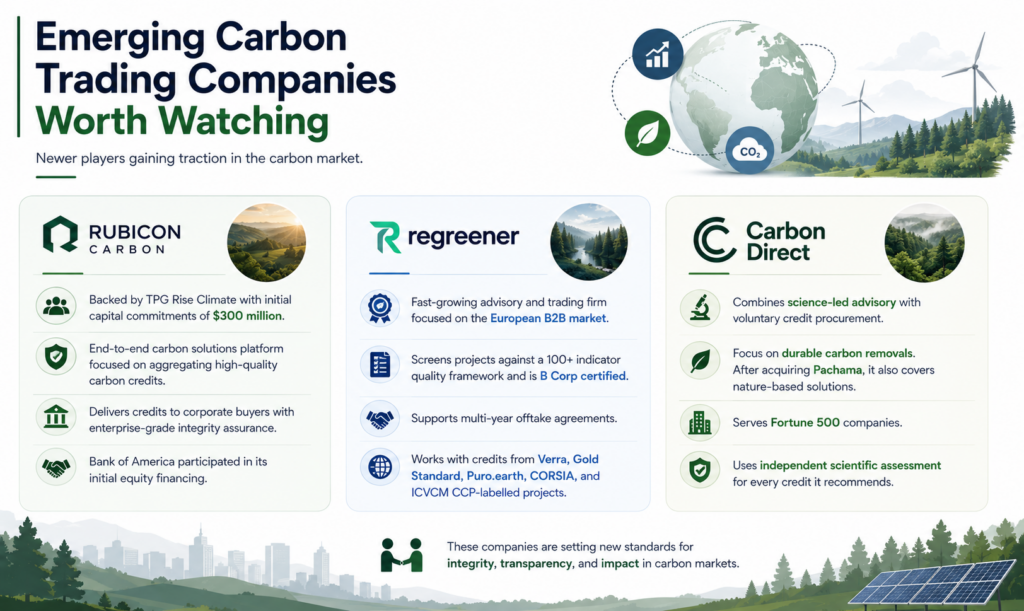
Beyond the established players, several newer entrants are gaining traction:
Rubicon Carbon Backed by TPG Rise Climate with initial capital commitments of $300 million, Rubicon Carbon operates as an end-to-end carbon solutions platform. It focuses on aggregating high-quality carbon credits and delivering them to corporate buyers with enterprise-grade integrity assurance. Bank of America participated in its initial equity financing.
Regreener A fast-growing advisory and trading firm focused on the European B2B market, Regreener screens projects against a 100+ indicator quality framework and is B Corp certified. It supports multi-year offtake agreements and works with credits from Verra, Gold Standard, Puro.earth, CORSIA, and ICVCM CCP-labelled projects.
Carbon Direct Carbon Direct combines science-led advisory with voluntary credit procurement, with a focus on durable carbon removals. After acquiring Pachama, it also covers nature-based solutions. It serves Fortune 500 companies and uses independent scientific assessment for every credit it recommends.
How to Start Engaging with Carbon Trading Companies
If you are new to this space and want to get started, here is a practical approach:
Step 1: Understand your emissions baseline Before you buy or trade any carbon credits, know what you are actually emitting. A credible carbon footprint calculation is the foundation of everything else.
Step 2: Identify your regulatory obligations Are you in a compliance market? Do you face CORSIA obligations if you are in aviation? Do you need to report under a corporate ESG framework? The answers shape which type of company you need to work with.
Step 3: Define your quality requirements Decide whether you want avoidance or removal credits, nature-based or technology-based, and what minimum rating from BeZero, Sylvera, or Calyx Global you require.
Step 4: Choose the right company type If you need compliance market access, work with an exchange or a specialist compliance broker. If you are building a voluntary strategy, a project developer or advisory firm may serve you better.
Step 5: Negotiate the right structure Spot purchases are fine for smaller volumes, but if you have long-term commitments, consider forward agreements or offtake deals that lock in price and supply.
Frequently Asked Questions
What is the largest carbon trading company in the world?
It depends on how you measure it. ICE is the largest carbon exchange by trading volume and liquidity, particularly for compliance markets. Xpansiv leads in voluntary carbon spot trading. South Pole is among the largest by project portfolio and credit volume in the voluntary space. Shell and Vitol are among the most active commodity traders in compliance carbon markets.
Are carbon trading companies the same as carbon registries?
No. Registries like Verra and Gold Standard certify and track credits. Carbon trading companies buy, sell, broker, or develop those credits in the marketplace. Some infrastructure providers like Xpansiv bridge both functions with their registry technology, but they are fundamentally different roles.
How do I know if a carbon trading company is legitimate?
Look for ICROA accreditation, which is the industry standard for carbon offset traders. Check whether the company discloses project details and credit serial numbers. Look for affiliations with recognized quality frameworks like the ICVCM Core Carbon Principles. Established companies will also have transparent track records and third-party verifications.
Can individuals trade carbon credits?
Retail access to carbon markets is limited but growing. Some platforms are beginning to offer retail-friendly interfaces for voluntary carbon credits. However, most carbon trading today happens between institutional players, corporations, and financial firms. Direct trading on exchanges like ICE and Xpansiv typically requires institutional accreditation.
What types of projects do carbon trading companies typically deal in?
The most common categories include REDD+ forest protection, afforestation and reforestation, renewable energy, clean cookstoves, methane capture, and carbon removal technologies like biochar and direct air capture. Nature-based solutions remain the largest segment by volume, but removal credits are growing fast as buyers prioritize permanence.
Are carbon markets regulated?
Compliance markets are regulated by government bodies. The EU ETS is overseen by the European Commission. The California Cap and Trade program is administered by the California Air Resources Board. Voluntary markets have historically been self-regulated through standards bodies, but this is changing as regulators in the US, UK, EU, and Singapore increasingly look at voluntary carbon market oversight.
How do carbon prices vary across different markets?
Carbon prices vary widely. EU ETS allowances have traded between roughly €50 and €100 per tonne in recent years. California allowances have tracked lower. Voluntary credits range from less than $1 per tonne for lower-quality offsets to over $100 per tonne for premium carbon removal credits. Price depends on the credit type, project vintage, quality rating, and the co-benefits the project delivers.
Final Thoughts
The carbon trading industry is one of the most dynamic corners of global finance right now.
From the deep liquidity of ICE and EEX in compliance markets to the innovation of Xpansiv in voluntary trading, from the project development expertise of South Pole to the emerging tech platforms of AirCarbon Exchange and CIX, the landscape of carbon trading companies is rich, diverse, and evolving fast.
What matters most, regardless of which company you engage with, is quality. The market has learned that cheap credits without integrity are not a solution to climate change. The top carbon trading companies understand this, and the best ones are actively raising the bar.
As Article 6 matures, as new compliance systems emerge, and as corporate net-zero commitments grow, the role of carbon trading companies in the global economy will only become more important.
Understanding who these players are, what they do, and how they operate gives you a real edge in navigating this market, whether you are a buyer, a seller, an investor, or simply someone who wants to understand where the climate finance world is heading.
For more in-depth guides on carbon markets, carbon credits, and sustainability strategies, explore the resources at Carbon Market Network.